The online journal of Luke Dockery

Tag: Kingdom Parables

The Department of Government Efficiency…and The Parable of the Weeds

I am generally hesitant to comment on political matters, partially because politics can be so divisive, and partially because I am generally not informed enough to do so with any credibility. On the other hand, I am all about discussing Scripture, and also discerning how the wisdom of Scripture can be brought to bear on the challenging issues of life. Thus, this post.

Over the last few weeks, the new Department of Government Efficiency (DOGE) has been rifling through the drawers of the federal government, seeking to identify and eliminate waste, significantly by cutting funding or eliminating jobs. We live in a wildly polarized society, so I shouldn’t be surprised by the wide gulf between the different responses I have observed to DOGE’s activities so far. And yet, I am: on social media, some of my friends are hailing all of this as a much-needed and valuable work, while others identify it as the onset of fascism and the harbinger of the downfall of our nation.

And all I can think about is Jesus’s Parable of the Weeds.


Found in Matthew 13, the Parable of the Weeds is one of Jesus’s many parables that focuses on the nature of God’s kingdom:

24 He put another parable before them, saying, “The kingdom of heaven may be compared to a man who sowed good seed in his field, 25 but while his men were sleeping, his enemy came and sowed weeds among the wheat and went away. 26 So when the plants came up and bore grain, then the weeds appeared also. 27 And the servants of the master of the house came and said to him, ‘Master, did you not sow good seed in your field? How then does it have weeds?’ 28 He said to them, ‘An enemy has done this.’ So the servants said to him, ‘Then do you want us to go and gather them?’ 29 But he said, ‘No, lest in gathering the weeds you root up the wheat along with them. 30 Let both grow together until the harvest, and at harvest time I will tell the reapers, “Gather the weeds first and bind them in bundles to be burned, but gather the wheat into my barn.”’”

36 Then he left the crowds and went into the house. And his disciples came to him, saying, “Explain to us the parable of the weeds of the field.” 37 He answered, “The one who sows the good seed is the Son of Man. 38 The field is the world, and the good seed is the sons of the kingdom. The weeds are the sons of the evil one, 39 and the enemy who sowed them is the devil. The harvest is the end of the age, and the reapers are angels. 40 Just as the weeds are gathered and burned with fire, so will it be at the end of the age. 41 The Son of Man will send his angels, and they will gather out of his kingdom all causes of sin and all law-breakers, 42 and throw them into the fiery furnace. In that place there will be weeping and gnashing of teeth. 43 Then the righteous will shine like the sun in the kingdom of their Father. He who has ears, let him hear.”

(Matthew 13.24-30; 36-43)

This is a parable about the kingdom of God growing in a hostile environment and some of the realities that come with that. A man sows seed in a field, but then an enemy comes and secretly sows weeds among the good seed. When the plants start to grow, it becomes apparent what has happened, and the servants, wanting to be helpful, ask their master if they should pull the weeds. The master, though acknowledging the existence of the weeds and the problem they represent, tells his servants not to pull up the weeds because they might cause damage to the wheat when they do so. In other words, the effort to root out the bad can actively harm the good. 

Sometimes the effort to root out the bad can actively harm the good. Share on X

Jesus goes on to explain the spiritual significance of this parable and there are some really important lessons there that I have discussed elsewhere.[1] I don’t want to pretend or suggest that this parable is somehow about what we see going on in our current political landscape, but I do think there is a principle here that applies.

I don’t think any fair-minded person would deny that the U.S. federal government operates on a massive scale, and that in such a vast and complicated structure, there is bound to be a significant amount of inefficiency and even incompetence. Put differently, there really are weeds in the field. But that doesn’t mean that the wise course of action is to rush in and start indiscriminately yanking up the weeds, because you likely are going to pull out a lot of good plants as well.

From my perspective, this is what DOGE has done. I know an increasing number of good, faithful civil servants who are losing employment because of sweeping cuts, as well as good, worthwhile programs that are being defunded. None of this is to suggest that the federal government is efficient, or that no cuts should be made—there really are weeds in the field! But it does suggest that when you have such a vast and complicated network of employees and programs with problems that have accumulated over decades, you’re probably not going to be able to wisely solve the problem within a few weeks.


[1] Jeremy Myers & Luke Dockery, Kingdom Parables: A Study of the Stories of Jesus (Springdale, AR, Deeper Youth Ministry, 2024), 29-31.

Recent Publications

I have not written as much in this space over the last few months as I would have liked. Part of that is related to the regular busyness of full-time ministry, adjunct teaching, and being a dad, but part of it is also tied to an increased amount of writing and editing that I have done this year:


Earlier this year, I announced the publication of a new book on the parables of Jesus, co-written with Jeremy Myers and published through Deeper Youth Ministry. This was a fun project to work on, and I think it is a really helpful and accessible resource for Bible classes. From the back of the book:

The parables of Jesus are beloved by many, but are not always well understood. It is commonly believed that Jesus taught with simple stories in order to make it easy for His audience to understand, but while the stories do tend to be simple, the parables of Jesus are often anything but easy. In fact, Scripture repeatedly records the confusion of Jesus’s audience when He teaches in parables, and even relates Jesus explaining that He speaks in parables specifically because He knows some of His audience won’t be able to hear and understand them.

Kingdom Parables guides students through a close study of Jesus’s parables, not with an expectation that they will be easy to understand, but that they will offer important teaching about the kingdom of God and how God expects citizens of His kingdom to live.

The book is available in paperback on Amazon, and in digital format on the Deeper Youth Ministry website.


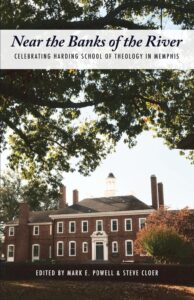
In April, Regnum media released a special volume to honor Harding School of Theology, which is moving from Memphis, TN to Searcy, AR this fall. Near the Banks of the River: Celebrating Harding School of Theology in Memphis was a tribute to the work of HST, and brought together excellent essays by several distinguished HST graduates in various fields. I helped to edit this volume, and also did the layout and design. From the back of the book:

For 66 years, from 1958-2024, Harding School of Theology in Memphis has had a national and global impact training over 1800 graduates and 4700 students. A large percentage of influential ministers, academic thought-leaders, and innovative practitioners in Churches of Christ trace their roots back to HST. As the school prepares to transition to Searcy, Arkansas in fall 2024, this collection of original essays celebrates the influence of HST in Memphis and looks to the future of theological education and missional leadership.

Near the Banks of the River is available in paperback on Amazon.


Just this month, Regnum released our most recent volume, Walking with Wisdom: A Study of Proverbs, by Lance Hawley. Dr. Hawley is an excellent professor at Harding School of Theology, and produced a scholarly yet accessible work. I worked on the editing, layout, and design of this project as well. From the back of the book:

The people of God may desire to make good and faithful decisions, but actually doing so takes wisdom and courage.The Book of Proverbs aims at cultivating wisdom, insight, and understanding in its readers, so that they will choose the way of God instead of the way of folly. It is ancient wisdom that wants all people to know the joys of Wisdom’s party.

In Walking with Wisdom, Lance Hawley guides readers through the book of Proverbs with a special emphasis on its significance for contemporary life. It is ideal for small group studies, Bible classes, and personal study. The book includes chapters on what Proverbs has to say about relationships, money, and wise speech, along with chapters on how to cultivate and celebrate wisdom.

Walking with Wisdom is also available on Amazon in paperback (Kindle version is forthcoming).


Now that my summer youth ministry grind is over, I hope to get back to writing here with some degree of regularity, but as you can see, I have managed to keep busy!

Kingdom Parables: A Study of the Stories of Jesus

I am excited to announce that I have a new book out—Kingdom Parables: A Study of the Stories of Jesus. This is the latest in the Deeper Youth Ministry Bible Study series, and is available for purchase in paperback on Amazon, or digitally on the Deeper Youth Ministry website.

This was a fun project to work on, partially because the parables of Jesus are incredibly interesting to study, and also because I wrote it with my good friend Jeremy Myers. Jeremy and I have worked together with Deeper Youth Ministry for several years and he now directs the annual Deeper Youth Conference, but this is the first time we wrote a book together. It was truly a collaborative project, and I was proud of the end result.

From the back of the book:

The parables of Jesus are beloved by many, but are not always well understood. It is commonly believed that Jesus taught with simple stories in order to make it easy for His audience to understand, but while the stories do tend to be simple, the parables of Jesus are often anything but easy. In fact, Scripture repeatedly records the confusion of Jesus’s audience when He teaches in parables, and even relates Jesus explaining that He speaks in parables specifically because He knows some of His audience won’t be able to hear and understand them.

Kingdom Parables guides students through a close study of Jesus’s parables, not with an expectation that they will be easy to understand, but that they will offer important teaching about the kingdom of God and how God expects citizens of His kingdom to live.

If you work with or teach teenagers, I hope you will give it a look—there are 18 lessons in total, including introductory and summary lessons.

Purchase the Book

Paperback: Amazon $12.99

Digital: Deeper Youth Ministry $10

© 2026 The Doc File

Theme by Anders Noren — Up ↑