The online journal of Luke Dockery

Tag: Love

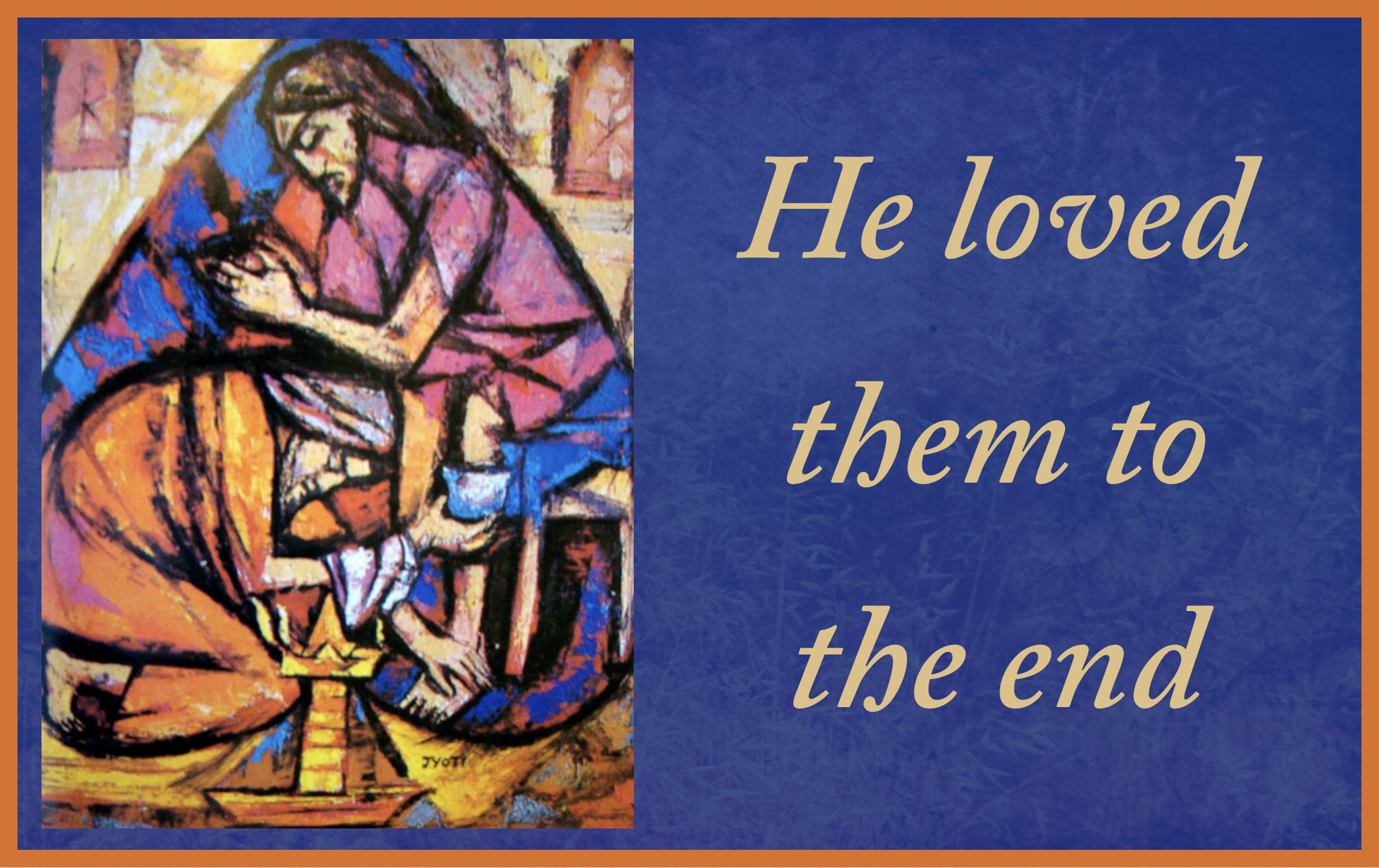
“He Loved Them to the End”

Today’s reflection comes from John 13 (the daily Bible reading format I am following this year involves readings from both testaments each day), the beginning of what is typically referred to as Jesus’ “Farewell Discourse”—teachings from John 13-17 that Jesus delivers to His disciples on the night that He was betrayed.

The content of John 13 is introduced to us in verse 1 with these interesting words:

“Now before the Feast of the Passover, when Jesus knew that His hour had come to depart out of this world to the Father, having loved His own who were in the world, He loved them to the end.”

Jesus knows He is about to die, and with this knowledge in mind, how does He spend His last evening? He chooses to spend it with “His own”, the disciples He had led and lived with for years, whom He loved. This seems straightforward enough, right? If you knew that you were about to die, I suspect that you would want to spend your remaining time with those you love. I would too.

But there is more to the story. John 13 is all about love, and the introductory verse we just read sets us up to examine the love that Jesus shows for His disciples compared to their response to Him.

The chapter looks something like this, in outline form:

13.1: Jesus loved His own to the end [Summary Statement]

13.2-20: Jesus shows His love by washing the disciples’ feet [Exemplary Love of Jesus]

13.21-30: Jesus predicts the betrayal by Judas [Disciples’ Failure to Love]

13.31-35: Jesus encourages the disciples to love like He has loved them [Exemplary Love of Jesus]

13.26-38: Jesus predicts the denial by Peter [Disciples’ Failure to Love]

With this outline in mind, the last night of Jesus becomes remarkable rather than straightforward. Jesus spends His last night washing the feet of those who will betray, deny, and desert Him hours later. He knows that this will happen, and this is still how He chooses to spend His last evening: loving those who will fail to love Him.

If you knew you were about to die, is this what you would do? Neither would I.

As I look around in the world in which we live, I see a desperate need for love. I witness all sorts of people cutting off ties and cancelling relationships with “their own”—family members, longtime friends, brothers and sisters in Christ—rather than “loving them to the end.”

I think we find God’s answer to the bitter division and rancor of our times in this text and the example of Jesus: we are to love as Christ has loved us. Jesus loved His disciples even when He knew they would fail to love Him in return. He loves us even when we forsake Him. And He calls us to love in the same way.

In a society that normalizes and encourages the dissolution of relationships when we disagree over a whole host of issues, Jesus offers—commands, actually—another way.

It is not easy, but it is clear: “He loved them until the end.”
Jyoti Sahi, Jesus Washing the Feet of Peter, Oil on Canvas


In this loose series of Scripture Reflections, I am sharing brief thoughts spurred on by my Bible reading this year. By way of reminder, my goal for these brief posts is two-fold:

(1) To remark on aspects of the biblical text that I find to be of interest that the reader may or may not have thought about previously.

(2) When possible, to point ahead to the work and person of Jesus Christ. I believe the Bible is a unified story that points to Jesus, which means that He is frequently alluded to or foreshadowed in some way throughout the biblical canon.


C.S. Lewis on Dogs and the Love of God

As regular readers of The Doc File have probably surmised, I am a big fan of C.S. Lewis. I reread Mere Christianity and The Chronicles of Narnia in 2020, and so far in 2021, I have reread The Screwtape Letters and am currently in the middle of The Problem of Pain.

I think there is a lot to like about Lewis’s writing, but one helpful quality is his ability to use helpful analogies to illustrate theological points. In The Problem of Pain, Lewis describes different ways in which it can be said that God “loves” humanity:

Another type is the love of a man for a beast—a relation constantly used in Scripture to symbolise the relation between God and men: ‘we are his people and the sheep of his pasture.’ This is in some ways a better analogy than the preceding, because the inferior party is sentient, and yet unmistakably inferior: but it is less good in so far as man has not made the beast and does not fully understand it.

Its great merit lies in the fact that the association of (say) man and dog is primarily for the man’s sake: he tames the dog primarily that he may love it, not that it may love him, and that it may serve him, not that he may serve it. Yet at the same time, the dog’s interests are not sacrificed to the man’s. The one end (that he may love it) cannot be fully attained unless it also, in its fashion, loves him, not can it serve him unless he, in a different fashion, serves it.

Now just because the dog is by human standards one of the ‘best’ of irrational creatures, and a proper object for man to love—of course, with that degree and kind of love which is proper to such an object, and not with silly anthropomorphic exaggerations—man interferes with the dog and makes it more lovable than it was in mere nature. In its state of nature it has a smell, and habits, which frustrate man’s love: he washes it, house-trains it, teaches it not to steal, and is so enabled to love it completely.

To the puppy the whole proceeding would seem, if it were a theologian, to cast grave doubts on the ‘goodness’ of man: but the full-grown and full-trained dog, larger, healthier, and longer-lived than the wild dog, and admitted, as it were by Grace, to a whole world of affections, loyalties, interests, and comforts entirely beyond its animal destiny, would have no such doubts. It will be noted that the man (I am speaking throughout of the good man) takes all these pains with the dog, and gives all these pains to the dog, only because it is an animal high in the scale—because it is so nearly lovable that it is worth his while to make it fully lovable. He does not house-train the earwig or give baths to centipedes. We may wish, indeed, that we were of so little account to God that He left us alone to follow our natural impulses—that He would give over trying to train us into something so unlike our natural selves: but once again, we are asking not for more love, but for less.”

The Problem of Pain, 35-36


Lewis’s analogy is astute:

(1) Indeed, God does interfere in the lives of those who would be His followers. He does not leave us alone to follow our natural impulses and, instead, makes all sorts of demands upon us and calls us to live in ways that are decidedly unnatural (what can be more unnatural than voluntarily laying power aside to instead serve others, or foregoing the opportunity for retaliation when it is presented?) This can certainly be frustrating.

(2) However, as we mature beyond being spiritual “puppies” and begin to grow and be trained through the sanctification of God’s Spirit, it becomes easier to see the grace that was present, all along, in God’s demands. We are so much better off than if we had been left to our own devices.

Praise God for His interference, a great manifestation of His abundant love!

The Christian Story, Free Will, and Love Potions

Really, the Christian Story is a fairly simple one. God created a world that was good—beautiful, well-suited for its purpose. Humanity, created in God’s image, was the pinnacle of creation, and was given the vocation of ruling over, tending, and cultivating what God had made.

But something went wrong. Rather than living according to the standard that God had set up, Adam and Eve determine to go their own way, and in choosing to eat the fruit of the forbidden tree, grasp for moral autonomy. The results are disastrous as sin enters into the world, damaging the relationship between humanity and God, damaging the relationship between humans, damaging the way we view ourselves, and actively placing a curse on the good creation that God had made.

The rest of the Christian Story is basically the account of God working to redeem and undo the damage that was done in Eden (and continues to be done) when men and women seek moral autonomy for themselves. That redemption and undoing was definitely accomplished in the work of Jesus on the cross, but will ultimately come when death dies, God establishes the New Heavens and New Earth, and dwells with His people forever (1 Corinthians 15, Revelation 21).

Not too long ago, I was summarizing this story to a group of teenagers at a weekend retreat that I was speaking at, and after I finished, a young man came up and asked me a great question: “If Adam and Eve’s sin caused so much damage, and God knew that they were going to do it, why did He create them with free will in the first place?”

This is a common enough question, but it’s a great question. It’s a thinking question, and I was proud of the young man for asking it (Incidentally, the question presumes that God has exhaustive foreknowledge of the future. I am fine with that, but not all Christians agree with that presupposition. See these posts.).

How would you answer the question? The typical answer that is given is that God created out of love, wants His creation to love Him in return, and the only way for that to truly happen is if humans were created with the power to choose: love is only real if it is chosen, not forced. Typically, this is illustrated with the example of parents: parents want their kids to obey them, but they don’t want programmed robots; they want their children to lovingly obey them. And it is the same with God.

But this isn’t the metaphor I used with this young man, since I have found that parental metaphors are not particularly relatable to people who haven’t yet been parents. Instead, I said this: “Imagine there was a girl you really really liked. Everything about her was perfect. You are 100% convinced that this is the girl that you want to spend the rest of your life with. Now let’s also say that you had a magic love potion that you could give this girl that would make her love you forever. She would never know about it, but as soon as she took it, she would always love you faithfully. Would you give her the potion?”

Pretty quickly, the young man responded that he wouldn’t. When I asked him why not, he said, “Because it wouldn’t be real love.” And then, he got it.

Real love is at the heart of the Christian Story. Not coercive love. Not programmed love. Not love-potion love.

With all the freedom in the world, God chose to create us, and chose to redeem us through His Incarnate Son. And in response to the love that God has first shown us, He invites us to freely love Him in return.

F. F. Bruce on the Love of God

Powerful words from F. F. Bruce on John 3.16:

“If there is one sentence more than another which sums up the message of the Fourth Gospel, it is this. The love of God is limitless; it embraces all mankind. No sacrifice was too great to bring its unmeasured intensity home to men and women: the best that God had to give, he gave—his only Son, his well-beloved. Nor was it for one nation or group that he was given: he was given so that all, without distinction or exception, who repose their faith on him might be rescued from destruction and blessed with the life that is life indeed. The gospel of salvation and life has its source in the love of God.” 
—The Gospel of John, by F. F. Bruce, pp. 89-90
As you think about your sweetheart on Valentine’s Day, remember the Love which makes all others possible!

© 2026 The Doc File

Theme by Anders Noren — Up ↑








