The online journal of Luke Dockery

Tag: Movies (Page 1 of 2)

The Hero(ine) of It’s A Wonderful Life

Every year at this time, I make sure to watch It’s A Wonderful Life. In addition to being (easily) the best Christmas movie of all time, it is also in my Top 5 of all movies.

Last year after viewing the film, I wrote a series of tweets that I am now compiling into this short post.

Here is my hot take (or, absolutely obvious observation). While George Bailey, the self-sacrificing Everyman that we root for and admire, is the main character of It’s A Wonderful Life, the hero of the film is actually a heroine: his wife Mary.

  • It is Mary who gives George the courage to give up his dreams (doing big exciting things all over the world) and instead accept his calling (a grueling, grinding life of service to his community).
  • It is Mary who gives George the idea of how to save the Building & Loan during the Depression (foregoing a honeymoon to meet the financial needs of a frantic mob).
  • It is Mary who creatively turns an old abandoned house into a well-kept home for her family (where George, the forward-thinking, would-be engineer could see nothing but a ruin).
  • It is Mary who mobilizes the massive prayer effort that drives the plot of the movie, bringing Clarence Odbody onto the scene and helping George to see how meaningful his life has been.
  • It is Mary who raises the necessary funds to solve the financial crisis that had driven George to the brink of suicide.

In the end, George had a Wonderful Life and was a blessing to so many people, but it was the quiet support of Mary in the background that empowered him to be so. This, I believe, is one of life’s great realities and a central truth of Christianity as well: the most heroic people in life are not necessarily those with wealth, fame, or influence, but those who quietly spend their lives in sacrificial service to others. Isn’t that truly the meaning of Christmas?

The most heroic people in life are not necessarily those with wealth, fame, or influence, but those who quietly spend their lives in sacrificial service to others. Isn’t that truly the meaning of Christmas? Share on X

Thanksgiving: Enzo the Baker, the Men of Jabesh-Gilead, and Gratitude

Some previously-published (and slightly edited) thoughts on Thanksgiving:

One of my all-time favorite movie scenes occurs fairly early in Francis Ford Coppola’s iconic classic, The Godfather.

Vito Corleone, Don of the Corleone crime family and the “Godfather” of the movie’s title, is in the hospital, having barely survived an attempt on his life. His youngest son, Michael, comes to visit him, but discovers that his father is unguarded and all by himself, and realizes that another attempt is about to be made on his life.

Michael calls his older brother on the phone and tells him to send reinforcements, and then hides his father in another hospital room.

About this time, Enzo the Baker arrives.

Earlier in the movie, the Godfather had used his considerable influence to take care of some immigration issues that Enzo was struggling with, and now the young Sicilian has come to pay his respects to the ailing Don.

Michael tries to warn Enzo of the danger he is in, but Enzo refuses to leave:

“You better get out of here, Enzo, there’s gonna be trouble.”

“If there is trouble, I stay here to help you. For your father. For your father.”

The two men go outside and wait on the front steps, posing as bodyguards. A car of would-be assassins pulls up, but confused by the appearance of guards where they weren’t expecting to find any, they drive on.

Scared to death, Enzo begins to shake and struggles to light a cigarette. He is out of place in the world of organized crime, but a debt of gratitude has compelled an ordinary man to act in an extraordinary fashion, risking his life to save someone else.


We talk a lot about being thankful, or grateful, at this time of year, but I wonder if we don’t often mistake appreciation for gratitude.

Sure, we’re glad that we are able to gather with family, and we appreciate the fact that we have a lot of blessings—we certainly wouldn’t want to try living without those blessings—but often that’s as far as it goes.

But gratitude goes a step further than appreciation. From Wikipedia:

“Gratitude is the substance of a heart ready to show appreciation, or thankfulness; it is not simply an emotion, which involves a pleasant feeling that can occur when we receive a favor or benefit from another person, but rather the combination of a state of being and an emotion; often accompanied by a desire to thank them, or to reciprocate for a favour they have done for you.”

Gratitude is a feeling of appreciation accompanied by a desire to act. It was a deep feeling of gratitude that drove Enzo to disregard his own safety in order to help the man who had helped him.

One of my favorite Old Testament stories illustrates gratitude very well, and focuses on the men of Jabesh-Gilead.

Just after Saul has been anointed as the first king of Israel, the Ammonites come and besiege the town of Jabesh-Gilead. The elders of Jabesh know that they can’t withstand the Ammonites, and they also know that they will be treated harshly if they surrender, so they send messengers throughout Israel, hoping that someone will come to their aid.

When Saul hears the news, he becomes angry and promises to deliver the town in 1 Samuel 11.9,11:

“They said to the messengers who had come, “Thus you shall say to the men of Jabesh-gilead, ‘Tomorrow, by the time the sun is hot, you will have deliverance.’” So the messengers went and told the men of Jabesh; and they were glad.

The next morning Saul put the people in three companies; and they came into the midst of the camp at the morning watch and struck down the Ammonites until the heat of the day. Those who survived were scattered, so that no two of them were left together.”

Saul’s rescuing of the town of Jabesh-Gilead serves to cement himself as the King of Israel, but if you were to stop reading there, you would be unaware of the debt of gratitude that the men of Jabesh apparently felt toward him.

In fact, you have to go many years into the future, to the very end of Saul’s reign, before Jabesh-Gilead is mentioned again.

This time, Saul has gone to war against the Philistines, and the fighting has gone very badly for the Israelites: three of Saul’s sons are killed, and Saul takes his own life after being badly wounded by an archer.

When the Philistines come upon the body of Saul, they cut off his head and take his weapons. The weapons end up in a temple to a false god, and Saul’s body is hung as a war trophy on the wall of the town of Beth-Shan.
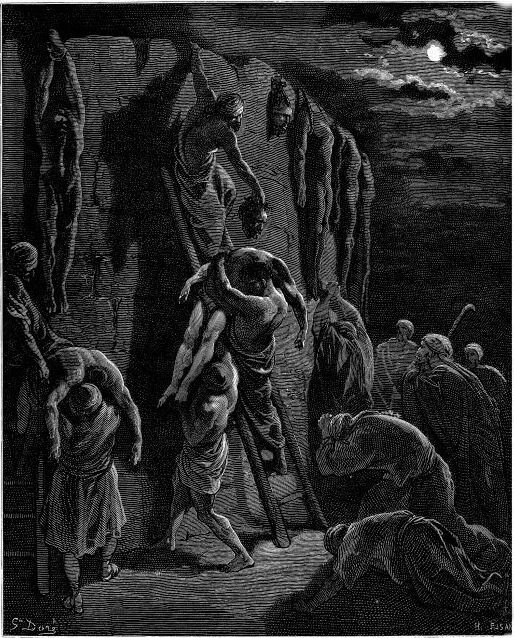
It is at this point, many years after Saul had rescued them from the Ammonites that the men of Jabesh-Gilead make their appearance in 1 Samuel 31.11-13:

“Now when the inhabitants of Jabesh-gilead heard what the Philistines had done to Saul, all the valiant men rose and walked all night, and took the body of Saul and the bodies of his sons from the wall of Beth-shan, and they came to Jabesh and burned them there. They took their bones and buried them under the tamarisk tree at Jabesh, and fasted seven days.”

When the men of Jabesh-Gilead hear what has happened to Saul, they remember the debt of gratitude they owe him, walk all night into enemy territory, retrieve his body, and bury it honorably.

This act of gratitude is even more impressive when you realize that this is a debt that they have been waiting to pay for 40 years—the entire length of Saul’s reign. It seems likely that some of the valiant men who made the journey that night weren’t even born yet when Saul had saved their town, and yet they are still willing to risk their lives to protect his honor.

Gratitude compels people to act.


As a Christian, I believe that Jesus sacrificed Himself to cleanse me of sin and to make reconciliation with God possible.

I very much appreciate that sacrifice, but more than that, I am grateful for it—I wish there was something I could do to repay the debt of gratitude that I feel.

But there isn’t. The best I can do is to try to live each day for Jesus, to live as He Himself did.

I fail often, and sometimes I fail miserably, but I am still compelled to try. Gratitude will permit nothing less.


The Dark Knight: Worth The Wait

I really liked The Dark Knight.

In general, I’m a fan of the superhero genre, but I thought The Dark Knight freed itself of that classification—it was a really good movie that just happened to be about a superhero.

I thought Heath Ledger was outstanding, and that he gave an original interpretation of the Joker which was truly frightening. I know that some people are criticizing the suggestion that he deserves an Oscar nod as being overly sentimental, but I doubt you’ll see many performances that are better, and the fact that it was in a movie that is sensationally popular (a characteristic that is often looked down upon by award voters) shouldn’t be held against him.

As the title implies, The Dark Knight is a very dark movie, darker maybe than a lot of people are comfortable with, but I think that’s its great strength. Against a backdrop of larger than life characters, fantastic car chases, vicious fight scenes, and devastating personal tragedy, it delivers a dark and startling message that should make us all think.

There is a constant struggle between Good and Evil, and that struggle is complicated by the fact that Good can’t resort to the same methods to win that Evil can. If it does, it loses its goodness, and ultimately, the cause it was fighting for in the first place.

It’s a lesson that Batman learns, and at a high price.

If you haven’t seen it yet, do. I’m actually considering going a second time myself…

Harrison Ford, Propagandist

I saw Indiana Jones and the Kingdom of the Crystal Skull the night after it came out. I didn’t think it was amazing, but I wasn’t too disappointed either.

The plot was far-fetched, and there were parts that were absolutely ludicrous, but really, since when do we go to Indiana Jones seeking realism?

All in all, I thought Crystal Skull fit in pretty well with the other three movies in the Indiana Jones franchise. It may have been the worst of the four, but it didn’t shame the series or anything like that.

Well, that’s just my opinion—the Communist Party of Russia apparently disagrees.

According to this article, they sent an open letter to Harrison Ford calling for Crystal Skull to be removed from Russian theaters and condemning it as “anti-Soviet propaganda.”

The film is set in 1957, and with no more Nazis left to fight, Indy finds himself competing with a group of vicious Soviet agents to find a mystical crystal skull in Peru.

The letter to Ford takes great exception to this, reminding him that, “in 1957 the USSR was not sending terrorists to America but sending the Sputnik satellite into space!”

It’s a year Soviets remember clearly—after Sputnik, everything was pretty much downhill.

Oh and by the way, so far, the Communist Party’s pleas seem to have fallen on deaf ears: Crystal Skull is being shown on over 800 screens in Russia, which is the most ever for a foreign film.

A Titanic Joke

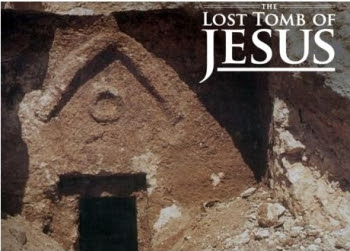
There has been a big uproar over the last few days about an upcoming documentary by filmmaker James Cameron which airs on the Discovery Channel this Sunday night and chronicles the discovery of the supposed tomb of Jesus of Nazareth. Cameron is famous for directing the highest-grossing film of all time, Titanic, which told the story of a big boat that sunk after a collision with an iceberg tore a gaping hole in it.

His new film, The Lost Tomb of Jesus, is somewhat similar, but this time, it’s Cameron’s unfounded theory that’s filled with holes.

Self-billed as the “Archaeological Discovery of the Millennium,” the documentary focuses on the 1980 discovery of a tomb in the Talpiot neighborhood of Jerusalem. This tomb contained ten ossuaries, which are basically limestone boxes that contain skeletal remains. Six of the ten ossuaries are inscribed with significant New Testament names, and according to the documentary, this supposedly proves it to be the family tomb of the Jesus of the New Testament.

I’m not really interested in going into great detail debunking the Cameron crew’s ridiculous claims in The Lost Tomb; that has already been done by people who are much more knowledgeable than I am, and there will be even more debunking after the documentary appears on TV.

I do, however, want to make a few quick observations that I’ve had about the Talpiot Tomb issue:

The “evidence” supporting Cameron’s claim is laughable.

Once again, I don’t want to go into great detail on this, but here is an example of the type of scientific reasoning used to back this theory:

One of the ossuaries has the name “Matthew” on it. The problem with this is that we don’t know of any person related to Jesus named Matthew. Rather than come to the explanation that a Matthew has no place in the family tomb of Jesus of Nazareth, and maybe this tomb belongs to some other Jesus, the Cameron bunch instead use this as evidence that the tomb must be authentic, because after all, Jesus of Nazareth did know a guy named Matthew! That must prove it!

Similarly, one of the boxes has a variation of the name “Mary” on it. DNA evidence has shown that this person was not related to the person in the “Jesus” ossuary. So what conclusion does the documentary make? This “Mary” must be Mary Magdalene, who we now plainly see must have been Jesus’ wife! Never mind the fact that, outside of fictional novels, there is no evidence that Jesus was ever married!

According to the circular logic of the Lost Tomb theorists, the presence of an unrelated Mary in the tomb proves that she is the wife of Jesus, and the fact that the now-proven wife of Jesus is found in the tomb proves that it really is the authentic tomb.

Don’t worry; it’s not just you. It really doesn’t make any sense.

This is too big to just ignore.

The implications of the “discovery” are massive: if the skeletal remains of the Jesus of the New Testament were to be found, it would show the Resurrection to be a sham. And as the Apostle Paul pointed out, if Christ was not raised from the dead, then our faith (and, consequently, Christianity) is worthless.

I’ve heard some people say that this isn’t really an issue, because people who really believe aren’t going to be shaken by such pseudo-science and will reject the claims, while people who don’t believe are just going to use it as another reason for why they don’t.

I agree, but what about people who haven’t made up their minds yet? There are undoubtedly some people who won’t give Christianity an honest hearing because they have been turned off by “scientific proof.” I mean, just look at the repercussions of The DaVinci Code—and it even claimed to be a work of fiction!

As Christians, we can’t just completely ignore this. Just because we recognize it as foolishness, doesn’t mean that other well-meaning people won’t be deceived by it.

James Cameron’s ability to annoy me has reached new heights.

I accounted for about $7.50 of the $600,000,000+ that Titanic roped in, and honestly, I didn’t regret it at the time. Sure, the first half of the movie was painful, dominated by a cheesy love story, and yes, I did cheer when the Leonardo DiCaprio character finally froze to death, but the whole sinking ship part was pretty cool.

Of course, then the movie received a bazillion awards, James Cameron was all over TV being full of himself, Earth’s female population under the age of 16 became Leonardo-obsessed, and I got really tired of the movie.

But none of that compares to my annoyance with the man now.

See, if James Cameron was actually seeking truth, or even if he hated Christianity and really wanted to disprove it somehow, I could accept him making the documentary. I still wouldn’t like it, but I could accept his motives. But I don’t think he’s doing it for either of those reasons; it’s all about recognition and money. If it wasn’t, he wouldn’t be releasing a Resurrection-denying documentary in the middle of Lent, a month before Easter, and we would be hearing more about the actual archaeologists who worked on the project rather than just the man who made the movie about them.

Making a documentary that denies the Resurrection and unleashing Celine Dion’s My Heart Will Go On on an unsuspecting world. Yep, this guy is going to have a lot to answer for.

« Older posts

© 2026 The Doc File

Theme by Anders Noren — Up ↑