The online journal of Luke Dockery

Tag: Natural Disasters

Moral Evil and Natural Evil

In this series, I am attempting to approach the topic of suffering from a variety of different angles. As I mentioned in the first post, I am using the term “suffering” to sum up the famous Problem of Evil. I talk about the Problem of Evil at length in this post on Alexander Campbell, but perhaps it would be beneficial to state the problem outright, the original statement of which is generally credited to Epicurus:

“Is God willing to prevent evil, but not able? Then He is not omnipotent. Is He able, but not willing? Then He is malevolent. Is He both able and willing? Then whence cometh evil? Is He neither able nor willing? Then why call Him God?”

So basically the issue is, if God is good and powerful, why does He allow evil and suffering to exist in the world?

Now, it’s a fair question to ask if all suffering is evil or the result of evil. As humans we admittedly have very limited perspectives, and sometimes things which are good for us certainly don’t seem good at the time they occur (think about an infant getting a vaccine, for example). Regardless, evil certainly exists in the world, and a lot of suffering occurs because of it.

Philosophers and theologians and people who discuss this topic will often distinguish between two kinds of evil: moral evil and natural evil.


Moral Evil

Generally speaking, moral evil refers to the evil acts that people choose to commit. A lot of the suffering which occurs in the world happens because people choose to do things which cause harm to one another. Fatal car accidents caused by alcohol consumption, child molestation, ISIS beheadings, and the Holocaust are all examples of moral evil. People do foolish and terrible things which cause a great deal of suffering for others.

Really, this type of evil is easier to explain, at least, if you have a robust view of human free will. As I discussed a little in this post, I think a theology which embraces the idea that God created humans with free will is important and makes the most sense of the teachings of Scripture. The basic idea is that God created people out of His love and desires that we love Him in return. Certainly God could have created us like robots who had no choice but to “love” Him, but a coerced feeling like that wouldn’t really be love at all. To enable us to choose to love Him, God also gives us the ability to reject Him, and when we abuse our freedom of will, all sorts of bad things can happen.

When it comes to moral evil, you can blame God for the way He made the world (though, based on the previous paragraph, what other options were available?), but really, the blame lies with people who make bad or evil choices.

Natural Evil

Natural evil generally refers to those “random” things which occur, not because of the actions of people, but as a result of the world “naturally” operates (I put those two words in quotations because they are loaded with some major assumptions). Hurricanes, tsunamis, tornadoes, genetic conditions and human decay and death in general are examples of natural evil.

Now, human choices can still exacerbate natural evils and make the suffering greater than it would be otherwise (certain behaviors can make illness more likely, social problems like poverty can increase the amount of suffering which comes from natural disasters, etc.), but for the most part, people have no control over natural evil—we suffer simply because we live in a world where these types of things occur.

Because of this, I think natural evil is a little harder to explain away. We can understand when negative things happen to people who deserve them, and we can understand, as horrible as it is, when people suffer because other people choose to do evil. But why do we live in a world where natural disasters kill so many unsuspecting people? Why do children get cancer and die? Did God design the world this way, and if so, why? If God didn’t design the world this way, what happened to it for everything to get so messed up?

In the next post, I’ll try to take a closer look at natural evil, and specifically, the idea of chaos: the element of randomness in life which we can’t control which has potential for unleashing great suffering. For me, as the parent of a little girl with a genetic condition, this is one of the really tough areas of examining suffering theologically.
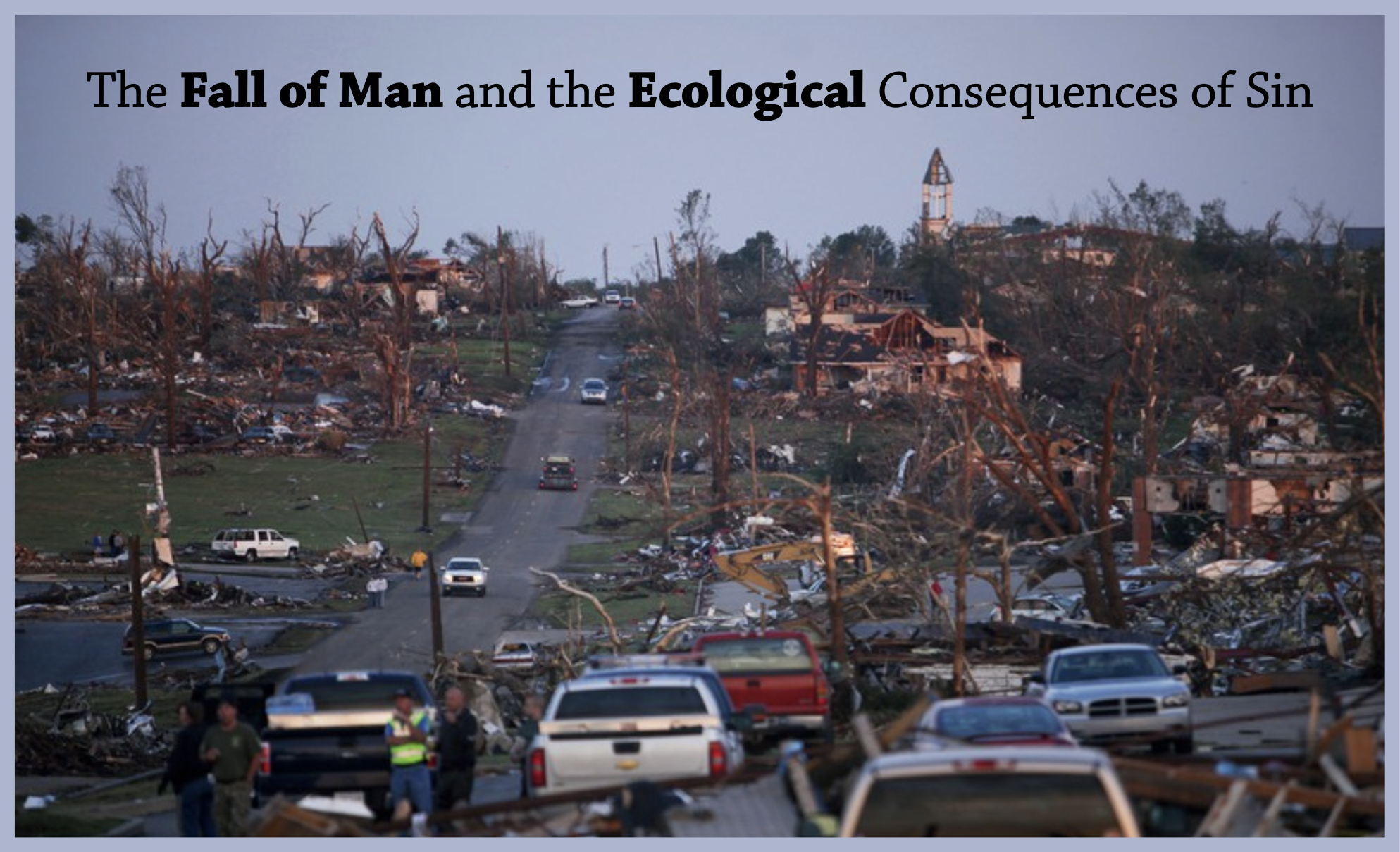

The Fall of Man and the Ecological Consequences of Sin

In the first post of this series on the Fall of Man in Genesis 3 and the widespread devastation of sin, I mentioned that we tend to focus on the theological and personal consequences of Adam and Eve’s sin while ignoring some of the other areas. I think the most ignored of those other areas is the ecological consequences associated with the sin in the Garden of Eden.

Men and women were created to live in relationship with God and with one another, and, in a sense, with creation as well. This is clear in the early chapters of Genesis. Genesis 1.26-30 recounts how Adam and Eve were to have dominion over creation, and Genesis 2.15 mentions that they were to work it and keep it. So in effect, Adam and Eve were to rule over creation, but to do so as stewards who would take care of what God had made.

But following their disobedience to God’s command to not eat of the forbidden fruit in Genesis 3, the ecological consequence is evident, as a curse is placed on creation in Genesis 3.17-19:

“And to Adam he said, ‘Because you have listened to the voice of your wife and have eaten of the tree of which I commanded you, ‘You shall not eat of it,’ cursed is the ground because of you; 

in pain you shall eat of it all the days of your life; thorns and thistles it shall bring forth for you; and you shall eat the plants of the field. 

By the sweat of your face you shall eat bread, till you return to the ground, for out of it you were taken; for you are dust, and to dust you shall return.’” 

This curse makes it clear that the relationship between man and creation has been destroyed as well. And that’s pretty easy to see, right? Rather than embrace our role as stewards of God’s earth, we tend to exploit creation to satisfy our own selfish desires. There are countless examples of companies that have carelessly polluted in order to cut corners and maximize profits, and even “little” problems like widespread littering show a basic lack of respect for the home God has created for us.

And I think there is significant indication in Scripture that the problem isn’t all one-sided: creation itself doesn’t operate the way it was intended to. In Romans 8.20-22, Paul makes this point, speaking of creation in personified terms:

“For the creation was subjected to futility, not willingly, but because of him who subjected it, in hope that the creation itself will be set free from its bondage to corruption and obtain the freedom of the glory of the children of God. For we know that the whole creation has been groaning together in the pains of childbirth until now.”

A creation that is subjected to futility, bound to corruption and groaning in the pains of childbirth seems distinctly different from the creation that God made and called “good.” I suppose this is ultimately unprovable, but my personal opinion is that the natural disasters that plague our lives—tornadoes, hurricanes, earthquakes, tsunamis, etc.—are symptomatic of the problems Paul refers to, as creation lives out a cursed existence different from the one for which it was intended.[1]

In sum, sin has devastated this aspect of our existence as well. Creation is less than the good and hospitable home for humanity for which it was created to be, and we fail to care for it as we should.[2]


[1] If my thinking on this is correct, then it stands in judgment against the hurtful things that some religious people say in very public ways following a natural disaster such as “Hurricane Katrina was God’s judgment against the wickedness of New Orleans”. Natural disasters are a condition of our broken world, rather than God’s wrath against a specific people/place. Incidentally, I think the promise made to Noah following the flood (Genesis 9.8-17) that man and creation would not again be judged by a massive flood (and perhaps, by extension, other natural disasters) supports this idea.

[2] I mentioned the general neglect of this topic, and I think that neglect is itself evidence of the distorted relationship we have with creation. In a significant portion of Christendom, discussion of the creation care is considered to be a “political” or “liberal” idea, despite the fact that environmental stewardship is clearly a biblical principle!

© 2026 The Doc File

Theme by Anders Noren — Up ↑






