If you pay any attention to these sorts of things, by now you are well aware that there is a ministry crisis in churches: there are far more churches seeking ministers than there are ministers seeking churches. This is a widespread phenomenon in churches (of various groups and denominations) within the United States, as indicated by a much-discussed Barna study. Looking more specifically at Churches of Christ, The Christian Chronicle has covered this multiple times. I even blogged about it myself in a roundabout way last year.
Despite all of the attention given to this very real problem, much of the focus has been on reasons why people leave ministry. An examination of those reasons is really important, but I think we also need to examine reasons why we are not training nearly as many ministers as we once did. There are groups out there that are working hard to encourage and train young people who have an interest in ministry (Harding’s Kerusso Experience is a great example of that; Lads to Leaders/Leaderettes and Leadership Training for Christ ostensibly do this as well), but I think a key aspect in this discussion—at least within the context of Churches of Christ—is for us to acknowledge some trends that have developed over several decades that are working against us when it comes to instilling interest in ministry in people at a young age.
So, why is it that we don’t train as many ministers as we once did? I’m sure there are lots of reasons, and what I am about to suggest is not intended to be an exhaustive list, but it is a start. For each trend I discuss, I’ll offer a question to prompt reflection on how we might respond, in light of these trends.
To be clear, I am not suggesting that these trends are inherently negative in and of themselves. They have had the effect, however, of making the practice of raising up ministers within the local congregation more difficult.
1. Transitioning Away from a Small Church Fellowship
Historically, Churches of Christ have been a small church fellowship. As of 2015, nearly 90% of congregations within Churches of Christ had less than 200 members (see chart below).
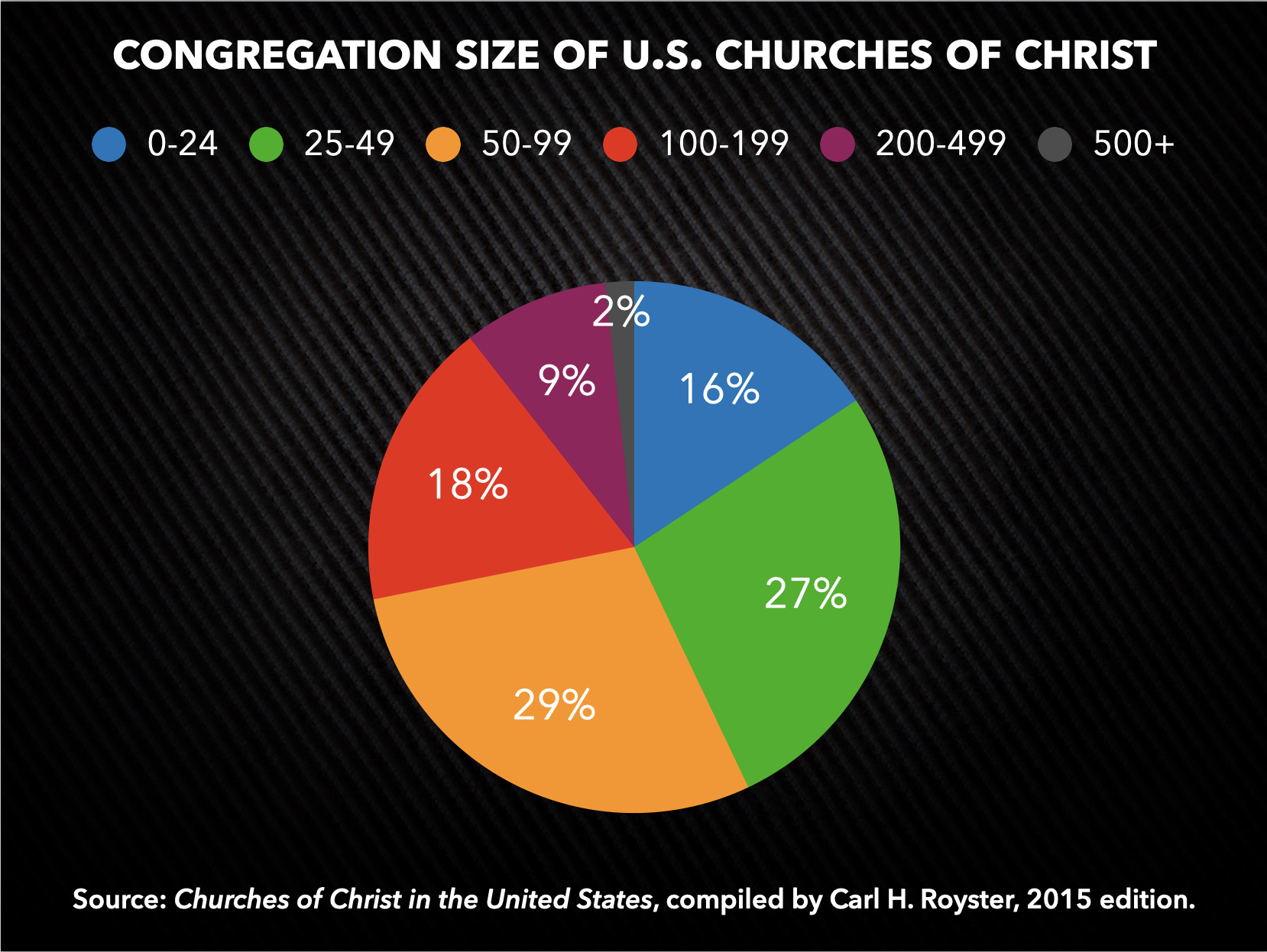
Over time, though, this trend is slowly changing. The United States is becoming increasingly urbanized, where small towns shrink and dry up as people move off for other opportunities, and as this happens, the small churches in those small towns dwindle as well. You probably hear statistics about “X number of churches close their doors every week/month/year….” Well, those churches are overwhelmingly small churches. It’s not that all of the Christians are disappearing and it’s certainly not that all of our churches are growing larger, but there is a shift that is occurring of members from smaller churches consolidating with larger ones as they move to cities, or as their previous congregations shrink beyond the point of sustainability.
Why does trend matter? Because small churches produce a disproportionate amount of preachers. This occurs because it is in small churches where young men receive opportunity to serve and lead. This comes out of necessity—there are jobs to be done and tasks to be performed, and no one else to do them. On the other hand, at larger churches, there are many more people willing to serve and lead, and you actually have to look for opportunities to get young people involved.[1]
In a context where more of our churches are larger, how can we create spaces for young people to have opportunities to lead in worship?
2. The Transformation (or Elimination) of Sunday Nights
I do not know the full history of the traditional Sunday night worship services in Churches of Christ. I know that for many years, it was essentially a carbon copy of what we did on Sunday mornings, but that they also tended to be less formal: men were less likely to wear suits, women were less likely to wear dresses, men who didn’t normally make it into the Sunday morning rotation got to lead singing, and in many churches, you would have occasional singing nights or youth worship nights where young men would have opportunity to serve. At the previous congregation where I worked, we had a monthly Youth-Led Worship where we would meet early to help young men practice and prepare, and then kids and teens would lead the entire service (prayers, songs, Lord’s Table, lesson, etc.).
Over the course of my lifetime, though, I have increasingly become aware of churches moving away from a traditional Sunday night service. Some churches have moved from a combined worship service to a small group model, and meet in members’ homes. Other churches have moved from a worship service to a Bible class format. Others have canceled evening services and replaced them with service projects. Others have canceled them and replaced them with nothing.
And, anecdotally, I would say that larger churches (i.e. the ones that already struggle to give young people a place to lead and be trained in leading worship) tend to be the most likely to abandon the traditional Sunday night service (removing yet another opportunity for training).
These Sunday night changes might be quite beneficial on the whole for the congregations in which they are occurring, but realistically, it still represents a lost venue for young people to have opportunity to lead.
In a context where the Sunday night service is disappearing, when and where can young people have opportunities to lead in worship?
3. Transition from Sect to Denomination: the Loss of Confidence and Importance
These next two trends have been developing for decades, but are helpful, I believe, in understanding so many things about Churches of Christ, especially in the 20th century and beyond.[2] First, a couple of definitions:
Sect: A religious organization that insists that it—and it alone—constitutes the entirety of the kingdom of God. Typically, a sect stands in judgment both on other religious organizations and on the larger culture in which it exists.
Denomination: In the American context, a church that recognizes it is only a part of the universal body of Christ. A denomination has typically made its peace with the dominant culture in which it exists.[3]
In other words, a sect is a group that emphasizes distinction: the call is to be radically different from the world, and to view other religious groups somewhat antagonistically. A denomination, on the other hand, tends to emphasize (or at least accept), being part of a larger whole: one “type” of Christianity amongst others, living in the context of the world.
This is a sociological description rather than a theological prescription: I’m not making the claim that this is a good development, but rather, that it is an accurate description of what has largely (not universally) happened within Churches of Christ over the last 100 years.[4] There was a time that Churches of Christ largely believed that “they were the only ones going to heaven” and that other believers, while they may be sincere, were sincerely mistaken, and not “true Christians.”[5] That still exists, but is much less prevalent than it once was. There are many in Churches of Christ today who have little to no appreciation of Restoration history or theology and would broadly claim that one church is as good as another. Others would hold strongly to certain doctrinal teachings, but still show a greater degree of both self-critique and approval of other groups than was true in the past. All of this reflects the shift from sect to denomination described above.
This is relevant to the issue at hand, I think, because this transition reflects a shakiness in our self-understanding: at one point, we were convinced that we taught the truth, while others were in error. This gives confidence in the importance of the preaching task: not only do we need to let the unchurched know about Jesus; but we also need to let the incorrectly churched know the truth about the importance of baptism, acceptable worship, and proper church governance. Virtually everyone is in error and, thus, in trouble, and we know the answer. This confidence and importance provide great motivation for dedicating a life to preaching.
On the other hand, if we are less confident in the rightness of our belief, and maybe many of our neighbors in other Christian groups don’t really need us to straighten them out, a life of preaching seems less important and less desirable.
In a context where we are less certain of our exclusive access to the truth, how can we still convey the value of preaching and other forms of ministry?
4. Transition from Sect to Denomination: at Home in the World
The other part of this transition is a feeling of comfort and belonging the world. In the early 20th century, this did not describe Churches of Christ. The early 1900s witnessed the growing split between the less educated, lower class, and theologically conservative Churches of Christ and the more educated, higher class, theologically liberal Disciples of Christ. As the split spread and then formalized, the Disciples often found themselves with the nice church buildings (now adorned with pianos) and standing in society, while the Churches of Christ were left with little in capital, real estate, and social standing.
Most members of Churches of Christ were not wealthy, and had no expectation of being so. This began to change in the economic boom following World War II, as wealth increased across virtually all demographics in the United States. Economic blessings led to nice, new church buildings, prestige in society, and changing expectations.
Those in ministry will tell you that a common barrier to young people entering ministry is discouragement from their parents because of financial concerns. The feeling is that ministry does not pay well (often true), and parents will often emphasize financial security over God’s call. My suspicion is that this parental discouragement stems from this broader transition to affluence: back when all of us were poor, being poor as a preacher was no worse than anything else. As our bank accounts have swelled, the desirability of preaching has diminished.
In a context where we value and respect financial security, how can we better compensate those in ministry so it is a more desirable option? How can we disciple all of our people to place less value upon financial security?
5. Secularization and the Loss of the Minister’s Prestige
Another major transition that has been going on in our society for a long time is increasing secularization. We have increasingly carved out spaces where God is not allowed (physically and metaphorically), a higher percentage of people no longer claim faith of any kind, and even people who are Christians increasingly view the world through secular lenses.[6]
In our increasingly post-Christian society, being a preacher (or some other type of minister) doesn’t bring the same sort of respect and prestige that it once did. In frontier America, where formal education was sparse, people tended to be self-taught, and many were illiterate, the preacher was often the most educated person in the community. It was naturally assumed that this was a person who had done some serious learning, and had something to say that was worth listening to.
This is no longer widely assumed. Many people are highly educated, and have access to tools that allow them to study Scripture in sophisticated ways. More than that, in a highly-secularized society, a minister may be well-educated, but the assumption may be that his or her education is fundamentally not valuable: if the Christian faith is ultimately a fairy tale, why should we be impressed that you are well-versed in it?[7]
In a context where ministers are not respected within society, how can we raise the level of respect they are shown in our churches? How can we disciple all of our people to place less value on the opinions of others?
6. Disquiet around Gender Roles
You are likely aware that the debate about gender roles is raging in Churches of Christ. This is certainly not unique to us, but what is relatively distinct is our practice of congregational autonomy: there is no denominational hierarchy dealing out an official position on female inclusion in church leadership, so individual churches have the task of interpreting the teachings of Scripture and applying them in their own contexts. In practice, this means that Churches of Christ are kind of like the wild west, where different churches have their own rules and understanding. Thus, you can find a variety of practices within Churches of Christ, ranging from full egalitarianism to full patriarchalism to all sorts of shades and variations in between.
Historically, this was not the case. Until fairly recently, for a long time, the broad consensus was that church leadership was for men, and the concept of “church leadership” was defined in such a way that it included any sort of up-in-front role during the worship assembly. Things are much different now: you really can’t assume where a given church is on this issue without doing some research, and honestly, a lot of churches themselves aren’t sure where they are on the issue.
My goal here is not to adjudicate this issue or tell you what you should think about it; rather, I am simply acknowleding that the landscape of Churches of Christ is much more confusing in this area than it once was, and I think it has ramifications for our actual topic at hand, helping to plant the seed of ministry within young people in our churches.
For churches that are clear about their positions on this (at one end of the spectrum or the other), it’s not really a problem, but for the large (and growing) number of churches that are somewhere in the middle and are trying to figure out what is permissable and what isn’t, it becomes a lot more complicated, and special worship services led by young people tend to bring a controversial issue front and center.[8]
In a context where gender roles are such a controversial topic, how can we seek to train young people in a way that doesn’t foster division and strife?
[1]This is easier said than done: we get nervous in front of people, and the larger the group of people, the more nervous we tend to get. So a young man who might be willing to present a lesson in front of 50 people will likely be less willing to do the same lesson in front of 500 people. Expectations of quality and professionalism tend to increase in larger congregations as well, placing a greater burden and barrier on young people who are inherently inexperienced and less skilled.
[2]What I present here will naturally be simplified and reductive. For fuller expositions on this topic, see David Edwin Harrell, “Emergence of the “Church of Christ” Denomination” (1972), and Richard T. Hughes, Reviving the Ancient Faith: The Story of Churches of Christ in America (Abilene, TX: ACU Press, 1996). Harrell and Hughes are two of the most respected historians within the Stone-Campbell Restoration Movement. Theologically, they were at different ends of the theological spectrum of Churches of Christ, but their sociological analyses of the transition of Churches of Christ from sect to denomination are closely in sync.
[3]These definitions come from Hughes, Reviving the Ancient Faith, xii-xiii.
[4]Indeed, I would argue that both of these categories fall short of how Jesus would have citizens of His kingdom envision themselves.
[5]There is good reason to argue that this sort of sectarianism betrayed the unifying vision of the early leaders of the Stone-Campbell Restoration Movement, but that is beyond the scope of this article. The point is simply that there was a time when this was a widespread and common belief amongst those in Churches of Christ.
[6]As famously argued in Charles Taylor’s A Secular Age.
[7]It should be added that some of the loss of respect felt toward those in ministry is self-inflicted: the constant drumbeat of those in various forms of ministry, across denominational affiliation and the theological spectrum, who abuse that position through sexual sin, financial dishonesty, or other types of abusive behavior have greatly diminished the public trust in those in ministry.
[8]This may seem counterintuitive to some readers: why would it be problematic to have a youth-led worship service that reflected the same gender roles that a regular worship service would have in that context? I understand the question, but it does seem to make a difference, for at least three reasons. First, young people, especially teens, tend to be more rebellious and push the envelope more than those of older generations. So, you might have lots of women who are very comfortable in traditional gender roles in the church, but that doesn’t mean that teenage girls are. Second, you may have parents who are generally okay with the ways things are for themselves, but feel the need to advocate for greater opportunities for their daughters. Third, there are some people who are fine listening to a sermon from a well-trained male preacher but start to ask questions when listening to a 12-year-old boy offer a fairly shallow (and sometimes theologically heterodox) lesson.

All four New Testament Evangelists agree: there is no good news, no gospel of Jesus Christ, without John the Baptist. John’s whole life was lived with but one purpose; he was born, a man of destiny, to declare the imminent arrival of the coming Messiah. This voice crying in the wilderness, this “lantern which shone in front of the Son of God,” is extraordinary in many ways, but most of all for the single-mindedness with which he pursued his mission even to death, for John the Baptist feared no man, not even Herod the king, and no woman either, not even Herod’s wife, who in the end arranged to have his head cut off. But let us take note: this firebrand who recognized no superior was utterly submissive before the One whose coming he lived and died to illuminate. “John said to them, ‘One is coming who is mightier than I, and I am not fit to untie the thong of his sandal.’” (Luke 3:15-16).