The online journal of Luke Dockery

Tag: Quarantine

Return From Exile

My friend Smith Hopkins preaches for the Oliver Creek Church of Christ in Bartlett, Tennessee, and there are so many things I appreciate about him as a thinker, a minister, and a leader. During this season of pandemic and quarantine, he has been producing a series on YouTube called Light In The Darkness, and recently, he invited me on to have a conversation about the transition out of quarantine and back into some semblance of normalcy.

From my perspective, the biblical notion of Exile is instructive for us as we think about living during a pandemic and the interruptions and struggles that come with that. But in Scripture, following the period of the Exile, we have the Return from Exile, seen especially in the historical books of Ezra and Nehemiah. I think there are some lessons from that biblical period that are helpful for us as we begin to think what our own “return” looks like. Here is a hint: don’t place your hope in the wrong things.

I hope this discussion is helpful for you!

Perspective: Reframing Quarantine as a Season of Growth

Making the Most of our Trials

Consider it pure joy, my brothers and sisters, whenever you face trials of many kinds, because you know that the testing of your faith produces perseverance. Let perseverance finish its work so that you may be mature and complete, not lacking anything.

(James 1.2-4)

When James wrote these words nearly 2,000 years ago, he certainly didn’t have the worldwide effects of COVID-19 in mind, but once we realize that these aren’t directly about us, we can still see that they teach principles that do apply to us today.

First, in various ways, people all over the world (whether they are believers or not) find themselves facing trials. Some are grieving the loss of loved ones who have perished because of coronavirus. Others are worried about their health or the health of others they care about. Some people have lost jobs or are dealing with diminished income. Others are reeling from the negative mental and emotional effects of social distancing directives. So, it’s a trying time. That seems clear enough.

But I also think there is a significant point of connection in the way we view this current season of quarantine. At the heart of James 1.2-4 is James imploring his audience to reframe their situations. Rather than spend their time lamenting over the trials they face, he encourages them to reframe their trying experiences by viewing them as opportunities for growth, specifically in the sense that they can bring about perseverance and maturity.

It is only natural to respond to this current season with complaining, fear, laziness, selfishness, isolation, and mindless consumption. But here’s the thing: as a disciple of Jesus, I believed that I am frequently—no, constantly—called to rise above my natural inclinations and live a redeemed life, reflecting the reality that I am a new creation in Christ Jesus.

So, in this post, I want to share some practices that I have been working on (habits that I am trying to form) to help me rise above my natural inclinations and view this season as an opportunity for growth in various aspects of my life. I certainly don’t want to give the impression that I am doing this flawlessly; indeed, it is a constant struggle for me to reframe the COVID-19 quarantine as an opportunity for growth. But, that is the goal. Also, some of these practices may not be possible for everyone. However, my hope is that you will find some ideas in this post that will be helpful for you as you seek to grow in this season.

Changes in Perspective

I mentioned above several of the “natural” responses that I think a lot of us are currently experiencing. Although each of these could likely merit individual posts, briefly, here is how I am trying to reframe these responses:

  • From Complaining to Thanksgiving: Maybe you have felt the urge to complain at times during this current season of quarantine. I certainly have. Many of my plans have been altered or canceled. My routine has been changed. I am limited in the places I can go to and the things I can do. As a disciple of Jesus, I am not called to complain, however, but to give thanks. And really, I don’t have much to complain about, but have much to be thankful for: my family and I are healthy, we have a nice home in which to “shelter in place”, and we have plenty of food. In a time when millions of people have been laid off of work, my wife and I both have jobs where we can continue to work from home.
  • From Fear to Trust: The uncertainty in our world right now makes it easy to be fearful. We have to stay away from other people to limit the spread of disease. Economic forecasts are concerning. Future plans are up in the air. Even as we begin discussions of “opening America back up,” no one knows how long we will live in this limbo period before things are back to “normal”. As a disciple of Jesus, my life should not be characterized by fear or anxiety, but an unrelenting trust in the protection and provision of my heavenly Father.
  • From Laziness to Activity: Especially for those who are not working, or whose workload has diminished significantly, this can easily be a time of boredom and laziness. It can be hard to find the motivation to get up and do productive tasks. As a disciple of Jesus, I do not want to be lazy; I want to be healthy and productive. I want everything I do to be done as if I were doing it for the Lord (Colossians 3.23).
  • From Selfishness to Generosity: This is somewhat related to fear, but in times when it seems that there is not enough to go around, it can be very easy to hoard as much as we can, and keep what we have to ourselves. As a disciple of Jesus, though, I am not to place my confidence in material possessions, and I am to share what I have with others who need it.
  • From Isolation to Community: By necessity, we are physically isolated from one another right now, but that doesn’t mean that all of our relationships and interaction with people should be suspended. As a disciple of Jesus, I know that we were created for relationship, and it is important that I continue to cultivate and maintain relationships with others.
  • From Mindless Consumption to Thoughtful Consumption: Like many others, I am spending virtually all of my time at home right now, and much of it is spent on the computer or in front of a screen. There is an endless supply of content to be consumed. Some of it is actively harmful; some is perhaps less sinister but is still mindless and thus, not helpful. As a disciple of Jesus, I want to be more thoughtful in what I consume—I want to focus on that which is true, honorable, lovely, excellent, etc. (Philippians 4.8).

Helpful Practices

Here are some specific actions I have begun to do which reflect one or more of the changes in perspective mentioned above:

  • Morning Walks: Most days, I wake up and take a long (usually 60-90 minutes) morning walk, and while walking, I pray and also listen to audiobooks and/or podcasts. This accomplishes several objectives. The walks themselves help me stay active and healthy. The time in prayer helps produce an attitude of thankfulness within me, and moves me in the direction of trusting in God and thinking about the needs of others. Listening to books and podcasts is an example of thoughtful consumption, which I will mention more below.
  • Reading: Instead of binge-watching Netflix, I have tried to spend a lot of time reading and listening to books. I listened to Atomic Habits as an audiobook, which was outstanding, and provided me with the motivation to implement some of the habits I am attempting during quarantine. I am four books into The Chronicles of Narnia, which provides imaginative distraction from current reality, and also helps re-orient me from fear to trust. Listening to the After Class podcast and Seth Godin’s Akimbo have been helpful as well.
  • Careful Reading of COVID-19 News: It is an extremely unfortunate sign of the times in which we live that the COVID-19 crisis has become so politicized. There are a ton of people out there offering viewpoints on what is going on, and some of it is extremely dishearting, riddled with doomsday predictions, conspiracy theory rantings, or political ax-grinding. I try to limit how much of this I consume, period, and what I do read, I try to limit credible sources. Usually, I am looking for factual information; when I read analysis of the situation, I try to expose myself to well-written, if slanted, pieces from both sides of the political spectrum (like The Atlantic and National Review).
  • Workout Alarms: Monday-Friday, my cell phone alarm goes off 4-5 times per day on the hour as a reminder to get up from my chair and exercise. I have a routine of pullups, burpees, squats, and pushups that I have followed successfully (an evening routine of stair-walking, curls, and dips has been less successful). This helps me stay active during the day, and along with walks, has helped this to not be a season of sedentary weight gain. I’ve actually lost some weight over the last month, and I have gotten noticeably stronger—when I moved to Searcy last summer, I could barely do a pullup; I am now doing sets of 7-10 at a time.
  • Doxology Hand-washing: I confess that I am one of those for whom COVID-19 has completely altered my hand-washing habits. Unless my hands were coated in mud or paint or something like that, I never spend 20 seconds washing my hands, so that has been a massive adjustment. To help me wash for the appropriate amount of time, I sing Doxology while washing. In addition to helping me develop a healthy habit, this also means that every time I wash my hands for 20 seconds, my heart is inclined in grateful praise to God who provides all that I have.
  • Zoom Bible Study: I don’t really like Zoom; I look forward to the time when I do not use it regularly. But it has been a blessing in that it has enabled me to continue to teach Bible classes and participate in Bible studies. This is not only a crucial opportunity for connecting with other isolated people; it is also a constant re-ordering of my mind away from myself and my immediate circumstances and toward God.
  • Family Walks: Paired with my usual habit of morning walks, we usually take family walks in the evenings. This is another instance of exercise, but also helps our moods and attitudes (it is so nice to get out of the house), provides the opportunity for conversation, and also seeing and visiting with neighbors.
  • Driveway Church: Like many churches, our congregation has started sharing a lot of content online, including weekly worship services. We appreciate that and tune in each week, but there’s no denying that virtual worship misses the key component of fellowship that you get from being there in person. For the last few weeks, we have had Driveway Church, where we met with other members of our church who live in our neighborhood in our driveway, observing social distancing protocols. We sing, pray, read Scripture, and partake of the Lord’s Supper together. In one sense, it’s nothing profound or special; in another sense, it is incredibly profound and special.
  • Generosity: Caroline and I have both been blessed to keep our jobs and work from home, which means that we are not suffering financially as many are. We have looked for opportunities to give money to others, and also to support local businesses by getting more takeout and food delivered than normal (and, who am I kidding, I like Mexican food a lot!).

I am not going to pretend that I am enjoying everything about this current season of life; I certainly do not. But trying to change my perspective and reframe this as an opportunity for growth has been helpful for me. Whenever this ends and I am able to return to a more “normal” version of life, I hope to do so better than I was before: stronger, healthier, more generous, more thoughtful, and more dependent on God.

It is my hope that this season can be similarly beneficial for you.

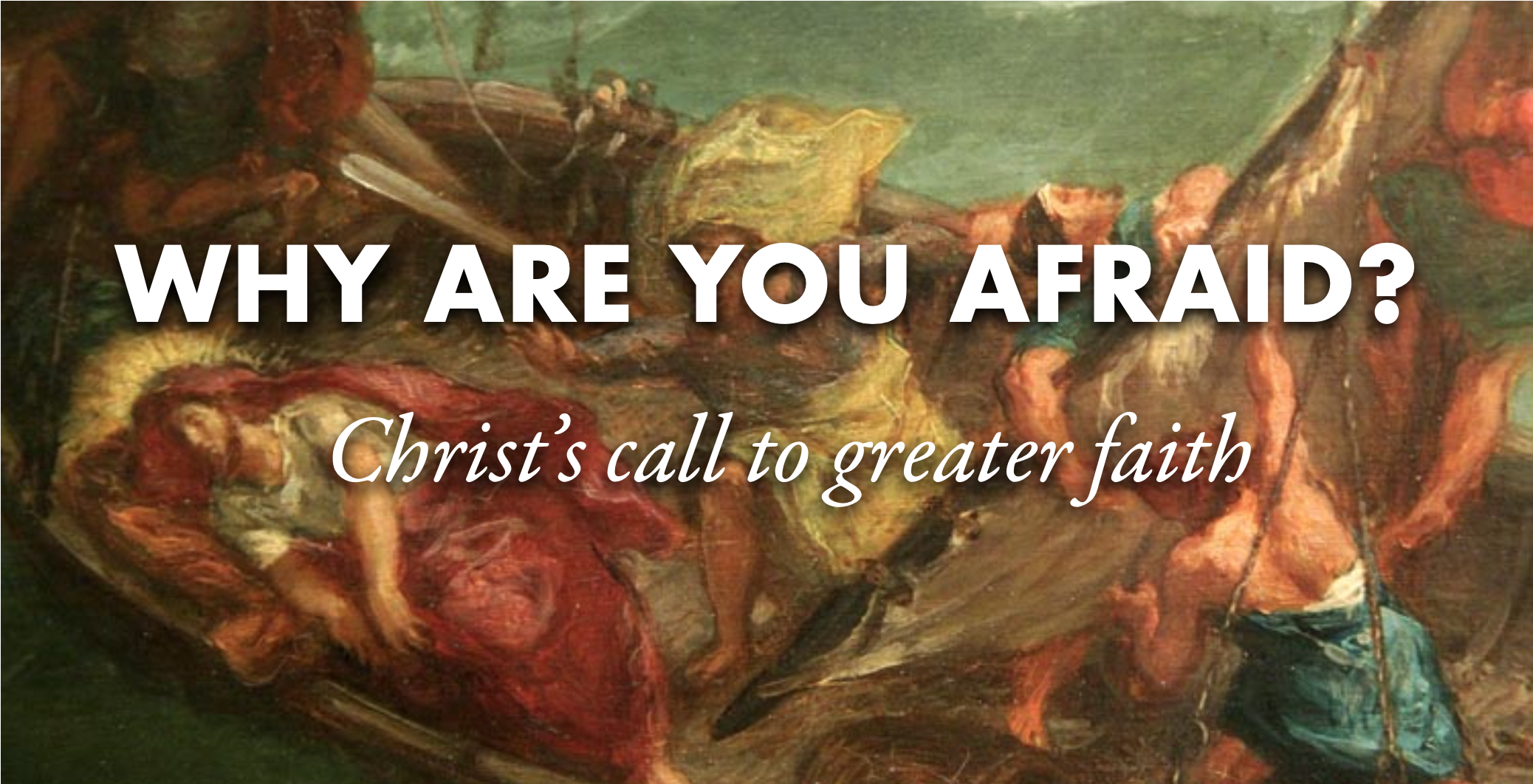
Why Are You Afraid?

In Matthew’s gospel, he follows the Sermon on the Mount in chapters 5-7 with his account of some of the extraordinary miracles that Jesus performs in chapters 8-9. The power of Christ overcomes a variety of maladies: He cleanses lepers, heals paralysis, casts out demons, restores the blind and mute, and brings a little girl back from the dead.

It is in this context that Matthew tells the story of Jesus miraculously calming a storm:

And when He got into the boat His disciples followed Him. And behold, there arose a great storm on the sea, so that the boat was being swamped by the waves; but He was asleep.

And they went and woke Him, saying, “Save us Lord; we are perishing.”

And He said to them, “Why are you afraid, O you of little faith?” Then He rose and rebuked the winds and the sea, and there was a great calm. And the men marveled, saying, “What sort of man is this, that even winds and sea obey Him?”

(Matthew 8.23-27)

There are several lessons we could take from this remarkable event, but I just want to focus on one. Jesus’ disciples are so terrified that they wake Him up in fear of their lives. His response is astounding: “Why are you afraid?” He asks. At first glance, it seems that Jesus is being incredibly obtuse—a great storm had arisen and the boat was being swamped by the waves; obviously the disciples are afraid because of the storm!

But Jesus was not obtuse; indeed, He was the most perceptive of all men. He certainly understood why His disciples were afraid, and so His question must have been about something else. He wasn’t seeking information; rather, He was prompting transformation.

When Jesus asked His disciples why they were afraid, He wasn’t seeking information; He was prompting transformation. Share on X

The second part of Jesus’ statement is telling, as He calls His disciples “you of little faith.” Tied to His question in this way, the implication is clear: if the disciples had more faith, they would not be afraid! Jesus’ disciples had just witnessed His marvelous power in a variety of different situations. This should have bolstered their faith and enabled them to realize that their Teacher was more powerful than the storm which threatened them!

Currently, our world is under siege by a viral pandemic. Millions are sick; hundreds of thousands have died. Millions more have lost jobs, or at least had their incomes diminished. Virtually all of us have had our lives altered in some way. Our plans have been canceled, we are stuck in our homes, we are having to distance ourselves from family and friends. Our worship routines have been disrupted.

What is unique about the current situation is only the scope of the storm; the reality is that, in a variety of ways, we are constantly buffeted by the storms of this life, and the waves threaten to swamp us:

  • A middle-aged man learns that he has been laid off from his job and is plagued by financial uncertainty as he wonders how he will provide for his family.
  • A woman learns that her husband of twenty years, the love of her life, has been carrying on an affair with another woman.
  • Two young parents learn that their infant son has a genetic condition which will greatly limit his life.
  • A single mother of two teenage boys is diagnosed with stage four cancer and told that there is no hope.
  • A house fire destroys a family’s home and all of their earthly possessions.

When the storms of life come, like the disciples, our tendency is to run to Jesus and ask Him to save us. And I wonder if He responds similarly: “Why are you afraid, O you of little faith?”

It’s not that Jesus doesn’t understand our storms—the good news of the Incarnation is that Jesus stepped into the human condition in a unique way. He understands our fears, our trials, and our heartaches. He sympathizes with our weaknesses (Hebrews 4.15). But the same Jesus also says, “In the world you will have tribulation. But take heart; I have overcome the world.” (John 16.33b).

The Christ who calms storms knows what frightens us, but He also asks us to realize: truly, ultimately, with Jesus on our side, the scary things of life aren’t scary! He is more powerful than the storm!

Lord, increase our faith!


In this loose series of Scripture Reflections, I am sharing brief thoughts spurred on by my Bible reading this year. By way of reminder, my goal for these brief posts is two-fold:

(1) To remark on aspects of the biblical text that I find to be of interest that the reader may or may not have thought about previously.

(2) When possible, to point ahead to the work and person of Jesus Christ. I believe the Bible is a unified story that points to Jesus, which means that He is frequently alluded to or foreshadowed in some way throughout the biblical canon.

© 2026 The Doc File

Theme by Anders Noren — Up ↑






