The online journal of Luke Dockery

Tag: Salvation

Three Views on the Permanence of Salvation

This is a post that I have been intending to write for some time, but recent readings on God’s providence and sovereignty have brought it to my mind again.

When someone becomes a Christian and is saved, is that salvation permanent, or can it be lost? The answer to that question has been hotly debated for a long time, and in this post, I’d like to briefly summarize three different popular answers. My point in this post is not to argue which answer is correct (though I’ll let you know where I stand), but rather to emphasize the practical consequences of each viewpoint, and to indicate that two views which people frequently equate with one another are actually significantly different.

Perseverance of the Saints

This perspective is one of the central tenants of Calvinism (the “P” in “TULIP”). It holds that God, in his sovereign power, keeps those who are saved, saved. Also known as eternal security, the idea is that nothing in heaven or earth can separate true Christians from the loved of God (Romans 8.39). The adjective true in “true Christians” from the previous sentence is an important one, as we’ll see in our hypothetical example below.

Once Saved Always Saved

A popular version (or perversion?) of Perseverance of the Saints is the teaching of Once Saved Always Saved which you hear in many evangelical groups today. Many of the same Bible verses will be used to support this view, and this perspective is often held to be synonymous with Perseverance of the Saints, but as we will see below, there is a crucial difference between the two.

The Reality of Apostasy

The third perspective holds that someone can be truly saved and then later fall away from that salvation (the word apostasy means to fall away). This view does not intend to undermine God’s sovereignty, but rather holds than in his sovereignty, God has chosen to give free will to humanity, and that he will permit them to use that free will to walk away from their faith. This is the view that I hold, and I think it is the only one that correctly interprets passages like Hebrews 6.4-6.

A Hypothetical Case Study

To examine some of the practical applications of these different perspectives, let’s take a look at a hypothetical case study.

Frank grew up going to church sporadically, but never really took it seriously. Then, at a summer church camp after his senior year in high school, his conscience was pricked, he decided that he wanted to dedicate his life to the Lord, and he became a Christian and was saved.*

For several weeks after this, Frank was very active in a local church, and even tried to share his faith with his friends. Then, he went off to college, struggled to find a church there, and before long, completely quit attending. Furthermore, he got heavily involved in the college party scene. Before long, he became a heavy drinker, was sexually promiscuous, and experimented with illegal drugs.

After a few semesters, Frank actually dropped out of college, and began selling drugs to make a living and to support his own habit. As time went on, he moved on to increasingly dangerous drugs, and his lifestyle became more dangerous and volatile; he would use violence to get what he wanted, and was even implicated in a couple of drug-related murders. Ultimately, he is killed one night in a drug deal gone bad.

So, at the point of his death, was Frank saved? Let’s look at how the three perspectives above would answer that question.

In the Perseverance of the Saints view, Frank was never saved in the first place. Although God guarantees the salvation of those who are truly converted, it is evident based on Frank’s lifestyle of selfish choices and sinful behavior that he was never truly converted in the first place. In other words, true Christians are eternally secure in their salvation, but Frank was never saved in the first place: whatever happened at church camp his senior year just looked like he was being saved; he really wasn’t. If he had really been saved, he would have lived a drastically different sort of life.

In the Once Saved Always Saved view, Frank was saved. Back in summer camp he had done what was necessary to be saved, and God promises to keep those who are saved, saved. Thus, regardless of whatever Frank did later in life, God is faithful, and saves him anyway.

In the Reality of Apostasy view, Frank was saved but then forfeited that salvation. Back in summer camp Frank did was was necessary to be saved, and so he really did receive salvation. Sadly, the choices he made following conversion did not live up to the commitment he made at conversion, and since God honors the free will of humans, he allowed Frank to choose to forfeit his salvation.

Conclusion

I think the three views and their practical implications can be summarized as follows:
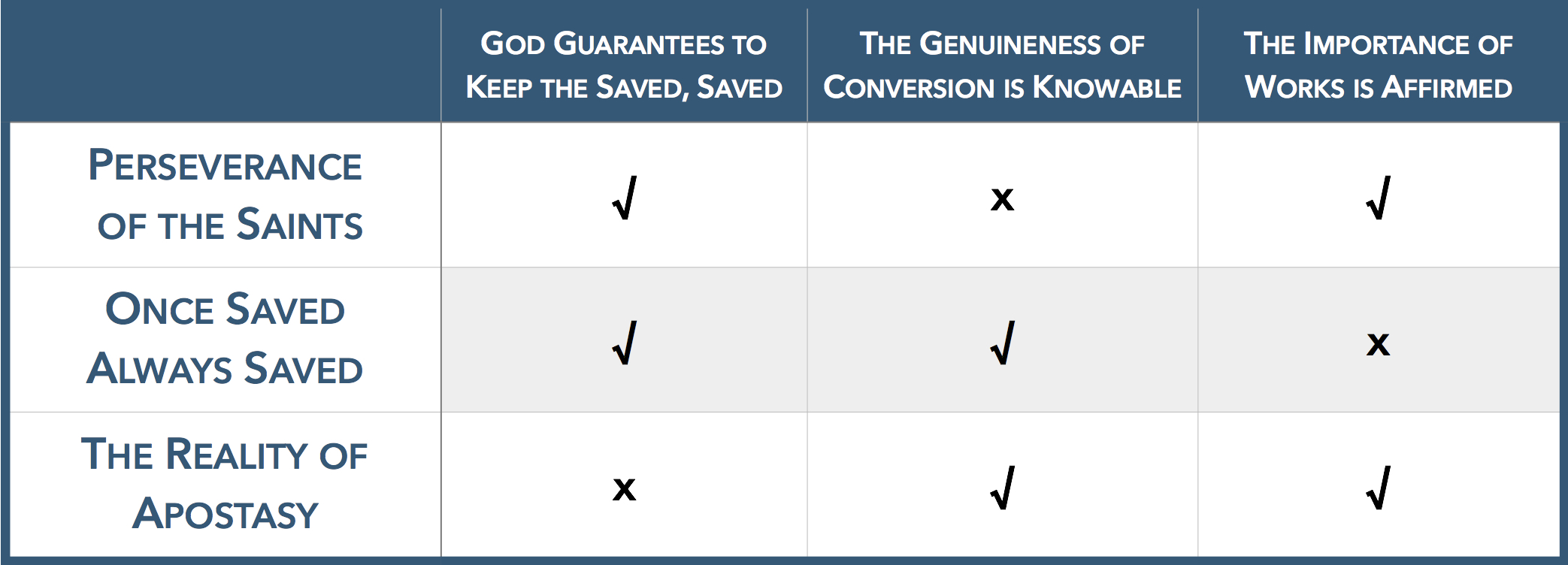
Perseverance of the Saints: God guarantees the salvation of the truly saved, but the genuineness of our salvation is borne out in our works. If we don’t show good works in our lives, it’s evident that we were never really saved in the first place. Of course, the practical problem with this is that it becomes impossible to tell (at least, from the outside) if a person’s salvation experience is truly genuine: we have to wait and see how they live before we can know. For me this is a big problem, because I think Scripture teaches that we can know that we are saved. At least from a practical standpoint, that is denied in this view.

Once Saved Always Saved: God guarantees the salvation of those who are saved, so those who do what is necessary to be saved are saved forever, regardless of what they do later in life. The practical problem here is that it completely devalues the importance of good works in our lives: we can apparently be saved without them. For me, this is completely unacceptable: I don’t know how the Bible could be any clearer that what we do in life actually matters. Practically, that idea is denied in this view.

Reality of Apostasy: God guarantees the salvation of his people, the church, and so those who are saved, added to the church, and remain a part of the church, are saved. However, if our lifestyle is characterized by continual disobedience to God’s will, then God honors our choices and allows us to forfeit our salvation. This view affirms that we can really know we are saved when it happens (as apposed to the first view), and that our works matter (as opposed to the second). Instead, it gives up the idea that those who are saved are saved no matter what. That in and of itself is not a problem (because I think the Bible teaches that salvation can be lost), but the practical problem that can arise is that people can press this view to unhealthy extremes lose all assurance of their salvation and are constantly unsure of their status before God (e.g. I went to church this morning and took communion, so I am okay/I got upset and cursed at my spouse today so I am lost). However, I don’t think this unhealthy extreme is the necessary result of this view, and in my personal life, I affirm the reality of apostasy while remaining confident that I am saved by God’s grace and that his grace continues to keep me saved as long as I continue to follow Him.

*Obviously, people also have different views on what a person must do to be saved. The Bible teaches that we are saved by grace through faith, but there is significant disagreement about the nature of that faith: is it mental assent, or is it an obedient faith that requires specific acts on our part? The way we are saved is not the focus of this post, however. For the sake of our hypothetical argument, just assume that being saved means what you, the reader, think it means.
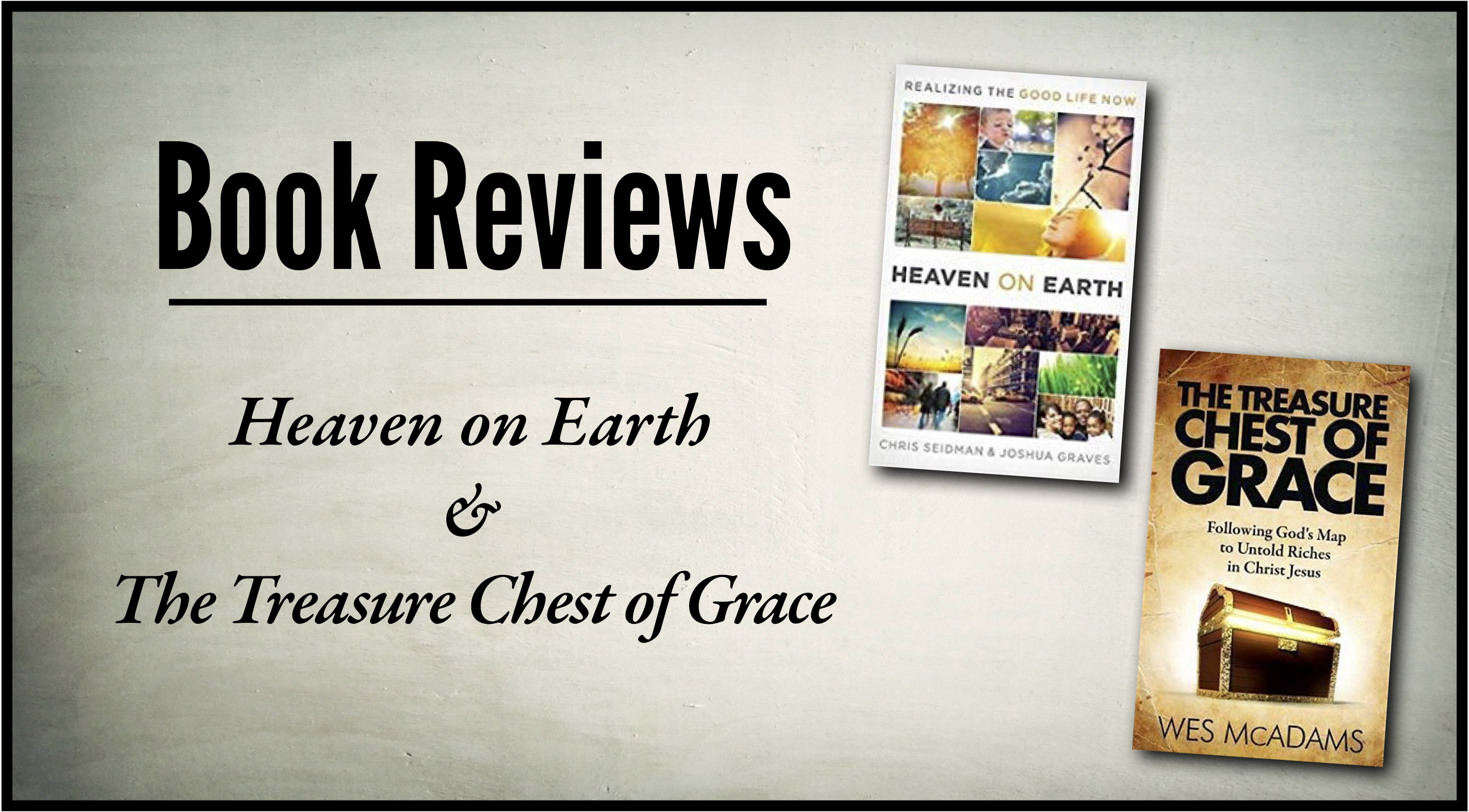
Two for One Book Reviews: Heaven on Earth and The Treasure Chest of Grace

I enjoy reading and sharing helpful things that I read with others. I like to read lots of different kinds of books, but as a minister and a theology students, a lot of what I read tends to focus on those areas.

As a part of my schooling, I read widely across the spectrum of Christianity. This invariably means that I read a lot of things I disagree with, but also that I am challenged to think about what the Bible teaches and what I believe frequently. That’s a good thing, I think.

Over the last several years, I have noticed a marked increase in the number of books being put out by ministers and thinkers within Churches of Christ. This is also a good thing, I think, and I have made an effort to read some of those books when I get the chance (and in the process, have come across some very good material). Having said all that, I wanted to offer some quick reviews of a couple of those books: Heaven on Earth: Realizing the Good Life Now, by Chris Seidman and Joshua Graves, and The Treasure Chest of Grace: Following God’s Map to Untold Riches in Christ Jesus, by Wes McAdams.

Heaven on Earth

Heaven on Earth was good, although it was not what I expected. The book is actually a careful examination of Jesus’ Beatitudes at the beginning of the Sermon on the Mount, and how living those out makes a difference in the here and now (while also identifying us as the kind of people who will be with Jesus eternally).

The subtitle, “Realizing the Good Life Now”, could potentially mean a lot of things, but basically, the authors assert that living this way (according to the Beatitudes) constitutes living the “good life”, and helps us to establish the ideals of God’s Kingdom on earth (to be clear, there are no hints of prosperity gospel nonsense in this book about how God wants us to be happy and therefore will shower us with material blessings if we are faithful to Him).

Each chapter covers a Beatitude, and discusses what it means as well as illustrating it with an abundance of real-life examples, mostly from modern day. The two authors do not write together, and instead, take turns writing different chapters. This is probably my main criticism of the book, as I think it gives it a choppiness in thought and style that wouldn’t be present if either writer was working entirely on his own.

Here are some good quotes:

“The good life is only possible in so far as God is involved. Experiencing the good life is more about what God has done and is doing that what we have done or are doing.” (xi)

“For Jesus, the kingdom of heaven had everything to do with life on this side of the grave while many of us are inclined to think it mostly has something to do with life on the other side. Consequently , we think of Jesus’ proclamation of the kingdom of heaven coming near as meaning through Jesus we now have access to the pace of heaven after we die. Even though this is one aspect of the context, it is not the entire context.” (3)

“The longer Paul dwelled in the kingdom of light the more aware he became of the darkness in his own life.” (16)

“Mourning is a pure vision of the large gulf between how things could be versus how things actually are.” (28)

“How do we respond to the pain and suffering that haunts us? Something’s amiss. Is life beautiful? Yes. But just on the horizon of its inherent beauty is a wild storm, waiting to tear everything to pieces, total destruction. Life is beautiful. But life is also deadly, depressing, and full of pain.” (33)

“Doing the right thing—whether individually (righteousness) or collectively (justice)—is always a primary interest of God in the prophets, because a life is the totality of choices made for the individual and the community.” (57)

“The person you are setting free when you reconcile is yourself.” (99)

“The most dangerous believers in the world to the kingdom of darkness are the ones who live as though they have nothing to lose.” (109)

“Faith is about seeing the world as God sees it. Not simply seeing the world for what it is—in all its paradox of beauty and death—but also seeing the world for what it will one day become.” (131)

The Treasure Chest of Grace

The Treasure Chest of Grace focuses on the fact that we have been saved by grace—nothing we have done or can do on our own has any bearing on salvation apart of the gracious acts of God on our behalf—and then sets about determining what conditions we must meet in order to become recipients of that grace. This is where the “map” of the subtitle comes in: the pages of Scripture reveal to us what we must do in order to come into contact with God’s grace.

This book differs significantly from Heaven on Earth in that McAdams uses no stories or modern-day examples to prove his points; he only uses Scripture. This is by design: “I have made every effort in this book to prove every point with Scripture, and only Scripture. No quotations of man are used to prove any point, only words inspired by God” (8). I understand his reasoning and certainly agree with him at the core (we should base our religious beliefs on Scripture, not something else), but I think the writing suffered somewhat as a result: a short book peppered with hundreds of Scripture references and no other illustrations or examples is harder to read. My other gentle critique is a subjective one: I don’t like really short chapters. The main body of the book is 144 pages long, and those pages are divided into 25 chapters, rendering the average chapter as a little less than six pages long. Constantly shifting from chapter to chapter gives the reader the impression that some thoughts haven’t been well developed (which I don’t think is true, I just think that many of the “chapters” would function better as sections within longer chapters).

Anyway, on to the quotes:

“Man is utterly incapable of earning the things we receive from God. This does not mean, of course, that we are incapable of obeying Him, pleasing Him, honoring Him, glorifying Him; but we must remember that by doing so, we have earned nothing.” (16)

“When people try to save themselves, they are communicating to God that they have no need for His grace.” (25)

“If there were nothing man had to do to receive salvation, there would be none who were lost.” (46)

“Too often people have assumed that because God freely gives grace, He gives it without conditions.” (78)

“Unfortunately many in the religious world have tried to sever the biblical ties between salvation and baptism” (97)

“Man is not saved because he obeys the gospel; he is saved when he obeys the gospel. The gospel itself, not the obedience of man, is the reason man is saved.” (106)

“Your salvation lies at the lace where His “amazing grace” meets your “trust and obey”.” (152)

“Do not mistake the emphasis on baptism to mean that it is more significant than it really is. Nor should you make the mistake of assuming baptism is meaningless or insignificant. Because it is a part of God’s plan to redeem man, it has great importance. But without the blood of Christ, baptism is nothing more than a glorified bath.” (155)

I thought both of these books were short, easy-to-read, helpful treatments of two very biblical ideas: what living the Beatitudes means for us as citizens of God’s Kingdom, and how God’s grace and our obedient faith work together in the act of salvation. I was thankful to have read both.

Wayne Grudem on Penal Substitution and Baptism

Wayne Grudem is an evangelical theologian, and a smart man—I have read stuff from him before in the course of research—but this quotation of his on the idea of theological disagreements blows my mind (and not in a good way):

“I’m thankful that believers who differ on the issue of baptism can still have wonderful fellowship with one another across denominational lines, and can have respect for each other’s sincerely held views. I certainly do not put the question of baptism in the same category as the denial of penal substitutionary atonement…because that seems to me to be a denial of the heart of the Gospel…But differing views on baptism…do not have serious consequences of that type.”

So basically, accepting a view of the atonement that centers on penal substitution is more important than baptism. What?
It has become a trendy thing for Christians to want to distance themselves from penal substitutionary atonement, which I think is unfortunate, because the Bible definitely and repeatedly affirms that Jesus Christ was punished in our place as part of the atonement (John 1.29, Romans 3.21-26, 2 Corinthians 5.21, Galatians 3.13, Hebrews 9.29, 1 Peter 2.24).
However, I am aware of nowhere in the New Testament where possessing the single, correct understanding of the atonement is tied to an individual’s salvation or the forgiveness of sins (which is a good thing, because although Christ’s substitution for us was part of the atonement, the Bible indicates that there was more to it than just that). On the other hand, there are plenty of scriptures that link baptism to salvation and the forgiveness of sins (Acts 2.38, Acts 22.16, Romans 6.1-4, 1 Peter 3.21).
I think Grudem is mixed up on this one.

God Wants Sons, Not Slaves

In Will God Run?, Charles Hodge writes some powerful words on salvation, grace, and the restoration of relationship with the Father (emphasis is mine throughout):

The father gave the prodigal a ring. When the son met the father he said, “I have sinned against heaven and in thy sight, and I am no more worthy to be called thy son. I wish to be recognized as a servant, a slave.” The father’s first impulse is to get that notion from his system. He said, “Son, you are my son. I don’t want slaves. I want sons.” Salvation is restoration![1]

Salvation is more than penalty remitted; it is basically relationship restored!…May we suggest again, he is forgiven because he was a son. He didn’t buy salvation because he was penitent. He didn’t earn restoration because he came home. His fondest hope was to be given a decent job as that of a servant. Beloved, we are saved by grace and must never forget it.[2]

Religion’s advice is “try a little bit harder, work at it just a little bit more.” Christianity is not advanced humanism, not just simply a few good morals! If Christianity were only morals, Socrates could be our savior. But Christianity is the restoration of a father-son relationship.[3]

Salvation…is the placing of God’s best robe on the worst sinner! We strive to place ourselves not to need the robe when that is our basic need! God’s answer is not “clean up, son.” It’s not “try a little bit harder.’ God’s answer is, “Come home, son. Come home.”[4]

There is so much to weigh in on in these few quotations, but I’ll just briefly touch on one issue. So often, people seem to think (and maybe they think this because it is implied in preaching), that they just need to “get their lives right” and then in some sense they will be worthy of being God’s children.

This thinking is completely backwards. First, we are at no point worthy of being God’s children, and secondly, while moral living is important, it proceeds from a right relationship with the father; it does not precede that relationship.


[1] Charles B. Hodge, Jr., Will God Run? (Searcy, AR: Resource Publications, 2002), 50.

[2] Ibid.

[3] Ibid, 52.

[4] Ibid.

© 2026 The Doc File

Theme by Anders Noren — Up ↑







