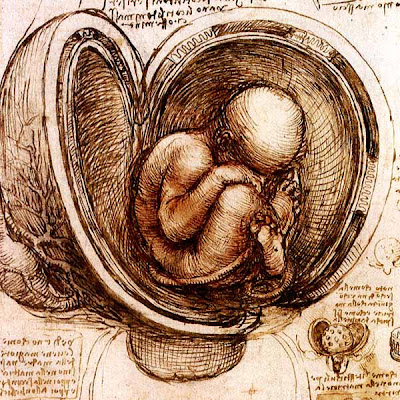
It is my firm belief that human life begins at conception. I’ll explain why I believe that in this post, but it’s on that premise that I oppose the practice of abortion.
After all, if that premise is not true, then the abortion debate is much ado about nothing. But if it is true, then abortion is nothing less than government-sanctioned, premeditated murder. To put it bluntly, abortion is either the equivalent of brushing off skin cells, or it is the equivalent of shooting your next door neighbor.
There’s a big difference there, so figuring out exactly when human life begins is important.
The Scriptural Argument
As I mentioned in the introductory post to this series, I’m a Christian, and that influences my views on abortion. I think Scripture clearly teaches that life begins at conception, and frankly, that alone would be enough for me (though I think there are other arguments as well).
There are a lot of verses that I could reference and a lot of points that could be made, but I’ll narrow it down to just a couple.
First, the same Greek word, BREPHOS, is used in the New Testament to describe an adolescent child (2 Timothy 3.15), a newborn child (Luke 2.2), and an unborn child (Luke 1.44). New Testament writers didn’t seem to make a distinction between children before and after birth.
Like the Greek of the New Testament, the Hebrew of the Old Testament makes no distinction between an “infant” and a “fetus.” The Hebrew word, GEHEVER, is used over 60 times in the Old Testament, usually to refer to an adult male (Psalm 34.8, Job 3.23, Psalm 125.7). But in Job 3.3, this same word is used to refer to an unborn child at the moment of his conception.
I think an even stronger argument concerning the beginning of life comes from the incarnation of Jesus. Concerning the incarnation, the Bible teaches that the Son of God emptied Himself, became flesh, and dwelt among us (Philippians 2.5-8, John 1.1-14).
The question then arises, “at what point did the Son of God become flesh, and begin His life as a human?” There’s only one answer that makes sense: Jesus didn’t begin His humanity on the night He was born in Bethlehem; the Messiah of the Jews and Savior of the World became flesh at the point that the Holy Spirit caused Mary to become pregnant (Luke 1.35)!
The Scientific Argument
Science is certainly not my area of expertise, and I won’t pretend otherwise. Certainly there are scientists and doctors who would argue that life doesn’t begin at conception, but many of them argue that it does.
And consider: the day before an infant is born and the day after an infant is born, the infant is almost identical in terms of development. The significant difference is in terms of environment (out in the world as opposed to inside the womb).
A few years ago, I had to write a paper on Embryonic Stem Cell Research for an Ethics class, and I came across this article which suggests that we can more clearly determine when life begins by comparing it to when life ends. I would suggest that you take the time to read the article, but the author, who is a professor of Neurobiology and Anatomy at the University of Utah, points out that:
Death occurs when the body ceases to act in a coordinated manner to support the continued healthy function of all bodily organs. Cellular life may continue for some time following the loss of integrated bodily function, but once the ability to act in a coordinated manner has been lost, “life” cannot be restored to a corpse-no matter how “alive” the cells composing the body may yet be.
Applying that same definition of life, it’s clear when life begins:
From the earliest stages of development, human embryos clearly function as organisms. Embryos are not merely collections of human cells, but living creatures with all the properties that define any organism as distinct from a group of cells; embryos are capable of growing, maturing, maintaining a physiologic balance between various organ systems, adapting to changing circumstances, and repairing injury. Mere groups of human cells do nothing like this under any circumstances.
The Common Sense Argument
If life doesn’t begin at conception, then when does it begin? Other “starting lines” seem arbitrary:
Is life determined by viability? An infant isn’t a person until it can survive outside the womb? That’s problematic, because with advances in medicine, that date continues to change. For that matter, if humanity is determined by how well someone can survive, a lot of toddlers, people in nursing homes and paraplegics are in trouble—are they less human than the rest of us?
Does life begin at birth? That seems like more of a concrete dividing line, but if that’s the case, why are there restrictions on late-term abortions? And why does Barack Obama not support the lives of infants who survive abortion attempts and emerge from the womb living (For the record, I’ve pointed out before that at least Obama is consistent on this issue—if it’s okay to abort an infant right before birth, it should also be okay to let the infant die immediately afterwards.)?
It seems that our gut tells us that humanity begins prior to birth. Consider the following example. When a couple who is pro-choice and has no problem with the practice of abortion decides to start a family and conceives, their view of the unborn changes dramatically. No longer is a fetus just a bundle of cells; instead, it is an unborn infant. It is considered to be a member of the family and the parents plan for it accordingly. They get excited when it moves and are concerned about its health. They don’t wait for the moment of birth to bestow personhood upon it!
So what do we make of this inconsistency? Is life determined by the feelings of the parents? Is an unborn infant a human only if the parents consider it to be so, only if it is wanted? This is the most ludicrous position of all, but it’s the position where many end up.
Conclusion
There’s much more to be said, but the point of this post was to put forth reasons why I believe human life begins at conception, and why, therefore, the issue is an important one. There are more arguments that could be made, but I think I’ve said plenty.
At this point, I’m still laying the foundation for later posts and not really anticipating a lot of disagreement from most of my readers, but if you do take issue with something I’ve said, let me know.









