Revelation is a challenging book. It is written as apocalypse—a specific literary genre that leans heavily into historical context. The problem is that most readers are not familiar with the genre or the historical context, so Revelation remains largely impenetrable, susceptible to the wild speculation of religious charlatans and geopolitical prognosticators.
Regardless of the difficulties, most Christians are at least vaguely aware of the broad point of the book—there is a cosmic spiritual struggle going on between Jesus and the forces of darkness (the great dragon and his allies). The forces of darkness are powerful and seductive. They are actively recruiting followers of the Slain Lamb to commit treason and switch sides, and at times, it can seem like this is the smart move because it appears that the dragon is winning.
“Don’t be deceived!” says John in his apocalypse, and indeed, he reveals the reality of the situation: it is important that we choose wisely about whose side we are on in this cosmic struggle, because it is God’s side that will be overwhelmingly victorious.
At times, Christians can lose sight of this essential aspect of the Christian story. Often when we think of Jesus, we look back to the things Jesus did—His incarnation, ministry, miracles, crucifixion, and resurrection. Sometimes, we look around at our current lives and the ways Jesus gives meaning, comfort, and support to our existence right now. All of this is good, but while Christianity is a historically rooted faith that empowers meaningful life in the present, it is ultimately a future-facing endeavor: Jesus is coming again, and when He returns, He will fix the brokenness of the world and set it right.
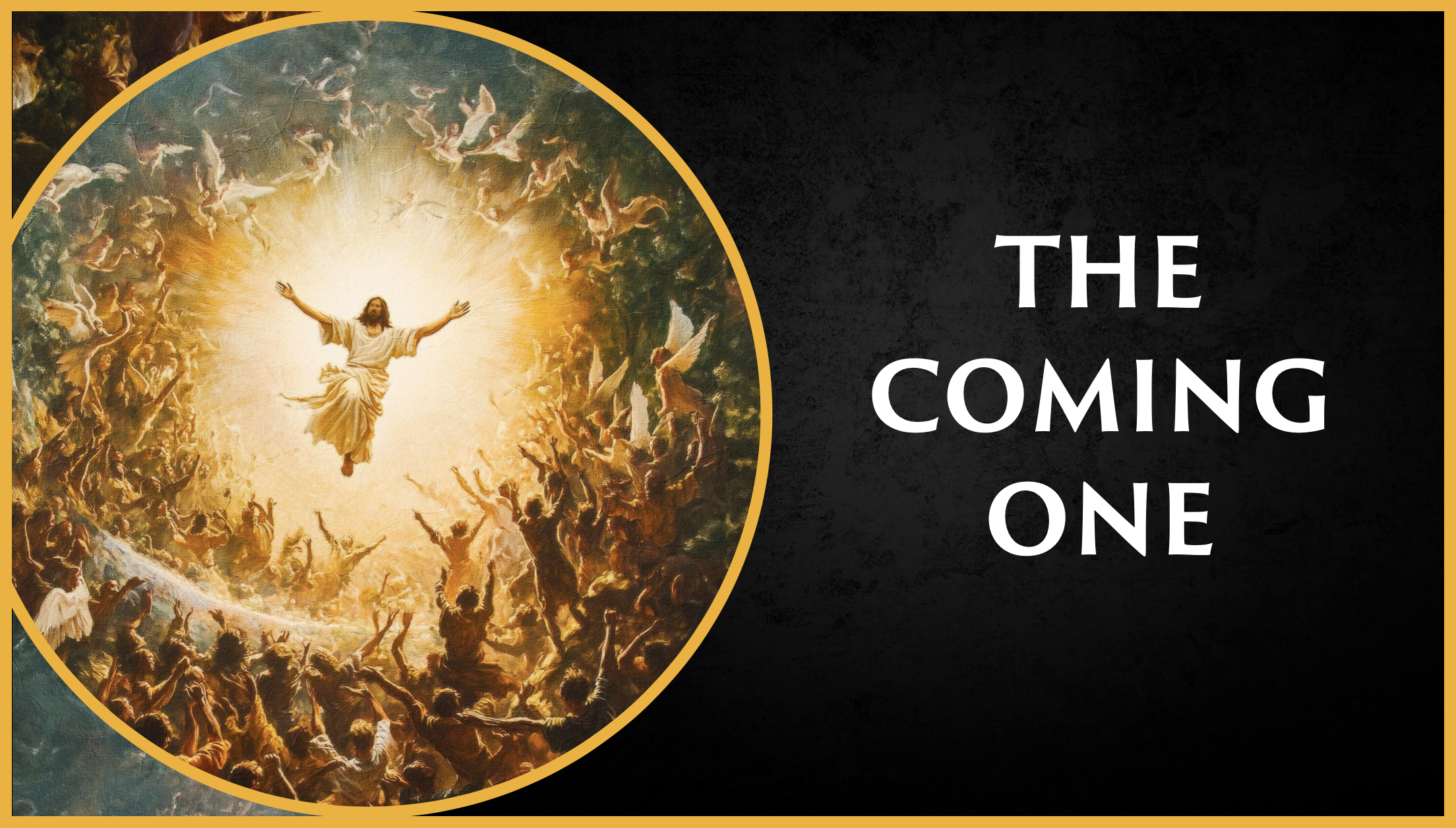
This truth is underscored by one of Jesus’s titles that occurs multiple times in the book of Revelation, and is in the Gospels as well: ho erchomenos (Ὁ ἐρχόμενος), which translates as “The One who is to come” or more directly, “The Coming One.”[1]
8 “I am the Alpha and the Omega,” says the Lord God, “who is and who was and who is to come, the Almighty.”
(Revelation 1.8)
2 Now when John heard in prison about the deeds of the Christ, he sent word by his disciples 3 and said to him, “Are you the one who is to come, or shall we look for another?”
(Matthew 11.2-3)
Jesus is The Coming One; His awaited arrival is a key aspect of His characterization, and while the title remains the same, the two verses quoted above (and others like them) describe two different comings. The first coming, of course, began at His incarnation. It was the arrival of the Jewish Messiah from the line of David, the one who would fulfill the faithfulness that Israel had always lacked. Jesus of Nazareth perfectly imaged the Father, sacrificed His life on behalf of the world, and conquered evil, sin, and death in His resurrection.
He then ascended to heaven, which leads to the Second Coming, because Jesus promised a return. He remains the Coming One, because He is coming again. This is an aspect of the Son that is somewhat out of vogue into today’s world (even among Christians!). Perhaps this is because He has been so long in coming that we are a bit embarrassed about it. Doesn’t it seem that He is perhaps, well, late? Don’t worry about that, Peter says:
8 But do not overlook this one fact, beloved, that with the Lord one day is as a thousand years, and a thousand years as one day. 9 The Lord is not slow to fulfill his promise as some count slowness, but is patient toward you, not wishing that any should perish, but that all should reach repentance.
(2 Peter 3.8–9)
Or perhaps we deemphasize this because the Second Coming is tied to judgment—King Jesus will eradicate evil when He returns, and that necessarily involves a quarantine of all those who reject His authority and want nothing to do with Him. Such notions are unpopular in a tolerant, pluralistic world where everyone is encouraged to live out their own truths.
Regardless of our emphasis, however, Scripture is clear: Jesus is the Coming One. He came before, and He is coming again. It’s who He is.
Scripture is clear: Jesus is the Coming One. He came before, and He is coming again. It’s who He is. Share on XDespite the many centuries of waiting, many were not ready when He came the first time. We cannot make the same mistake:
10 But the day of the Lord will come like a thief, and then the heavens will pass away with a roar, and the heavenly bodies will be burned up and dissolved, and the earth and the works that are done on it will be exposed.
11 Since all these things are thus to be dissolved, what sort of people ought you to be in lives of holiness and godliness, 12 waiting for and hastening the coming of the day of God, because of which the heavens will be set on fire and dissolved, and the heavenly bodies will melt as they burn! 13 But according to his promise we are waiting for new heavens and a new earth in which righteousness dwells.
(2 Peter 3.10–13)
We must be ready. He is, and was, and is to come. The Coming One.
 In this loose series of Scripture Reflections, I am sharing brief thoughts spurred on by my Bible reading. By way of reminder, my goal for these brief posts is two-fold:
(1) To remark on aspects of the biblical text that I find to be of interest that the reader may or may not have thought about previously.
(2) When possible, to point to the work and person of Jesus Christ. I believe the Bible is a unified story that points to Jesus, which means that He is frequently alluded to or foreshadowed in some way throughout the biblical canon.
[1] Fleming Rutledge, Advent: The Once and Future Coming of Jesus Christ (Grand Rapids: Eerdmans, 2018), 279n6, called my attention to this title.







