The online journal of Luke Dockery

Tag: Sin (Page 3 of 4)

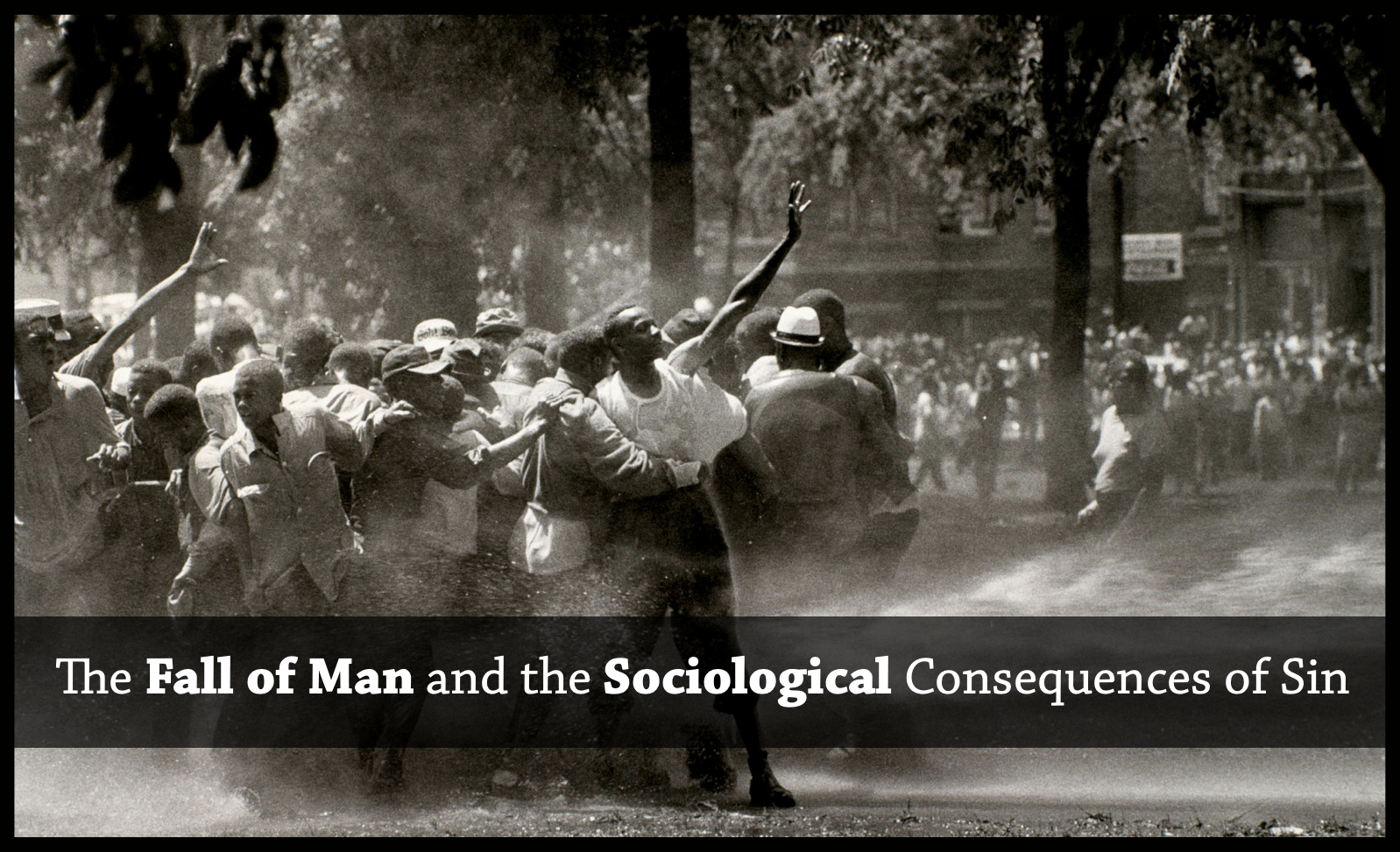
The Fall of Man and the Sociological Consequences of Sin

In our continuing discussion of the Fall of Man in Genesis 3 and the widespread devastation of sin, we have already covered the theological and personal consequences of Adam and Eve’s misdeed; in this post we turn to the sociological fallout of that sin, or the way that sin affects our relationships with one another.

Returning to our text, we can see this dimension clearly played out in verses 11-13:

“[God] said, ‘Who told you that you were naked? Have you eaten of the tree of which I commanded you not to eat?’ The man said, ‘The woman whom you gave to be with me, she gave me fruit of the tree, and I ate.’ Then the Lord God said to the woman, ‘What is this that you have done?’ The woman said, ‘The serpent deceived me, and I ate.’”

People were created to live in community with one another. Specifically, Eve was created to be the perfect partner for Adam (Genesis 2.18-25). But when God confronts Adam and Eve with their sin, something very significant (and unfortunate) happens: the unity that had previously existed between Adam and Eve is shattered as Adam immediately blames his wife for the sin which they had committed together.

This brings a conflict and disharmony between them that would be passed down over time (Genesis 3.16), and we can see it unfold in the pages of Genesis in the accounts of numerous broken relationships—Cain’s murder of his brother, the depraved society of Sodom and Gomorrah, the distorted relationships between Sarah and Hagar, Jacob and Esau, Jacob and Laban, Joseph and his brothers, and more. But the problems certainly don’t stop there—this same conflict and disharmony continue to darken and distort our world today.

Our world is deeply flawed by sin, and this manifests itself everyday sociologically, as we treat one another in a wide array of horrible, messed up ways:

  • On an international level, countries wage war and kill because of conflict over ideology or resources.
  • Systemic evils such as poverty, abortion, racism, sex trafficking, government corruption, lotteries, and more stem from our exploitation of our neighbors in order that we might obtain our own selfish desires.
  • Horrific acts of incomprehensible violence fill our news cycles. Mass shootings at elementary schools, the use of passenger airliners as terrorist missiles, bombings at marathon finish lines and incomprehensible barbarity at soccer matches shock and dismay us and cause us to weep.
  • Our interpersonal relationships are also a mess. Dishonesty, reckless ambition, and violence abound. The (supposedly) lifelong bonds of marriage are broken on a whim.

And the sum result: our society as a whole stagnates and decays, as people live lives marked by self-interest and fear of one another. The community for which we were created is broken.

Sin destroys our relationships with one another.

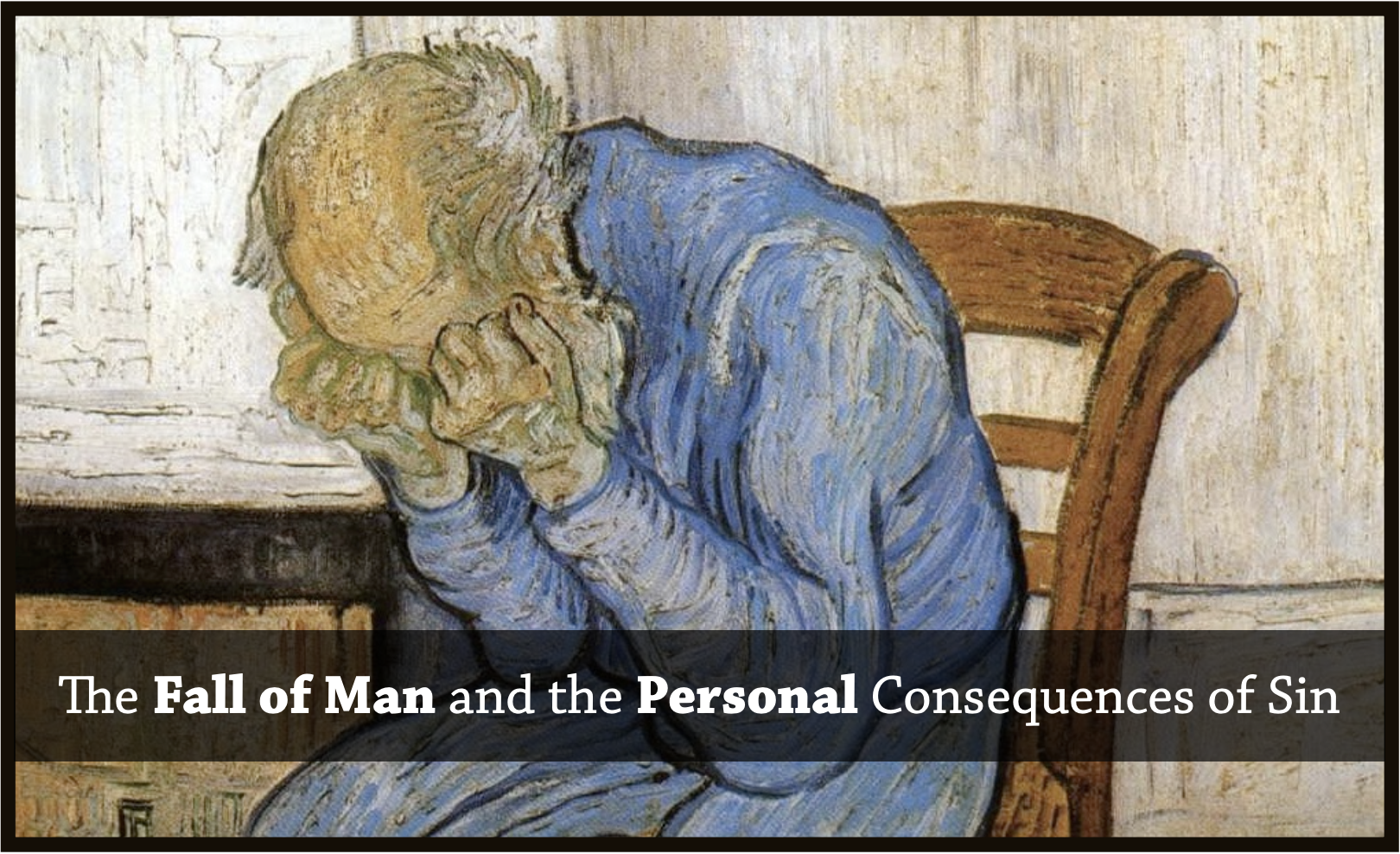
The Fall of Man and the Personal Consequences of Sin

As I discussed in the introduction to this series, Genesis 3 relates the story of the Fall of Man, where Adam and Eve commit sin in the Garden of Eden by eating fruit from the tree of knowledge of good and evil after God had specifically commanded them not to.

A whole host of negative effects befall Adam and Eve (and consequently, the rest of us) as a result of their disobedience, and the point of this series is to examine some of those effects in more detail. Basically, sin messes everything up.

In the last post, we focused on the theological consequences that came about as the result of Adam and Eve’s sin: our relationship with God is destroyed and we become slaves to sin instead.

Next, we want to turn our attention to the personal consequences of sin (which, as well shall see, are closely related to the theological consequences). Returning to our text in Genesis 3, this aspect of sin’s destructiveness is hinted at in Genesis 3.7, 10-11 where Adam and Eve realize they are naked, sew together fig leaves to make loincloths and then, because of their nakedness, hide from God when He enters the garden.

What was so bad about Adam and Eve being naked? After all, it was the way God had created them, so clearly He had no problem with it! The problem came from Adam and Eve themselves: after they sin by eating the forbidden fruit, they become self-conscious and immediately feel that there is something wrong with them, and they are ashamed of themselves.* Ever since then, men and women have felt the same way: we exist in a state of inner conflict, lacking the self-confidence and self-acceptance that we should have as God’s creatures.

Basically, the process looks something like this:

  1. Humans were created for the purpose of living in relationship with God.
  2. Sins distorts and destroys that relationship.
  3. Without a relationship with God, we are inherently unfulfilled, because we are not living out the purpose for which we were created.
  4. We feel bad about ourselves and follow all sorts of false avenues looking for fulfillment.

Just consider our world today. People desperately want to feel happy or significant or fulfilled, so they are willing to try anything: fame, fortune, career accomplishment, relationships, children, sex, drugs, sports, whatever. Why do you think the self-help industry generates billions of dollars each year? It’s because deep down, we all feel like there’s something wrong with us. We struggle with self-confidence and self-image, and we are convinced that we are deeply flawed.

And, biblically speaking, people are messed up; we are deeply flawed. But flatter abs, a more secure retirement, or a better relationship with your boyfriend won’t provide the answer. Oh sure, you might feel a little better about yourself for a while, but it won’t last. We were created to live in relationship with God, and only in the context of that relationship can we find the solution to our deep flaws.


*It is important to note that, according to the biblical account, Adam and Eve are ashamed of their nakedness, not of their sin (it should have been the other way around). Sin had fundamentally changed the way they viewed themselves.

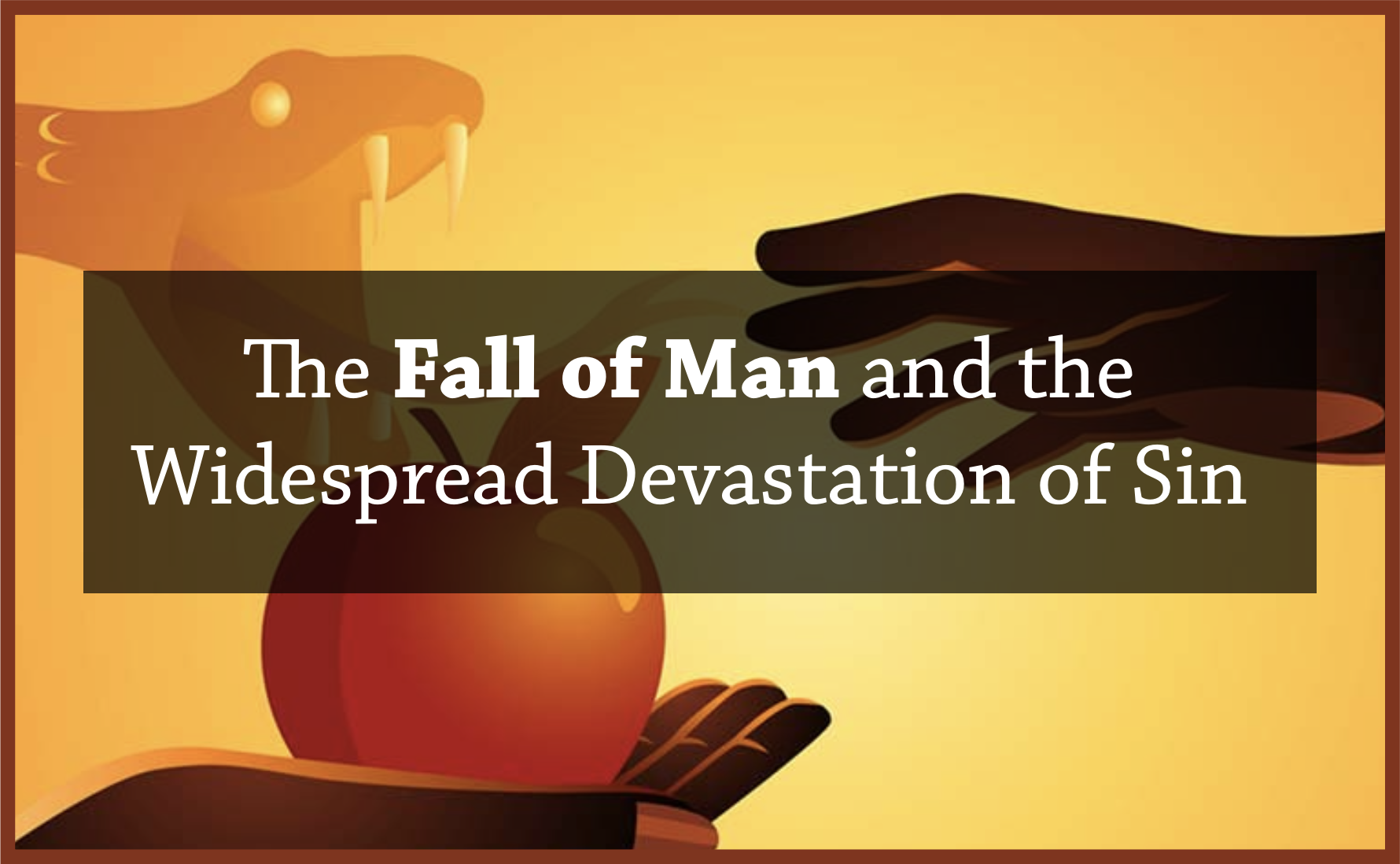
The Fall of Man and the Widespread Devastation of Sin: An Introduction

Most Christians are generally familiar with the story of the Fall of Man as related in Genesis 3. Adam and Eve are placed in a garden paradise to live with only one prohibition: they are not to eat from the tree of knowledge of good and evil (Genesis 2.16-17). But then, the crafty serpent, who elsewhere in the Bible is equated with Satan,[1] comes along and entices Eve to disobey God and eat the forbidden fruit. Eve shares the fruit with her husband, and Adam violates the command of God as well.

Usually, when we talk about this event, we focus on it in a couple of predictable ways: the disobedient act of eating the fruit represents the first human sin, and as a result, the spiritual relationship between humanity and God is ruptured, and physical death comes to mankind as a result.

Both of those things—the disruption of our relationship with God and our mortality—are important, and are certainly framed as results of Adam and Eve’s sin in Genesis 3. But the consequences of sin don’t stop there; they are widespread, and affect all areas of life. To put it another way, sin messes everything up, and as a result, we live in a messed-up world.[2]

Over the next few posts, I’d like to look at the theological, personal, sociological, ecological, and physical consequences of sin,[3] and these categories come directly from the account in Genesis 3:

  • Genesis 3.8-10: Adam and Eve hide from God because they are afraid (theological effects).
  • Genesis 3.10-11: Adam and Eve realize they are naked (personal effects).
  • Genesis 3.12-13, 16: Adam and Eve refuse to take responsibility and their relationship is changed (sociological effects).
  • Genesis 3.17-19: Creation itself becomes cursed (ecological effects).
  • Genesis 3.22-23: Adam and Eve are kicked out of the garden and separated from the tree of life (physical effects).

Hopefully, this series will help us take sin more seriously, and see how all-destructive it is.


[1] See, for example, Revelation 12.9.

[2] One of the biggest problems I have with folks who consider Genesis 1-11 to be allegorical rather than historical (i.e., they don’t believe that the first 11 chapters of Genesis relate actual, historical events) is that such a view strips away the Bible’s explanation for the reason why our world is the way it is. The Bible repeatedly affirms that sin is a huge problem, and our own observations repeatedly affirm that our world in its current state is fundamentally jacked up. Genesis 3 provides the biblical explanation for the enormity of sin, and a groaning creation (cf. Romans 8.22).

[3] This series of posts is based in considerable part on the lectures of Dr. Mark Powell in his Systematic Theology class which I took at Harding School of Theology.

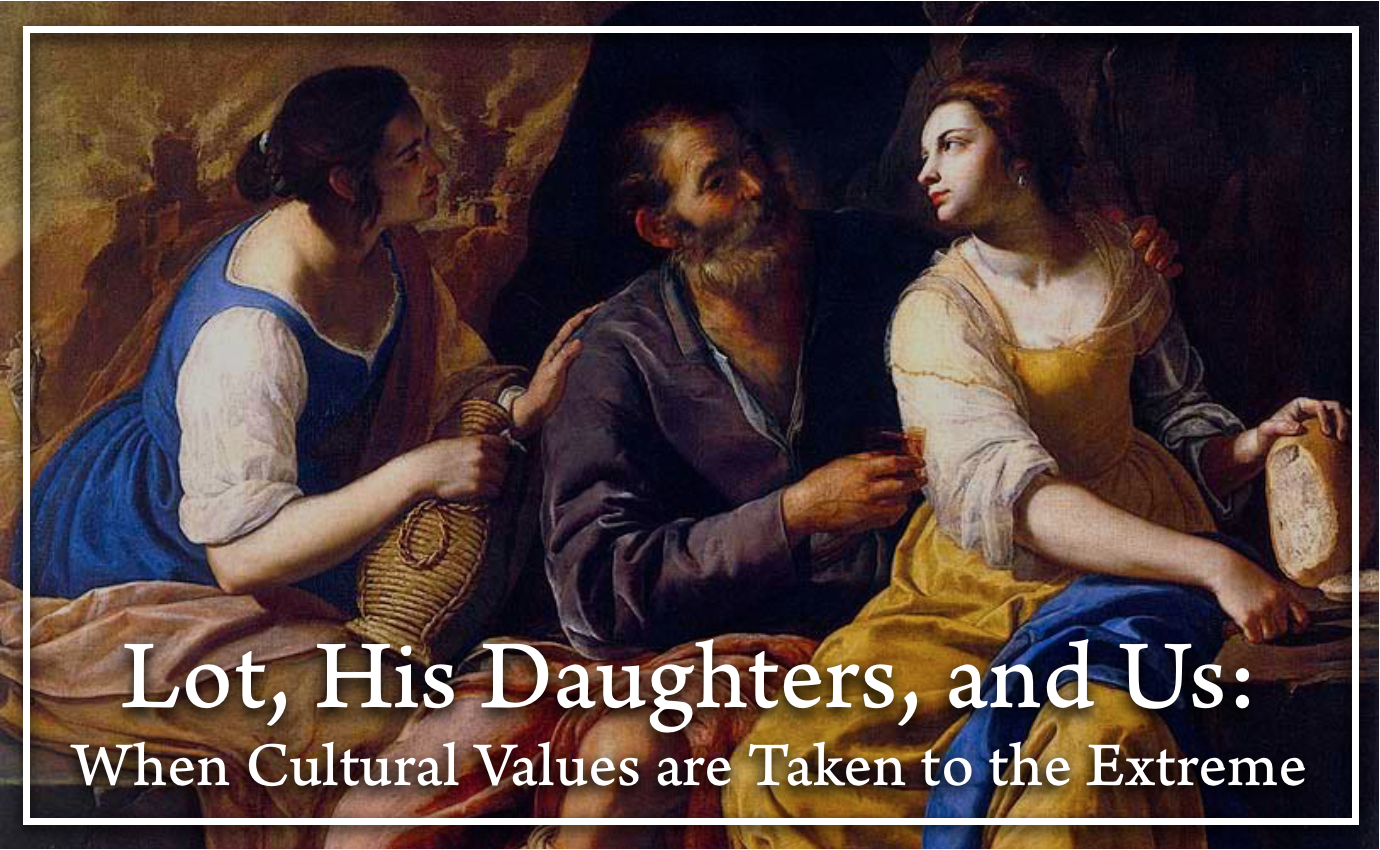
Lot, His Daughters, And Us: When Cultural Values are Taken to the Extreme

I’ve been encouraging my High School Bible Class to read through the narrative portions of Scripture this year and have been giving them a daily schedule to help. I think this is a good thing to do for many reasons, but one reason is that there are certain parts of the Bible which are often passed over in Bible classes and sermons, but it’s still important for people to know they are there (especially teens, who should be in the process of developing their own faith rather than relying on the faith of their parents).

When they made it to Genesis 19, I got a lot of questions, and as I discussed their questions with them, it struck me how often certain values that a culture emphasizes (which may be good in and of themselves) can be taken to dangerous and often sinful extremes.

The Importance of Hospitality

Genesis 19 covers the destruction of Sodom, which was something they were vaguely familiar with, but there were a couple of details that they had missed out on. Two angels, appearing as men, come to Sodom and stay with Lot, and the wicked men of the city bang on Lot’s doors and demand that Lot hand over the two men to them so they can engage in sexual relations with them. Lot’s response is shocking to our modern ears:

“Lot went out to the men at the entrance, shut the door after him, and said, ‘I beg you, my brothers, do not act so wickedly. Behold, I have to daughters who have not known any man. Let me bring them out to you, and do to them as you please. Only do nothing to these men, for they have come under the shelter of my roof.’”

Lot doesn’t seem to be in the running for any Father of the Year awards here, as he offers his daughters to the would-be rapists rather than his guests. That’s hard to understand unless you realize that the idea of hospitality and taking good care of one’s guests was of paramount importance in many ancient cultures (and some modern ones). It’s not that Lot was eager to give up his daughters—I’m sure he wasn’t—it’s just that hospitality was such an important cultural value that it led him to an extreme (and I would suggest, sinful) action. Fortunately for Lot’s daughters, the two angels intervene and strike the wicked men with blindness.

A Woman’s Value Through Child-Bearing

Another example of this phenomenon actually comes from the same chapter of Genesis. Ultimately, only Lot and his two daughters escape the destruction of Sodom, as his sons-in-law remained in the city and his wife was turned into a pillar of salt when she looked back on the destruction of the city.

Lot and his daughters flee to the hills and live in a cave, and here, another shocking development is recorded:

“And the firstborn said to the younger, ‘Our father is old, and there is not a man on earth to come in to us after the manner of all the earth. Come, let us make our father drink wine, and we will lie with him, that we may preserve offspring from our father.’ So they made their father drink wine that night. And the firstborn went in and lay with her father. He did not know when she lay down or when she arose.

The next day, the firstborn said to the younger, ‘Behold, I lay last night with my father. Let us make him drink wine tonight also. Then you go in and lie with him, that we may preserve offspring from our father.’ So they made their father drink wine that night also. And the younger arose and lay with him, and he did not know when she lay down or when she arose. Thus both the daughters of Lot became pregnant by their father.”

So a few days after Lot offers his daughters to rapists, they now get him drunk in order to sleep with him—Lot’s family seems to be the picture of dysfunction, right? Once again though, I think what we have here is a cultural value taken to an unhealthy extreme. In this case it seems that (as was often the case in many ancient cultures, and even some cultures today) for Lot’s daughters, their entire value as humans was derived from their ability to carry on the family line of their father through the bearing of children. With their husbands-to-be destroyed in the obliteration of Sodom and thus their means of child-bearing suddenly removed from them, Lot’s daughters turn to a sinful and (I imagine) undesirable last resort.

What About Us?

With a little careful reflection on the cultural forces that pulled on Lot and his daughters, I think their actions are a little more understandable. That being said, I don’t think these stories show us that the influences of culture validates sinful behavior—not at all. On the contrary, I believe one thing these stories do show us is how, if we’re not careful, the ideals we value as a culture can push us to do unthinkable things.

For example, in American society, one of our most sacred values is individual freedom. Many of the people who colonized the United States came here out of the desire to find freedom of one type or another. The American Revolution was fought because the descendants of those colonists felt that they should be free to govern themselves. The importance of liberty was hammered first into the Declaration of Independence and later into the U.S. Constitution, primarily through the Bill of Rights. As Americans, we pride ourselves on being free people.

But how could freedom be a bad thing? Well, it is the cultural value of freedom that, when taken to an extreme, is used to justify the yearly destruction of hundreds of thousands of unborn infants in the U.S. As a society, we are engaged in an ongoing genocide against our own unborn, but we pretend it is okay because supposedly, the mother should be free to do whatever she wants with her own body. It is cast as an issue of freedom and personal rights.

Clearly, our cultural values can cause moral blind spots for us today just as they did for Lot and his daughters some 4,000 years ago. Perhaps in the distant future, people will look back on our society and shake their heads in shame at the plague of abortion that we have embraced. And perhaps they will be able to somewhat understand our sin because of the cultural values that influence us and that we use to justify it.

But it will still be sin.

Is All Sin The Same In God’s Eyes?

During my years of ministry, I don’t know how many times I have heard someone claim, in one form or another, that “all sins are the same in God’s eyes”. Basically the idea is that we as humans distinguish between different types of sin and consider some to be worse than others, but that God doesn’t do that—He is holy, He doesn’t tolerate any type of sin, and therefore, to him one type of sin is just as bad as any other.[1]

This idea has certainly become a basic tenet of pop theology, but is it biblical? I would humbly submit that it is not, and it’s an idea that I wish could be put to rest.

Why Isn’t All Sin Equal?

First off, we should mention that all sin is equal in the sense that it separates us from God. Romans 6.23 says that the wages of sin is death—we can’t have any relationship with God until we do something about the sin in our lives. So all sin, any sin, is a big deal because it damages our relationship with the Father.

So why, then, isn’t all sin equal?

(1) The Bible teaches that there are different degrees of sin.

There are a whole lot of examples that could be used here, but just consider the following:

  • In John 19.11, when speaking to Pilate in the context of his arrest and trial, Jesus  says,“You would have no authority over Me, unless it had been given you from above; for this reason he who delivered Me to you has the greater sin.” Here Jesus explicitly says that one sin is worse than another.
  • Speaking to the Pharisees in Matthew 23.23-24, Jesus says that they had neglected the “weightier provisions of the law”—justice and mercy and faithfulness—and had instead focused on minor issues. To me, if some parts of the law were more important than others, then the implication is that neglecting those portions was a greater sin.
  • In Matthew 7.3, in the context of being careful about the way we judge others, Jesus says, “Why do you look at the speck that is in your brother’s eye, but do not notice the log that is in your own eye?” The clear indication here is that the log is a bigger problem than the speck, and should therefore be dealt with first.
  • Luke 12.10 talks about sinning against the Holy Spirit, and how it is unforgivable. People debate all the time about exactly what this sin refers to (and I have my own thoughts on this), but if there is a certain sin that is unforgivable, doesn’t that mean that it is worse than others?
  • Ezekiel 23 compares the cities of Samaria (the capital of Israel) and Jerusalem (the capital of Judah), and clearly states that Jerusalem was more corrupt than Samaria (v.11) because of her greater degree of unfaithfulness.
  • When the Israelites worshiped the golden calf at Mt. Sinai (Exodus 32), Moses charged them with committing a “great sin”. If all sins are the same, why is this one specifically referred to as “great”?
  • In Paul’s first letter to Timothy, he emphasizes how terrible it is for a Christian man to neglect his family. In 1 Timothy 5.8, he says, “But if anyone does not provide for his people, and especially his own household, he has denied the faith, and is worse than an unbeliever.” If one can be worse than someone else, doesn’t that imply greater sinfulness?

(2) Some sins have harsher consequences than others.

When you think of the earthly consequences of sin, do all sins seem to be the same? Committing lust in your heart is undoubtedly a sin, but does it have the same consequences as committing adultery? In one case, the sin is limited to yourself, while the other necessarily involves another person and could potentially destroy an entire family. Stealing a piece of gum is a sin, but it is unlikely that it will cause great damage to the person you steal it from. On the other hand, committing murder destroys a life and affects an untold number of people. In short, some sins might not have long-lasting temporal effects, while others literally destroy people’s lives.

This can also be seen in the Bible—if all sin is the same, why did God decide to basically reboot the whole system in the days of Noah and start from scratch? At no other point did God decide to do this, so the indication is that things must have somehow been worse in the days of Noah.

What about Sodom and Gomorrah? Undoubtedly every city on earth is plagued by a great amount of sin—why were these cities singled out for destruction? I would submit that it was because their sinfulness was so widespread—in just the small glimpse we get of Sodom, it appears that the majority of people were guilty of homosexuality, inhospitality, violence against strangers, and sexual assault. It seems that the sinfulness of Sodom was worse than in other places.

There is also some indication in the Bible that different types of sin may have different eternal consequences as well.

First, in Matthew 11.20-24, Jesus pronounces woe upon cities which had witnessed the signs He had performed but failed to repent (particularly relevant parts in the following scriptures are emphasized in bold):

“Then He began to denounce the cities where most of His mighty works had been done, because they did not repent. ‘Woe to you, Chorazin! Woe to you, Bethsaida! For if the mighty works done in you had been done in Tyre and Sidon, they would have repented long ago in sackcloth and ashes. But I tell you, it will be more bearable on the day of judgment for Tyre and Sidon than for you. And you, Capernaum, will you be exalted to heaven? You will be brought down to Hades. For if the mighty works done in you had been done in Sodom, it would have remained until this day. But I tell you that it will be more tolerable on the day of judgment for the land of Sodom than for you.’”

Now, granted, Jesus seems to be personifying entire cities here and it’s difficult to draw firm conclusions based on passages of figurative language, but the implication is that condemnation will be worse for some in the Day of Judgment than for others. If some persons/cities merit greater punishment in the Day of Judgment than others, that certainly indicates to me that all sins are not equal.

Secondly, in Luke 12.35-48, Jesus tells a parable about the importance of being ready for the (second) coming of the Son of Man:

“‘Stay dressed for action and keep your lamps burning, and be like men who are waiting for their master to come home from the wedding feast, so that they may open the door to him at once when he comes and knocks. Blessed are those servants whom the master finds awake when he comes. Truly I say to you, he will dress himself for service and have them recline at the table, and he will come and serve them. If he comes in the second watch, or in the third, and finds them awake, blessed are those servants! But know this, that if the master of the house had known at what hour the thief was coming, he wold not have left his house to be broken into. You also must be ready, for the Son of Man is coming at an hour you do not expect.’

Peter said, ‘Lord, are you telling this parable for us or for all?’ And the Lord said, ‘Who then is the faithful and wise manager, whom his master will set over his household, to give them their portion of food at the proper time? Blessed is that servant whom his master will find so doing when he comes. Truly, I say to you, he will set him over all his possessions. But if that servant says to himself, ‘My master is delayed in coming,’ and begins to beat the male and female servants, and to eat and drink and get drunk, the master of that servant will come on a day when he does not expect him and at an hour he does not know, and will cut him in pieces and put him with the unfaithful. And that servant who knew his master’s will but did not get ready or act according to his will, will receive a severe beating. But the one who did not know, and did what deserved a beating, will receive a light beating. Everyone to whom much was given, of him much will be required, and from him to whom they entrusted much, they will demand the more.’”

Again, Jesus is speaking in a parable here, but the parable does deal with His unexpected return and the accompanying judgment. Once again, the indication is that in the Day of Judgment, some sins will have worse consequences than others, as some who are guilty and bound for punishment will receive “severe beatings” while others receive “light beatings.”

Finally, Hebrews 10.26-29:

“For if we go on sinning deliberately after receiving the knowledge of the truth, there no longer remains a sacrifice for sins, but a fearful expectation of judgment, and a fury of fire that will consume the adversaries. Anyone who has set aside the law of Moses dies without mercy on the evidence of two or three witnesses. How much worse punishment, do you think, will be deserved by the one who has trampled underfoot the Son of God, and has profaned the blood of the covenant by which he was sanctified, and has outraged the Spirit of grace?”

Here the Hebrew writer suggests that those who had come to know Christ and then subsequently forsaken Him would merit worse punishment than others. Furthermore, to underscore why such persons would receive harsher treatment, the author uses extreme language to emphasize the severity of such an action, describing it as trampling the Son of God, profaning His blood, and outraging the Spirit.

Perhaps none of these three passages are crystal clear, but taken together, they suggest at least the possibility that there will be different “levels” or “degrees” of eternal punishment for different people.

(3) Some sins are harder to repent of than others.

Biblically, repentance isn’t just being “sorry” for sin, it’s a conscious turning away from the sin in your life. From that perspective, some sins are harder to repent of than others. It’s one thing to turn away from a sin that you commit by accident; it’s another thing entirely to repent of a sin that you plan out ahead of time and intentionally commit—in other words, it’s easier to turn away from sins we are already trying to avoid than those we seek out.

Hebrews 6.4-8 conveys a similar message, saying that for those who have “tasted the good word of God” and then fallen away, it is “impossible to renew them again to repentance.” This is a much-debated passage, but at the very least, the indication is that the sin of these people places them in a category that makes repentance more difficult than for others.

Furthermore, sinful addictions that destroy people’s lives are much harder to repent of than single, isolated sins.[2]

(4) Simple logic tells us that not all sin is the same.

To reiterate what I said above, all sin is the same in the sense that it separates us from God, but if it was the same in every sense, then that would mean that stealing a piece of gum is just as bad as stealing a car, which is just as bad as killing someone, which is just as bad as killing 20 people. Does that really make any sense?

Put another way, that would mean that in God’s eyes, Mother Teresa and Adolf Hitler are exactly the same, because they both committed sin at some point in their lives. If it’s so easy for us to see the difference in the goodness of those two people, does it make any sense at all that God would look at them in exactly the same way (where do you think our moral code comes from in the first place?)?

Then Why Do So Many People Believe This?

If the idea of all sins being equal didn’t come from the Bible, where did it come from? I don’t have any proof of this, but I suspect it came out of the desire to emphasize two ideas about sin that are very true:

(1) Every sin, no matter how small it seems, is a big deal and requires forgiveness.

Sometimes, in an effort to emphasize the grace of God and His willingness to forgive, some people effectively minimize the magnitude of sin. The idea here is that it doesn’t matter what kind of language you use, it doesn’t matter if you live a sexually immoral life, it doesn’t matter if you are a chronic gossip, because you can just ask for forgiveness and it’s that easy.

The thing to remember is that while grace is free, it isn’t cheap. The sin of mankind is such a big deal that it required the death of the sinless Son of God to make grace possible. Sin—all sin—is a big deal.

(2) Even the “big” sins that we think of as being terrible can still be forgiven.

Sometimes, when people commit very public, very damaging sins, we tend to write them off. A girl gets pregnant out of wedlock or a man divorces his wife, and too often, they are treated like their lives are over and that God has no use for them anymore. The idea here is that only especially saintly people who avoid all “major” sins can ever hope to have a relationship with God.

As mentioned above, it cost God a lot to forgive sin, but thanks to the work of Christ on the cross, He is able and eager to do just that, regardless of how “bad” your sin is (Prodigal Son, Apostle Paul, etc.).

With these two ideas in mind, it’s easy enough to imagine where the “All Sin is Equal” idea came from: simultaneously wanting to underscore that even the “worst” of sins can be forgiven but that even “minor” sins are a big deal and separate us from God, it’s not a huge jump to just declare that all sins must be the same from God’s perspective.

Hopefully, as I’ve explained above, that idea doesn’t make sense logically, and it doesn’t square with the teachings of Scripture either. As we move forward, let’s emphasize that all sin is a big deal, but that it can still be forgiven.

I want to be clear that my intention in this post is not to maximize or minimize any specific sin, or to encourage active reflection on how some sins “rank” in comparison to others. Instead, I am simply calling for people to quit saying, “All sin is the same in God’s eyes”, because biblically, that just isn’t a true statement.


[1]This is an edited version of the original post on this topic.

[2]I’m not intending to debate addiction as sin vs. addiction as illness. Really, I think it’s a moot point—even if addictions affect the body and mind like illnesses do, they still begin with sinful behavior.
« Older posts Newer posts »

© 2026 The Doc File

Theme by Anders Noren — Up ↑