The online journal of Luke Dockery

Tag: Solomon

God’s Idea of a King

Near the end of Deuteronomy, the second giving of God’s law to the Israelite people as they prepare to enter the Promised Land, there is an interesting section on how Israel’s kings are supposed to act.

14 “When you come to the land that the LORD your God is giving you, and you possess it and dwell in it and then say, ‘I will set a king over me, like all the nations that are around me,’ 15 you may indeed set a king over you whom the LORD your God will choose. One from among your brothers you shall set as king over you. You may not put a foreigner over you, who is not your brother. 16 Only he must not acquire many horses for himself or cause the people to return to Egypt in order to acquire many horses, since the LORD has said to you, ‘You shall never return that way again.’ 17 And he shall not acquire many wives for himself, lest his heart turn away, nor shall he acquire for himself excessive silver and gold.

18 “And when he sits on the throne of his kingdom, he shall write for himself in a book a copy of this law, approved by the Levitical priests. 19 And it shall be with him, and he shall read in it all the days of his life, that he may learn to fear the LORD his God by keeping all the words of this law and these statutes, and doing them, 20 that his heart may not be lifted up above his brothers, and that he may not turn aside from the commandment, either to the right hand or to the left, so that he may continue long in his kingdom, he and his children, in Israel.

(Deuteronomy 17.14-20)

Among other things, it is emphasized here that the king is not to acquire horses from Egypt, nor acquire many wives for himself, nor acquire excessive silver and gold. Instead of these things, he should focus on God’s law.

Often, especially in children’s bibles and other less thoughtful interpretations of Scripture, Solomon is held up as an exemplary king. Certainly, Solomon starts well, as he asks God for an understanding heart and is commended by God for doing so, but the continuing narrative of Solomon runs like a systematic checklist of all the things that Israelite kings are not supposed to do:

  • Solomon accumulates excessive amounts of wealth (1 Kings 9.14, 28; 10.14-25)
  • Solomon acquires war horses from Egypt (1 Kings 10.28-29)
  • Solomon takes many wives for himself (1 Kings 11.1-3)
  • Solomon ignores God’s law (1 Kings 11.4-8)

Clearly, Solomon is not God’s idea of a king.

Jesus is.

Though taken to Egypt as an infant to escape Herod’s murderous paranoia, Jesus reenacts the story of Israel, departing from Egypt. Jesus never returns to Egypt or flirts with doing so, and is never enticed by the wealth or military power that Egypt so often represents in the biblical story. In fact, the only instance we have of Jesus riding an animal is not a powerful Egyptian war horse, but a simple donkey—Jesus arrives in Jerusalem on Palm Sunday, not in kingly fashion, but on a lowly beast of burden.

Jesus clearly valued relationships, as evidenced by the apostles to whom He devoted much time and all the people with whom He interacts and to whom He shows such care. But Jesus never married, and certainly never took many wives, swayed neither by sexual appetite nor the desire for political alliances. Jesus is portrayed as a husband, but His bride is the church—the people of God—for whom He selflessly gives all.

And far from acquiring excessive silver and gold, Jesus, who possessed all wealth and privilege, emptied Himself, took the form of a servant, and lived as an itinerant, homeless preacher.

Jesus did focus on God’s law, though. He regularly attended synagogue, knew Scripture by heart, and presented Himself as its ultimate interpreter.

It is a common interpretative misstep to think we are supposed to view biblical characters as heroes, when often, upon closer inspection, these “heroes” actually reveal profound human weakness and our desperate need for a Savior. Such is the case of Solomon, who, far from being a hero, is actually portrayed as a king who utterly fails God’s job description.

What does God’s idea of a king look like?

Jesus of Nazareth.


In this loose series of Scripture Reflections, I am sharing brief thoughts spurred on by my Bible reading. By way of reminder, my goal for these brief posts is two-fold:

(1) To remark on aspects of the biblical text that I find to be of interest that the reader may or may not have thought about previously.

(2) When possible, to point to the work and person of Jesus Christ. I believe the Bible is a unified story that points to Jesus, which means that He is frequently alluded to or foreshadowed in some way throughout the biblical canon.
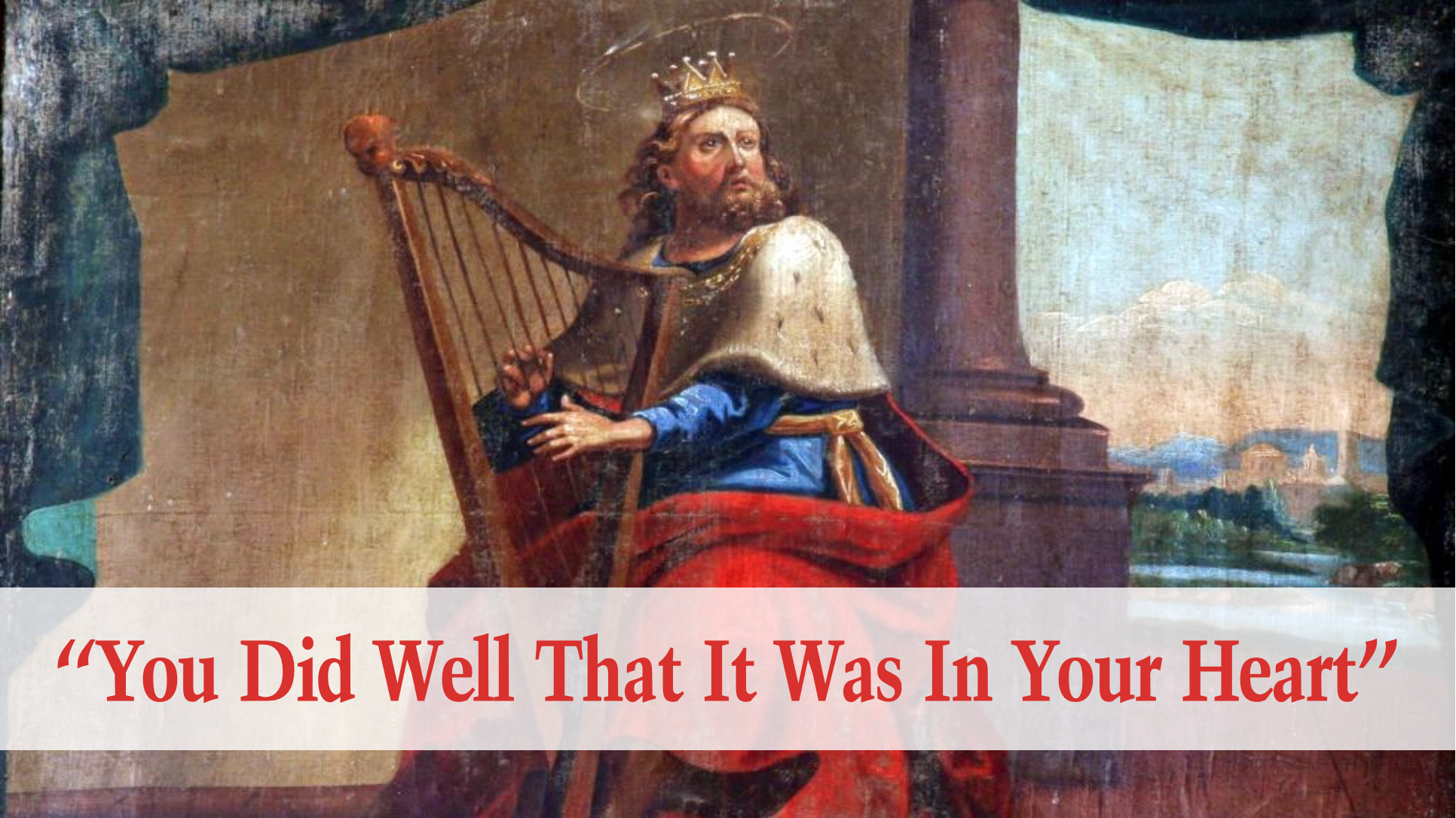
“You Did Well That It Was In Your Heart”

After the death of King Saul, there is a struggle between David and Saul’s son, Ish-bosheth, for the throne of Israel. With God’s support, David eventually wins out, things settle down, and everything seems to be okay.

But David isn’t happy. He isn’t happy because he realizes that while he lives in a nice, comfortable house made of cedar, the Ark of God is kept in a tent!

This doesn’t seem right to David, so he determines that he wants to build a temple for the Ark to be housed in. That sounds like a good idea, but God rejects his offer in 1 Chronicles 22.8-10:

“But the word of the Lord came to me, saying, ‘You have shed much blood and have waged great wars; you shall not build a house to My name, because you have shed so much blood on the earth before Me. Behold a son will be born to you, who shall be a man of rest; and I will give him rest from all his enemies on every side; for his name shall be Solomon, and I will give peace and quiet to Israel in his days. He shall build a house for My name, and he shall be My son and I will be his father; and I will establish the throne of his kingdom over Israel forever.’”

Later, Solomon talks about his father’s desire to build a temple for God in 1 Kings 8.17-19:

“Now it was in the heart of my father David to build a house for the name of the Lord, the God of Israel. But the Lord said to my father David, ‘Because it was in your heart to build a house for My name, you did well that it was in your heart. Nevertheless you shall not build the house, but your son who will be born to you, he will build the house for My name.’”

Did you catch that? God tells David, “You did well that it was in your heart.”

Even though David wasn’t going to be able to accomplish his goal of building the temple, God still appreciated and honored David’s intentions. Because he had been a man of war, David was told that he would not be the one to build a temple for the Lord—but God still appreciated that David had the desire to do so.

“It’s the thought that counts” is a common saying that we tend to throw around when we receive a gift we don’t like. It’s somewhat of an ironic saying since often the reason we receive bad gifts is specifically because very little thought was put into it, but I think it’s still a true statement, and it’s basically what God tells David in this story: “It’s the thought that counts.”

By extension, this passage means that God cares about our intentions as well. And to me, as a Christian and as a minister, that is incredibly encouraging—while our actions certainly matter, the thoughts behind our actions matter as well. We can’t always control how things turn out, but we can control our intentions.

When we try to do something big for God, as David did, and we fail and our plans don’t pan out, I’m thankful to know that we have a God who says, “You did well that it was in your heart!”

I don’t know what your exact situation is…

  • Maybe you try to help a friend with a problem like substance abuse or financial or marital difficulties, but your assistance is refused…God looks at your “failure” and says, “You did well that it was in your heart!”
  • Maybe you try to influence others for good and try to be salt and light in the world, but your influence is ignored and they continue to embrace darkness…You did well that it was in your heart!
  • Maybe you’re a youth minister and you’ve got that teen who you’ve poured yourself into— teaching, going to athletic events, modeling the Christian life, praying for them and lying awake at night worrying about them—but they choose to follow the world…You did well that it was in your heart!
  • Maybe you try to share your faith with someone, perhaps a family member or close friend, but it simply falls on deaf ears…You did well that it was in your heart!

Realize that you are going to fail in life. Your results won’t always match up with your intentions and your plans. But our God is someone who sees our hearts and appreciates our best efforts. With that in mind, let us attempt great things for Him!

Influence and…Faux Hawks

The Idolatry of Solomon, by Franz Francken II, 1622
Influence is a powerful force—both the influence that we have on other people and the influence that others have on us. This is by no means a new or ground-breaking statement, but it is an idea that was hammered home to me last night in an unusual way.
I was standing in front of the bathroom mirror after taking a shower, when I realized that the way my hair was laying pretty closely resembled a faux hawk. And here’s the shocking part: I caught myself thinking, “You know, that really doesn’t look too bad.” This completely blew me away, because when faux hawks first became popular a couple of years ago, I thought they were irredeemably stupid. I don’t ever remember consciously changing my opinion on the matter, but apparently, seeing one faux hawk after another for the last couple of years gradually influenced me to think of it as a normal and acceptable haircut (Don’t worry, I have since returned to my senses and there is no danger that you will see me sporting a faux hawk—ever.).
This shocking event illustrates an important point about influence—you can gradually, subtly be influenced to completely change the way you think about a certain behavior, practice, or way of life, and it can happen without you even realizing it. Sometimes you might change your mind about something relatively innocent or unimportant (like a hairstyle), but influence can also change us in much more significant (and sometimes negative) ways.
I’m currently reading a book called Sticky Faith, which addresses the alarming rate at which Christian teenagers tend to drop out of the church about the time they graduate from high school. There are a lot of reasons why this happens, but a major one is influence—when teens leave home and move off to college, they are largely freed from the greatest influence in their lives (parents), and are especially susceptible to new influences that they encounter. Often, these new and different influences push them to places where they never thought they would end up—most faithful Christian teenagers don’t plan to go to college, drop out of church, and become involved in a lifestyle of binge-drinking and sexual promiscuity, but it happens as they are influenced to change the way they look at things and to fit in with their surroundings.
Although this phenomenon always seems to be surprising to youth ministers and parents when they witness it in individual cases, it’s really shouldn’t surprise us at all, because the Bible explicitly teaches us that the influences of others can lead us to sin:
  • King Solomon was influenced by his foreign wives and concubines to turn away from following God and build places of worship to idols instead (1 Kings 11.1-13).
  • Herod’s stepdaughter was influenced by her mother to ask that John the Baptist be beheaded (Matthew 14.1-12).
  • In Galatians 2.11-21, Paul describes how certain men had influenced Peter and Barnabas to withdraw from fellowshipping with Gentiles.
  • In 1 Corinthians 15.33, Paul comes right out and says, “Do not be deceived: ‘Bad company ruins good morals.’”
The good news is that influence works both ways—good influences have a lot of power as well:
  • “You are the light of the world. A city set on a hill cannot be hidden. Nor do people light a lamp and put it under a basket, but on a stand, and it gives light to all in the house. In the same way, let your light shine before others, so that they may see your good works and give glory to your Father who is in heaven.” (Matthew 5.13-16)
  • “Let no one despise you for your youth, but set the believers an example in speech, in conduct, in love, in faith, in purity.” (1 Timothy 4.12)
  • “Keep your conduct among the Gentiles honorable, so that when they speak against you as evildoers, they may see your good deeds and glorify God on the day of visitation.” (1 Peter 2.12)
Ultimately, when talking about influence, I think it all boils down to a couple of important points:
(1) All of us are susceptible to outside influences, so it is important that we monitor those influences closely. What kind of people do you surround yourself with? What music do you listen to? What movies or TV shows do you watch? If you are a parent, answer those same questions about your children. Don’t be naive—if you surround yourself with bad influences, no matter who you are, they are affecting you negatively.
(2) All of us influence others as well, so it is important that we are aware of the kind of example we are setting. You never know who might be watching you and who might be influenced by what you do. As a youth minister I do a lot of things, but I have long thought that the most important thing I can do is to be a good example of Christian living for the young people I minister to. Certainly I don’t always succeed, but I always try to be aware that I am broadcasting an influence—for good or bad— at all times.

Moderation


In Ecclesiastes 7.16-18, Solomon writes:

“Do not be overrighteous, neither be overwise—why destroy yourself? Do not be overwicked, and do not be a fool—why die before your time? It is good to grasp the one and not let go of the other. The man who fears God will avoid all extremes.”

Those verses come in the context of a longer passage on wisdom, and Solomon suggests that avoiding extremes is a wise thing to do.

Generally speaking, I consider myself to be a moderate sort of guy.

Politically, there are a few issues that I am very, very conservative on, but for the most part, I’m not dead-set on a lot of things and can see both sides of a lot of issues.

Religiously, in the broad spectrum of Christianity, I would certainly be considered conservative, but in my specific religious fellowship, I’m pretty much in the middle (in the past, I would’ve thought I was pretty conservative, but over the last few years, I’ve come into contact with more and more people who have verified my middle-of-the-road-ness).

I say all that to say this: the problem with moderation is that when you’re in the middle, you have to deal with the people on both extremes.

It can be a frustrating endeavor.

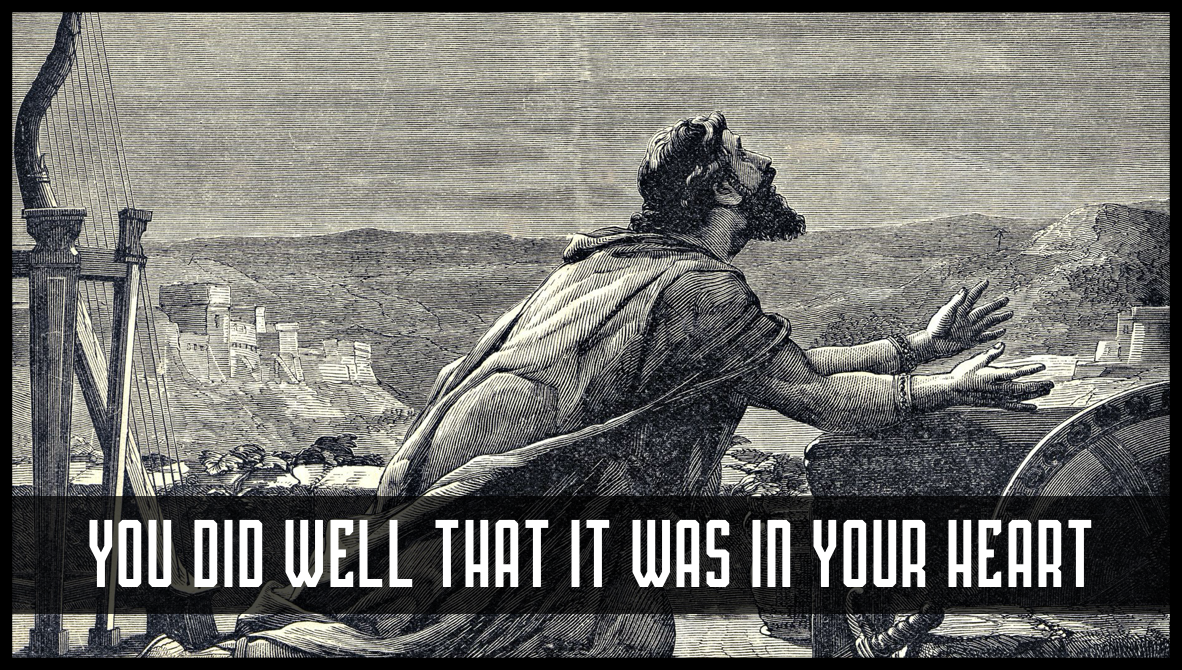
“You Did Well That It Was In Your Heart”

After the death of King Saul, there is a struggle between David and Saul’s son, Ish-bosheth, for the throne of Israel. With God’s support, David eventually wins out, things settle down, and everything seems to be okay.

But David isn’t happy. He isn’t happy because he realizes that while he lives in a nice, comfortable house made of cedar, the Ark of God is kept in a tent!

This doesn’t seem right to David, so he determines that he wants to build a temple for the Ark to be housed in. That sounds like a good idea, but God rejects his offer in 1 Chronicles 22.8-10:

“But the word of the Lord came to me, saying, ‘You have shed much blood and have waged great wars; you shall not build a house to My name, because you have shed so much blood on the earth before Me. Behold a son will be born to you, who shall be a man of rest; and I will give him rest from all his enemies on every side; for his name shall be Solomon, and I will give peace and quiet to Israel in his days. He shall build a house for My name, and he shall be My son and I will be his father; and I will establish the throne of his kingdom over Israel forever.’”

Later, Solomon talks about his father’s desire to build a temple for God in 1 Kings 8.17-19:

“Now it was in the heart of my father David to build a house for the name of the Lord, the God of Israel. But the Lord said to my father David, ‘Because it was in your heart to build a house for My name, you did well that it was in your heart. Nevertheless you shall not build the house, but your son who will be born to you, he will build the house for My name.’”

Because he had been a man of war, David was told that he would not be the one to build a temple for the Lord—but God still appreciated that David had the desire to do so.

“It’s the thought that counts” is a common saying that we tend to throw around when we receive a gift we don’t like. It’s somewhat of an ironic saying, since often the reason we receive bad gifts is specifically because very little thought was put into it, but I think it’s still a true statement, and it’s basically what God tells David in this story.

While our actions certainly matter, the thoughts behind our actions matter as well. We can’t always control how things turn out, but we can control our intentions.

When we decide to try to do something good, even if it doesn’t work out the way we plan, it’s still important that we try.

If you try to help a friend with a problem, but your assistance is refused…

If you try to influence others for good, but your example is ignored…

If you share your faith with someone, but it falls on deaf ears…

Whatever the circumstance, it’s still important that you try.

“You did well that it was in your heart…”

© 2026 The Doc File

Theme by Anders Noren — Up ↑