As humans, we are constantly being influenced—or discipled—by the content and messaging we take in. That is true for all of us: children, teens, and adults.
A metaphor I have been using recently to help reflect on this reality is the idea of two volume controls. You might imagine that one volume control is labeled “God,” and this is the control that channels God’s truth into our lives. We turn up the God volume in our lives when we engage in practices like reading Scripture, praying, worshipping, spending time with Christian mentors and examples, reading thoughtful Christian books and listening to Christian music, and spending time in creation. The other volume control is labeled “World,” and this is the control that either distracts us from God or distorts our Christian worldview. This content may or may not be bad in and of itself, but it doesn’t help us align our lives with God’s mission.
The tension between these two volume controls has always existed, but a particular challenge in our current context is that the World control is turned up so loud—the messaging infiltrates our lives at every turn because of the ubiquity and constant connectivity of digital technology. By default, if you don’t take steps to prevent this, the God volume will tend to be low, while the World volume will be very high. Disciples of Jesus need to be thoughtful and intentional about how to reverse this—we cannot allow ourselves to float along in the current of the mighty stream of culture with the World volume blaring all along the way.
What this means for most of us is probably a combination of turning down the World volume and turning up the God volume. The former task—turning down the volume of the World—is essential. Depending on who you are, that may look like:
- Watching and listening to less of the political content that makes your heart anxious and makes you suspicious of your neighbors.
- Spending less time doomscrolling on social media and allowing algorithms to plan the trajectory of your thoughts and attention.
- Cutting out music and shows in your life that promote behaviors and worldviews that are incompatible with Christianity.
- Lowering the importance of things that are not necessarily bad—like devotion to a sports team—on the priority list of your life.
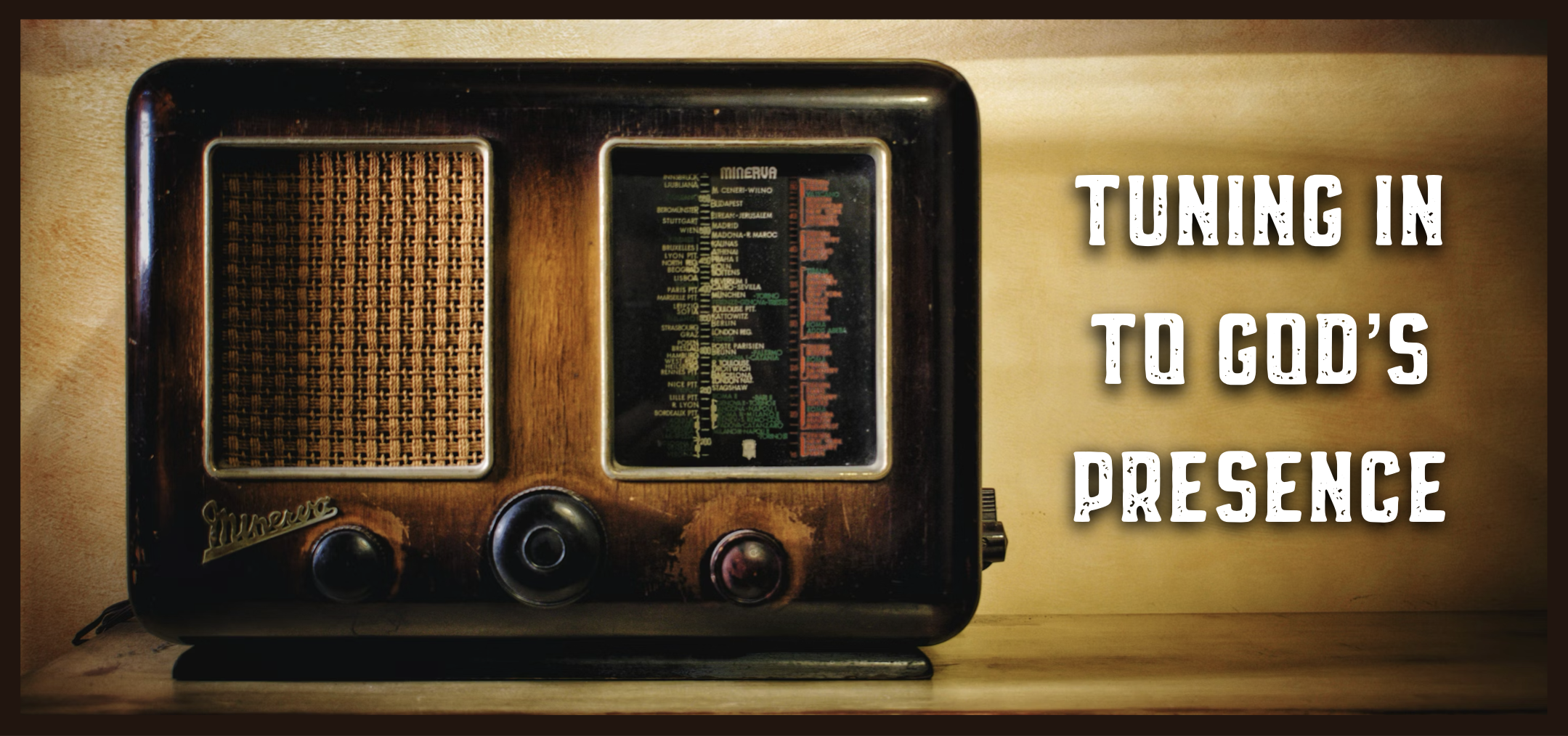
As you reflect on your own life, you probably have some specific ideas of how you might do this, and I encourage you to spend some time working on turning the World volume down. But that’s not actually the point of this post; instead, I want to reflect a bit on turning up the God volume, or to mix metaphors just a bit, tuning in to God’s presence.
I am in my 20th year of congregational ministry, and it may not surprise you to hear that, in many ways, the God volume has generally been pretty loud in my life. I spend quite a bit of time reading Scripture, teaching Bible classes, spending time with other believers, and having conversations about faith. But it is also true that many of those activities, while good, can easily trend toward the intellectual side of faith. I naturally gravitate toward learning and thinking, and there is nothing wrong with that, but following Jesus is ultimately relational, and staying firmly planted on the intellectual side of things is to miss a significant part of the picture.
With all that in mind, in 2026, I wanted to more intentionally tune in to God’s presence. Not just to know more about God, but to know Him better, and to approach this goal through repeated spiritual rhythms. Here are three practices that have become a significant part of my life this year.
Morning Renewal
Early in the year when I was at NCYM, I went to a session led by Dr. Jeremy Smith and Dr. Brandon Fredenburg from the Vocati Program, which is essentially a summer retreat for teens that leans heavily into spiritual practices. In this session, we learned a Morning Renewal, a daily prayer to be said (ideally) right when you wake up.
I have adapted their prayer slightly for my own use:
O LORD, open my lips, and my mouth will proclaim Your praise.
Open my ears to hear Your voice.
Open my eyes to see Your works.
Open my hands to wield Your strength.
Open my heart to embrace Your world.Father God, you are here. Lord Jesus, you are here. Holy Spirit, you are here. And I am here.
I breathe today as one dead to sin and alive to God in Christ Jesus. I am here to do your will, O God.
For you are our compassionate, gracious God, slow to anger, abounding in steadfast love and faithfulness to all created things, in all ways, at all times.
Glory be to the Father, and to the Son, and to the Holy Spirit. As it was in the beginning, is now, and forever shall be—worlds without end. Amen.
Remembering to say this prayer first thing in the morning is still a work in progress for me, but I do say it most days early in the day, and it has been a helpful practice:
- It starts my day by orienting my mind toward God and what He has already prepared for me to do.
- It reminds me that God is already present in my life and in my world; I don’t have to seek Him out as much as I just need to pay attention.
- It is a pledge that my purpose in life is to do God’s will.
- It reminds me of the gracious character of the God I serve.
Beginning the day with the Morning Renewal helps me to start the day with purpose, encouragement, and determination.
Daily Remembrances
In early 2025 at the Harding Youth Ministers Workshop, I heard an excellent presentation on summer internships by Justin Hammond.[1] Although it wasn’t the main point of the presentation, Justin shared that he had written a “Personal Manifesto” of important truths that he needs to remember that he reads to himself every day. He has the student interns he works with engage in the same practice.
Inspired by this, I decided to make my own list. I call it my “Daily Remembrances,” and each day when I am in the office, I pray through the list. Here is my current list, with some comment/explanation:
- Every day is a gift. I firmly believe that this statement is at the core of a contented life. My life is not a right; it is a gift. I need to remember to begin each day with gratitude and with wonder that I have been given another day to make the most of.
- God is a generous giver. He has given me enough time, money, energy, and resources to accomplish what is needed. I have a busy life with a lot of accumulated responsibilities. I am inclined toward fatigue and anxiousness, concerned that I will never be able to do everything I need to do. However, I firmly believe that God is a generous Father, and because of that, I need to remember to live out of an abundance mindset rather than a scarcity mindset: God has given me what I need in order to accomplish what He wants me to do. It is enough.
- It is a tremendous privilege to work with teens and point them toward Jesus. I have been a youth minister for 20 years. Sometimes, it can become routine. Sometimes, my students can get on my nerves and I can be cranky with them. Sometimes, I just want to do something else. I need to remember what a blessing and honor it is to do what I get to do.
- I will choose to be positive and grateful rather than negative and complaining. People who know me well can tell you that I tend to fall on the pessimistic side. Being a negative complainer accomplishes nothing and benefits no one. It discourages others and saps my own resilience. I need to remember that when I am positive and grateful, I lighten the loads of those around me and foster contentment that allows for long-term sustainability.
- I will be a strong, gentle, and supportive husband and father. I am confident that I am not the only one who is often not at my best around those I love the most. Too often I am tired and stressed by other things which means I can be passive, cranky, and withdrawn with my family. I need to remember that God has given me the sacred duty of leading my family, and that it is my responsibility to love them like Jesus does.
- I will work hard AND value sabbath. I rarely need to be reminded to work hard; indeed, I am something of a workaholic (a familial trait). Sabbath is more of a struggle for me, however. I need to remember that sabbath is a gift and a commandment from God, and that I will do my work better and longer if I rest sufficiently.
- God is good regardless of my emotions or circumstances in the moment. I am so limited in my perspective, bound by time and hostage to the emotions of the moment. Wrapped up in my own problems and my inability to perceive reality, sometimes God seems distant, arbitrary, or uncaring. I need to remember that God’s goodness is not dependent upon my emotional status, but is revealed in His faithful love throughout history.
- Because of the resurrection of Christ, my labor is not in vain. Sometimes, I feel like a failure. My best efforts don’t seem to amount to much. Others seem to be so much more effective than I am. I want to give up. I need to remember Paul’s assurance that the resurrection of Christ has fundamentally altered the operating principles of the universe and that everything I do for Him always matters.
When I remember these truths, it transforms the trajectory of my day, making me more intentional, more resilient, more grateful, more content, and more loving.
Monthly Psalter
I mentioned earlier that Bible reading has generally been a big part of my life. Despite that, I have to confess that the reading of Psalms has been more peripheral. Of course, I had read through Psalms many times, but I never felt that I really appreciated the Psalms. And more than that, I felt that I was the worse for it—there was something I was missing out on until I improved my relationship with the Psalms.
So, this year I determined to change that. I purchased a nice, leather-bound Psalter and then began following a daily reading plan that goes through all 150 psalms each month. As I write this in late July, I have read through the Psalms six times so far this year and am nearing completion of a seventh, and I think I now have enough of a vantage point to say that this has been a deeply formative practice:
- First, I generally read from Psalms in the morning and evening, and this has been an excellent way to bracket my day. The combination of the Morning Renewal, Daily Remembrances, and reading from Psalms has been such a significant way to “turn up the God volume” at the start of my day in a way that lingers throughout.
- Second, it has helped me to greatly grow in the language of praise. It seems obvious to say that Christians should be good at praising God, but the reality is that this has been an area of needed growth for me for a long time, and the practice of reading through the Psalms over and over again has helped with this.
- Third, the Psalms is a deep wellspring of biblical wisdom, and it’s like I am getting continual injections of a needed supplement in my life. I am constantly reminded of the goodness of God and His Word, the brevity of my life, and the necessity of turning over all vengeance and negative feelings to God.
- Fourth, and perhaps most simply, I like the Psalms now. I don’t have all of the Psalms memorized or anything like that, but many of them have become like old friends that I look forward to seeing again on the next read-through.
I’m not saying I will read through the Psalter every month for the rest of my life, but I do intend to continue the practice of regularly and repeatedly reading through the Psalms. I’ve simply seen too many benefits to stop.
I don’t want to give the impression that I have now spiritually arrived and that if you will follow the three life hacks I have outlined above, you, too, can become as spiritually advanced as I am! Far from it. I still have a long way to go, and by God’s grace, His Spirit will work within me to continue to transform me into the person He wants me to be. But these simple, repeatable practices have helped me to tune in to the presence of God in my life, and to orient myself to His purposes. My hope is that you will find something here to benefit your life of discipleship as well.
[1] Justin Hammond, “Purposeful Summer Internships,” presentation at the 2025 Youth Ministers Workshop, Harding University Center for Ministry, January 31, 2025, https://scholarworks.harding.edu/youth-conf/3