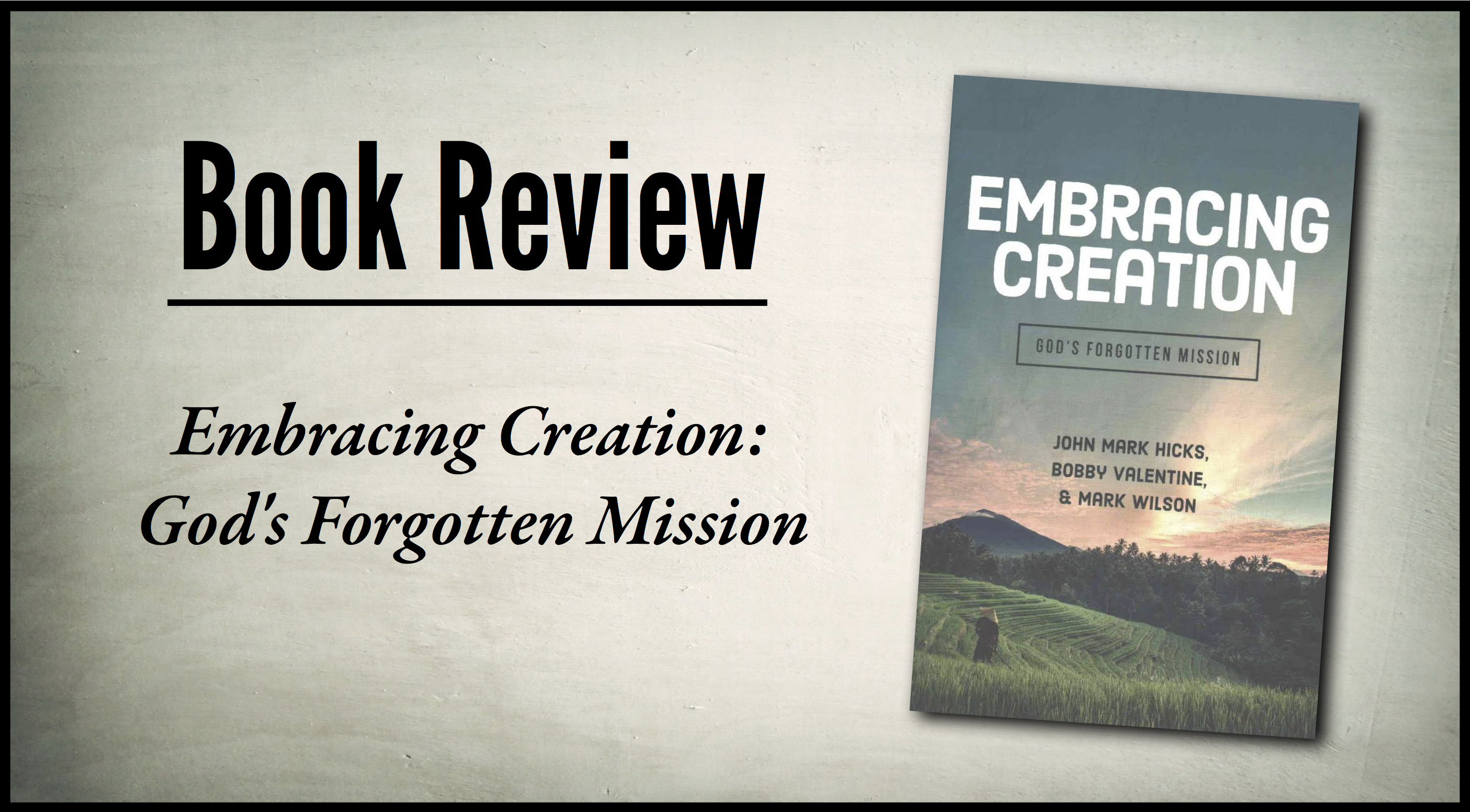
At the end of December, I finished one of the better books I read in 2016: Embracing Creation: God’s Forgotten Mission, by John Mark Hicks, Bobby Valentine, and Mark Wilson. Dr. Hicks is a former professor of mine, and I “know” Bobby through social media. Both men have written much that has challenged me, and I have been blessed by their thoughts on the Stone-Campbell Restoration Movement (Hicks and Valentine), suffering and the problem of evil (Hicks), and the “Jewishness” of Christianity (Valentine). I had not previously read anything by Wilson.
I will go ahead and jump to my overall conclusion and recommendation: this is an important book, deserving of a wide readership (especially within Churches of Christ, which is the primary intended audience). Although Embracing Creation is more complex than I am indicating here, it largely comes down to two significant arguments, which are both based on the biblical reality that God cares deeply about what He has created.
First, humans are to reflect God’s care and concern for creation, and should practice thoughtful stewardship of our planet. Truly, this should not be a controversial claim, but because conversations surrounding care for the environment are frequently hijacked for political purposes, it often is made out to be controversial. Embracing Creation does not argue for a godless environmentalism that holds up nature as something to be worshipped; it does encourage a deep, biblical care for a creation that God calls good, but has been too often treated as expendable and unimportant by humans.
Second, God does not intend that His creation be destroyed, but will redeem and recreate it, and will dwell with creation in the New Heavens and New Earth. This will also be a controversial claim for many, but again, it need not be.* Hicks, Valentine, and Wilson argue (and effectively, in my opinion) that the notion of an annihilated and completely destroyed earth and an eternal existence for God’s saints in an other-worldly heaven is actually a fairly modern notion, and does not reflect the biblical text, the belief of the early church, or the beliefs of pioneers in the Stone-Campbell Restoration Movement. Instead, these witnesses all point to a redeemed earth, which will be refined and recreated in a way that is analogous to our own resurrection bodies, and will serve as the location of our joyous eternal existence with God. Three texts which are generally brought up to refute this perspective—John 14.2-3, 2 Peter 3.6-7,13; 1 Thessalonians 4.16-17—are all addressed (and quite adequately, I thought).
Here are some of my favorite quotations from the book:
Creation does not belong to human beings. It belongs to God, and it is the Messiah’s inheritance. We are only stewards and junior partners, though we are coheirs with Christ. (16)
Too often we hear “dominion” in tyrannical, oppressive, militaristic, or manipulative ways, but this is not how God rules. As images of God, we rule in the likeness of God. (39)
Above all, Psalm 104 reveals an astounding truth: creation, animate and inanimate, is the object of divine love. If God, like an artist, dotes so tenderly over it, then should not those created in God’s image reflect the same divine delight, love, and care for creation? (53)
The resurrection of Jesus, then, is the pledge of a future harvest, a preview of coming attractions. It is God’s answer to creation’s lament. (91)
Though chaos remains in the old creation, chaos will disappear in the new. (130)
God’s promise is “See, I am making all things new” (Rev. 21:5). The text does not say that God will make new things. Rather, God will make all things new. This is restoration, healing, and renewal. (131)
Creation is intrinsically good, and this goodness is not based on its utility for humans. (139)
On one level, it does not matter if “global warming” is real or imagined, caused by nature or humans. Caring for God’s good world is a matter of obedience and discipleship…If the Father is mindful of the death of even a single sparrow (Matt. 10:29), then we, who reflect the divine image, will care as well. (140)
Scripture never says heaven, separated from the earth, is the eternal destiny of the redeemed. Forecasting a doomed earth and an eternal celestial abode can result in an escapist outlook that hunkers down until we “fly away,” diminishing support for creation stewardship. (166)
Before closing, there were a couple areas of the book which I thought were weaknesses. First, I think Embracing Creation is a very challenging read for the average Christian. I have spent years (and years!) in grad school reading books on Scripture, theology, and ministry on a regular basis, and felt right at home with this work, but I found myself wondering how well I would have followed it if I had read it as a young minister before I had any sort of seminary training. Now, the exact intended audience of the book is never stated directly (that I can remember), but because I feel the two main points described above are so important and so often neglected, I wish the book would have been written at a somewhat simpler level to make it more accessible.
Second, there is an intriguing chapter at the end of the book entitled, “God’s Restoration Movement: Revisioning the Restoration Plea.” This chapter will be of special interest for readers from Churches of Christ (or other branches of the Stone-Campbell Restoration Movement), and basically argues that we should view the concept of Restoration not as a return to the practice and beliefs of the first century church (i.e., a look back to restore the church), but rather, a working towards the time when God will come and redeem all of creation (i.e., a look ahead to restore the entire cosmos). This is a thought-provoking proposal, but ultimately, I think it presents an either/or dichotomy which is not necessary: can we not be a people who seek to follow the basic design, practice, and spirit of the early church while also eagerly anticipating and working toward the day when God will make all things new? Interestingly, throughout Embracing Creation, early Restoration pioneers such as Alexander Campbell, Walter Scott, and David Lipscomb are quoted as men who understood God’s plan of Restoration for all creation, and yet they still held to the idea of Restoration as we have typically conceived and discussed it. Can we not do the same?
With these gentle critiques in mind, the fact remains that Embracing Creation is a compelling and important book. It is a book that not everyone will agree with, but perhaps for that reason alone, it should be read by many people. And as I described above, I think its two main points are scripturally spot-on, and their understanding is greatly needed in the church today.
*Some will hear this and associate it with some version of Premillennialism or Jehovah’s Witness eschatology. What Embracing Creation proposes has nothing to do with either.