
O Lord, how long shall I cry for help, and you will not hear?
Or cry to you “Violence!” and you will not save?
Why do you make me see iniquity, and why do you idly look at wrong?
Destruction and violence are before me; strife and contention arise.
So the law is paralyzed, and justice never goes forth.
For the wicked surround the righteous; so justice goes forth perverted.”
(Habakkuk 1.2-4, ESV)
Tucked away near the end of the Old Testament is the Book of Habakkuk. Habakkuk appears as a prophet who speaks to God for the people, rather than a prophet who speaks for God to the people. Habakkuk voices his lament—his call of frustration and despair—to God, on behalf of his people.
We don’t know much about Habakkuk. We know he lived and worked during the reign of the wicked King Jehoiakim in the last days of the kingdom of Judah. Judah had prospered during the reign of the righteous King Josiah, but Josiah was killed in battle, and his son Jehoiakim did not follow in his footsteps.
Instead, Jehoiakim was one of the most godless, selfish, and tyrannical kings ever to rule over Judah. We can actually learn quite a bit about Jehoiakim’s reign from the Book of Jeremiah, as Jeremiah also prophesied in Judah at this time. From that book, we know that Jehoiakim’s reign was characterized by violence and injustice (Jeremiah 22.13-17). People were not treated fairly and the wealthy took advantage of those who were less fortunate. We also know that Jehoiakim was antagonistic toward God’s prophets who tried to direct him to a better path. Jehoiakim ordered the death of the prophet Uriah (Jeremiah 20.20-24) and refused to listen to the warnings of Jeremiah, even burning one of his scrolls (Jeremiah 36).
The Book of Habakkuk dates to approximately 610-605 B.C. Around this time, Nebuchadnezzar had defeated the combined forces of Egypt and Assyria at the Battle of Carchemesh and asserted Babylon as the dominant world power. The threat of Babylon lay like a shadow over the land of Palestine.
And it is in this context that the prophet Habakkuk speaks out. In agony, Habakkuk looked around at a struggling and imperfect world filled with heartbreak and suffering and violence and injustice and he cried out, “Don’t you care, Lord? Why do You let this go on?”
Yahweh was the God who made a covenant with Abraham and his descendants and who taught them what justice and righteousness was, and it is to Him who Habakkuk cries out because of the injustice and unrighteousness he saw surrounding him. As he struggled to make sense of it all, he lamented to God.
With a little reflection, I think we can see how Habakkuk’s ancient questions are also modern questions which are very relevant to us.
The stories on the news unsettle us. They remind us not of how far we have come, but of how far we still have to go. They remind us of a great racial divide that exists in our country between black and white.
The stories are not the same, but they have similarities: black men dying at the hands of white police officers following some sort of run-in with the law. Sometimes those officers are not indicted for their actions, and unhappy citizens take to the streets and protests and riots occur. We have heard the names of Michael Brown, Eric Garner, Walter Scott, and Freddie Gray. We have seen the footage of protests in places like New York City and South Carolina, and riots in Ferguson and Baltimore.
I claim neither the knowledge of the facts of these specific cases nor the sufficient wisdom to know whose fault it was in each case, or where or how much blame should be placed. It is hard for me to know if justice has been served or not.
It is a delicate situation:
- I don’t want to condemn police officers. Law enforcement officials fulfill a vital role in our society, and the vast majority of them selflessly do a good job. That doesn’t change the fact, however, that we clearly have some officers who exercise very poor judgment with tragic results.
- I don’t want to excuse the behavior of those who, when confronted by an officer, resist arrest or run away or attempt to fight back. Neither do I believe, though, that such behavior should merit an immediate death sentence.
- I don’t want to excuse violent protests and rioting in the streets. Neither do I want to suggest that there is nothing to protest and be upset about.
Regardless of whether or not justice was served in these individual cases, I do know that injustice exists in our country. I know that African Americans are incarcerated in this country at a much higher rate than Caucasians. I know that African Americans are more likely to experience poverty, and that there is a high correlation between poverty and crime. Thus, African Americans are also more likely to be involved in and to be victims of violent crime than are their white counterparts. That is unjust.
Further, I know that many black people have no trust in this nation’s justice system, nor in the officers who are supposed to uphold the laws of this country and protect its citizens. The statistics suggest that there is some reason to be concerned about this, and yet, I also know that there are many white people who refuse to even consider that there might be some validity to these concerns and conclusions.
And I know that in many environments, whether on talk shows, or social media, or in churches, or amongst friends, we are unable to even discuss these issues in a productive fashion because the divide is so great.
And in the midst of it all, I don’t know what to do other than to cry out to God, with language similar to Habakkuk’s…
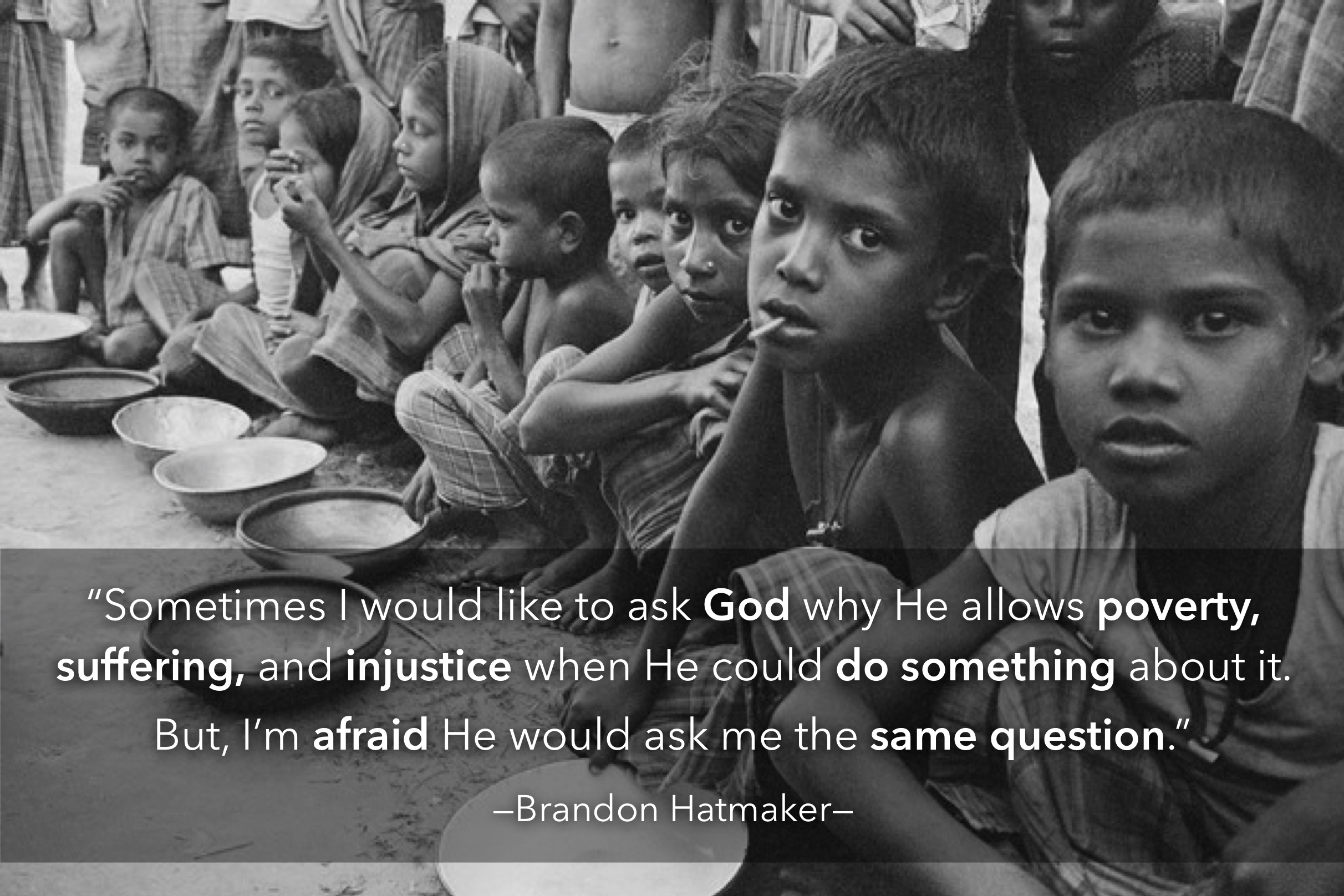
Violence abounds in our society, in our world. It seems that destruction and violence are ever before us. When we cry “Violence!”, God, why do you not save?
The very systems we put in place to uphold order and limit violence seem to fail us. At times, it seems that the law is, in fact, paralyzed, and that justice never goes forth. Instead, justice is perverted.
God responds to Habbakuk. He doesn’t rebuke Habakkuk for his questions or frustrations. God is bigger than our emotions or our questions; He desires that we bring these before Him.
But God does respond (Habakkuk 1.5-11). Indeed, God is aware of all that is going on. He has seen the injustice and oppression, and He is going to act: He will use the Babylonians to punish Judah for their wickedness.
This revelation prompts additional lament from Habakkuk, who doesn’t understand why God would punish evil Judah with the even-more-evil Babylonians (Habakkuk 1.12-2.1). Those who were to be punished were more righteous than the ones who were to do the punishing!
God assures Habakkuk that He is in control of these events, and that the Babylonians will also be punished in time (Habakkuk 2.2-20).
The Book of Habakkuk concludes with a prayer of Habakkuk’s confident trust in God (Habakkuk 3.1-19). He has unburdened his heart and turned his doubts and fears over to God, he has heard God’s response, and now he expresses confidence that God will act, and bring about what is best.
While there are no easy answers, the Book of Habakkuk helps us to think more clearly about the problems and injustices in our own society.
(1) As we look around and see these heartbreaking tragedies and we are reminded of the inequities of our society, we cannot claim specific knowledge for why God allows these things to continue. But Habakkuk reminds us that God sees these things, and that He is sovereign over them. As people of faith, we trust in that sovereignty. We know that God is in control of the world, and that He works in all situations—even terrible ones—to bring about His good purposes.
(2) Also, Habakkuk and the other Old Testament prophets remind us to consider our own place in society: If destruction and violence are all around us, to what degree do we allow those things to continue? If the law is paralyzed and justice never goes forth, to what degree are we responsible for that paralysis and injustice? In the words of Dietrich Bonhoeffer, “Silence in the face of evil is itself evil: God will not hold us guiltless. Not to speak is to speak. Not to act is to act.” If the evidence suggests that an entire subset of our population is suffering injustice and we, in our privilege, refuse to work to address the problem or even acknowledge that there is a problem, we become complicit in it.
(3) And finally, Habakkuk reminds us of the appropriateness of lament. It is right for us to be distressed, and to bring that distress before God. In His sovereignty, He is the one who can do something about it. And while we lament, we yearn for a day when justice will roll down like waters, righteousness like an ever-flowing stream, and when God shall wipe every tear from our eyes.

 Tweet This







