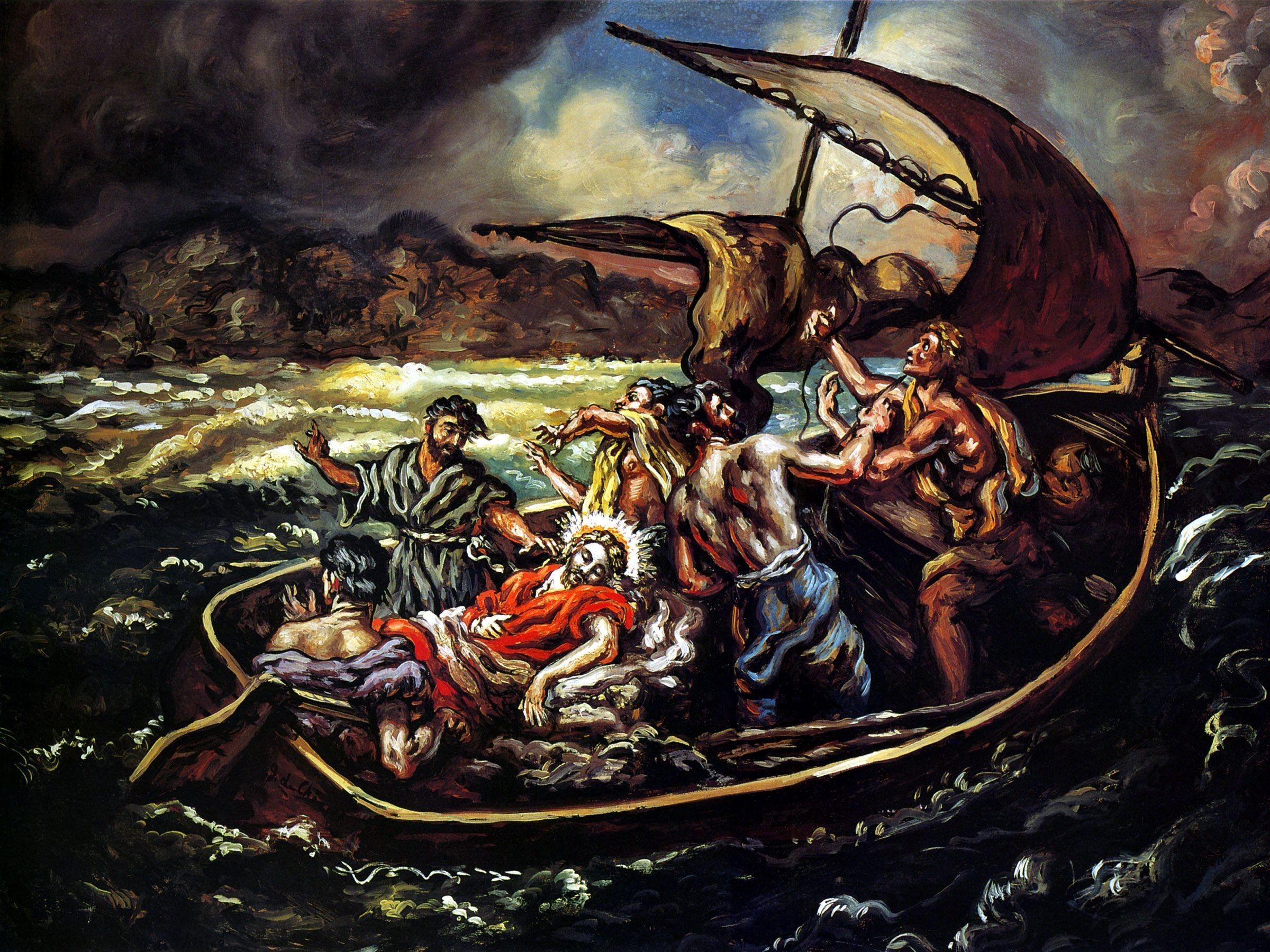
This is an adapted version of a sermon a preached this past Sunday. Happy Thanksgiving!
Thanksgiving is one of my favorite holidays of the year. I enjoy spending time with family, and I enjoy the good food that you get to eat at Thanksgiving. I’m also a big fan of Christmas, and to me, Thanksgiving always kicks off the Christmas season, so I like that about it too.
But most of all, as a Christian and a minister, I really appreciate that we have this time built into our yearly rhythm where we are encouraged to stop, reflect, and give thanks for what we have. That is an incredibly biblical thing to do. Thanksgiving is the basic response that God’s people should have in light of what God has done, and although this may be something that we lose sight of at times, this holiday, anchored on our calendars, helps remind us of this action which is central to our lives as followers of Jesus.
This particular Thanksgiving meditation comes from a somewhat unusual source: the Book of Ecclesiastes. I say “somewhat unusual” because the Book of Ecclesiastes is not something we focus on too much. Many people have a quotation from Ecclesiastes that they like, but they don’t really study the book in detail. A big part of this, I think, is that a lot of people think that the Book of Ecclesiastes is really depressing! Many people (including biblical scholars) suggest that Ecclesiastes has a very pessimistic view on life.
I disagree with that, though; I don’t think Ecclesiastes is pessimistic, I just think that it is very realistic. My wife would laugh to hear me say this, because all the time she tells me that I am a pessimist, and I disagree and say that I am a realist. I am just very aware that the world is broken, that people are deeply flawed, that we tend to get let down a lot, and that there is a lot of disappointment in life. I don’t always walk around with a scowl on my face or imagine the worst possible outcome of every situation, but I acknowledge that there are a lot of things that happen in life that are out of our control, that we don’t understand, and that we wish didn’t happen. And I think that is exactly how the author of Ecclesiastes looks at the world. I love Ecclesiastes.
And in this very realistic book, I think we are given a great perspective on Thanksgiving.
Real Talk About Money
I want to look specifically at the last half of Ecclesiastes 5, but to give a little bit of context, Ecclesiastes starts off with the author (who calls himself the Teacher or Preacher depending on your translation) saying that life is vanity, like chasing after the wind. And what he means by this is not that life has no meaning, but that life is brief and it’s hard to grasp, both literally and metaphorically—we don’t get to determine how long our lives are, and there are things about life that we simply can’t understand. It’s like trying to catch the wind or smoke.
And then the Teacher talks about all of these things in life that he sought after to find meaning, and he says that none of it lasts. We could say more, but that’s sufficient to give us an idea of what is going on in Ecclesiastes. Picking up in Ecclesiastes 5.10-17:
He who loves money will not be satisfied with money, nor he who loves wealth with his income; this also is vanity. When goods increase, they increase who eat them, and what advantage has their owner but to see them with his eyes? Sweet is the sleep of a laborer, whether he eats little or much, but the full stomach of the rich will not let him sleep.
There is a grievous evil that I have seen under the sun: riches were kept by their owner to his hurt, and those riches were lost in a bad venture. And he is father of a son, but he has nothing in his hand. As he came from his mother’s womb he shall go again, naked as he came, and shall take nothing for his toil that he may carry away in his hand. This also is a grievous evil: just as he came, so shall he go, and what gain is there to him who toils for the wind? Moreover, all his days he eats in darkness in much vexation and sickness and anger.
The Teacher begins by talking about money, and he has some important things to say about it. The harshest feedback I ever got from a sermon came once when I preached about money, but here’s the deal: the Bible talks about money all the time! The Law of Moses discusses it in detail, it is addressed repeatedly in wisdom literature (like Ecclesiastes), the prophets deal with the (mis)use of money, Jesus talks about it frequently, etc. If we want to be biblical, we will talk about money a lot—not because we worship it, but because we want to make sure that we don’t!
 Tweet This
From earlier chapters in Ecclesiastes, we know that the Teacher was incredibly wealthy. He knew all about what money could buy, and he said it was vanity—vapor, smoke. It doesn’t last, and therefore doesn’t provide real significance. Here he goes on to list some of the problems that can come with money: addiction (v.10), it attracts the greedy (v.11), it promotes worry and lack of sleep (v.12), it leads to hoarding (v.13), it can easily be lost (v.14), and it cannot follow us after death (vv.15-17).[1]
Here I am, thinking that things would be a lot better if I just made a little bit more, but the Teacher doesn’t seem to agree. What a downer!
I should be clear here that money is not inherently a bad thing, but Scripture has a lot to say about wealth that should make us very careful in how we view it. Money can very easily become bad for us. It can compete with God for our devotion, twist our hearts, and destroy our lives.
To combat that, we should consider our money and indeed, all of our material possessions, as being a loan from God. All that we have belongs to God, but He gives us our possessions so that we can use them for His glory. Therefore, we should take care of our money and be good stewards of it, but we should always remember that it isn’t really ours. This perspective will help us to not get too attached to our money, and also to look for ways we can use it which will glorify God.
Everything Is A Gift
If this sounds pessimistic (first, it’s not; it’s realistic!), keep reading in Ecclesiastes 5.18-20:
Behold, what I have seen to be good and fitting is to eat and drink and find enjoyment in all the toil with which one toils under the sun the few days of his life that God has given him, for this is his lot. Everyone also to whom God has given wealth and possessions and power to enjoy them, and to accept his lot and rejoice in his toil—this is the gift of God. For he will not much remember the days of his life because God keeps him occupied with joy in his heart.
Ecclesiastes 5 ends with a summary statement emphasizing the importance of enjoying the blessings that God has given us (cf. Ecclesiastes 2.24-26).
Work is a good thing; we were created to be workers. When God created Adam, He placed him in the garden and told him to tend and cultivate it. From the beginning, we were intended to be workers. Think about those who are disabled and cannot work, or those who need jobs to provide for their families but can’t find them; those are unfortunate situations. If you are able to work and have a job, that is a blessing. If you enjoy your work and enjoy the people you work with, that is an even greater blessing.
In Ecclesiastes, the Teacher doesn’t understand everything about life (and if you go through the book, he is very clear about the parts of life that don’t make sense to him), but he does know that work, food, and family are blessings—gifts—from the Lord and should be enjoyed as such.[2] It is incredibly important that we view these things as gifts rather than achievements; if we do so, it completely changes our perspective.
Gifts are not something that we deserve. They are something that we receive because of the gracious nature of the giver. When you think about things in terms of gifts, it really changes your perspective. And here’s the secret, according to the Teacher of Ecclesiastes: everything is a gift! Life—as confusing as it is, as filled with heartache as it can be—is a gift. Work is a gift. Our food, our families…all of it: gift. If we look at the things that we have as gifts, it changes everything.
These are blessings God bestows on us to enjoy, not objectives for us to obsessively strive after. There is a lot of joy to be found in living a simple life that is satisfied with meaningful work, sufficient food, and edifying relationships.[3]
Content No Matter What?
This is all tied very closely to the idea of contentment, and if you’ll allow me, I want to jump to the New Testament for a minute to say a few words about that idea.
Paul’s letter to the Philippians is a favorite for a lot of people; it is one of his more positive letters, despite the fact that he wrote it from prison. He begins it by sharing his thankfulness for the Christians at Philippi. As Paul contemplates the possibility of his impending execution, He speaks of his great concern for spreading the Gospel and how Christ is at the very center of his work and identity regardless of what happens to him. He talks about the humility of Jesus and how He serves as an example to us, how as followers of Christ we are to be lights in the world and seek the standard of Jesus.
And then as Paul is closing the letter and encouraging the Philippian Christians, he says this in 4.10-13:
I rejoiced in the Lord greatly that now at length you have revived your concern for me. You were indeed concerned for me, but you had no opportunity. Not that I am speaking of being in need, for I have learned in whatever situation I am to be content. I know how to be brought low, and I know how to abound. In any and every circumstance, I have learned the secret of facing plenty and hunger, abundance and need. I can do all things through Him who strengthens me.
I think contentment is less about what you have and more about your attitude of thankfulness toward what you have. Paul says that he has learned to be content in whatever circumstance he finds himself. That confirms to me that contentment is an internal quality rather than an external one; it does not depend on what is going on around us. Paul had a lot of difficulty in his life (he was beaten, imprisoned, scourged, left for dead, shipwrecked, etc.), but he was able to find contentment regardless.
This also helps us better understand what Paul means in his famous “I can do all things through Christ who gives me strength” quote. This verse gets taken out of context and abused a lot, but Paul isn’t talking here about passing an algebra test or getting a job promotion or winning a basketball game. Instead, what he means is that Jesus Christ empowers him to find contentment in all situations.
And to me (and to tie this back to Ecclesiastes), one of the simplest and most powerful ways of finding contentment in all situations is to remember that our blessings are a gift from God.
Our world is filled with people who are chasing after the standards and achievements of the world in some obsessive quest for significance. As Christians, though, we are not to live lives of hopeless desperation; we find our significance and our meaning in the God who gives us all things. Our identity and purpose is not based on achievement; it is based on gift from our Creator.
And that is a cause for great Thanksgiving.
[1]See Chad Landman, Wisdom for Life: 6 Weeks in Ecclesiastes (Hashtag Media, 2013), 18.
[2]Phillip McMillion, Wisdom Literature Class Lecture Notes (Memphis: Harding University Graduate School of Religion, Fall 2010).
[3]William P. Brown, Character In Crisis: A Fresh Approach to the Wisdom Literature of the Old Testament (Grand Rapids, MI: Eerdmans, 1996), 136.