The online journal of Luke Dockery

Category: Bible Study (Page 38 of 40)

What Language Study Has Taught Me About The Bible

I have written before about my (mis)adventures in the study of languages, and this semester is a continuation of that trend, as I am simultaneously taking my final Greek class and my first Hebrew class.

The two languages are different enough that, so far, I haven’t gotten them too mixed up in my head, but studying both at the same time has been difficult and has required a lot of my brainpower. Greek is now pretty familiar (this is my fourth class in it) and I actually enjoy working and translating it, but Hebrew is just so foreign that it has been a strain.

Having said all this, I am repeatedly struck by three significant lessons that I have learned from language study:

(1) We owe such a debt to those who have gone on before us and have translated the Scriptures into our own languages. Language study takes a lot of patience, diligence, and perseverance. Translating from one language to another is difficult, and is especially more difficult when you are translating from hard-to-read ancient texts. There was a time when the vast majority of church-going people were unable to read the Bible for themselves, and were completely reliant on what others told them about it. We are in such a position of privilege to be able to read Scripture in our own tongue, and to do so with a great degree of confidence that what we are reading is an accurate portrayal of the original.

(2) It is important to read from and consult multiple translations. As I mentioned above, translating from one language to another is difficult. Anyone who has engaged in the process knows that often, a certain Hebrew or Greek word can be translated in multiple ways in English, and the different options have to be weighed. Ultimately, a lot of opinion and subjective interpretation comes into play when translating from one language to another, not because people are biased or dishonest or irresponsible, but simply because there is no other way to translate. A certain degree of interpretation is inherently involved. One of the great things about consulting multiple translations is that they tend to have a way of correcting the biases and weaknesses of one another. In other words, if you’re holding onto a particular doctrinal position based on one translation which is in disagreement with all others, you probably need to reevaluate your position.

(3) The Bible is a masterpiece. Studying the Bible in its original languages emphasizes to me how awesome it is. It is so intricately woven together, with certain words or literary devices emphasizing themes or creating links between different stories, books, and even between the Old and New Testaments. It has reinforced to me the unity and diversity of Scripture: composed by dozens of human authors whose individual voices shine through, but ultimately inspired by the Spirit of God, who works all pieces together into a complete and complementary whole.

To sum it all up, while studying biblical languages has been (and will continue to be) a challenge, it has also been a blessing because of these important lessons I have learned (or relearned). Hopefully, they will bless your lives as well.

Book Review: The Epic of God


Last night I finished reading Michael Whitworth’s The Epic of God, which is a guide to the Book of Genesis (rather than a full commentary), and it was a really good book.

The Epic of God is not written to be a scholarly commentary, and there’s absolutely nothing wrong with that. In fact, I would argue that what Whitworth has done is equally if not more valuable: he has produced a text which is informed and supported by scholarship (it is a well-researched book) but is easily read and understood by the average Christian. This is an important accomplishment, and I am always appreciative of efforts that bridge the gap between the church and the academy.

Anyway, I wrote a somewhat more in-depth review on the book’s Amazon page, but here I just wanted to do what I enjoy—share good quotations! Here they are (with my comments in brackets):

“After Adam was created and placed in Eden, he was given the task of working and keeping the garden. Work is often though to be a consequence of the Fall, but notice that in the perfect world that God created, man was created to work as a means of glorifying the Lord.” (26) [Amen! Work is a good thing!]

“Sin is not a blunder we can flippantly dismiss with ‘Everyone makes mistakes.’ A mistake is wearing two socks that don’t match; sin is an offense and abomination against a holy God. Our sins cost God the life of his Son.” (79)

“There is never an excuse to be selfish with God’s blessings.” (120)

“The God of Abraham has fixed an appointed time, unknown to all but him, when all suffering will come to a fantastic end! It will be the moment when the Son comes to be glorified with his church and render awestruck all who have put their faith in him…knowing that our heartache will eventually give way to hallelujahs can help us bear the pain a little while longer. God sees. God knows. God cares. He has appointed a time when he will visit his people in their distress and bring with him the redemption of the ages!” (165) [One of the definite strengths of the book is the way the author ties the story of Genesis into God’s greater story of the redemption and salvation of his creation.]

“And this is the truth that Abraham discovered on that occasion, that God’s commitment to justice is greater than our own…But his commitment to mercy is equally greater than our own.” (167-68)

“The life of faith is an odyssey of unexpected twists and turns.” (190) [This has certainly been true in my life!]

“If you are having difficulty surrendering to God what is most valuable to you, perhaps you have never acknowledged it as coming from him to begin with.” (215) [Ouch.]

“Prayer is for our benefit, not God’s. Praying for something that is in the will of God shapes us spiritually in ways few other things can. God’s desires become our own, and we start to see things as he does.” (232-33)

“It is natural and healthy for parents to want their children to succeed in every area. But what shall it profit a child if he becomes a Rhodes scholar or wins the Heisman trophy, yet loses his soul? (303) [Yeah, I wish every youth group parent I have or will ever have would read this quote about three times a day.]

“It is not healthy, not does it deepen our faith, to play the what-if game…when we find ourselves in the throes of suffering and pain, we must refuse to play the what-if game. Ask instead, ‘What if God is greater than my current circumstances? If God is indeed working out a plan to bring Himself greater glory, how should I react?’ Then respond accordingly, confident that he can use our disappointments to deepen our faith and bring our lives into greater harmony with him.” (327) [This was very helpful for me to read, as I struggle with playing the what-if game.]

“We frail and pathetic humans have a bad habit of gauging God’s presence based on our circumstances…But veterans of the life of faith know that circumstances are no better a barometer of whether God is with you than overcast skies are proof that the sun has vanished completely.” (329) [Wow.]

I know that was a lot of quotations, but as I said, it was a really good book! The Epic of God will deepen your understanding of the Book of Genesis, but more importantly, it will deepen your faith as well!

Why Don’t We All Read the Bible the Same Way?

If you at all pay attention to the world of Christendom, you are aware of the fact that a lot of people who claim to follow the teachings of the same book (the Bible) come to vastly different conclusions about what that book teaches. Why is that?

I think there are a lot of reasons: sometimes people read the Bible with less than pure intentions, and that can certainly affect the way it is interpreted. Other times people simply haven’t been trained very well, and this can warp their understandings as well.

But I think one of the biggest reasons that there is such a wide variety in the way the Bible is interpreted stems from the fact that people are very different from one another: we come from different ethnic, social, economic, and geographical backgrounds, and we also have significantly different personal experiences. All of these things combine to make us unique people who look at the world (and Scripture) in unique ways. It just makes sense that we would see some things differently. I recently read an example which illustrates this profound influence that our different backgrounds can have on the way we read and interpret Scripture.[1]

Using the story of the Prodigal Son (Luke 15.11-32), one scholar had readers from different cultures read the story silently and then recount it to someone else. The results were surprising:

  • Only 6 percent of American readers mentioned the famine that came upon the land while the prodigal was in the far country (15.14). In contrast, 100 percent of the recounted the way the prodigal wasted his estate (15.13).
  • When the same exercise was used with residents of St. Petersburg, Russia, 84 percent mentioned the famine while only 34 percent mentioned the squandering.

So what’s the point?

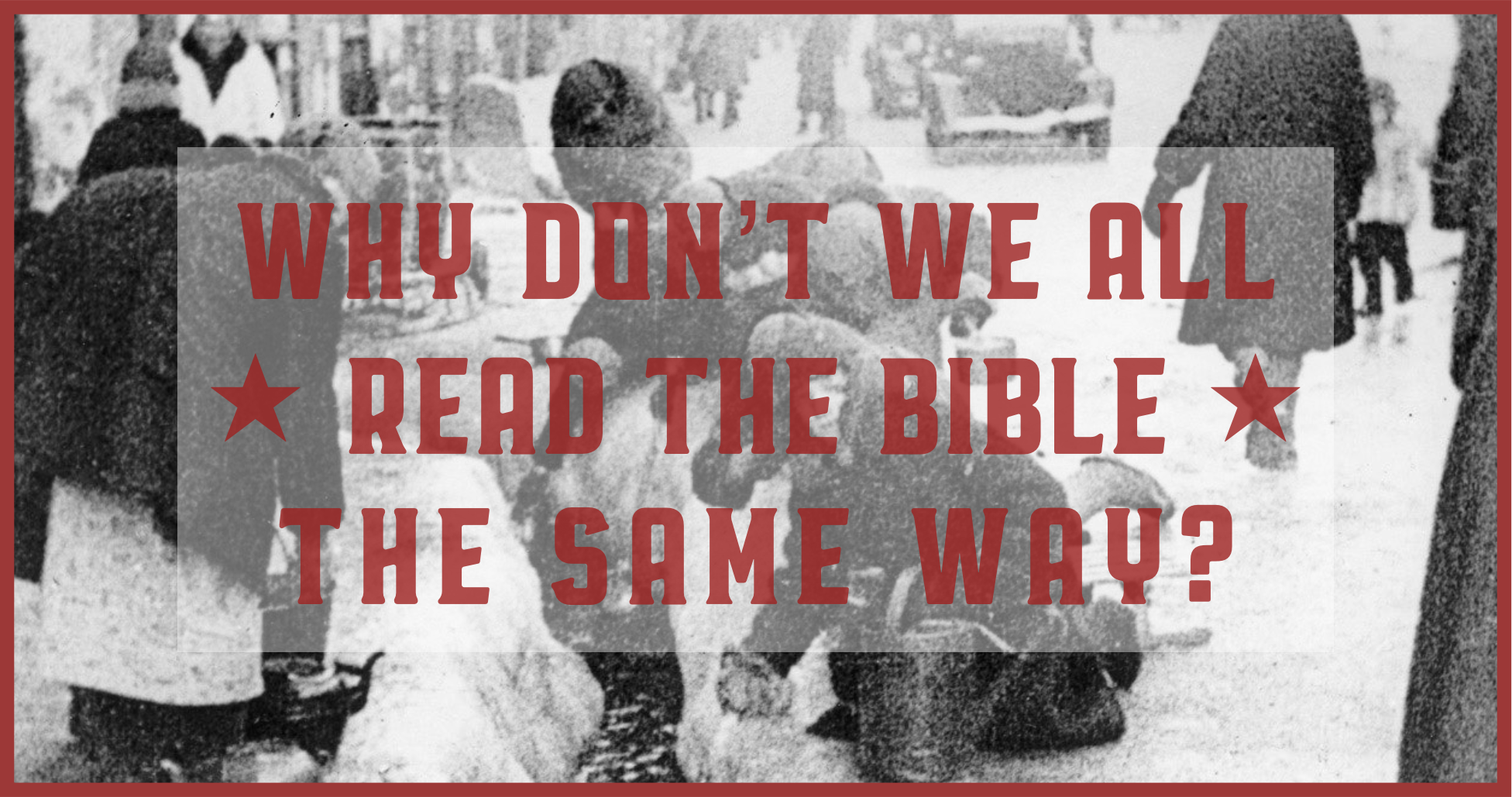
In 1941, the army of Nazi Germany besieged St. Petersburg (then Leningrad) for about 2 1/2 years, leading to the death of 670,000 people (the picture above shows destitute citizens fetching water from a busted water line). The Russians polled in the exercise were survivors of the famine or descendants who had heard of the horrors of it throughout their lives, and thus it was only natural that they would be quick to hear of the problem of famine in the prodigal’s misadventures.

On the other hand, American readers had never experienced famine, but they definitely were familiar with wasteful and excessive lifestyles. It makes sense that they would seize upon these aspects of the parable.

While these differences don’t mean that the two groups would necessarily come to irreconcilably different interpretations of Jesus’ story, the example does illustrate how differences in our backgrounds and experiences can cause us to read the Bible differently, and can impact our interpretations accordingly.

To me, there are at least three implications of this point:

  1. We need to be humble about our interpretations, realizing that they are at least in part influenced by our own personal experiences and backgrounds and thus, subject to bias.
  2. Since Scripture does not have an unlimited number of valid interpretations (if it did, it would be meaningless), it follows that the backgrounds and experiences of some people help them to arrive at valid interpretations, while those of others hinder them from doing so.
  3. The solution is for us to study more and seek God’s guidance in understanding His word! This enables us to learn from each other, discovering the blind spots in our own perspectives and helping others to do the same. God doesn’t intend that His will for our lives be unintelligible, but that doesn’t mean that discerning it through Scripture won’t require time, effort, and practice.

[1] Clayton N. Croy, Prima Scriptura: An Introduction to New Testament Interpretation (Baker Academic: Grand Rapids, 2011), 5-6.

Being Humble About Our “New Interpretations”

Some more good stuff from Jonathan Pennington’s Reading the Gospels Wisely on the importance of studying the history of the interpretation of the biblical text:

“Any time we think we have come up with a new and insightful interpretation, the odds are that someone has already had this insight and expressed it better; conversely, if we do arrive at an entirely new interpretation, then chances are, if none of the tens of thousands of students of Scripture have ever seen things that way, that interpretation may have serious weaknesses and blind spots.”

So basically, if you’re reading Scripture and feel like you’ve come upon a new and brilliant interpretation of a verse or passage that you’ve never heard before, do a little research: most likely someone else has already developed that same interpretation and has done so in a better and more thorough way. And that’s a good thing, because it leads to a deeper understanding of the Bible.

And it’s also possible (though unlikely) that your research will show that you have, indeed, come up with a new interpretation that no one else has ever thought of before. If that’s the case, your new interpretation is most likely flawed.

Either way, I think researching and reading the interpretive views of others is helpful in determining accuracy, and also leads to humility as well. Both are good things.

Different Types of Maps: Read (and Preach, and Teach) the Whole Bible

In 2 Timothy 3.16-17, Paul writes:

“All Scripture is breathed out by God and profitable for teaching, for reproof, for correction, and for training in righteousness, that the man of God may be complete, equipped for every good work.”

Based on Paul’s words here, I think it should be obvious that we should give attention to all of Scripture, rather than just study the parts that we like over and over again. Some people focus on Paul’s writings; others spend a lot of time in the Gospels. Some folks obsess over the accounts of the early church in Acts, while others never stray far from the wisdom literature or the historical books of the Old Testament.

And it’s okay to have favorites, but if we emphasize our favorites to the point that we neglect the other portions of Scripture, then we aren’t taking Paul’s words from 2 Timothy 3.16-17 very seriously.

In Reading the Gospels Wisely: A Narrative and Theological Introduction, Jonathan T. Pennington puts it very well:

“…For Jefferson County, Kentucky, where I live, we could look at a topographical map that shows terrain and elevations or a road map; at a map that records annual rainfall or one that indicates historical landmarks and points of scenic interest; or we could consult a survey that shows where property lines begin and end. These are all different maps, and they would look very different if set beside one another. But of course they don’t contradict one another. They are complementary and beneficial. They are different discourses of truth—or different ways of approaching and presenting knowledge.

If this is true for maps of Jefferson County, Kentucky, how much more for theology and Holy Scripture. We need to think of the Bible not as a single map that just gives us doctrinal statements or moral commands, but we must realize that the Bible is like an atlas—a collection of maps/books that shows us the way, the truth, and the life but in a variety of languages or discourses or ways of communicating. To privilege—or worse, to rely exclusively on—only one form is detrimental to apprehending truth; a topographical map helps little when we’re seeking the best restaurants.”

What a great analogy this is! The Bible is true, but it presents truth in a variety of ways. In Matthew, truth might be presented through a parable. In 1 Kings or Acts, it might be presented in historical narrative. In Psalms, truth is presented through poetry, and in Proverbs through pithy sayings. In books like Romans, Paul often presents truth in direct theological or doctrinal statements, and in Revelation, John presents truth through bizarre and sometimes frightening visions.

All of these different “maps” are a vital part of the entire “atlas” of the Bible. Some are more useful for certain purposes than others, but all contain truth and none should be neglected.

I think all people of faith would do well to be more well-rounded in our Bible study.

« Older posts Newer posts »

© 2026 The Doc File

Theme by Anders Noren — Up ↑