The online journal of Luke Dockery

Category: Christian Living (Page 34 of 36)

Winter Retreat Recap: SHINE

This past weekend was our annual youth group Winter Retreat. This is one of my favorite youth group events of the year, because we are able to take a break from our regular schedules for a weekend and focus on other things instead. It is always a time where the kids in our group grow closer together, get spiritually re-engergized, and have a ton of fun.

This year, the theme of our retreat was “SHINE,” and we talked about light and darkness from a spiritual perspective. Throughout Scripture, God is consistently portrayed using the metaphor of light, and as followers of God, Christians are to be people of light as well.

Our teachings on this topic were organized around three lessons which showed the progression of the theme throughout the weekend:

(1) The Shining Face of Moses (Exodus 33.18-23; Exodus 34.28-35). After Moses leads the people out of Egypt, he spends 40 days and 40 nights with God on Mt. Sinai while God gives the Law to him. Moses is protected in the crevice of a rock, and is only able to see the back of God’s glory as He passes, but the glory of God is so bright that it leaves Moses with a face that literally shines. He even wears a veil to cover his face. Being in the presence of God changes us.

(2) The Shining Light Comes to Earth (John 1.1-14; The Nativity Story). With the birth of Jesus, God reveals His glory and brings His Light to the earth in a new and special way. Jesus was fully God and fully man at the same time, and this means that the life of Jesus gives us the perfect example of how we can live in our dark world and still shine God’s Light.

(3) Shining God’s Light to Others (John 8.12; John 9.5; Matthew 5.14-16; Philippians 2.14-15; 1 John 1.5-7). After talking about the greatness of God’s glory and how that glory was brought to earth in a special way through the Incarnation of Jesus Christ, our last lesson brought all this together, and focus on our main task as Christians: shining the light of God into our dark world.

Instead of presenting this material in a traditional lecture format, our teens were broken into discussion groups based on age, and processed and learned the material that way. We then combined the separate groups for a larger group discussion, which (hopefully) helped to reinforce the material.

It was a great weekend! We had a lot of fun, and I am optimistic that the teens learned a lot as well.


Seeing Our Problems As Blessings

Something that I realized once in a rare moment of clarity was how, as Americans, we are so incredibly blessed that even most of our “problems”—the things we worry and complain about—are really just outgrowths of our blessings.

Let me give a few examples:

  1. The main complaints you hear from college students center on (a) how expensive college is and (b) how difficult and stressful college coursework is (I have been guilty of both of these complaints in my life). But from another perspective, it’s easy to see how fortunate we are to live in a country where the government provides a great deal of assistance in paying for college and basically gives students as much time as they need to pay it back. Furthermore, whatever temporary stresses and hardships college work can bring on someone is more than made up for by the opportunities a college education affords. Having the opportunity to go to college is a great blessing!
  2. You hear people complain all the time about their cars (I especially hear this from teenagers!)—about how they are too small, or too old, or not cool enough, or get poor gas mileage, etc.—when the idea of owning a car is literally unimaginable to most people in the world. Owning a car is a great blessing!
  3. People complain about their jobs—about low pay, or how boring it is, or how mean their bosses are, or how annoying their coworkers are—when there are people all over the world who are unemployed and in desperate need of work. Having a job is a great blessing!
  4. Parents often spend a great deal of time worrying about their children. They worry about how their kids do in school, if they have the right kind of friends, if they have enough friends, getting them to every sports practice on time so the coach will give them playing time and they can grow up to become the next superstar in their sport. Some parents have children with health concerns, and worry about the uncertainty associated with that (this one strikes home with me). But all of these worries are only made possible by the fact that parents have children in the first place, and children are truly one of the great, great blessings of life!
  5. And finally, from a spiritual standpoint, I hear Christians complain all the time about problems that exist in the church of which they are a part—people they don’t like, bad sermons, unfriendliness, lack of programs—when there are millions of people throughout the world who have never even heard of Christ, or even if they have heard and decided to follow Him, have no local congregation of the church to be a part of. You wouldn’t be able to complain about your church if you didn’t have one; having a church family is a great blessing!

Obviously, I am speaking in generalizations here, and each of us has trials and issues that we have to face in our own lives. But on the whole, we are so incredibly blessed…I don’t know what we’d do if we had to deal with real problems on a daily basis.

When Nero Was On The Throne

It has been interesting to me over the last 12 hours or so to read Facebook status updates and tweets from my Christians friends about yesterday’s presidential election. The fact that some of these Christians are celebrating the reelection of President Obama while others are lamenting it tell me that either:

  1. Applying Christian values to voting is a difficult and murky process.
  2. Christians aren’t very aware of what “Christian values” actually are.
  3. Both 1 and 2 are partially true.

But I digress. If your candidate won yesterday, be happy, be thankful, and try not to gloat too much. If your candidate did not win yesterday (and if you are in this group, you are the real audience for this post), remember that as a Christian, you can glorify God by showing respect to the one who is in authority, even if he wasn’t your choice:

“Let every person be subject to the governing authorities. For there is no authority except from God, and those that exist have been instituted by God. Therefore whoever resists the authorities resists what God has appointed, and those who resist will incur judgment. For rulers are not a terror to good conduct, but to bad. Would you have no fear of the one who is in authority? Then do what is good, and you will receive his approval, for he is God’s servant for your good. But if you do wrong, be afraid, for he does not bear the sword in vain. For he is the servant of God, an avenger who carries out God’s wrath on the wrongdoer. Therefore one must be in subjection, not only to avoid God’s wrath but also for the sake of conscience. For because of this you also pay taxes, for the authorities are ministers of God, attending to this very thing. Pay to all what is owed to them: taxes to whom taxes are owed, revenue to whom revenue is owed, respect to whom respect is owed, honor to whom honor is owed.”

(Romans 13.1-7)

Paul’s words here are pretty hard to swallow for Christians who struggle to respect and submit to their leaders. When we think about leaders that we don’t like much, it can be difficult for us to affirm statements like, “the authorities are ministers of God” and that resisting them means that we are resisting “what God has appointed”. But that’s exactly what Paul says.

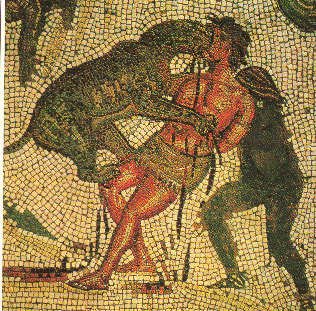
Mosaic depicting a Christian martyr

And to those who are inclined to think that Paul just didn’t understand about bad leaders, realize that he wrote these words to the Christians in Rome while Nero was Emperor. Nero was a vile man and a dedicated persecutor of Christians who was known for using the bodies of captured Christians as fuel for the fires which lit his garden at night. No President that our nation has ever had could hold a candle to Nero when it comes to sheer wickedness*, and it was most likely during the reign of Nero that Paul himself was executed. And yet, to a man such as this, Paul urges Christians to be in subjection.

If your candidate didn’t win yesterday, it’s okay to be disappointed. It’s okay to disagree with the policies of the current President, and it’s okay to hope for a better outcome next time. But respect your President, and be in subjection to him. Even if it is hard.


*Please do not interpret this to mean that I am suggesting that President Obama is somehow equivalent to Nero. I am not.

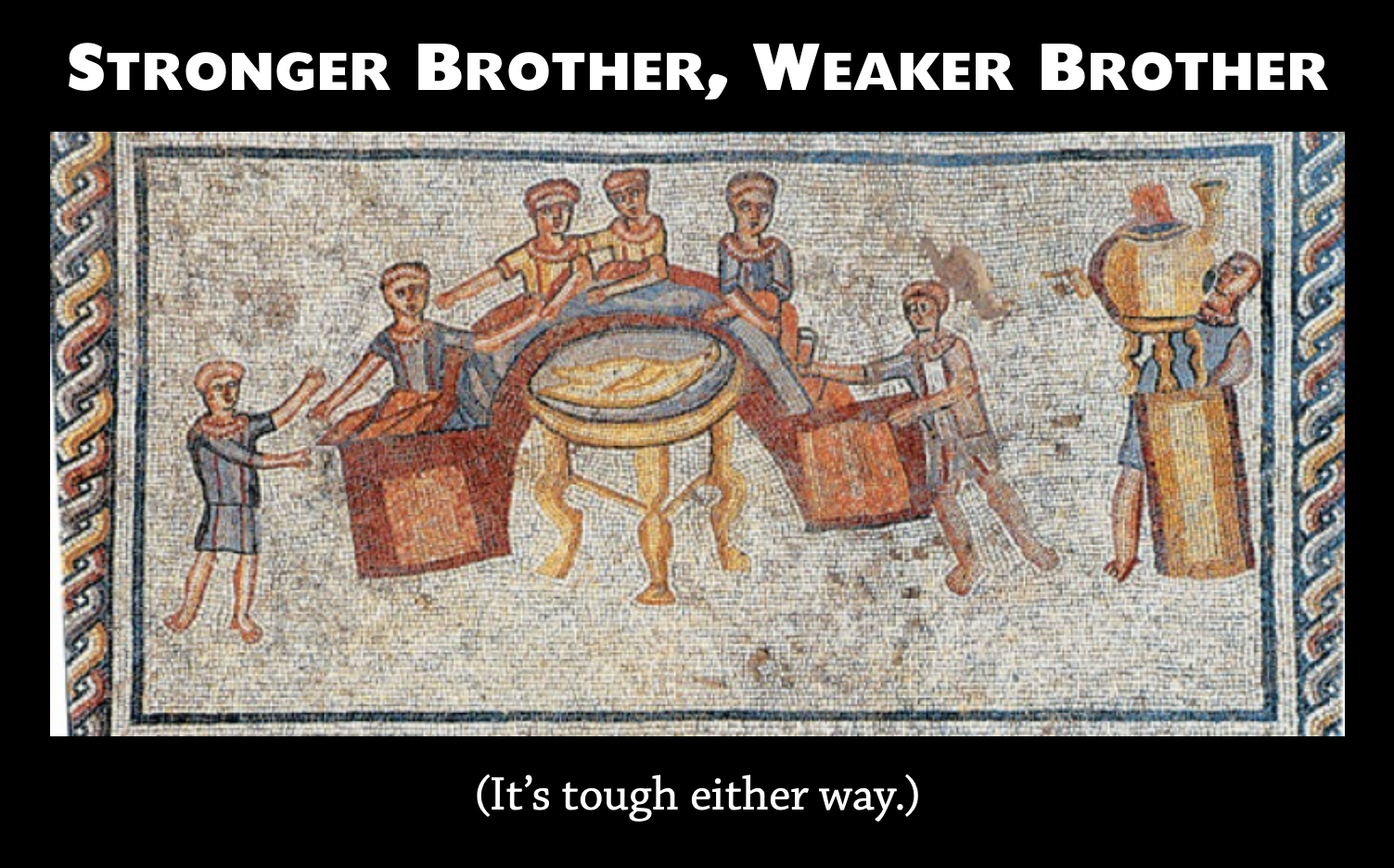
Stronger Brother, Weaker Brother: It’s Tough Either Way

There are a few places in the New Testament where  Paul addresses the idea of the stronger brother and the weaker brother, usually in the context of the issue of eating meat that had formerly been sacrificed to idols (Romans 14; 1 Corinthians 8.4-13; 1 Corinthians 10.25-32).

It’s a fairly complex issue, but basically, Paul says that since idols are nothing (because they represent gods which don’t actually exist), eating food that had previously been offered to them is no big deal. Stronger, more mature Christians would be able to realize this, and would see that eating such meat would not be inherently wrong.

However, weaker, newer Christians, especially those who had been recently converted from a pagan background, could struggle with the idea of eating meat that had been sacrificed to an idol, and could feel like they were compromising their faith by doing so. For these Christians, it would be wrong for them to eat because doing so would violate their conscience.

Paul’s real focus in these passages is less on giving specific instructions on which activities should be partaken in and which should be abstained from, and more about teaching the stronger and weaker brothers how to interact with one another. Basically, they should treat one another with love: the stronger brother should be willing to give up meat forever in order to avoid leading his weaker brother to sin against his conscience, and the weaker brother shouldn’t try to bind his stronger brother’s actions by his own conscience.

In many ways, Paul’s thoughts are summed up in Romans 14.3:

“Let not the one who eats despise the one who abstains, and let not the one who abstains pass judgment on the one who eats, for God has welcomed him.”

Depending on the issue, I think I have been both the weaker and stronger brother at different times, and what Paul commands in Romans 14.3 is challenging to both groups.

The stronger brother is not to despise the weaker. I’ve seen this happen a lot, and it can be tempting to do. We grow frustrated at the qualms of our weaker brethren and so it gets easy to ridicule them as hopelessly backward and just write them off completely. Maybe make jokes about their limited understanding and speak with condescension to and about them.

The weaker brother is not to pass judgment on the stronger. This is tempting as well. Since our brothers are doing something that our own consciences won’t permit us to do, we are tempted to view them as less holy or less devoted to their faith than we are. Perhaps we even cease to think of them as faithful Christians.

As Paul points out in the verse above, both of these attitudes are wrong. Regardless of which side we find ourselves on, we have to be careful about how we treat each other: love and respect for our brethren should always be our primary response.

Legacy, Cap Anson, and Enoch

Cap Anson was Major League Baseball’s first superstar. Anson spent the majority of his career as a player/coach for the Chicago White Stockings, and was the first professional player to amass 3,000 hits.  Some of the many records he set during his career lasted for decades.

Anson was a fierce competitor, and his accomplishments in baseball were so important to him that he left instructions that his tombstone read, “Here lies a man who batted .300.”

I’m a huge baseball fan and I think it would be neat to play it at the same level as someone like Cap Anson, but to choose to sum up your entire life with a baseball statistic? Even I think that’s a little sad, and it reveals a perspective on life that is more than a little skewed.

If you could write your own epitaph, or choose just a few words to sum up your life, what words would you use? Perhaps a better question would be, if others were to sum up your life based on what they saw—how you spent your time and money, the things that seemed important to you—what words would they use?

  • Always looking for a promotion…
  • Had the largest house on the block…
  • Biggest gossip in town…
  • Obsessed with cars…
  • Lived vicariously through his children…

Closely related to all of this is the idea of legacy. In legal terms, a legacy is a gift of property or money, usually by means of a will. In a more general sense, your legacy is whatever you leave behind for those who come after you—in some ways it is a token or a synopsis of your life.

If we had the benefit of hearing the epitaphs that others would write for us, it might reveal how skewed our perspectives can be at times (not unlike Cap Anson’s), and let us see that the legacies we leave are often shallow and insignificant.

In Genesis 5, in the midst of a list of Adam’s descendants, we are introduced to a man named Enoch. Enoch lived for 365 years, but his life was summed up in just a few brief words:

“Enoch walked with God, and he was not, for God took him.”

“Walked with God.” That’s an epitaph that I could be happy with, and a legacy that I would be proud to have. But legacies like that don’t come about by accident; rather, they come from a stubborn, persistent lifestyle of discipleship. So all that leads to this question: What will your legacy be? Put in another way, if you were to pass from this life today, what would your tombstone say?

If you would like it to read differently, then it’s up to you to live differently.

« Older posts Newer posts »

© 2026 The Doc File

Theme by Anders Noren — Up ↑