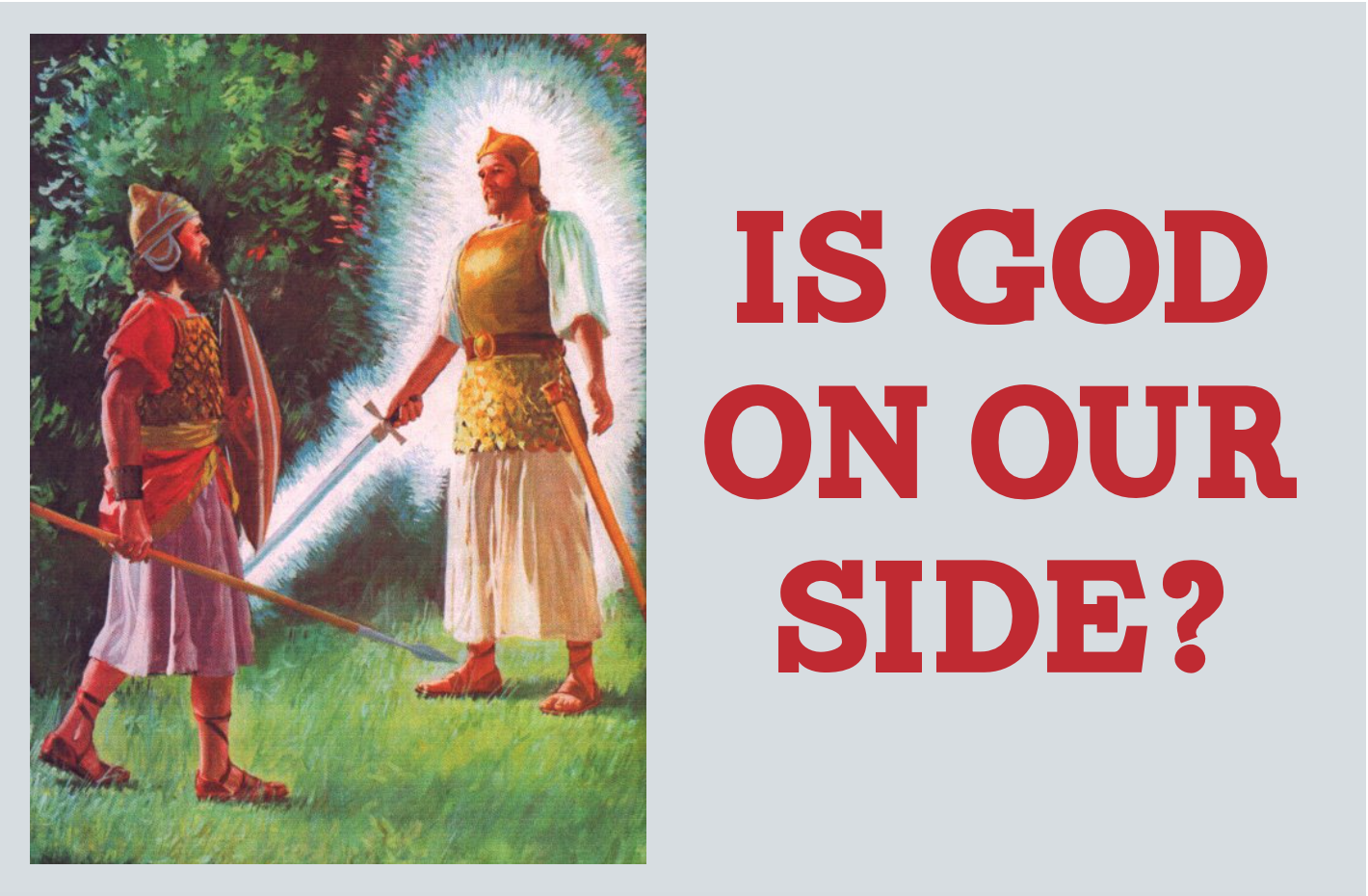
“God is on our side.”
It’s a phrase you hear often (or something like it) in Christian books, music, and teaching. It’s a popular notion, and why wouldn’t it be? Of course we like the idea of having God on our side! But is it biblical?
The Book of Joshua recounts the efforts of the Israelites (God’s chosen, set-apart people) as they work to accomplish their (divinely-appointed) mission to conquer the land of Canaan (the land which God had promised to give to them). If there was ever a time of God being on “our” side, you’d expect to find it here.
As Joshua is about to lead the people over the first big hurdle of the Conquest, the defeat of the city of Jericho, he has an interesting encounter (Joshua 5.13-15):
“When Joshua was by Jericho, he lifted up his eyes and looked, and behold, a man was standing before him with his drawn sword in his hand.And Joshua went to him and said to him, ‘Are you for us, or for our adversaries?’ And he said, ‘No; but I am the commander of the army of the LORD. Now I have come.’
And Joshua fell on his face to the earth and worshiped and said to him, ‘What does my lord say to his servant?’ And the commander of the LORD’s army said to Joshua, ‘Take off your sandals from your feet, for the place where you are standing is holy.’ And Joshua did so.”
It’s interesting to me: Joshua asks the man if he is on the side of the Israelites, or on the side of Jericho, and in response, he says, “Neither; I’m on God’s side, not yours.”
Later on in Joshua 24, Joshua, advanced in age, addresses the people. He knows that he is near death, and is concerned about what the people will do after he is gone (Joshua 24.15-20):
“‘…Choose this day whom you will serve, whether the gods your fathers served in the region beyond the River, or the gods of the Amorites in whose land you dwell. But as for me and my house, we will serve the LORD.’
Then the people answered, ‘Far be it from us that we should forsake the LORD to serve other gods, for it is the LORD our God who brought us and our fathers up from the land of Egypt, out of the house of slavery, and who did those great signs in our sight and preserved us in all the way that we went, and among all the peoples through whom we passed. And the LORD drove out before us all the peoples, the Amorites who lived in the land. Therefore we also will served the LORD, for he is our God.’
But Joshua said to the people, ‘You are not able to serve the LORD, for he is a holy God. He is a jealous God; he will not forgive your transgressions or your sins. If you forsake the LORD and served foreign gods, then he will turn and do you harm and consume you, after having done you good.’”
In response to Joshua’s concern, the people basically say, “Don’t worry about it Joshua—we’ll serve the LORD. After all, He’s always been on our side.”
But Joshua isn’t convinced; he believes that the people won’t be faithful to God and that then they’ll find that He isn’t on their side at all—where He once provided for them and fought for them, He will now withhold blessings and actively fight against them.
And how well Joshua knows his people! Within a generation, they will fall away from following God and as a result, will experience a long period of turmoil and suffering as God allows their neighbors to conquer and oppress them (the Book of Judges, which recounts this time period, is one of the lowest points in all of Scripture!).
So, having said all that, back to the original question: is God on our side? I’d have to answer with a qualified “no.”
First, the qualifications:
I’m not doubting God’s love for us, His interest in our condition, or His saving work on our behalf. I’m not doubting that we can cast all our anxiety on Him, because He cares for us (1 Peter 5.7). I’m not doubting that God is “for us” in a Romans 8 sort of way, or that God doesn’t root for us to be successful (where success is defined in terms of faithfulness).
So what am I saying? Here’s my big point:
Jesus didn’t come to earth to live and die for us because God was on our side. He came so that we could be on God’s side.
Maybe it sounds like I’m just arguing semantics, but really, I think there’s more to it than that. One perspective is centered on mankind, while the other is centered on God: if God is on our side, then all the focus is on us, instead of on God. But the focus should be on God, not us.
This helps to explain the Israelites in the Old Testament. When they were on God’s side and followed Him faithfully, He blessed them with prosperity and victory over their enemies. When they ceased to be on His side, the blessings ceased as well.
This also helps to put the Incarnation into proper perspective. The Incarnation wasn’t about Jesus becoming a man because humanity is the focus of everything; the Incarnation was about God becoming a man in order that men could become more like God, because God is the focus of everything!
So, with this God-centered perspective in mind, let’s ask the question one last time: is God on our side? According to Scripture, we don’t even have a side; we have to choose a side! The real question is, are we going to choose to be on God’s side, or will we side with the world?