The online journal of Luke Dockery

Category: Discipleship (Page 12 of 23)

A Different King Named Jesus

Today’s reflection comes from Acts 17, where Paul and Silas travel to Thessalonica as part of the Second Missionary Journey. As was Paul’s custom, they head first to the synagogue and tell the Jews there about Jesus, using the Hebrew Bible. This method is successful, at least with some:

“Some of the Jews believed Paul and Silas and joined them. In the synagogue there were many Greeks. They worshiped the one true God. There were also many important women. They joined Paul and Silas too.

(Acts 17.4, IEB)

But there are also some Jews who reject Paul and Silas’s message and who, out of jealousy (v.5), hire some men to stir up trouble against them. A mob ensues, and cries out:

”[These men] do things against the laws of Caesar. They say that there is a different king named Jesus.”

(Acts 17.7b)

This proclamation (from a mob, no less!) highlights one of the central truths of Scripture, but one that needs to be carefully nuanced: Jesus is the King of the world.

This idea, that Jesus is King, is what the most popular titles used for Jesus are getting at. When we say that Jesus is Messiah or Christ (the same term in two different languages), the idea is that He is the promised king from the line of David, the One to whom the narrative of the Hebrew Bible points. When we say that Jesus is Lord, we are moving from Hebrew to Roman thought: Lord was the title given to Caesar, the presumed king of the known world. To say that “Jesus is Lord” is to necessarily imply that Caesar is not.

And, indeed, this is the very notion proclaimed in the verse quoted above—the mob was right. Jesus is the King of the world, seated at the right hand of God the Father since His resurrection and ascension. Followers of King Jesus owe ultimate allegiance to Him, and this will invariably put them at odds with various other would-be kings from time to time. For those who are desperate to cling to worldly power and demand ultimate allegiance from their subjects, citizenship in God’s kingdom is an inherent threat. May we never forget that King Herod sought to eliminate the baby Jesus who He viewed as a rival, that Jesus was ultimately crucified with “King of the Jews” nailed above His head as the charge of which He was guilty, and that Peter and Paul would ultimately be martyred under the authority of a rival king (Nero) because of their allegiance to Jesus.

But, the mob was also wrong. While Jesus is certainly King, He is a different kind of king. He wasn’t seeking Herod’s throne, control of the Jewish establishment in Jerusalem, or even the overthrow of the Roman Empire. Such prizes were much too petty for the rightful King of the Universe. This is why Jesus can clearly state that His kingdom is not of this world and that His followers will not use violence to bring it about. It is why early Christians were at pains to show that they were good citizens who sought the welfare of the communities in which they lived (cf. Jeremiah 29.7), loved their neighbors, and submitted to government authorities.

The nuanced kingship of Jesus must lie at the center of the lives and identity of Christians today. On the one hand, Christians should be the best neighbors and citizens around. We are willing to help and sacrifice for our communities because we love others (including our enemies!). We seek to be at peace with all people, so we avoid controversies and quarrels. We appreciate the value of submission, so we obey the laws of our land whenever we can do so in good conscience, even when we find those laws irksome.

On the other hand, our ultimate allegiance is to King Jesus, and our primary citizenship lies in His kingdom, not in whatever earthly nation that we happen to inhabit. This means that we are all-too-aware of the fallenness of our earthly nations. We should not hesitate to critique them when they are in the wrong, and we should not be surprised when they demand from us more allegiance than they have a right to (after all, this is what fallen earthly kingdoms invariably do).

And if and when we are ever placed in a position where we must choose where our loyalties lie, there is no choice: our allegiance is to a different King, and His name is Jesus.

If and when we are ever placed in a position where we must choose where our loyalties lie, there is no choice: our allegiance is to a different King, and His name is Jesus. Share on X

The point of this post—that Jesus is the King of the universe and it is to Him that Christians owe ultimate allegiance—may seem like an obvious point, and, indeed, I think it should be obvious. Sadly, though, research proves otherwise. Consider the following survey results (sourced at the bottom of the graphic):

Obviously, there are many, many people who claim to be “Christian”, but do not embrace the reality at the center of the Christian faith: Jesus is Lord, and that means that no one else is.


This image, drawing inspiration from the book of Revelation, is one of my favorite images depicting Jesus as King. The artist is Chris Koelle, and it comes from a graphic novel of the Book of  Revelation that I highly recommend.


In this loose series of Scripture Reflections, I am sharing brief thoughts spurred on by my Bible reading this year. By way of reminder, my goal for these brief posts is two-fold:

(1) To remark on aspects of the biblical text that I find to be of interest that the reader may or may not have thought about previously.

(2) When possible, to point ahead to the work and person of Jesus Christ. I believe the Bible is a unified story that points to Jesus, which means that He is frequently alluded to or foreshadowed in some way throughout the biblical canon.

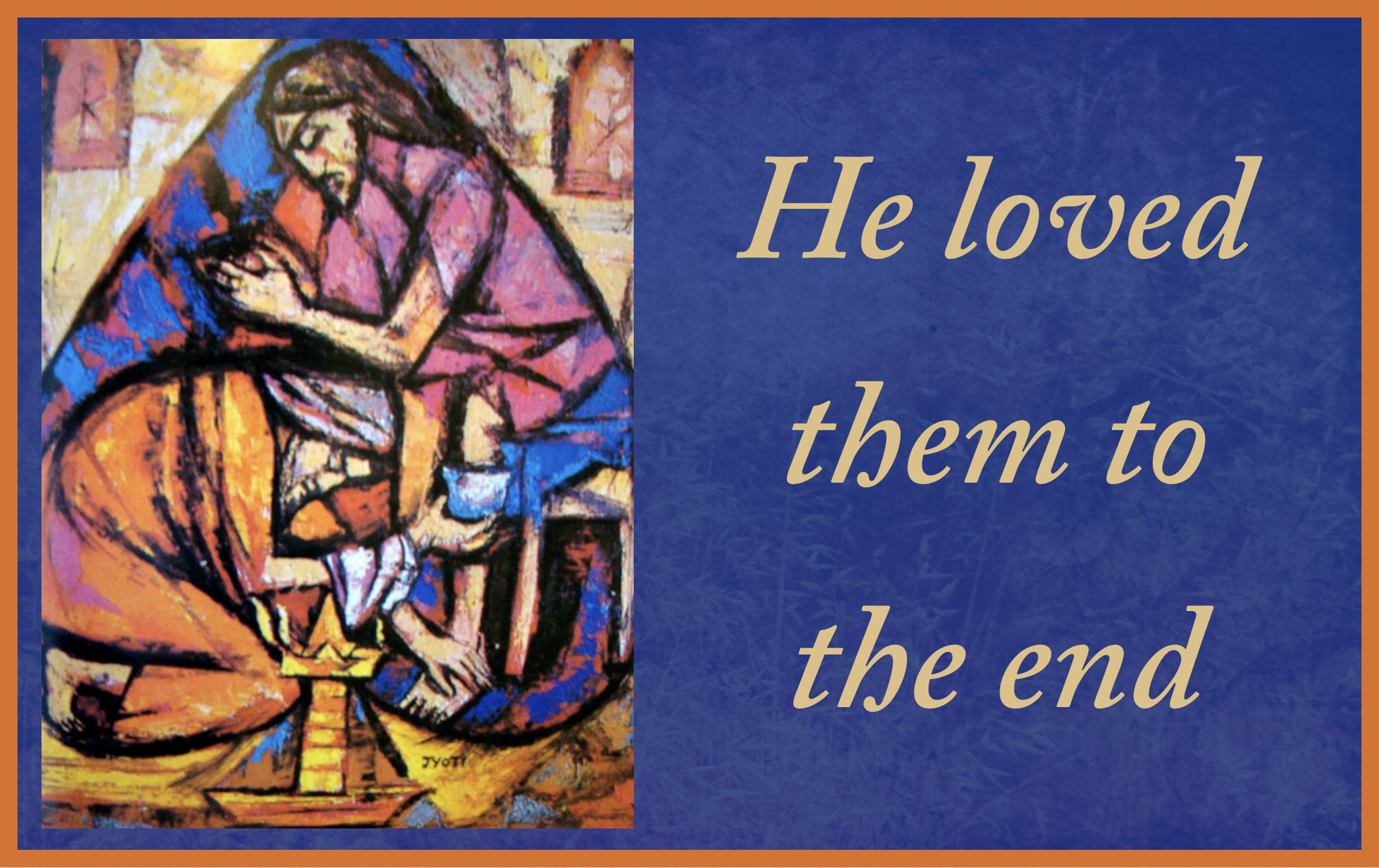
“He Loved Them to the End”

Today’s reflection comes from John 13 (the daily Bible reading format I am following this year involves readings from both testaments each day), the beginning of what is typically referred to as Jesus’ “Farewell Discourse”—teachings from John 13-17 that Jesus delivers to His disciples on the night that He was betrayed.

The content of John 13 is introduced to us in verse 1 with these interesting words:

“Now before the Feast of the Passover, when Jesus knew that His hour had come to depart out of this world to the Father, having loved His own who were in the world, He loved them to the end.”

Jesus knows He is about to die, and with this knowledge in mind, how does He spend His last evening? He chooses to spend it with “His own”, the disciples He had led and lived with for years, whom He loved. This seems straightforward enough, right? If you knew that you were about to die, I suspect that you would want to spend your remaining time with those you love. I would too.

But there is more to the story. John 13 is all about love, and the introductory verse we just read sets us up to examine the love that Jesus shows for His disciples compared to their response to Him.

The chapter looks something like this, in outline form:

13.1: Jesus loved His own to the end [Summary Statement]

13.2-20: Jesus shows His love by washing the disciples’ feet [Exemplary Love of Jesus]

13.21-30: Jesus predicts the betrayal by Judas [Disciples’ Failure to Love]

13.31-35: Jesus encourages the disciples to love like He has loved them [Exemplary Love of Jesus]

13.26-38: Jesus predicts the denial by Peter [Disciples’ Failure to Love]

With this outline in mind, the last night of Jesus becomes remarkable rather than straightforward. Jesus spends His last night washing the feet of those who will betray, deny, and desert Him hours later. He knows that this will happen, and this is still how He chooses to spend His last evening: loving those who will fail to love Him.

If you knew you were about to die, is this what you would do? Neither would I.

As I look around in the world in which we live, I see a desperate need for love. I witness all sorts of people cutting off ties and cancelling relationships with “their own”—family members, longtime friends, brothers and sisters in Christ—rather than “loving them to the end.”

I think we find God’s answer to the bitter division and rancor of our times in this text and the example of Jesus: we are to love as Christ has loved us. Jesus loved His disciples even when He knew they would fail to love Him in return. He loves us even when we forsake Him. And He calls us to love in the same way.

In a society that normalizes and encourages the dissolution of relationships when we disagree over a whole host of issues, Jesus offers—commands, actually—another way.

It is not easy, but it is clear: “He loved them until the end.”

Jyoti Sahi, Jesus Washing the Feet of Peter, Oil on Canvas


In this loose series of Scripture Reflections, I am sharing brief thoughts spurred on by my Bible reading this year. By way of reminder, my goal for these brief posts is two-fold:

(1) To remark on aspects of the biblical text that I find to be of interest that the reader may or may not have thought about previously.

(2) When possible, to point ahead to the work and person of Jesus Christ. I believe the Bible is a unified story that points to Jesus, which means that He is frequently alluded to or foreshadowed in some way throughout the biblical canon.

Church Camp Baptisms and Mountaintop Christianity

Note: this post is a little more disjointed than much of what I write, but it accurately reflects the way in which I have been wrestling with this topic back-and-forth for some time.

Church camp is a significant part of the yearly youth ministry calendar, and a pretty standard feature of church camp (at least in my experience) are camp baptisms. The next statement I make may be jarring to some of you, and I want to clearly state that if you were baptized at church camp and had your sins washed away and hold to that moment as the time when you committed your life to Jesus, that is great, and I applaud you. Having said that, here comes the (perhaps) jarring statement: I am not a huge fan of camp baptisms.

There are several reasons for this:

  1. Camp baptisms usually happen away from the presence of the camper’s parents, and since parents are the primary spiritual influencers of their children, not having them present for such a major step is not ideal.
  2. Camp is an emotionally-charged environment, and it can be easy to get caught up in the camp experience and make a decision that no longer seems so pressing or important a few weeks later when camp is over and the emotional experience has faded.
  3. Many times camp baptisms happen in clusters: several kids from one cabin or one friend group will all decide to get baptized together or within a couple of days of one another and the question arises: do these students really want to give their lives to Christ, or are they just doing what all of their friends are doing?
  4. The purely pragmatic reason: personal experience shows that a lot of time these baptisms don’t really “stick” in the sense that they are often false starts that don’t lead to a life of faithfulness (probably because of some combination of reasons 1-3).

At this point, youth ministry veterans are likely reflecting on these reasons and nodding in agreement—they have seen it all before, too many times to count!

Having acknowledged all this, I now want to push back against what I have just said.


A few years ago, I was talking to a young man (out of college, in his 20s) who was questioning his baptism largely for the reasons mentioned above. He did it at church camp when he was young and he didn’t know a lot at the time—what if he was just caught up in the emotions of the moment and decided to get baptized because other people were?

And, of course, these are some of my own concerns.


Churches of Christ are spiritual descendants of the Stone-Campbell Restoration Movement, a primitivist, back-to-the-Bible movement whose aim was to bring about unity among followers of Jesus by simply trying to be the church that we read about in the Bible. At the same time, that Movement developed in a specific time and place, and was certainly influenced by that historical context. For the sake of this post, that influence can be seen in at least two ways.

First, it was a movement that prized logic and reason. Intellectually and philosophically, the early leaders of the Stone-Campbell Movement were greatly influenced by the Enlightenment. This doesn’t mean that they universally condemned emotion, but rationality and clear thinking were highly valued.

Second, as a product of the American frontier, the Stone-Campbell Movement also valued the rugged individualism that was so characteristic of American society. People were free to read the Bible and interpret it for themselves, and should base their beliefs on Scripture rather than the teachings of some priest or state church.

Against such a backdrop, is it any wonder that I am immediately suspicious of decisions to follow Jesus that seem to be largely influenced by emotion and the influence of what other people are doing?


My favorite thing about my spiritual heritage is that the Stone-Campbell Movement is, fundamentally, a back-to-the-Bible movement, so as I was talking to my friend who was questioning his own baptism, I immediately thought of Scripture, and specifically, the Book of Acts, where we have so many accounts of people giving their lives to following Jesus.

One of the prime examples is in Acts 2, where Peter preaches to a large crowd on Pentecost, basically telling them that the Jesus they had crucified was the Messiah and Son of God, and that He had been raised from the dead and was sitting at the right hand of God:

37 Now when they heard this they were cut to the heart, and said to Peter and the rest of the apostles, “Brothers, what shall we do?” 38 And Peter said to them, “Repent and be baptized every one of you in the name of Jesus Christ for the forgiveness of your sins, and you will receive the gift of the Holy Spirit. 39 For the promise is for you and for your children and for all who are far off, everyone whom the Lord our God calls to himself.” 40 And with many other words he bore witness and continued to exhort them, saying, “Save yourselves from this crooked generation.” 41 So those who received his word were baptized, and there were added that day about three thousand souls.

(Acts 2.37-41)

Two details pertaining to our present conversation that jump out of this text: (1) Peter’s audience was cut to the heart, and (2) 3,000 responded and were baptized. In other words, in this biblical example of conversion, those who made the decision to be baptized were clearly influenced by emotion and almost certainly by the example of others as well.


The issue of church camp baptisms is clearly tied to what might generally be referred to as “Mountaintop Christianity”, the idea that we have mountaintop experiences—intense, emotional events where we encounter God in a powerful way.

Traditionally, youth ministry has largely been structured around mountaintop experiences and scheduling these sorts of events—mission trips, youth rallies, spiritual retreats, and, yes, church camp—throughout the year. The idea is to provide meaningful spiritual experiences and hope that they will contribute to lifelong discipleship. For example, just last week, I spent a week camping, hiking, and climbing a literal mountain with some of my students. It was a wonderful week characterized by deepened relationships with one another and with God.

The problem, of course, is that you cannot live on the mountain. At some point, you have to come back down to real life, and just like the fading glory of Moses’s face after he spent time with God on Sinai, over time, the spiritual clarity and closeness experienced at church camp or on the mission trip begins to fade. Students are left to limp along until their next spiritual fix at the next mountaintop experience—unless, of course, they have graduated and had their last such experience. It seems likely to me that this is another reason that teens struggle with faithfulness after high school.


So what should we do? The experience you get on the mountaintop clearly isn’t sustainable; should we eliminate such emotional experiences altogether? When kids want to get baptized at church camp, should we prevent them from doing so?

I don’t think so.

Let’s remember, God is the Originator of the mountaintop experience! His encounters with Moses left him fundamentally changed. In the New Testament, Peter, James, and John were blown away by their own mountaintop experience when Jesus was transfigured before them.

And perhaps most fundamentally of all, God mandated mountaintop experiences in the communal life and yearly rhythms of the people of Israel with the pilgrimage feasts of Passover, Pentecost, and Tabernacles. Three times per year, they were to travel to Jerusalem; you think traveling with thousands of your fellow Israelites to visit the Temple in Jerusalem and commemorate great events in your national history would constitute a mountaintop experience? Would it stir up your spiritual devotion and strengthen your identity as part of God’s people? Surely it would.

But, when you returned home, would the feeling fade away after a while? Would it be difficult to go back to normal life?


So, what are we to make of all this? Sometimes, church camp baptisms seem to be decisions made on the spur of the moment, driven by emotion and the influence of others. All too often, the conviction behind the decision fades away once camp is over. And yet, we undoubtedly have biblical conversion accounts driven by emotion and the influence of others.

Similarly, a spiritual diet of mountaintop binges offset by long periods of famine seems to be unsustainable and, likely, spiritually damaging. And yet, we see the principle of spiritual highs in Scripture, even established by God Himself.

I am not sure what to make of it all, but here are a few ideas:

  1. We should emphasize discipleship over conversion. I truly believe that a large part of our struggle is that we have focused too much on converting people and not enough on discipling them. Conversion may occur in hyper-emotional mountaintop experiences, but discipleship occurs every day, on the mountains, in the valleys, and in the monotony of the plateaus as well. In the example of 3,000 being baptized on the Day of Pentecost (Acts 2.41), that mountaintop experience was followed by the habitual practices of teaching, fellowship, the breaking of bread, praising God, and prayers (Acts 2.42, 46-47). These are practices of discipleship. When I talk to young people who are considering baptism, increasingly, I focus on the cost of discipleship and the demands of following Jesus long term, after the water has dried and the emotions have faded.
  2. We don’t want to manipulate people, but we should seek to minister to the whole person, including the emotions. In other words, I don’t believe that we should always be carefully crafting events and experiences in order to trigger an emotional response, but neither should we ignore the emotional aspect of people or dismiss it as irrelevant. God created us as whole persons, emotions included.
  3. We should rejoice when people are influenced for good by the community of faith. When you stop to think about it, this is kind of a no-brainer. As parents, we want our kids to be surrounded by good influences who will point them to Jesus. As a dad, minister, and Christian in general, I am very mindful of the influence I have on others and want to point them to Jesus. Of course I don’t want to coerce people into becoming followers of Jesus, but I absolutely want to influence others in that direction. When that occurs, it should be cause for rejoicing, not for questioning the motives of the convert.
  4. We shouldn’t eliminate the mountains in life, but should use those experiences to enlighten the valleys. Spiritual mountaintop experiences are not the problem; indeed, as we saw, they are biblical. The problem is the expectation that all of life will be a mountaintop. Rather than eliminate these experiences, we should embrace them, but we should also prepare students for the times when things are not as easy or inspiring. The spiritual truths and spiritual vibrancy that we learn and experience on the mountain can give us clarity for the more difficult times in life.
  5. We should provide mountaintop experiences for adults too. If going from a regular diet of mountaintop experiences in youth group to never having them as adults is jarring (it is), but mountaintop experiences themselves are biblical and beneficial (they are), then the solution isn’t to get rid of them; it is to include them in adult life as well. One of the great personal blessings of youth ministry is that, as an adult, I still regularly get to participate in things like this. Whether it is participating in church-wide retreats, mission trips, attending lectureships, or volunteering to serve at a summer camp, these experiences provide needed spiritual encouragement for adults just as they do with teenagers.


The Very Political Book of Revelation

Recently at Cloverdale, our preaching minister completed an excellent series of lessons on the Book of Revelation. Not only was the series well done, it was also incredibly encouraging in a very difficult season (the worst statistical days of the pandemic and the bitter presidential election and its aftermath).

Revelation is somewhat of an infamous book: as an example of apocalyptic literature, to modern readers it comes across as strange, unfamiliar, and notoriously difficult to understand. Efforts at understanding the book have been further complicated by long traditions of treating Revelation as some sort of crystal ball that gives detailed geopolitical predictions about the time period of the interpreter in question. This has led to all sorts of fantastical claims—Christians needing to support the modern nation of Israel in building a third Temple to hasten the return of Jesus, references in Revelation to the USSR, or the COVID-19 vaccine being the mark of the beast—that would have been absolutely unimaginable to John, the author of Revelation, or the first-century Christians to whom he was writing.

Although the imaginative imagery and apocalyptic genre of Revelation are challenging to us as modern readers, it remains an intelligible book if we seek to understand it on its own terms. John is writing to seven congregations of Christians in Asia Minor about things that actually would have been relevant to them in their time and place. He peels back the curtain to allow his audience to see the spiritual realities that lay behind their daily experiences.

Specifically, he addresses the pressure that Rome, the great beast (itself under the influence of Satan, the great dragon), is placing upon Christians to deny their allegiance to King Jesus and instead succumb to the social, economic, and religious demands of Caesar. To those faithfully resisting Roman pressure, John encourages them to persevere with the assurance that Jesus has already claimed the victory over Satan, and that His followers will be vindicated. To those who have already compromised their faith and acquiesced to the demands of Rome, John’s message is one of warning and judgment: they must repent before they are destroyed along with the rest of God’s enemies.

The message of Revelation would have come across as strikingly political to the original audience. Share on X

A third-century Roman coin (AD 244) depicting Emperor Philip II holding the earth in the palm of his hand.

Though challenging to us, this message would have been easily understood by John’s original audience(s), and it would have come across as strikingly political. After all, the Mediterranean world of the New Testament time period was all about Rome. Propaganda proclaimed that Rome was good news (“gospel”) for the world and the bringer of peace. Rome deified its emperors and depicted them as omnipotent rulers whose dominion extended over the entire earth. So interconnected was Roman government, Roman religion, Roman military might, and Roman society that it was impossible to be considered a good citizen or a good neighbor if one resisted the expectation to sacrifice to the gods or pledge allegiance to Caesar above all else. And in such a context, John depicts Rome as a hideous beast under the influence of evil spiritual forces! This is a deeply political text.

In light of this reality—the evil and corruption of the world around them, what are Christians to do? Before we answer that question, we should first note what they are not encouraged to do:

  • They are not encouraged to obsess over how beastly Rome is and constantly rail against it because of this. After all, it should be expected that beasts will act in beastly ways. Rome is a beast, not the Bride of Christ! 
  • Furthermore, they are not encouraged to “Make Rome Great Again”, hearkening back to some fictitious history when the beast was somehow not a beast. 
  • On the other hand, neither are they encouraged to revolt against Rome or tear down all the pillars upon which society is built and work to create a utopian society where justice reigns.

Instead, John encourages those to whom he is writing to remain faithful to Jesus, their Lord, at all costs. Keeping with the political nature of Revelation, as I have discussed before, the statement “Jesus is Lord” is an inherently political claim:

“Lord” is an interesting word; to us, it is almost exclusively a religious term. We tend to think of it as a synonym for “God”, but really, “Lord” was a favorite title of Jesus in the early church. And it’s not primarily a religious title, either; it was a title with distinctly political overtones. “Lord” was the official title for the Roman Emperor: laws, edicts and decrees were signed “Lord Caesar.” This means that when early Christians called Jesus “Lord”, they were making a political statement: by saying that Jesus was Lord, they were simultaneously saying that Caesar was not. Jesus was the One who had absolute authority over their lives, He set the standards by which they were to live, He was the One to whom they owed primary allegiance, and it was He who sat on the throne of the universe.

The Book of Revelation may not tell us when Jesus will return or what will happen in the Middle East next year, but it is incredibly relevant. It makes the striking political claim to Christians that, rather than worry about the kingdoms of this world—which are beastly and will one day come to nothing—we are to “return to our first love” and live out the confession that Jesus is Lord in our daily lives. Instead of trying to reform or uphold or overthrow the society in which we live in order to make it better, our focus should be on living as citizens of God’s kingdom, the better reality that already exists. It is a kingdom that will never be destroyed and will one day supplant and replace all earthly kingdoms. It is a kingdom that subverts worldly understandings of power and wealth, led by a King who laid down unparalleled power and unimaginable wealth to live as a servant and die as a sacrifice to save His subjects.

I have frequently said that I am not a very political person, but that is not technically accurate. Certainly, I am not very political in the sense that I do not focus on partisan loyalties in the American political spectrum, but I confess that Jesus is Lord, and seek to place my allegiance to Him at the center of my life.

As the Book of Revelation shows us, that is a very political claim.

I confess that Jesus is Lord, and seek to place my allegiance to Him at the center of my life. As the Book of Revelation shows, that is a very political claim. Share on X

C.S. Lewis on Dogs and the Love of God

As regular readers of The Doc File have probably surmised, I am a big fan of C.S. Lewis. I reread Mere Christianity and The Chronicles of Narnia in 2020, and so far in 2021, I have reread The Screwtape Letters and am currently in the middle of The Problem of Pain.

I think there is a lot to like about Lewis’s writing, but one helpful quality is his ability to use helpful analogies to illustrate theological points. In The Problem of Pain, Lewis describes different ways in which it can be said that God “loves” humanity:

Another type is the love of a man for a beast—a relation constantly used in Scripture to symbolise the relation between God and men: ‘we are his people and the sheep of his pasture.’ This is in some ways a better analogy than the preceding, because the inferior party is sentient, and yet unmistakably inferior: but it is less good in so far as man has not made the beast and does not fully understand it.

Its great merit lies in the fact that the association of (say) man and dog is primarily for the man’s sake: he tames the dog primarily that he may love it, not that it may love him, and that it may serve him, not that he may serve it. Yet at the same time, the dog’s interests are not sacrificed to the man’s. The one end (that he may love it) cannot be fully attained unless it also, in its fashion, loves him, not can it serve him unless he, in a different fashion, serves it.

Now just because the dog is by human standards one of the ‘best’ of irrational creatures, and a proper object for man to love—of course, with that degree and kind of love which is proper to such an object, and not with silly anthropomorphic exaggerations—man interferes with the dog and makes it more lovable than it was in mere nature. In its state of nature it has a smell, and habits, which frustrate man’s love: he washes it, house-trains it, teaches it not to steal, and is so enabled to love it completely.

To the puppy the whole proceeding would seem, if it were a theologian, to cast grave doubts on the ‘goodness’ of man: but the full-grown and full-trained dog, larger, healthier, and longer-lived than the wild dog, and admitted, as it were by Grace, to a whole world of affections, loyalties, interests, and comforts entirely beyond its animal destiny, would have no such doubts. It will be noted that the man (I am speaking throughout of the good man) takes all these pains with the dog, and gives all these pains to the dog, only because it is an animal high in the scale—because it is so nearly lovable that it is worth his while to make it fully lovable. He does not house-train the earwig or give baths to centipedes. We may wish, indeed, that we were of so little account to God that He left us alone to follow our natural impulses—that He would give over trying to train us into something so unlike our natural selves: but once again, we are asking not for more love, but for less.”

The Problem of Pain, 35-36


Lewis’s analogy is astute:

(1) Indeed, God does interfere in the lives of those who would be His followers. He does not leave us alone to follow our natural impulses and, instead, makes all sorts of demands upon us and calls us to live in ways that are decidedly unnatural (what can be more unnatural than voluntarily laying power aside to instead serve others, or foregoing the opportunity for retaliation when it is presented?) This can certainly be frustrating.

(2) However, as we mature beyond being spiritual “puppies” and begin to grow and be trained through the sanctification of God’s Spirit, it becomes easier to see the grace that was present, all along, in God’s demands. We are so much better off than if we had been left to our own devices.

Praise God for His interference, a great manifestation of His abundant love!

« Older posts Newer posts »

© 2026 The Doc File

Theme by Anders Noren — Up ↑