The online journal of Luke Dockery

Category: Discipleship (Page 11 of 23)

Reading and Walking in 2021

In April 2013, I started walking laps around the church auditorium while studying or reading. I found this helped me to focus better, and also it was a good way to be a little less sedentary while at work.

Each lap around the auditorium was approximately 74 yards:

In 2019, I moved to a new city and began working at a new church with a different-sized auditorium (each lap is now 118 yards).

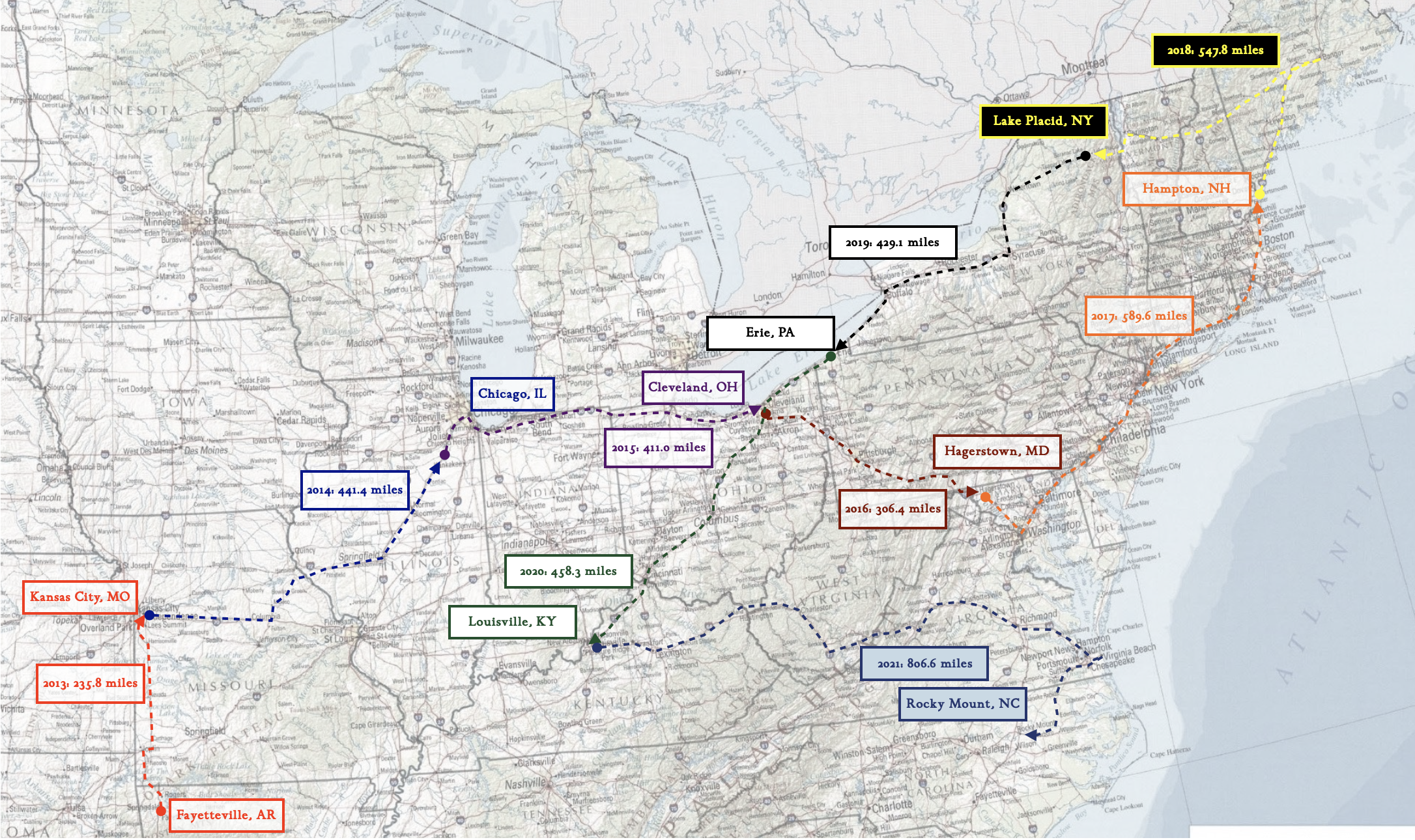
In 2021, I was back in the office, and I did a lot of walking, but I was honestly floored when I added up the totals for the year:

Total Laps in 2021: 12,031 (approximately 118 yards per lap)

Total Distance in 2021: 806.6 miles

Total Distance to date: 4,226 miles

In 2021, my totals were the equivalent of walking from Louisville, Kentucky through three (and nearly four!) state capitals: over to Lexington, Kentucky, then Charleston, West Virginia, then on to Richmond, Virginia, continuing to Virginia Beach to see the ocean again, and then heading southwest toward Raleigh, North Carolina before stopping just outside of Rocky Mount.

My goal for the year was to hit 500 miles again, something I had done previously in 2017 and 2018. Clearly, I obliterated that goal and with a total of 806.6 miles, passed my previous record by over 200 miles. I thought I had had a good mileage year, but I didn’t add up the numbers until this past week and I was shocked by the total.

Here’s to another year of reading and walking in 2022!


An Invitation

I’ve never done this before, and I apologize if it comes across as pushy or preachy, but…I think you should give Reading and Walking a try yourself.

When I started Reading and Walking eight years ago, it was a random thing I tried to help me stay awake while reading grad school textbooks, and I never could have guessed that it would become such an ingrained practice. Neither could I have guessed that it would become such a formative practice for me.

As humans, we are embodied creatures, with physical, mental, spiritual, and emotional components working together to form an integrated whole. This practice of Reading and Walking speaks to that, as over the past eight years I have studied Scripture and poured over theology, challenged myself with languages, science, and psychology, laughed and cried with novels and books on lament and injustice, all while walking over 4,000 miles. All of that to say, I remain a person with all sorts of flaws, but my health—physically, mentally, spiritually, and emotionally—is so much better than it would be without adopting this practice. It has been such a gift and has helped to form me into a better version of myself.

I invite you to give it a try yourself. Not everyone has ready access to a church auditorium to walk around, and people tell me frequently that they could never be coordinated enough to walk and read without bumping into things (though you would be surprised at how good your body gets at doing this!), but indoor walking tracks, outdoor trails, and GPS trackers are plentiful, and audiobooks are freely available at the local library that you can check out and listen to on your phone.

Read a couple dozen books while you walk a couple hundred miles. Make sure to include a healthy dose of Scripture and other authors that point you to Christ the King. Then see how you feel at the end of the year. I suspect it won’t seem like such a weird practice anymore.

Saltless Christians

In Matthew 5.13, early in the Sermon on the Mount, Jesus says,

“You are the salt of the earth, but if salt has lost its taste, how shall its saltiness be restored? It is no longer good for anything except to be thrown out and trampled under people’s feet.”

This is obviously a well-known passage, but what struck me about it this time is just how absurd the metaphor Jesus uses is and how harsh the implication of that metaphor is.

First, the absurdity: can you imagine sitting down at a restaurant with a plate of bland food and reaching for the salt only to discover that the salt had lost its flavor and was itself completely tasteless? Of course not: salt is inherently salty; it can’t be anything else. In the same way, it is absurd for someone to claim to be a Christian, and yet not “taste” anything like Christ. A saltless Christian should be an oxymoron.

And the harshness: did you catch what Jesus said about salt that had lost its taste? He said it was worthless and ought to be thrown out. So while it is absurd to have someone who claims to be a Christian but fails to exhibit the character of Christ, if that absurdity actually happens (and it does, all the time), then those “Christians” are worthless—“no longer good for anything.” Ouch.

It is very tempting for me to soften the words I just typed, but I’m not going to, because Jesus certainly didn’t soften them in the Sermon on the Mount. These words, which come right at the beginning of that sermon, are serious and weighty, and they provide sobering reminders for those of us who claim to be disciples of Jesus: (a) it is absurd for us to call ourselves Christians and then fail to resemble Him in our lives, and (b) if we do that, we are “no longer good for anything.”

According to Jesus, it is absurd for us to call ourselves Christians and then fail to resemble Him in our lives, and if we do that, we are “no longer good for anything” (Matthew 5.13). Share on X

In this loose series of Scripture Reflections, I am sharing brief thoughts spurred on by my Bible reading this year. By way of reminder, my goal for these brief posts is two-fold:

(1) To remark on aspects of the biblical text that I find to be of interest that the reader may or may not have thought about previously.

(2) When possible, to point ahead to the work and person of Jesus Christ. I believe the Bible is a unified story that points to Jesus, which means that He is frequently alluded to or foreshadowed in some way throughout the biblical canon.

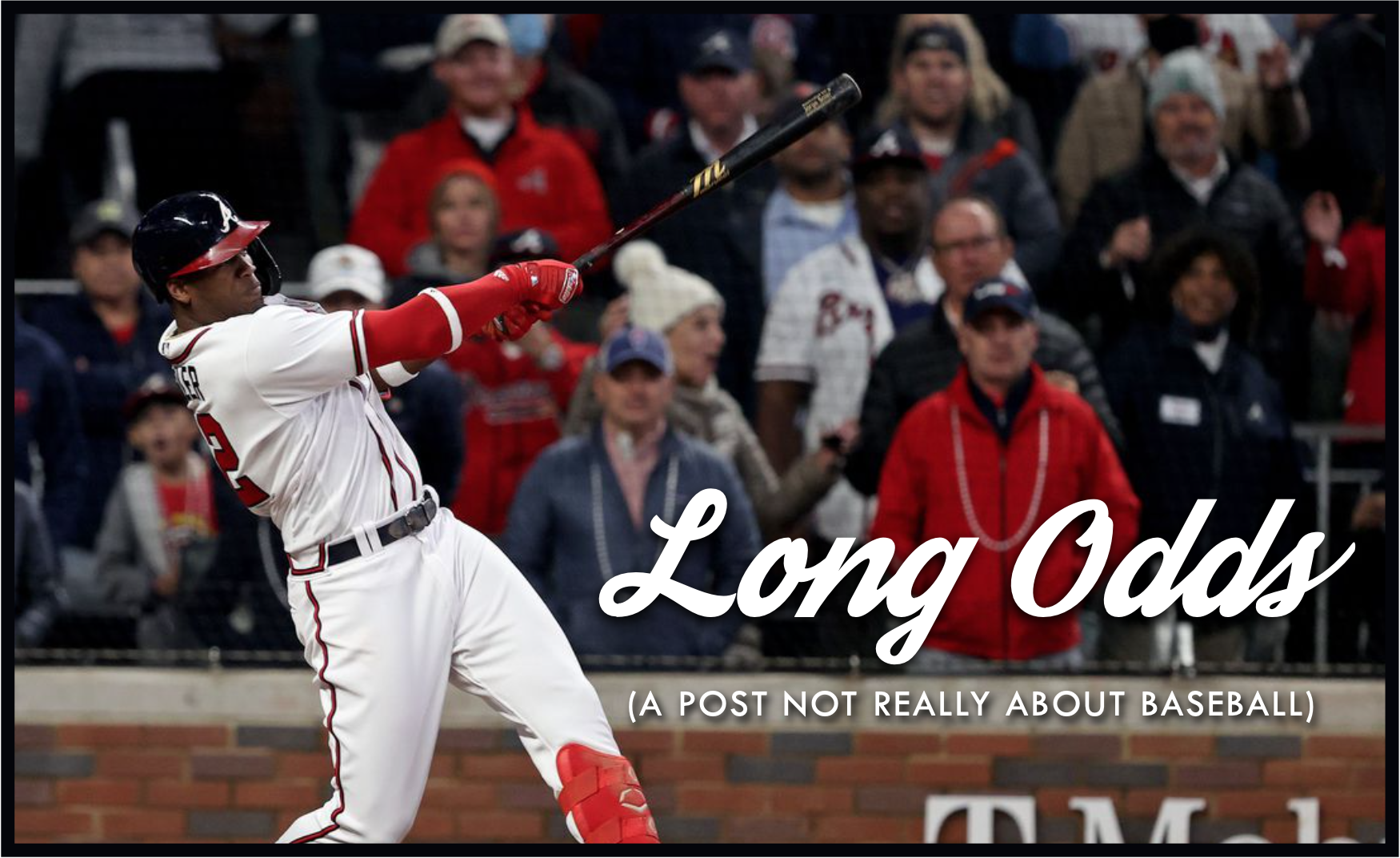
Long Odds (A Post Not Really About Baseball)

Elsa/Getty Images

My team, the Atlanta Braves, won the World Series this past Tuesday evening, defeating the Houston Astros in six games. It was their first World Series victory since 1995, when I was 12 years old. I used to write a lot about baseball and the Braves; I believe baseball is the greatest of sports, partially because of its rich history, and also because of the way that it reveals so much about life and the human condition.

This year’s Atlanta Braves is no different. Let me provide some brief context.

The 2020 Braves played really well in a COVID-shortened season, winning their division and taking the historically-good Los Angeles Dodgers to the brink of elimination in the National League Championship Series, before ultimately losing in heartbreaking fashion. Still, hopes were high for 2021; it looked like the Braves were poised to make another run at the World Series.

Then, everything went wrong.


The Braves’ projected pitching ace, Mike Soroka, who missed most of 2020 with a torn Achilles, tore it again and was lost for the season. Their biggest free-agent signing, Marcell Ozuna, was first injured and then suspended for the rest of the season after a domestic abuse incident with his ex-wife. Ronald Acuña, Jr., arguably the Braves’ best player and a legitimate MVP candidate, tore his ACL while chasing down a fly ball.

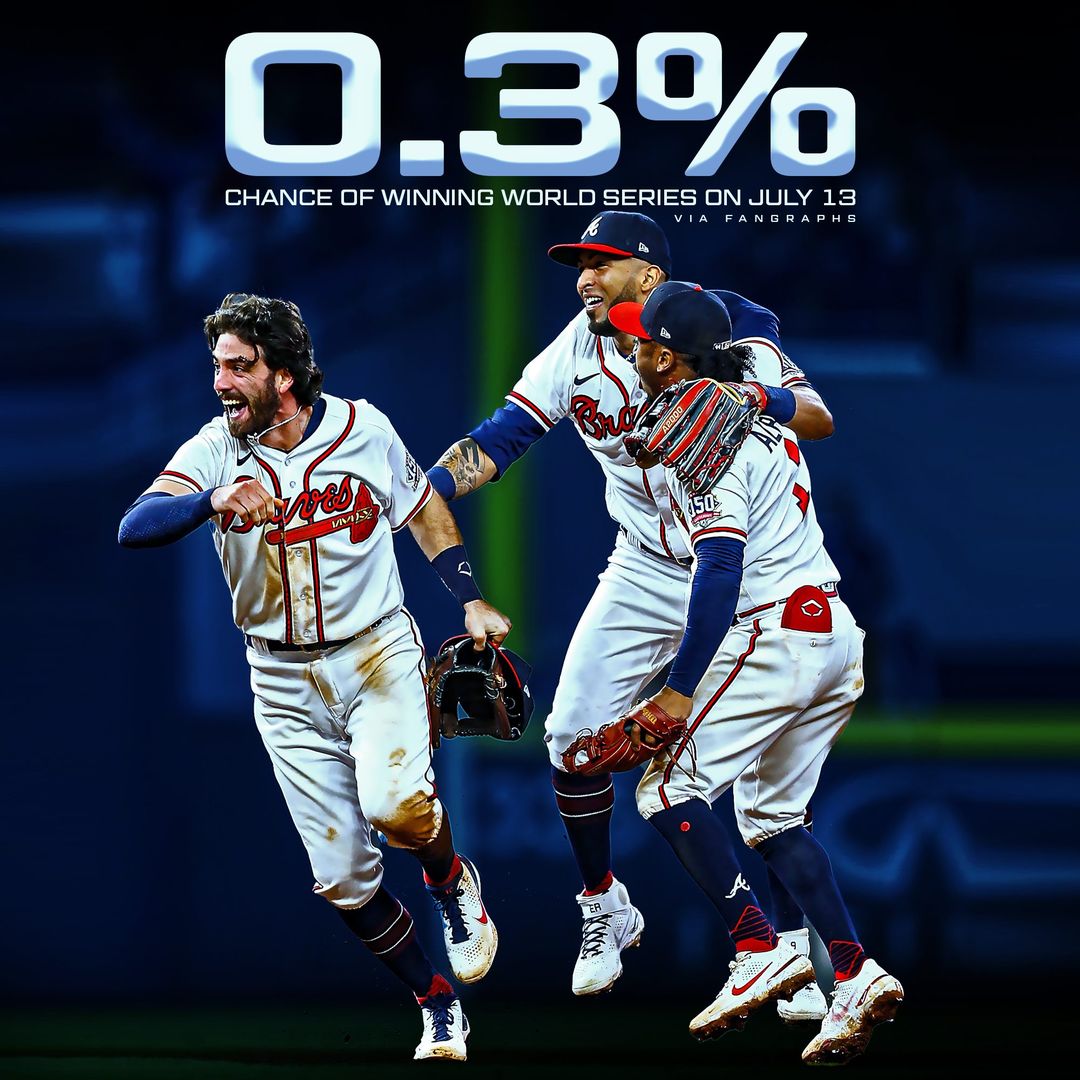
It was a really frustrating season. The Braves were still below .500 at the All-Star break, and, according to FanGraphs, by July 13, had just a 0.3% chance of winning the World Series. Those are long odds.

Against such odds, it would have been the most natural choice in the world for Braves management to throw in the towel, start selling players before the MLB trade deadline, and begin planning for next season. But that’s not what they did. Instead, believing in the team they had, they added several more pieces before the trade deadline, the season completely turned around, and three months later, they had won a World Championship.


Perhaps, you can already see where this not-really-about-baseball post is headed: how often in various aspects of life do we “listen to the odds” and throw in the towel rather than continuing to grind, maybe trying a new approach, and pressing on?

  • I’m thinking of those working or worshiping at declining churches where you just can’t envision how things might turn around…
  • I’m thinking about troubled marriages where it seems like “we’ve tried everything” and there doesn’t seem to be any hope for improvement…
  • I’m thinking of those who are trapped in patterns of sinfulness and can’t seem to break out…
  • I’m thinking of those dealing with estranged relationships with family members, unfaithful children, friendships destroyed by conflict, etc.…

The list goes on and on.


Ezekiel 37 recounts a bizarre story, where Ezekiel is taken to a valley full of bones and the LORD asks him, “Son of man, can these bones live?”

Ezekiel is very unsure about the entire situation. The bones are dry; far past life. The odds of them living again would be very long indeed. But it’s Yahweh that Ezekiel is talking to, and so he says, “O LORD, you know.” God tells him to prophesy over the bones, and as he does so, the bones come together, they are bound by sinews, and then covered with flesh and skin. Yahweh commands Ezekiel further, he prophesies again, and breath comes to the newly formed bodies. They are alive again.

This prophetic object lesson represents the house of Israel. Decimated by Babylon and taken into exile, it looked like all hope was lost. There didn’t seem to be any hope for the future. God was not finished with His people, though, and this was the message He wanted Ezekiel to understand and share.

Israel would live again, but they would be different: God would place His own Spirit within His people (Ezekiel 37.14).


To be clear, what I’m not saying in this post is that God had a hand in the Braves’ improbable World Series run, or that their season turnaround is somehow comparable to the events of Ezekiel 37. In my opinion, baseball is the greatest of all sports, but at the end of the day, it’s just a game. I don’t think that God was too concerned about who won the World Series.

Having said that, look at what can be accomplished through belief, determination, and calculated risk-taking! The Atlanta Braves of July 13 had a 0.3% chance of winning the World Series, but truly, that team didn’t win. Team management believed in the core players of the team, took risks by going out and adding additional players, and through the determination and perseverance of the revamped team, the season turned around completely. The Atlanta Braves won the World Series, but it wasn’t the same team from July. To improve their odds, they tried something different.


With all of this churning in my mind, I am left reflecting on some questions that are really not about baseball at all:

How often do we succumb to the odds simply because we give up too soon rather than continuing to struggle and persevere? It can be difficult to discern how long to stick with something that seems unlikely to work, but a common element of many success stories is the element of near despair before the turning point comes. If we throw in the towel too soon, we guarantee failure.

When the odds are long, are we willing to change the odds by taking risks and changing what we do? Churches that are declining shouldn’t continue to do all of the same things that led to decline in the first place. Those in troubled marriages need to change patterns of behavior if they want circumstances to improve.

Do we believe that God can overcome the long odds in our lives? If long odds—outcomes that seem impossible or at least very improbable—can be overcome by human effort, how much more so can this occur in circumstances where God’s guidance is being sought and where the outcome is clearly in accordance with His will? God may not care who wins the World Series, but don’t you believe He is interested in the health of His church, the healing of your marriage, or the defeat of sin in your life?

Perhaps, it all comes down to this: for those of us who worship a God who brings the dead to life, why would we be concerned about the improbable? What do long odds mean to us?

For those of us who worship a God who brings the dead to life, why would we be concerned about the improbable? Share on X

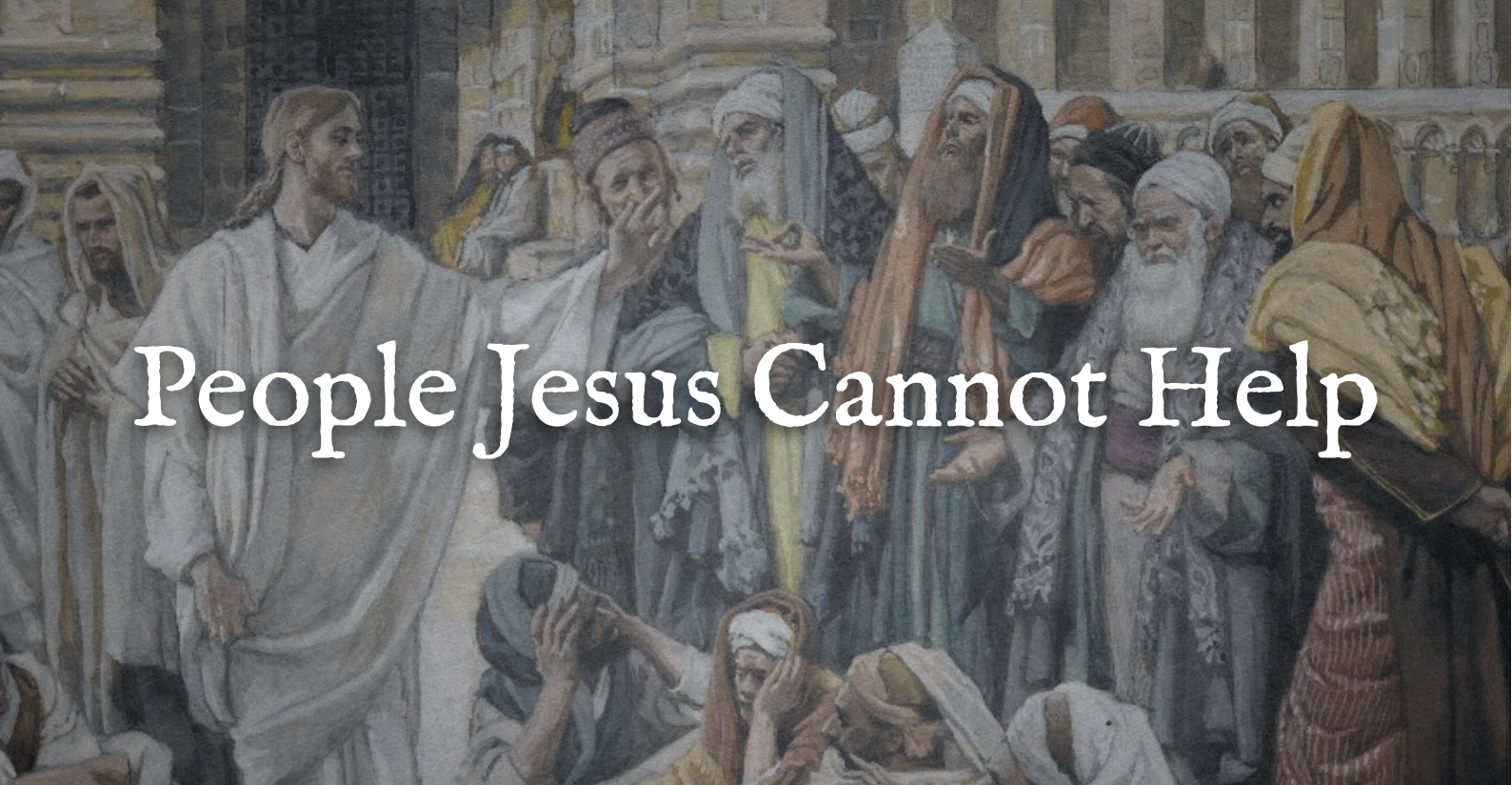
People Jesus Cannot Help

There is an interesting episode recorded in Matthew 8.10-12, in the context of Jesus calling Matthew to follow Him:

And as Jesus reclined at table in the house, behold, many tax collectors and sinners came and were reclining with Jesus and His disciples. And when the Pharisees saw this, they said to his disciples, “Why does your teacher eat with tax collectors and sinners?” But when He heard it, He said, “Those who are well have no need of a physician, but those who are sick.”

Perhaps you have heard the expression, “The church is a hospital for sinners, not a museum for saints.” I have a few quibbles with that saying, but I think it does highlight the truth that the church is not a place for people who have everything figured out, but rather, is the place for people who realize that they absolutely cannot figure everything out on their own.


The Pharisees who feuded so frequently with Jesus were the sort of people who thought they had everything figured out on their own. They thought they had cornered the market on truth and personal holiness, and had rigid codes about who they would and would not associate with. For them, it was unthinkable that a genuinely holy teacher would willingly choose to associate with those who were spiritually sick, and they made every effort to keep their distance from the sinners who were so different from them.

The Pharisees were correct that there was a difference between them and the “tax collectors and sinners”, but it wasn’t the difference they assumed. You see, like the sinners they avoided, the Pharisees were sick too, because all people sin and fall short of God’s glory (Romans 3.23). The crucial difference was that unlike the tax collectors and sinners, who recognized their spiritual sickness and craved the healing presence of the Great Physician, the Pharisees deceived themselves into thinking they were well and thus, had no need of Jesus.

To return to an earlier metaphor, hospitals can help a lot of people who are ill, but they can’t help anyone who refuses admission to the hospital because they deny that they are sick! Put in another way, all of us are sick, but those who consider themselves to be well have no use for Jesus. And that is the really tragic thing: Jesus can help anyone who can admit that they need help! It is those who stubbornly maintain that there is no problem that He can do nothing for.

Jesus can help anyone who can admit that they need help! It is those who stubbornly maintain that there is no problem that He can do nothing for. Share on X

So the question we all must ask ourselves is, “Do I (mistakenly) believe I am healthy, or do I realize that I am sick?”

When I look at a person who is lost and in bondage to sin, there is a difference between that person and myself. The difference is not that they are spiritually sick and that I am immune from such a sickness; the difference is that I have been to see the Doctor! The Great Physician has diagnosed my illness and given me a prescription of His blood!

May we always be mindful of our own inherent sickness, humble enough to accept Christ’s cure, and caring enough to share that cure with others.


In this loose series of Scripture Reflections, I am sharing brief thoughts spurred on by my Bible reading this year. By way of reminder, my goal for these brief posts is two-fold:

(1) To remark on aspects of the biblical text that I find to be of interest that the reader may or may not have thought about previously.

(2) When possible, to point ahead to the work and person of Jesus Christ. I believe the Bible is a unified story that points to Jesus, which means that He is frequently alluded to or foreshadowed in some way throughout the biblical canon.

2021 Harding University Lectureship Recap

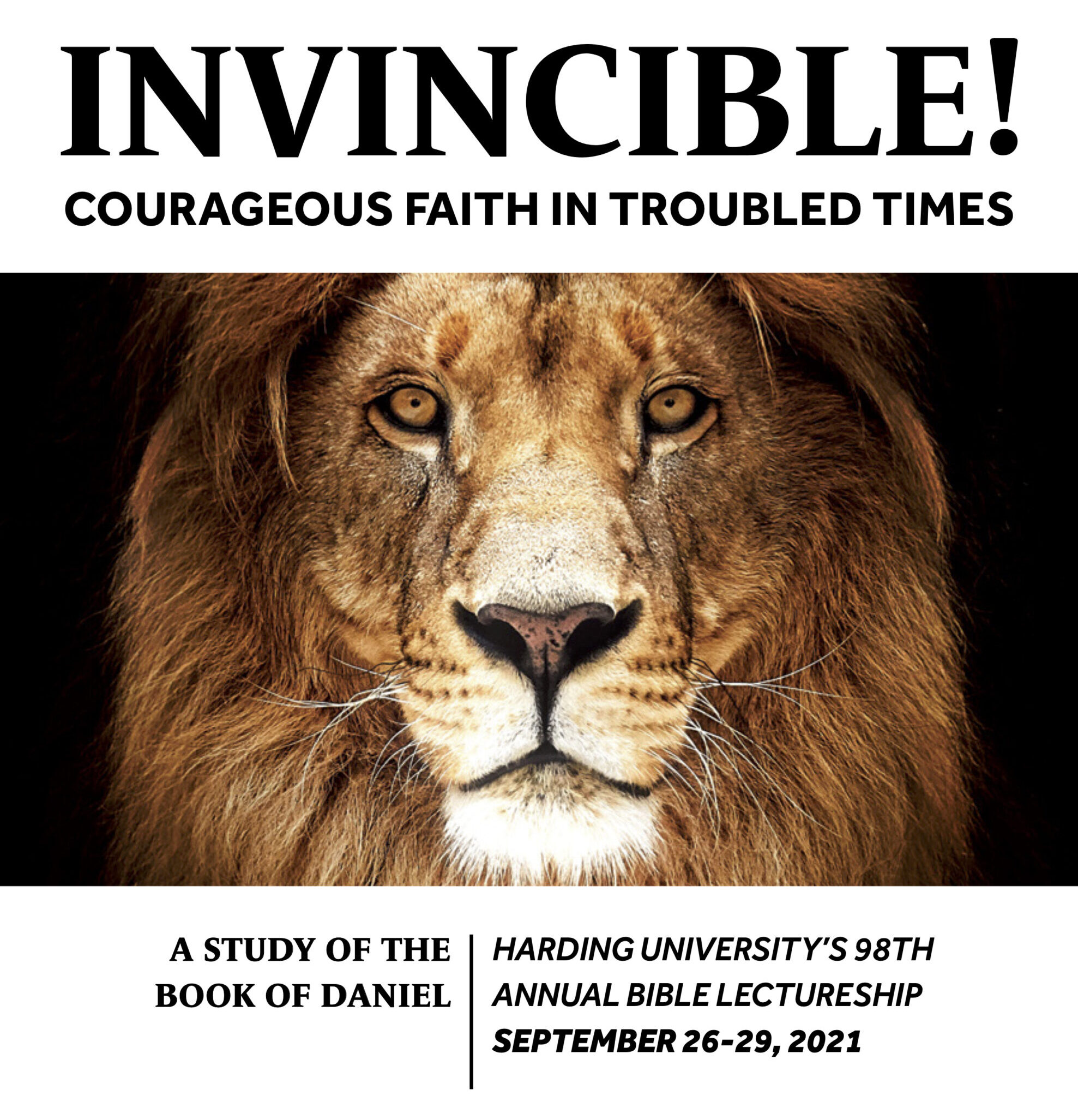
Harding University’s 98th annual Bible Lectureship was a couple of weeks ago, at the end of September. I always enjoy going to Lectureship and was bummed when it had to be canceled in 2020 due to COVID-19*. I have also developed the practice of providing a quick recap of Lectureship and the different presentations I got to attend. The theme for this year was Invincible! Courageous Faith in Troubled Times, with Daniel being the theme book.

I was privileged to attend several good lectures and classes, and here is a brief recap of what I went to, along with some takeaway quotes:

Invincible: God’s Eternal Kingdom, David Shannon: David is the President of Freed-Hardeman University, and kicked off Lectureship with this keynote on Sunday night. His emphasis was on Daniel 7, the depravity of earthly kingdoms, and the superiority of the kingdom of the Son of Man.

“The only way to overcome Satan is to belong to a kingdom with power greater than his.”

In Your Dreams, Nebuchadnezzar: There Is A God in Heaven!, Sammie Berry: Sammie is a long-time preacher at Dallas West Church of Christ, and focused on Daniel 2 and the interpretation of Nebuchadnezzar’s dream. Daniel and his friends had received the very best Babylonian training, but that had proven insufficient to decipher Nebuchadnezzar’s dream. Instead, Daniel went to his friends and asked them to pray that the God of Heaven would reveal the interpretation.

“God is in control and His children can thrive in a toxic culture.”

T.B. Larimore and Christian Identity: Respecting Conscience, United By Love, Nathan Guy: Nathan is an alumnus and the current headmaster of Mars Hill Bible School, which has historical ties to Larimore, the popular and influential second-generation Restoration Movement teacher and preacher. Larimore was known for his devotion to peace and unity, and Guy described him as a man of the Book, a man of peace, and a man who left minor matters alone.

“No word of bitterness shall ever fall from my lips, even in self-defense. I shall certainly never retaliate.”

(Larimore)

A Supernatural Cast of Characters, Dan Oden: Dr. Oden teaches Old Testament at Harding, and was one of my professors at Harding School of Theology. His lecture focused on some of the supernatural figures in the book of Daniel and tracked points of comparison with Divine Council motifs from the Ancient Near East. I thought he did an excellent job in making a challenging and scholarly topic accessible and compelling for his audience.

“When we put our faith in God, the Cloud-Rider, we become Sons of God.”

In the University of Babylon: Daring to Be Different, David Hunzicker: David serves as one of the ministers at the North Boulevard Church of Christ in Murfreesboro, TN. I had never heard him before, but his was perhaps my favorite of all the lectures I heard. He focused on the clash between the kingdom of Babylon and the kingdom of God, and for those of us who belong to the latter, offered the following encouragements: (1) If you have been stunned silent by Babylon, speak up; (2) If you have developed bitterness toward Babylon, look up; (3) If you have compromised to Babylon, stand up.

 “Seize every opportunity to show where your true loyalty lies.”

History in His Story: Biography and Archaeology of the Life of Jesus, Kevin Burr: This lecture was technically off-schedule, but was another of my favorite presentations. Kevin is the Minister of Discipleship at the Kings Crossing Church of Christ in Corpus Christi and also received his Ph.D. from Asbury Seminary where he wrote a dissertation combining the fields of historiography and Jesus studies. This presentation reflected on the gospels as Greco-Roman biographies and applied some of the historian’s tools of the trade to the New Testament.

“If an author is generally reliable in areas we can check them, it is reasonable to infer they are generally reliable where we can’t.”

In the Fiery Furnace: Demonstrating Courage Under Fire, Phil Brookman: Phil preaches for the Memorial Road Church of Christ in OKC, and I always enjoy hearing him. He focused on the story of Shadrach, Meshach, and Abednego, and the idea of resistance: this is not a story of how to avoid death, but how to live life: when we practice resistance, we are fully alive.

“For Christians, resistance is vital; without it, we become weak and ineffective.”

Courageous Faith in the Face of Persecution (Parts 1-2), Mani Pagidipalli: Mani was a classmate of mine at HST, and is a remarkable individual, who serves as both a medical surgeon and preacher. He gave a moving presentation of the persecution of Christians in India.

“If you feel like you are living under Nebuchadnezzar, be like Daniel. No whining, no complaining, no “woe is me”, no “it’s not fair”. Just a willingness to be God’s servant wherever and whenever to whomever.”

Pledging Allegiance: Unpacking Images of Authority in the Books of Daniel and Revelation, Part 1, Alan Howell and Garrett Best: Alan is the Missionary in Residence at Harding, and Garrett preaches for the Oliver Creek Church of Christ in the Memphis area and just recently wrote his dissertation on the book of Revelation. This was a really neat presentation that combined biblical studies with missiology. The basic thesis was that proper interpretation of symbols of authority is important for navigating both our cultural settings and the contours of Scripture. Garrett examined symbols of power in the book of Revelation, and Alan talked about symbols of power in Mozambique and interpreting Revelation for that context.

“Revelation takes imperial propaganda, subverts it, and reorients it to Jesus.”

Arkansas College: “A Sacrifice to the Fierce Spirit of War and Destruction”, Allen Diles: Allen teaches church history at Harding, and did a really fine job with this presentation. I have done research on Robert Graham and the creation of Arkansas College, so this was of special interest to me. Diles provided a helpful review of things I had studied a few years ago, but also taught me a good bit of new information about the college (my focus was more on Graham than the school itself). Ultimately, the story of Arkansas College is a tale of tragedy, as a really promising and prestigious school was destroyed in the flames of the Civil War.

“Winds of secession began to swirl, and Arkansas College was not exempt from the storm.”

The Handwriting on the Wall: God is Not Mocked!, Jason Darden: Jason teaches Bible at Harding, preaches at the West Pleasure Church of Christ, and is someone I always enjoy hearing. He focused on the story of Belshazzar, who mocks God by using sacred vessels taken from the Jerusalem temple by Nebuchadnezzar (likely his grandfather) for a wild party. But God is not mocked, and will not have His vessels misused.

“Belshazzar had to have known [the story of Nebuchadnezzar’s humbling]. But he learned nothing!”

Written in the Book: God Gives a Hope Beyond the Grave, Jeff Jenkins: I have known of Jeff for several years in his work as the preacher of the Lewisville Church of Christ in the Dallas area as well as The Jenkins Institute, but this was my first opportunity to hear him preach. This keynote didn’t interact with the text from Daniel as much as I would have hoped, but it was an excellent message on the importance of biblical hope in difficult times. Jeff emphasized that biblical hope is tied to the appearing of Christ: His first appearing brought grace, and His second appearing will bring glory (Titus 2.11-14).

“Biblical hope is not wishful thinking.”

The Coddling of the Christian Mind, Bob Turner: Bob preaches for the Church of Christ at White Station in Memphis, and formerly worked in the library at Harding School of Theology. I always love to listen to Bob; he is a great thinker, and an outstanding cultural exegete. In this lecture, Bob talked about the well-known The Coddling of the American Mind, and applied the lessons therein to Christian faith by refuting three popular myths: (1) What doesn’t kill you makes you weaker, (2) Always trust your feelings, (3) Life is a battle between good people and evil people.

“If you demonize people who are just like you, what are you going to do with people who are different?”

The Biggies: Teaching the Essentials of the Christian Faith, Scott Adair: Scott teaches in the Bible department at Harding, and this class was a representation of the major project that he has been working on for the last few years. Scott shows how the practice of baptism encapsulates the core doctrines of the Christian faith: (1) Jesus Christ is Lord, Son of God; (2) A Belief in One God, who is Father, Son, and Spirit; (3) The Death and Resurrection of Jesus; (4) The Church as the Assembly of the Saints; (5) Forgiveness of Sins; (6) The Gift of the Holy Spirit; (7) Resurrection of the Dead. I love Scott’s work in this area, teach it regularly to my teenagers, and believe it can be an invaluable tool to help us discern whether or not a church conflict is related to a foundational matter.

“The New Testament is a compilation of apostolic documents written primarily to remind churches or individuals of the gospel they received, to establish them further in the gospel, and to hold them accountable to the ethical demands of the gospel.”

As He Had Done Before: Persisting in Prayer, Bruce McLarty: Lectureship ended with a bang, as Dr. McLarty returned to Harding for the first time since he was retired as Harding’s President last fall. He received a standing ovation and predictably did a wonderful job emphasizing Daniel’s long life of persistent faithfulness while living in exile. Daniel’s story gives us a wider perspective that reveals God’s faithfulness to the Hebrew exiles, and Bruce finished with a stirring declaration of God’s faithfulness to us today, despite whatever difficulties and challenges we may face.

“Daniel’s strategy was not to change Babylon or Persia; it was to not let Babylon or Persia change him.”

As always, Lectureship was a blessing for me, and it was especially nice to be able to attend again after the necessary cancellation last year. I would highly recommend taking part in this next year if you are able!


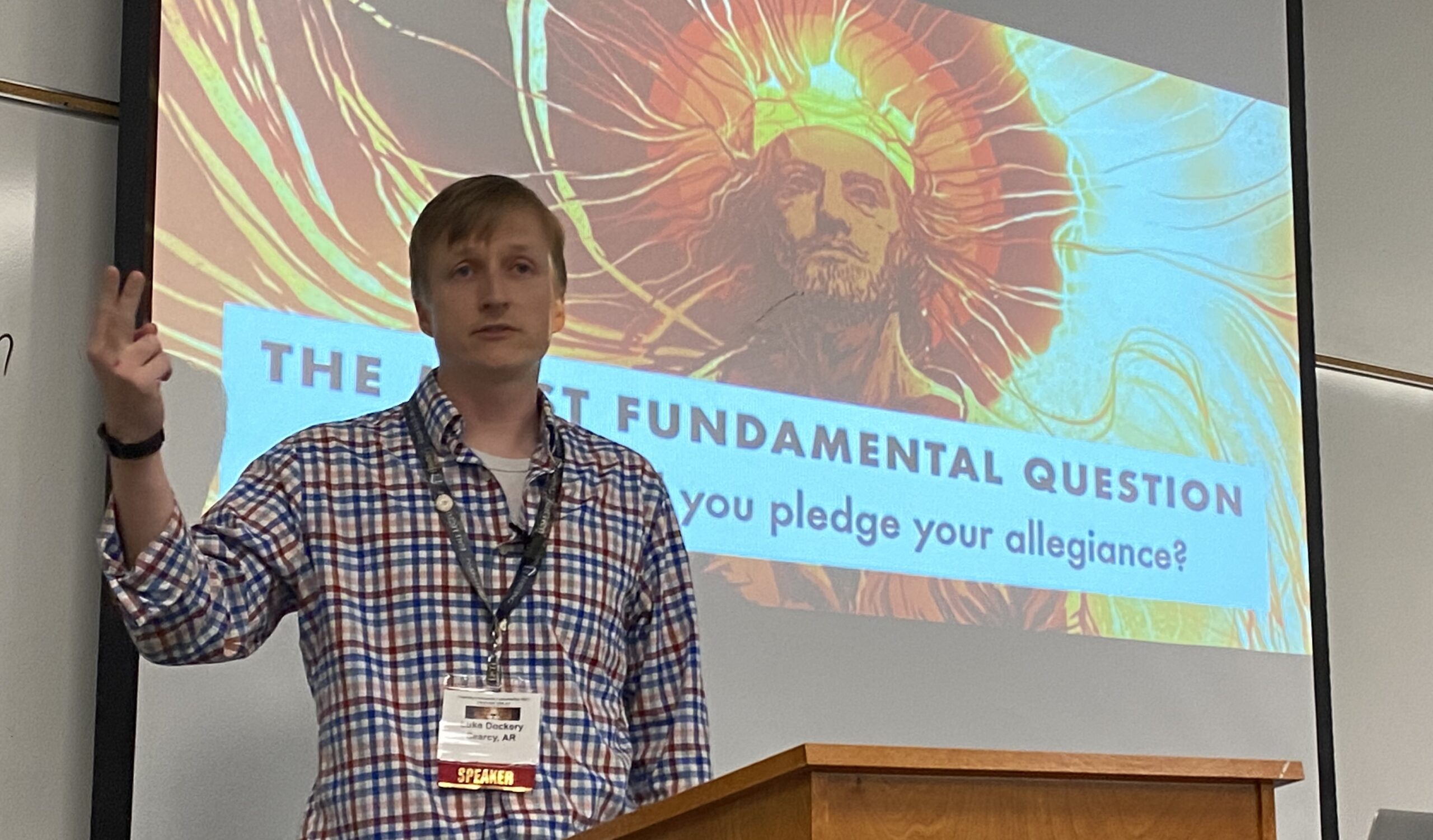
I was honored to have the opportunity to present this year as well, as part of the youth ministry track. My lecture was entitled, Allegiance to the King: Single-minded Devotion in a World of Divided Loyalties, and focused on the faith of American teenagers (and adults), Hananiah, Mishael, and Azariah, and some important ideas from Matthew Bates’s Salvation By Allegiance Alone. I will likely share more of that content at some later time, but it was studying for this year’s presentation was a great blessing to me, and I am glad to have done it.

*Technically, it wasn’t canceled and was still offered online in a scaled-back, modified fashion. But really, it was canceled.

« Older posts Newer posts »

© 2026 The Doc File

Theme by Anders Noren — Up ↑