Elsa/Getty Images
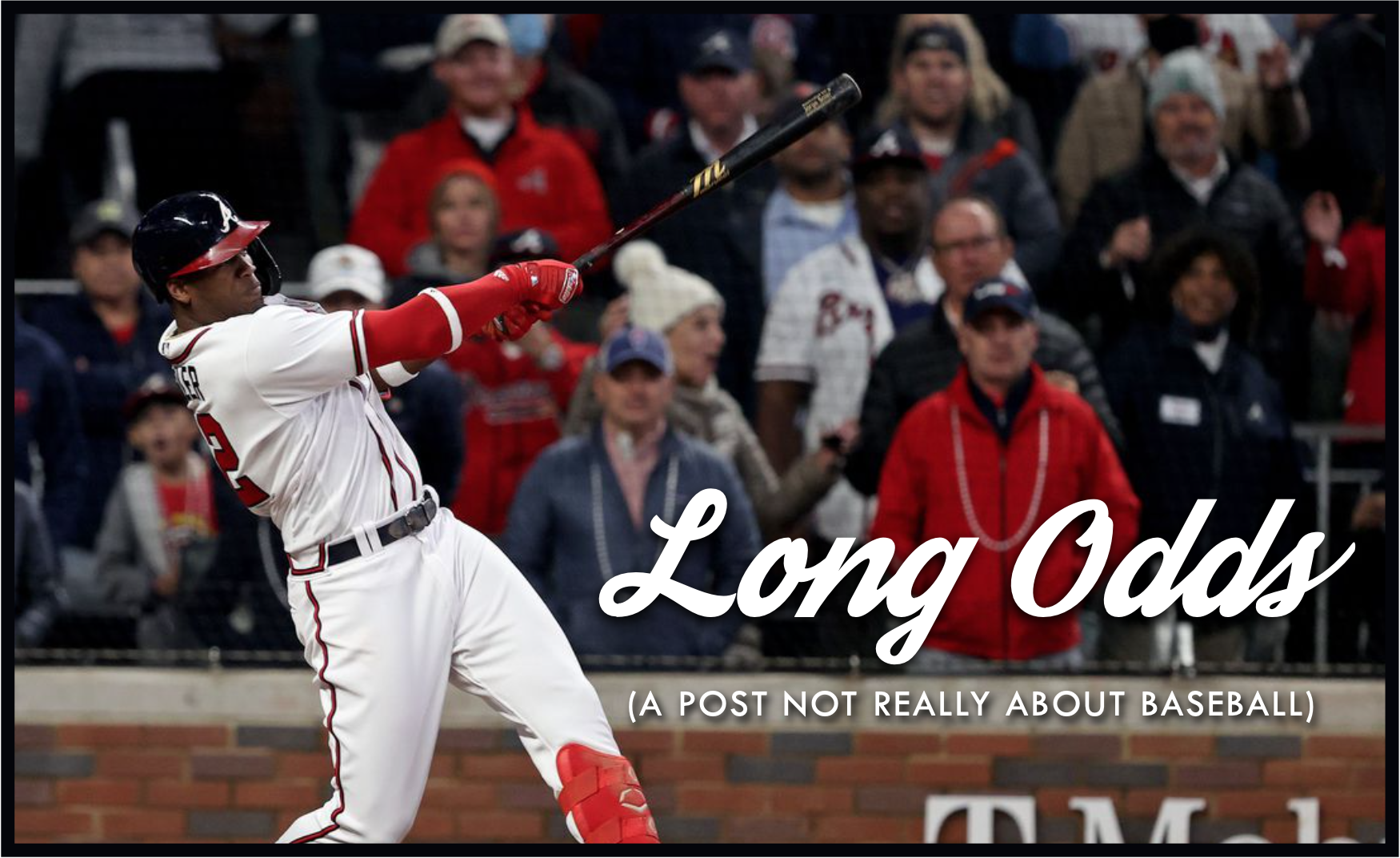
My team, the Atlanta Braves, won the World Series this past Tuesday evening, defeating the Houston Astros in six games. It was their first World Series victory since 1995, when I was 12 years old. I used to write a lot about baseball and the Braves; I believe baseball is the greatest of sports, partially because of its rich history, and also because of the way that it reveals so much about life and the human condition.
This year’s Atlanta Braves is no different. Let me provide some brief context.
The 2020 Braves played really well in a COVID-shortened season, winning their division and taking the historically-good Los Angeles Dodgers to the brink of elimination in the National League Championship Series, before ultimately losing in heartbreaking fashion. Still, hopes were high for 2021; it looked like the Braves were poised to make another run at the World Series.
Then, everything went wrong.
The Braves’ projected pitching ace, Mike Soroka, who missed most of 2020 with a torn Achilles, tore it again and was lost for the season. Their biggest free-agent signing, Marcell Ozuna, was first injured and then suspended for the rest of the season after a domestic abuse incident with his ex-wife. Ronald Acuña, Jr., arguably the Braves’ best player and a legitimate MVP candidate, tore his ACL while chasing down a fly ball.
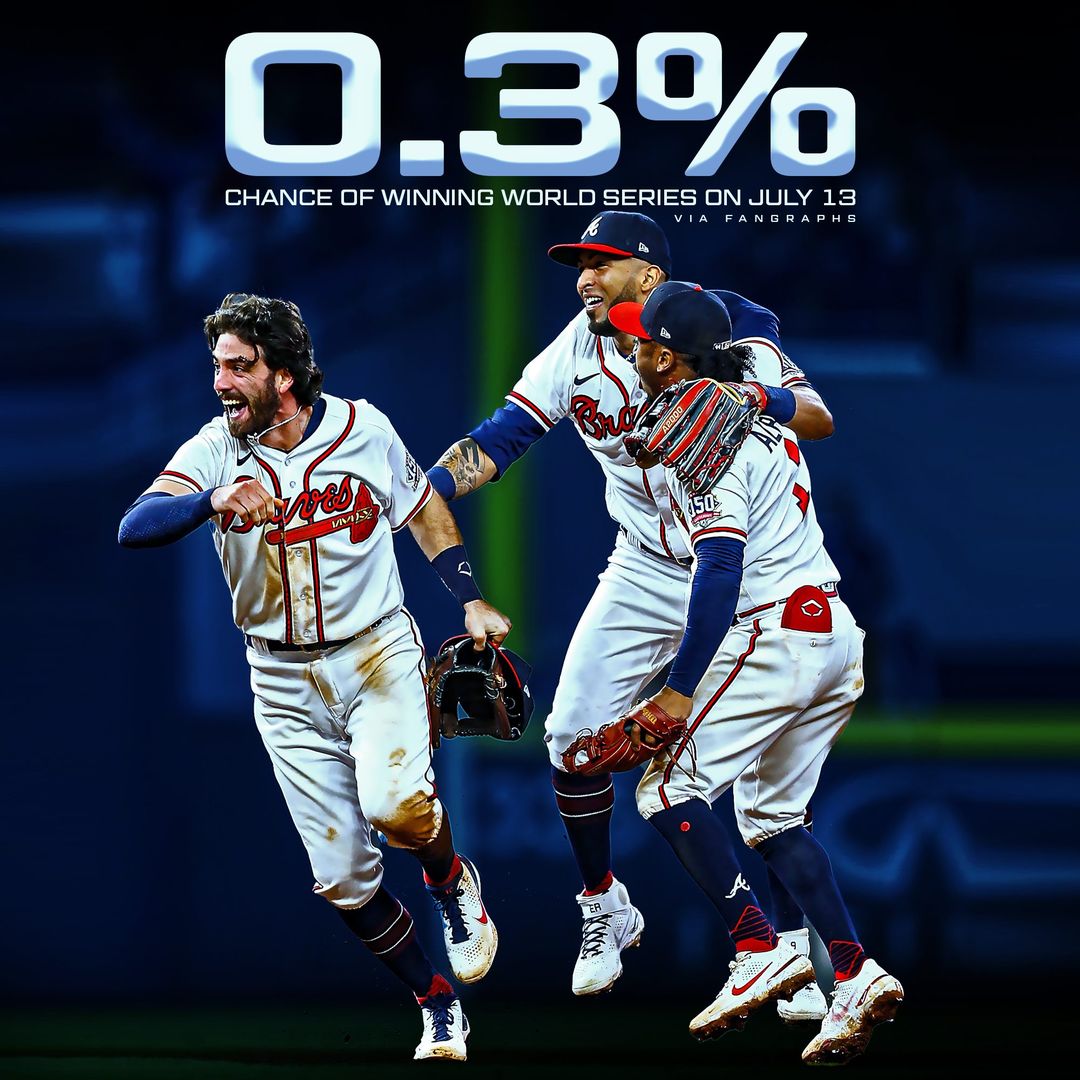
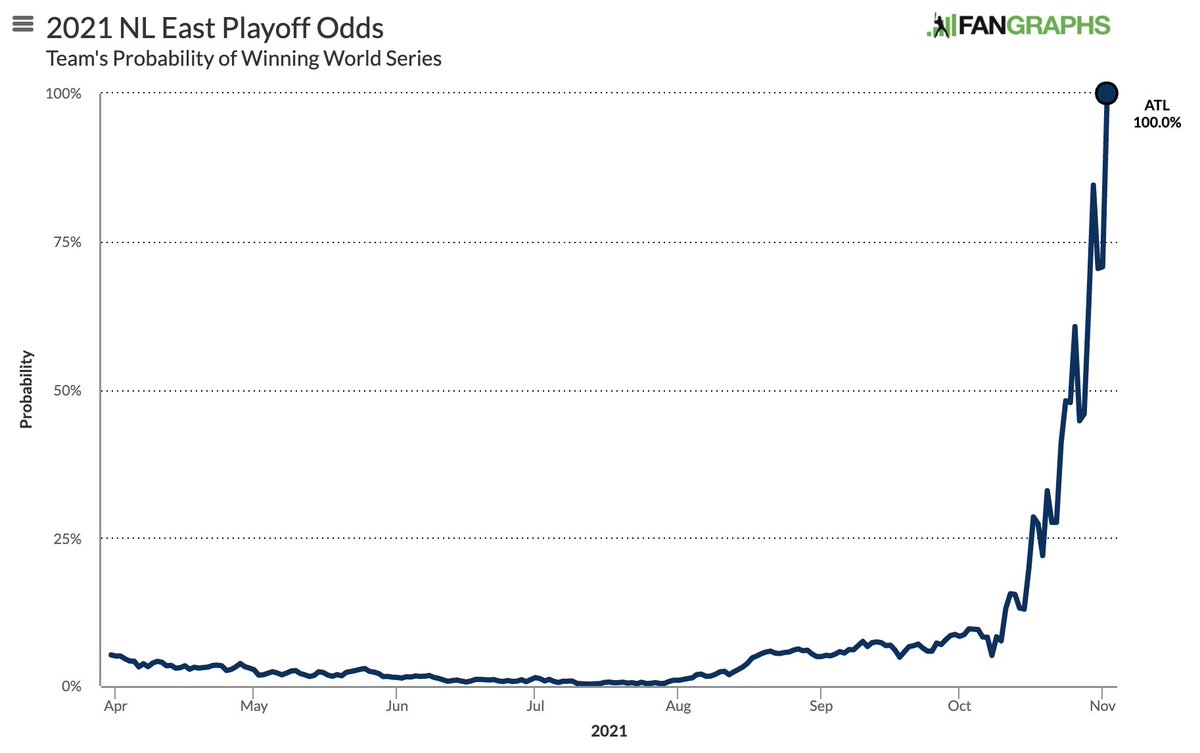
It was a really frustrating season. The Braves were still below .500 at the All-Star break, and, according to FanGraphs, by July 13, had just a 0.3% chance of winning the World Series. Those are long odds.
Against such odds, it would have been the most natural choice in the world for Braves management to throw in the towel, start selling players before the MLB trade deadline, and begin planning for next season. But that’s not what they did. Instead, believing in the team they had, they added several more pieces before the trade deadline, the season completely turned around, and three months later, they had won a World Championship.
Perhaps, you can already see where this not-really-about-baseball post is headed: how often in various aspects of life do we “listen to the odds” and throw in the towel rather than continuing to grind, maybe trying a new approach, and pressing on?
- I’m thinking of those working or worshiping at declining churches where you just can’t envision how things might turn around…
- I’m thinking about troubled marriages where it seems like “we’ve tried everything” and there doesn’t seem to be any hope for improvement…
- I’m thinking of those who are trapped in patterns of sinfulness and can’t seem to break out…
- I’m thinking of those dealing with estranged relationships with family members, unfaithful children, friendships destroyed by conflict, etc.…
The list goes on and on.
Ezekiel 37 recounts a bizarre story, where Ezekiel is taken to a valley full of bones and the LORD asks him, “Son of man, can these bones live?”
Ezekiel is very unsure about the entire situation. The bones are dry; far past life. The odds of them living again would be very long indeed. But it’s Yahweh that Ezekiel is talking to, and so he says, “O LORD, you know.” God tells him to prophesy over the bones, and as he does so, the bones come together, they are bound by sinews, and then covered with flesh and skin. Yahweh commands Ezekiel further, he prophesies again, and breath comes to the newly formed bodies. They are alive again.
This prophetic object lesson represents the house of Israel. Decimated by Babylon and taken into exile, it looked like all hope was lost. There didn’t seem to be any hope for the future. God was not finished with His people, though, and this was the message He wanted Ezekiel to understand and share.
Israel would live again, but they would be different: God would place His own Spirit within His people (Ezekiel 37.14).
To be clear, what I’m not saying in this post is that God had a hand in the Braves’ improbable World Series run, or that their season turnaround is somehow comparable to the events of Ezekiel 37. In my opinion, baseball is the greatest of all sports, but at the end of the day, it’s just a game. I don’t think that God was too concerned about who won the World Series.
Having said that, look at what can be accomplished through belief, determination, and calculated risk-taking! The Atlanta Braves of July 13 had a 0.3% chance of winning the World Series, but truly, that team didn’t win. Team management believed in the core players of the team, took risks by going out and adding additional players, and through the determination and perseverance of the revamped team, the season turned around completely. The Atlanta Braves won the World Series, but it wasn’t the same team from July. To improve their odds, they tried something different.
With all of this churning in my mind, I am left reflecting on some questions that are really not about baseball at all:
How often do we succumb to the odds simply because we give up too soon rather than continuing to struggle and persevere? It can be difficult to discern how long to stick with something that seems unlikely to work, but a common element of many success stories is the element of near despair before the turning point comes. If we throw in the towel too soon, we guarantee failure.
When the odds are long, are we willing to change the odds by taking risks and changing what we do? Churches that are declining shouldn’t continue to do all of the same things that led to decline in the first place. Those in troubled marriages need to change patterns of behavior if they want circumstances to improve.
Do we believe that God can overcome the long odds in our lives? If long odds—outcomes that seem impossible or at least very improbable—can be overcome by human effort, how much more so can this occur in circumstances where God’s guidance is being sought and where the outcome is clearly in accordance with His will? God may not care who wins the World Series, but don’t you believe He is interested in the health of His church, the healing of your marriage, or the defeat of sin in your life?
Perhaps, it all comes down to this: for those of us who worship a God who brings the dead to life, why would we be concerned about the improbable? What do long odds mean to us?
For those of us who worship a God who brings the dead to life, why would we be concerned about the improbable? Share on X






