The online journal of Luke Dockery

Category: Discipleship (Page 10 of 23)

2022 Harding University Lectureship Recap

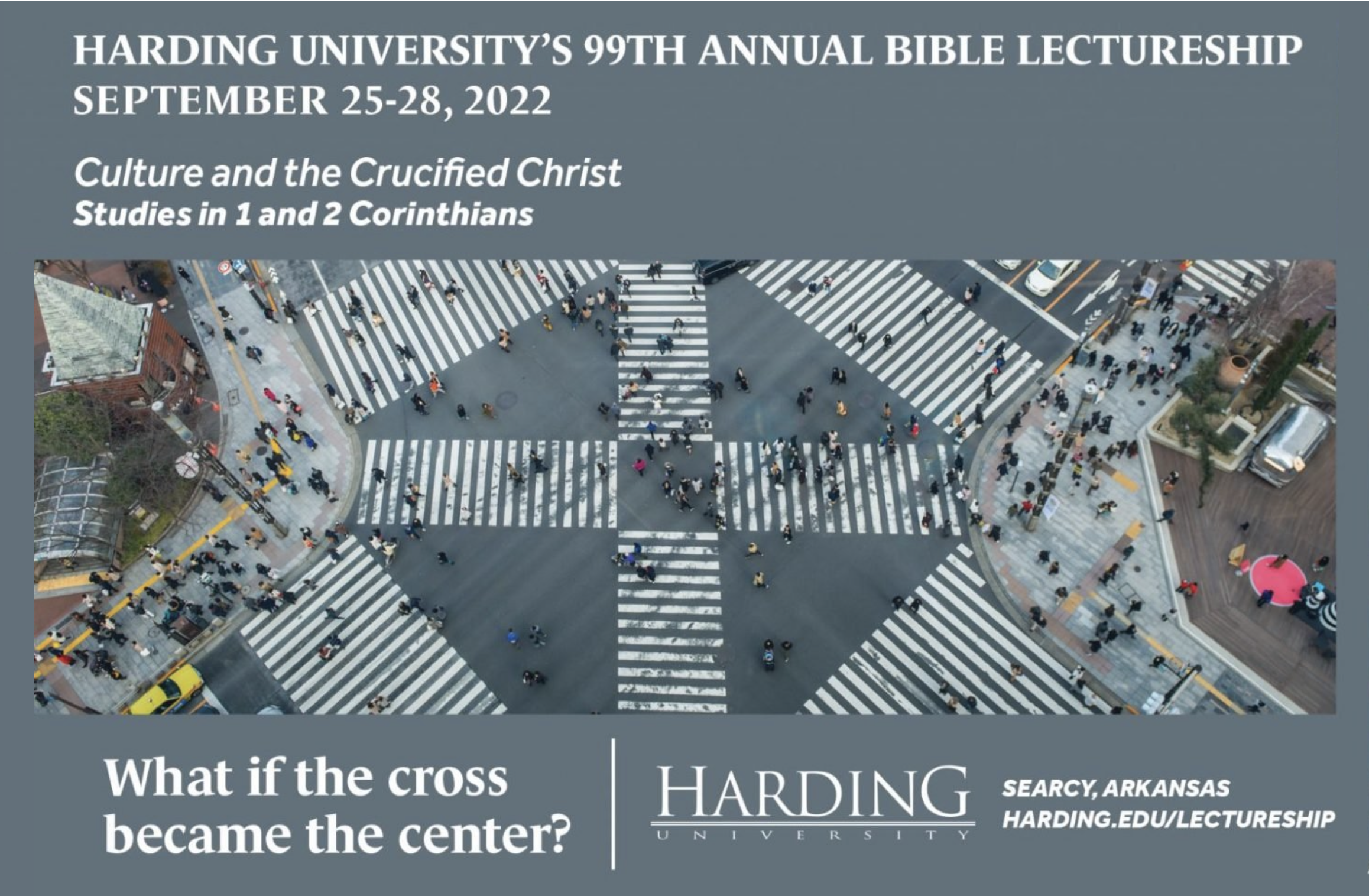
Harding University’s 99th annual Bible Lectureship was a couple of weeks ago, at the end of September. I always enjoy going to Lectureship, and have developed the practice of providing a quick recap of Lectureship and the different presentations I got to attend. The theme for this year was Culture and the Crucified Christ: Studies in 1 and 2 Corinthians.

I was privileged to attend several good lectures and classes, and here is a brief recap of what I went to, along with some takeaway quotes:

United In Mind and Purpose (1 Corinthians 1.10-17), Mike Williams: Mike is the new president of Harding, and kicked off Lectureship with this keynote on Sunday night. He focused on Paul’s correction of the factionalism of the church in Corinth, and reflected on how, in many ways, we live in a society that is primed for fragmentation. As the church, we must do better. (I agree!)

“If love and unity reveal God’s presence, does division reveal His absence?”

Corinth and Vicinity, Dale Manor: Dr. Manor is a treasure—a classically-trained archaeologist with a wealth of information about the ancient world, and I try to catch one of his lectures each year. He gave a good overview of the geographic/topographic background of Corinth, and how it helps us to understand some of the content of the Corinthian correspondence. This was fascinating if you are interested in history, culture, or archaeology, and, as always, Dr. Manor spoke to an overflowing room.

“Paul appropriated commercial, cultural, and political contexts to teach.”

Paul’s Use of the Old Testament in 1-2 Corinthians, Kevin Youngblood: Dr. Youngblood teaches Bible at Harding, is a top-notch biblical scholar, and always has great material. This was a particularly insightful lecture, as he established how direct quotations, allusions, and echoes from the Old Testament are woven throughout 1 Corinthians. He shared the following “Big Picture Implications”, which I thought were worth repeating here:

  1. Apostolic authority does not render Old Testament authority unnecessary or redundant.
  2. The church is reliving Israel’s experience and is therefore vulnerable to Israel’s mistakes.
  3. The Christ event and the ongoing ministry of the church are the culmination of prophetic vision.
  4. Creational principles outlined in Genesis are universal and enduring.
  5. Not every Old Testament reference Paul makes is intended to be a formal interpretation of the text (rhetorical use of Scripture).

“We are saved by faith; we are also lost by faith. A pattern of unbelief prevents us from entering the Promised Land.”

Discipleship in a Secular Age: Toward Missional Community, Greg McKinzie: Greg is a former missionary, an adjunct professor at Lipscomb University, and the editor of Missio Dei journal. Greg is a brilliant guy, and I wish he could have had a bit more time. He was engaging some difficult material (the philosophical work of Charles Taylor), and he just didn’t have enough time to say everyone he wanted to say. Still, he had some valuable things to say, including the following statement (which, to me, was sobering):

“Discipleship talk is increasing in proportion to the decline of the American church…with little effect.”

Washed, Sanctified, Justified (1 Corinthians 6.9-20), Leonardo Gilbert: Leonardo serves as the minister of the Sheldon Heights Church of Christ in Chicago, and this was my first opportunity to get to hear him. He gave a rousing message emphasizing the importance of our witness as Christians, the necessity of realizing that there is a spiritual war waging all around us, and the encouragement that comes from remembering that the Spirit of God Himself resides within us.

 “Being a Christian is like getting into a boxing ring. Sometimes you’re going to get hit. But the fight is fixed.”

Becoming a Spiritual People: Discipleship for Unity (1 Corinthians 3.1-6), Kevin Burr: Kevin is the Minister of Discipleship at the Kings Crossing Church of Christ in Corpus Christi, and also one of my best friends. In his session, he look at the factionalism that was present in Corinth and Paul’s teaching on the diversity of God’s gifts leading to the unity and health of the Body of Christ. His practical suggestions for developing unity in our churches:

  1. Recognize our God-given gifts in each other.
  2. Put our God-given gifts to work.
  3. Value our God-given gifts.

“If we belittle others because their gifts look different than ours, we have failed the test of unity.”

Your Body is God’s Temple: Sexual Ethics (1 Corinthians 6.12-20), Keith Stanglin: Keith is a former professor at Harding and Austin Graduate School, and currently serves as the director of the Center For Christian Studies. In this session, he examined sexual ethics in Scripture through the teaching of Jesus, and then Paul in 1 Corinthians 5-7.

“Jesus relied on the Bible [for His views on sexual ethics] and evidences moral rigor regarding sex.”

God and the Founding Fathers, Jared Dockery: It was cool to go to a lecture taught by my brother, who is a history professor at Harding. This was a really interesting class to me, because we looked at the positions of several Founding Fathers—Patrick Henry, Roger Sherman, Benjamin Franklin, Thomas Jefferson, John Adams, and George Washington—on several topics—belief in God, Christ’s divinity, providence, and the civic benefit of religion. I thought it was a helpful and nuanced presentation on a challenging and contentious subject.

“The Founders were clearly not trying to establish a rigidly secular society.”

All Things to All People (1 Corinthians 9.19-23), Monte Cox: Dr. Cox is the Dean of the College of Bible and Ministry, and is always one of my favorite speakers. He delivered the Tuesday evening keynote, and did a good job providing an overview of 1 Corinthians 6-10, showing how the idea of rights is woven throughout that section: Paul repeatedly tells the Corinthian Christians that their rights are not the only issue to be considered.

“Too many of us have been preoccupied for too long with defending our rights instead of relinquishing our rights for the sake of the gospel.”

We Do Not Lose Heart: Longevity in Ministry, Jim Martin: Dr. Martin is the Vice President of Harding School of Theology, and also one of the most encouraging people I know. He offered a lot of really practical wisdom in this session related to things that can cause ministers to lose their way, as well as common characteristics of long-term ministers.

“Do I desire to be married to a church, or just date a church? Marriages are hard—you are committed for good and bad times, and you open yourself up for pain.”

Helping Your Church Stay on Mission, Steve Cloer: After preaching for several years in Ft. Worth, Steve is now in Memphis, where he teaches at Harding School of Theology and directs the Doctor of Ministry program there. Steve started with a discussion of Acts 6, where a legitimate issue that needed addressing ran the risk of distracting the apostles from their mission. The church runs into all sorts of issues and barriers today that can be a distraction as well. How can the church stay on mission?

  1. Solid preaching on the mission of God.
  2. Spend significant time in the neighborhood, which provides a motivation and an entry-point for mission.
  3. Tell stories about what God is doing among us.

“Churches are going to focus on something. The leader must help them focus on mission, becuase if they don’t, churches are going to focus on all sorts of things.”

Head Coverings and Headship in 1 Corinthians 11, Rick Oster: Dr. Oster was one of my favorite professors at HST, and he had a packed house as he addressed a challenging and controversial passage in 1 Corinthians. Oster’s scholarly work is in New Testament text and especially the historical backgrounds of the text, and he presented his perspective that the Roman practice of having the person leading a religious ceremony (whether male or female) wear a veil lies behind Paul’s instructions in the first part of 1 Corinthians 11. The Corinthian church was continuing this practice, which would have been strange to those from other backgrounds (Jewish, Greek, North African, etc.), and Paul was concerned that it would confuse the Christians there about the biblical teaching of male headship. Oster’s interpretative take here is certainly not the only one, and I don’t believe he makes an airtight case, but he does make a plausible one (reconstructing the historical background of a one-sided conversation is always challenging).

“Paul is not concerned that both genders are prophesying; he is concerned that, visually, they are undermining the teaching of male headship.”

Men and Women in Church Leadership (1 Corinthians 14.26-40), Allen Black: Dr. Black was another of my favorite teachers at HST, and he continued the theme of handling a controversial text in front of a big crowd on Wednesday afternoon. I thought Dr. Black did a great job, talking about how we approach different texts that seem to be in tension with one another (like 1 Corinthians 11 where women are mentioned as praying and prophesying and 1 Corinthians 14 where women are told to keep silent), outlining various approaches to the disputed portions of 1 Corinthians 14.26-40, and presenting his own views. Perhaps the most edifying portion of his lecture for me was the way he talked about the views of John Mark Hicks, who he regards as a close friend, but disagrees with on this issue; this was a model of respectful and gracious disagreement.

“The ideal is self-sacrificial male leadership.”

Raised in Power (1 Corinthians 15.35-58), Jonathan Storment: Jonathan preaches at the Pleasant Valley Church of Christ in Little Rock, and is always a joy to listen to, as he is an engaging and thoughtful speaker. Storment talked about the Christian emphasis on the value of the body as part of God’s good creation, and emphasized the stark differences between the Secular Story and the Christian Story. Among some things that he said that I found really insightful:

  • In our current (secular) society, both conservatives and liberals operate from a functionally atheist perspective. Conservatives say there is no God, so we must fight to preserve our way of life; liberals say there is no God, so no one can tell me what to do.
  • At the roots of postmodernism are the philosophies of Marx, Freud, and Nietzsche, who were all deeply suspicious of love (i.e. the Christian value). For Marx, it was all about money, for Freud, it was all about sex, and for Nietzsche is was all about power.

“Beneath this [the Secular Story] is nothing but despair.”

“You don’t bury a Christian; you plant him.”


In addition to attending all of the lectures described above, I also had the opportunity to moderate a panel on discipleship in youth ministry, and contribute to another class on adult Bible class resources. I also taught my youth ministry college class one night, coached third base at my son’s baseball game another night, had a few meetings, and hosted two guests in my home. It was a busy week!

I was blessed to attend Lectureship this year, to see so many old friends, and to sit at the feet of so many great teachers (indeed, I have been blessed again going over my notes and typing up these short summaries). I would highly recommend taking part in this next year if you are able!
The Doctrine of Unity

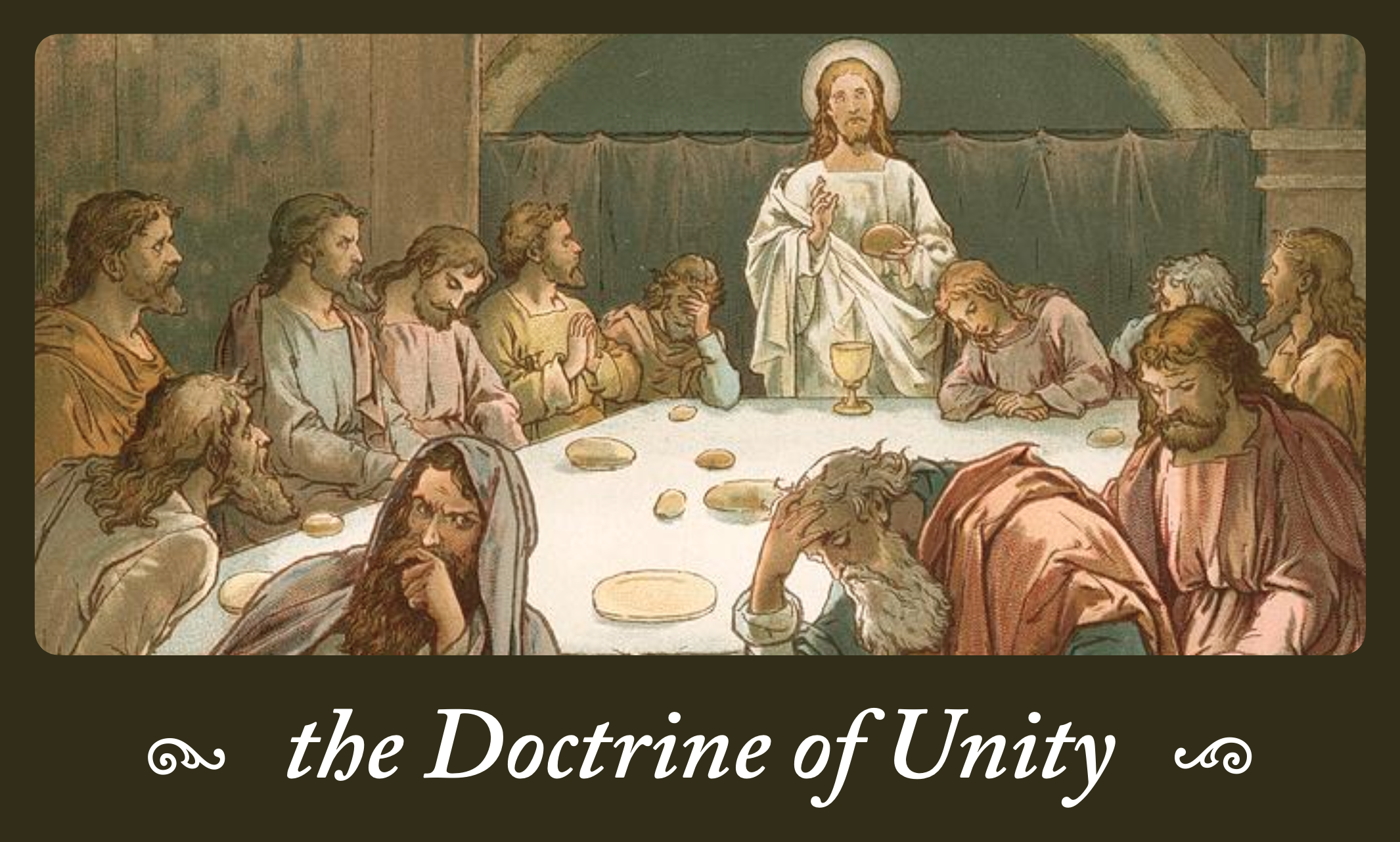
The Gospel of John differs from the other gospels in various ways, but one significant difference is John’s inclusion of the extensive time Jesus spends with His disciples on the night of His betrayal and arrest. This section spans John 13-17, and includes Jesus washing the disciples’ feet, His impending betrayal and Peter’s denial, His promise of the coming of the Holy Spirit and the accompanying revelation that He will be leaving them soon, and a repeated emphasis on the importance of love.

Near the end of this section, Jesus also teaches on the subject of unity:

“I do not ask for these only, but also for those who will believe in Me through their word, that they may all be one, just as You, Father, are in Me, and I in You, that they also may be in Us, so that the world may believe that You have sent Me. The glory that You have given Me I have given to them, that they may be one even as We are one, I in them and You in Me, that they may become perfectly one, so that the world may know that You sent Me and loved them even as You loved Me.”

(John 17.20-23)

Here, near the end of the “High Priestly Prayer”, Jesus prays for unity among His followers. When you think about it, this places followers of Jesus in an interesting position: generally, we pray to God asking Him to answer our prayers; in this instance, it seems remarkable to me that we have the opportunity to answer His. 

Furthermore, the unity that Jesus prays for is not arbitrary—it is both formative and practical. It is formative in the sense that, when followers of Christ are unified, we reflect the very nature of the Triune God who exists in perfect unity while displaying diversity. In other words, practicing and displaying unity forms us into the likeness of God. Additionally, unity is practical in the sense that it leads the world to realize the truth of the identity of Jesus Himself.

I have spent my life in Churches of Christ, a group of autonomous congregations of believers that have historical ties to the American Restoration Movement of the 1800s. This movement sought to strip away man-made traditions and restore the Church that they read about in the pages of the New Testament.

The American Restoration Movement (also called the Stone-Campbell Movement) was, significantly, a unity movement. Although the restoration of the New Testament Church was seen as important in its own right, it was also viewed as a means of bringing unity to a fragmented world of Christian denominations: if Christ-followers of different varieties could all just agree to follow the beliefs and practices described in the New Testament, then the elusive unity among His disciples for which Jesus prayed could finally be achieved. To an extent, it worked, as thousands of people left their respective denominations and linked up with the new movement, wanting to be known only as Christians and recognizing only the authority of the Bible. Alas, the unity did not last. Restoration congregations began to divide in the late 19th century, and in 1906, the U.S. Census recognized a formal division between Churches of Christ and Disciples of Christ.

I am proud of the initial focus on unity among my spiritual ancestors, and saddened by the degree to which that strain of our religious DNA later weakened—in the 20th century, Churches of Christ split and divided over all sorts of doctrinal issues (real or imagined), and a passion for unity was not something for which we were generally known. This is really unfortunate, though, because the reality is that more than just a good idea or a noble goal, unity is a doctrine—it is a clear teaching of Jesus. It is one of the last things He emphasized to His disciples before He went to the cross, and He said that it should be one of their defining characteristics.

More than just a good idea or a noble goal, unity is a doctrine. Share on X

This doesn’t mean that we should ignore all other doctrines for the sake of unity, but I do think that doctrinal disagreements that lead us to break unity with other believers should be at least as clearly taught or as central as the doctrine of unity is.

To put it another way, I want to be obedient to the teachings of Jesus. However, if my desire to properly understand and follow the teachings of Jesus has led me, in practice, to minimize the importance of seeking unity with others who proclaim Jesus as Lord, then it is important for me to realize that I am not actually being obedient. Because unity is a doctrine.

Doctrinal disagreements that lead us to break unity with other Christians should be at least as clearly taught or as central as the doctrine of unity is. Share on X

In this loose series of Scripture Reflections, I am sharing brief thoughts spurred on by my Bible reading. By way of reminder, my goal for these brief posts is two-fold:

(1) To remark on aspects of the biblical text that I find to be of interest that the reader may or may not have thought about previously.

(2) When possible, to point to the work and person of Jesus Christ. I believe the Bible is a unified story that points to Jesus, which means that He is frequently alluded to or foreshadowed in some way throughout the biblical canon.

My Kingdom is Not From This World

I have been doing my daily Bible reading out of The Word on Fire Bible; it has been a novel experience that I have enjoyed. It is a project from Catholic Bishop Robert Barron, who pens articles throughout the volume. Here are some features that I have appreciated so far:

  • It is an NRSV, which, though a well-known and widely-read translation, is one I have not used significantly before, so I have enjoyed working through a new translation.
  • It contains beautiful artwork from Christian history along with theological reflections.
  • It contains several excerpts and articles from Catholic thinkers throughout history (including Bishop Barron). I am not a Roman Catholic and some of the interpretations I read seem, frankly, bizarre to me, but others have been very insightful, and even those that seem strange to me still help me to better understand the Catholic perspective.

Today, as I read John 18, I really appreciated Barron’s commentary on Jesus’ statement, “My kingdom is not from this world”:

We have to be careful in interpreting this observation, because there is always a double meaning to the term “world” in the Gospel of John. On the one hand, “world” designates the universe that God has created and that he sustains in love. This is the world that God loved enough to send his only Son as its Savior. On the other hand, “world” means that manner of ordering things which is out of step with God’s intentions; it indicates a political and cultural realm in which selfishness, hatred, division, and violence hold sway.

What Jesus implies, therefore, is not that his kingdom is irrelevant to ordinary experience, but that his way of ordering is radically out of step with the way practiced by Caesar, Pilate, Herod, and all the other usual suspects. In short, Jesus’ kingdom has everything to do with “this world” in the first sense of the term and nothing to do with it in the second.[1]

This is really helpful. I observe many Christians who emphasize the “spiritual” nature of God’s kingdom in a way that suggests we should be less interested in things that happen in this “world” and almost renders faith to be irrelevant to daily life, aloof from the goings-on in the world around us. Others, while claiming allegiance to Jesus, find themselves totally wrapped up in the “world’s” manner of ordering things, obsessed with the political machinations and societal influences of the day, and largely viewing things through the lens of power.

Properly understanding the different ways that John (and, indeed, the New Testament in general) uses the word “world” helps us to avoid either of these traps. God loves the world—it is His creation, filled with humans who bear His image—and showed this by His Son stepping into mundane human existence and living among us. What could be more practical or relevant than that? He lived among everyday people, attended weddings and funerals (doing some really surprising things at both), healed people who were sick, enjoyed children, criticized religious and political leaders, and taught about God. And in that teaching, He made very clear that God’s ways of doing things and the ideals He values were very different from the ways the “world” does things and the ideals it values (perhaps most clearly seen in the upside-down nature of the Beatitudes).

By all means, let us affirm that God’s kingdom is not from this world—but let’s make sure we know what Jesus meant when He said that.


[1] Bishop Robert Barron, “Christ the King,” in The Word on Fire Bible: The Gospels (Park Ridge, IL: Word on Fire Catholic Ministries, 2020), 562.

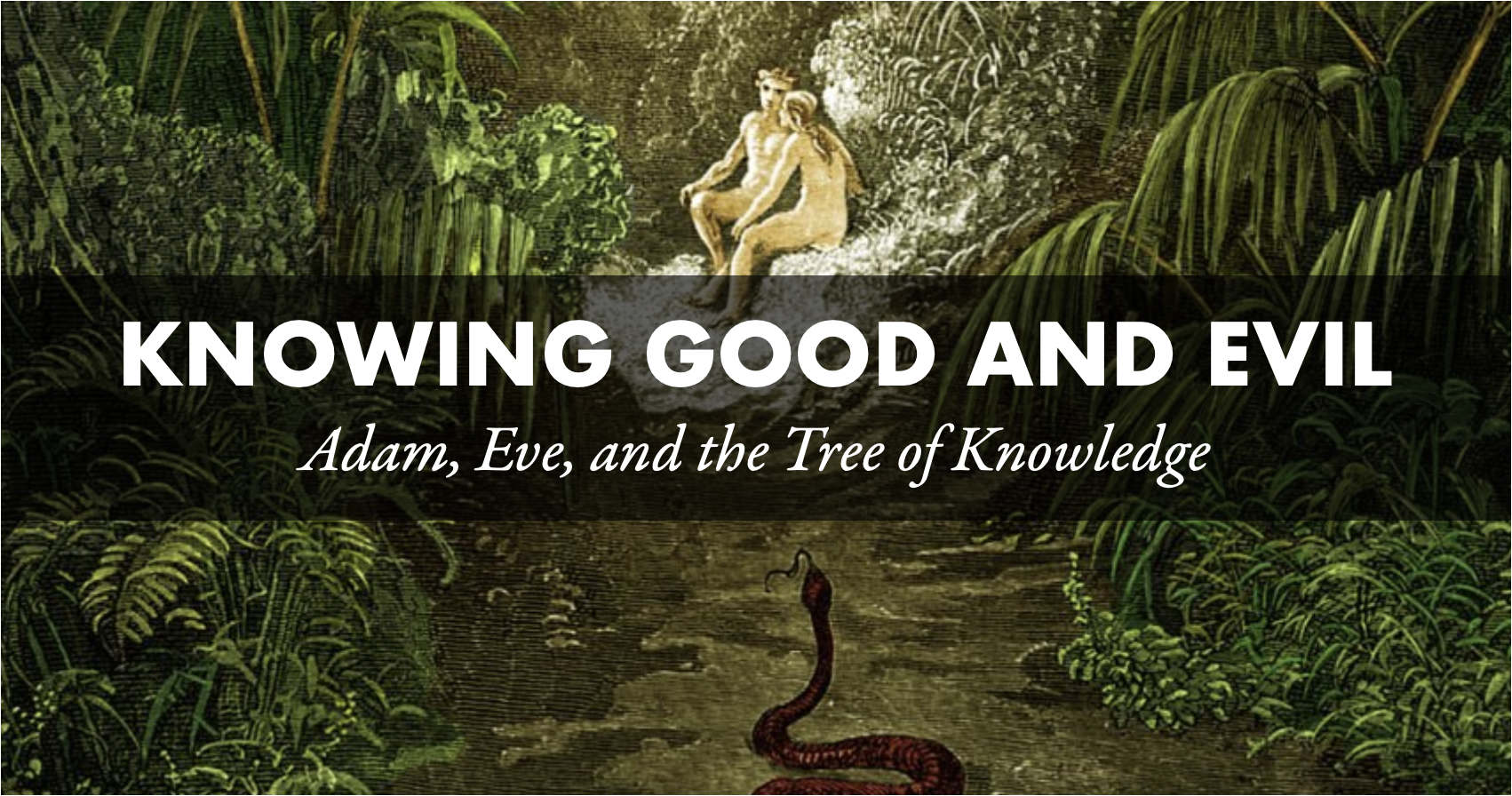
Knowing Good and Evil: Adam, Eve, and the Tree of Knowledge

The story of Adam, Eve, and the serpent in the Garden of Eden is one of the fundamental elements of the Story of Scripture—the Bible’s account for how things got to the messed up state that they are in. This story is well known, but, in my experience, an important detail of this story is not as well understood.

In Genesis 2, God tells humanity:

You may surely eat of every tree of the garden, but of the tree of the knowledge of good and evil you shall not eat, for in the day that you eat of it you shall surely die.

(Genesis 2.16b-17)

We hear a little more about this prohibition in a conversation between Eve and the crafty serpent at the beginning of Genesis 3:

He said to the woman, “Did God actually say, ‘You shall not eat of any tree in the garden’?” And the woman said to the serpent, “We may eat of the fruit of the trees in the garden, but God said, ‘You shall not eat of the fruit of the tree that is in the midst of the garden, neither shall you touch it, lest you die.’”

But the serpent said to the woman, “You will not surely die. For God knows that when you eat of it your eyes will be opened, and you will be like God, knowing good and evil.”

(Genesis 3.1b-5)

Often, you can hear this explained as the tree giving Adam and Eve the ability to recognize the difference between good and evil. However, when you think about it, this interpretation doesn’t make a lot of sense: how is it a bad thing to recognize the difference between good and evil? Isn’t a fundamental part of parenting helping our children learn the difference between good and evil, right and wrong? Doesn’t the biblical text frequently implore followers of God to pursue the way of blessing rather than the way of curses? The narrow way rather than the broad way? The fruit of the Spirit rather than the work of the flesh? Indeed, a significant aspect of preaching is helping the church to recognize the difference between good and evil.


Instead, a better understanding is that eating the fruit of the Tree of Knowledge represents defining good and evil for oneself. In other words, what the serpent tempted Adam and Eve with was moral autonomy: the right to decide for ourselves what is best.

As Christopher J.H. Wright states:

It is the prerogative of God in the supreme goodness of his own being to decide and define what constitutes goodness and therefore conversely what constitutes evil. Humans however, in choosing to decide for ourselves what we will deem good or evil usurp the prerogative of God in rebellious moral autonomy. And at the same time, of course, by making our own definitions in a state of rebellion and disobedience, we end up in the moral perversions and chaos that pervade fallen human life.[1]

Defining good and evil is God’s job; not ours. When we determine for ourselves what is right and wrong, we are seeking to climb onto a throne that rightly belongs to God alone.

Wright continues:

This interpretation of the phrase is supported by the way God recognizes the nature of what has happened: “The man has now become like one of us, knowing good and evil” (Gen 3:22). God accepts that humans have indeed breached the Creator-creature distinction. Not that humans have now become gods, but that they have chosen to act as though they were—defining and deciding for themselves what they will regard as good and evil. Therein lies the root of all other forms of idolatry: we deify our own capacities, and thereby make gods of ourselves and our choices and all their implications.[2]

Understanding the sin of Adam and Eve in this way helps us to see more clearly why it was such a big deal. Eating the fruit was not some curious attempt to learn something important that God had withheld from His human partners. It’s not that Adam and Eve were hopeless to recognize and distinguish good from evil: God had already told them. He had already defined for them what was good, and placed boundaries around what was not good for them. It was God’s definitions that the parents of humanity sought to challenge; they wanted the ability to define things for themselves. Indeed, eating the fruit was an act of rebellion, not curiosity.

Understanding the sin of Adam and Eve in this way also helps us to see how we are just like them. It can be easy to be hard on our ancestors for their sinful behavior and the way in which it has messed everything up in our world, but the reality is that every time we choose to do things that God has defined for us as evil, we become Adam and Eve; we reenact their rebellion. This is why the oft-heard statement, “I could never follow a God who…” is so dangerous: it inherently places ourselves upon the throne, defining what “good” should be like, and what God should be like. Ultimately, it creates a God in our image, rather than us reflecting the God in whose image we were created.

Every time we choose to do things that God has defined for us as evil, we become Adam and Eve; we reenact their rebellion. Share on X The oft-heard statement, “I could never follow a God who…” is so dangerous: it inherently places ourselves upon the throne, defining what “good” should be like, and what God should be like. Share on X

[1] Christopher J. H. Wright, The Mission of God: Unlocking the Bible’s Grand Narrative (Downers Grove, IL: IVP Academic, 2006): 164. Emphasis in the original.

[2] Ibid.

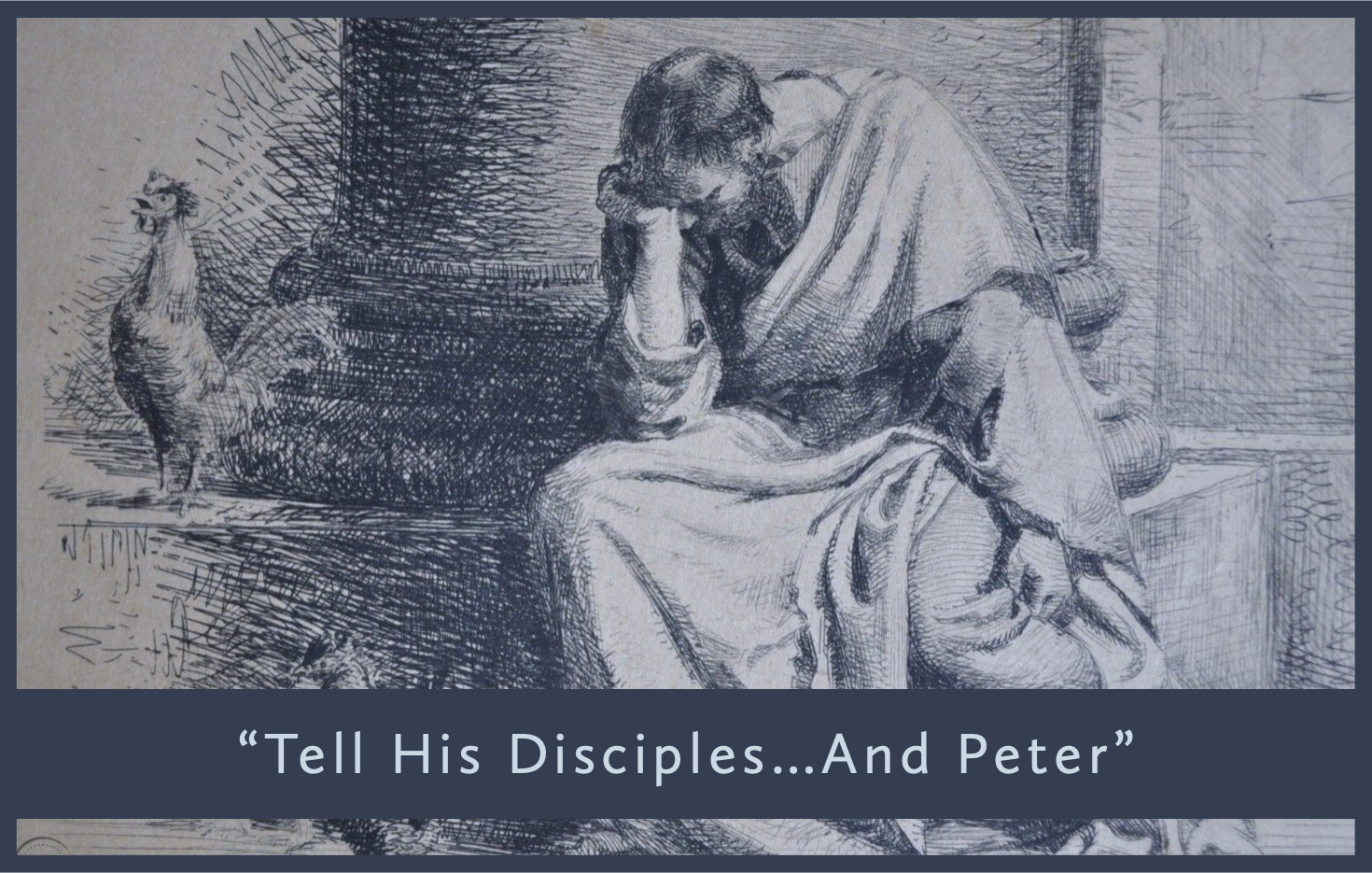
“Tell His Disciples…and Peter”

In the Gospel of Mark, after Jesus has been crucified and buried, and right before the controversial ending of Mark, Mary Magdalene, Mary the mother of James, and Salome come to the tomb of Jesus with spices to anoint Him. They discovered the stone rolled away from the tomb and the tomb itself empty. They see a young man, dressed in a white robe sitting at the side of the tomb and are alarmed.

He tells them:

“Do not be alarmed; you are looking for Jesus of Nazareth, who was crucified. He has been raised; he is not here. Look, there is the place they laid him. But go, tell his disciples and Peter that he is going ahead of you to Galilee; there you will see him, just as he told you.”

(Mark 16.6-7)

Some of this is straightforward enough: remarkably, Jesus has been resurrected from death, and this news needs to be shared with his disciples. Furthermore, this news affirms something that Jesus Himself had told His disciples earlier in Mark 14.28, that He would return from death and go before His disciples to Galilee. Things have happened just as Jesus predicted, and now He calls His disciples to join Him again.

Of course, in that same context in Mark 14, Jesus had also predicted that His disciples would desert Him in the moment of crisis and had specifically told Peter that he would desert Him by denying Him three times (Mark 14.29-31). And that had also come to pass (Mark 14.66-72).

The different gospel accounts (including Mark) are quite clear that Peter is devastated by his denial of Jesus once he really comes to grips with what he has done. I can imagine that the shame and heartache he felt on Thursday night following his denials had only continued and intensified when Jesus was subsequently scourged, crucified, and buried. Peter had been willing to kill for Jesus in the Garden of Gethsemane, but wasn’t willing to die for Him; He had let down His Lord and teacher. I wonder if he even considered himself a disciple anymore.

The messenger at the tomb seems perceptive of all of this. “Go tell His disciples,” he says, “and Peter.” Perhaps Peter is separate because he is no longer one of the disciples, or perhaps it is just a repetition of what happened on the night of Jesus’ betrayal and arrest. Then, it was predicted that all of the disciples would desert Jesus, but Peter is singled out as the one who will deny Him three times. Now, all the disciples are invited to meet the resurrected Christ, but Peter, the one who failed so spectacularly, is singled out with a special invitation.

As one commentator states:

“Why do you suppose the angel singled out Peter as one who was particularly to be told this message? It was done because just three days prior to this, Peter had denied that he had had any association with the Lord. This underscored the fact that, although Peter had rejected Jesus, Jesus had not rejected him.

The same was true of all the disciples. On the night of Jesus’ betrayal, the other apostles did basically what Peter did. All the rest forsook Him and refused to stand by Him. They left and fled in fear for their own lives. But on the heels of the resurrection is the affirmation that though the disciples had abandoned Him, He was not abandoning them.… What they had thought was over and done with, a thing broken, too broken to mend, was still very much alive.”[1]

I imagine that being singled out on the night of Jesus’ betrayal was awkward and awful for Peter. But now, to specifically be included in the invitation to meet the resurrected Christ? That must have been so reassuring: despite Peter’s past failures, Jesus still wanted to see him.


As of the time this article was published, yesterday was Easter, the church’s celebration of the events of Mark 16. Christians around the world proclaim the message that the women at the tomb were told to share. It is a day of joy, celebration, and hope: in the midst of a world plagued by Sin and Death, the resurrection reminds us that Death does not get the last word, and will indeed be defeated someday. There is a sense of triumphalism surrounding Easter, and that is appropriate because Jesus the Christ certainly triumphed.

But there are many, many out there who perhaps feel on Easter similarly to how Peter felt on the Sunday of the Resurrection. There are many who have followed Jesus at one point, but perhaps deserted Him when things got too difficult. Maybe they denied Him to their peers, or quit following Him because they feared death—if not literal death, the death to self that true discipleship requires. For those in this category, Easter possibly brings feelings of guilt and shame similar to those experienced by Peter.

Such feelings are not necessary, however, because the Good News of the empty tomb is for disciples…and Peter. If you have failed and, perhaps, failed so spectacularly that you feel that there is no place for you among followers of Jesus any longer—be reassured. The invitation to meet and follow the resurrected Christ is for you, too. Just like Peter.

If you have failed so spectacularly that you feel that there is no place for you among followers of Jesus any longer—be reassured. The invitation to meet and follow the resurrected Christ is for you, too. Just like Peter. Share on X

In this loose series of Scripture Reflections, I am sharing brief thoughts spurred on by my Bible reading. By way of reminder, my goal for these brief posts is two-fold:

(1) To remark on aspects of the biblical text that I find to be of interest that the reader may or may not have thought about previously.

(2) When possible, to point ahead to the work and person of Jesus Christ. I believe the Bible is a unified story that points to Jesus, which means that He is frequently alluded to or foreshadowed in some way throughout the biblical canon.


[1] Joe D. Schubert, Mark: Introduce Us to the Master: Expository Studies in the Gospel of Mark (Searcy, AR: Resource Publications, 1987): 306.

« Older posts Newer posts »

© 2026 The Doc File

Theme by Anders Noren — Up ↑