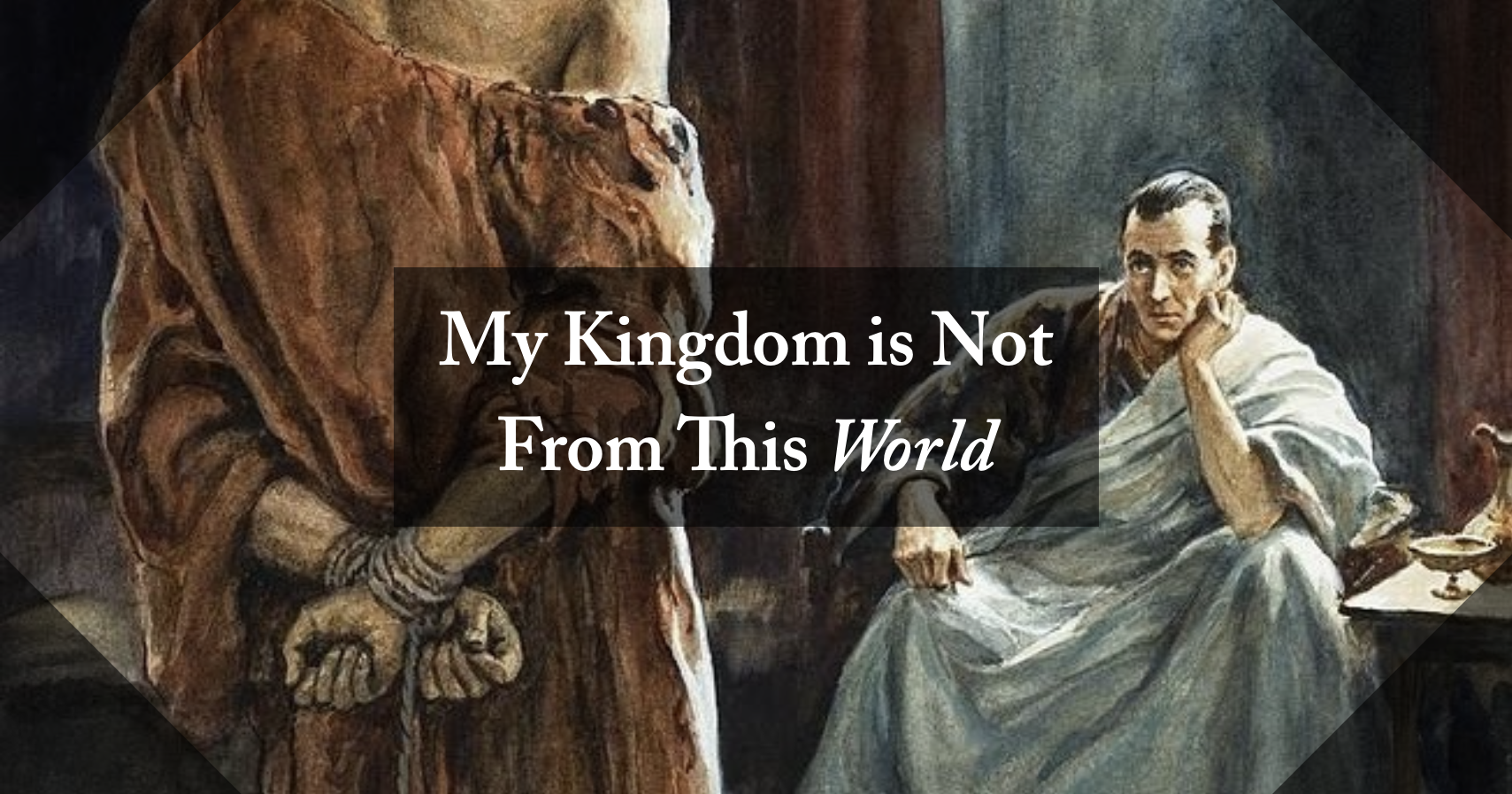
I have been doing my daily Bible reading out of The Word on Fire Bible; it has been a novel experience that I have enjoyed. It is a project from Catholic Bishop Robert Barron, who pens articles throughout the volume. Here are some features that I have appreciated so far:
- It is an NRSV, which, though a well-known and widely-read translation, is one I have not used significantly before, so I have enjoyed working through a new translation.
- It contains beautiful artwork from Christian history along with theological reflections.
- It contains several excerpts and articles from Catholic thinkers throughout history (including Bishop Barron). I am not a Roman Catholic and some of the interpretations I read seem, frankly, bizarre to me, but others have been very insightful, and even those that seem strange to me still help me to better understand the Catholic perspective.
Today, as I read John 18, I really appreciated Barron’s commentary on Jesus’ statement, “My kingdom is not from this world”:
We have to be careful in interpreting this observation, because there is always a double meaning to the term “world” in the Gospel of John. On the one hand, “world” designates the universe that God has created and that he sustains in love. This is the world that God loved enough to send his only Son as its Savior. On the other hand, “world” means that manner of ordering things which is out of step with God’s intentions; it indicates a political and cultural realm in which selfishness, hatred, division, and violence hold sway.
What Jesus implies, therefore, is not that his kingdom is irrelevant to ordinary experience, but that his way of ordering is radically out of step with the way practiced by Caesar, Pilate, Herod, and all the other usual suspects. In short, Jesus’ kingdom has everything to do with “this world” in the first sense of the term and nothing to do with it in the second.[1]
This is really helpful. I observe many Christians who emphasize the “spiritual” nature of God’s kingdom in a way that suggests we should be less interested in things that happen in this “world” and almost renders faith to be irrelevant to daily life, aloof from the goings-on in the world around us. Others, while claiming allegiance to Jesus, find themselves totally wrapped up in the “world’s” manner of ordering things, obsessed with the political machinations and societal influences of the day, and largely viewing things through the lens of power.
Properly understanding the different ways that John (and, indeed, the New Testament in general) uses the word “world” helps us to avoid either of these traps. God loves the world—it is His creation, filled with humans who bear His image—and showed this by His Son stepping into mundane human existence and living among us. What could be more practical or relevant than that? He lived among everyday people, attended weddings and funerals (doing some really surprising things at both), healed people who were sick, enjoyed children, criticized religious and political leaders, and taught about God. And in that teaching, He made very clear that God’s ways of doing things and the ideals He values were very different from the ways the “world” does things and the ideals it values (perhaps most clearly seen in the upside-down nature of the Beatitudes).
By all means, let us affirm that God’s kingdom is not from this world—but let’s make sure we know what Jesus meant when He said that.
[1] Bishop Robert Barron, “Christ the King,” in The Word on Fire Bible: The Gospels (Park Ridge, IL: Word on Fire Catholic Ministries, 2020), 562.







