The online journal of Luke Dockery

Category: Quotations (Page 1 of 17)

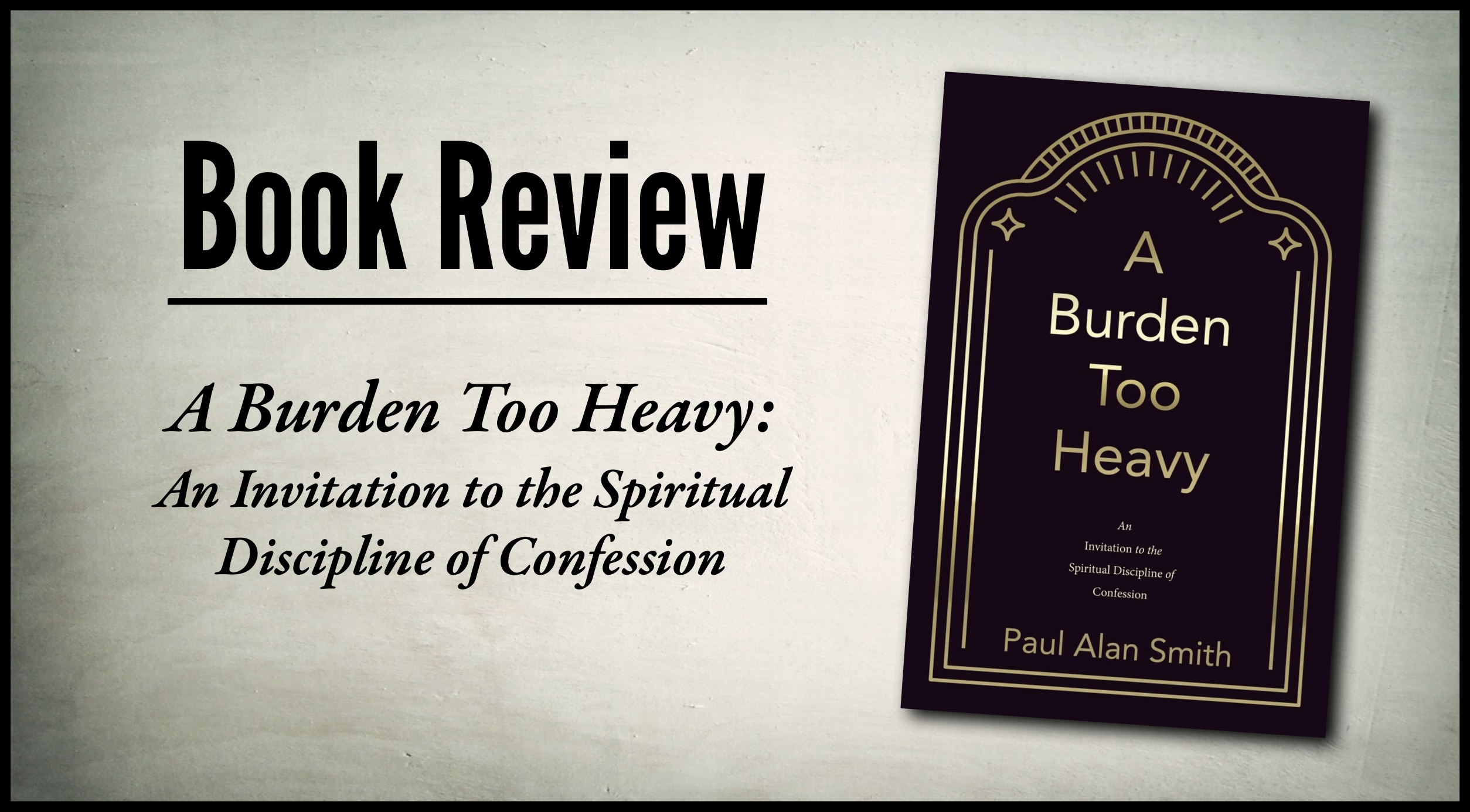
Book Review: A Burden Too Heavy

A while back, I was contacted by Paul Smith, who asked if I would be interested in reading and reviewing a book that he had recently written. I’ve never met Paul in person, but have interacted with him over the years on the web and have enjoyed his writing, so I was happy to agree. And I was not disappointed—his book, A Burden Too Heavy: An Invitation to the Spiritual Discipline of Confession, was an enjoyable read and offers needed corrective teaching to the church.

The word “confession” brings to mind different ideas, so Smith begins by helpfully defining what he means by the term:[1]

I believe the concept of “confession” has at least four applications found in Scripture.…First there are declarative confessions: adoration and praise to God, the declaration of faith in God, and the profession of the truth of a proposition. Second, there is the offering of thanksgiving and gratitude. Third, there is a recognition of physical and spiritual hardship, yet assertion of hopeful faith, through lamentation. Finally, there is a negative connotation of the acknowledgement of sin. In addition to these biblical usages of the word confession, there is another meaning of the word, that of a specific Confession of Faith, which serves to give identity to one assembly of Christians as distinct from others who observe a different confession of faith. (pp. xiv-xv)

Ultimately, what Smith hopes to impress upon the reader is the necessity of developing a confessional lifestyle, characterized by “a pervasive sense of the power of confession and an acceptance of the practices of confession” (xv). The book is structured in three parts.

Smith ministers and lives within the context of Churches of Christ, and those in Churches of Christ are the primary audience of the book, so in Part 1, he offers a brief (but excellent) history of the Stone-Campbell Restoration Movement (chapter 1) followed by an analysis of why the peculiarities that history made Churches of Christs resistant to the spiritual discipline of confession (chapter 2). To put it succinctly, a movement centered on the idea that we could perfectly restore God’s church through human effort led to a pride and arrogance that minimized the transcendence of God and made the admission of mistakes or errors very difficult—both elements of a confessional posture. This section of the book makes evident that the critiques offered by Smith throughout the book come from a place of deep affection for Churches of Christ and admiration for the spiritual ancestors of the Stone-Campbell Movement.[2]

Part 2 is comprised of three chapters. Chapter 3 provides a survey of the Bible, and examines how praise, thanksgiving, lament, and confession of sin are present in Scripture, particularly in the Psalms, but also in other places in the Old and New Testaments. Chapter 4 surveys confessional literature outside of Scripture, from the Early Church Fathers through the Medieval Period and Reformation and up through the Modern and Postmodern periods. Sadly, Churches of Christ have often been guilty of “neglecting the wisdom of the Christian centuries” (80), which means that strong historical emphasis on confessionalism has largely been missed. The historical record, however, is clear:

“The uniform message from many different theological perspectives promoting all forms of confession is an indication that confession has always been a critical component of any Christian theology.” (80)

Chapter 5 takes up the example of Dietrich Bonhoeffer as a case study. Although Bonhoeffer has no direct connection to the Stone-Campbell Movement, this chapter, in addition to being a fascinating survey study of Bonhoeffer in its own right,[3] serves to illustrate what a confessional lifestyle looks like “on the ground,” and how it would benefit Churches of Christ.

Part 3 is where things get practical: what is looks like for the principles emphasized in the book to be played out in life, and Paul addresses this by looking at confessionals in the life of the individual disciple (chapter 6) and the church (chapter 7). Chapter 6 reads much like a standard book on spiritual disciplines, with discussion of Lectio Divina, Meditation Prayer, Ignatius’s Spiritual Exercises, Fasting, and using a Spiritual Director.[4] Chapter 7 looks at how the “acts of worship” can shape a church confessionally, and helpfully examines the connection between confession and the Lord’s Supper, congregational prayer, singing, preaching, and giving.

A Burden Too Heavy ends with a conclusion summarizing the book’s key arguments, and especially why this matters for Churches of Christ:

“The twenty-first-century Churches of Christ share a unique opportunity and problem. The opportunity is to present the vision of men such as Elias Smith, Abner Jones, Barton W. Stone, and Thomas and Alexander Campbell to a culture where the reality of a divided Church is a stumbling block to accepting the gospel of Christ. The problem is that for over two centuries the vision of a restored and united Church has been distorted. It has been distorted by a number of issues, but primary among them has been the lack of a clear, focused and intentional theology of confession. A disposition toward arrogance, numbers acrimonious divisions, and a crippling identity crisis are all results of this lack of a confessional theology.” (146-47)

In addition to the quotations included above, there were several noteworthy quotations throughout the book that I thought were worth sharing (my own thoughts are added in bold):

“…This hermeneutic [command, example, necessary inference] elevated the human deductive reasoning that Thomas Campbell sought to minimize in the Declaration and Address. With the addition of “necessary implication” or “necessary inference” as a part of this restoration hermeneutic, Moses Lard negated the intent of Thomas Campbell to wean Christians off dependency on “the wisdom of men.” (12-13) This point might be a bit technical for some, but as a Restoration History hobbyist, I thought it was profound: basically, within 50 years, a key original tenet of the Restoration Movement was turned on its head.

“Praise is fundamentally an act of confession: a confession that someone or something is higher than the one offering the praise.” (44)

“…Confession is the antidote to the number one impediment of the life of faith—human pride.” (62)

“A church that has no sense of its history cannot own the positive features of its history nor can it confess the errors of its history.” (78) This is such a good point—when we don’t know our history, we truly do not know who we are. We can neither draw from our strengths or learn from our weaknesses.

“…If a preacher is unable to address his own joy and thanksgiving, as well as his doubts and fears, in the most intimate of worship settings, it will be impossible for his congregation to move toward a fully confessional lifestyle.” (131) This is an important reminder that leaders must actually lead. You cannot impart what you do not possess.

“A confessional theology is a theology that has the ability to admit its own failings. Confession praises God’s perfection and simultaneously acknowledges human weakness.” (142)

I really enjoyed A Burden Too Heavy. It was not a lengthy read (just under 150 pages), but Smith accomplished much in a short space: a penetrating analysis of the Stone-Campbell Movement, a survey of Biblical literature and the Christian tradition, a review of the life and theology of Dietrich Bonhoeffer, a summary of spiritual disciplines, and practical advice for congregational worship. And, most impressively of all, all of these seemingly disparate elements fit together as part of a coherent and forceful argument: the spiritual discipline of confession is a vital element that is largely missing in the ecclesiology of Churches of Christ and the individual lives of its members.

Smith’s work is a valiant attempt to reclaim that missing element. I fear—for the same reasons he mentions in his analysis of Churches of Christ—that many will be resistant to the sort of changes he proposes. But perhaps some will listen, and for that reason, I hope this book enjoys the widest possible readership.


[1] In this post, I will post page numbers in parentheses after quotations, and reserve footnotes for purposes of explanation. The italics in the following quotations are from the original.

[2] I point this out because it has been my experience that sometimes authors speak of the Restoration Movement with thinly veiled contempt, which I find to be off-putting. Smith is clearly writing this book out of a desire to help a fellowship that he loves and to which he is indebted.

[3] Bonhoeffer has long been a personal hero and area of study for Smith, so I was delighted (but not surprised!) to see this chapter in the book. Interestingly, I had just finished reading Bonhoeffer’s Life Together when I read this, and this summary helped emphasize some of the key ideas in Life Together.

[4] After talking about Spiritual Direction, Smith includes a section on “Redeeming the Role of Spiritual Director Within the Churches of Christ,” where he addresses the Boston Movement/International Churches of Christ, and issues of spiritual abuse in the past, and explains how different spiritual direction is from these abusive practices. This is a helpful section and I am glad it was included, but I fear it will be insufficient to soothe the concerns of those with direct experience with this movement.

The Model for Every Christian Preacher

What does the model Christian preacher look like? That question likely prompts various responses from different people. Some perhaps think of a polished communicator who is pleasing to listen to. Others might prefer someone with theological depth who delves into the biblical text in profound or novel ways. Some might yearn for nostalgia—a certain type of preaching that they miss from a bygone era. And still others might look for someone who is entertaining, who tells funny jokes and keeps our attention. 

With a little more reflection, we might say that, obviously, Jesus is the model Christian preacher. After all, Jesus is the model of all of Christian life, we are His disciples, and we seek to become like Him. No sermon has ever been as brilliant or powerful as the Sermon on the Mount, so this is obviously the correct answer, right?

What I wrote in the previous paragraph is true, but there is a really crucial way in which we cannot emulate Jesus when it comes to preaching—Jesus Himself is the focus of Christian preaching, the Son of God who, following His resurrection and ascension has been enthroned as the King of the universe, and has the ultimate authority to interpret to teach, command, and judge. 

On the contrary, when I preach, it is not myself that should be the focus, and the only authority that I have is that which is derived from God’s revealed word. In that sense, the model Christian preacher is not Jesus, but John the Baptist. 

As Fleming Rutledge writes in Advent: The Once & Future Coming of Jesus Christ (emphasis mine):

All four New Testament Evangelists agree: there is no good news, no gospel of Jesus Christ, without John the Baptist. John’s whole life was lived with but one purpose; he was born, a man of destiny, to declare the imminent arrival of the coming Messiah. This voice crying in the wilderness, this “lantern which shone in front of the Son of God,” is extraordinary in many ways, but most of all for the single-mindedness with which he pursued his mission even to death, for John the Baptist feared no man, not even Herod the king, and no woman either, not even Herod’s wife, who in the end arranged to have his head cut off. But let us take note: this firebrand who recognized no superior was utterly submissive before the One whose coming he lived and died to illuminate. “John said to them, ‘One is coming who is mightier than I, and I am not fit to untie the thong of his sandal.’” (Luke 3:15-16).

To be the witness, to point away from himself to Jesus Christ—this is the destiny of John, and in these things, he is a model for every Christian preacher.[1]

The model Christian preacher, regardless of style, appearance, or skill, is one who draws the audience’s attention away from himself and instead points directly to Jesus Christ. And this is the challenge for all of us who have the privilege and the burden to preach—people should walk away from our sermons not reflecting upon our wit, brilliance, or skill, but upon Jesus Christ and Him crucified (cf. 1 Corinthians 2.1-2).

The model Christian preacher, regardless of style, appearance, or skill, is one who draws the audience’s attention away from himself and instead points directly to Jesus Christ. Share on X

[1] Fleming Rutledge, Advent: The Once and Future Coming of Jesus Christ (Grand Rapids: Eerdmans, 2018), 276.

Crusaders, Incomplete Baptisms, and the Parts We Keep from God

There is a legend that before going into battle, Crusaders would be baptized, pledging their lives to Jesus. But, as the legend goes, as they marched through the baptismal waters, they would hold their swords above their heads as they plunged into the water. It’s as if they were keeping that part of themselves from God—their weapon hands needed to be kept free from divine interference so they could do their killing properly.

I’m not sure if the legend is true. It can be easy to pick on those involved in the Crusades, which are often condemned as a sort of Christian holocaust. Actual historical study of the Crusades paint a more nuanced and complex picture, but the fact remains that the Crusades don’t represent a highpoint in Christian history. Furthermore, I’ve read another version of the legend that has Charlemagne doing this with his troops before battle, and he lived a few hundred years before the First Crusade. Perhaps the multiple attestation gives credence to some Christian soldiers doing this at their baptisms at some point in time. It seems quite possible to me, because it is just the sort of thing that people would do.

As John Mark Comer says in reference to this legend in his book, Live No Lies:

Legend or history, the imagery is piercing. We all do this. We might not hold up a sword; for us it could be a debit card, a relationship, a sexual ethic, a wound, an entertainment habit, a political or even a theological position. It could be anything. But how often do we say, if not in a word, then by our actions, Not this Jesus. Not this.[1]

I don’t know how that strikes you, but for me, it was a punch in the gut. It’s easy to look at the story of someone holding a sword hand out of the baptismal waters and see the clear hypocrisy, the deficient discipleship, but what about our own lives? As Comer points out, there are a lot of parts of ourselves that we can be tempted to try to keep from God and hold onto ourselves. That’s the problem, though: Christ must be Lord of all, or He is Lord of nothing. Following Jesus only when it is convenient isn’t really following Him at all.

Christ must be Lord of all, or He is Lord of nothing. Following Jesus only when it is convenient isn’t really following Him at all. Share on X

Lord, let me keep nothing back from You. Help me to give it all.


[1] John Mark Comer, Live No Lies (USA: WaterBrook, 2021), 250. This was one of my Top 10 books from this past year.

My Kingdom is Not From This World

I have been doing my daily Bible reading out of The Word on Fire Bible; it has been a novel experience that I have enjoyed. It is a project from Catholic Bishop Robert Barron, who pens articles throughout the volume. Here are some features that I have appreciated so far:

  • It is an NRSV, which, though a well-known and widely-read translation, is one I have not used significantly before, so I have enjoyed working through a new translation.
  • It contains beautiful artwork from Christian history along with theological reflections.
  • It contains several excerpts and articles from Catholic thinkers throughout history (including Bishop Barron). I am not a Roman Catholic and some of the interpretations I read seem, frankly, bizarre to me, but others have been very insightful, and even those that seem strange to me still help me to better understand the Catholic perspective.

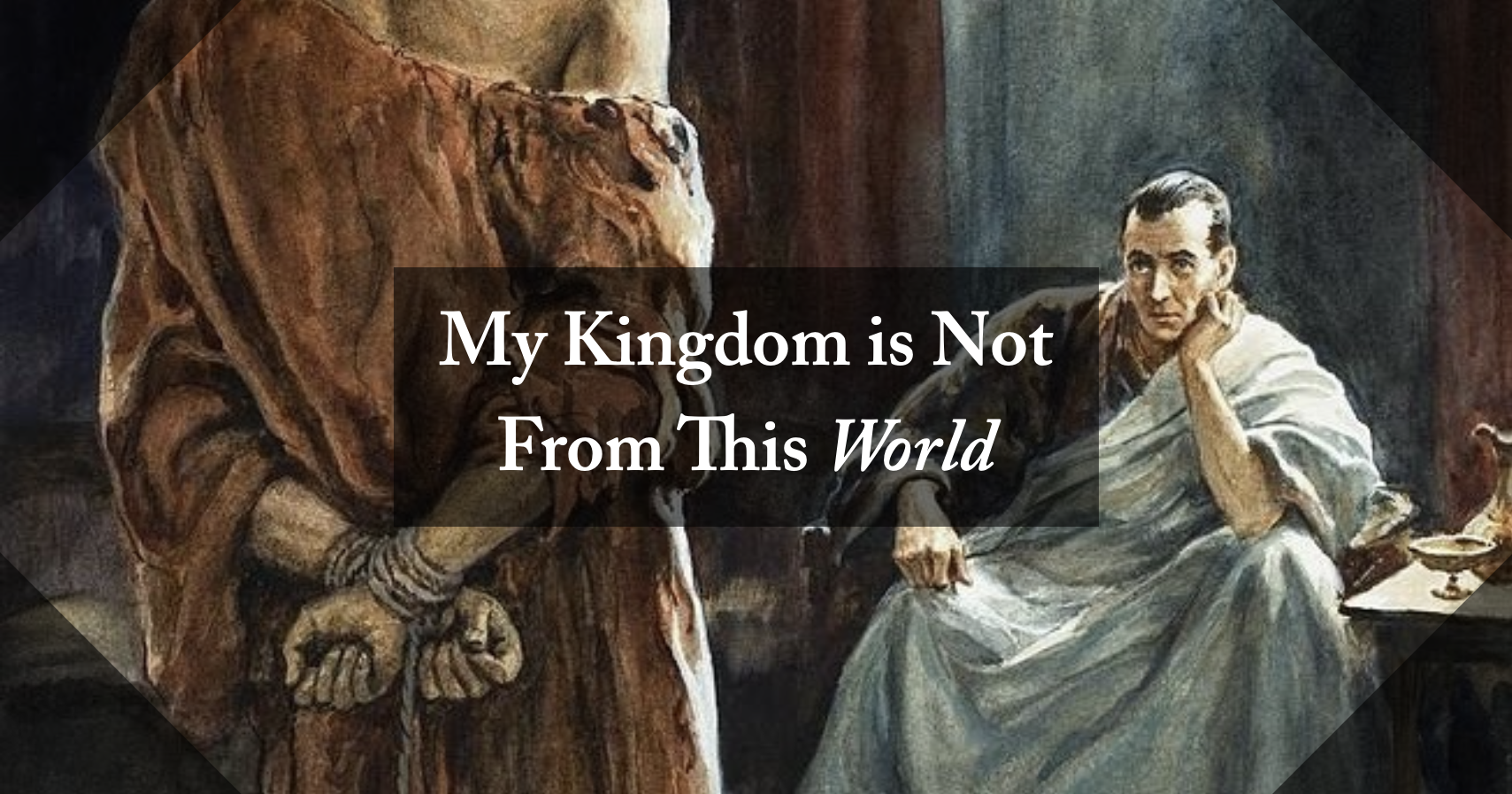
Today, as I read John 18, I really appreciated Barron’s commentary on Jesus’ statement, “My kingdom is not from this world”:

We have to be careful in interpreting this observation, because there is always a double meaning to the term “world” in the Gospel of John. On the one hand, “world” designates the universe that God has created and that he sustains in love. This is the world that God loved enough to send his only Son as its Savior. On the other hand, “world” means that manner of ordering things which is out of step with God’s intentions; it indicates a political and cultural realm in which selfishness, hatred, division, and violence hold sway.

What Jesus implies, therefore, is not that his kingdom is irrelevant to ordinary experience, but that his way of ordering is radically out of step with the way practiced by Caesar, Pilate, Herod, and all the other usual suspects. In short, Jesus’ kingdom has everything to do with “this world” in the first sense of the term and nothing to do with it in the second.[1]

This is really helpful. I observe many Christians who emphasize the “spiritual” nature of God’s kingdom in a way that suggests we should be less interested in things that happen in this “world” and almost renders faith to be irrelevant to daily life, aloof from the goings-on in the world around us. Others, while claiming allegiance to Jesus, find themselves totally wrapped up in the “world’s” manner of ordering things, obsessed with the political machinations and societal influences of the day, and largely viewing things through the lens of power.

Properly understanding the different ways that John (and, indeed, the New Testament in general) uses the word “world” helps us to avoid either of these traps. God loves the world—it is His creation, filled with humans who bear His image—and showed this by His Son stepping into mundane human existence and living among us. What could be more practical or relevant than that? He lived among everyday people, attended weddings and funerals (doing some really surprising things at both), healed people who were sick, enjoyed children, criticized religious and political leaders, and taught about God. And in that teaching, He made very clear that God’s ways of doing things and the ideals He values were very different from the ways the “world” does things and the ideals it values (perhaps most clearly seen in the upside-down nature of the Beatitudes).

By all means, let us affirm that God’s kingdom is not from this world—but let’s make sure we know what Jesus meant when He said that.


[1] Bishop Robert Barron, “Christ the King,” in The Word on Fire Bible: The Gospels (Park Ridge, IL: Word on Fire Catholic Ministries, 2020), 562.

C.S. Lewis on Dogs and the Love of God

As regular readers of The Doc File have probably surmised, I am a big fan of C.S. Lewis. I reread Mere Christianity and The Chronicles of Narnia in 2020, and so far in 2021, I have reread The Screwtape Letters and am currently in the middle of The Problem of Pain.

I think there is a lot to like about Lewis’s writing, but one helpful quality is his ability to use helpful analogies to illustrate theological points. In The Problem of Pain, Lewis describes different ways in which it can be said that God “loves” humanity:

Another type is the love of a man for a beast—a relation constantly used in Scripture to symbolise the relation between God and men: ‘we are his people and the sheep of his pasture.’ This is in some ways a better analogy than the preceding, because the inferior party is sentient, and yet unmistakably inferior: but it is less good in so far as man has not made the beast and does not fully understand it.

Its great merit lies in the fact that the association of (say) man and dog is primarily for the man’s sake: he tames the dog primarily that he may love it, not that it may love him, and that it may serve him, not that he may serve it. Yet at the same time, the dog’s interests are not sacrificed to the man’s. The one end (that he may love it) cannot be fully attained unless it also, in its fashion, loves him, not can it serve him unless he, in a different fashion, serves it.

Now just because the dog is by human standards one of the ‘best’ of irrational creatures, and a proper object for man to love—of course, with that degree and kind of love which is proper to such an object, and not with silly anthropomorphic exaggerations—man interferes with the dog and makes it more lovable than it was in mere nature. In its state of nature it has a smell, and habits, which frustrate man’s love: he washes it, house-trains it, teaches it not to steal, and is so enabled to love it completely.

To the puppy the whole proceeding would seem, if it were a theologian, to cast grave doubts on the ‘goodness’ of man: but the full-grown and full-trained dog, larger, healthier, and longer-lived than the wild dog, and admitted, as it were by Grace, to a whole world of affections, loyalties, interests, and comforts entirely beyond its animal destiny, would have no such doubts. It will be noted that the man (I am speaking throughout of the good man) takes all these pains with the dog, and gives all these pains to the dog, only because it is an animal high in the scale—because it is so nearly lovable that it is worth his while to make it fully lovable. He does not house-train the earwig or give baths to centipedes. We may wish, indeed, that we were of so little account to God that He left us alone to follow our natural impulses—that He would give over trying to train us into something so unlike our natural selves: but once again, we are asking not for more love, but for less.”

The Problem of Pain, 35-36


Lewis’s analogy is astute:

(1) Indeed, God does interfere in the lives of those who would be His followers. He does not leave us alone to follow our natural impulses and, instead, makes all sorts of demands upon us and calls us to live in ways that are decidedly unnatural (what can be more unnatural than voluntarily laying power aside to instead serve others, or foregoing the opportunity for retaliation when it is presented?) This can certainly be frustrating.

(2) However, as we mature beyond being spiritual “puppies” and begin to grow and be trained through the sanctification of God’s Spirit, it becomes easier to see the grace that was present, all along, in God’s demands. We are so much better off than if we had been left to our own devices.

Praise God for His interference, a great manifestation of His abundant love!

« Older posts

© 2026 The Doc File

Theme by Anders Noren — Up ↑