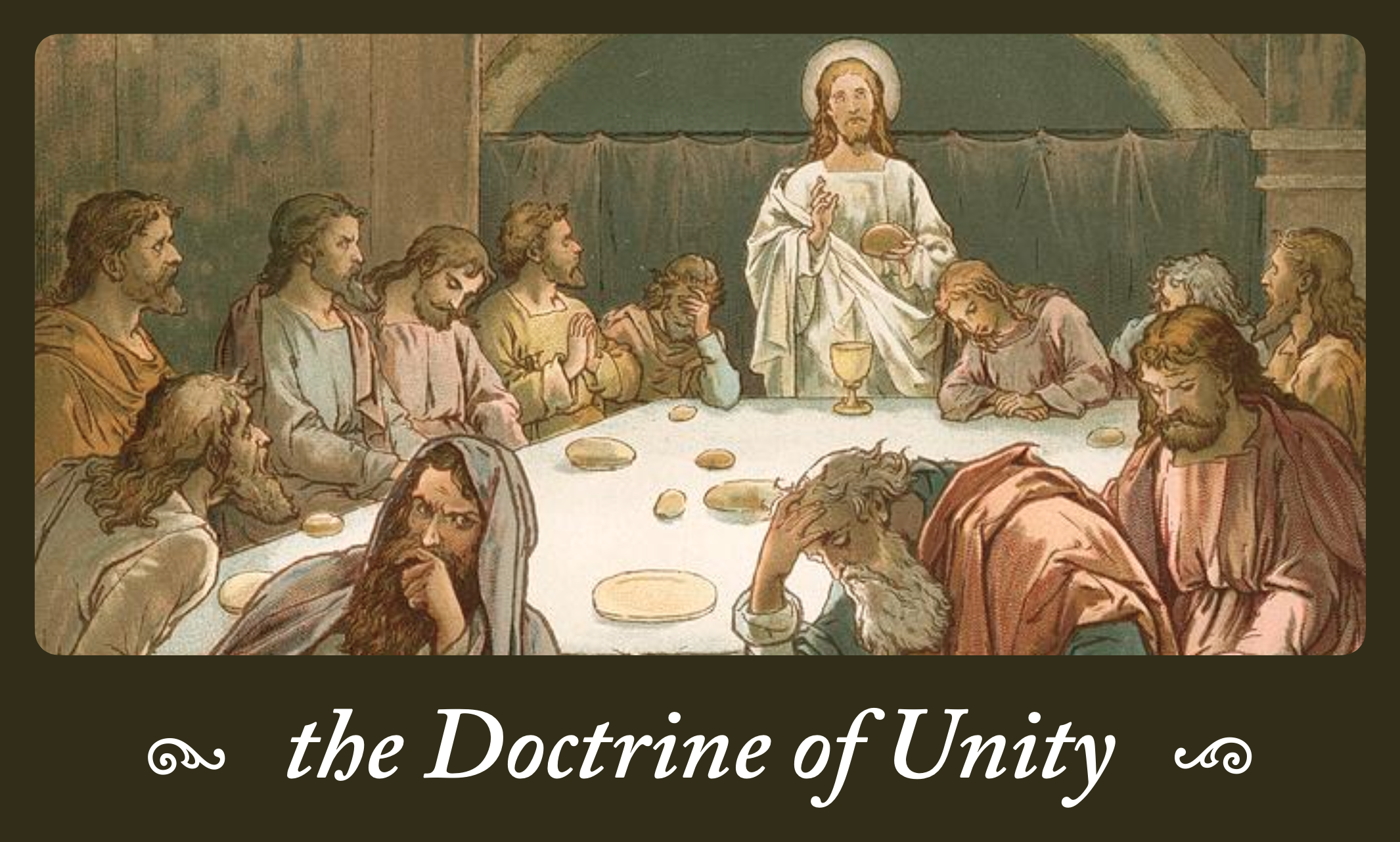
The Gospel of John differs from the other gospels in various ways, but one significant difference is John’s inclusion of the extensive time Jesus spends with His disciples on the night of His betrayal and arrest. This section spans John 13-17, and includes Jesus washing the disciples’ feet, His impending betrayal and Peter’s denial, His promise of the coming of the Holy Spirit and the accompanying revelation that He will be leaving them soon, and a repeated emphasis on the importance of love.
Near the end of this section, Jesus also teaches on the subject of unity:
“I do not ask for these only, but also for those who will believe in Me through their word, that they may all be one, just as You, Father, are in Me, and I in You, that they also may be in Us, so that the world may believe that You have sent Me. The glory that You have given Me I have given to them, that they may be one even as We are one, I in them and You in Me, that they may become perfectly one, so that the world may know that You sent Me and loved them even as You loved Me.”
(John 17.20-23)
Here, near the end of the “High Priestly Prayer”, Jesus prays for unity among His followers. When you think about it, this places followers of Jesus in an interesting position: generally, we pray to God asking Him to answer our prayers; in this instance, it seems remarkable to me that we have the opportunity to answer His.
Furthermore, the unity that Jesus prays for is not arbitrary—it is both formative and practical. It is formative in the sense that, when followers of Christ are unified, we reflect the very nature of the Triune God who exists in perfect unity while displaying diversity. In other words, practicing and displaying unity forms us into the likeness of God. Additionally, unity is practical in the sense that it leads the world to realize the truth of the identity of Jesus Himself.
I have spent my life in Churches of Christ, a group of autonomous congregations of believers that have historical ties to the American Restoration Movement of the 1800s. This movement sought to strip away man-made traditions and restore the Church that they read about in the pages of the New Testament.
The American Restoration Movement (also called the Stone-Campbell Movement) was, significantly, a unity movement. Although the restoration of the New Testament Church was seen as important in its own right, it was also viewed as a means of bringing unity to a fragmented world of Christian denominations: if Christ-followers of different varieties could all just agree to follow the beliefs and practices described in the New Testament, then the elusive unity among His disciples for which Jesus prayed could finally be achieved. To an extent, it worked, as thousands of people left their respective denominations and linked up with the new movement, wanting to be known only as Christians and recognizing only the authority of the Bible. Alas, the unity did not last. Restoration congregations began to divide in the late 19th century, and in 1906, the U.S. Census recognized a formal division between Churches of Christ and Disciples of Christ.
I am proud of the initial focus on unity among my spiritual ancestors, and saddened by the degree to which that strain of our religious DNA later weakened—in the 20th century, Churches of Christ split and divided over all sorts of doctrinal issues (real or imagined), and a passion for unity was not something for which we were generally known. This is really unfortunate, though, because the reality is that more than just a good idea or a noble goal, unity is a doctrine—it is a clear teaching of Jesus. It is one of the last things He emphasized to His disciples before He went to the cross, and He said that it should be one of their defining characteristics.
More than just a good idea or a noble goal, unity is a doctrine. Share on XThis doesn’t mean that we should ignore all other doctrines for the sake of unity, but I do think that doctrinal disagreements that lead us to break unity with other believers should be at least as clearly taught or as central as the doctrine of unity is.
To put it another way, I want to be obedient to the teachings of Jesus. However, if my desire to properly understand and follow the teachings of Jesus has led me, in practice, to minimize the importance of seeking unity with others who proclaim Jesus as Lord, then it is important for me to realize that I am not actually being obedient. Because unity is a doctrine.
Doctrinal disagreements that lead us to break unity with other Christians should be at least as clearly taught or as central as the doctrine of unity is. Share on X In this loose series of Scripture Reflections, I am sharing brief thoughts spurred on by my Bible reading. By way of reminder, my goal for these brief posts is two-fold:
(1) To remark on aspects of the biblical text that I find to be of interest that the reader may or may not have thought about previously.
(2) When possible, to point to the work and person of Jesus Christ. I believe the Bible is a unified story that points to Jesus, which means that He is frequently alluded to or foreshadowed in some way throughout the biblical canon.








Love it! Thank you for sharing. I think it would be an interesting exercise for congregations to come up with “Deal Breaker” doctrines and see how heavily emphasized these deal breakers are when compared with the emphasis on unity. I wonder if that framework my shift priorities a bit.
Wow, that last sentence was terrible, I think I meant ” I wonder if that framework would shift my priorities a bit”
Garrett,
Thanks for reading and commenting; I agree that would be an interesting exercise!
What would be equally interesting to me would be to survey individual members to see what would constitute a “Deal Breaker”—I suspect that the results would be all over the place! This is part of our problem; I love Churches of Christ and I love our emphasis on basing our practices upon Scripture. In reality, though, what we often get is everyone’s individual interpretation of Scripture being the things that actually determine our doctrine, so we are all over the place: one person is pretty sure that instrumental music in worship is a deal breaker, while another thinks that belief in the Trinity might not be necessary.
That arrangement—where we claim that the Bible is our only standard, but really it’s each person’s interpretation of the Bible—doesn’t seem healthy or sustainable to me. I think distinguishing between matters of first importance and other secondary (or tertiary) matters is needed, and I would suggest that the “Seven Ones” in Ephesians 4 and the content of the early gospel proclamations in Acts (both of which, by the way, map pretty closely onto the Apostles’ Creed) are good starting places for determining what is primary.
I rambled a bit, but I agree with you: I think congregations knowing what their Deal Breakers are would be good; I’m just concerned that we may not have enough theological structure in place to know how to determine what those are.