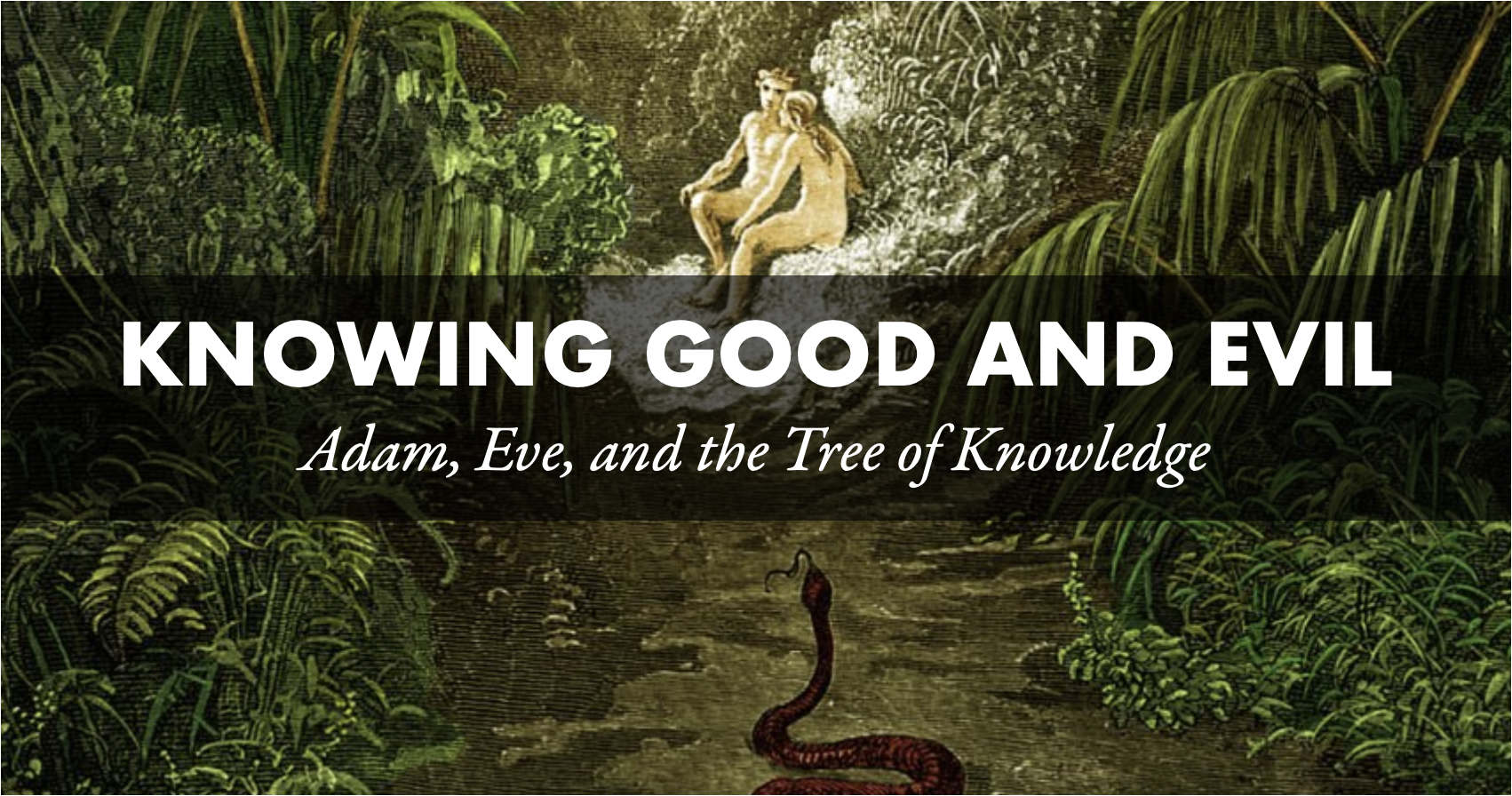
The story of Adam, Eve, and the serpent in the Garden of Eden is one of the fundamental elements of the Story of Scripture—the Bible’s account for how things got to the messed up state that they are in. This story is well known, but, in my experience, an important detail of this story is not as well understood.
In Genesis 2, God tells humanity:
You may surely eat of every tree of the garden, but of the tree of the knowledge of good and evil you shall not eat, for in the day that you eat of it you shall surely die.
(Genesis 2.16b-17)
We hear a little more about this prohibition in a conversation between Eve and the crafty serpent at the beginning of Genesis 3:
He said to the woman, “Did God actually say, ‘You shall not eat of any tree in the garden’?” And the woman said to the serpent, “We may eat of the fruit of the trees in the garden, but God said, ‘You shall not eat of the fruit of the tree that is in the midst of the garden, neither shall you touch it, lest you die.’”
But the serpent said to the woman, “You will not surely die. For God knows that when you eat of it your eyes will be opened, and you will be like God, knowing good and evil.”
(Genesis 3.1b-5)
Often, you can hear this explained as the tree giving Adam and Eve the ability to recognize the difference between good and evil. However, when you think about it, this interpretation doesn’t make a lot of sense: how is it a bad thing to recognize the difference between good and evil? Isn’t a fundamental part of parenting helping our children learn the difference between good and evil, right and wrong? Doesn’t the biblical text frequently implore followers of God to pursue the way of blessing rather than the way of curses? The narrow way rather than the broad way? The fruit of the Spirit rather than the work of the flesh? Indeed, a significant aspect of preaching is helping the church to recognize the difference between good and evil.
Instead, a better understanding is that eating the fruit of the Tree of Knowledge represents defining good and evil for oneself. In other words, what the serpent tempted Adam and Eve with was moral autonomy: the right to decide for ourselves what is best.
As Christopher J.H. Wright states:
It is the prerogative of God in the supreme goodness of his own being to decide and define what constitutes goodness and therefore conversely what constitutes evil. Humans however, in choosing to decide for ourselves what we will deem good or evil usurp the prerogative of God in rebellious moral autonomy. And at the same time, of course, by making our own definitions in a state of rebellion and disobedience, we end up in the moral perversions and chaos that pervade fallen human life.[1]
Defining good and evil is God’s job; not ours. When we determine for ourselves what is right and wrong, we are seeking to climb onto a throne that rightly belongs to God alone.
Wright continues:
This interpretation of the phrase is supported by the way God recognizes the nature of what has happened: “The man has now become like one of us, knowing good and evil” (Gen 3:22). God accepts that humans have indeed breached the Creator-creature distinction. Not that humans have now become gods, but that they have chosen to act as though they were—defining and deciding for themselves what they will regard as good and evil. Therein lies the root of all other forms of idolatry: we deify our own capacities, and thereby make gods of ourselves and our choices and all their implications.[2]
Understanding the sin of Adam and Eve in this way helps us to see more clearly why it was such a big deal. Eating the fruit was not some curious attempt to learn something important that God had withheld from His human partners. It’s not that Adam and Eve were hopeless to recognize and distinguish good from evil: God had already told them. He had already defined for them what was good, and placed boundaries around what was not good for them. It was God’s definitions that the parents of humanity sought to challenge; they wanted the ability to define things for themselves. Indeed, eating the fruit was an act of rebellion, not curiosity.
Understanding the sin of Adam and Eve in this way also helps us to see how we are just like them. It can be easy to be hard on our ancestors for their sinful behavior and the way in which it has messed everything up in our world, but the reality is that every time we choose to do things that God has defined for us as evil, we become Adam and Eve; we reenact their rebellion. This is why the oft-heard statement, “I could never follow a God who…” is so dangerous: it inherently places ourselves upon the throne, defining what “good” should be like, and what God should be like. Ultimately, it creates a God in our image, rather than us reflecting the God in whose image we were created.
Every time we choose to do things that God has defined for us as evil, we become Adam and Eve; we reenact their rebellion. Share on X The oft-heard statement, “I could never follow a God who…” is so dangerous: it inherently places ourselves upon the throne, defining what “good” should be like, and what God should be like. Share on X[1] Christopher J. H. Wright, The Mission of God: Unlocking the Bible’s Grand Narrative (Downers Grove, IL: IVP Academic, 2006): 164. Emphasis in the original.
[2] Ibid.








Good stuff Luke, thank you.
Thanks for reading, Keith!