The online journal of Luke Dockery

Category: Discipleship (Page 16 of 23)

Scattered Reflections on Race-related Issues

Like many people, I have been distressed by so many aspects of the race-related incidents that have been erupting all over the nation:

  • The tragic and unjust deaths of African Americans, whether at the hands of overreaching and brutal law enforcement officers or racist vigilantes
  • The protests in response to these outrageous acts that have, at times, turned violent  (and seemingly, at times have been coopted and corrupted by outside influences)
  • In some places, the brutal and violent responses by police officers to even peaceful protests
  • The very poor handling of the entire situation by President Trump whose rhetoric only escalates the tensions
  • The negative attention received by countless law enforcement officers across the country who seek to serve and protect and want to be a part of the solution rather than the problem

Though I am deeply convicted by what I have seen and heard, I am always uncertain about how to respond, at least, in a public proclamatory way such as this. On the one hand, as a middle-class white guy in a largely-white context, I don’t presume to be an expert in such matters, and I have been doing my best to listen rather than to speak. Furthermore, I am not interested in virtue signaling, which can seem like an easy practice that doesn’t actually accomplish or help anything.

On the other hand, I have seen and heard from many black friends and acquaintances about how painful it is when white people (especially Christians) maintain silence, and how supported and loved they feel when people such as myself speak out in solidarity instead. So, that’s what this post is, in a disorganized sort of way.

Foundational Issues

As a Christian, there are two fundamental ideas that guide my thoughts on race before anything else:

  1. All humans are created in the image of God. This conveys the notion of being God’s representatives on earth, tasked with carrying out His will (we see this in Genesis 1-2). Unfortunately, due to sin, humans fail to properly reflect the image of God, but that doesn’t change the God-appointed identity given to each and every human. We are equal. This is antithetical to the notion and practice of racism.
  2. Jesus said that the greatest commandment is to love God with everything we have, and the second is to love our neighbors as ourselves. Loving my neighbor is also antithetical to the notion and practice of racism. Beyond that, loving my neighbor compels me to try to see things from my neighbor’s perspective, and appreciate that his/her experiences may be different from my own.

Personal Repentance

My position is a fairly simple one: I think we have massive racial issues in our country. I think we come by those issues honestly because they are an original part of our national DNA, and I think that the solution to the problem is challenging and will never fully be realized until Jesus returns (more on that below). But the solution must start with me. Here is a statement made by a (white) minister friend of mine, which exactly echoes my own sentiments:

I don’t like the phrase “there’s not a racist bone in my body.” Because if I’m being honest with myself, I am inclined to judge a man by the color of his skin. Just because I don’t like that part of me doesn’t mean it’s not in there. The recent unjust killings of black folks in our country shouldn’t only cause us to point fingers at the perpetrators, though we should demand justice. These killings should also cause us to lift the hoods of our hearts to see the racism that might be lurking there. My goal as a Christian is not to deny my prejudice but to repent of it. The God I worship seeks to bring people of all colors into His kingdom, to make us all children of Abraham through faith in Christ. So I must turn my racist bone over to God so He can renovate my heart. True change in our churches and systems and nation starts with my willingness to say, “Lord, change this wicked way in me.”

Personal repentance must be my first response.

Systemic Racism

Here is a definition of systemic (or, institutional) racism from an excellent article by David French (I will discuss this article further below):

A system in which public policies, institutional practices, cultural representations, and other norms work in various, often reinforcing ways to perpetuate racial group inequity. It identifies dimensions of our history and culture that have allowed privileges associated with “whiteness” and disadvantages associated with “color” to endure and adapt over time. Structural racism is not something that a few people or institutions choose to practice. Instead it has been a feature of the social, economic and political systems in which we all exist.

This is a hotly-debated topic (along with the corresponding idea of white privilege), and I don’t really intend to get into it in this post, but based on my reading and listening to the perspectives of black friends and acquaintances, it seems clear to me that this sort of racism exists in this country. We could debate how and where we see it and how intentional it is in its various manifestations, but it exists.

If that statement upsets you or makes you defensive, but you are open to having your perspective changed, I would recommend Michelle Alexander’s, The New Jim Crow: Mass Incarceration in the Age of Colorblindness. I read this book last year, and it was one of my top books of 2019, but let’s be clear: I did not enjoy reading it at all. It was a punch in the gut. But it was meticulously researched and footnoted, and it clearly established (to my mind, at least) one aspect of systemic racism.

I also recommend David French’s wonderful article that I referenced above: “American Racism: We’ve Got So Very Far To Go”. French is a thoughtful, conservative commentator, and shares his own journey in coming to terms with the immensity of the racial problem in the US. This is a calm, even-handed, and reflective piece, and I like the simple way he handles systemic racism as a logical progression (emphasis added by me):

  1. Slavery was legal and defended morally and (ultimately) militarily from 1619 to 1865.

  2. After slavery, racial discrimination was lawful and defended morally (and often violently) from 1865 to 1964.
  3. The Civil Rights Act of 1964 did not end illegal discrimination or racism, it mainly gave black Americans the legal tools to fight back against legal injustices.
  4. It is unreasonable to believe that social structures and cultural attitudes that were constructed over a period of 345 years will disappear in 56.
  5. Moreover, the consequences of 345 years of legal and cultural discrimination, are going to be dire, deep-seated, complex, and extraordinarily difficult to comprehensively ameliorate.

Black Lives Matter

There are specific groups that use the “Black Lives Matter” slogan that have detailed ideologies, portions of which I disagree with (I am decidedly not a Marxist, for example). But “Black Lives Matter” as a slogan is completely true and I have no issues with it. Frankly, I have a hard time understanding those who do. From the beginning, to anyone who is listening, it is clear that the slogan means “Black Lives Matter too” rather than “only Black Lives Matter.”

“Black Lives Matter” is a true statement. It doesn’t need qualification (Here is a thoughtful article, written from a Christian perspective,  on that very idea.)

Colorblind

I was raised at a time when I think it was a popular idea to promote “colorblindness” as the solution to racism, and you hear these notions a lot today: “I don’t see people in color! We are all the same! There’s only one race; the human race.”

I think these statements generally come from very well-meaning people who truly wish that racism wasn’t a problem, but I think they are problematic. From a theological perspective, God clearly appreciates diversity, because it is what He created! The story of the Old Testament is the promise of God to save all peoples of the earth through Abraham and his descendants, and in the New Testament, we see this become a reality as people from all points of the globe become part of God’s multi-ethnic family. So much of the New Testament writings reflect the tension between Jews and Gentiles, and the answer isn’t a colorblind approach that pretends no differences exists or that forces one group to become just like the other, but for different parts of the body to learn to live in unity with one another! This same idea is what is portrayed in beautiful and vivid language in the Book of Revelation:

After this I looked, and behold, a great multitude that no one could number, from every nation, from all tribes and peoples and languages, standing before the throne and before the Lamb, clothed in white robes, with palm branches in their hands, and crying out with a loud voice, “Salvation belongs to our God who sits on the throne, and to the Lamb!”

(Revelation 7.9-10)

Furthermore, I think “colorblind” perspectives are also problematic because they fall short of loving our neighbors. Part of loving our neighbors is trying to understand them and what it is like to walk in their shoes. It is to sympathize with their struggles and support them in those struggles. I don’t see how we can do that while doggedly insisting that we don’t see color and failing to appreciate the way in which color shapes who we are and what we experience.

On this topic, I found a comment from another friend to be particularly helpful:

As a Native American man, I get nervous when I hear people say they don’t see color. In essence you are saying you don’t see the beauty and diversity of God’s creation. The Psalmist says that “we are fearfully and wonderfully made” (Psalm 139.14). The problem is not that we see differences—for God made us all intentionally and unique from one another. The problem arises when we conclude others are lesser because of those differences.

Notice different skin colors.

Observe the beauty of other cultures.

Admire different languages.

Then praise God for His creativity and love.

“…Brown and yellow, black and white – they are precious in His sight. Jesus loves the little children of the world.”

Calls For Patience

Sometimes, well-meaning but truly oblivious people wonder why there is such an urgency to deal with this now. Why all the protests? Why the frustration? Why the violence? Instead, the suggestion is made, wouldn’t it be preferable to be patient and work for the change that you want to see?

Well, I certainly don’t approve of violence, but I wonder, just how patient can you expect people to be?

At times, it seems to me that we (as a society) ask African Americans to have superhuman amounts of forgiveness and patience: forgiveness for the inhumane ways they have been treated in the past (and continue to be treated), and patience as they wait for things to get better. Not only is this unfair, it is also highly ironic, considering the fact that, historically in the US, African Americans have been treated as subhuman. This is an undeniable fact, from the practice of slavery, to the 3/5 Compromise, to the practice of segregation, and more.

The following words from Langston Hughes touch on this, and are both prophetic and haunting:

Negroes
Sweet and docile,
Meek, humble, and kind:
Beware the day
They change their minds!

Wind
In the cotton fields,
Gentle breeze:
Beware the hour
It uproots trees!

The reality is that it has been far too long, and we are reaping the consequences of that reality.

The Solution to the Problem

I don’t actually think that the problem of racism will be solved until Jesus returns, because ultimately, it is one of the many consequences of sin that plagues the broken world in which we live. That does not mean that I think we should do nothing about it and just wait until Jesus returns to sort it all out. On the contrary, I think the sin in my own life will continue to be a problem until I die or until Jesus returns, but identifying that sin and repenting of it is a major concern of mine!

So, to be clear, I am in favor of efforts to root out racism and bring about reconciliation and equality in our society. It is my hope that recents events will lead to change in that direction.

Having said that, as a Christian,  I don’t believe that the primary way in which I am called to change the world is through the political process. Rather, it is being salt and light, living as a citizen of God’s kingdom, and being an agent of new creation in an old and dying world. This may sound naive (“Christians have excused and supported racism in all sorts of ways over the years!”), but I don’t think this is naive at all: if each and every person in the world who names Jesus as Lord actually lived according to the kingdom principles Jesus established, then the world would be radically different.

Ultimately, this will be the solution to racism. When Jesus returns, and God’s will is done on earth as it is in heaven, then racism and every other form of sin will be a thing of the past. In the meantime, the best thing I can do is to allow God’s Spirit to transform my life and bring it in line with the character of Christ.

If all Christians, by God’s grace, were to do that, imagine the leavening influence that could have in our families…and our churches…and our communities…and our world.

Lord, have mercy. And come quickly.

Additional Resources to Consider:

“Racial Turmoil in America: A Biblical Response”

“A Christian Response to George Floyd’s Death in Minnesota”

A New Heaven & A New Earth Part 8: The Unified Story of Scripture

This post is part of an ongoing series. You can find links to all the posts here.

Some of the content of this post was anticipated in the previous one, when we looked at the consequences of sin as described in Genesis 3 and then saw how Revelation 21-22 show that, when Jesus returns, all of these consequences will be dealt with (including the curse that is placed on creation). Today, we are going to continue to spend time in these same areas of Scripture.

Before we do that, though, I want to reflect on the nature of Scripture itself: what is this book we have that we call “the Bible”? 

Well, first, we should probably point out that the Bible is not a book so much as it is a library of books. As we have it, it is a library of 66 books written over hundreds and hundreds of years by dozens of people.[1] Nevertheless, in the background, behind all of these human authors is the reality that Scripture is God-breathed:  in a way that we will never fully understand, the Holy Spirit worked in conjunction with humans to produce the Bible.


So, when I say that the Bible is a library of books, I don’t mean to say that because of that, it is hopelessly disjointed or contradictory; no: the Bible is a library of books all telling the same grand Story. 

And we need to come to that Story on its own terms.[2]

When asked what the Bible is, many Christians would say something about it being an instruction manual for how to go to heaven when we die (ever heard the B.I.B.L.E. = “Basic Instructions Before Leaving Earth mnemonic device?). As we discussed in an earlier post, not only does the phrase “go to heaven” not appear anywhere in the Bible in relation to death, this also just doesn’t seem to be the grand Story that Genesis is introducing. Genesis doesn’t talk about going to heaven when we die, and there are only minimal instructions. Instead, it introduces a story about a good God who lovingly created a good world. He created humanity in His image and tasked them with overseeing and stewarding His creation. When humans disobeyed God and betrayed His trust, they were sent into exile, sin reigned in the world, and creation was tainted, but God did not give up on His people or His creation. Instead, God set a plan in place to redeem and restore humanity, and, indeed, all of creation.[3]

This is what you would expect from reading the first book of the Bible, and it’s what you get when you read the last book of the Bible. Even though Genesis and Revelation were written hundreds of years apart by different authors in different languages, when compared to one another they provide fitting bookends to the Scripture library.

(It would be of great benefit to read Genesis 1-3 and Revelation 21-22 back-to-back before proceeding. Go ahead…I’ll wait.)

Creation and New Creation

Simply put, Genesis 1-3 describes the creation of the heavens and the earth, and Revelation 21-22 talks about the new creation of the new heavens and new earth.[4] In the description of the new heavens and new earth in Revelation 21-22, over and over again you have echoes of what occurred in the creation of the heavens and earth in Genesis 1-3:

  • In Genesis 1.4, there is a division of light and darkness; in Revelation 21.25, there is no night.
  • In Genesis 1.10, there is a division of land and sea; in Revelation 21.1, there is no more sea.
  • In Genesis 1.16, the rule of the sun and moon is described; in Revelation 21.23, we learn that there is no need for the sun or moon.
  • In Genesis 2.10, we are told about a river flowing out of the Garden of Eden; in Revelation 22.1, we are told about a river flowing from God’s throne.
  • Genesis 2.9 describes the Tree of Life in the midst of the garden; Revelation 22.2 describes the Tree of Life throughout the city.
  • Genesis 2.12 tells us that gold and precious stones are in the land; Revelation 21.19 tells us that gold and precious stones are throughout.
  • God walks in the garden, among His creation as described in Genesis 3.8; Revelation 21.3 states that God’s dwelling will be with His people.
  • Following Adam and Eve’s sin, Genesis 3.17 states that the ground itself will be cursed; in the New Creation, there will be no more curse (Revelation 22.3).
  • As a result of sin and the curse, life in creation is characterized by pain and sorrow (Genesis 3.17-19); in the new creation, there will be no more sorrow, pain, or tears (Revelation 21.1-4).
  • Additionally, the sin results in death, described as a returning to the dust (Genesis 3.19); in the New Heavens and New Earth, there is no more death (Revelation 21.4).
  • Adam and Eve are banished from the garden, and cherubim guard the entrance to it (Genesis 3.24); angels actively invite into the city in Revelation 21.9.

There are actually many more points of comparison that could be made, but I think these are sufficient to prove the point: in Revelation, John is clearly describing the eternity that God’s people will spend with Him in the New Heavens and New Earth in language that echoes back to the story of creation and fall in Genesis 1-3.

In making these connections between Revelation and Genesis, John is making a significant and profound theological point, and it is, in fact, the point of the Story of Scripture. God is going to redeem, recreate, and perfect the creation that was tainted by our sin. And when He does so, He will dwell with His people forever.

God is going to redeem, recreate, and perfect the creation that was tainted by our sin. And when He does so, He will dwell with His people forever. Share on X

[1]When I say “as we have it,” I am not implying that there are missing books of the Bible or anything like that. Rather, this is a reflection of the fact the number 66 is a product of combining the New Testament to the Hebrew Bible, and counting the books of the Hebrew Bible differently (for example, originally, Ezra and Nehemiah were combined in one book, 1-2 Kings were one book, etc.).

[2]Beginning to read Scripture in this way, as a grand, overarching, and interconnected Story, was a game-changer for me. Rather than pulling verses (or even entire books!) out of context, they must be read in light of the Story that Scripture is telling. 

[3]See Wes McAdams, “7 Things I Noticed When I Read Genesis Today,” and “A Quick Summary of the Old Testament.” These posts come from a series in which Wes read entire books of the Bible in one sitting to better glean the broad themes and discern the Story that Scripture tells. I highly recommend the series and the book that came from it.

[4]Or, we could say, the “recreation of the renewed heavens and renewed earth.” This is not a theological point that I am simply asserting here; the whole series has pointed in this direction. And we see it here, in Revelation 21.5: Jesus does not say, “I am making all new things”; He says, “I am making all things new.” This is renewal language: the point of Revelation 21-22 is that God is performing an epic makeover. Certainly, absolutely, things are different, but there are clear and repeated points of continuity to what was before.

A New Heaven & A New Earth Part 7: Sin’s Consequences and Remedy

This post is part of an ongoing series. You can find links to all the posts here.

Last week, we looked at some New Testament texts that point to the idea of cosmic redemption—when Jesus returns, it’s not just faithful men and women who are going to be “saved”; in some sense, the redemptive work of Jesus reaches beyond humanity to the rest of creation as well. We looked at several passages that are frequently overlooked, but together, they present a fairly consistent message: God’s salvation is restorative and holistic. It is restorative in that it fixes what went wrong with creation, and it is holistic in that God intends to restore “all things” in heaven and on earth, including our bodies and creation itself.[1]

In this post, we are going to look at a similar idea, but we’re going to go about it in a different way: we’re going to examine how Genesis 3 describes the far-reaching consequences of Adam and Eve’s sin, and then look at what God is going to do to address those consequences. 

Here is the basic premise, the underlying questions that we want to consider:

  • Do we believe that God, through Jesus, is going to overcome and defeat sin?
  • If so, shouldn’t that mean that whatever God does to overcome and defeat sin should address all of the different types of consequences that sin produces?


Sin’s Far-Reaching Consequences

Genesis 3 is going to be central for our thinking in this post, but really, we shouldn’t just drop down into Genesis 3, because the story actually begins in Genesis 1. In the beginning, God created the heavens and the earth, and we have an account of what was created on each day. On the sixth day, God creates humanity. And everything God creates He calls good.

Humanity is special: God creates humans, male and female, in His own image, and gives them a task. Humans are supposed to rule over and take care of creation. This was the plan: God has created this wonderful place where humans can live, and where God can also dwell in relationship with them.

But things go badly very quickly.

Adam and Eve are placed in a garden paradise to live with only one prohibition: they are not to eat from the tree of knowledge of good and evil (Genesis 2.16-17). But then, the crafty serpent (elsewhere in the Bible identified as Satan[2]) comes along and entices Eve to disobey God and eat the forbidden fruit. Eve shares the fruit with her husband and Adam violates the command of God as well.

Usually, when we talk about this event, we focus on it in a couple of predictable ways: the disobedient act of eating the fruit represents the first human sin, and as a result, the spiritual relationship between humanity and God is ruptured, and physical death comes to mankind as a result.

Both of those things—the disruption of our relationship with God and our mortality—are important, and are certainly presented as results of Adam and Eve’s sin in Genesis 3. But the consequences of sin don’t stop there; they are widespread, and affect all areas of life. To put it in other words, sin breaks everything, and as a result, we live in a broken world.

Genesis 3 indicates that sin has theological, personal, sociological, ecological, and physical consequences:[3]

  • Genesis 3.8-10: Adam and Eve hide from God because they are afraid (theological effects).
  • Genesis 3.10-11: Adam and Eve realize they are naked and are ashamed (personal effects).
  • Genesis 3.12-13, 16: Adam and Eve refuse to take responsibility and their relationship is changed (sociological effects).
  • Genesis 3.17-19: Creation itself becomes cursed (ecological effects).
  • Genesis 3.22-24: Adam and Eve are kicked out of the garden and separated from the tree of life (physical effects).

We will look at each of these categories individually in order to see how the Bible portrays sin as an incredibly serious problem. Sin is all-destroying.

The Theological Consequences of Sin

This category probably won’t require as much commentary as some of the others, since this (along with physical effects) tends to be the area we hone in on.

Simply put, what I mean by “theological consequences” is that sin affects our relationship with God. Just as Adam and Eve hide from the presence of God when they hear Him walking in the garden after they have eaten the forbidden fruit, so we too are unfit to stand in the presence of a holy God. Scripture repeatedly affirms that our sin separates us from God (Isaiah 59.2; Romans 3.23), and this is a big deal, because we were specifically created to live in relationship with God. With that intended relationship destroyed, people desperately seek out all sorts of ways of living out their desires in order to find meaning and fulfillment in life.

In the process, we become enslaved to sin (John 8.34; Romans 6), which is a powerful and disturbing image—the very desires that we chase after in hopes of finding fulfillment become our masters, and on our own, we are powerless to escape their bondage! It’s a desperate situation to be in, and in large part accounts for a society where there are so many people who are completely lost without any hope or direction in life.

Sin destroys our relationship with God.

The Personal Consequences of Sin

Genesis 3 also describes personal consequences of sin (which, as we shall see, are closely related to the theological consequences). This aspect of sin’s destructiveness is hinted at in Genesis 3.7, 10-11 where Adam and Eve realize they are naked, sew together fig leaves to make loincloths and then, because of their nakedness, hide from God when He enters the garden.

What was so bad about Adam and Eve being naked? After all, it was the way God had created them, so clearly He had no problem with it! The problem came from Adam and Eve themselves: after they sin by eating the forbidden fruit, they become self-conscious and immediately feel that there is something wrong with them, and they are ashamed.[4] Ever since then, men and women have felt the same way: we exist in a state of inner conflict, lacking the self-confidence and self-acceptance that we should have as God’s image-bearers.

Basically, the process looks something like this:

  1. Humans were created for the purpose of living in relationship with God.
  2. Sin distorts and destroys that relationship.
  3. Without a relationship with God, we are inherently unfulfilled, because we are not living out the purpose for which we were created.
  4. We feel bad about ourselves and follow all sorts of false avenues looking for fulfillment.

Just consider our world today. People desperately want to feel happy or significant or fulfilled, so they are willing to try anything: fame, fortune, career accomplishment, relationships, children, sex, drugs, sports, etc. Why do you think the self-help industry generates billions of dollars each year? It is because deep down, we all feel like there is something wrong with us. We struggle with self-confidence and self-image, and we are convinced that we are deeply flawed.

And, biblically speaking, people are messed up; we are deeply flawed. But flatter abs, a more secure retirement, or a better relationship with your boyfriend won’t provide the answer. Oh sure, these things might make you feel a little better about yourself for a while, but it won’t last. We were created to live in relationship with God, and only in the context of that relationship can we find the solution to our deep flaws.

Sin destroys the way we look at ourselves.

The Sociological Consequences of Sin

Returning to our text in Genesis 3, we can see the sociological dimension of sin clearly played out in verses 11-13:

11 “[God] said, “Who told you that you were naked? Have you eaten of the tree of which I commanded you not to eat?” 12 The man said, “The woman whom you gave to be with me, she gave me fruit of the tree, and I ate.” 13 Then the LORD God said to the woman, “What is this that you have done?” The woman said, “The serpent deceived me, and I ate.””

People were created to live in community with one another. Specifically, Eve was created to be the perfect counterpart for Adam (Genesis 2.18-25). But when God confronts Adam and Eve with their sin, something very significant (and unfortunate) happens: the unity that had previously existed between Adam and Eve is disrupted as Adam immediately blames his wife for the sin that they had committed together.

This brings a conflict and disharmony between them that would be passed down and magnified over time (v.16), and we can see it unfold in the pages of Genesis—Cain’s murder of his brother Abel, the continually evil humanity of Genesis 6, the depraved society of Sodom and Gomorrah, the broken relationships between Sarah and Hagar, Jacob and Esau, Joseph and his brothers, and more. But the problems don’t stop there—this same conflict and disharmony continues to darken and distort our world today.

Our world is deeply flawed by sin, and this manifests itself everyday sociologically, as we treat one another in a wide array of horrible, messed up ways:

  • On an international level, nations wage war and kill because of conflict over ideology or resources.
  • Systemic evils such as poverty, abortion, racism, sex trafficking, government corruption, lotteries, and more stem from our exploitation of our neighbors in order that we might obtain our own selfish desires.
  • Horrific acts of incomprehensible violence fill our news cycles. Mass shootings at elementary schools, the use of passenger airliners as terrorist missiles, and bombings at marathon finish lines shock and dismay us and cause us to weep.
  • Our interpersonal relationships are a mess. Dishonesty, reckless ambition, and violence abound. The (supposedly) lifelong bonds of marriage are broken on a whim.

And the sum result: our society as a whole stagnates and decays, as people live lives marked by self-interest and fear of one another. The community for which we were created is broken.

Sin destroys our relationships with one another.

The Ecological Consequences of Sin

As mentioned above, we tend to focus on the theological and personal consequences of Adam and Eve’s sin while ignoring some of the other areas. I think the most ignored of those other areas is the ecological consequences associated with the sin in the Garden of Eden (at least, in the Christian circles in which I reside).[5]

Men and women were created to live in relationship with God and with one another, and, in a sense, with creation as well. This is clear in the early chapters of Genesis. Genesis 1.26-30 recounts how Adam and Eve were to have dominion over creation, and Genesis 2.15 mentions that they were to work it and keep it. So in effect, Adam and Eve were to rule over creation, but to do so as stewards who would take care of what God had made.

But, following their disobedience to God’s command to not eat of the forbidden fruit in Genesis 3, the ecological consequence is evident, as a curse is placed on creation in Genesis 3.17-19:

17 “And to Adam he said, ‘Because you have listened to the voice of your wife and have eaten of the tree of which I commanded you, ‘You shall not eat of it,’ cursed is the ground because of you; in pain you shall eat of it all the days of your life; 18 thorns and thistles it shall bring forth for you; and you shall eat the plants of the field. 19 By the sweat of your face you shall eat bread, till you return to the ground, for out of it you were taken; for you are dust, and to dust you shall return.’”

This curse makes it clear that the relationship between man and creation has been damaged as well. And that’s pretty easy to see, right? Rather than embrace our role as stewards of God’s earth, we tend to exploit creation to satisfy our own selfish desires. There are countless examples of companies that have carelessly polluted in order to cut corners and maximize profits, carelessness and consumptive greed leads to the extinction of plant and animal species, and even “little” problems like widespread littering show a basic lack of respect for the home God has created for us.

Furthermore, there is significant indication in Scripture that the problem isn’t all one-sided: creation itself doesn’t operate the way it was intended to. In Romans 8.20-22 (a text that we considered last week), Paul makes this point, speaking of creation in personified terms:

20 “For the creation was subjected to futility, not willingly, but because of him who subjected it, in hope 21 that the creation itself will be set free from its bondage to corruption and obtain the freedom of the glory of the children of God. 22 For we know that the whole creation has been groaning together in the pains of childbirth until now.”

A creation that is subjected to futility, bound to corruption and groans in the pains of childbirth seems distinctly different from the creation that God made and called “good.” I suppose this is ultimately unprovable, but my personal opinion is that the natural disasters that plague our lives—tornadoes, hurricanes, earthquakes, and, yes, global pandemics—are symptomatic of the problems Paul refers to, as creation lives out a cursed existence different from the one for which it was intended.[6]

It’s worth pointing out that there was a degree of chaos in creation from the beginning (creation was “good,” not “perfect,” the serpent was present along with his temptation toward evil, and the Garden of Eden needed to be tended and kept), but it does seem clear that that chaos was intensified following Adam and Eve’s sin by the curse that was placed on creation.[7] Adam and Eve are ultimately expelled from Eden, and outside of the Garden, creation is less than the good and hospitable home for humanity which it was created to be, and we fail to care for it as we should.

Sin destroys our relationship with creation.

The Physical Consequences of Sin

As I mentioned earlier, when we talk about sin in the Garden and the Fall of Man, we tend to focus on the theological and physical consequences. We began by examining the theological fallout from Adam and Eve’s fateful actions, and we will conclude by looking at the physical ramifications.

God had told Adam and Eve that if they ate from the Tree of Knowledge of Good and Evil, they “would surely die” (Genesis 2.16-17; 3.3), and although they didn’t drop dead as soon as the fruit passed their lips, physical death did ultimately result as they were expelled from the Garden of Eden and deprived of access to the Tree of Life (Genesis 3.22-23).

This development should provide some clarity to our thinking on death. Often, we talk about death being a “natural part of life,” but although death is a universal experience to humans, theologically, it is not “natural.” God created us as mortals with access to immortality in the Garden. Because of sin, that access was taken away and the reality of death came to be fundamental to human existence. No wonder that Paul can talk of death as an “enemy” in 1 Corinthians 15.26: death is not a part of the existence that God desired for us! It is a result of sin and it belongs to the realm of Satan.

Outside of the Garden of Eden, Adam and Eve (and all of their descendants) are subjected to the futility of mortality. We have mutations in our DNA that lead to horrible diseases, we get sick because our immune systems don’t perfectly protect us, we grow old and weak, and ultimately, we die.

Sin leads to physical death.

The Remedy to Sin’s Consequences

As you can see, sin is like a pervasive cancer, a sickness spreading throughout the world that causes damage and devastation in all sorts of ways. The consequences of sin certainly include separation from God and physical death, but they are much more widespread and far-reaching than just that.

Going back to something I said at the beginning:

  • Do we believe that God, through Jesus, is going to overcome and defeat sin?
  • If so, shouldn’t that mean that whatever God does to overcome and defeat sin should address all of the different types of consequences that sin produces?

And thus, the main point of this post: if sin is this widespread, then the remedy for sin must also be this widespread.

Otherwise, sin is not overcome. God does not defeat it. God does not win.

Now, I don’t think we always do a good job talking about all these different consequences of sin, and we  also struggle to talk about how God, through Christ, fully and systematically defeats sin. But the Bible actually gives us a picture of how, in the end, all of these consequences of sin are undone:

1 Then I saw a new heaven and a new earth, for the first heaven and the first earth had passed away, and the sea was no more. 2 And I saw the holy city, new Jerusalem, coming down out of heaven from God, prepared as a bride adorned for her husband. 3 And I heard a loud voice from the throne saying, “Behold, the dwelling place of God is with man. He will dwell with them, and they will be his people, and God himself will be with them as their God. 4 He will wipe away every tear from their eyes, and death shall be no more, neither shall there be mourning, nor crying, nor pain anymore, for the former things have passed away.”

5 And he who was seated on the throne said, “Behold, I am making all things new.” Also he said, “Write this down, for these words are trustworthy and true.”

(Revelation 21.1-5)

Revelation 21.1-5 (and really, all of Revelation 21-22) is a major passage that reinforces the NHNE perspective that we have been examining in this series. We are not going to examine it in detail in the post, and we will continue to touch on it in coming weeks, but you will notice in the few verses above that there are several ideas present that we have discussed previously:

  • The language of “a new heaven and a new earth”; our eternal location is not described as “heaven”
  • The holy city, new Jerusalem comes down out of heaven
  • It is described as “prepared as a bride adorned for her husband” (remember, “I go to prepare a place for you”)
  • God will dwell/tabernacle with His people, as He has done throughout the biblical story
  • The One on the throne says, “Behold, I am making all things new.” He doesn’t say, “Behold, I am making all new things.” See the difference?

But what does this passage and the wider context of Revelation 21-22 have to say about the defeat of sin? If we look closely, we can see that this portrayal of the New Heaven and New Earth clearly announces a solution to the widespread effects of sin.

The Remedy to the Theological Consequences

3 And I heard a loud voice from the throne saying, “Behold, the dwelling place of God is with man. He will dwell with them, and they will be his people, and God himself will be with them as their God.

(Revelation 21.3)

22 And I saw no temple in the city, for its temple is the Lord God the Almighty and the Lamb. 23 And the city has no need of sun or moon to shine on it, for the glory of God gives it light, and its lamp is the Lamb. 24 By its light will the nations walk, and the kings of the earth will bring their glory into it, 25 and its gates will never be shut by day—and there will be no night there. 26 They will bring into it the glory and the honor of the nations. 27 But nothing unclean will ever enter it, nor anyone who does what is detestable or false, but only those who are written in the Lamb’s book of life.

(Revelation 21. 22-27)

The relationship between God and humanity has been restored. God dwells eternally with His people.

The Remedy to the Personal Consequences

4 He will wipe away every tear from their eyes, and death shall be no more, neither shall there be mourning, nor crying, nor pain anymore, for the former things have passed away.”

(Revelation 21.4)

No longer will we feel shame and revulsion about ourselves. The crying and the pain will have passed away.

The Remedy to the Sociological Consequences

1 Then the angel showed me the river of the water of life, bright as crystal, flowing from the throne of God and of the Lamb 2 through the middle of the street of the city; also, on either side of the river, the tree of life with its twelve kinds of fruit, yielding its fruit each month. The leaves of the tree were for the healing of the nations.

(Revelation 22.1-2)

The removal of our crying and pain (21.4) obviously has implications for our sociological strife as well, but 22.1-2 goes even further: the leaves of the Tree of Life are for the healing of the nations. No longer will nation war against nation, or brother against brother.

The Remedy to the Ecological Consequences

3 No longer will there be anything accursed, but the throne of God and of the Lamb will be in it, and his servants will worship him.

(Revelation 22.3)

After a discussion of the new creation, with the river of the water of life and the tree of life with its fruit and healing leaves (22.1-2), we are told that there will no longer be anything accursed. The curse that set creation in bondage is no more. Creation has been redeemed, and has obtained “the freedom of the glory of the children of God (Romans 8).

The Remedy to the Physical Consequences

5 And night will be no more. They will need no light of lamp or sun, for the Lord God will be their light, and they will reign forever and ever.

(Revelation 22.5)

Death has been removed from existence. God’s people will live and reign with Him eternally.

Conclusion: Does God Defeat Sin…Or Not?

The biblical narrative describes a pervasive sin problem that affects every aspect of existence, but it also provides a conclusion to the story where every consequence of sin has been overcome, including the curse placed upon creation.

Renewed eschatology adequately addresses all of the different consequences of sin that Scripture describes, but on the other hand, I simply do not see how the traditional understanding, where God’s good creation is destroyed and thrown away, does. If sin damages creation itself, then the remedy for sin must fix creation; it cannot simply destroy it.

A creation that is destroyed is simply not what the biblical story anticipates. It is a result that allows the power of sin to remain unvanquished.

A creation that is destroyed is simply not what the biblical story anticipates. It is a result that allows the power of sin to remain unvanquished. Share on X

But, thankfully, Scripture assures us of a different outcome: God does win, sin is defeated, and all of its consequences are put to rights. Our relationship with God is restored, our shame is taken away, we are enabled to live in harmony with one another, creation is renewed, and we dwell with our Creator for eternity.

Come, Lord Jesus! Amen.


[1] Or, to put it in terms we hear frequently, salvation is not just about saving human “souls.”

[2] See Revelation 12.9. Some argue that when Satan is identified as the “ancient serpent” in Revelation 12.9, this is a reference to Leviathan, the chaos monster of various Ancient Near Eastern texts (including the Book of Job), rather than the serpent of Genesis 3, who (according to this view) is just another of God’s animal creations.

I struggle with this argument. While not denying the importance of the chaos monster in ANE thought, I am not convinced that this archetype would be more prevalent in the minds of John’s first-century audience than the serpent of Genesis 3. Furthermore, the serpent of Genesis 3 is clearly an element of chaos! He brings disruption and distortion into God’s good creation. With that in mind, it seems possible to me that this is a case of both/and rather than either/or: Satan is a chaotic, malevolent force that seeks to disrupt the order that God built into His creation. We see this in Genesis 3.

[3] These thoughts on the widespread devastation of sin are based in considerable part on the lectures of Dr. Mark Powell in his Systematic Theology class which I took at Harding School of Theology.

[4] It is important to note that, according to the biblical account, Adam and Eve are ashamed of their nakedness, not of their sin (it should have been the other way around). Sin had fundamentally changed the way they viewed themselves.

[5] It is probably more accurate to say that different segments of Christianity emphasize these various types of consequences to different degrees. For example, more progressive Christians spend a great deal of energy addressing issues like racism and the environment (sociological and ecological consequences), while more conservative Christians tend to focus less on such issues. On the other hand, conservative Christians are more likely to focus on sinful behaviors (theological consequences) than their progressive counterparts.

From where I sit, we would all do well to acknowledge the widespread devastation of sin, and seek to address it in all of its forms. 

Speaking as a theologically conservative Christian, I think the general neglect of the ecological consequences of sin is itself evidence of the distorted relationship we have with creation. The sad reality is that, all too often, discussion of creation care is dismissed as a political idea (specifically a politically liberal idea), despite the fact that environmental stewardship is a clear biblical principle! We must do better.

[6] If my thinking on this is correct, then it also stands in judgment against the hurtful things that some religious people say in very public ways following a natural disaster such as “Hurricane Katrina was God’s judgment against the wickedness of New Orleans”.

God is sovereign and can bring judgment in any way He chooses, but it is incredibly presumptuous for humans to proclaim what God is doing when such has not been revealed. Natural disasters are a condition of our broken world, and while God can use these events to accomplish His purposes, it is theological malpractice to rush in when such an event occurs to declare why God supposedly brought it about.

[7] For more on this, see “Creation, Chaos, and Suffering”, in which I interact with the views of Terence E. Fretheim in Creation Untamed: The Bible, God, and Natural Disasters.

A New Heaven & A New Earth Part 6: The Redemption of All Things

This post is part of an ongoing series. You can find links to all the posts here.

We have spent the last few posts examining passages that supposedly contradict the renewed earth perspective, and have seen that these texts don’t actually oppose that perspective. Indeed, they fit better with the NHNE view than with the traditional idea that this earth will be destroyed and that when Jesus comes, we will leave this earth and return to heaven with Him.

Today marks a shift in this series, as we begin to make positive arguments for the renewed earth perspective. In this post, in particular, we are going to be looking at several texts that teach cosmic redemption: God intends to redeem and restore all of creation, not just humans. 

The content and line of argumentation employed in this post rely significantly on J. Richard Middleton’s A New Heaven and a New Earth: Reclaiming Biblical Eschatology.[1] We are going to look at several New Testament passages[2] that all describe God’s salvation in some sense, and with each passage, we are going to ask two questions:

  • How is salvation described in this passage?
  • What is the object or recipient of God’s salvation in this passage? Who or what gets saved?


Acts 3.19-21

Here, in context, Peter is preaching the Gospel outside the temple. He has told his audience (“Men of Israel”) that the God of their fathers has raised Jesus from the dead following HIs crucifixion, and that this was foretold by the mouths of the prophets.

19 Repent therefore, and turn back, that your sins may be blotted out, 20 that times of refreshing may come from the presence of the Lord, and that he may send the Christ appointed for you, Jesus, 21 whom heaven must receive until the time for restoring all the things about which God spoke by the mouth of his holy prophets long ago.

There is not a lot of detail in this passage and it is somewhat cryptic, but looking at our two questions, we can see the answers.

How is salvation described in this passage? Who or what gets saved?

Depending on your translation, Acts 3.21 says something like “universal restoration” or “restoring all the things.”[3] According to Peter, salvation is restorative in that it fixes what sin has broken, and it is also holistic in that it affects everything.[4]

Peter also says that God has talked about this through the mouth of the prophets. Later in this series, we will track the notion of cosmic redemption throughout Scripture, but it is worth keeping in mind that Peter says universal restoration is something that has been prophesied.

This is a brief text and perhaps a murky one, but I think it becomes clearer when it is placed beside some other statements in the New Testament.

Ephesians 1.3-10

Here, Paul discusses God’s plan of salvation and the spiritual blessings we have in Christ:

3 Blessed be the God and Father of our Lord Jesus Christ, who has blessed us in Christ with every spiritual blessing in the heavenly places, 4 even as he chose us in him before the foundation of the world, that we should be holy and blameless before him. In love 5 he predestined us for adoption to himself as sons through Jesus Christ, according to the purpose of his will, 6 to the praise of his glorious grace, with which he has blessed us in the Beloved. 7 In him we have redemption through his blood, the forgiveness of our trespasses, according to the riches of his grace, 8 which he lavished upon us, in all wisdom and insight 9 making known to us the mystery of his will, according to his purpose, which he set forth in Christ 10 as a plan for the fullness of time, to unite all things in him, things in heaven and things on earth.

This passage talks about our adoption into God’s family and the redemption and forgiveness we have made possible through Jesus Christ. And then, look specifically at verses 9-10: how is salvation described in this passage? Who or what gets saved?

“Here salvation (God’s plan for the fullness of time) is understood as gathering up or unifying in Christ that which has been fragmented (or perhaps alienated) through sin.”[5]

So again, we see salvation described in restorative terms, and it is also holistic, because what will be saved? Paul is as explicit as he can be: “all things…things in heaven and on earth.” If you think back to the first post in this series, we talked about heaven and earth as the biblical pairing that we see over and over again in Scripture (cf. Genesis 1.1).

Salvation will be as widespread as creation.

Colossians 1.15-20

This has been one of my favorite texts in the New Testament for several years. It is a magisterial text that elevates Jesus Christ as the Creator, Sustainer, and Redeemer. But it wasn’t until I considered it more closely that I saw how it also teaches cosmic redemption.

15 He is the image of the invisible God, the firstborn of all creation. 16 For by him all things were created, in heaven and on earth, visible and invisible, whether thrones or dominions or rulers or authorities—all things were created through him and for him. 17 And he is before all things, and in him all things hold together. 18 And he is the head of the body, the church. He is the beginning, the firstborn from the dead, that in everything he might be preeminent. 19 For in him all the fullness of God was pleased to dwell, 20 and through him to reconcile to himself all things, whether on earth or in heaven, making peace by the blood of his cross.

Look at verse 19-20 specifically: how is salvation described in this passage? Who or what gets saved?

Salvation is described in terms of reconciliation, making peace between those who are at enmity with one another by removing the cause of the enmity between them: sin. So, again, we see salvation as restorative. 

As Christians, we tend to think of this in very individualistic terms: Jesus died for me. While that is certainly true, it’s not what this text emphasizes: the reconciliation made possible by Jesus is applied to “all things, whether on earth or in heaven.”

This clearly refers to more than just humans:

  • Colossians 1.16: “all things…in heaven and on earth” were created through Jesus. 
  • Colossians 1.17: “all things” hold together in Him. 
  • Colossians 1.20: “All things, whether on earth or in heaven” will be reconciled in Him.

The same language is used in all three instances: what Jesus created, He also sustains and will redeem. Salvation is holistic. It is as wide as creation; it is cosmic in scope.

Romans 8.18-23

I like this passage a lot; I think it is really neat, and also weird. After talking about how those who are led by the Spirit are sons of God and fellow heirs with Christ, Paul launches into a series of thoughts about future glory:

18 For I consider that the sufferings of this present time are not worth comparing with the glory that is to be revealed to us. 19 For the creation waits with eager longing for the revealing of the sons of God. 20 For the creation was subjected to futility, not willingly, but because of him who subjected it, in hope 21 that the creation itself will be set free from its bondage to corruption and obtain the freedom of the glory of the children of God. 22 For we know that the whole creation has been groaning together in the pains of childbirth until now. 23 And not only the creation, but we ourselves, who have the firstfruits of the Spirit, groan inwardly as we wait eagerly for adoption as sons, the redemption of our bodies.

The background of this passage lies in the Fall of Man in Genesis 3 and the fact that a curse is placed on Creation itself because of human sin (v. 20; cf. Genesis 3.17-19). Because of human sin, creation has been “subjected to futility” and is under “bondage to decay”. Both the “whole creation” and “we ourselves” long for redemption.

How is salvation described in this passage? Who or what gets saved?

Salvation is described here as liberation—being set free from bondage—and also as redemption.  Again, this is restorative language. Furthermore, creation itself[6] is longing to be liberated, and we ourselves long for the redemption of our own bodies.[7] Salvation is about more than just us; it is holistic.

2 Peter 3.10-13

We will not spend much time on this passage because we covered it at length in a previous post. In context, Peter is giving a warning to those who scoff and think that judgment won’t come, and he tells them that indeed it will. Here, near the end of 2 Peter 3, he talks about how we should live lives of holiness and godliness, waiting for the coming day of God (and of course, this is when “salvation” comes):

10 But the day of the Lord will come like a thief, and then the heavens will pass away with a roar, and the heavenly bodies will be burned up and dissolved, and the earth and the works that are done on it will be exposed. 11 Since all these things are thus to be dissolved, what sort of people ought you to be in lives of holiness and godliness, 12 waiting for and hastening the coming of the day of God, because of which the heavens will be set on fire and dissolved, and the heavenly bodies will melt as they burn! 13 But according to his promise we are waiting for new heavens and a new earth in which righteousness dwells.

How is salvation described in this passage? Who or what gets saved?

We have studied this already: there is a process where “the earth and the works in it” will be disclosed or laid bare, and we talked about the idea of refining or purification by fire. Again, salvation is restorative.

Then, Peter says, a new heavens and a new earth will come about—not brand new, but a new version of what was before—salvation is holistic.

Putting It All Together

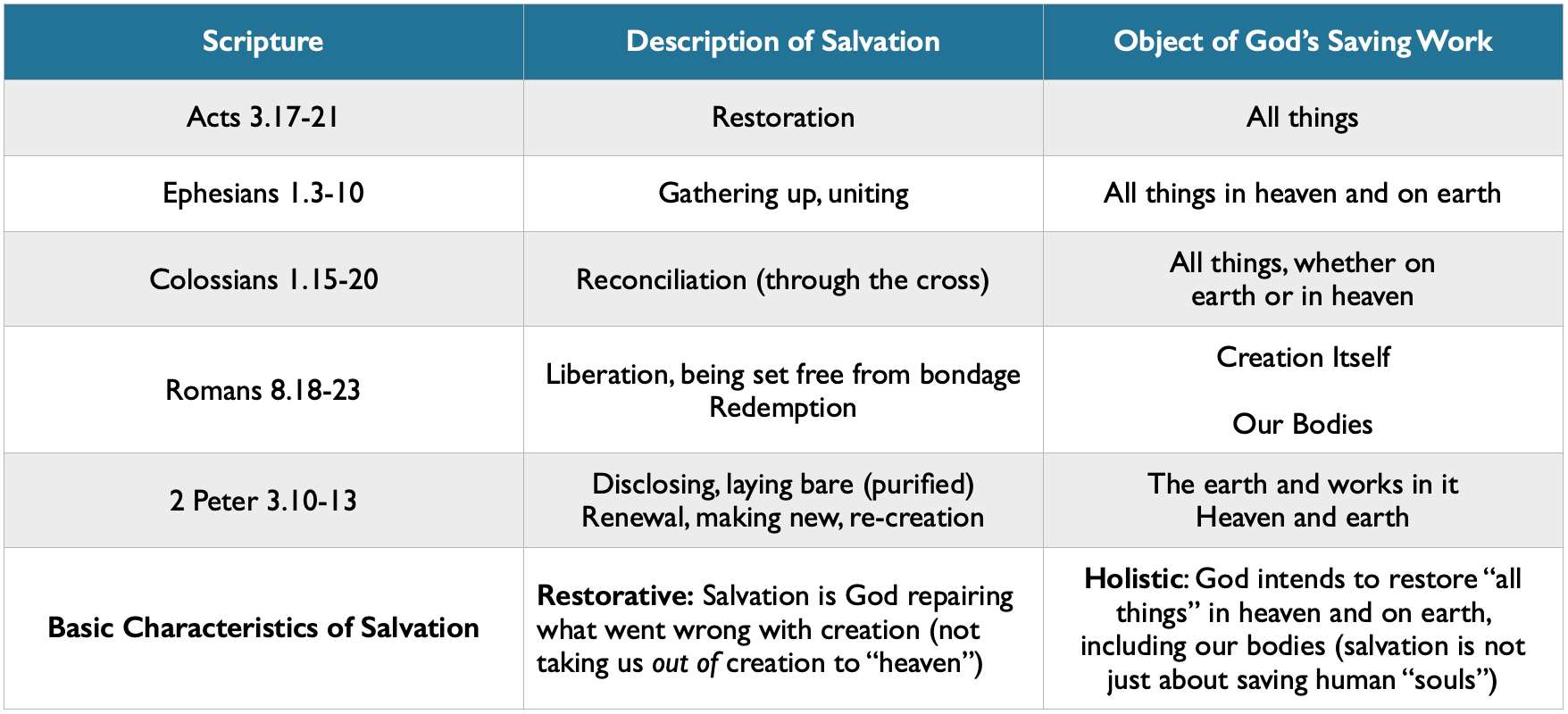
Here is a summary of what we have seen in the passages we have discussed:[8]

So, tying all this together, what can we conclude? In the words of Middleton:

“First, salvation is conceived not as God doing something completely new, but rather as redoing something, fixing or repairing what went wrong; this point is expressed in the language of restoration, reconciliation, renewal, and redemption found in these tests. Second, this restorative work is applied as holistically and comprehensively as possible, to all things in heaven and on earth, where the phrase “heaven and earth” is how Scripture typically designates the entire created order (with the earth understood as the distinctively human realm [Ps. 115:16]). The point is that the final salvific state envisioned in these five texts clearly contradicts an understanding of an immaterial, supramundane “heaven” as the ultimate dwelling place of the redeemed.”[9]

Scripture describes redemption in cosmic terms. It is restorative and holistic.


[1]J. Richard Middleton, A New Heaven and a New Earth: Reclaiming Biblical Eschatology, (Grand Rapids: Baker Academic, 2014): 155-63.

[2]I am not attempting in this post (or even in this entire series) to examine every passage in Scripture that supports the notion of a renewed creation. In this post, we are looking at a certain kind of text that supports this idea of cosmic redemption. In future posts, we will trace this theme through Scripture in different ways, but there are some passages that we will not get to.

For example, in Matthew 5.5 Jesus says, “Blessed are the meek, for they shall inherit the earth.” Although this passage was not central to my own development on this topic, it is a verse that is frequently referenced in support of NHNE. For an excellent discussion of this passage, see Jacob Rutledge, “The Christian and Creation, Chapter 4: Jesus and the Restoration of All Things.”

[3]BDAG, 112, glosses this word, apokatastasis/αποκαταστασις as “restoration”, and suggests a meaning of “restoring everything to perfection or, as of stars in their orbits, to their starting points.”

As Middleton, 157 n.5, points out, this term does not refer to the ultimate salvation of all people. Cosmic redemption is not universalism. While Scripture teaches that God loves and will ultimately redeem His creation, it also teaches that God honors the choices of humans who reject His love and offer of redemption. Middleton, 207-09, covers this in more detail.

[4]The word here is the common Greek word, panta/παντα, which means “all”. Here, it appears in the neuter gender, which is what provides the translation “things.” So, “all things” is the more literal translation; “universal” is more interpretive, but seems sound.

[5]Middleton, 158.

[6]The Greek word for “creation” in this passage is ktisis/κτισις and refers simply to something that is created. Those seeking a different interpretation than what I offer above will occasionally try to argue that in this text, ktisis is referring to humans rather than other forms of creation (animals, plants, rocks, etc.). This interpretation cannot be correct.

BDAG, 573, acknowledges the dispute over the meaning of the word in this passage, but does state that it is usually “taken to mean the waiting of the whole creation below the human level (animate and inanimate).”

Jimmy Allen, Survey of Romans (Searcy, AR: 1973): 79, presses further, helpfully laying out why ktisis cannot refer to humans in this passage. First, it cannot refer to those who are in Christ, because a clear distinction is made between believers and ktisis in Romans 8.23 (“not only the creation, but we ourselves…”). Second, it cannot refer to those who are outside of Christ, because “unbelievers do not look forward to the revealing of God’s sons in glory nor will they obtain the glorious liberty of God’s children.”

[7]This is a reference to the resurrection and the glorious transformation of our bodies, which we will discuss at length in a later post.

[8] This chart is adapted from Middleton, 163.

[9] Ibid.

A New Heaven & A New Earth Part 5: “Problem” Texts–John 14.1-3

This post is part of an ongoing series. You can find links to all the posts here.

Today’s post is the third focused specifically on dealing with “problem” passages that are frequently brought up as evidence that the Bible does not teach that creation will be renewed when Jesus returns. My contention is that these texts are really not “problems” after all—when properly understood, they either argue for the NHNE perspective, or at least, do not argue against it.

Previously, we have discussed 1 Thessalonians 4.13-18 and 2 Peter 3.1-13, and today, we will look at John 14.1-3. There are, certainly, other texts that people use to argue against the NHNE perspective, but these are the “Big 3” in my experience, and next week, we will move on and begin looking at various arguments for the renewed creation perspective.[1]

I will be clear up front: I do not believe that John 14.1-3 clearly teaches the NHNE position, but neither do I believe that it is a problem for that position.

Here is the passage in question:

1 Let not your hearts be troubled. Believe in God; believe also in me. 2 In my Father’s house are many rooms. If it were not so, would I have told you that I go to prepare a place for you? 3 And if I go and prepare a place for you, I will come again and will take you to myself, that where I am you may be also.

Why is this text considered to be a “problem”? Frequently, this passage is read to mean that Jesus is preparing a place for us in heaven and so when He returns, He will take us back with Him to heaven. 

Is this the only way to read it? Well, certainly not. Let’s take a closer look.


The Harmony of Scripture

First off, at this point, it is helpful for us to remember some of what we have studied in previous posts, because it is important for us to consider these passages in relation to one another.

I do not believe that the New Testament presents a bunch of contradictory ideas about what happens when Jesus returns (or anything else, for that matter), where one text presents a certain idea and another text says something completely different. Instead, I believe the teaching of Scripture is consistent and unified and that various passages harmonize with one another to provide a fuller picture on a given subject.

So, if we have 1 Thessalonians 4 in mind, we know from the historical background and use of imperial language in that passage that we are going to meet Jesus and then return here (whatever “here” is like at that point). Thus, we should already be skeptical about any interpretation of John 14 that indicates that when Jesus returns we will leave here to go somewhere else with Him.

Looking at the Passage in Context

In context, what is Jesus trying to do in this passage? John 14.1 gives us the answer as Jesus tells His disciples, “Let not your hearts be troubled.” Jesus is providing comfort to His disciples.

If we go up a few verses (remember, chapter additions were added much later; this is all part of Jesus’ “Farewell Discourse”), we see that there is plenty that Jesus has told them that would have been distressing to them: one of the disciples will betray Him, Jesus will not be with them much longer, and Peter will deny Jesus repeatedly. With all of this in their minds, it makes sense that the disciples would be troubled!

But Jesus tells them not to be troubled, but to trust in God and in Himself. We then have the famous verse, “In my Father’s house are many rooms” (v.2).

Rooms

I want to look at the two crucial words/phrases in this verse—“Father’s house” and “rooms”—in reverse order.

The word translated as “rooms” or “dwelling places” is the Greek word μοναι/monai, which can mean something like “temporary lodging place”.[2] Because of this, it has been argued that this is a reference to the intermediate state and that Jesus is preparing an interim resting place for His disciples when they die,  prior to the return of Jesus and the resurrection of the dead.

This seems unlikely, though, because John 14.3 focuses on when Jesus comes again and not on when the disciples will die.[3]

Father’s House

Generally speaking, “Father’s house” is temple language. Think of the story of Jesus as a boy when His parents find Him in the temple and He says, “Did you not now that I must be in My Father’s house?” (Luke 2.49), or Jesus cleansing the temple in John 2.16 and saying, “Do not make my Father’s house a den of trade.”[4]

When Jesus talks about His Father’s house in John 14.2, He isn’t referring to the literal temple, but rather, is using this language as a shorthand for “where God is”—in ancient understanding, temples were places where God dwells, and we see this throughout the story of Scripture. 

We referenced this idea when we discussed the relationship between Heaven and Earth in the first post of this series. Heaven is God’s domain, the earth is humanity’s domain, and we see throughout the biblical story that there are times and places where heaven and earth overlap[5]—where God dwells with humanity in a special way:

  • At creation, God constructed a cosmic temple[6] where God was able to dwell with humans and walked with them in the garden.
  • With the tabernacle (and later, its more permanent counterpart, the temple), God created a means to dwell within the midst of the nation of Israel.
  • In the incarnation, the Word became flesh and “tabernacled” among us. Jesus Himself was a walking temple, as God dwelt among us in an unprecedented way. 
  • Through the giving of the Spirit, God’s presence was multiplied exponentially. God’s Spirit lives within believers, and Paul says that we are temples of God’s Spirit, individually (1 Corinthians 3.16) and collectively (1 Corinthians 6.19-20).
  • In eternity, God will make His dwelling (tabernacle) with humanity in the new heaven and new earth (Revelation 21.1-5).

Throughout Scripture, we can see how temple language is used to indicate spaces where God’s presence can dwell with humanity. Here, in John 14, when Jesus talks about His “Father’s house”, this is the background against which we need to hear His statement. And the emphasis of what Jesus says here is not the where of His Father’s house, but its expansiveness: there is plenty of room for everyone: many dwelling places. Remember, this is a passage of comfort.

Jesus will go and prepare a place for His disciples in His Father’s house, and will come again so they can dwell together.

But When Will This Happen?

In my discussion of the Greek word μοναι/monai above, I argued that this passage can’t really be a reference to the intermediate state, because the emphasis is on when Jesus comes again, not on when the disciples themselves die. So, what does Jesus mean when He says, “I will come again”? When will this happen?

It is easy for us to read these words and immediately think of the Second Coming, but I am not sure that does justice to the context of this passage. This is the night that Jesus is betrayed. In a matter of hours, Jesus will “go away”. He will be forcibly removed from their presence, tried, scourged, and crucified, ultimately leaving them at His death. He would then “come again” to be with them following His resurrection. 

Thus, in one sense, I think we can say that the most straightforward way of reading this passage is in light of what was about to happen to Jesus and the disciples. This reading makes sense from a theological perspective as well: when Jesus “goes away” to be crucified, He absorbs the sins of the world upon Himself and makes it possible for all people to have a relationship with the Father. 

A little later in John 14.23, Jesus says, “If anyone loves me, he will keep my word, and my Father will love him, and we will come to him and make our home with him.” The word “home” in this passage is μονὴν/monen, the same word Jesus used in 14.2, and I think we see this happening in a powerful way at Pentecost, with the sending of God’s Spirit to live among God’s people and make his home among us.[7]

However, once we have acknowledged the immediate context of Jesus’ words in John 14.1-3, I think there is also a fuller meaning to which this passage points, just as the current indwelling of the Spirit is a guarantee or down payment that points to our future inheritance (2 Corinthians 1.22, 5.5; Ephesians 1.13-14).[8] As Jesus’ work on the cross and His defeat of sin and death make it possible for the Spirit to come and dwell among us, so also it makes possible God’s ultimate dwelling with His people in the new creation—He prepares this for us.

When Jesus returns, we will go to be with Him (1 Thessalonians 4.17; John 14.3).[9] Revelation 21.2 describes that time of God’s ultimate dwelling with His people by saying that “the holy city, new Jerusalem” will come “down out of heaven from God, prepared as a bride adorned for her husband”, and the word “prepared” is the same word that Jesus uses in John 14.3.

Or, as Hicks, Valentine, and Wilson describe it in Embracing Creation:

“Jesus goes away to complete the construction (preparation) of God’s new house, the new creation. When Jesus returns, the heavenly Jerusalem will descend—with Jesus—to the new earth under the new heavens. Jesus will receive us, and we will dwell with Jesus within the Father’s house forever.”[10]

With all of that in mind, I think there is a two-fold answer to the question of when the things that Jesus describes in John 14.1-3 will happen. First, Jesus is going away to be crucified, but He will return to His disciples after the resurrection, and what He accomplishes in the meantime will change everything and will make it possible for God to dwell with His people in an unprecedented way. But beyond that, this points ahead to eternity, where Jesus will return again take us to Himself, and the Father will fully and eternally dwell with us in His house—a new heaven and a new earth.

Conclusion

It is important to remember that the focus of John 14.1-3 is really not on what happens when Jesus returns; it is that Jesus’ disciples can be comforted in the knowledge that when He returns, they can be with Him forever (wherever that may be). 

Thus, this passage doesn’t really come down on the NHNE issue one way or the other. It does, however, fit nicely with other texts such as 1 Thessalonians 4 and Revelation 21 in a way that the traditional view does not.


[1]J. Richard Middleton, A New Heaven and a New Earth: Reclaiming Biblical Eschatology, (Grand Rapids: Baker Academic, 2014): 179-237, has an excellent, lengthy discussion of various texts that could be construed as presenting a perspective contrary to renewed eschatology.

[2]The King James Version erroneously translates this word as “mansions,” which is the source of old songs like “Mansion Over the Hilltop” and “An Empty Mansion.” The theological point of this verse is the comfort of dwelling with God, not on the magnificent opulence of that dwelling.

[3]Middleton, 228-29; Ian Paul, “Jesus’ farewell discourse in John 14”, https://www.psephizo.com/biblical-studies/jesus-farewell-discourse-in-john-14/

[4]Technically, the word for “house” does not occur in the Greek of the Luke 2 passage, but the fact that Jesus is in the temple and that it is widely translated this way illustrates the point I am making: “Father’s house” is temple language.

[5]See Timothy Mackie and Jonathan Collins, When Heaven Meets Earth: A 12-Part Biblical Study on Heaven (Portland: The Bible Project, 2017). This resource is available for download on The Bible Project website here.

[6]The notion that God is depicted as creating a cosmic temple and setting it in order in Genesis 1-2 and setting it in order is a widespread understanding in biblical studies. For helpful summaries of this, see John Mark Hicks, Bobby Valentine, and Mark Wilson, Embracing Creation: God’s Forgotten Mission, (Abilene, TX: Leafwood: 2016): 33-45; Middleton, 46-49, 163-65, 168-72.

[7] I am indebted to Stephen Scaggs for his thoughts in helping me to understand this reading of the text. 

Embracing Creation, 195: “In one sense, Jesus comes even now in the presence of the Spirit to live within us and make his home among us. This is his promise in John 14:23, the only place where Jesus uses this word other than John 14:2. In the coming of the Spirit, the Father and Son, Jesus said, will “make our home [dwelling place] with them.”

See also Middleton, 229.

[8]Embracing Creation, 196, discusses the “fuller experience” to which this passage refers beyond the immediate context. 

[9]To me, the language of 1 Thessalonians 4.17 and John 14.3 are strikingly similar. In 1 Thessalonians 4.17, we will be “caught up” to meet the Lord in the air; in John 14.3, Jesus says, “I will take you to myself.” These are forceful actions, initiated by Jesus, that result in our dwelling with Him.

[10]Embracing Creation, 196.

« Older posts Newer posts »

© 2026 The Doc File

Theme by Anders Noren — Up ↑