The online journal of Luke Dockery

Category: Discipleship (Page 17 of 23)

The Christian Response to a Broken World

Over the weekend, my family and I passed the 50-day milestone of our COVID-19-inspired home isolation. I have tried to view this as an opportunity for growth, and there have certainly been some benefits to this season, but like the vast majority of folks, I acknowledge its challenges and am ready to move on to something else.

There is no denying that this is a rough time all around the world. Hundreds of thousands of people have died, and millions have contracted COVID-19. Financial uncertainty is widespread, as millions have lost their jobs.  The quarantine directives have been particularly devastating in parts of the world with food insecurities where starvation is a legitimate threat. Closer to home, financial stress and sheltering-in-place have created a volatile mix that, according to some reports, has led to a spike in abuse, mental health issues, and suicide.


In light of what is literally a worldwide crisis, you would like to think that perhaps this shared experience could bring us together somewhat—unify us in a time of need as we all pull together to jointly overcome. To be sure, that has happened to a degree, but louder, shriller voices continue to sow discord and division, placing blame along party lines and even promoting wild conspiracy theories.

From my perspective, the response to these events from a lot of Christians has been pretty disappointing as well. Too often, we are quick to speak and slow to listen instead of the other way around (see James 1.19), and when we react in that way, we can often add fuel to the fires of heartache, division, and confusion that are already waging.

The reality is that we live in a broken world marred by lots of problems. As Christians living in this context, how should we respond when tragedy occurs? I don’t claim to have all the answers, but here are three responses that I believe are helpful in the face of tragedy:

(1) In response to a broken world, Christians should lament. Perhaps our most basic response to suffering is that we should weep with those who weep (Romans 12.15). That seems like the most obvious thing in the world, but recently, instead of this, I have seen Christians telling those who weep that what they weep about isn’t really a big deal or worth weeping about at all! When the world gives us evidence of its brokenness, we should acknowledge that brokenness, allow ourselves feel distress, and bring that distress before God. It has become popular, in some circles, to criticize prayer as a response to horrible tragedy, but as Christians, we should take no note of such dismissals. Christians believe that God is ultimately sovereign over the universe, and thus, He is the one who can do something about the brokenness in our world. It is absolutely appropriate that we bring out laments before our Father, as we yearn for a day when He will wipe every tear from our eyes (Revelation 21.4).

(2) In response to a broken world, Christians should aid the suffering. I think part of the reason that a lot of people are critical of prayer is that they feel that this is all that Christians do. And perhaps that can be a fair criticism at times, because God certainly expects us to accompany our prayers with righteous actions. Philip Yancey says that the church forms the front line of God’s response to the suffering world, and I think he is right: Christians have a responsibility to get into the mess of the world and try to do something to clean it up. That is probably accomplished less by questioning the statistics that are released, distrusting the media, or berating government officials, and more by being present with those who suffer, and looking for ways to aid those who are in need: offering a shoulder to cry on (even a socially-distant one!) for the grieving, a card or phone call for the lonely, a bag of groceries or a check in the mail for those with financial needs.[1]

(3) In response to a broken world, Christians should proclaim Jesus. Too often, this part is neglected. In John 16.33, Jesus was speaking to His disciples on the night of His arrest and He said simply, “In this world you will have tribulation.” Though not spoken directly to us, those words certainly apply to us as well; as recent and ongoing events remind us, we live in the same world, a world which was created good but has been tainted by sin and is now characterized by heartache. As Christians, we weep with those who weep, we do what we can to help those who are suffering, but we also remember the second half of John 16.33: “In this world you will have tribulation…but take courage, I have overcome the world!” As Christians, we also proclaim that the death and resurrection of Jesus Christ mean that sin, illness, suffering, strife, injustice, and death do not get the last word. As Christians, we long for the day when Jesus returns, when death dies, and when every tear is wiped away from our eyes.

This is not an exhaustive list, and I am certain that more could be said. At the same time, I am equally certain that if Christians everywhere would respond to suffering and tragedy in our world in these ways, the Christian witness would be strengthened, the suffering of people would be limited, and the borders of God’s Kingdom would be expanded.

This is an updated version of an older post. 


[1]If you have been blessed with financial means and would like to share with those who are in need, please contact me. I am working to help some ministers in impoverished areas who are providing food for vulnerable populations who are at risk of literally starving, and I would be happy to help your gift get to a place where it could accomplish much good.

A New Heaven & A New Earth Part 4: “Problem” Texts–2 Peter 3.1-13

This post is part of an ongoing series. You can find links to all the posts here.

Last week’s post was about our first “problem” text, 1 Thessalonians 4.13-17. In that post, I argued that, when properly understood in its historical context, paying close attention to the specific Greek words that Paul uses, this passage isn’t actually a “problem” for the NHNE perspective at all; it actually supports renewed eschatology.

For me, the “problem” passage we are going to look at today was even more important in my own journey, because this was the passage that to me most seemed to refute the notion that God would renew and redeem creation when Jesus returned. I am talking about 2 Peter 3.1-13, which is another “problem” in the sense that it supposedly opposes renewed eschatology. When properly understood, I don’t think it does, and I think it actually fits quite well with the NHNE perspective.

There is a lot going on in this passage that we will need to consider, and even in what I am sure will be a very long post, we won’t be able to fully do it justice.

Let’s start by taking a look at the passage itself (I have the verse that people tend to focus on in bold):

1 This is now the second letter that I am writing to you, beloved. In both of them I am stirring up your sincere mind by way of reminder, 2 that you should remember the predictions of the holy prophets and the commandment of the Lord and Savior through your apostles, 3 knowing this first of all, that scoffers will come in the last days with scoffing, following their own sinful desires. 4 They will say, “Where is the promise of his coming? For ever since the fathers fell asleep, all things are continuing as they were from the beginning of creation.” 5 For they deliberately overlook this fact, that the heavens existed long ago, and the earth was formed out of water and through water by the word of God, 6 and that by means of these the world that then existed was deluged with water and perished. 7 But by the same word the heavens and earth that now exist are stored up for fire, being kept until the day of judgment and destruction of the ungodly.

8 But do not overlook this one fact, beloved, that with the Lord one day is as a thousand years, and a thousand years as one day. 9 The Lord is not slow to fulfill his promise as some count slowness, but is patient toward you, not wishing that any should perish, but that all should reach repentance. 10 But the day of the Lord will come like a thief, and then the heavens will pass away with a roar, and the heavenly bodies will be burned up and dissolved, and the earth and the works that are done on it will be exposed.

11 Since all these things are thus to be dissolved, what sort of people ought you to be in lives of holiness and godliness, 12 waiting for and hastening the coming of the day of God, because of which the heavens will be set on fire and dissolved, and the heavenly bodies will melt as they burn! 13 But according to his promise we are waiting for new heavens and a new earth in which righteousness dwells.


Different Translations

When I taught through this passage in Bible class, I made sure that we read from several different Bible translations, paying close attention to the different ways that 2 Peter 3.10 is translated. Above, I quoted from the ESV. Here is verse 10 again:

10 But the day of the Lord will come like a thief, and then the heavens will pass away with a roar, and the heavenly bodies will be burned up and dissolved, and the earth and the works that are done on it will be exposed.

Here is the same verse in the KJV: 

10 But the day of the Lord will come as a thief in the night; in the which the heavens shall pass away with a great noise, and the elements shall melt with fervent heat, the earth also and the works that are therein shall be burned up.

The NKJV:

10 But the day of the Lord will come as a thief in the night, in which the heavens will pass away with a great noise, and the elements will melt with fervent heat; both the earth and the works that are in it will be burned up.

And also, the NASB:

10 But the day of the Lord will come like a thief, in which the heavens will pass away with a roar and the elements will be destroyed with intense heat, and the earth and its works will be burned up.

Lest you think that the ESV is the oddball and that all other translations say that the earth will be “burned up” in v. 10, here is the NIV:

10 But the day of the Lord will come like a thief. The heavens will disappear with a roar; the elements will be destroyed by fire, and the earth and everything done in it will be laid bare.

And, finally, the NRSV:

10 But the day of the Lord will come like a thief, and then the heavens will pass away with a loud noise, and the elements will be dissolved with fire, and the earth and everything that is done on it will be disclosed.

Obviously, we have a translation issue here: one group of translations says that, in this context, the earth and its works will be “burned up”, while the other translations say the earth and its works will be “exposed”, “laid bare”, or “disclosed”. We will get into the details of this textual problem later, but for the moment, we will just acknowledge why this appears to be problematic for the idea of a renewed cosmos when Jesus comes: if you are reading from the NJKV or a similar translation, this verse makes it seem like the earth is going to be destroyed or annihilated by fire. Thus, we will either (1) go off to heaven with Jesus (which works well if paired with a faulty interpretation of 1 Thessalonians 4), or (2) live in a “new heavens and a new earth” (v.13) that is completely distinct from our current system.[1]

In other words, the idea that our current earth will in some way be renewed, redeemed, transformed—the perspective I am presenting in this series—is dismissed, because it sounds like it’s going to be burned up.

Is this the best way to read this passage? In this post, we’re going to take a closer look. I will confess that this is a challenging passage, but I think we can bring some clarity to it.

Context

First, let’s look at the point of what Peter is trying to say in context. In this section, Peter is talking about sinful people who scoff at the notion of judgment. They say things like, “You say judgment is going to happen, but everything just continues as it always has!” (v.4), but Peter points out that judgment came upon the earth before when God judged the world by a flood (v.5-6). In the same way, “the heavens and earth that now exist are stored up for fire, being kept until the day of judgment and the destruction of the ungodly” (v.7).

This knowledge—God’s impending judgment upon evil—should encourage the wicked to repent.

When the day of the Lord comes, the heavenly bodies[2] will be burned up and dissolved, and the earth and the works that are done on it will be…burned up? exposed? (This is the verse that we looked at in multiple translations; we’ll get to it in a few minutes.)

Because of all this, Peter says that we should be motivated to live lives of holiness and godliness, waiting for the coming day of God, and anticipating “new heavens and a new earth in which righteousness dwells” (v.13).

So, to keep things in perspective, whatever v.10 is talking about, what is the main point of this passage? Judgment upon evil has happened before (flood), judgment upon evil is going to happen again (fire), and the knowledge of this should motivate us to live holy lives.

Interpreting the Passage: Important Ideas to Consider

Three Worlds, and the Comparison to Noah: 

In 2 Peter 3.1-13, Peter refers to three different habitable worlds:[3]

  • Past: The original “heavens” and “earth” that emerged from and through water by the command of God. This world “perished” in the flood of Noah (2 Peter 3.5-6)
  • Present: The “heavens and earth that now exist” that are “stored up for fire” at the command of God (2 Peter 3.7,10,12)
  • Future: The future “new heavens and a new earth in which righteousness dwells” according to the promise of God (2 Peter 3.13)

Keeping these three worlds in mind is helpful as we consider the comparison that is made to the days of Noah: whatever is going to happen with fire in this present world, Peter compares to the judgment that God brought on the world through the flood.

Did the flood of Noah destroy the world? Well, yes…and no.

Certainly, the world as it had previously been was no more, but it’s not like the earth ceased to exist. The flood brought judgment upon the sins of the world and it certainly changed things. In some ways, it reset the system and perhaps even instituted a new system of existence (kind of like reformatting the hard drive of a computer after it crashes).

The flood of Noah washed the earth clean, preparing it to be a new sort of world (the “Present” world, as described above). But the earth was not annihilated.

Biblical Use of Fiery Judgment

The notion of fiery judgment upon the earth that Peter uses in this passage has a background in the Hebrew prophets, where it is a repeated motif.

One example of this is Malachi 4.1 (though, see also Malachi 3.1-4, Isaiah 34.4, Isaiah 64.1, and Zephaniah 3.8, among others):

1 “For behold, the day is coming, burning like an oven, when all the arrogant and all evildoers will be stubble. The day that is coming shall set them ablaze, says the LORD of hosts, so that it will leave them neither root nor branch.”

This is common judgment language, but in Malachi 4, who is the focus of it? Who will actually be burned up? The arrogant and all evildoers. Compare that to 2 Peter 3.7, which says that this fire is being stored up to bring destruction on the ungodly. The emphasis here, and in the entire passage, is not on destroying all that has been created, but a judgment of destruction upon the wicked.[4]

“The earth and the works that are done on it will be __________.”

We noted this problem at the beginning of the post, that different translations render 2 Peter 3.10 in very different ways, and one of those ways indicates that the earth will be “burned up.”

This is not a translation problem, but a textual one. As you probably know, we have thousands and thousands of hand-copied New Testament manuscripts, and, as you can imagine if you were responsible for copying the entire New Testament by hand, no matter how hard you tried, you would make some mistakes. Textual criticism is the academic study of comparing manuscripts with one another to determine which is more accurate and reflects the original reading.

Textual criticism is a complex field, and I do not pretend to be an expert, but here are two major rules of textual criticism:

  • Older manuscripts are considered to be more reliable than recent ones. This makes a lot of sense if you think about it: since you are trying to figure out what the original copy said, it would be more likely that manuscripts that are closer chronologically to the original would be closer in content as well, because there would be less time and fewer iterations for mistakes to accumulate.
  • When you have two textual variants (a disagreement between two manuscripts), the more difficult reading is considered more likely to be authentic. This one might seem counterintuitive, but also makes sense when you think about it. A scribe copying a manuscript is unlikely to change a word or passage that reads satisfactorily into something that is less clear; he is much more likely to smooth out passages that seem difficult to make them understandable.

In 2 Peter 3.10, different manuscript traditions have different words. Some have the Greek word heurethesetai/εύρεθησεται (will be found, will be exposed, will be laid bare), while others have the word katakaesetai/κατακαησεται (will be burned up, will be consumed).

  • The older, more reliable manuscripts (Vaticanus, Sinaiticus) have heurethesetai (will be found, will be exposed, will be laid bare) in v. 10.[5]
  • This is also the more difficult reading and thus, preferred. If you are a scribe copying this text, based on the language earlier in this passage (that talks about fire and destruction), it would be easy to lose your place or make an assumption and think that katakaesetai fits here. It is much more difficult to explain why a scribe would insert the word heurethesetai in this context. 

To sum up, going back to our rules for textual criticism: “exposed/laid bare” is the older reading, and it is the more difficult reading as well. So even though we have different translations of the Bible that have different readings here, our best guess is that the Greek text originally said heurethesetai. This is what my Greek New Testament has as well.[6]

So, the idea here is that when this fiery judgment comes, it will work in such a way as to expose the things that have been done on earth, not destroy the earth. It is like a refining or purifying fire—God’s judgment determines what is pure and what is not.[7]

What Are the “Elements” or “Heavenly Bodies” of v.10,12?

Unlike the textual issue we have been discussing, this is a translation issue. The Greek word stoicheia/στοιχεια can be translated in different ways in English, and each of those English renderings has multiple possible meanings:[8]

  • Stoicheia could refer to Elements, like the basic building blocks of the physical universe. As modern readers, we hear this word and probably think of things like carbon, hydrogen, etc. that we would find on the Periodic Table of Elements. Obviously, this would have been unknown to Peter’s audience, and cannot be what he was referring to. There is evidence in the ancient world that stoicheia was used to refer to the “elements” of earth, air, fire, and water, but interpreting the word in this way would mean that the earth is included in the meltdown, whereas 2 Peter 3 doesn’t say that the earth will be destroyed or burned up, as already explained above. Thus, this meaning seems untenable.
  • Stoicheia could refer to Elements, in the sense of “elementary teachings” or false teaching. It is used in that way elsewhere in the New Testament (Colossians 2.8,20), so the idea could be that these false teachings will be destroyed, and the false teachers themselves will be exposed and subject to judgment.
  • Stoicheia could refer to Heavenly Bodies, like the sun, moon, and stars. If this is correct, perhaps what this passage is referring to is that the “top layer” of the world will be removed (see Isaiah 34.4), so that what lies beneath on the world can be exposed and judged.
  • Stoicheia could refer to Heavenly Bodies, as a reference to angelic powers, beings that Paul describes as powers, principalities, etc. This would make sense in that it could be talking about God bringing judgment upon spiritual forces that are in rebellion to God, paralleling the humans who are in rebellion to God and are going to be judged as well. So, first, the heavenly bodies are judged and destroyed, then the earth is laid bare/exposed, and finally the ungodly are next in line for God’s judgment.

Ultimately, I am not sure which of these understandings is correct, but I lean toward “heavenly bodies” being the better translation.

“New heavens and a new earth in which righteousness dwells”

When all of this happens, when the present world is judged, when evil is exposed and destroyed and the world is changed (“destroyed” through a refining process), 2 Peter 3.13 describes the future world as a “new heavens and a new earth in which righteousness dwells.”[9]

There are multiple Greek words for “new”, which have overlapping but somewhat distinct meanings:

  • Neos/νεος: the primary usage of this word in the New Testament refers to something that has been in existence for a relatively short time. Something that is “fresh” or “brand new.”[10]
  • Kainos/καινος: this word can be used similarly to neos, but also can refer to that which is recent in contrast to something old in the sense that what is old has become obsolete. It is a newer and better version of what has been.[11]

It is interesting to note that kainos is the word used here. On its own, this doesn’t prove anything, but it does give additional evidence to the idea that the new heavens and new earth is a refined, purified, restored, recreated heavens and earth rather than a brand new replacement for something that has been destroyed. It is a newer and better version of what has been.

Conclusion

Putting all of this together, 2 Peter 3 is not about the annihilation of the earth; it is about a fiery judgment upon sin, analogous to the watery judgment on sin through the flood. This judgment will expose all that has been done, and wickedness will be judged and destroyed in some sense. 

The fallout from all of this is that everything will be changed. Just as things were dramatically different after the flood of Noah brought about a new world, this instance of fiery judgment will purify and refine God’s creation and will bring about a new heavens and a new earth in which righteousness dwells. As Christians, this is what we look forward to, and our hope, as well as our sober acknowledgment of the certainty of judgment, motivates us to live in a certain way.[12]

Far from refuting the notion of a renewed earth, 2 Peter 3 actually teaches it.


[1]Most people who hold to (1) would probably acknowledge the existence of “new heavens and a new earth” because 2 Peter 3.13 mentions it, but would just equate that with heaven. This interpretation is perplexing to me (talking about “new heavens and a new earth” seems like a really confusing way of talking about “heaven as it already is”), but I wanted to acknowledge that these people, though mistaken in my view, are not ignoring 2 Peter 3.13.

[2]Depending on your translation, “heavenly bodies” is instead rendered as “elements.” We will discuss this later.

[3]This listing is based significantly on John Mark Hicks, Bobby Valentine, and Mark Wilson, Embracing Creation: God’s Forgotten Mission, (Abilene, TX: Leafwood: 2016): 197, but altered to fit a different translation.

[4]This is just one example to show the common biblical practice of using language fiery destruction to talk about God’s judgment upon sin. J. Richard Middleton, A New Heaven and a New Earth: Reclaiming Biblical Eschatology, (Grand Rapids: Baker Academic, 2014): 109-28, discusses at length the ways in which biblical authors depict God coming in judgment upon the world, how storms, earthquakes, and fire are a part of this imagery, and how the effects of God’s judgment are cosmic in scope.

It is also worth pointing out that this is apocalyptic language, commonly used in biblical prophecy, and not always intended to be pressed literally. For example, in Acts 2, Peter describes the events of the Day of Pentecost as fulfilling the prophecy of Joel: “And I will show wonders in the heavens above and signs on the earth below, blood, and fire, and vapor of smoke; the sun shall be turned to darkness and the moon to blood…” (Acts 2.19-20, quoting from Joel 2.30-31). Obviously, these things did not literally happen on that Day of Pentecost. I am indebted to Mark Wilson for pointing this out.

[5]Middleton, 160-62, overviews the text-critical issue and explains in greater detail why heurethesetai/εύρεθησεται is the preferred reading.

[6]The UBS Greek New Testament: Reader’s Edition with Textual Notes (Stuttgart, Germany: Deutsche Bibelgesellschaft, 2010). 

I have heard that more recent versions of the Greek New Testament have a negative rendering of heurethesetai/εύρεθησεται (“not found”), but have not confirmed this. Regardless, Hicks, Valentine, and Wilson, Embracing Creation, 198, address this: “The addition of the negative (“not found”), favored by some textual critics, lacks support from any Greek manuscripts, and it cannot explain the origin of the more difficult reading (“found” rather than “not found”).

[7]I am indebted to Andrew Gass, preacher at the West Oaks church of Christ in Columbus, Texas, for pointing out that Peter himself uses the imagery of fire as a refining and purifying force in 1 Peter 1.7.

Middleton, 194, “…the image of judgment by fire in 2 Peter 3 is not purely destructive, but instead may be understood as a smelting process by which the dross of human sinfulness is burned off, so that “found means something like “standing the test” or “showing one’s mettle.” John C. Nugent, Endangered Gospel: How Fixing the World is Killing the Church (Eugene, OR: Cascade Books, 2016), 38n1, “In [2 Peter 3:10] the earth is disclosed or revealed, whereas only heavenly elements are burned. Together they convey a refining of God’s good creation. The impurities are burned off so the true essence will shine forth all the more brilliantly.”

[8]Middleton, 190-93; 198-200.

[9]In this discussion, it is easy to focus on the language of “new heavens and a new earth” in 2 Peter 3.13 and overlook the second part, “in which righteousness dwells,” but the second part is essential: the context of this passage is directly about the judgment on and destruction of evil; once evil is dealt with, the future world that is brought about is a place characterized by righteousness.

[10]Walter Bauer,  A Greek-English Lexicon of the New Testament and Other Early Christian Literature, 3rd rev. ed., ed. Frederick W. Danker (Chicago: University of Chicago Press, 2000), 669.

[11]BDAG, 496-97.

[12]How does this fit with the 1 Thessalonians 4 passage that we discussed last week? Because I am hesitant to speculate, I have relegated this to a footnote, but let me offer a hypothetical reconstruction of how these may fit together: Jesus returns with the sound of a trumpet as the heavenly bodies are destroyed, we meet Him in the air as this earth is laid bare, the evil works are exposed and destroyed, our world is refined/renewed/recreated, and then we escort him back here, to live with God eternally in a New Heaven and New Earth.


A New Heaven & A New Earth Series

Below, you can find links to each of the posts in the A New Heaven & A New Earth series:

Book Review: Atomic Habits

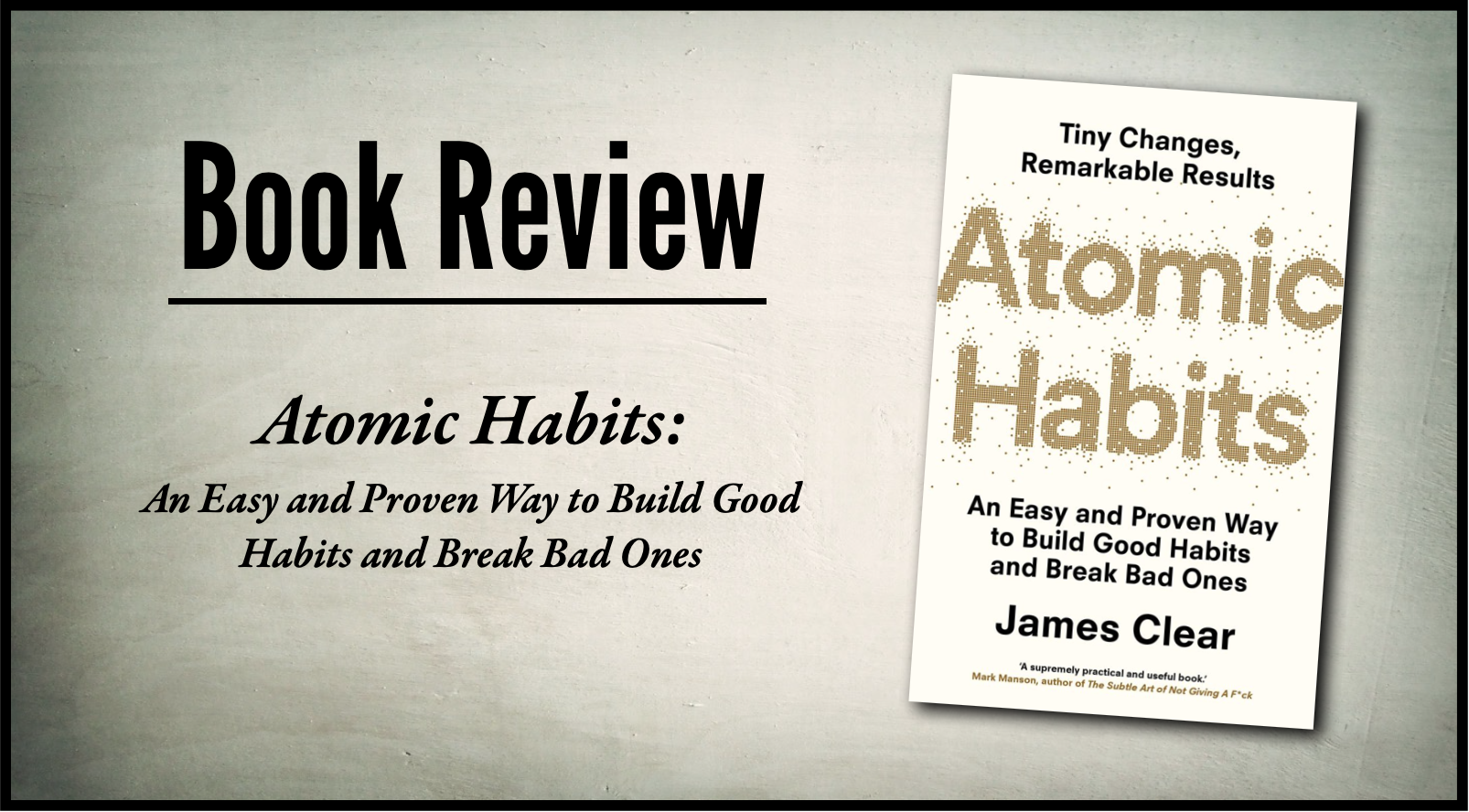
I mentioned in a previous post that I have done a lot of reading during this season of quarantine. Some of that has been just for entertainment or increasing my knowledge in a certain area, but some has been more of the “self-help” variety. Atomic Habits: An Easy and Proven Way to Build Good Habits and Break Bad Ones by James Clear definitely falls into the self-help category.

Before I go any further, I want to make two points very clear:

  1. Generally speaking, I really don’t like self-help books.
  2. I really, really liked Atomic Habits.

This review will be a little different from usual, because I “read” Atomic Habits as an audiobook. I took some notes on my phone while listening, so I will have some summary points to share, but I won’t have page numbers for any of the specific quotations.

Summary

Atoms are very small things. They are the building blocks of the world around us, but they are invisible to the naked eye. They are also very powerful—the power of the atom can provide electricity to an entire region in the form of a power plant, or untold devastation in the form of a nuclear bomb. This is the premise of Atomic Habits: habits are little, sometimes nearly invisible things that can bring about powerful change—for good or ill—in our lives.

James Clear offers four laws (I think he used the “laws” terminology; I am not certain) for successfully building good habits, and also an inversion to each law to help break bad habits:

  1. Make it Obvious: If you want to successfully implement a new habit, it needs to be something that is in your face and can be easily remembered. If you want to read more before bed, set a nightly alarm to remind you to do so. Have a specific time and location where you plan to implement your habit (“I will go for a 2-mile run at 7 AM in the morning.”). Stack your new habit onto another habit that you already do (“While showering in the morning, I will pray about my day.”).  The inversion of this law: Make it Invisible. If you always crave junk food at the end of the day while watching TV, then do something other than watch TV. Take a walk or read a book—remove the cue that encourages the bad habit you are trying to avoid.
  2. Make it Attractive: If you want to successfully implement a new habit, it needs to be something that is desirable to you. Which habits are attractive to us are significantly determined by the culture in which we live, so you should join a culture where your desired behavior is the normal behavior. In other words, hang out with people who are already doing the thing you want to do. If you want to eat healthily, go out to eat with friends who are healthy eaters. If you want to get in better shape, spend time with friends who work out regularly. If you want to become a better Bible student, join a Bible study group. You can also make a new habit attractive by connecting something you need to do (the new habit) with something you want to do (“I will get to spend ten minutes on social media after I complete my morning run.”). The inversion of this law: Make it Unattractive. Reframe your mindset by highlighting the benefits of avoiding the bad habit. If you want to quit smoking, focus on how cutting cigarettes out of your life will improve your health, put money back into your bank account, and make your car smell better.
  3. Make it Easy: If you want to successfully implement a new habit, you have to do it…a lot. You have to get your reps in: the amount of time you have spent performing a habit is not as important as the number of times you have performed it. To begin with, focus on just doing the thing even if your initial efforts are easier than your ultimate goals. So, say for example that you want to start a habit of working out regularly at the gym. To start, it is not as important that every workout be an hour long at high intensity (or whatever the ultimate goal is); what is important is that you go to the gym without missing if at all possible. Pack your workout clothes in your gym bag and set your alarm the night before. If you have a busy day or aren’t feeling well, don’t skip your workout; just abbreviate it. Go run for ten minutes instead of an hour; do five push-ups instead of thirty. Make it as easy as you need to, but get your reps in. By doing this, you are using a commitment device, which is a choice you are making in the present that locks in better behavior in the future. The inversion of this law: Make it Hard. Make it difficult to continue to do the things you don’t want to do. If you want to stop eating junk food, get it out of your house. Now, whenever you have a craving, you’ll have to drive somewhere to get it. If you want to stop watching so much TV, put your television in another room where you don’t spend as much time, or unplug it after each use. Now, a habit that you may have indulged when you were feeling tired or lazy requires extra energy to do.
  4. Make it Satisfying: If you want to successfully implement a new habit, you have to feel good about it. Identity is what sustains a habit. Ultimately, you want to think of yourself as the kind of person who [does whatever the habit is that you are trying to implement]. Track your habits to see your improvement over time. Try to keep your habit streak alive. You are not perfect and will have a lapse, but when you do, try to avoid a second lapse. The inversion of this law: Make it Unsatisfying. We are less likely to repeat a bad habit if it is painful or unsatisfying. Enlist an accountability partner who will ask you how you are doing in avoiding your bad habit.

Quotations

Here were some of my favorite quotations from the book (again, sorry that I don’t have page numbers for these):

“Time magnifies the margin between success and failure. It will multiply whatever you feed it. Good habits make time your ally; bad habits make time your enemy. Your habits can compound for you or against you.”

“You do not rise to the level of your goals; you fall to the level of your systems.”

“Every action you take is a vote for the kind of person you will become.”

“This is the secret of self-control: make the cues of your good habits obvious; make the cues of your bad habits invisible.”

“The most effective form of learning is practice, not planning.”

“Create an environment where doing the right this is as easy as possible.”

“It’s better to do less than you hoped for than nothing at all.”

“Incentives can start a habit; identity sustains a habit.”

“The first mistake is never the one that ruins you. It’s the spiral of repeated mistakes that follows. Missing once is an accident; missing twice is the start of a new habit.”

“We optimize for what we measure, and when we choose the wrong measurement, we get the wrong behavior.”

“Until you work as hard as those you admire, don’t explain away their success as luck.”

“It doesn’t matter what you are trying to become better at; if you only do the work when it is convenient or exciting, then you will never be consistent enough to achieve remarkable results.”

It is hard for me to overstate how much I appreciated this book. Clear does not write from a Christian perspective, but this book is really all about discipline and character formation, and I found that much of what he wrote applied to me as a disciple of Jesus.

I give this book a strong recommendation. I have implemented some of his advice in my own life as I seek to grow during this season of quarantine, and have found it to be helpful and practical. It’s a book that I plan on buying a physical copy of so I can keep coming back to it.

A New Heaven & A New Earth Part 3: “Problem” Texts–1 Thessalonians 4.13-18

Introduction

Last week, we talked about some “distractions”—different things that are not really related to renewed eschatology, but that people often think of and want to talk about when NHNE is discussed. First, we talked about some alternative visions of what the end times look like: historic premillennialism, dispensational premillennialism, and Jehovah’s Witness eschatology, and ultimately, I shared with you the problems I have with each of those perspectives, and insisted that renewed eschatology is not any of these views.

Then, we talked about the intermediate state, the time period between an individual’s death and the second coming of Christ. Ultimately, I did not come down strongly on what happens to us when we die, but I argued that this is not the basis of Christian hope. The Bible says that believers will be taken care of when they die and in some sense “be with the Lord”, but that this is not the focus. The Christian hope is not about “going to heaven when you die” (those words are never found in the Bible); rather, it is about what happens when Jesus returns—Satan, sin, and death are defeated, we are resurrected and given new bodies, and we live with God eternally. That’s where this series comes in: what does that look like? Do we fly off to heaven and live as spirits with God, or does God in some sense come down, heaven and earth unite, and we live eternally with Him in some sort of embodied existence?


“Problem” Texts

Today and for the next few weeks, we are going to be looking at texts that are often produced in an attempt to refute the renewed earth position. These three texts—1 Thessalonians 4, 2 Peter 3, and John 14.1-3—are ones that I thought of myself when I was first exposed to the NHNE perspective, and I have repeatedly witnessed them being produced in an attempt to refute it.[1] However, I consider these to be “problem” texts, with the quotation marks meaning that I don’t believe these texts, properly understood, oppose the renewed earth perspective at all.

The first text that we want to consider is 1 Thessalonians 4.13-18:

13 But we do not want you to be uninformed, brothers, about those who are asleep, that you may not grieve as others do who have no hope. 14 For since we believe that Jesus died and rose again, even so, through Jesus, God will bring with him those who have fallen asleep. 15 For this we declare to you by a word from the Lord, that we who are alive, who are left until the coming of the Lord, will not precede those who have fallen asleep. 16 For the Lord himself will descend from heaven with a cry of command, with the voice of an archangel, and with the sound of the trumpet of God. And the dead in Christ will rise first. 17 Then we who are alive, who are left, will be caught up together with them in the clouds to meet the Lord in the air, and so we will always be with the Lord. 18 Therefore encourage one another with these words.

Generally, this is read to mean that we will “meet” Jesus in the air (v.17) and then float away with Him back to heaven. But is this the best way to read this passage?

First, what is the purpose of this passage? Contextually, Paul is providing comfort to the Thessalonian Christians about their fellow believers who have died. The point here is really not to describe exactly what their current condition is, but rather to argue that they are taken care of by Jesus. They will rise first when Jesus returns. Paul’s words are meant to provide comfort and reassurance to the Christians in Thessalonica about their loved ones who have died.

Second, to interpret this passage properly, we have to see that this is a text with political overtones, and for us to pick up on this, we have to be familiar with the politics of the first century. Paul is writing to people living in a Roman colony, and the Imperial Cult was a major feature of their lives.[2]

There are several terms used in our Bibles that were actually very commonly used in reference to Rome. For example, we tend to think of the word “gospel” (ευαγγελιον) as a specifically Christian word that refers to the “Good News” of Jesus Christ. But before that, this same word was used in reference to Caesar Augustus, who was seen as bringing about an age of peace and prosperity. Similarly, we tend to think of the title “Lord” as a specific title for Jesus, but first, it was a title for Caesar. When early Christians referred to Jesus as Lord, they were actually making a very subversive claim, because they were stating that Jesus is Lord; Caesar is not. In a similar way, some of the language used in 1 Thessalonians 4 is technical language that Paul borrows from Roman political life.

In 1 Thessalonians 4.15, Paul uses the Greek word parousia (παρουσια; this is the word translated as the “coming” of the Lord). This word often referred to an official divine or imperial visit, the coming of a god or a king into a city. In ancient times, this was a matter of great ceremony and celebration (and, indeed, Paul mentions the voice of an archangel and the sound of a trumpet).

Then, in 4.17, Paul uses the Greek word apantesin, (απαντησιν) which is translated in our Bibles as “meet” the Lord in the air. In English, the word meet can mean different things. Consider three hypothetical scenarios between me and a friend:

  • Scenario 1: My friend calls me at my office at the church building. “Let’s go eat! I’ll drive. Meet me in the parking lot.” So in this instance, my friend comes, I go out to meet him, and then leave with him.
  • Scenario 2: My friend calls me at my office at the church building. “Hey, I have that document you needed, but I am in a hurry. Can you meet me in the parking lot?” So in this instance, my friend comes, I go out to meet him, and then we both go our separate ways.
  • Scenario 3: My friend calls me at my office at the church building. “Hey, I brought those books for you. There are several boxes of them, and I could use some help bringing them in. Can you meet me in the parking lot?” So, in this instance, my friend comes, I go out to meet him, and we both come back to where I am.

In English, any of these scenarios work, because the word “meet” has a range of meaning. The context is necessary to determine which meaning is the correct one. When we read 1 Thessalonians 4.17 and see the English word “meet”, we just assume that the word has the same range of meaning as our word “meet”, and then we have tended to interpret it as meaning that we “meet” Jesus in the air and then return with Him to heaven.

But the Greek word that is used here for “meet” (apantesin/απαντησιν) has an almost technical meaning: sending a delegation outside the city to receive a dignitary who was on the way to the town. So, if Caesar came to your city, you would apantesin him—the leading citizens of the city would go out to welcome him and escort him back. This is how the word is used in many ancient documents and inscriptions outside of the Bible, but is also used this way elsewhere in the New Testament:

  • Acts 28.11-15: In this passage, Paul is on his journey to Rome, and in verse 15, the “brothers” come out to “meet” Paul. When they “meet” him, did they go back with Paul to where he came from? Or did they welcome Paul and then accompany him back to Rome? Obviously, the latter.
  • Matthew 25.1-6: This is the Parable of the Wise and Foolish Virgins. In verse 6, when the wise virgins went out to “meet” the bridegroom, did they leave and go back with him? Or did they welcome the bridegroom into where they had been? Obviously, the latter.
  • John 12.12-15: A version of this same word (hypantesin/υπαντησιν) is also used in verse 13 of John’s account of Jesus’s triumphal entry. When the crowd went out to “meet” Jesus with palm branches, did they leave and go back to where Jesus came from? Or did they welcome him into Jerusalem where they had been? Obviously, the latter.

In each of these contexts, you can see that the word means precisely as we defined it earlier: apantesin refers to a group of people going out to meet someone special (Caesar, an apostle, a bridegroom, the Messiah, the Returning King Jesus), and then welcoming that person back to where you are.

1 Thessalonians 4 is a passage written by a Roman citizen (Paul), to Roman citizens (Thessalonian Christians) living in a Roman colony (Thessalonica) where he borrows politically-charged Roman words and applies them to the return of Jesus. Against this backdrop of what these Greek words actually mean, this text takes on a clear (but different than what we are used to) meaning: Jesus will return with great ceremony, and we will meet Him in the air to escort Him back here. And we will be with Him forever.[3]

I am going to share 1 Thessalonians 4.13-18 again, but now, instead of the words “Lord”, “coming”, and “meet”, I am going to replace them with what the words mean in their historical context:

13 But we do not want you to be uninformed, brothers, about those who are asleep, that you may not grieve as others do who have no hope. 14 For since we believe that Jesus died and rose again, even so, through Jesus, God will bring with him those who have fallen asleep. 15 For this we declare to you by a word from [Our King, Jesus, the true Caesar], that we who are alive, who are left until the [royal visit from our God, King Jesus], will not precede those who have fallen asleep. 16 For [King Jesus] himself will descend from heaven with a cry of command, with the voice of an archangel, and with the sound of the trumpet of God. And the dead in Christ will rise first. 17 Then we who are alive, who are left, will be caught up together with them in the clouds to meet [King Jesus] in the air, [to welcome Him and escort Him back here], and so we will always be with [our God and King]. 18 Therefore encourage one another with these words.

1 Thessalonians doesn’t argue against the renewed earth perspective. It doesn’t teach that we will meet Jesus in the air and then float off to heaven with Him. That is simply not what the word means. 

If you only know the English word “meet”, then the traditional interpretation makes sense. But once you know what the Greek word apantesin means, it changes everything. This is not a case of having different possible interpretations: in English, the word “meet” can mean a lot of different things, but the Greek word apantesin does not have that same flexibility. We have looked at it and it has a very specific meaning: the traditional interpretation does not work with the actual meaning of the Greek word.[4]

This passage tells us that we are going to meet Jesus in the air, and then come back here. It doesn’t tell us what “here” means exactly, or what it is going to look like (in other words, it doesn’t prove the NHNE case), but it does not refute it in any way.

When I was ignorant about the historical background of this passage and the specific meaning of the word, it was one of my top passages for “disproving” renewed eschatology. But when I studied it, I had to face the facts that it didn’t say what I assumed it said. So it forced me to reconsider my thinking: if I am going to be honest, I have to do something with this information; I can’t just pretend that it’s not there.

Excursus: How in the World are we Supposed to Know This?

When I first presented this material, one question I received was, “How in the world are we supposed to know this? Do we have to read Greek or be experts on ancient history to understand the Bible?”

That is a good and important question, and I understand the concern and confusion that underlies it. As Christians, we believe it is really important for us to understand the Bible, because it directs how we should live our lives. If mastery of ancient languages and obscure historical details is necessary to understand it, that is too high of a bar for the vast majority of us.

We need to remember, though, that Scripture was written for us, but it was not written to us. It is written for us in the sense that it has something to teach us, it applies to our lives, it gives us instruction and direction, etc. But it was not written to us in the sense that we were not the immediate, primary audience. In this case, that audience was the Christians at Thessalonica. Paul was writing to them about problems they were having, telling them things they needed to hear, and in ways that they could understand. When he talked to them and referred to concepts like parousia and apantesin, they would have absolutely understood what he was talking about without any trouble. But we are 2,000 years removed from that context and are products of a different culture who speak a different language.

Although it is a common assumption that we should be able to just read the Bible for what it says at face value and that it should be easy for us to understand, when you think about it, that’s really not a very reasonable assumption. I do think that Scripture is basically understandable and that we can learn what we need to know about the Gospel story and how to be saved by just reading the text without understanding much behind it. But the idea that we can basically read someone else’s mail—Paul’s letter to the Thessalonian Christians—from 2,000 years ago and easily understand everything that is going on without doing some extra work at times doesn’t make a lot of sense. Let me give an example to explain my point.

I live in Arkansas, in the Southern United States. Since we don’t write a lot of letters anymore, let’s say that I send an email or a text to a friend who lives in Alabama. While updating my friend on how things are going in my life, I say, “Oh, I burned my hand on the 4th of July; I was holding a Roman candle.” My friend in Alabama would know exactly what I was talking about: July 4th is Independence Day in the United States, and a common way of celebrating in the United States is by shooting off fireworks, of which Roman candles are one variety. Particularly daring (or foolish!) celebrants sometimes hold Roman candles in their hands to shoot them off, which can easily lead to burns. All of this background knowledge related to the celebration of American Independence Day would be easily understood by my friend.

If, however, I were to send an email or Facebook message to a preacher in, say, India or Uganda, and were to say, “Oh, I burned my hand on the 4th of July; I was holding a Roman candle,” that statement would likely require some explanation. What is special about July 4? Why am I holding a candle from the capital city of Italy, or, alternatively, some ancient Roman artifact? How did it come to burn my hand?

With this example in mind, I think it is easy to see how it would be necessary for us to do some additional work (through understanding historical background, cultural practices, and linguistic nuances) to come to a place where we can understand certain parts of the biblical text at a deeper level.[5]

All of that to say, it shouldn’t alarm us that studying the Bible on a deeper level yields new insights and understandings. Rather, it should fill us with wonder and praise that God’s Scripture can be so meaningful at different levels—providing comfort, guidance, and purpose for life at even surface-level readings, while also containing untold depths that keep scholars searching and learning for their entire lives.


[1]When I taught this material as a Bible class, I solicited additional texts from the class for us to consider, but these were the only ones that were really brought up. I am sure there are other texts that could be discussed as well; J. Richard Middleton, A New Heaven and a New Earth: Reclaiming Biblical Eschatology, (Grand Rapids: Baker Academic, 2014): 179-237, discusses at length various texts that could be construed as presenting a perspective contrary to renewed eschatology, and I recommend his work.

[2]For more on the political background of 1 Thessalonians 4, see Bobby Valentine’s excellent post, “Paul, the Roman Imperial Cult, the Return of King Jesus and “Flying Away” in 1 Thessalonians 4.17”, http://stonedcampbelldisciple.com/2011/03/10/paul-the-roman-imperial-cult-the-return-of-king-jesus-and-flying-away-in-1-thessalonians-4-17/; Also, Middleton, 222-25. These two sources lie significantly behind what I have written here.

[3]Michael R. Cosby, “Hellenistic Formal Receptions and Paul’s Use of ΑΠΑΝΤΗΣΙΣ in 1 Thessalonians 4:17,” Bulletin for Biblical Research 4 (1994): 15-34, argues against this technical meaning, saying that Paul’s description in this passage lacks many of the elements of Hellenistic receptions as seen in records from ancient papyri: “Instead of being a cipher for understanding what Paul meant through the supposed use of a technical term, they function more as a foil—a loose pattern to play against when describing the coming of the heavenly king” (31). Cosby’s analysis is flawed for multiple reasons, as Robert H. Gundry, “A Brief Note on “Hellenistic Formal Receptions and Paul’s Use of ΑΠΑΝΤΗΣΙΣ in 1 Thessalonians 4:17,”” Bulletin for Biblical Research 6 (1996): 39-41 points out: “Paul’s description of the Parousia in 1 These 4:15-17 comes closer to what we know of Hellentistc formal receptions than Cosby allows” (41). Gundry further states that all the imperial elements that Paul includes in this passage combine to render the connotation of απαντησις that I have set forth in this article. 

Additionally, Cosby’s analysis is problematic because, in his survey of relevant ancient texts, he acknowledges a diversity of practices in relation to Hellenistic Formal Receptions, but then conjures up some sort of standard set of practices against which Paul’s description supposedly comes up deficient. Finally, the notion that Paul is using the entire imperial imagery as a foil to lampoon imperial power and highlight the superiority of Jesus is surely correct; but such a comparison only makes sense if it is referring to the arrival of a conquering dignitary who is welcomed back to his rightful domain.

More recent commentators like Middleton and Valentine (mentioned above) and Gene L. Green, The Letters to the Thessalonians (Pillar New Testament Commentary; Leicester: Apollos; Grand Rapids: Eerdmans, 2002), 223-26, reject Cosby’s view as well. The scholarly case for the technical meaning of απαντησις as has been suggested here is solid. 

[4]A question I was asked when teaching this material is that if this is what the word apantesin means, why do all of our translations use the word “meet”? Why don’t they use something like “welcome” or “escort”? Well, in short, those words don’t really convey the meaning of apantesin, either. Again, this is a specialized technical word that simply doesn’t have a parallel in English. It conveys the meaning of “go out and meet a visiting dignitary, welcome him, and escort him back to your city.” We simply don’t have a word for that. “Meet” doesn’t convey all of that meaning, but it does as good of a job as any other English word we have.

[5]Valentine, “Paul, the Roman Imperial Cult, the Return of King Jesus and “Flying Away” in 1 Thessalonians 4.17”,  begins his essay by establishing this same idea, that we must within “Understanding Distance” of 1 Thessalonians.

« Older posts Newer posts »

© 2026 The Doc File

Theme by Anders Noren — Up ↑