The online journal of Luke Dockery

Category: Discipleship (Page 18 of 23)

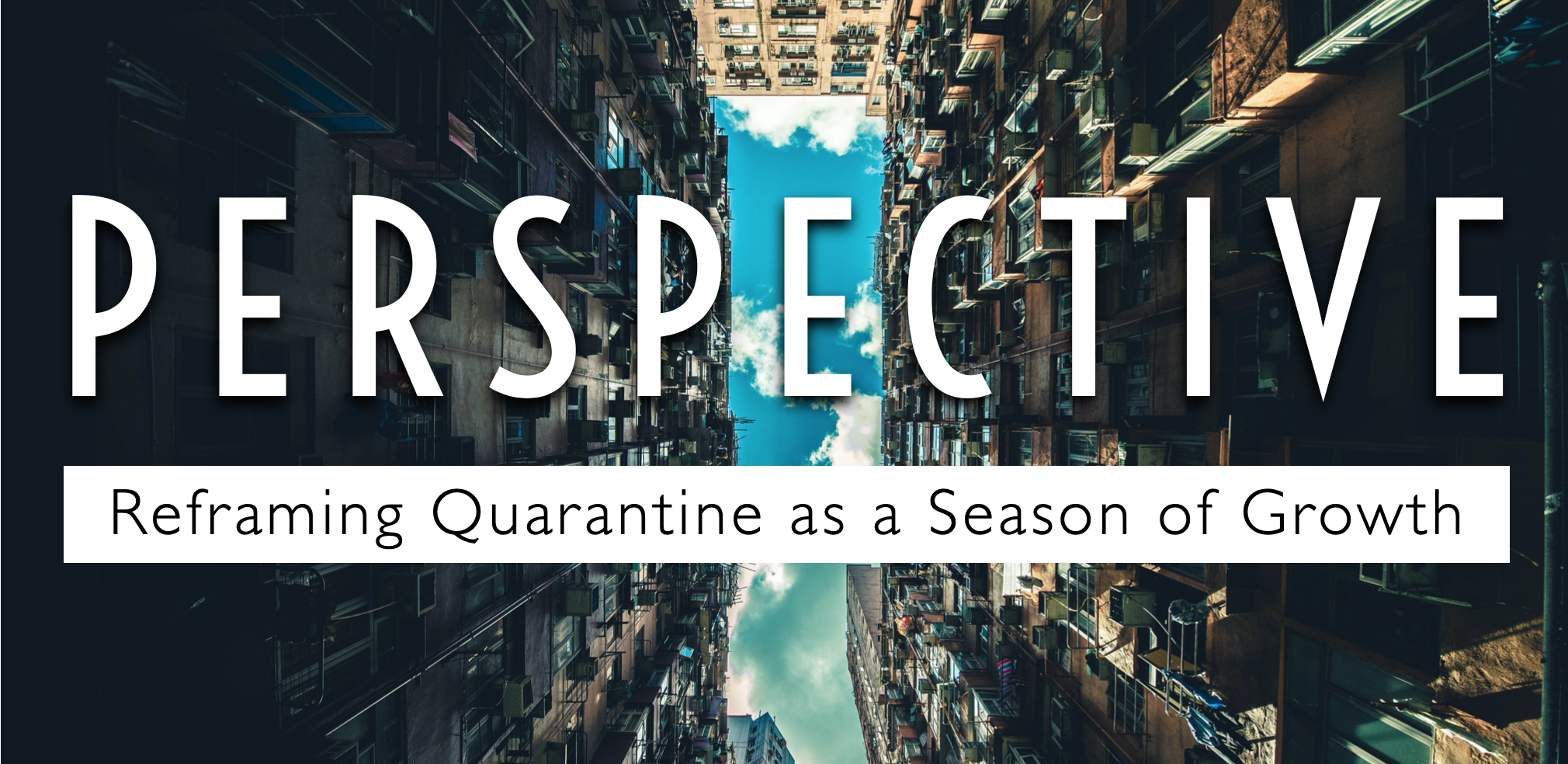
Perspective: Reframing Quarantine as a Season of Growth

Making the Most of our Trials

Consider it pure joy, my brothers and sisters, whenever you face trials of many kinds, because you know that the testing of your faith produces perseverance. Let perseverance finish its work so that you may be mature and complete, not lacking anything.

(James 1.2-4)

When James wrote these words nearly 2,000 years ago, he certainly didn’t have the worldwide effects of COVID-19 in mind, but once we realize that these aren’t directly about us, we can still see that they teach principles that do apply to us today.

First, in various ways, people all over the world (whether they are believers or not) find themselves facing trials. Some are grieving the loss of loved ones who have perished because of coronavirus. Others are worried about their health or the health of others they care about. Some people have lost jobs or are dealing with diminished income. Others are reeling from the negative mental and emotional effects of social distancing directives. So, it’s a trying time. That seems clear enough.

But I also think there is a significant point of connection in the way we view this current season of quarantine. At the heart of James 1.2-4 is James imploring his audience to reframe their situations. Rather than spend their time lamenting over the trials they face, he encourages them to reframe their trying experiences by viewing them as opportunities for growth, specifically in the sense that they can bring about perseverance and maturity.

It is only natural to respond to this current season with complaining, fear, laziness, selfishness, isolation, and mindless consumption. But here’s the thing: as a disciple of Jesus, I believed that I am frequently—no, constantly—called to rise above my natural inclinations and live a redeemed life, reflecting the reality that I am a new creation in Christ Jesus.

So, in this post, I want to share some practices that I have been working on (habits that I am trying to form) to help me rise above my natural inclinations and view this season as an opportunity for growth in various aspects of my life. I certainly don’t want to give the impression that I am doing this flawlessly; indeed, it is a constant struggle for me to reframe the COVID-19 quarantine as an opportunity for growth. But, that is the goal. Also, some of these practices may not be possible for everyone. However, my hope is that you will find some ideas in this post that will be helpful for you as you seek to grow in this season.

Changes in Perspective

I mentioned above several of the “natural” responses that I think a lot of us are currently experiencing. Although each of these could likely merit individual posts, briefly, here is how I am trying to reframe these responses:

  • From Complaining to Thanksgiving: Maybe you have felt the urge to complain at times during this current season of quarantine. I certainly have. Many of my plans have been altered or canceled. My routine has been changed. I am limited in the places I can go to and the things I can do. As a disciple of Jesus, I am not called to complain, however, but to give thanks. And really, I don’t have much to complain about, but have much to be thankful for: my family and I are healthy, we have a nice home in which to “shelter in place”, and we have plenty of food. In a time when millions of people have been laid off of work, my wife and I both have jobs where we can continue to work from home.
  • From Fear to Trust: The uncertainty in our world right now makes it easy to be fearful. We have to stay away from other people to limit the spread of disease. Economic forecasts are concerning. Future plans are up in the air. Even as we begin discussions of “opening America back up,” no one knows how long we will live in this limbo period before things are back to “normal”. As a disciple of Jesus, my life should not be characterized by fear or anxiety, but an unrelenting trust in the protection and provision of my heavenly Father.
  • From Laziness to Activity: Especially for those who are not working, or whose workload has diminished significantly, this can easily be a time of boredom and laziness. It can be hard to find the motivation to get up and do productive tasks. As a disciple of Jesus, I do not want to be lazy; I want to be healthy and productive. I want everything I do to be done as if I were doing it for the Lord (Colossians 3.23).
  • From Selfishness to Generosity: This is somewhat related to fear, but in times when it seems that there is not enough to go around, it can be very easy to hoard as much as we can, and keep what we have to ourselves. As a disciple of Jesus, though, I am not to place my confidence in material possessions, and I am to share what I have with others who need it.
  • From Isolation to Community: By necessity, we are physically isolated from one another right now, but that doesn’t mean that all of our relationships and interaction with people should be suspended. As a disciple of Jesus, I know that we were created for relationship, and it is important that I continue to cultivate and maintain relationships with others.
  • From Mindless Consumption to Thoughtful Consumption: Like many others, I am spending virtually all of my time at home right now, and much of it is spent on the computer or in front of a screen. There is an endless supply of content to be consumed. Some of it is actively harmful; some is perhaps less sinister but is still mindless and thus, not helpful. As a disciple of Jesus, I want to be more thoughtful in what I consume—I want to focus on that which is true, honorable, lovely, excellent, etc. (Philippians 4.8).

Helpful Practices

Here are some specific actions I have begun to do which reflect one or more of the changes in perspective mentioned above:

  • Morning Walks: Most days, I wake up and take a long (usually 60-90 minutes) morning walk, and while walking, I pray and also listen to audiobooks and/or podcasts. This accomplishes several objectives. The walks themselves help me stay active and healthy. The time in prayer helps produce an attitude of thankfulness within me, and moves me in the direction of trusting in God and thinking about the needs of others. Listening to books and podcasts is an example of thoughtful consumption, which I will mention more below.
  • Reading: Instead of binge-watching Netflix, I have tried to spend a lot of time reading and listening to books. I listened to Atomic Habits as an audiobook, which was outstanding, and provided me with the motivation to implement some of the habits I am attempting during quarantine. I am four books into The Chronicles of Narnia, which provides imaginative distraction from current reality, and also helps re-orient me from fear to trust. Listening to the After Class podcast and Seth Godin’s Akimbo have been helpful as well.
  • Careful Reading of COVID-19 News: It is an extremely unfortunate sign of the times in which we live that the COVID-19 crisis has become so politicized. There are a ton of people out there offering viewpoints on what is going on, and some of it is extremely dishearting, riddled with doomsday predictions, conspiracy theory rantings, or political ax-grinding. I try to limit how much of this I consume, period, and what I do read, I try to limit credible sources. Usually, I am looking for factual information; when I read analysis of the situation, I try to expose myself to well-written, if slanted, pieces from both sides of the political spectrum (like The Atlantic and National Review).
  • Workout Alarms: Monday-Friday, my cell phone alarm goes off 4-5 times per day on the hour as a reminder to get up from my chair and exercise. I have a routine of pullups, burpees, squats, and pushups that I have followed successfully (an evening routine of stair-walking, curls, and dips has been less successful). This helps me stay active during the day, and along with walks, has helped this to not be a season of sedentary weight gain. I’ve actually lost some weight over the last month, and I have gotten noticeably stronger—when I moved to Searcy last summer, I could barely do a pullup; I am now doing sets of 7-10 at a time.
  • Doxology Hand-washing: I confess that I am one of those for whom COVID-19 has completely altered my hand-washing habits. Unless my hands were coated in mud or paint or something like that, I never spend 20 seconds washing my hands, so that has been a massive adjustment. To help me wash for the appropriate amount of time, I sing Doxology while washing. In addition to helping me develop a healthy habit, this also means that every time I wash my hands for 20 seconds, my heart is inclined in grateful praise to God who provides all that I have.
  • Zoom Bible Study: I don’t really like Zoom; I look forward to the time when I do not use it regularly. But it has been a blessing in that it has enabled me to continue to teach Bible classes and participate in Bible studies. This is not only a crucial opportunity for connecting with other isolated people; it is also a constant re-ordering of my mind away from myself and my immediate circumstances and toward God.
  • Family Walks: Paired with my usual habit of morning walks, we usually take family walks in the evenings. This is another instance of exercise, but also helps our moods and attitudes (it is so nice to get out of the house), provides the opportunity for conversation, and also seeing and visiting with neighbors.
  • Driveway Church: Like many churches, our congregation has started sharing a lot of content online, including weekly worship services. We appreciate that and tune in each week, but there’s no denying that virtual worship misses the key component of fellowship that you get from being there in person. For the last few weeks, we have had Driveway Church, where we met with other members of our church who live in our neighborhood in our driveway, observing social distancing protocols. We sing, pray, read Scripture, and partake of the Lord’s Supper together. In one sense, it’s nothing profound or special; in another sense, it is incredibly profound and special.
  • Generosity: Caroline and I have both been blessed to keep our jobs and work from home, which means that we are not suffering financially as many are. We have looked for opportunities to give money to others, and also to support local businesses by getting more takeout and food delivered than normal (and, who am I kidding, I like Mexican food a lot!).

I am not going to pretend that I am enjoying everything about this current season of life; I certainly do not. But trying to change my perspective and reframe this as an opportunity for growth has been helpful for me. Whenever this ends and I am able to return to a more “normal” version of life, I hope to do so better than I was before: stronger, healthier, more generous, more thoughtful, and more dependent on God.

It is my hope that this season can be similarly beneficial for you.
A New Heaven & A New Earth Part 2: Distractions

Introduction

Last week, we introduced renewed eschatology, the idea that at the return of Jesus, the entire cosmos will be made over into a “New Heaven and New Earth”, and that God will dwell there with His people forever.

This differs from the more traditional spiritual heaven view that emphasizes that we will in some sense “fly away” to be with Jesus in heaven, and the earth will be burned up at His second coming.

In this series of posts, I will be explaining and supporting the renewed earth position, and as I mentioned last time, it has taken me a long time to come around to this perspective. If you think I am crazy for believing this, that’s okay at this point, because I haven’t tried to biblically support it yet. We’re going to spend the next several weeks doing that; don’t worry!

Today, we’re actually going to spend our time talking about some ideas that don’t really have anything to do with renewed eschatology at all, which is why I titled this post “Distractions”—these ideas distract us from our purpose of examining the renewed earth argument, but it is still important that we talk about them, because in my experience, anytime NHNE is discussed,[1] people immediately think of these other things. So, my hope is that we can address these ideas in this post and get them out of the way so we can then proceed with our study and not worry about them anymore.


What Renewed Eschatology is Not

Renewed Eschatology is not premillennialism. In my context (churches of Christ), premillennialism is generally looked down upon, and anything that remotely sounds like premillennialism is regarded with suspicion. The NHNE perspective is not premillennialism, but to better establish that point, we first need to discuss premillennialism a bit. So, what is it?

Premillennialism falls into two basic categories:

  • Historic premillennialism is a very old view (dating back to early Church Fathers) that interprets Revelation 20.1-6 as a period of time when Christ will literally reign on this earth before final judgment. I disagree with this view and this interpretation of Revelation 20, but I don’t find it to be particularly harmful.
  • Dispensational premillennialism is a relatively young view (1800s) and is the version of premillennialism that you are likely more familiar with. Like historic premillennialists, dispensational premillennialists also interpret Revelation 20 to refer to a literal reign by Jesus on earth, but this is no minor point of doctrine; rather, it becomes a controlling lens through which they look at all of Scripture. When Jesus came to earth, He intended to set up His kingdom but was rejected by His people and had to set up the church instead.[2]

There are many different teachings associated with dispensational premillennialism (the rapture, the Left Behind books, a literal battle of Armageddon, etc.) and also many different variations (pre-tribulation, mid-tribulation, post-tribulation, etc.), but ultimately, this isn’t a study of premillennialism, so we don’t need to get into all of that. What is important to emphasize here is that all of this (the 1000-year reign of Jesus on earth) happens before the final judgment and an eternity in heaven.

Really, the only element in common between renewed eschatology and premillennialism is that both have something to do with the earth. But in premillennialism, the millennium is a temporary time of Jesus reigning before the end. NHNE is about a renewed earth and heaven united, and God dwelling with His people there forever.

Renewed Eschatology is not what Jehovah’s Witnesses believe. Jehovah’s Witnessed believe that God will extend His heavenly kingdom to include earth, and earth will be transformed to a paradise similar to Eden. But they also believe a lot of things that, from my perspective, are way out there:

A central teaching of Jehovah’s Witnesses is that the current world era, or “system of things”, entered the “last days” in 1914 and faces imminent destruction through intervention by God and Jesus Christ, leading to deliverance for those who worship God acceptably. They consider all other present-day religions to be false, identifying them with “Babylon the Great,” or the “harlot” of  Revelation 17, and believe that they will soon be destroyed by the United Nations, which they believe is represented in scripture by the scarlet-colored wild beast of Revelation chapter 17. This development will mark the beginning of the “great tribulation”. Satan will subsequently use world governments to attack Jehovah’s Witnesses, an action that will prompt God to begin the war of Armageddon, during which all forms of government and all people not counted as Christ’s “sheep” will be destroyed.

After Armageddon, God will extend his heavenly kingdom to include earth, which will be transformed into a paradise similar to the Garden of Eden. Most of those who had died before God’s intervention will gradually be resurrected during the thousand year “judgment day”. This judgment will be based on their actions after resurrection rather than past deeds. At the end of the thousand years, Christ will hand all authority back to God. Then a final test will take place when Satan is released to mislead perfect mankind. Those who fail will be destroyed, along with Satan and his demons. The end result will be a fully tested, glorified human race on earth.[3]

Commonalities

Renewed eschatology does hold that Jesus will return to “earth”, but it is not this earth, but rather, a renewed earth. Also, this will not be part of a millennium, but is the eternal state of things.

Renewed eschatology has some similarities to the Jehovah’s Witness view of some sort of Edenic, recreated earth, but these similarities were not borrowed from Jehovah’s Witnesses. NHNE is a much older view, and if anything, it lies in the background and had elements borrowed from it by Jehovah’s Witnesses. Furthermore, the biblical vision of the “new earth” is not simply a return to Eden, but rather, the potential of Eden fully realized, with God, humanity, and creation living in harmony with one another.

Neither of these views—dispensational premillennialism nor Jehovah’s Witness eschatology—is what I am advocating in this series, but it is important that we discuss them, because as we move forward, there may be a temptation, at least with some, to think “this sounds like __________” (especially premillennialism). It’s not. I don’t believe in any of the views that we just described. Speaking candidly, from my perspective:

  • Historic premillennialism misinterprets Revelation 20.1-6, but isn’t really a big deal.
  • Dispensational premillennialism is a hot mess that leads to a lot of theological problems.
  • Jehovah’s Witness eschatology is crazy.

The Intermediate State

The intermediate state is the time period between an individual’s death and the second coming of Christ. In this series, we are most interested in what happens at the return of Jesus rather than our individual deaths, but we will address the intermediate state here because many people conflate these two issues.

There are different perspectives of what the intermediate state will look like. Here are some of the most common ones:[4]

  • Hadean Realm: This is the view that when we die, we go to “Hades”, the realm of the dead, and experience a conscious existence either in a place of bliss or a place of torment. This is based significantly on the story of the Rich Man and Lazarus that Jesus tells in Luke 16.19-31. After death, Lazarus finds himself in a place of comfort at “Abraham’s Bosom”, while the Rich Man is in Torment. Some find further support for this perspective in Luke 23.39-43, where Jesus tells the thief on the cross, “Today you will be with Me in paradise.”

But what if the story of the Rich Man and Lazarus is actually a parable (as the vast majority of New Testament scholars believe) rather than Jesus trying to give a sheet-sermon description of what happens after death? The point of the parable seems to be that our actions in this life influence our destination in the next life, and that once we have died, it is too late to change that destination.

Furthermore, should we equate “Paradise” from Jesus’ statement to the thief on the cross with “Abraham’s Bosom” without explicit biblical teaching telling us that they are the same?

Finally, in some sense, doesn’t this view suggest that judgment has already happened as opposed to judgment being what happens when Jesus returns? It seems disingenuous to say that Lazarus and the Rich Man are awaiting judgment when they are already experiencing reward and punishment, respectively, as they await the formality of additional judgment.

  • Entrance Into Eternity–Heaven: This is the view that, at death, the faithful immediately enter into the presence of God and live with Him in heaven. Supporters of this perspective point to passages from Paul in Philippians 1.21-24 and 2 Corinthians 5.1-9, where he seems to say that it is better to be with the Lord than to continue living. But does Paul mean that this (being with the Lord) will happen immediately at death, or is he just looking forward to being with God in eternity, and he knows that death is, in a sense, the first step toward that?

Some proponents of this view believe it to be supported by the “thief on the cross” passage mentioned above (Luke 23.39-43), only in this view, “paradise” is “heaven.” But was Jesus really in heaven “today”—the same day He was crucified? Jesus was raised on the third day, and on that day, He told Mary Magdalene, “Do not cling to me, for I have not yet ascended to the Father” (John 20.17). It doesn’t seem to me like Jesus went to heaven at death.

Furthermore, there is the passage in Revelation 6.9-10 where martyrs surround God’s throne crying out, “How long?” They are wondering how long evil will continue on earth; do they actually seem to be at peace? This seems to cut against the traditional idea.[5]

Plus, if the Hadean Realm perspective seems to cut against the notion that judgment occurs at the return of Jesus, this view, which places the faithful dead in heaven already, certainly does so.

  • Entrance Into Eternity–Soul Sleep: What if we’re only aware of the passing of time because we are living on earth? What if we die and for us it seems like we immediately enter judgment because we have no concept of time? Thousands of years pass on earth, but we have no knowledge go it? This view is largely based on the notion that in the Bible, death is frequently described as “sleep.” A good example of this comes from the story of Saul and the Witch of Endor in 1 Samuel 28.15, where the spirit of Samuel is summoned and he complains about being “awakened” from his rest.

But should “sleep” be taken literally here, or is this (and other places in Scripture employing the same terminology) simply a metaphor for death, and a suggestion that death brings about a rest from the toils of life here on earth?

Furthermore, what about Hebrews 12.1 and the great cloud of witnesses mentioned there? How can they witness what we are doing and cheer us on if they are asleep?

Ultimately, we can debate these back and forth.[6] As you have probably discerned, I am not entirely sure what I believe about this because I think there are problems with each perspective.

But here is the real point: regardless of what you believe about this, it is a “distraction” from the topic of this study on renewed eschatology in the sense that it’s not what we’re talking about. We’re talking about what happens when Jesus returns, not what happens in the time in between when you die and when Jesus returns. So we can debate these different views and have interesting discussions about them, but it really doesn’t have to do much with renewed eschatology.

Except…it is a good example of how distracted we have become from the actual Christian hope.

We have long talked about going to heaven when we die, but there is not even one passage in the Bible that talks about “going to heaven” after we die. The phrase “go to heaven” doesn’t appear anywhere in the Old or New Testaments in relation to death.[7] Not once. If that was what Christian hope was all about, don’t you think we’d find that in there somewhere?

There are passages that talk about getting to be “with Jesus” after death, and we have mentioned them above (Luke 23.42-32; Philippians 1.21-24; 2 Corinthians 5.6-9), but this really isn’t the focus of our hope.

The hope for Christians isn’t about life after death—a temporary condition until the Second Coming of Christ where, regardless of which view you take, we are, in some sense, with God and taken care of. Instead, the hope for Christians is about life after life after death—what happens when Jesus returns, we are resurrected and given new bodies, and live with God for eternity.[8]

So, why the change? If the Bible teaches that our hope is based on what happens when Jesus returns, why do we focus so much on what happens when we die?

I don’t know the answer to that question; there are probably several reasons. I do wonder, though: it has been nearly 2,000 years since the New Testament was written and these promises were made, and I wonder if we get tired of waiting. The return of Jesus can seem so uncertain and far off in the future, while death seems much closer and much more certain. Perhaps it is easier for us, impatient as we are, to focus on what happens to us at death than what happens when Jesus returns, and death is defeated.

And I do want to reassure you: whatever happens after death, whichever of the views above is the correct one, for those who die in Christ, we will be taken care of, and we will in some sense “be with the Lord.” We can rest assured of that. But that is just temporary. It is the intermediate state. It’s not what we hope for.

With these “distractions” out of the way, next time we can dive into Scripture, and begin looking at several passages that are generally used to “refute” the renewed earth perspective. When considered closely, I don’t think they do.


[1]As a reminder, NHNE is short for “New Heavens and New Earth.” Throughout this series, I will use “NHNE”, “New Heavens and New Earth”, “renewed eschatology”, and “renewed earth” interchangeably.

[2]This makes the church, and really, the crucifixion and atonement, a back-up plan. Those who subscribe to this position would disagree with the characterization I just used, but theologically, I think it is unavoidable.

[3]Wikipedia contributors, “Eschatology of Jehovah’s Witnesses,” Wikipedia, The Free Encyclopedia, https://en.wikipedia.org/w/index.php?title=Eschatology_of_Jehovah%27s_Witnesses&oldid=898880289 (accessed October 28, 2018).

[4]This discussion of the intermediate state is influenced by Stanley J. Grenz, Theology for the Community of God, (Grand Rapids: Eerdmans, 1994): 589-98, and J. Richard Middleton, A New Heaven and a New Earth: Reclaiming Biblical Eschatology, (Grand Rapids: Baker Academic, 2014): 227-37.

[5]In “Waiting With Us,” John Mark Hicks suggests that these saints, though in the presence of God, share with those of us on earth the lamenting over sin and injustice, and yearn for God’s redemption of all things. So, just because these martyrs are not entirely blissful does not mean the notion that the faithful enter into heaven upon death is incorrect.

[6]For an excellent overview of these different views, see Scott Elliott, “Where Do We Go When We Die.” Scott leans toward the “heaven” view, though rightly asserts that there isn’t enough biblical data for us to be dogmatic about it.

[7]Timothy Mackie and Jonathan Collins, When Heaven Meets Earth: A 12-Part Biblical Study on Heaven (Portland: The Bible Project, 2017). This resource is available for download on The Bible Project website here.

[8]For “Life after life after death” see N.T. Wright, Surprised By Hope: Rethinking Heaven, the Resurrection, and the Mission of the Church, (New York: HarperOne, 2008): 148-52.

Why Are You Afraid?

In Matthew’s gospel, he follows the Sermon on the Mount in chapters 5-7 with his account of some of the extraordinary miracles that Jesus performs in chapters 8-9. The power of Christ overcomes a variety of maladies: He cleanses lepers, heals paralysis, casts out demons, restores the blind and mute, and brings a little girl back from the dead.

It is in this context that Matthew tells the story of Jesus miraculously calming a storm:

And when He got into the boat His disciples followed Him. And behold, there arose a great storm on the sea, so that the boat was being swamped by the waves; but He was asleep.

And they went and woke Him, saying, “Save us Lord; we are perishing.”

And He said to them, “Why are you afraid, O you of little faith?” Then He rose and rebuked the winds and the sea, and there was a great calm. And the men marveled, saying, “What sort of man is this, that even winds and sea obey Him?”

(Matthew 8.23-27)

There are several lessons we could take from this remarkable event, but I just want to focus on one. Jesus’ disciples are so terrified that they wake Him up in fear of their lives. His response is astounding: “Why are you afraid?” He asks. At first glance, it seems that Jesus is being incredibly obtuse—a great storm had arisen and the boat was being swamped by the waves; obviously the disciples are afraid because of the storm!

But Jesus was not obtuse; indeed, He was the most perceptive of all men. He certainly understood why His disciples were afraid, and so His question must have been about something else. He wasn’t seeking information; rather, He was prompting transformation.

When Jesus asked His disciples why they were afraid, He wasn’t seeking information; He was prompting transformation. Share on X

The second part of Jesus’ statement is telling, as He calls His disciples “you of little faith.” Tied to His question in this way, the implication is clear: if the disciples had more faith, they would not be afraid! Jesus’ disciples had just witnessed His marvelous power in a variety of different situations. This should have bolstered their faith and enabled them to realize that their Teacher was more powerful than the storm which threatened them!

Currently, our world is under siege by a viral pandemic. Millions are sick; hundreds of thousands have died. Millions more have lost jobs, or at least had their incomes diminished. Virtually all of us have had our lives altered in some way. Our plans have been canceled, we are stuck in our homes, we are having to distance ourselves from family and friends. Our worship routines have been disrupted.

What is unique about the current situation is only the scope of the storm; the reality is that, in a variety of ways, we are constantly buffeted by the storms of this life, and the waves threaten to swamp us:

  • A middle-aged man learns that he has been laid off from his job and is plagued by financial uncertainty as he wonders how he will provide for his family.
  • A woman learns that her husband of twenty years, the love of her life, has been carrying on an affair with another woman.
  • Two young parents learn that their infant son has a genetic condition which will greatly limit his life.
  • A single mother of two teenage boys is diagnosed with stage four cancer and told that there is no hope.
  • A house fire destroys a family’s home and all of their earthly possessions.

When the storms of life come, like the disciples, our tendency is to run to Jesus and ask Him to save us. And I wonder if He responds similarly: “Why are you afraid, O you of little faith?”

It’s not that Jesus doesn’t understand our storms—the good news of the Incarnation is that Jesus stepped into the human condition in a unique way. He understands our fears, our trials, and our heartaches. He sympathizes with our weaknesses (Hebrews 4.15). But the same Jesus also says, “In the world you will have tribulation. But take heart; I have overcome the world.” (John 16.33b).

The Christ who calms storms knows what frightens us, but He also asks us to realize: truly, ultimately, with Jesus on our side, the scary things of life aren’t scary! He is more powerful than the storm!

Lord, increase our faith!


In this loose series of Scripture Reflections, I am sharing brief thoughts spurred on by my Bible reading this year. By way of reminder, my goal for these brief posts is two-fold:

(1) To remark on aspects of the biblical text that I find to be of interest that the reader may or may not have thought about previously.

(2) When possible, to point ahead to the work and person of Jesus Christ. I believe the Bible is a unified story that points to Jesus, which means that He is frequently alluded to or foreshadowed in some way throughout the biblical canon.

A New Heaven & A New Earth: What the Bible Teaches about Eternity

Introduction

A major part of the hope that we have as Christians—a hope that gives us motivation to live faithfully—is that we trust that God will raise us from the dead and that we will live with Him for eternity. 

This should give us peace, confidence, purpose, and boldness.

But there are different ways of viewing what this eternity with God, this paradise, will look like. In fact, an entire branch of Christian theology called eschatology is devoted to the study of eternity and the end times.[1] I’d like to spend several blog posts talking about eschatology, and looking at what the Bible says about it. 

I want to warn you up front: this will be a very challenging study for some. The view that I am going to propose in this series of posts I will refer to as renewed eschatology or NHNE.[2] I believe this to be the biblical view, but it is not what I would call the typical view of eternity that most American Christians hold.

Before we get any further, I want to quickly give you two different perspectives to help frame what we are going to be talking about in this series. These are two different views of what the Bible is about and what our future looks like.

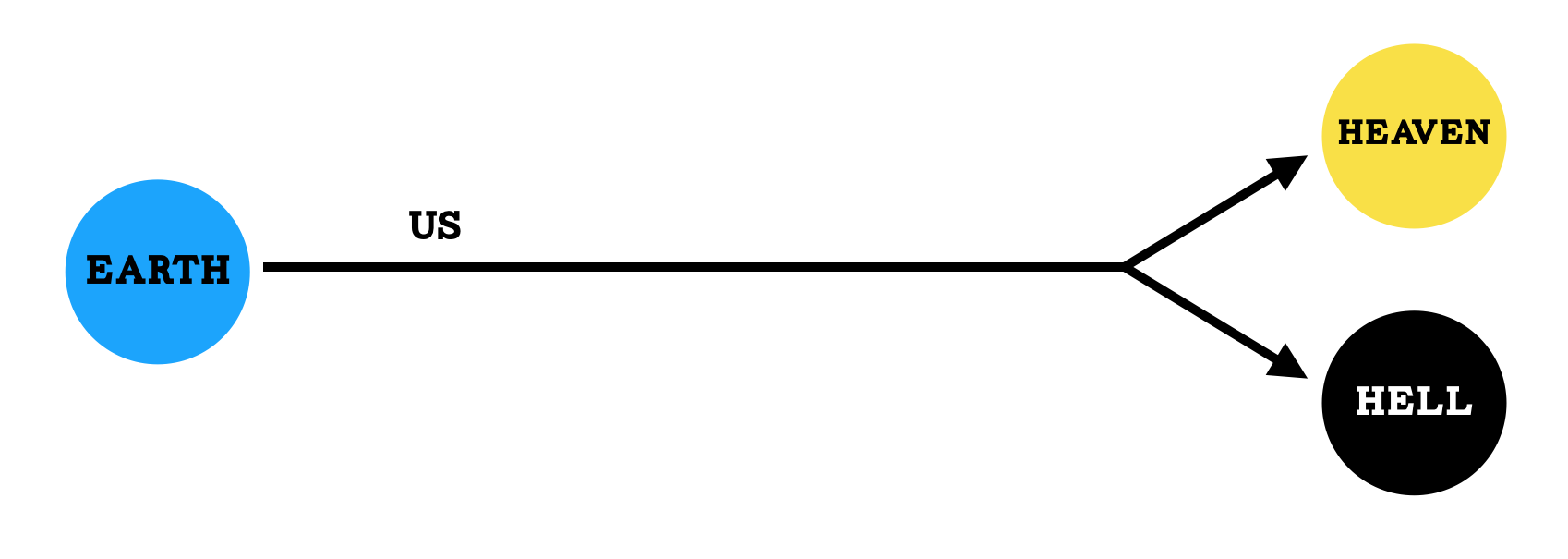
The first view, which I will call the spiritual heaven perspective, says that we live in a world that was created good but became tainted after Adam and Eve’s sin in the Garden. Things are bad and broken and we are lost in our sin.

The Good News is that Jesus came to die for our sin and save us, so that when we die, we can forever leave this broken world (which is bound for fiery destruction) and enjoy a spiritual existence with God forever in heaven. The people that reject God will spend eternity in hell.

In the meantime, we are basically running out the clock, doing our best to survive in a broken world, waiting for Jesus to come rescue us, and hopefully, trying to help other people to be rescued as well. You might think of the Titanic going down: as Christians, we are in the lifeboats, going around trying to save people from drowning…but the ship is going down.


I think this is what much of the non-Christian world believes that Christians believe,[3] and furthermore, I think it actually is what many Christians believe. I believed it myself for a long time. In many ways, it is the traditional Christian perspective.[4]

The problem is, I don’t think the Bible actually teaches this. It certainly teaches parts of it: heaven and hell are real, judgment is real, Jesus came to save us, etc.—but the overall presentation of this view is not, in my opinion, what the Bible teaches.

(Some of you are thinking that I am nuts, and at this point, that is okay.)

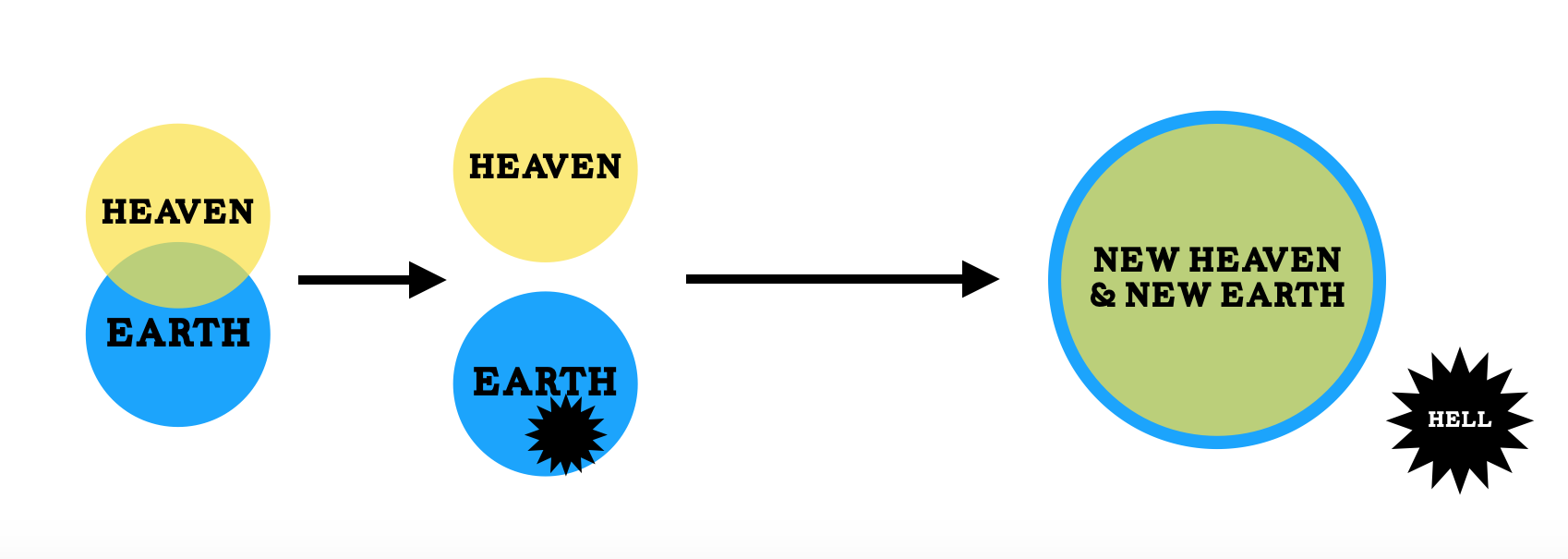
The second view, the renewed earth perspective, also says that this world was created good as the dwelling place of people. Earth parallels heaven, the dwelling place of God (Genesis 1.1), and at the beginning, these two realms overlapped: God was able to dwell with people and walked in the Garden with them. But we sinned. The earth became tainted. Our close relationship with God was destroyed. Our sin separates us from God, forcing the close union of heaven and earth to be driven apart. Things are bad and broken, and we are lost in our sin. And more than that: our accumulated sin multiplies and continues to defile the earth—there is a sense in which we have created hell on earth with our cumulative rebellion against God.

The Good News is that God is not content to leave things this way. Jesus came to reconcile all of creation to Himself, including humanity, and to specifically confront the problem of sin. Through His death and resurrection, Jesus has brought about a new order of things, or as Paul says, “new creation.” One day Jesus will return and sin, Satan, and death will be fully defeated, the entire cosmos will be made over into a “New Heaven and New Earth”—a unified whole—and God will dwell with His people forever, while those who reject Him will be separated from Him forever.[5]

In the meantime, rather than running out the clock, waiting to be rescued, or even frantically rowing around in our lifeboat picking up survivors while the world sinks around us, we are actively involved as citizens of God’s kingdom and agents of new creation in taking back the world that rightly belongs to God and inviting others to join us in that project. We do this by living according to the principles that Jesus lays out for His followers, and seeking to counteract the effects of sin in our world.

Now, these two views share a lot of terms and concepts, but when you look at them as a whole, they are two very different perspectives on the story the Bible is telling, and what eternity will look like.

Background of this Study

Over the last couple of years, I have seen more and more discussions about eschatology in the Christian blogosphere and in various Facebook groups, and, honestly, I have been concerned at times by the tone I have witnessed in some of those discussions (where those who hold to renewed eschatology are written off as false teachers or heretics) as well as the general level of ignorance (where some who have sought to refute the NHNE perspective reveal that they don’t actually understand it at all). Perhaps this series of posts will add something constructive to those conversations, but really, I did not write all of this material in response to the recent interest that I have observed about this topic.

Actually, this topic is one that I have been personally wrestling with for about ten years. When I first heard the renewed earth perspective, I was in graduate school and, well, I thought it was crazy. I had several immediate objections based on some specific passages of Scripture, and I wondered if my professor had ever read them! But, as it turned out, my teacher had read the Bible (more thoughtfully than I had), and had answers to my objections.

Time passed and I continued to read and study, and this idea of God redeeming and renewing all of creation at the return of Jesus continued to pop up over and over. I realized that a lot of respected biblical scholars held to this view, and I also came to realize that this wasn’t a “new” interpretation, but actually a very old one, and one that had also been held by my ancestors in the Restoration Movement. I gradually came to think, “This isn’t so crazy…I can see it either way.”[6]

Later, I began to study some of the specific passages that I used to think refuted the renewed earth view, but I realized that when I studied them in context and did the linguistic and historical legwork, they actually seemed to argue against the spiritual heaven (“traditional”) view rather than for it. I grudgingly thought, “Well, this renewed eschatology view seems more biblically accurate to me, but I’m not sure it really matters that much.”

Eventually, at the church where I worked, we started this project called The Story of the Bible. This was a long Bible survey study for our adult Bible classes using videos from The Bible Project as a companion resource. As I had never done before, I sat down and studied the Bible, writing dozens of lessons (and editing dozens more) about different biblical books and drawing main ideas from them. When we started that project, I had zero intention of teaching a different view on eternity (or really, emphasizing anything related to eternity) but as we studied, this idea of God redeeming all of creation just hit us over and over again…because this is what the Story of the Bible is about.

As we went through this study in our adult classes, it became clear to me that our church leadership needed to discuss eschatology (and specifically, the renewed earth perspective) more, so I went to our Elders and they agreed. We had a great study together for several weeks and wrestled with a lot of Scripture and talked back and forth and challenged one another. By the end of the study, they no longer thought I was crazy (I think a couple of them did when we started!), and they wanted me to teach an adult Bible class specifically on renewed eschatology. And that class is the source of the material you are reading now.

Goals for this Series

I believe that Scripture teaches that when Jesus returns, the cosmos will be renewed and redeemed and that the faithful will live with God eternally in a New Heaven and a New Earth. If, at the end of this series, you agree with me—great! But that is not my primary goal for this series.

Instead, here are my goals:

First, I want to look at what the Bible teaches about eternity with an open mind. This will be very difficult for some, and I get that—this material was very challenging for me when I was first exposed to it. I am stubborn and I give up the positions I hold with great reluctance; as I mentioned previously, I have been wrestling with this for ten years. 

Ultimately, I don’t ask that you agree with me, but I do ask that you have an open mind and honestly consider what we discuss. Read the biblical passages that are mentioned. Look at the extra material I link to that lays out certain arguments in greater detail. If you want to respond to something that I say (and I welcome that!), make arguments based on Scripture, not on tradition. Ultimately, what I am going to present in this series of posts is correct or incorrect based on whether or not it lines up with what the Bible teaches. With that in mind, counter-arguments to what I am presenting that start with, “I always thought…” or “I’ve always heard that…” aren’t the best.

Second, I want to provide an opportunity for us to challenge ourselves. Some of the ideas that we’re going to discuss will be challenging. It will require looking at certain passages very carefully and learning some things about Greek, about history, and about textual criticism.

From my perspective, we have decades and decades of confusion and misinterpretations that we have to peel back to see what the Bible teaches on this subject, and that is going to require hard work. I will do my best to make everything as understandable as possible, but I am sure that I will not be as clear sometimes as I would like to be. Having said that, if you feel like some of this material is difficult, that’s okay, because it is supposed to be.

I’m not sure where we got the idea that we can become mature Christians by never challenging ourselves to dig deeper into God’s word, but it’s not true. 

Finally, at the end of this study, I want us to respect one another regardless of which conclusion we come to. I think this is an important topic, and at the end of all this, I will explain why I think it matters, but ultimately, understanding how eternity works is not necessary for you to enjoy it. Getting this right or wrong is not a “salvation issue” (I dislike that terminology), although I would argue that you will appreciate and anticipate your salvation more if you hold to the view that I am going to teach in this series.

I mentioned earlier that I have witnessed some unfortunate conversations over the last couple of years where people who hold to renewed eschatology are branded as false teachers. I would find that to be laughable if writing someone off as a false teacher was not such a serious act—one that Scripture doesn’t take lightly. Suffice it to say, if at the end of all this you arrive at a different conclusion than I do, I will still respect you for it; I hope you can reciprocate that feeling.

What does the Bible teach about eternity? I hope you’ll join us as we seek to answer that question.


[1]The Greek word εσχατος means “last”, so literally, “eschatology” refers to the study of the last things.

[2]Short for “New Heavens and New Earth.” Throughout this series, I will use “NHNE”, “New Heavens and New Earth”, “renewed eschatology”, and “renewed earth” interchangeably. 

[3]I think many non-Christians also fundamentally misunderstand the notion of God’s grace, and think Christians believe that we get to heaven by being “good enough”. To be fair, many Christians misunderstand this as well!

[4]I really hesitate to concede the term “traditional” to refer to this view, because as we will see later, the alternative view—renewed eschatology—has a long and storied place in the historical Christian tradition. But nevertheless, the spiritual heaven perspective has been the dominant view among evangelical and fundamentalist churches (and certainly churches of Christ as well) for as long as any of us have been alive.

[5]Much of the language in this description is drawn from Timothy Mackie and Jonathan Collins, When Heaven Meets Earth: A 12-Part Biblical Study on Heaven (Portland: The Bible Project, 2017). This resource is available for download on The Bible Project website here.

[6]I will have a post later focusing specifically on this, but as many readers of this blog know, I am deeply interested in the history of the Stone-Campbell Restoration Movement, and seeing that many of my spiritual forebears believed in renewed eschatology was very significant to me.

A Christian Response to COVID-19

Although it is not an official policy of mine, it is pretty rare that I write in response to major events that are going on in the world. It is not that I am unconcerned with current events, but usually, there are already a ton of voices weighing in on a given issue, I rarely feel like an expert who needs to have his opinion shared, and in general, I try to be more proactive than reactive in what I write and post.

I am not totally sure what prompts me to write in this case; certainly, there are a lot of people talking about Coronavirus already, and I am definitely no expert. Perhaps I am writing because (1) I feel a sense of uneasy concern, so the reminders I will share below are reminders that I need to hear, and (2) I took the day off of work so I could focus on watching the SEC Basketball Tournament, which has now been canceled because of COVID-19 concerns, so it is on my mind and I have a little time on my hands.

So here is the issue: we have what is now a global pandemic on our hands, which is leading to unprecedented cancellations of major events. It is quite contagious, and many times more lethal than the flu. Although many people who contract it barely suffer at all, it is particularly dangerous for those who are elderly and those who have compromised immune systems. It light of these realities, what might be a “Christian response” to Coronavirus?

Here are a few ideas, all taken from the Sermon on the Mount.

Christians are not to live in fear.

“Therefore I tell you, do not be anxious about your life, what you will eat or what you will drink, nor about your body, what you will put on. Is not life more than food, and the body more than clothing? Look at the birds of the air: they neither sow nor reap nor gather into barns, and yet your heavenly Father feeds them. Are you not of more value than they?  And which of you by being anxious can add a single hour to his span of life?  And why are you anxious about clothing? Consider the lilies of the field, how they grow: they neither toil nor spin, yet I tell you, even Solomon in all his glory was not arrayed like one of these. But if God so clothes the grass of the field, which today is alive and tomorrow is thrown into the oven, will he not much more clothe you, O you of little faith? Therefore do not be anxious, saying, ‘What shall we eat?’ or ‘What shall we drink?’ or ‘What shall we wear?’ For the Gentiles seek after all these things, and your heavenly Father knows that you need them all. But seek first the kingdom of God and his righteousness, and all these things will be added to you.

“Therefore do not be anxious about tomorrow, for tomorrow will be anxious for itself. Sufficient for the day is its own trouble.”

(Matthew 6.25-34)

There is a lot of fear and anxiety in the world right now. Plans are being upset and lives are being unsettled. A lot of recreational events that normally help to distract us from the concerns of life are being canceled, which seems to magnify the problem. It is easy to be afraid.

But it is inherently un-Christian to live lives that are driven by fear. We are not called to be people of fear, but people of boldness who absolutely rely on our Heavenly Father to protect us.

Currently, there is cause for concern and a need for wisdom and discernment in what we do. But we should not be alarmists or fearmongers.


Christians are to value truth.

“Again you have heard that it was said to those of old, ‘You shall not swear falsely, but shall perform to the Lord what you have sworn.’ But I say to you, Do not take an oath at all, either by heaven, for it is the throne of God, or by the earth, for it is his footstool, or by Jerusalem, for it is the city of the great King. And do not take an oath by your head, for you cannot make one hair white or black. Let what you say be simply ‘Yes’ or ‘No’; anything more than this comes from evil.”

(Matthew 5.33-37)

This one should be pretty obvious; we know that we are supposed to be people of truth. Jesus was full of grace and truth, and in the Sermon on the Mount, He taught His followers that they should be people of such absolute integrity that it wouldn’t be necessary for them to take elaborate oaths because others implicitly trusted them.

Christians should value truth at all times, but perhaps especially so in times of fear and uncertainty. Part of that means that we should be careful about what sort of information we share online. I have seen multiple people (some of them preachers no less!) share disdain for the “hysteria” surrounding Coronavirus saying it is nowhere near as deadly as the common flu. Although COVID-19 is not nearly as widespread as the common flu (currently), it is far more lethal to those who contract it—that is a statistical reality. We need to be very careful about the information we share, and make sure to verify that it is accurate.

Related to the point above, it seems to me that a remarkable number of my online friends and acquaintances have suddenly become amateur epidemiologists, and speak with a great deal of certainty that is probably unwarranted. Part of being truthful is not giving the impression that we know more than we do; I am the first to admit that I am not the most informed about what is going on. I want to be careful about who I listen to, careful about what I share with others, and careful that I do not give the impression that I am an expert. I want to value truth.

Christians are to love their neighbors.

“You have heard that it was said, ‘You shall love your neighbor and hate your enemy.’  But I say to you, Love your enemies and pray for those who persecute you, so that you may be sons of your Father who is in heaven. For he makes his sun rise on the evil and on the good, and sends rain on the just and on the unjust. For if you love those who love you, what reward do you have? Do not even the tax collectors do the same? And if you greet only your brothers, what more are you doing than others? Do not even the Gentiles do the same? You therefore must be perfect, as your heavenly Father is perfect.

(Matthew 5.43-48)

“So whatever you wish that others would do to you, do also to them, for this is the Law and the Prophets.”

(Matthew 7.12)

A common response I have seen from many people, a lot of them Christians, is something like, “What’s the big deal? Maybe I’ll get the virus, and if I do, I’ll probably recover. And even if it kills me, as a Christian, I don’t fear death. I’m  not going to change what I do just because of this virus.”

There’s some truth to that, and it would be a great perspective…if we all lived on islands by ourselves. The reality is that whether or not you are concerned about catching the disease yourself (and personally, I am not), you should be concerned about the possibility of spreading the disease to others, especially those who are less able to fight it off, and those who may not share the same Christian hope of conquering death that you do. Loving our neighbors means that we want to go to reasonable measures to keep them safe from the spread of illness.

Also, loving others means that hoarding supplies probably isn’t the most Christian thing you can do either. Sure, it is important that you have enough to provide for your family, but a Christian response to possessions—at any time—is that we should be prepared to share whatever we have with others (so if you have 300 rolls of toilet paper stocked up, you might want to keep an eye out for people lamenting that they can’t find any and help them out!).

Christians are to pray.

Pray then like this:
“Our Father in heaven,hallowed be your name.
Your kingdom come, your will be done, on earth as it is in heaven.
Give us this day our daily bread,
and forgive us our debts, as we also have forgiven our debtors.
And lead us not into temptation, but deliver us from evil.
(Matthew 6.9-13)

“Ask, and it will be given to you; seek, and you will find; knock, and it will be opened to you. For everyone who asks receives, and the one who seeks finds, and to the one who knocks it will be opened. Or which one of you, if his son asks him for bread, will give him a stone? Or if he asks for a fish, will give him a serpent? If you then, who are evil, know how to give good gifts to your children, how much more will your Father who is in heaven give good things to those who ask him!

(Matthew 7.7-11)

Prayer should always be at the forefront of how Christians respond to…anything. We should pray for those in positions of authority who are making decisions about how best to proceed while limiting the spread of the virus. We should pray for those suffering from financial fallout from the effects of travel being limited and events being canceled. We should pray for those who are sick. We should pray for those treating and caring for them. We should pray for those working for vaccines and anti-viral drugs. We should pray for those who have lost loved ones. We should pray for those dealing with the difficulties of quarantine. And as Jesus reminds us, we should pray with fervency and perseverance.

Prayer reminds us of our own limitations and is an acknowledgment of our unlimited God. Prayer leads us to trust instead of fear. Prayer makes us mindful of others rather than just ourselves.

Conclusion: Christians are to let their lights shine.

“You are the light of the world. A city set on a hill cannot be hidden. Nor do people light a lamp and put it under a basket, but on a stand, and it gives light to all in the house. In the same way, let your light shine before others, so that they may see your good works and give glory to your Father who is in heaven.”

(Matthew 5.14-16)

Jesus says that His followers are like a city set on a hill—incredibly visible to the world around us. The reality is that people in the world see how Christians behave, and they are paying attention. Perhaps this is especially true in times of uncertainty. When we fail to live as we are called to, it is incredibly damaging to the cause of Christ. But when we live according to the commands of our King, others see that and are brought to give glory to God:

  • In a world filled with fear, Christians are called to rely on our Heavenly Father.
  • In a world filled with misinformation, political posturing, conspiracy theories, and hysteria, Christians are called to value truth.
  • In a world filled with shortsighted self-interest, Christians are called to love others.
  • In a world filled with uncertainty of what to do, Christians are called to pray.

May we seek to live as Jesus calls us to, and in so doing, to bring glory to God our Father!

« Older posts Newer posts »

© 2026 The Doc File

Theme by Anders Noren — Up ↑