The online journal of Luke Dockery

Category: Christianity (Page 32 of 64)

Jeroboam and the Lure of Political Power

The Story of Jeroboam

Jeroboam is one of the Bible’s incredibly tragic characters. He was a man who God granted an amazing opportunity, and he squandered it away. 

Jeroboam’s story begins with King Solomon, who himself was a tragic character: a man who was given wisdom, power, and great wealth by God, but who turned away from God and began to worship other gods (1 Kings 11.1-8). Because of this, God ultimately determines to divide the kingdom of Israel in the days of Rehoboam, Solomon’s son. Rehoboam remains king over two tribes in the south (creating the Southern Kingdom of Judah), while Jeroboam is established as king over the remaining ten tribes (creating the Northern Kingdom of Israel).

The story is absolutely clear that God, in His grace, has offered a covenant agreement to Jeroboam: God will bless him, make him king over Israel, and give Him all that he desires if he will listen to God’s commands and walk in His ways like David did. And moreover, God promises to build Jeroboam a house or a dynasty like He did for David. 

Jeroboam’s rise to power was the work of God’s providential hand, and Jeroboam knew this. And yet, as soon as he sits down on the throne, Jeroboam’s thinking seems to shift from providential to pragmatic: the question Jeroboam asks himself is, “What do I need to do to stay in power?” 

Ironically, Jeroboam already had the answer—God had told him he simply needed to listen to God’s commands and walk in His ways as David did, but Jeroboam ignores that answer and pursues his own plans instead.

After some initial efforts to fortify some of his cities, Jeroboam makes his big mistake. He reasons that if the citizens of the Northern Kingdom return to the Jerusalem Temple (in the Southern Kingdom) to offer sacrifices as they are supposed to, it will draw their hearts back to Rehoboam king of Judah, and then they won’t want to follow Jeroboam anymore, and will overthrow him and return to Rehoboam and Judah. So Jeroboam gets what he thinks is a brilliant idea, and he makes two golden calves; he sets one up in Dan and another in Bethel, representing the northern and southern borders of the territory of the Northern Kingdom.

Scholars debate whether Jeroboam is trying to get the Israelites to worship another god by doing this, or, rather, if he is simply introducing an innovation in the way in which they worship Jehovah/Yahweh. I tend to think it is the latter, but calves are so closely related with Canaanite pagan religion that it is hard to be sure.

Either way, it doesn’t really matter. Even if Jeroboam was not setting up worship of a new god (and thus not violating the first commandment),  he was still guilty of creating an image to serve as a symbol of God (which violates the second commandment). So at the very least, he perverted the worship of the true God. Jeroboam’s disregard for the religious statues that God had set up did not stop there, as he also created alternate worship sites on high places at Dan and Bethel, put in place non-Levitical priests, and instituted his own feast day. These actions broke God’s commandments, and also revealed Jeroboam’s feelings that civil matters were more important than religious conviction.

Jeroboam has not been on the throne for long, but already he has dramatically departed from God’s instruction to walk in all His ways as David did. Instead, Jeroboam seems to have forgotten Who placed him on the throne in the first place, and rather than obey the real Power behind the throne, takes matters into his own hands to secure his position by his own power.

In 1 Kings 13, a prophet comes from God and condemns what Jeroboam has done, also predicting that judgment will come upon him because of it:

O altar, altar, thus says the LORD: “Behold, a son shall be born to the house of David, Josiah by name, and he shall sacrifice on you the priests of the high places who make offerings on you, and human bones shall be burned on you.” And he gave a sign the same day, saying, “This is the sign that the LORD has spoken: ‘Behold, the altar shall be torn down, and the ashes that are on it shall be poured out.’”

(1 Kings 13.2-3)

Not surprisingly, Jeroboam isn’t a big fan of this message and stretches out his hand: “Seize him!” But as soon as this happens, his hand “dried up, so that he could not draw it back to himself” (1 Kings 13.4). Ironically, in this very act, Jeroboam actually gives credibility to the prophecy—clearly, there is some power behind it because Jeroboam’s hand shrivels up, and furthermore, the altar was torn down as the prophecy said. Jeroboam asks the prophet to entreat God for him that his hand might be restored, and the prophet does so, and Jeroboam is healed.

Jeroboam is probably grateful to the man of God for his healing, and invites him to dine with him, but the prophet refuses because God had commanded him to return directly after his mission was completed. It is possible that dining with the king would have made the prophet appear to approve of the religious apostasy that Jeroboam was promoting.

Here, the narrative takes leave of Jeroboam and follows the young prophet and his strange interaction with an old prophet from Bethel. Since our focus is on Jeroboam we won’t dwell on this, but it is a tragic story of the young prophet from Judah being deceived by the older prophet from Israel, disobeying God, and dying as a result. This may seem like strange information to include in an extended narrative on the reign of Jeroboam, but it reinforces the idea that God expects to be obeyed, and severe consequences fall upon those who refuse to do so.

Regardless of this cautionary tale, 1 Kings 13 ends by saying:

After this thing Jeroboam did not turn from his evil way, but made priests for the high places again from among all the people. Any who would, he ordained to be priests of the high places. And this thing became sin to the house of Jeroboam, so as to cut it off and to destroy it from the face of the earth.

(1 Kings 13.33-34)

So this story also shows us that Jeroboam remains unrepentant—he is determined to continue his disobedience to God. 

The rest of Jeroboam’s reign isn’t very happy. His son grows sick, and when he enquires of a prophet of God to determine if his sone will recover, he learns that not only will his son die, but because Jeroboam had incited the wrath of heaven by leading the Northern Kingdom into idolatry instead of being faithful to the covenant God had offered him, judgment had been pronounced not just on Jeroboam, but on every male from his house—the line of Jeroboam will be wiped out.

We also know that he was a man of war, and that he warred constantly with Rehoboam, and also fought against Rehoboam’s son, Abijam/Abijah and was defeated by him (2 Chronicles 13) and never recovered the level of power he had previously had. 

And that is basically what we know about Jeroboam.

Sacrificing Principle for Political Gain

Jeroboam is one of the truly tragic characters of Scripture. His legacy is that he is the man who “made Israel to sin”—this lamentable epitaph is mentioned over 20 times in Scripture, and his sinfulness really summarizes the entire period of the Divided Kingdom. I think there are a lot of things we can learn from the sad story of Jeroboam, but I want to focus on just one that I believe is particularly relevant for a lot of people today.

Jeroboam’s blessing, security, and power rested in his obedience to God. Instead of trusting in God, however, he chose to do the pragmatic thing. He made religious changes for political reasons, thinking that this would ensure his longevity as king. Instead, it led to the downfall of his kingdom. Jeroboam’s power and position rested on his faithfulness, not his politics. 

If there is a lesson that I think American Christians need to hear in 2019—a time of rampant political division and rabid political devotion—it might be this one: political power is not the means by which Christians are called to change the world. 

As most of my readers know, I am a part of Churches of Christ, which find historical roots in the American Restoration Movement. Our heritage has an interesting and diverse relationship with politics. Some Restorationist voices were highly involved in politics: Alexander Campbell, one of the key early leaders in the movement, served as a member of the Virginia Constitutional Convention in 1829-30. James A. Garfield, 20th President of the United States, was a Restoration Movement preacher. 

Others had a much different view of politics. David Lipscomb, the longtime Gospel Advocate editor and a major leader in Churches of Christ in the decades following the Civil War, was avowedly apolitical. He was a pacifist who didn’t think Christians should serve in the military or even vote. J.N. Armstrong, the first President of Harding College, was strongly influenced by Lipscomb and had similar views.

I take this brief historical detour as a way of saying that I think that, in the spirit of Romans 14, the Christian’s relationship to politics is one of those areas where we are to do our best to follow the teachings and ethics of Jesus and be careful not to judge the scruples of others. 

Having said that, when it comes to politics, let us never sacrifice principle for political expediency.

In the crisis of the moment, it might seem like a good thing to do, but as Jeroboam learned, it never pays off. I think Jeroboam’s disobedience was largely motivated by fear—he was afraid of what would happen if he let the people go to Judah to worship, so out of his fear, he made a politically expedient decision. 

We live in an environment where political fervor always seems to be at a fever pitch. If we aren’t focused on a current or coming election, we are enamored with the latest political scandal or partisan feud.

In the last Presidential election, I heard a lot of fear from Christians (regardless of their political views) about what was going to happen. Speaking for myself (again, in the spirit of Romans 14, I am not placing judgment on those who disagree), I found myself unable to vote for either major party candidate. Both candidates had been in the public eye for a long time, and I knew plenty about the kind of people they were and the sort of character they had, and I didn’t feel like I could vote for either one. What really bothered me, though, was how often I was told or read from other Christians who supported one candidate or the other (because I got this from both sides of the aisle), that I basically needed to ignore my principles and vote for the “lesser of two evils” (whoever that may have been depending on the person I was talking to at the time), with the implication being that if I didn’t, our next President would likely bring about the end of the world.

You know, I don’t care who you vote for, but it does bother me:

  • When Christians encourage others to choose the lesser evil…because we aren’t supposed to choose evil in greater or lesser varieties!
  • When Christians encourage others to ignore their principles…because we aren’t supposed to ignore our principles!
  • When Christians suggest that the future hinges upon some human ruler…because God is the one who is in charge! When Pharaoh ruled the world, God freed His people from Egypt! When Nebuchadnezzar ruled the world, God saved three Hebrew teenagers from a fiery death! When Nero ruled the world, God orchestrated the greatest growth in the history of the church!

It is up to you to choose what your relationship with politics will be, and in my personal opinion, our political voice is an opportunity that we have to glorify God. However, let us never make the mistake of thinking that political power is the means by which Christians are called to change the world, or that it is acceptable for us to sacrifice our principles for the sake of political expediency.

The lure of political power is strong, and it can easily deceive us into thinking that the ends justify the means. But as Jeroboam learned, they do not. 

Long Gratitude

It frequently works out that I get to preach right around Thanksgiving, which is something that I enjoy. Thanksgiving is one of my favorite holidays of the year, and I like getting to call attention to our collective need to stop, reflect, and give thanks for what we have. Furthermore, I especially like to preach about Thanksgiving using unusual texts that may not be the first that come to mind when we think of thankfulness and gratitude. The following is an edited version of my Thanksgiving sermon for this year.

As I have written before, I believe that the Bible is a literary masterpiece and that we read it better and more faithfully when we pay close attention to the ways that certain stories are told and the techniques that are used. In keeping with that idea, I want to look at three seemingly random stories from the Old Testament, see how they connect with one another, and then see what we can glean about the idea of gratitude.

Judges 19-21

The first story comes from the Book of Judges, and is the narrative surrounding a civil war that happens during this lawless period of time in Israel’s history. For the sake of length, I’m not going to include all of this text, but it is a very graphic story, and to me, this may be the darkest, worst chapters in all of Scripture. 

To quickly summarize, there has been a civil war between the tribe of Benjamin and rest of the tribes of Israel. A city in the land of Benjamin had acted very wickedly, their Benjamite cousins refused to punish them, and as a result, the rest of Israel engages in a bloody civil war with them.

The tribe of Benjamin is greatly outnumbered, and they are almost wiped out, down to only 600 men by the end. At this point, the rest of the tribes of Israel, though they have been very angry with Benjamin, suddenly realize that one of the tribes is on the verge of extinction, and this isn’t acceptable to them. 

So they talk, and they realize that when it came time for everyone to gather together to fight against the Benjamites, one town from the tribe of Gad—Jabesh-Gilead—didn’t join in the fight. As a result, they decide to punish Jabesh-Gilead: they attack the town, destroy it, and kill all of the inhabitants except for 400 of the young women, and they forcibly give these women to the remaining Benjamites so they can repopulate the tribe (Remember, I told you that these are awful chapters, and this is a very lawless time).

The author of Judges doesn’t try to argue that this is a good thing or that it is what God intended (just the opposite); he just reports what happens. 

But here is the key idea: the town of Jabesh-Gilead becomes the means of saving the tribe of Benjamin.

1 Samuel 11

We have to fast forward in time a good bit to get to our next story, which is in 1 Samuel 11. The Book of Judges is not strictly chronological, so it is hard to place Judges 19-21 exactly on a timeline, but based on a few clues in the text, I think we are safe in saying that there are at least a couple hundred years between the events of Judges 19-21 and 1 Samuel 11.

In 1 Samuel 11, we are now out of the period of the Judges, and at the beginning of the united kingdom. Saul was anointed and proclaimed king in 1 Samuel 10, and now in 1 Samuel 11, he faces an early test of his leadership.

Let’s take a look at this text:

[1] Then Nahash the Ammonite went up and besieged Jabesh-gilead, and all the men of Jabesh said to Nahash, “Make a treaty with us, and we will serve you.” [2] But Nahash the Ammonite said to them, “On this condition I will make a treaty with you, that I gouge out all your right eyes, and thus bring disgrace on all Israel.” [3] The elders of Jabesh said to him, “Give us seven days’ respite that we may send messengers through all the territory of Israel. Then, if there is no one to save us, we will give ourselves up to you.” [4] When the messengers came to Gibeah of Saul, they reported the matter in the ears of the people, and all the people wept aloud.

So the villain in this story is Nahash the Ammonite, who comes to lay siege to the town of Jabesh-Gilead. Now, remember, it has been a few hundred years, but this is the Jabesh-Gilead that was significantly involved in the salvation of the tribe of Benjamin.

Nahash is too powerful for Jabesh-Gilead, and so they basically sue for peace: “let’s make a treaty together, and we will be your servants.” But Nahash, who kind of seems like a jerk, basically says, “Sure, we can have a treaty, here are my terms: I’m going to gouge out your right eyes and bring shame to the whole country.”

This doesn’t seem like a great offer to the men of Jabesh-Gilead, so they ask for a little time to consider and send urgent requests for help throughout Israel. Some of these messengers come to Saul, the King of Israel, who, by the way, is from the tribe of Benjamin: 

[5] Now, behold, Saul was coming from the field behind the oxen. And Saul said, “What is wrong with the people, that they are weeping?” So they told him the news of the men of Jabesh. [6] And the Spirit of God rushed upon Saul when he heard these words, and his anger was greatly kindled. [7] He took a yoke of oxen and cut them in pieces and sent them throughout all the territory of Israel by the hand of the messengers, saying, “Whoever does not come out after Saul and Samuel, so shall it be done to his oxen!” Then the dread of the LORD fell upon the people, and they came out as one man. [8] When he mustered them at Bezek, the people of Israel were three hundred thousand, and the men of Judah thirty thousand. [9] And they said to the messengers who had come, “Thus shall you say to the men of Jabesh-gilead: ‘Tomorrow, by the time the sun is hot, you shall have salvation.’” When the messengers came and told the men of Jabesh, they were glad. [10] Therefore the men of Jabesh said, “Tomorrow we will give ourselves up to you, and you may do to us whatever seems good to you.” [11] And the next day Saul put the people in three companies. And they came into the midst of the camp in the morning watch and struck down the Ammonites until the heat of the day. And those who survived were scattered, so that no two of them were left together.

When Saul hears the news, he becomes very angry and promises to deliver the town. He raises an army and goes and defeats the Ammonites. Saul’s rescuing of the town of Jabesh-Gilead serves to cement himself as the King of Israel, and also provides a clue that there is something special about the relationship between the people of Jabesh-Gilead and the tribe of Benjamin.

So, here is the situation:

  • Earlier, the town of Jabesh-Gilead was the means of saving the tribe of Benjamin;
  • Now, hundreds of years later, Saul, a Benjamite, saves the town of Jabesh-Gilead.

1 Samuel 31

For our final story, we fast forward again, now to the end of Saul’s reign, 40 years later. Saul’s kingship, which had begun with so much promise, has completely unraveled. Because of Saul’s disobedience, God has rejected him as Israel’s king. He is currently waging a war against the Philistines, and it is not going well: three of his sons have been killed in battle (including Jonathan, the friend of David), and Saul takes his own life after being badly wounded by an archer. It’s a devastating defeat for the Israelites, and it gets even worse:

[8] The next day, when the Philistines came to strip the slain, they found Saul and his three sons fallen on Mount Gilboa. [9] So they cut off his head and stripped off his armor and sent messengers throughout the land of the Philistines, to carry the good news to the house of their idols and to the people. [10] They put his armor in the temple of Ashtaroth, and they fastened his body to the wall of Beth-shan.

The Philistines treat the bodies of Saul and his sons dishonorably, cutting off his head, taking his armor off, and using his body as a trophy. The put his armor in a pagan temple, and hang his body on the wall of the city of Beth-shan.

It’s at this point, some 40 years after Saul had rescued them from the Ammonites that the men of Jabesh-Gilead make their appearance in 1 Samuel 31.11-13:

[11] But when the inhabitants of Jabesh-gilead heard what the Philistines had done to Saul, [12] all the valiant men arose and went all night and took the body of Saul and the bodies of his sons from the wall of Beth-shan, and they came to Jabesh and burned them there. [13] And they took their bones and buried them under the tamarisk tree in Jabesh and fasted seven days.

When the men of Jabesh-Gilead hear what has happened to Saul, they remember the debt of gratitude they owe him, they walk all night into enemy territory, retrieve his body, and bury it honorably.

To recap the three stories:

  • First, the town of Jabesh-Gilead was the means of saving the tribe of Benjamin;
  • Then, hundreds of years later, Saul, a Benjamite, saves the town of Jabesh-Gilead.
  • Now, Jabesh-Gilead treats Saul and his family with kindness and honor.

Long Gratitude

This connection, between the town of Jabesh-Gilead and the tribe of Benjamin (and Saul in particular), is one that is easy to overlook in Scripture, but once we see it, it’s easy to explain. Arising out of some shady circumstances, Jabesh-Gilead becomes the means of saving the small remnant of the tribe of Benjamin and repopulating it. This is a story that would have been passed on for generations. By the time Saul comes around, even though it had been a couple hundred years, it seems likely that he would have known all about the story of the connection between his tribe and the city of Jabesh-Gilead, and so when the news reaches him that Jabesh-Gilead is in trouble, the debt of gratitude that he owes compels him to act immediately, and he brings deliverance upon the city.

This same connection and the gratitude that is tied up in it explains the actions of the men of Jabesh-Gilead 40 years later. It seems likely that some of the valiant men who made the journey that night to recover Saul’s body weren’t even born yet when Saul had saved their town, but they knew the story, the felt the gratitude, and they were willing to risk their lives to protect Saul’s honor.

In this season of Thanksgiving, as we reflect on these three stories, here is the point that I want to make: gratitude is not a fleeting emotion; it is a practiced habit. It is not a feeling; it is a lifestyle. It is not a sprint; it is a marathon. It is not short; it is long.

Too often, I think we can be guilty of living our lives with a “What have you done for me lately?” attitude toward God, forgetting that God has done everything for us, as the Creator, Sustainer, and Redeemer of all things. We live, move, and have our very being through Him. 

The repeated theme of Scripture is that God, in His grace, has initiated all sorts of good things toward us, and in response, we are to live a lifestyle of gratitude. Not a short, fleeting emotion, but long gratitude: a practiced habit. A way to live. 

A lifestyle of gratitude means that we acknowledge that God first loved us, so in return, we love God and others. God showed grace to us, so we show grace to others. God offers forgiveness to us, so we offer forgiveness to others. God blesses us in so many ways, so we use those blessings to bless others.

Long gratitude is a mindset; it’s not a desperate attempt to pay God back for something that can never be repaid, but it is mindfulness that is constantly aware of what God has done, is doing, and will do in our lives, and a desire to show appreciation for those things by the way we live and treat others.

Scripture As Story: Women at the Well

Introduction

In the Scripture as Story series, we have been talking about how God reveals Himself to us in a story. That is true in the sense that the Bible itself is a grand, overarching story about who God is and what He is doing in the world, and we best understand Scripture when we look at it as the ongoing story of what God is doing and how we supposed to respond to what God is doing, how we connect our story with God’s story.

But it’s also true that God reveals Himself to us in a story in the sense that God inspired humans to write Scripture as literature, and we read the Bible better and more faithfully when we read it as literature and when we pay attention to what the authors are trying to tell us. We talked about some of the specific techniques that we see biblical authors using, and we have also looked at a couple of case studies to help illustrate some of those techniques.

In this, the conclusion to the series, I want to present another case study to help us see Scripture as story, which is the repeated motif we see in multiple places in Scripture of men and women meeting at wells. That might seem like an obscure and random biblical detail, but we’re going to do is look at four different stories in the Bible, notice the repeated patterns, the differences, and then hopefully, see something significant that Scripture is trying to tell us about who Jesus is and what He came to earth to do.[1]

Isaac and Rebekah

The first story we want to look at comes from Genesis 24, which relates the story of Isaac meeting Rebekah. I am not going to include the whole chapter here because it is over 60 verses long, but will instead summarize it briefly.

Abraham is old and is concerned about what is going to happen after he is gone, and he wants to make sure that his son Isaac has a wife and specifically, not a wife from the land of Canaan, but rather, from one of his relatives from back in the old country.

So he sends his servant on a mission to travel to a distant country to find a wife for Isaac. This is a big task for the servant to do and he is feeling some pressure, and he goes to the city of Nahor (where Abraham’s family lives—the town is actually named after his brother) and he takes his camels to a well of water outside the city. It’s evening time, when women go out to draw water, and the servant prays to God for help in finding the right woman for Isaac.

I am not exactly sure what it is that makes the well the ideal place for finding a wife. As we’re going to see, it happens a lot in the Bible so I don’t think it was a coincidence. Today, there are several stereotypical places where people go to meet their spouses: church, bars (unfortunately), online dating sites…it seems like wells were kind of a dating spot of the ancient world.

Abraham’s servant prays, “Let the right woman be the one who, when I ask for a drink, she not only gives me a drink but offers to water my camels as well.” And immediately Rebekah, who is the granddaughter of Abraham’s brother Nahor, comes up with her water jar, and the Bible tells us that she is beautiful and unmarried, and the servant asks her for water and she gives him some and then waters his camels as well.

Of course, the servant is excited and tells Rebekah what is going on, and she invites him to stay at her family’s house, and then she rushes home to tell her family about all of this. The chapter goes on and we get a report of the family showing hospitality to the servant and he tells his story again, there is a betrothal, and eventually, Rebekah travels back with the servant and Isaac and Rebekah get married.

So what we have here is a betrothal story of two people getting engaged, and here are some of the key features:

  • Travel: the leading character of the story travels to a foreign country
  • Woman at well: he encounters a woman at a well
  • Water: someone draws water from the well
  • Report: the girl rushes home to bring news of the stranger’s arrival
  • Hospitality: the stranger is invited to the girl’s home and shown hospitality
  • Betrothal: a betrothal and marriage follows

This is what happens in Genesis 24; we now move on to our next story.

Jacob and Rachel

Our next story comes a few chapters later, in Genesis 29, and centers on Jacob, who is the son of Isaac and Rebekah. And Jacob is on a journey as well, because back in Genesis 28, Isaac had sent him specifically to Paddan-Aram, where Rebekah’s family lived, to find a wife there.

So Jacob travels there, and he goes to a well (perhaps his mother had informed him that this was a good place to find available bachelorettes!). There is a large stone over the mouth of this particular well, and apparently, the people would wait until all the flocks gathered there and the shepherds would get together to roll the stone away from the well so all the animals could be watered.

While Jacob is there waiting for this to happen, Rachel, the daughter of his uncle, comes up with her sheep. This is one of those places where we need to try not to read the text through our 21st-century Western eyes. For us, we realize that Rachel is Jacob’s first cousin and immediately we think that this makes her off-limits. But we have to realize that for Jacob, this actually makes Rachel a great candidate for marriage because he was specifically looking for a relative—he wasn’t supposed to marry a Canaanite girl. When Jacob sees Rachel and realizes who she is, he goes and by himself rolls away the huge stone from the well, and waters Rachel’s sheep (apparently the practice of men showing off for women in order to impress them is an ancient one!). Then Jacob kisses Rachel and weeps aloud, and tells her who he is. Rachel runs home to tell her father, Laban, and he comes out and welcomes Jacob into his home, and they make arrangements for Jacob to marry Rachel.

Of course, there is more to the story and Laban is a pretty shady character and Jacob ends up with two wives and stays with Laban for longer than he bargained for, but that is basically where we will leave off.

Let’s notice again the basic characteristics of these well betrothal stories:

  • Travel: the leading character of the story travels to a foreign country ✓
  • Woman at well: he encounters a woman at a well  ✓
  • Water: someone draws water from the well ✓
  • Report: the girl rushes home to bring news of the stranger’s arrival ✓
  • Hospitality: the stranger is invited to the girl’s home and shown hospitality ✓
  • Betrothal: a betrothal and marriage follows ✓

This is what happens in Genesis 29; we now move on to our next story.

Moses and Zipporah

Our next story may not be quite as well known; it comes from Exodus 2. Moses himself is famous, and the early parts of Exodus 2 are most likely very familiar: Moses is born, and in order to hide him from the wrath of Pharaoh, his mother puts him in a basket in the Nile River. Moses is eventually adopted by Pharaoh’s daughter and raised as an Egyptian. After he grows up, Moses one day sees an Egyptian mistreating a Hebrew and he gets angry and strikes him and kills him. Pharaoh finds out about this and Moses runs away, fleeing to the land of Midian, and once he is there, he sits down by a well.

At this point, if you are a Jewish person who has grown up hearing the scriptures and knows the scriptures well, or, alternatively, if you have been reading this blog post with any sort of attention, you should have some expectation of what is going to happen next, at least in a general sense.

And sure enough, while Moses is sitting there, seven young ladies, daughters of the priest of Midian, come to the well and draw water to water their father’s flocks. Some shepherds come to drive them away, but Moses stands up and saves the girls, and waters their flocks for them.

Then the girls go home and tell their father what happened. Their father tells them to go find Moses and invite him to their house so that they can feed him and show him hospitality, and Moses comes, and he becomes engaged to Zipporah, one of the man’s daughters, and she becomes his wife.

Again, let’s review the basic characteristics of these well betrothal stories:

  • Travel: the leading character of the story travels to a foreign country ✓
  • Woman at well: he encounters a woman at a well ✓
  • Water: someone draws water from the well ✓
  • Report: the girl rushes home to bring news of the stranger’s arrival ✓
  • Hospitality: the stranger is invited to the girl’s home and shown hospitality ✓
  • Betrothal: a betrothal and marriage follows ✓

This is what happens in Exodus 2; we now move on to our next story.

Jesus and a Samaritan Woman

Our final story comes from the New Testament, from John 4, and it is the famous story of Jesus and the Samaritan Woman at the well. This is a wonderful chapter and there are a lot of different parts we could examine closely, but for the focus of this post, we just want to sum up what happens and look at that in light of what we have already discussed.

John 4 begins with Jesus on a journey. Because of some trouble from the Pharisees, Jesus is traveling from Judea up to Galilee, and He passes through Samaria on the way. He comes to a town called Sychar, and he is tired, so Jesus sits down by the well.

Now, as a side note here, we need to remember that John is writing His gospel to a Jewish (Christian) audience who knew the Old Testament Scriptures. By now, the pattern that occurs with these well stories should be very familiar to us, and it would have been familiar to John’s audience as well. So we have certain expectations of what is supposed to happen next. 

Sure enough, a woman from Samaria comes to draw water, and Jesus asks her for a drink. But instead of giving Him a drink, the woman responds in shock because she can’t believe that Jesus had spoken to her as a Samaritan woman, because Jews and Samaritans don’t get along at all. Jesus then begins speaking to her about this living water that He has to offer and how people who drink it will never be thirsty again, and the water will become a spring welling up to eternal life, and the woman doesn’t really know what He’s talking about but that sounds good to her and so she asks for some of it.

And this whole conversation is a little strange and not really what we were expecting based on our previous well stories. Jesus then abruptly says, “Go, call your husband, and come here,” and the woman responds, “I have no husband.” If you’re hearing this story for the first time, perhaps you think, “Aha, she is not married—she is a good candidate for marriage after all, so maybe the story will turn out as we expected.”

But then Jesus tells the woman her whole marital history: yes, you’re not married, but you have been married five times before, and the guy you are with now isn’t your husband. This blows the woman away: how can Jesus know this? He must be a prophet! Then they proceed to talk a little bit more about the religious differences between Jews and Samaritans and the woman says that she is waiting for the Messiah to come, and Jesus says that He is, in fact, that Messiah.

The woman gets excited about this and she leaves her water jar and rushes back away to the town to tell the people about this strange man at the well who might be the Christ. In the meantime, Jesus’ disciples show up and they are confused that Jesus is talking to this woman, and then they try to give Him some food, but Jesus declines it, saying that He has all the food He needs, in that He is doing the will of the Father and is accomplishing His work.

And the disciples are completely clueless about what he means. Bless their hearts.

Many of the Samaritans from the village believe in Jesus because of the woman’s testimony, and they ask Jesus to stay with them for two days, and many more come to believe because of His words, and they tell the woman, “It is no longer because of what you said that we believe, for we have heard for ourselves, and we know that this is indeed the Savior of the world.”

At this point, we should review the key characteristics of these well betrothal stories that have been talking about, and we will quickly notice that John 4 has a lot in common with the others, but that there are some key differences:

  • Travel: the leading character of the story travels to a foreign country ✓
  • Woman at well: he encounters a woman at a well ✓
  • Water: someone draws water from the well Jesus asks for it; prompts a discussion on living water
  • Report: the girl rushes home to bring news of the stranger’s arrival ✓
  • Hospitality: the stranger is invited to the girl’s home and shown hospitality Yes, but the only food that is mentioned is Jesus’ spiritual food
  • Betrothal: a betrothal and marriage follows No, at least, not in the way we would expect

Jesus the Bridegroom

So what is going on here? Why is this set up like a betrothal story? What can we learn from the differences?

(1) Water: Jesus probably was thirsty, and He does ask the woman for water, but it seems that what He was actually doing was creating an opening for a spiritual conversation. He was moving the woman away from a discussion of a menial chore that she had to do day after day, and instead was addressing the deepest need of her heart: a life-giving spiritual water that only He possessed, which would lead to eternal life.

This living water was available to her. It was hers for the taking. Jesus gives rather than takes. He offers rather than receives.

(2) Food: In the other stories food is mentioned each time: the main character or protagonist is fed by the woman’s family. But in this passage, food is discussed by Jesus and His disciples. The disciples are trying to give Jesus food to eat, but He says He doesn’t need it; He has eaten already. He is satisfied, He is fed, by doing His father’s will, and by accomplishing the mission that His Father has sent Him on. So clearly, what has just happened is an example of Jesus fulfilling His mission: He has revealed who He is to the woman, and has extended His offer of living water to her.

And in that process, He has been made full.

(3) Marriage: This is the big one, and to see what is going on here, we actually need to flip back a chapter, to John 3. This is one of those instances where the chapter divisions in our Bibles (which were added much later) are not always helpful because they break up the surrounding context of what is happening.

Here we have a story of Jesus and His disciples baptizing, and John the Baptist was also baptizing. Some of John’s followers come to him to tell him that Jesus is baptizing more people than John is, and more people are beginning to follow Him, and isn’t John upset by this? But John tries to correct their thinking: 

[28] You yourselves bear me witness, that I said, ‘I am not the Christ, but I have been sent before him.’ [29] The one who has the bride is the bridegroom. The friend of the bridegroom, who stands and hears him, rejoices greatly at the bridegroom’s voice. Therefore this joy of mine is now complete. [30] He must increase, but I must decrease.” 

(John 10.28-30, ESV)

Did you hear what John called Jesus? He called him a bridegroom. John refers to himself as the friend of the bridegroom—the best man—if you will, but he calls Jesus the groom. And John’s point is that at a wedding, the best man doesn’t get upset that the groom gets more attention—he celebrates! He is there to celebrate the wedding of the bride and the groom.

So just before a story that follows the pattern of the Well Betrothal story, John the Baptist explicitly says that the reason people are flocking to Jesus is because He is the bridegroom receiving His bride.

This language of Jesus as a bridegroom is based on a repeated metaphor from the Old Testament of God as the husband and Israel as the wife in their relationship. In the Book of Jeremiah, the prophet Jeremiah says:

“[1] The word of the LORD came to me, saying, [2] “Go and proclaim in the hearing of Jerusalem, Thus says the LORD, “I remember the devotion of your youth, your love as a bride, how you followed me in the wilderness, in a land not sown. [3] Israel was holy to the LORD, the firstfruits of his harvest. All who ate of it incurred guilt; disaster came upon them, declares the LORD.” 

(Jeremiah 2.1-3, ESV)

The prophecy goes on to describe how the people of Israel had been unfaithful to God, how they had committed spiritual adultery by worshipping other gods, and as a result, the people were going to be punished. God actually describes in Jeremiah 3.6-8 how, because of the continuous unfaithfulness, God was divorcing His bride and sending them away. We call this the Exile: both the nations of Israel and Judah were conquered and the people were captured.

And yet, this isn’t the end of the story. In Jeremiah 3.14:

“Return, faithless people,” declares the Lord, “for I am your husband. I will choose you—one from a town and two from a clan—and bring you to Zion.

God has not given up on His wife; even though He had sent Israel away, He will come after her and bring her back. In a literal sense, a remnant of the people are allowed to return to the Land of Israel following the Exile, but still, Jeremiah points even further to the future:

[31] “Behold, the days are coming, declares the LORD, when I will make a new covenant with the house of Israel and the house of Judah, [32] not like the covenant that I made with their fathers on the day when I took them by the hand to bring them out of the land of Egypt, my covenant that they broke, though I was their husband, declares the LORD. [33] For this is the covenant that I will make with the house of Israel after those days, declares the LORD: I will put my law within them, and I will write it on their hearts. And I will be their God, and they shall be my people. [34] And no longer shall each one teach his neighbor and each his brother, saying, ‘Know the LORD,’ for they shall all know me, from the least of them to the greatest, declares the LORD. For I will forgive their iniquity, and I will remember their sin no more.”

(Jeremiah 31.31-34, ESV)

With all of this background in the Hebrew Scriptures, we can see what John is doing as He sets up this episode from the life of Jesus as a betrothal story. Jesus is the ultimate bridegroom who has traveled into a foreign land to secure a bride for Himself—not literally, but in a figurative sense: He is identifying Himself with God’s mission to call His people back through the giving of a new covenant, written on the heart.

Jesus’ mission is to restore His bride—to reconcile God’s people back to Him.

There are other places in the New Testament that teach us the same thing. The church is referred to as the bride of Christ in the Book of Revelation; in Ephesians 5 the relationship between a husband and wife is compared to the relationship between Christ and the church. 

But here, in John 4, this same idea of Jesus as the bridegroom is told in a clever and powerful way, through the story of His meeting with a Samaritan woman at a well.[2] 

Conclusion

I hope that, throughout this series, you have come to see benefits of paying close attention to Scripture and reading it as a story, and looking for the ideas and theological claims that the biblical writers are suggesting by the way that they write.

In this final installment, we have seen the repeated use of the well betrothal stories in the Bible, and how John uses a similar story to make an astounding claim about Jesus: He is here to accomplish God’s mission of restoring His bride, as He claimed He would do hundreds of years before. As a husband, Jesus will go to extraordinary lengths to love and protect and save His bride; as a husband, Jesus expects absolute devotion and faithfulness from His bride.

The implications for us are clear: God loves us, and He pursues us because He wants a relationship with us. He wants to care for, protect, and save us. But also, He wants us to be faithful—devoted to Him exclusively.


[1]To my knowledge, the motif of well betrothal stories was first pointed out in Robert Alter, The Art of Biblical Narrative (New York: Basic Books, 1981).

[2]When studying this initially, I saw the clear connection between John 4 and the Old Testament well betrothal stories, but I was unsure of exactly what the connection meant. Unfortunately, I have lost my notes and am unaware of which source helped point me in the right direction. So, I want to publicly state that the conclusions above are not original to me, and I regret not remembering to whom full credit belongs.

The Best Lesson I’ve Taught on Integrity

One of the foundational lessons I’ve learned from my years of youth ministry is this: regardless of what I teach to my students in Bible class, the loudest message they hear from me is the one I proclaim by the way I live my life on a daily basis. In fact, I consider one’s example to be one of the essential elements of effective youth ministry.

That’s not really a ground-breaking observation—we have common sayings in our culture that illustrate that our actions matter more than our claims or words (“Do as I say, not as I do”, “Don’t talk the talk if you can’t walk the walk”)—but I can remember well an event from church camp a few years ago that hammered this home to me more so than ever before.

Every summer our youth group spends a week at Green Valley Bible Camp, and I work as a counselor. Green Valley is a great place with a lot of fun and meaningful activities, and one of the long-standing camp traditions is that on Friday afternoons, there is an All-Star softball game between the male counselors and the senior boy campers. The All-Star game is kind of a big deal, especially for the campers, for whom it serves as some sort of coming-of-age rite of passage and an opportunity to talk trash to yours truly all year.

Anyway, in a particular game a few years ago, the campers shot out to a significant early lead while the counselors struggled mightily. We hit very poorly for the first couple of innings, but finally, we got a bit of a rally going: down several runs, we managed to score a couple and then had runners on second and third with two outs.

On the senior softball field at Green Valley, there is a big tree in foul ground down the third base line, with a large branch that reaches out over fair territory. The ground rules that we played with this particular year (sometimes they change from year to year depending on who the umpires are) were that any ball that hit the branch was automatically foul.

Our next hitter got up and hit a towering shot down the third base line that just barely nicked a few leaves from the overhanging branch. It didn’t alter the flight of the ball in any way, and neither umpire was able to tell that it had hit the tree at all. It soared into the outfield past the left fielder; both runners would have easily scored, and we would have been right back in the game.

Except…

I was the third base coach at the time, and since I was standing right by the overhanging branch, I could easily see and hear that the ball had grazed a couple of leaves. I let the umpire know, and it was ruled a foul ball. On the next pitch, the batter popped out to the pitcher. The rally ended, and we never really challenged again in the game. We ended up losing 10-4, and I got to hear taunts from my students for the next year about how they beat us. So, it was kind of a bummer.

Except…

One of my students was playing shortstop for the campers’ team and witnessed all that had happened. He was keenly aware of how big of a hit that would have been for us and how it could have changed the game. Within a few days of the event, he brought it up about six times and repeatedly talked about how awesome it was that I spoke up and told the truth regardless of the fact that it hurt my team.

I have done some figuring, and I think I’ve taught the youth group about 1100-1200 times during my years at Farmington. And probably dozens of times, I have taught about the importance of honesty and integrity, either as the focus of a lesson, or mentioned it in passing. But it became clear to me that none of those lessons made as much of an impression on this particular student as a simple action that I did at camp without thinking. Regardless of what I teach my students in Bible class, the loudest message they hear from me is the one I proclaim by the way I live my life on a daily basis.

There is always a danger to sharing a personal story where you are the hero (something I learned in preaching class), so I want to be clear here: I am not a hero; I make a lot of mistakes, and there are definitely times when I fail as an example. Rather, I share this story because it illustrates how important it is that we as parents, youth ministers, church leaders, etc. back up the things that we teach by the way that we live. I shudder to think what would’ve happened if I had kept my mouth shut and let the incorrect call stand—would this student have ever listened to me again when I talked about honesty and integrity, or would he have tuned me out since my actions wouldn’t have matched up with my teaching?

But by God’s grace, that’s not what happened. Instead, I was able to take advantage of an opportunity to teach a better lesson on integrity than all of those which I had spent hours and hours preparing.

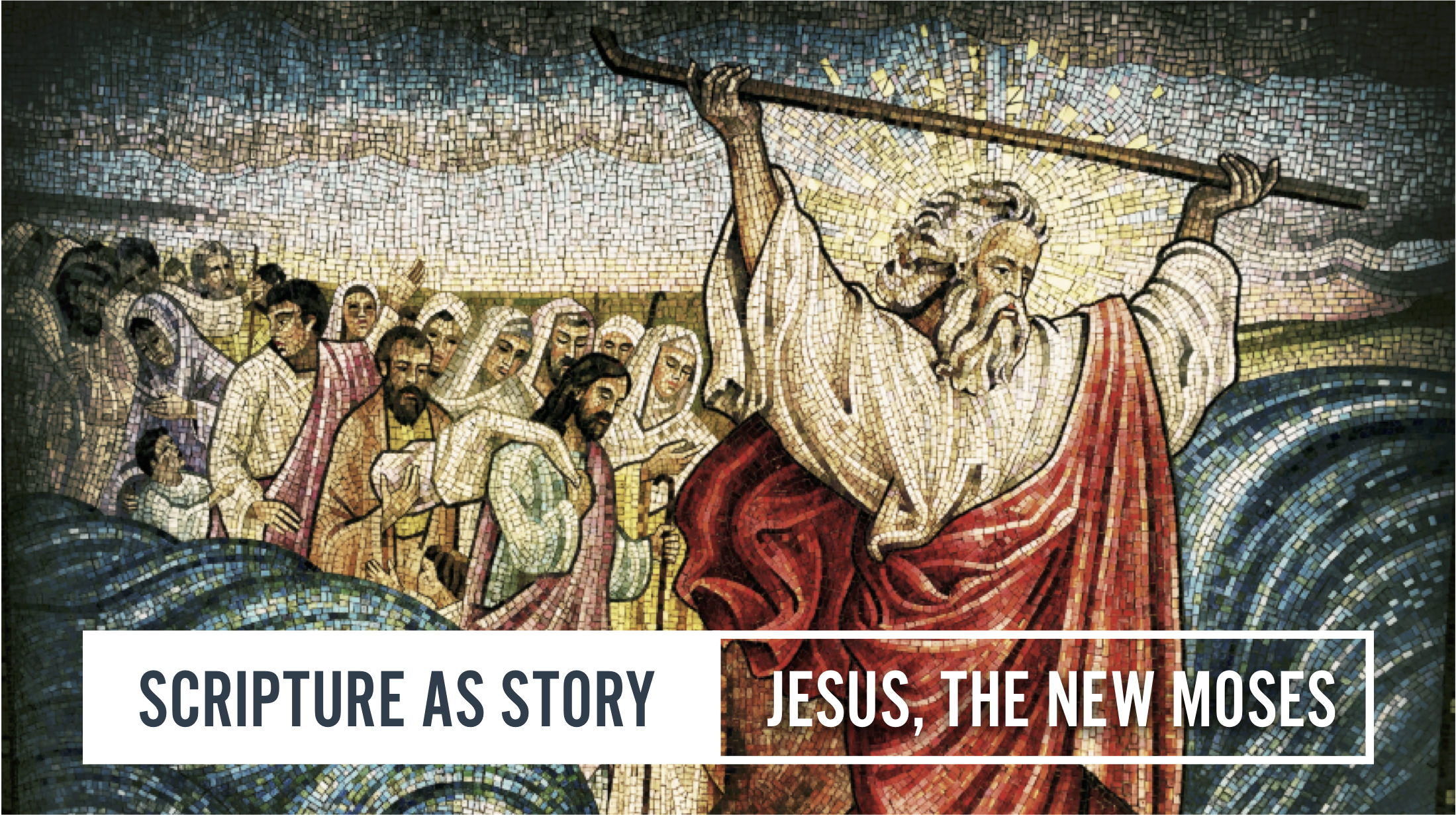
Scripture As Story: Jesus, the New Moses

Introduction

Today we continue our series on Scripture As Story, where we are emphasizing that the Bible is literature, and that we read the Bible better and more faithfully when we keep that in mind.

Last time, we looked at some specific techniques that we see the authors of Scripture using to help them tell their stories and share their teachings about God in a more compelling way. Today, I want to apply that understanding by using a case study to show how reading the Bible as literature and paying attention to the literary techniques that the Biblical authors use can actually help us to better understand the important lessons they are trying to teach us.

Specifically in this post, we are going to look at the connections that the writers of the Gospels (especially Matthew) make between Moses and Jesus, and what we can learn from those connections.[1] In Deuteronomy 18.15-16, Moses says that God was going to “raise up a prophet like me from among” Israel, and the Gospel writers go out of their way to connect Jesus to this prophecy, and claim that Jesus was, indeed, the prophet like Moses.

In John 1.21, 25, John the Baptist is asked if he is this prophet, and he says he’s not, but that he is preparing the way for Someone who is greater than he. In John 1.45, Philip tells Nathanael about Jesus, and says that He is the One “of whom Moses in the Law and also the prophets wrote.”

In Acts, Luke is even more explicit. In Acts 3.19-22:

“Repent therefore, and turn back, that your sins may be blotted out, that times of refreshing may come from the presence of the Lord, and that he may send the Christ appointed for you, Jesus, whom heaven must receive until the time for restoring all the things about which God spoke by the mouth of his holy prophets long ago. Moses said, ‘The Lord God will raise up for you a prophet like me from your brothers. You shall listen to him in whatever he tells you.”

Matthew doesn’t explicitly connect Jesus back to Deuteronomy 18, but he actually goes to greater lengths than the other Gospel writers to show the connections between Jesus and Moses. It is generally acknowledged that Matthew is writing to a primarily Jewish audience, and that He is concerned with connecting Jesus to the story of Israel, and one of the way’s he is going to do that is by repeatedly making comparisons between Jesus and Moses. 

Comparing Jesus and Moses

As we look at the way that Scripture presents the lives of Moses and Jesus, what are some similarities that we notice? I don’t claim that this is an exhaustive list, but take a look at the significant overlap between the way Scripture portrays their lives:

Moses Jesus
An evil king (Pharaoh) killed all the male Hebrew babies, but he was saved (Exodus 1.22) An evil king (Herod) tried to kill all the male babies around Bethlehem, but He was saved (Matthew 2.16)
He was hidden from Pharaoh (Exodus 2.2) An angel said to hide Him from Herod (Matthew 2.13)
Fled from Egypt, but later returned (Exodus 2.15; 4.18) Fled to Egypt, but later return to Israel (Matthew 2.13-23)
Gave up the riches and benefits of Egypt (Hebrews 11.24-26) Gave up the riches and benefits of Heaven (John 1.1-3; Philippians 2.5-8)
Became a shepherd (Exodus 3.1) Described Himself as the Good Shepherd (John 10.11)
His mission: redeem Israel from slavery to Egypt His mission: redeem humanity from slavery to sin
Often rejected by his own people Often rejected by His own people
Judged the people (Exodus 18.13-23) Will judge all people (Matthew 7.21-23; 25.31-46)
Goes up on a mountain to receive God’s law (Exodus 20-31) Goes up on a mountain to give God’s law (Matthew 5-7)
Fasted for 40 days on the mountain (Exodus 24.18) Fasted for 40 days in the wilderness (Matthew 4.2)
Performed signs/miracles Performed signs/miracles
Mediator of the covenant through the blood of young bulls (Exodus 24.8) Mediator of the covenant through His own blood (Matthew 26.28)
Delivers the five books of the Torah (Genesis-Deuteronomy) Delivers five extended sets of teaching/instruction (Matt. 5-7, 10, 13, 18, 24-25)
Lifted up the bronze snake in the wilderness (Numbers 21.9) In a similar way, He Himself was “lifted up” (John 3.14)
Commissions Joshua Commission disciples

Perhaps you find yourself thinking, “Well, that this is an interesting list, but what does it mean? How does this list of comparisons help us better understand who Jesus is?”

Why It Matters

What all of these comparisons help us to see is that, similar to Moses, Jesus is a multi-faceted character, and we better understand who Jesus is and what He came to accomplish if we can appreciate the many different roles that He fulfilled.

Liberator

The primary reason that we know about Moses in the first place is that God recruits him to liberate the people of Israel, who are helplessly trapped in the bonds of Egyptian slavery. Moses is a liberator.

Jesus, too, is a liberator, who came to earth on a mission to set people free from slavery, a slavery not from some oppressive foreign government or tyrant, but slavery from sin (Romans 6.6-7, 17-18).

Jesus liberates us from the power of sin.

Prophet

We actually began our discussion in Deuteronomy, where Moses says that a prophet like himself would come, and that this is Jesus.

Jesus was the ultimate prophet. A lot of times, when we hear the word “prophet” we think of someone who has a crystal ball or something and who can predict the future, but really, that is not a very helpful image when we talk about prophets in the Bible. Sure, at times, they predicted future events, and certainly Jesus did that, but the primary job of a prophet was to deliver a message to the people on behalf of God. Most of the time it wasn’t about the future; it was about what was going on right then that God wanted them to know.

And Jesus was the ultimate prophet; in a way that had never been done before or since, He fully revealed the message of God: who God is, what God is like, and what God wants from His people. 

Jesus was the prophet of prophets.

Lawgiver

Of course, one of the main things we associate with Moses is the giving of the 10 Commandments. God passed His law on to Moses on Mt. Sinai, and it was Moses’ job to share that with the people.

As we have already discussed, in Matthew 5, Jesus goes “up on a mountain” and there, He delivers teaching/instruction/law to His disciples.[2] He tells them that He did not come to abolish the Old Law but to fulfill it, and then He goes on to present Himself as the ultimate Lawgiver: “you have heard that it was said, but I say to you…”

Jesus is the One with authority—final authority—to interpret God’s Law. He is the Lawgiver—the One to whom we must listen.

Shepherd

Certainly Moses was literally a shepherd before God recruited him to lead the people of Israel, but after he became their leader he did so as a shepherd, willing to offer his own life up for them.

Similarly, Jesus is our Good Shepherd. He guides us, and provides for us, but also takes care of us and protects us, ultimately offering up Himself on our behalf.

Miracle Worker

Through the power of God, Moses accomplished great signs and wonders: the plagues in Egypt, the parting of the Red Sea, getting water from the rock. These were miracles that showed the great power of God, proved the identity of Moses as God’s representative, and brought about relief to suffering people.

Jesus, too, is presented as a great worker of miracles. He fed the hungry, healed the sick, cast out demons, stilled storms, and brought people back from the dead. These miracles showed God’s power, they testified to Jesus’ identity as the Messiah and Son of God, and they brought about relief to suffering people. They showed people what God’s kingdom was like, and they were a taste of New Creation.

Jesus was a Miracle Worker.

Intercessor

We noted earlier about Moses mediating the covenant through the blood of young bulls. More than that, after the people of Israel sinned by worshipping the Golden Calf and God wanted to wipe them out, Moses directly interceded with God on their behalf, offering to take punishment for them.

Jesus is portrayed as the ultimate intercessor. He mediates the covenant through the sacrifice of Himself and intercedes for us. The wages of sin is death (Romans 6.23), but Jesus takes that payment for us. As 2 Corinthians 5.21 says, “God made Him who knew no sin to be sin on our behalf…”

Jesus is the intercessor.

Commissioner

When I hear the word commissioner I think of the chief official of Major League Baseball or the NBA or NFL because that is the title that they use, but that’s not the idea here. A commissioner is someone who gives a commission—a task to be completed by those who come after.

At the end of his life, Moses commissions Joshua to carry on his mission. He tells Joshua to lead the people into the promised land and take possession of it and to keep the commandments when they are there. Joshua is assured that he can carry out this commission because God will be with him.

Jesus relays the ultimate commission. He tells His disciples to go into all the world—the Christian mission is a great one, it knows no geographical limits or bounds. As Christians, we are not told that we will inherit a small strip of land in Palestine, but rather, that we will inherit the earth. The kingdom of God is to be spread in all parts of the world. Further, Jesus tells them to observe all that He has commanded, and Jesus gives His disciples confidence that they can complete this mission, telling them that He Himself will be with them.

Jesus is the ultimate commissioner.

Judge

In Exodus 18, we have the story of Moses judging the people. When the people had a dispute, they would bring it before Moses and he would apply God’s law to these situations. But the task of judging the people is overwhelming for Moses, and his father-in-law Jethro actually advises him to get some help to share the burden.

Jesus is the judge in the ultimate sense—not settling the petty earthly disputes between people, but instead determining their eternal destinations. He says that not all who call Him Lord will enter the kingdom of heaven, but rather, they who do the will of God (Matthew 7.21). He further states that the way we treat other people, especially the “least of these”—the poor, the outcast, the oppressed—reflects how we treat Jesus, and affects our eternal destinies.

Jesus is the ultimate judge.

Conclusion

The Gospel writers—especially Matthew—go to great pains to make comparisons between Jesus and Moses. This is not a coincidence; by comparing Jesus to Moses, a man who fulfilled so many different roles in the early days of the history of the people of Israel, the New Testament shows us the many different roles Jesus plays.

There are many, many people in the world today who want to hold Jesus up as a great moral teacher or a man with brilliant insight, maybe even a prophet in some sense, but who want to stop at that point. But the Gospels go to great literary lengths to establish that Jesus is much more than this:

  • Jesus is the liberator who sets us free from the slavery of sin.
  • Jesus is the prophet who fully revealed the message of God.
  • Jesus is the lawgiver who has the final authority to interpret God’s law.
  • Jesus is the shepherd who guides us, provides for us, and lays down His life for us.
  • Jesus is the miracle worker who shows the power of God and brings relief to those who are suffering, giving them a taste of new creation.
  • Jesus is the intercessor who mediates the covenant for us, and receives the punishment that we deserve.
  • Jesus is the commissioner who extends to us the mission of expanding the borders of God’s kingdom throughout the world.
  • Jesus is the judge who determines the eternal destinies of all people.

In addition to all of these roles, the Bible goes even further: Jesus is God’s Son, God in the flesh Himself. In this sense, Jesus cannot be compared to Moses, nor to anyone else. He is absolutely unique.

In the Story of Scripture, this is the character of Jesus, and His characterization has radical implications for our lives: Jesus is God’s Son, He is the one who interprets God’s law, He died on our behalf, and He is the One who will judge how we have lived our lives and will determine our eternal destinies—how we respond to Jesus makes all the difference.


[1]I am by no means the first person to notice the connections between Jesus and Moses, and in fact, several books have been written on the topic.

Some articles that were helpful to me in the composition of this blog post include Garrett Best, “Jesus As The New Moses,” Ministry of Study, https://ministryofstudy.wordpress.com/2014/10/06/jesus-as-the-new-moses/ (accessed October 9, 2018); Cale Clarke, “Is Jesus a “Second Moses”?,” Catholic Answers, https://www.catholic.com/magazine/online-edition/is-jesus-a-second-moses (accessed October 9, 2018); “In what ways was Moses like Jesus?,” Got Questions, https://www.gotquestions.org/Moses-and-Jesus.html (accessed October 9, 2018).

[2]We typically translate the Hebrew word torah as “Law”, but a better translation would probably be something like “teaching” or “instruction.” It feels weird to say that Jesus was delivering “Law” in the Sermon on the Mount, but He was certainly giving teaching and instruction. Like Moses, He was delivering Torah.

« Older posts Newer posts »

© 2026 The Doc File

Theme by Anders Noren — Up ↑