The online journal of Luke Dockery

Category: Christianity (Page 33 of 64)

Scripture As Story: A Literary Masterpiece

Introduction

In this series, we are taking a narrative approach to Scripture: reading the Bible as literature, and specifically, as literature that is telling a grand, overarching story about who God is and what He is doing in the world. In the last post, we looked at that story itself, and in today’s installment, I want to continue our look at the Bible as literature by considering some specific examples in Scripture where reading narratively helps us to better understand what is going on. Here is the basic idea: good literature uses certain techniques to tell stories more powerfully, in ways that impact the reader (or hearer) on a deeper level, and the Bible does this too.

When I was first taught about this, I initially resisted it, but then it dawned on me: it really shouldn’t surprise us that God, though His Spirit, would inspire biblical authors to write in this way. After all, if God chooses to reveal Himself to us through a book, through a story, wouldn’t we expect it to be a really good story? Wouldn’t we expect it to be a very well-written book?

And that’s exactly what it is: even people who aren’t Christians, and don’t believe in the teachings or claims of the Bible, still hold it up as a literary masterpiece, because it is—it is an amazing story! I think it is fascinating when we examine this more closely, and when we look for literary techniques that Scripture uses, it helps us better understand the True Story that God is trying to tell us.

Figurative Language

The first technique I want to talk about is figurative language, which occurs when Scripture tells us something (often about God) using language that is meant to be taken metaphorically rather than literally. Let’s look at a couple of examples.

Short Hand, Dull Ear

“Behold, the LORD’s hand is not shortened, that it cannot save, or his ear dull, that it cannot hear; but your iniquities have made a separation between you and your God, and your sins have hidden his face from you so that he does not hear.” 

(Isaiah 59.1-2)

Here, Isaiah talks about God’s hand and His ear. What’s the point here? Is he saying that God literally has a hands and ears and other body parts like we do? No. Using figurative language, Isaiah is saying that God has the power to save His people and that furthermore, He knows their struggles and desires to save them. But at the same time, sin separates God’s people from Him, and limits the blessings that He bestows upon them.

East and the West

In Psalm 103.12, the Psalmist says,

“…as far as the east is from the west, so far does he remove our transgressions from us.”

Well, how far is the east from the west? Literally, it is impossible to measure, since both east and west are relative locations and directions. But figuratively, we get the point. This verse comes in the context of an entire psalm about God’s grace, mercy, and love, and the message is clear: the God of Scripture is a God who is eager to forgive, and when He forgives, He completely takes those sins away. He doesn’t hang them over our heads; they’re gone for good.

There are tons of examples of figurative language in Scripture, but I think you get the point: the Bible frequently uses metaphorical language to tell us very important things about who God is: He is powerful, He cares about us, and He is eager to forgive us, but He also takes sin seriously.

Foreshadowing

Foreshadowing is a literary device where the author gives a hint of what is to come. This builds anticipation as you read or hear a story, and it also helps to highlight really important features of the story.

Samson’s Hair

In Judges 13-16, there is a cycle of stories about Samson. I am not going to quote all of that here, but the basic story of Samson is pretty well-known. He is famous for being incredibly strong and using his strength to wreak havoc on the Philistines, who were the primary enemies of the Israelites in his day. That strength was tied to a vow that his parents had made with God, where Samson was never supposed to cut his hair.

As we read about Samson, we get a picture of a guy who doesn’t seem to be very bright, and who also seems to be ruled by his passions. He chases after women who get him in lots of trouble, he violates the vow he is under on a whim, and he gets angry and does incredibly violent things.

Eventually Samson falls for a woman named Delilah who doesn’t seem to care about him at all, and who tries to figure out the secret to his great strength so she can betray him to the Philistines. Delilah pesters him day after day, and if you read the story in the first half of Judges 16, you really get the idea that Samson is dumb or foolhardy (or both), and eventually he tells her his secret. Delilah then cuts Samson’s hair while he is sleeping, his strength leaves him, and the Philistines come and capture him.

And we read this:

And the Philistines seized him and gouged out his eyes and brought him down to Gaza and bound him with bronze shackles. And he ground at the mill in the prison. But the hair of his head began to grow again after it had been shaved. 

(Judges 16.21-22)

“But the hair of his head began to grow again…” This is an example of foreshadowing: we know that Samson’s long hair and the vow it represented was tied to his strength, and here we have a hint that despite the fact that Samson has been captured and his eyes have been gouged out and he is in chains, perhaps he is not done yet.

And if you know the rest of the story, Samson finds himself in a Philistine temple, standing between two pillars, and he prays to God, and God returns his strength to him, and Samson pushes the pillars down and the temple falls and he and all the Philistines are killed.

In this instance, the foreshadowing is a reminder of God’s grace: Samson might have been down and out, but that doesn’t mean that God was done with him yet.

David’s “Secret” Sin

King David is one of the great heroes of the Old Testament. He is called a “man after God’s own heart,” but the Bible doesn’t try to hide the fact that, like all of us, he was deeply flawed. We see this most clearly in 2 Samuel 11, where we have the story of David and Bathsheba.

David is walking on the roof of his house, and he sees a beautiful woman, Bathsheba, bathing, and (not unlike Samson) David shows no self-restraint and just gives in to his desire. He sends for Bathsheba, whose husband Uriah is off fighting in David’s army, sleeps with her, and she becomes pregnant. 

The fact that Bathsheba is pregnant presents David with a problem, because he’s afraid that his sin will become known, and so he does various things to try to cover it up, and ultimately, has Bathsheba’s husband Uriah killed in battle and then takes Bathsheba as his own wife to hide what he has done. And David thinks that he has successfully gotten away with his sin, but 2 Samuel 11 ends with this verse:

But the thing that David had done displeased the LORD.

(2 Samuel 11.27b)

“But the thing that David had done displeased the LORD…” This is another example of foreshadowing: the author hints that David hasn’t actually gotten away with anything, that the LORD knows about it, and that there will be consequences.

And sure enough, God sends the prophet Nathan to confront David about his sin. David and Bathsheba’s child dies as a result, and really, the rest of David’s life is pretty miserable because of what he did.

In this instance, the use of foreshadowing is a reminder of the destructiveness of sin, and the judgment that it brings.

Repetition

Sometimes, the biblical authors will repeat a key word or phrase to emphasize a main theme or idea. This happens frequently in Scripture, but a really good example of this is in the Book of Judges.

The period of the judges was a dark time in the history of Israel. It was a wild and lawless time. There was no centralized leadership of the people of Israel, and instead, God periodically raised up judges—regional, tribal leaders—to deliver His people from their enemies. 

As you go through the Book of Judges, there is a repeated cycle that develops that looks something like this:
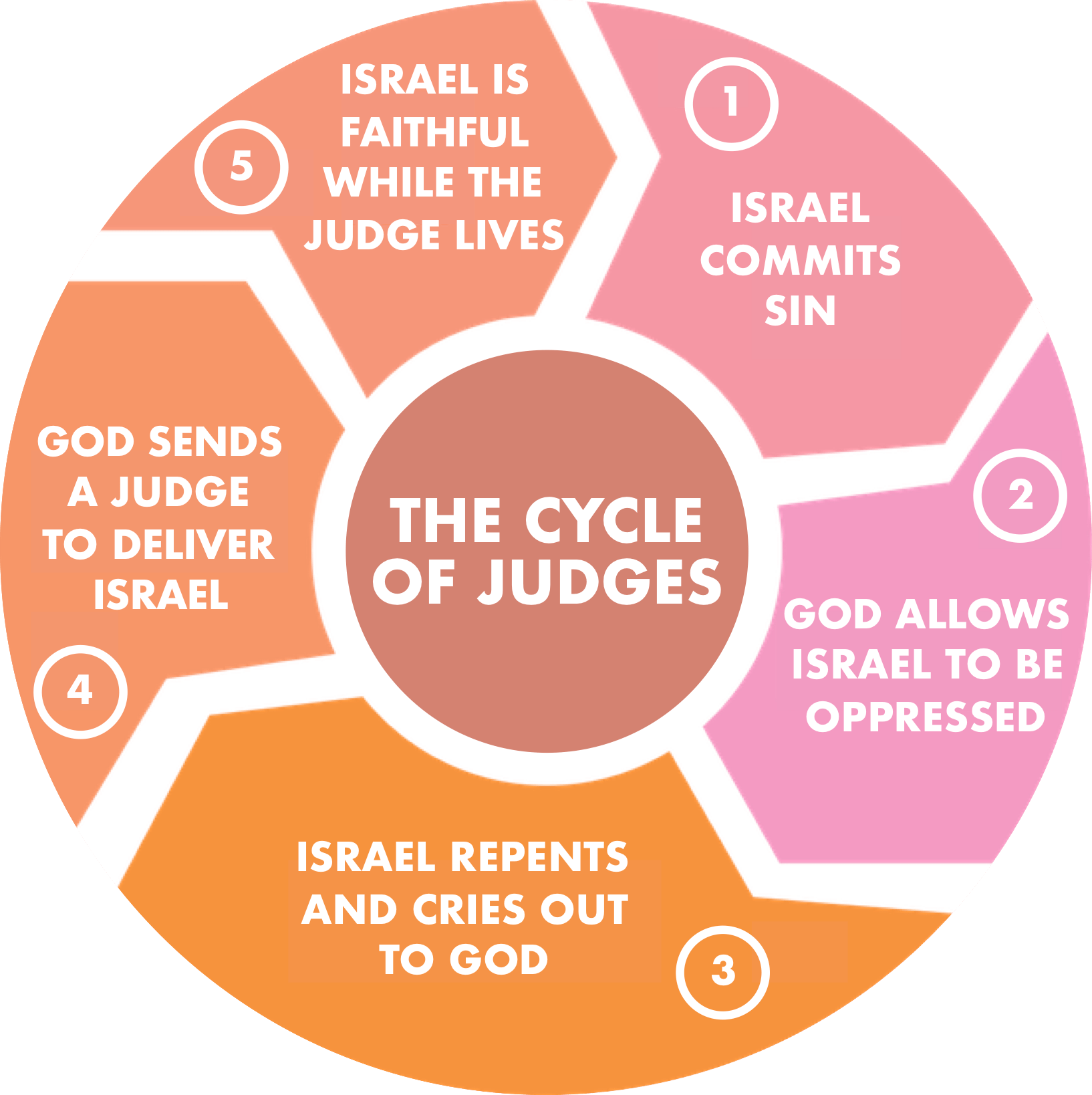
(1) The people of Israel commit sin; (2) God allows them to be oppressed by their enemies; (3) They then repent and cry out to God for deliverance; (4) God raises up a judge to deliver His people; (5) The people remain faithful while the judge lives, but after his/her death they sin again and the cycle repeats itself all over again.

But as you go throughout the Book of Judges and follow this repeating cycle, you notice it’s actually a downward spiral and that things are getting progressively worse. The judges are increasingly flawed and immoral people, and even when they save Israel, the peace doesn’t last for long. 

Finally, at the very end of the book there are two horrible stories told that emphasize the lawlessness of the land. And bracketing those stories there is the repetition of a key statement:

In those days there was no king in Israel. Everyone did what was right in his own eyes.

(Judges 17.6; 21.25)

What is the point of this repeated theme? Well, in the larger story of the people of Israel, it is justifying the need for a king, and in fact, Israel will get a king in the very next book—1 Samuel. But also, this repeated theme teaches what is a very fundamental biblical idea: humans are flawed, frail, and fallen, and when we try to do things on our own, wickedness and chaos is the result. This is the story of our world going back to the Garden of Eden—when we think that we know what is best rather than what God has told us, disaster is the inevitable result.

Echoing

What I am calling echoing is the frequent practice of the authors of Scripture to refer back to an earlier event in the Bible by repeating certain language, or telling stories in similar ways, or comparing certain characters.

Creation and New Creation

One example that shows this very clearly is a comparison between Genesis 1-3, which talks about the Creation of the heavens and the earth, and Revelation 21-22, which talks about the New Creation of the New Heavens and New Earth. Over and over again, what we read in Revelation echoes what occurred in Genesis:

Genesis Revelation
Division of light and darkness (Gen. 1.4) No night there (Rev. 21.25)
Division of land and sea (Gen. 1.10) No more sea (Rev. 21.1)
Rule of sun and moon (Gen. 1.16) No need of sun or moon (Rev. 21.23)
River flowing out of Eden (Gen. 2.10) River flowing from God’s throne (Rev. 22.1)
Tree of life in midst of garden (Gen. 29) Tree of life throughout the city (Rev. 22.2)
Gold and precious stones in the land (Gen. 2.12) Gold and precious stones throughout (Rev. 21.19)
God walking in the garden (Gen. 3.8) God dwelling with His people (Rev. 21.3)
Cursed ground because of sin (Gen. 3.17) No more curse (Rev. 22.3)
Pain and sorrow (Gen. 3.17-19) No more sorrow, pain, tears (Rev. 21.1-4)
Returning to the dust=death (Gen. 3.19) No more death (Rev. 21.4)
Cherubim guarding the Garden (Gen. 3.24) Angels inviting into the city (Rev. 21.9)

As John is writing Revelation, over and over again, there is a clear comparison to what happens in the beginning in Genesis, and what will happen in eternity, and his point is clear: the creation that God began which was tainted by sin, He is going to redeem, recreate, and perfect!

Similar Stories

Echoing also happens when Bible authors describe events in a way that calls to mind similar stories in earlier sections of Scripture. 

I mentioned earlier that at the end of the Book of Judges, you have a couple of really dark and horrible stories, and the worst is in Judges 19. This is an extremely graphic story, and because of length I won’t quote it here, but I encourage you to read it and then compare it to the story of the destruction of Sodom and Gomorrah in Genesis 19. These stories are eerily similar in a lot of respects. This doesn’t mean that the stories are made up, but it does show that the author of Judges is telling his story in such a way that it is supposed to remind you of Sodom and Gomorrah, and the point is what a dark and wicked place that Israel has become now that “everyone has done what is right in his own eyes.”

Comparing Characters

A really common form of echoing is to compare different characters, especially characters from the Old Testament with characters in the New Testament, and to do so in order to tell us more about the character on a deeper level. 

For example, in multiple places John the Baptist is compared to the Old Testament prophet of Elijah. Jesus is a particularly good example of this, as He is compared to a lot of different Old Testament characters: Adam, Melchizedek, David, Jonah, and especially to Moses (and I intend to do an entire post later in this series on Jesus as the new Moses).

But comparing characters is another way that biblical authors echo other portions of Scripture.

Conclusion

Really, I could write entire posts (or series of posts) on each of the literary devices we have talked about—Figurative Language, Foreshadowing, Repetition, Echoing—and there are a lot of other literary techniques that I didn’t even mention. 

But hopefully we have covered enough to make the point, which is that when God inspired the biblical authors to compose the books of the Bible that make up His Story, they told that story as storytellers, and we read the Bible better and more accurately if we realize this, look for the storytelling techniques they use, and see how that helps us to have a better understanding of what God is trying to reveal to us.

The Bible is not written as a history textbook. It’s not written like a police report, with just the facts and no interpretation. It is written narratively, and the ways that the authors tell their stories give us important information about the character of God, and the grand overarching Story of Scripture that we talked about last time: 

  • As we see in the repeated refrain of the Book of Judges, when people do what is right in their own eyes, the result is sin and evil and chaos, just like we had with Adam and Eve in the Garden of Eden.
  • As we see in the story of David and Bathsheba, sin brings judgment and consequences.
  • But as we also see in the story of Samson and in the figurative language of Isaiah and Psalms, God is gracious, and sin doesn’t have to have the last word. God is powerful to save and eager to forgive and restore.
  • And as we see in the way the whole Story ends in the final chapters of Revelation, God is redeeming and restoring the creation that He spoke into existence in Genesis: a New Heavens and a New Earth, where there will be no crying or mourning or pain, where we will dwell with the Creator forever.

I hope you will continue to follow along. In future posts, we will look at a few “case studies” that illustrate some of the ideas and literary techniques described above.


Scripture As Story: The Big Picture

Introduction

In this series, we are looking at Scripture as Story. Ultimately, we are going to look at various ways in which the biblical authors use literary techniques to reveal truth about God, but before we get into that, in this post, we want to look at the grand, overarching story that the Bible is telling, the “Big Picture” if you will.

Before we launch into that, I think it’s worth spending a little bit of time discussing why it is important for us to know and understand the Big Picture of the Bible.

First, have you ever had someone ask you what you believe, or what Christianity or the Bible is about, and you’re not really sure where to begin? Well, knowing the Big Picture of Scripture gives you a perfect answer: you can tell the story of God as Scripture tells it, and you can share your faith with confidence.

Second, have you ever studied a story or a book of the Bible in detail, but aren’t sure how it fits into the big picture? This is something I have noticed a lot in teaching teenagers: they might be able to talk about Joseph’s coat of many colors, Saul of Tarsus being struck down by a bright light, Daniel in the lions’ den, or all sorts of things about Jesus, but they’re not really sure how everything fits together. And, honestly, I think that is true of a lot of us. One of the advantages of knowing the Big Picture of the Bible is that it provides a framework upon which we can hang all of the details that we learn about various sections of Scripture.

Finally, have you ever struggled with the question, “What does God want for my life? How do I fit into God’s plan?” Perhaps the most important thing about knowing the Big Picture of the Bible is that it helps us to see how our own individual stories fit into God’s universal Story.

Now that we have talked about why the Big Picture is important, let’s launch into the Story itself. We will look at the story in six difference chapters.[1]

Creation

The story, of course, starts at the beginning:

In the beginning God created the heavens and the earth. The earth was formless and void and darkness was over the surface of the deep and the Spirit of God was moving over the surface of the waters. Then God said, “Let there be light” and there was light. God saw that the light was good and God separated light from darkness. God called the light day and the darkness he called night. And there was evening and morning, one day.

(Genesis 1.1-5)

God’s Story begins with His creation of all that is: everything we see and experience. He raised up the mountains, dug the valleys, and filled the seas. He set the stars in the sky, and placed the planets in their orbits.

He filled the waters and sky with fish and birds and brought forth vegetation on the earth. He created animals to walk upon the earth. His crowning point of creation was humanity: God breathed His Spirit into our flesh and made us in His likeness: “In the image of God, he created him. Male and female he created them” (Genesis 1.27). 

Over and over again, as God creates one thing and then another, God declared it to be good. There was order and harmony, interdependence and diversity. And there was glory: “The heavens declare the glory of God and the firmament shows his handiwork” (Psalm 19.1).

God blessed His creation and wanted it to flourish. He wanted humans to rule over and take care of creation. He wanted the heavens and earth to continue to declare His glory. He wanted to dwell with His creation in an intimate, relational way. 

Curse

But something tragic happened to ruin this goal. The Apostle Paul describes it in this way:

Therefore just as through one man sin entered into the world, and death through sin, and so death spread to all men, because all sinned.

(Romans 5.12)

Here Paul refers to a story that happened long before his time, but is a story we know well. In fact, it occurs very early in the Bible, immediately after the story of Creation.

God placed the first humans, Adam and Eve, in the garden of Eden. 

In that garden, there was a tree of knowledge of good and evil. God explicitly commanded them to not eat of that tree. For Adam and Eve, the tree represented much more than fruit: it was the choice to either live dependent on God, trusting fully in Him, or independent of Him, relying upon themselves to figure out what life was about. The tree represented freedom—or so they thought. 

Under the influence of the deceiving serpent, Eve took the fruit and ate of it, and shared it with her husband. Through this act of disobedience, Adam and Eve asserted their independence, telling God that they didn’t need Him. They could figure out life on their own and make their own decisions.

Immediately problems arose. Adam and Eve felt separation from God and they literally tried to hide from Him. They felt separation from one another and they blamed each other. They felt separation from the goodness God bestowed upon them in creation and they felt shame and tried to cover their nakedness. They felt separation from creation as the ground became cursed. The good world God had created broke.

Things just got worse and worse. Cain, Adam and Eve’s son, committed the first murder, killing his own brother. Death spread to the human race. The curse of sin escalated to the point that every inclination of the heart became full of evil all the time, the Bible says. All that God had made good was beginning to unravel.

How can this be fixed? What can be done to mend what is breaking? What can help creation declare God’s glory again?

Israel

The next chapter of the story begins in Genesis 12:

Now the Lord said to Abram, “Go forth from your country and from your relatives and from your father’s house to the land which I will show you; and I will make you into a great nation, and I will bless you, I will make your name great and you will be a blessing. I will bless those who bless you and the one who curses you I will curse. And in you all the families of the earth will be blessed.”

(Genesis 12.1-3)

God began fixing his broken world by calling a man named Abraham. He called Abraham to go to a different land so He could make him into a great nation. The purpose of this was not to make Abraham great, but for all the earth to be blessed and restored through Abraham.

Abraham’s son was Isaac, Isaac had Jacob, Jacob had 12 sons, and these sons turned into the twelve tribes of Israel. They would also become enslaved in Egypt, but God, through His mighty power, rescued them. No longer was it a small family, but a people: Israel. God took Israel to Sinai and made a covenant with them, teaching them how to live through the giving of His law.

God told them, “You are to be a kingdom of priests and a holy nation” (Exodus 19.6). Again, as with Abraham, God’s blessing of Israel was never about Israel: they were to be a light to the nations. Through them, God was going to fill the earth with His glory. Blessing and redemption were supposed to come. Israel was supposed to be good news for the world, but most of the time, it wasn’t.

This becomes painfully apparent almost immediately, as Israel struggles to keep their covenant. By the time Moses comes down from the mountain with the Ten Commandments, the people are already breaking them, worshiping an idol, a golden calf. God is angry, but He is also patient, and doesn’t give up on them. Instead, He tries to teach them by sending them leaders, prophets, and judges. He gives them land, a king (reluctantly), a city, and a temple. He heaps blessing upon them.

But the people keep straying from God’s covenant. They worship idols. They neglect and oppress the poor. They put their trust in military might and foreign nations rather than God. They don’t act as a kingdom of priests or a holy nation: instead of being a light to the nations, they are a part of the darkness.

Finally, God says, “Enough!” He sends Israel people into exile. He brings judgement upon His own people. They lose their land, their temple, their capital, and their king. 

But even in the midst of despair and devastation, God makes a promise. Someday…God would bring a new covenant. Someday…He would send a new King who would lead the people in the right way. Someday…He would give his people a new heart and spirit. God would use them to be a light to the world. But how was this going to happen? 

Jesus

And this is where a Story which has largely been sad to this point, suddenly takes a good turn. The Gospel of John describes it this way:

In the beginning was the Word and the Word was with God and the Word was God. He was with God in the beginning. All things were made through Him and without Him nothing was made that has been made. In Him was life and that life was the light of men…The Word became flesh and dwelt among us, and we have seen His glory, the glory as of the one and only coming down from the Father, full of grace and truth.

(John 1.1-4, 14)

In a small town, while no one was watching, God broke into our world in the form of a tiny baby named Jesus, who was also called the Christ. He grew up in Nazareth and began His ministry in Galilee. He launched His ministry when He read a passage from Isaiah 61, which talks about the Spirit anointing Him to preach good news to the poor, recovery of sight to the blind, release for the captives, freedom for the oppressed, and to proclaim the year of the Lord’s favor (Luke 4.18-19).

After reading that, he said, “Today this is fulfilled in your hearing” (Luke 4.21). What Jesus means is that now is the time when God was going to restore His people and begin the process of fulfilling the promise to Abraham of bringing blessing and healing to a broken world.

A new King was here! And this is better than the kings that Israel had before; this was good news. This new king went about teaching, preaching, and healing. He taught about what it looks like when God is King: it means loving God with all of your heart, soul, mind, and strength. It means loving your neighbor as yourself. 

He told people how to live as citizens of His kingdom. He talked abut repentance, and called people to deny themselves and take up their cross and follow Him. He said if you want to be great, you have to become a servant. He introduced a new way of life, one of love, faithfulness, and mercy. 

And He healed. He showed that the brokenness of our world, the curse of sin, was not a permanent condition—it was being reversed, undone. The lame began to walk, the poor were blessed, the lepers were cleansed, and the dead were raised. 

Then, Jesus suffered. He took the sin and brokenness of the world upon Himself by being beaten, ridiculed, and eventually dying on a cross. In that act, the guilt and power of sin began to be broken. 

Three days later, God raised Jesus by His power from the dead declaring Him Lord over the world. Jesus appeared to disciples proving that He was alive and He sent them to be witnesses of this new life and to invite others to partake of it.

What a wonderful chapter this is, but it ends with Jesus ascending back to heaven to be with His Father. What would happen next? Who would carry on the work of Jesus?

Church

We get the answer to those questions at the beginning of the Book of Acts:

When the day of Pentecost had come, they were all together in one place. And suddenly there came from heaven, a noise like a violent rushing wind, and it filled the whole house where they were sitting. And there appeared to them tongues as of fire distributing themselves and they rested on each one of them. And they were all filled with the Holy Spirit and began to speak with other tongues, as the Spirit was giving them utterance.

(Acts 2.1-4)

The Holy Spirit was poured out on the apostles of Jesus. It empowered them to be the witnesses Christ had called them to be of His life, death, and resurrection. Peter preached that in his first sermon and it convicted the listeners. They cried out, “What shall we do?”

Peter replied, “Repent and be baptized everyone of you in the name of Jesus and your sins will be forgiven and you will receive the gift of the Holy Spirit” (Acts 2.38). Three thousand people responded and were baptized, and with this, what we call the church was born. 

But really, God was simply fulfilling what He had promised long before: Israel was being restored. God’s people were receiving a new covenant in Christ Jesus. A new heart and spirit were being given to them. Now, they were empowered by the Spirit of God to fulfill what God promised to Abraham: to be a blessing to the rest of the world.

Now, being a part of God’s people (Israel) was no longer based on ethnic background, but rather, on relationship with Jesus. It did not matter whether you were Jew or Gentile, slave or free, male or female. All were now welcomed in Christ Jesus. Also, God’s people were not simply passive lights revealing a different way to live; they were actively sent throughout the world to proclaim the good news about Christ. So this is exactly what they did: Paul, Barnabas, Timothy, Titus and many others traveled all over the Roman Empire declaring the good news of what God was doing.

They carried on this great work, emboldened by God’s Spirit, and energized by a promise that infused their teaching and preaching, which brings us to the last chapter.

New Creation

That promise is described beautifully in John’s Revelation:

Then I saw a new heaven and a new earth; for the first heaven and the first earth passed away and there is no longer any sea. And I saw the holy city, new Jerusalem coming down out of heaven from God, made ready as a bride adorned for her husband. And I heard a loud voice from the throne, saying, “Behold the tabernacle of God is among men, and He will dwell among them and they shall be His people and God Himself will be among them. And He will wipe away every tear from their eyes; and there will no longer be any death; there will no longer be any mourning, or crying, or pain; the first things have passed away.” And He who sits on the throne said, “Behold I am making all things new.”

(Revelation 21.1-5)

The promise was that Someday, God was going to fully finish what He had started through Jesus. Jesus is going to come back and this time, He won’t be rejected. He won’t be killed.

This time, every knee will bow and every tongue will confess Jesus Christ as Lord. All that is evil, all that is rebellious, and all that is broken will be removed. Those that do not want the healing and forgiveness found in Christ will receive that wish, and be separated from God. 

God will make all things new. The curse of sin will no longer be present and God will be with His creation completely. All of creation—or in the words of John, the new heaven and new earth—will fully declare God’s glory. We will live with Him and serve Him forever.

Conclusion

This is the Story, the Big Picture of Scripture. It is what Christians believe. It is a story of good news (gospel) that we have to offer to the world. A story that Jesus is Lord, and that through His death and resurrection and the pouring out of the Holy Spirit, God is putting our broken world back together again.

There are numerous problems in our world that cause untold heartache—racial strife, political turmoil, poverty, crime, immorality, and more. But the Story of Scripture is that there is an answer to these and all other problems, and His name is Jesus. Through His death and resurrection, sin is broken.

This also gives us an answer to the question regarding the purpose of our own lives. Knowing the Big Picture of the Bible helps us to see how we connect our story to The Story, by joining in God’s Mission. First, we do this by responding in the same way that Peter’s audience did in the Book of Acts: we receive the good news of what Jesus has done, is doing, and will do into our own lives by repenting of sin and being baptized. And then, we let Jesus begin to put our broken lives back together by the power of the Spirit. Second, we are to join with Jesus and His people to be a light to the nations and bring the message of the healing of Jesus to rest of the broken world.

This is the Story that Scripture tells, the Big Picture of the Bible. It is the Story that changes everything.


[1]These chapter divisions and much of the content that follows comes from Steve Cloer, “What Is The Gospel?” in Gospel: Good News For A Desperate World, ed. Luke Dockery (Fayetteville, AR: Deeper Youth Ministry, 2017), 10-19. This essay was the manuscript version of a presentation that Steve made at the 2016 Deeper Youth Conference, and again, what follows relies heavily upon his outstanding work.

If you are a fan of alliteration, you could alternatively call these chapters Creation, Curse, Covenant, Christ, Church, and (New) Creation. I prefer “Israel” and “Jesus” over “Covenant” and “Christ” for reasons that are probably not worth going into here.

Pardon, Not Acquittal: Jesus and the Woman Caught in Adultery

Introduction

One of my favorite stories in Scripture is found in our modern Bibles in John 8, and is generally referred to as something like “Jesus and the Woman Caught in Adultery.” I love this story because it is a good example of how Jesus was so different from what people expected, and how He always did the right thing in any given situation.

Maybe you are like me: there are so many times in life when I find myself in a situation where I simply do not know what to do. Maybe I don’t know how to answer a certain question, or respond to a problem that someone is having, or face a crisis in my own life. I want to do the right thing, I want to do the thing that honors God, but sometimes, in the moment, it can be hard to have the wisdom to know what that thing is.

But not with Jesus. He often had people intentionally trying to put Him in impossible situations, but He would always know the right thing to do or say.

And that is certainly the case in this story.

Does This Story Belong In the Bible?

Before we launch into examining the story itself, we first need to answer the question, “Does this belong in the Bible?” And that might seem like a crazy question at first, because, after all, it is in our Bibles, so surely it belongs there…right?

We don’t have the original editions of the Bible. Instead, what we have are thousands and thousands of handwritten copies called manuscripts. We have fragments that date back to the early second century, but the best comprehensive manuscripts we have that contain most or all of the New Testament date back to the fourth and fifth centuries.

Compared to other ancient works, this is incredible. There are some ancient works of famous philosophers or poets of which we may only have a handful of copies, but there are thousands and thousands of biblical manuscripts. There are a lot of differences between the different manuscripts because they were copied down by hand, but since there are so many copies, we can compare them and with a very high degree of accuracy, determine what the original text said.

The study of these manuscripts is called textual criticism, and the earlier manuscripts are better, because they are closer to the original copies of the books of the New Testament, and thus give us a more accurate picture of what the original documents said.

The vast majority of differences between manuscripts are differences in things like spelling (basically the modern equivalent of a typo) where it is still very obvious what is supposed to be said. There are only a handful of places in the New Testament where there is a whole verse or verses that we are not sure about, and even in those, there is no point of doctrine that is compromised either way. So the biblical text that we have is very reliable.

But the story of the Woman Caught in Adultery, found in John 7.53-8.11, is one of those instances where different manuscripts disagree with one another. In most modern Bibles, John 7.53-8.11 will be included in brackets with a note next to it that says something like, “the earliest manuscripts do not include John 7.53-8.11.” What’s going on here?

The problem is that the earliest and best manuscripts we have do not put this story after John 7.52. Some do not contain the story at all, other manuscripts place it after John 21.25, one manuscript puts it after John 7.36, and some actually put it in the Gospel of Luke, after 21.38 (keep that in mind). So in this case, textual criticism tells us that this story about Jesus and the woman caught in adultery was almost certainly not originally at the end of John 7 and beginning of John 8.

But just because we don’t think this story is in the right place doesn’t mean that it isn’t a true story. It seems authentic; it certainly seems in keeping with the character of Jesus as we read in other places. It is referred to in other writings outside of the New Testament, so we know that it was a very early story, known in the second century.[1]

Some have suggested that this was preserved as a true story about Jesus, but wasn’t attached to a specific gospel, so different scribes who copied the manuscripts by hand added it at different places.

I think there is pretty good evidence that it was originally written by Luke. If you remember, earlier I mentioned that this story is included in some manuscripts of Luke, after Luke 21.38 (and if you look, it actually fits quite well there). But also, the theme, vocabulary, and style of writing in this story are more common to the books of Luke-Acts than they are the rest of John.[2] Luke’s gospel reflects a special interest on women, as this story obviously does, and there are various words and expressions used in this story that don’t appear elsewhere in John, but appear multiple times in Luke-Acts.[3]

But if Luke wrote this, why is it not in the earliest and most comprehensive manuscripts?

Well, Luke tells us at the beginning of his gospel (Luke 1.1-3) that he compiled his account of the life of Jesus based on the testimony of eyewitness accounts and that he took what he had collected and wrote it down. Luke would have compiled notes that he later collected and collated into a full text, sort of like if you can imagine having a folder with all of these stories of miracles and teachings of Jesus that you take and then compile together on one scroll.

This particular story fits in very well after Luke 21.38 (where it is in some manuscripts) but this point in Luke’s Gospel is also right before his telling of the betrayal, death, and resurrection of Jesus—the central elements of the Jesus story.

Luke’s Gospel in its current form is just about the right size for a typical ancient scroll, so it’s possible that Luke removed this story from his Gospel simply for the practical reason that he saw that he was running out of writing room, and he wanted to make sure that he covered the most important stuff.[4]

The story of Jesus and the Woman caught in adultery was still preserved as important and authentic, and was apparently widespread, which is how it got added to so many manuscripts in different places. None of this should make us uncomfortable or worried about the accuracy of our Bibles, but it should remind us that while the Bible is inspired by God, it is also a human product that God uses to reveal Himself to us.

The True Colors of the Pharisees

So while this story doesn’t really fit in the Gospel of John, I feel very confident that it is authentic, and that it fits in our Bibles. Let’s examine it more closely:

Early in the morning he came again to the temple. All the people came to him, and he sat down and taught them.

The scribes and the Pharisees brought a woman who had been caught in adultery, and placing her in the midst they said to him, “Teacher, this woman has been caught in the act of adultery. Now in the Law Moses commanded us to stone such women. So what do you say?”

This they said to test him, that they might have some charge to bring against him.

Here the Pharisees, the supposed keepers of the Law, slip up and show themselves to be less concerned with the integrity of the Law than they are in trapping Jesus in a difficult situation. You see, the Law of Moses did require that a woman caught in adultery be put to death, but it also required the same punishment for the man (Leviticus 20.10; Deuteronomy 22.22). Since the woman was “caught in the act of adultery,” the Pharisees clearly knew who the other guilty party was, and by not bringing him forward for punishment, showed that they weren’t too concerned with what the Law said.

Furthermore, despite what the Law said, “there is little evidence that it was carried out very often in first-century Palestine, especially in urban areas.”[5] Part of the reason for this is that the Jews were under Roman authority, and didn’t have the legal authority to execute people on their own (we see this again in the execution of Jesus).

So the Pharisees likely had no intention of executing the woman and weren’t really concerned about the Law of Moses. Instead, they were trying to trap Jesus between a rock and a hard place, forcing Him to either disregard the Law of Moses, or be the one who pronounced the woman’s death sentence (and thus, likely cause problems for him with the Roman authorities).

Jesus has been placed in a hard situation; out of nowhere, He is surrounded by an angry mob, asking Him to perform some on-the-spot biblical interpretation with massive implications. What is the right thing to do? How will He respond?

Writing on the Ground

Jesus bent down and wrote with his finger on the ground. And as they continued to ask him, he stood up and said to them, “Let him who is without sin among you be the first to throw a stone at her.” And once more he bent down and wrote on the ground.

Twice in this passage, it specifically mentions Jesus stooping down to write with His finger on the ground. It’s an interesting detail that is included, and helps the scene come to life for the reader. It is also one of the little characteristics of this story that make it seem genuine. Seeing that Jesus wrote on the ground but not necessarily knowing what it is that He wrote—this is the sort of detail that an eyewitness would remember and share.

Scholars and commentators have pounced on this little detail over the years and offered various interpretations of it:

  • Some have suggested that Jesus was writing out the 10 Commandments.
  • Some have argued that this was a direct reference to Jeremiah 17.13, where those who forsake God are “written in the dust”, and that Jesus is making a specific judgment against the Pharisees.
  • Some have proposed that the words Jesus writes are actually the specific sins of the scribes and Pharisees who have brought the adulterous woman before Him.

All of these suggestions (and others have been made as well) are interesting and, I guess, possible, but ultimately, we aren’t told what it is that Jesus writes on the ground. Personally, I’ve always been inclined to think that perhaps Jesus didn’t write anything of consequence on the ground at all, but just the act itself and the pause it produced helped to diffuse the energy and volatility of the situation and made the Pharisees more prepared to hear and respond to what Jesus says.

Sometimes when we find ourselves in a difficult situation, or perhaps when someone says something to us that just sets us off and makes our blood boil, the most important thing that we can do is to do nothing right then. Instead, the wise course of action is to take a deep breath and slow our heart rate before we respond (if we respond at all!).

Jesus says that He who is without sin is to cast the first stone. This is a reference to Deuteronomy 13.9 and 17.7—it is the witnesses of the crime who must be the first to throw the stones, and they cannot have been participants in the crime itself.[6]

So Jesus puts it back on those who were trying to trap Him: which of the woman’s accusers felt confident enough in their own sinlessness that they would take up the stone and begin the execution?

Pardon vs. Acquittal

But none of them do.

But when they heard it, they went away one by one, beginning with the older ones, and Jesus was left alone with the woman standing before him.

Jesus stood up and said to her, “Woman, where are they? Has no one condemned you?”

She said, “No one, Lord.”And Jesus said, “Neither do I condemn you; go, and from now on sin no more.”

The story of Jesus and the Woman caught in Adultery ends on a high note, as Jesus’ response to the Pharisees leaves them speechless. Seemingly, He awakens their consciences, and in shame, the slink away, realizing that they are in no place to pronounce judgment upon the woman.

“Woman, where are they? Has no one condemned you?”

“No one, Lord.”

“Neither do I condemn you; go, and from now on sin no more.”

Of course, Jesus is the One who is without sin, and is the One who actually has the right and authority to pronounce judgment. But He doesn’t condemn her. In fact, this is in keeping with the reason Jesus came into the world:

“For God did not send his Son into the world to condemn the world, but in order that the world might be saved through him.”

(John 3.17)

Jesus came on a rescue mission to seek and save those who were lost.

And what Jesus says here is incredibly important—Jesus pardons the woman, but He doesn’t say that her sin doesn’t matter or that it isn’t a big deal. Instead, He specifically addresses the sin—by telling her to “sin no more,” He indicates that He knew that she was indeed guilty of adultery and that she needed to change her life.

Which leads to an important idea that is central to the Gospel—Jesus offers us pardon, not acquittal:

  • If someone is acquitted of a crime, then they are declared to be “not guilty.” No punishment is due that person, because no sentence of guilt was passed.
  • If someone is pardoned of a crime, then they have been found guilty, but the punishment for the crime is taken away.

This is a central element to the gospel of Jesus Christ. Jesus doesn’t come to us and say, “Your sin is not a big deal; no crime has been committed, you are innocent.” Instead, He says, “Your sin is significant; it must be paid for, but you don’t have to pay the price.”

Our sin is such a big deal that Jesus paid the price for it on the cross; because of that sacrifice, pardon can be offered to the adulterous woman, and to the rest of us as well. And when we receive that pardon for our sins and appreciate it, we should be motivated, as Jesus told the woman, to go and sin no more.

Conclusion

The story of the woman caught in adultery is an interesting one. It presents textual problems, and we may be unsure of exactly where it fits in Scripture. But what a powerful story it is, and what important lessons it teaches us.

It teaches us about the nature of Jesus’ enemies. They were less interested in keeping God’s word than they were in trying to entrap Him. And in a similar way, we may find ourselves at times in difficult situations not because other people are trying to do the right thing, but because they are actively trying to cause problems for us.

This passage also teaches us something about how to respond to difficult situations. Jesus, the wisest of all men, doesn’t explode or react impulsively. Instead, He takes His time and calmly responds, diffusing the situation while applying biblical truth with clarity and grace.

And perhaps most of all, it shows us something about the kind of judge that Jesus, the Judge of all the World, is: He is looking to save, not to condemn. I think many people have an idea of God where He is distant and removed, watching us closely and just waiting for us to mess up so He can zap us. But this is not the picture of God that the Bible repeatedly offers. God is merciful and gracious, slow to anger, and abounding in steadfast love and faithfulness. God does not wink at sin or pretend that it doesn’t matter, but He is eager to pardon it, and He paid the price for it, Himself.

Each of us stands guilty in the sense that we have been convicted of sin in our lives. That is unquestionable. So the only real question is, have we received the pardon that God offers?


[1]Frank Pack, The Gospel According to John, Part I, The Living Word Commentary (Austin, TX: Sweet Publishing, 1975), 136.

[2]Ibid., 136; D. A. Carson, The Gospel According to John, The Pillar New Testament Commentary Series (Grand Rapids: Eerdmans, 1991), 334; http://www.tektonics.org/af/adulterypericope.php

[3]“Mount of Olives”, “scribes and Pharisees,” “eldest,” “accusers,” “early,” “all of the people”

[4] http://www.tektonics.org/af/adulterypericope.php

[5]Carson, 335.

[6]Ibid., 336.

Two Graduations: What My Special Needs Daughter Taught Me About Following Jesus

It’s June, which means that we have just completed another graduation season. As a youth minister, I go to a lot of graduations, but this year there were a couple of graduation ceremonies that were more significant to me.

First was my own graduation from Harding School of Theology. This one was a long time coming. It was an extensive program (a 78-hour degree, which is more coursework than many master’s and doctorate programs combined), and add to that the fact that I completed it while working full time, figuring out how to be a dad, and living hundreds of miles away, and I can say with only minimal chagrin that I started the program way back in 2010. Finishing a program that you have been engaged in for so long is certainly an accomplishment of sorts, and I’ve had a lot of people ask me how it feels to be done. I definitely feel grateful for all that I have learned and for all who made it possible (HST faculty and staff, my wife, my elders at church, etc.). I am also pleased to be done. But my overwhelming emotion is a little more difficult to explain, and that’s what this post is about.

About 10 days after my graduation, I went to another graduation ceremony—Kinsley’s Kindergarten graduation. I have written in different places about how the last 18 months or so have been very difficult for my little girl. Increased seizure activity has been hard to control and has led to several regressions (i.e., she has lost abilities that she once had). Nevertheless, during this past school year, she started Kindergarten in a self-contained class. Kinsley’s academic goals were made with her special needs in mind and were very modest by the standards of “typical” children, but still, due to the regressions, she didn’t hit those goals. In some sense, you could even say that her graduation from Kindergarten was something of a formality. But I can tell you this: I am far prouder of her graduation than my own.


I have always been a high achiever. I have always gotten good grades and done well in school. I was involved in a bunch of extracurricular activities to beef up my college résumé. I was a good (not great) athlete who worked hard and was, at times, pretty successful.

When I started grad school, I began to work even harder. I had become convinced that doing my best was a spiritual requirement (I still believe this, by the way), but “doing my best” easily became a justification for obsessive perfectionism. In school, I wanted every research paper to be perfect. In ministry, I wanted every teenager to be faithful and every sermon to be excellent. In my personal faith and theology, I wanted to be right on every issue and know the answer to every question. Some of this obsessive perfectionism I come by naturally (it runs in my family), but also, it was a core component of my faith. To be clear, I was never taught works righteousness growing up, or that God’s love for me was tied to my achievements and accomplishments, but somewhere along the way this became a big part of what following Jesus was for me.

When Kinsley came into my life (and more specifically, when she began to miss developmental milestones and we received her diagnosis), everything began to change for me. The reality is that I have a beautiful, wonderful daughter who, from a worldly perspective, will never achieve much of anything. And while I lament the ways in which her horrible disease has placed limitations upon her life, the reality is this: I don’t care about her achievements. I love her because she is my daughter, and I delight in her.

This realization and the implications of it have significantly affected my life. I don’t really care about achievement anymore. I don’t care about intelligence or talent. When parents talk about how clever their children are, or when friends speak of their accomplishments, I smile and try to be affirming, but it simply doesn’t matter much to me. And from that perspective, my own graduation doesn’t matter much to me either.

I still work hard, because I believe it is a spiritual imperative to do so—in all things I work as if I am working for Jesus because, really, I am. But I don’t work hard so God will love me more, or because my value is tied to my achievements. God loves me because I am His child, and that is enough.


I grew up in the church, have been a Christian for 20 years, a minister for 12, and I have a graduate degree in theology. But it was my daughter who taught me about grace simply by being her perfect, disabled self.

On second thought, that’s quite an achievement.


If This Is All There Is: An Easter Reflection on Hopeful Courage

After describing the resurrection as “of first importance” in 1 Corinthians 15, Paul goes on to get even more specific:

 “…If Christ has not been raised, then our preaching is in vain, your faith also is vain…if Christ has not been raised, your faith is worthless; you are still in your sins…if we have hoped in Christ in this life only, we are of all men most to be pitied.”

(1 Corinthians 15.14,17,19)

I once had a very well-meaning Sunday school teacher who said something to the effect that if it turns out that Christianity is not true, there is still no better way to live. His basic point, I think, was that a life characterized by Christian virtue, service, and sacrifice is a worthwhile way to spend our time on earth, even if we are ultimately incorrect about everything we claim and there is no eternity in view afterwards. I appreciate the sentiment, but I disagree, and the reason I disagree is that in light of Paul’s words above, I am pretty sure he would disagree.

If Jesus was not raised and this is all there is, Paul wouldn’t say, “Oh well, we were mistaken, but there’s no better way that we could have lived.” Instead, he would say that life was all a tragic joke, and that Christians were the butt of it. Of all people, we are most to be pitied.

This, I think, is cause for reflection: what if this is all there is?

If this is all there is, my career is a waste of time. I am nothing more than a delusional mentor to young people, feeding them false information and false hope, encouraging them to grow up to be as deluded as I am.

If this is all there is, I am foolish for staying in such a meaningless career that doesn’t compensate me nearly as well as countless others would.

If this is all there is, efforts at self-denial make no sense. Why should I deny myself anything? I have a limited time of existence, and I need to make the most of it by doing what I want, for as long as I can, as often as I can.

If this is all there is, then my beautiful daughter’s diseased and disabled life is the random byproduct of cosmic chance. There is no meaning, and no hope for something better in the future.

If this is all there is, any notion of turning the other cheek or loving my enemies is dangerous nonsense that should be disregarded immediately. Love those who would do me harm? Not retaliate when I am attacked? These are not natural responses, and they are not generally beneficial to me.

If this is all there is, why should I forgive? Oh sure, there are people who are an important part of my life who I want to be on good terms with and sometimes forgiveness is necessary to keep the peace and make life more pleasant. But a lot of times it is easier to write people off and forget about them than to forgive them.

If this is all there is, why spend so much time and effort in how I interact with people? Why be so careful about what I say and how I say it on social media? Why be careful about the way I act when I drive? Why be careful about the way I respond to people with whom I disagree?

If this is all there is, why the sleepless nights of concern over my students and the decisions they make, or over problems at church?

If this is all there is, I am giving up a lot of good opportunities for sleep on Sunday mornings.

If this is all there is, why spend my life doing anything but those things that make me happy, or bring me some level of satisfaction, or enforce my standards and values upon the world?

But.

I do not believe this is all there is.

Because the tomb was empty.

That gives me hope that there is more to the Story than the Broken Now, and that hope gives me the courage to continue to live in a way that makes no sense if this is all there is.

« Older posts Newer posts »

© 2026 The Doc File

Theme by Anders Noren — Up ↑