The online journal of Luke Dockery

Category: Christianity (Page 34 of 64)

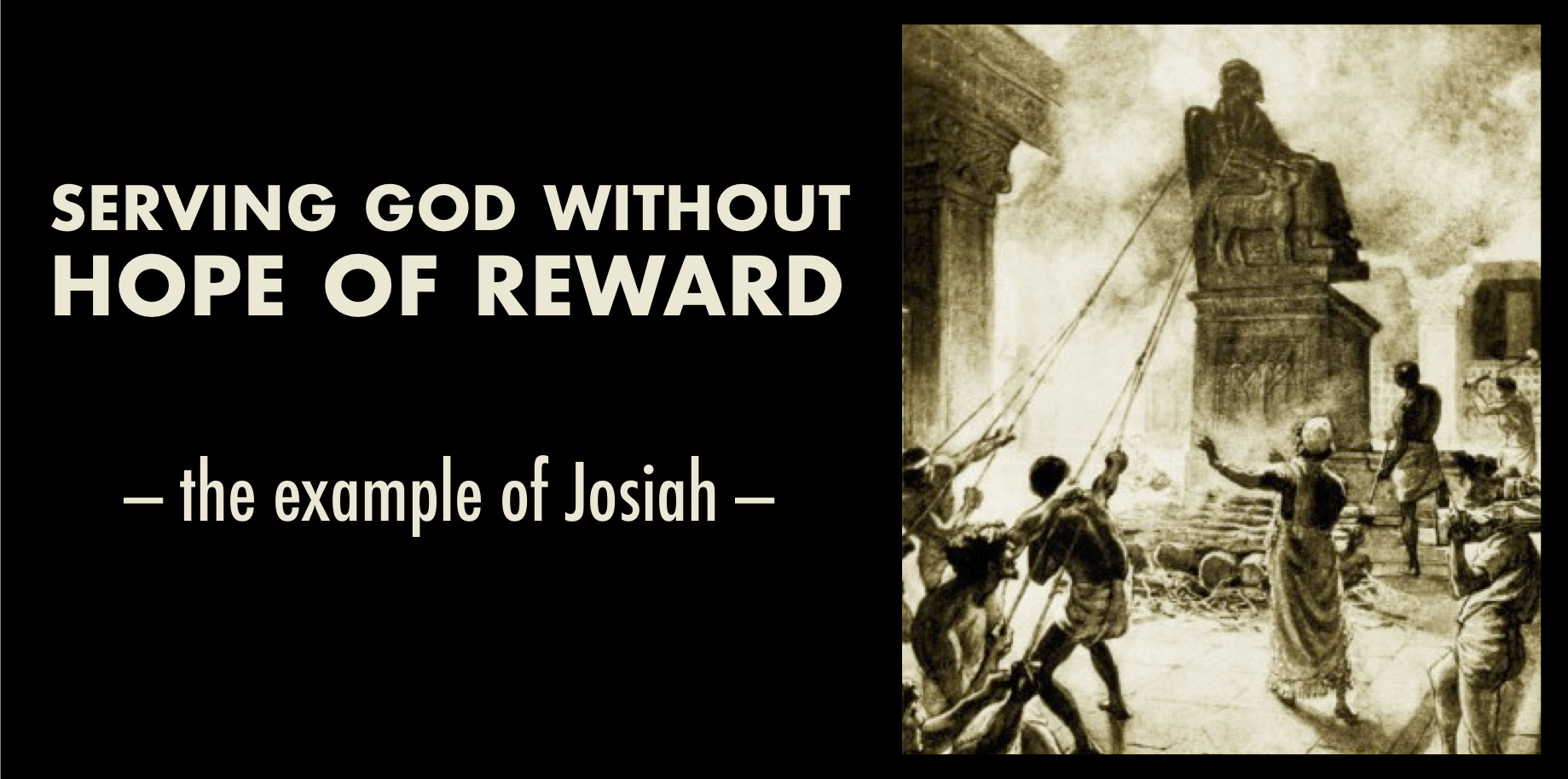
Serving God Without Hope of Reward: The Example of Josiah

A while back, I wrote a research paper on King Josiah, and ever since then he has been one of my favorite biblical characters.

Josiah came to power in the Southern Kingdom of Judah around 640 BC. This is a long time after the time of David and Solomon: the kingdom had been divided for almost 300 years, the Northern Kingdom of Israel has already been conquered by Assyria, and the Southern kingdom isn’t too far behind—a long series of mostly unfaithful kings (including Josiah’s father, Amon) have led Judah away from God, and before long, Babylon will begin to conquer them.

This is the situation when Josiah comes to power at the age of 8. Even though he’s young, and even though he had a wicked father, the Bible tells us in 2 Kings 2.22 that Josiah was a good and faithful king:

“He did right in the sight of the LORD and walked in all the way of his father David, nor did he turn aside to the right or to the left.”

According to 2 Kings 22, in the 18th year of his reign, Josiah begins a project to repair and restore the Temple, and during the construction project, the book of the law is found. Scholars and commentators disagree on exactly what this means, but basically, the Law of Moses has been found—either the entire Torah (the books of Genesis through Deuteronomy), or at the very least, the Book of Deuteronomy on its own. Either way, what this means is that the Law of Moses—the record of the covenant that God made with His people and the laws He gave them to follow—has been found and is read to King Josiah for the first time. It shows just how bad things had gotten under Josiah’s wicked father that Josiah apparently hadn’t been exposed to the Torah before now!

A covenant is an agreement or a promise made between two parties. To put it simply, in God’s covenant with the Israelites, God promised to be their God and protect them, and in return, the people were to be faithful and obedient to His commands. When Josiah hears the words of the Law, he tears his clothes because he realizes just how unfaithful Judah has been—they haven’t followed the commands of the Law of Moses, and they’ve worshipped gods other than Yahweh. In short, they haven’t kept up their part of the bargain.

So Josiah sends to Huldah the prophetess to inquire of the LORD—what does God say about the situation? Huldah responds in 2 Kings 22.15-20, but it isn’t good news:

“‘Thus says the LORD, the God of Israel: ‘Tell the man who sent you to me, Thus says the LORD, Behold, I will bring disaster upon this place and upon its inhabitants, all the words of the book that the king of Judah has read. Because they have forsaken me and have made offerings to other gods, that they might provoke me to anger with all the work of their hands, therefore my wrath will be kindled against this place, and it will not be quenched.

But to the king of Judah, who sent you to inquire of the LORD, thus shall you say to him, Thus says the LORD, the God of Israel: Regarding the words that you have heard, because your heart was penitent, and you humbled yourself before the LORD, when you heard how I spoke against this place and against its inhabitants, that they should become a desolation and a curse, and you have torn your clothes and wept before me, I also have heard you, declares the LORD.

Therefore, behold, I will gather you to your fathers, and you shall be gathered to your grave in peace, and your eyes shall not see all the disaster that I will bring upon this place.’’

And they brought back word to the king.”

So basically, God says that for all their wickedness, the people of Judah will be punished, but because Josiah humbled himself before God, he won’t have to witness the destruction of his country and will die before it happens.

Put yourself in the place of Josiah: what do you do next? No matter what you do, it’s too late for Judah and they’re going to be punished for their past sins after you die. It seems like whatever you do doesn’t matter, because the same negative consequence will happen either way. This is Josiah’s situation; what will he do next?

And this is why Josiah is one of my favorite Bible characters, and why he is such a good example for us: even when he knows that there’s no reward coming his way, he still does the right thing because of his devotion to God.

In 2 Kings 23, Josiah goes out and reads the Book of the Law in front of all the people and along with them, reestablishes the covenant with God. Then, he sets about in a systematic way to make things right. He goes throughout Judah and even into the northern territory of Israel and does away with unauthorized worship practices, destroying idols and pagan altars and getting rid of idolatrous priests. He removes the mediums and spiritists from the land as well, and also re-institutes the Passover feast:

“For no such Passover had been kept since the days of the judges who judged Israel, or during all the days of the kings of Israel or of the kings of Judah. But in the eighteenth year of King Josiah this Passover was kept to the LORD in Jerusalem.”

Josiah does all of this despite the knowledge that Judah is going to be punished no matter what, and sure enough, after Josiah is killed in a battle against Egypt, Judah is quickly overthrown.


Josiah’s life underscores how important it is to serve God because we love Him, not because we’re hoping to get something for doing so. I think a lot of times people get the idea that as Christians, we spend our lives doing good things for God and that He then pays us back by granting us eternal life.

To be clear, the Bible does speak of eternal life as a reward and the hope of living eternally in God’s presence should help to motivate us to keep going, especially when times get rough. But if the only reason you’re serving God is so He’ll pay you back with eternal life, then you really have the wrong perspective on things. Serving God will seem like a chore and, before long, you’ll fool yourself into thinking that God owes you something, when nothing could be further from the truth.
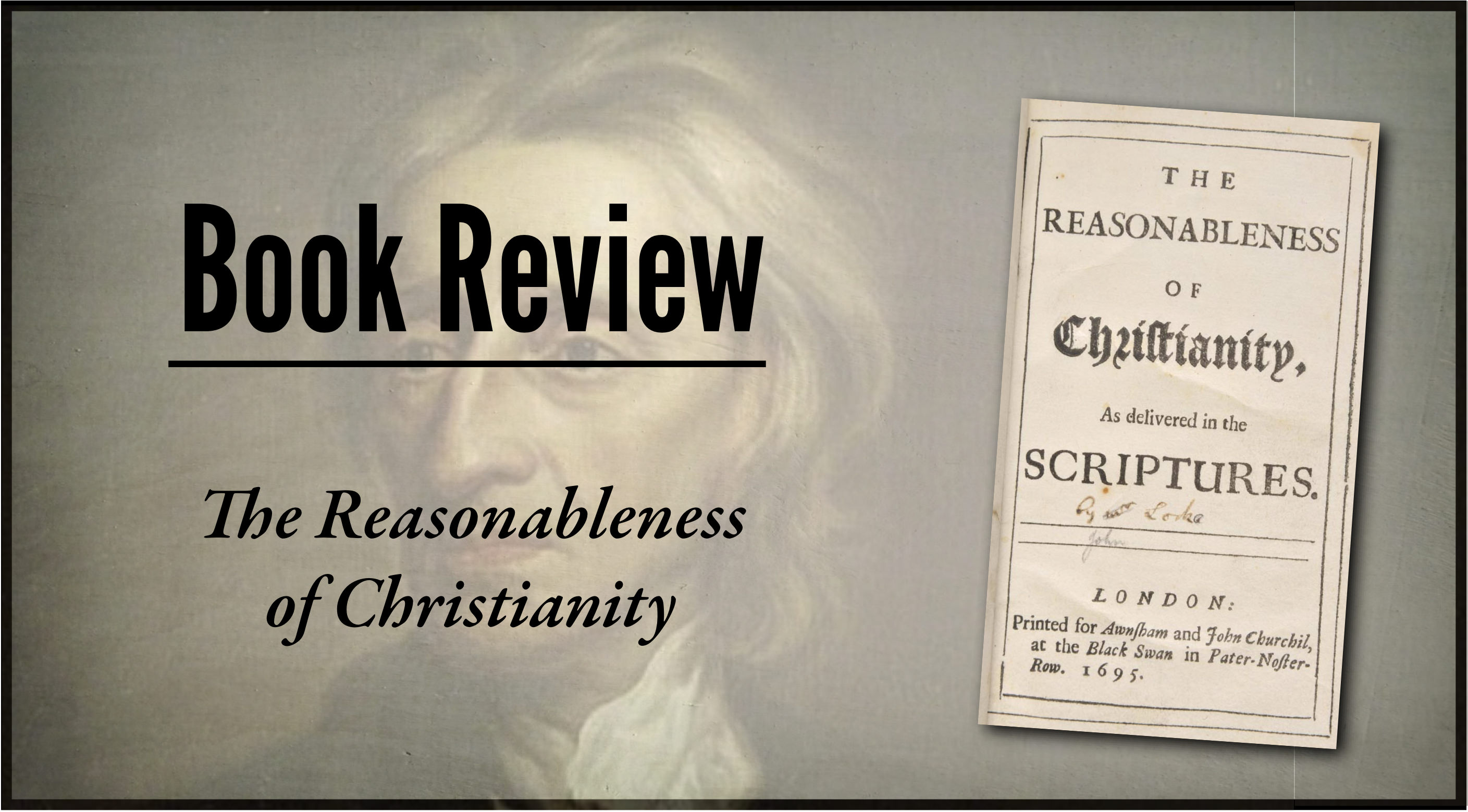
Book Review: The Reasonableness of Christianity

This semester I am in a church history class for grad school and as part of my reading for that class I recently finished John Locke’s The Reasonableness of Christianity. Locke is well-known to many people as a key thinker in the Enlightenment and specifically in the school of thought known as empiricism. His thoughts were very influential to the founding fathers of the United States, and he was also a great influence on Alexander Campbell, one of the leading early figures of the Stone-Campbell Restoration Movement.

In The Reasonableness of Christianity, Locke basically sets forth the Christian faith as he sees it. Scripture teaches that Adam sinned in the Garden of Eden and, as a result, lost bliss and immortality. Humanity inherits Adam’s immortality, although we are punished only for our own misdeeds. Unfortunately, all sin and fall short of God’s glory and thus, are in need of a Savior. Jesus Christ is this Savior, the Messiah of whom the prophets spoke.

God judges us according to the law of faith, and considers believers to be righteous, granting them life and immortality. Specifically, the faith that is necessary for justification is the belief that Jesus is the Messiah, and obedience to the moral and ethical standards that he set forth. Beyond this, Locke is open to differences of opinion on a variety of doctrines, and emphasizes the importance of tolerance in view of the fact that we have limited abilities and make mistakes about what we believe.

Here are some quotations that I particularly enjoyed and would like to share, along with some of my own thoughts:

“Nay, if God afford them a temporary, mortal life, ’tis his gift they owe to his bounty, they could not claim it as their right, nor does he injure them when he takes it from them.” (27)

We frequently pay lip service to the notion of our lives being a gift from God, but do we really believe that? I wonder, sometimes, when you hear the language we use when someone dies prematurely—it seems so unjust and tragic to us. I think Locke’s perspective is a better one: each day that we live is a gift from God, and from that perspective, however long we live is more than we have any right to expect or deserve.

“For if they believed him to be the Messiah, their King, but would not obey his laws, and would not have him reign over them, they were but the greater rebels…” (46)

This seems to me to be particularly relevant to the legions of nominal Christians that exist in our society who profess Jesus as Lord with their lips but deny Him with their lives. Those who reject Jesus live in rebellion to Him, but this is only to be expected. How much greater is the rebellion from those who claim Him as Lord but ignore His demands on their lives?

“‘Tis too hard a task for unassisted reason, to establish morality, in all its parts, upon its true foundations, with a clear and convincing light.” (60)

“…But yet some parts of that truth lie too deep for our natural powers easily to reach, and make plain and visible to mankind, without some light from above to direct them.” (65)

I expected Locke to hold human reason up as the ultimate source of knowledge and truth, but as the quotations above clearly show, he doesn’t do this. Rather, he is candid about the limitations of human reason, and ultimately holds that something greater that reason—revelation—is required for the establishment of universal moral truth.

Perhaps I approached The Reasonableness of Christianity with caricatures of Deism in my mind, but I was pleasantly surprised and impressed by what I read. There are certainly points I would quibble with, but on the whole, I thought Locke gave a succinct and fairly orthodox summation of the Christian faith. He does place significant value on reason, but this was actually less than I expected, and did not seem excessive to me. Locke does not dismiss Jesus’ miracles, but instead holds them to be essential (and reasonable) evidence that Jesus is exactly who He claims to be—the Messiah. Locke also asserts that Jesus’ ethical teachings are reasonable, but even these teachings ultimately required revelation. Left to its own reason, humanity had never been able to produce a universal moral law on its own.

Finally, although it was not the focus of this writing, I appreciated Locke’s emphasis on tolerance and the allowance for some diversity of opinion while at the same time upholding key fundamental doctrines about which all Christians must be in agreement. For Locke, the essentials are faith in Jesus as the Messiah and living a good moral life in accordance with His teachings.

In the context of the bitterly divided religious world in which Locke lived (and in which we still live today), such a call for tolerance seems like a hopeful basis for unity in God’s church. Of course, the difficulty always comes in determining which doctrines are fundamental and which are matters of opinion.

Gifts & Contentment: A Thanksgiving Message from Ecclesiastes

This is an adapted version of a sermon a preached this past Sunday. Happy Thanksgiving!

Thanksgiving is one of my favorite holidays of the year. I enjoy spending time with family, and I enjoy the good food that you get to eat at Thanksgiving. I’m also a big fan of Christmas, and to me, Thanksgiving always kicks off the Christmas season, so I like that about it too.

But most of all, as a Christian and a minister, I really appreciate that we have this time built into our yearly rhythm where we are encouraged to stop, reflect, and give thanks for what we have. That is an incredibly biblical thing to do. Thanksgiving is the basic response that God’s people should have in light of what God has done, and although this may be something that we lose sight of at times, this holiday, anchored on our calendars, helps remind us of this action which is central to our lives as followers of Jesus.

This particular Thanksgiving meditation comes from a somewhat unusual source: the Book of Ecclesiastes. I say “somewhat unusual” because the Book of Ecclesiastes is not something we focus on too much. Many people have a quotation from Ecclesiastes that they like, but they don’t really study the book in detail. A big part of this, I think, is that a lot of people think that the Book of Ecclesiastes is really depressing! Many people (including biblical scholars) suggest that Ecclesiastes has a very pessimistic view on life.

I disagree with that, though; I don’t think Ecclesiastes is pessimistic, I just think that it is very realistic. My wife would laugh to hear me say this, because all the time she tells me that I am a pessimist, and I disagree and say that I am a realist. I am just very aware that the world is broken, that people are deeply flawed, that we tend to get let down a lot, and that there is a lot of disappointment in life. I don’t always walk around with a scowl on my face or imagine the worst possible outcome of every situation, but I acknowledge that there are a lot of things that happen in life that are out of our control, that we don’t understand, and that we wish didn’t happen. And I think that is exactly how the author of Ecclesiastes looks at the world. I love Ecclesiastes.

And in this very realistic book, I think we are given a great perspective on Thanksgiving.

Real Talk About Money

I want to look specifically at the last half of Ecclesiastes 5, but to give a little bit of context, Ecclesiastes starts off with the author (who calls himself the Teacher or Preacher depending on your translation) saying that life is vanity, like chasing after the wind. And what he means by this is not that life has no meaning, but that life is brief and it’s hard to grasp, both literally and metaphorically—we don’t get to determine how long our lives are, and there are things about life that we simply can’t understand. It’s like trying to catch the wind or smoke.

And then the Teacher talks about all of these things in life that he sought after to find meaning, and he says that none of it lasts. We could say more, but that’s sufficient to give us an idea of what is going on in Ecclesiastes. Picking up in Ecclesiastes 5.10-17:

He who loves money will not be satisfied with money, nor he who loves wealth with his income; this also is vanity. When goods increase, they increase who eat them, and what advantage has their owner but to see them with his eyes? Sweet is the sleep of a laborer, whether he eats little or much, but the full stomach of the rich will not let him sleep.

There is a grievous evil that I have seen under the sun: riches were kept by their owner to his hurt, and those riches were lost in a bad venture. And he is father of a son, but he has nothing in his hand. As he came from his mother’s womb he shall go again, naked as he came, and shall take nothing for his toil that he may carry away in his hand. This also is a grievous evil: just as he came, so shall he go, and what gain is there to him who toils for the wind? Moreover, all his days he eats in darkness in much vexation and sickness and anger.

The Teacher begins by talking about money, and he has some important things to say about it. The harshest feedback I ever got from a sermon came once when I preached about money, but here’s the deal: the Bible talks about money all the time! The Law of Moses discusses it in detail, it is addressed repeatedly in wisdom literature (like Ecclesiastes), the prophets deal with the (mis)use of money, Jesus talks about it frequently, etc. If we want to be biblical, we will talk about money a lot—not because we worship it, but because we want to make sure that we don’t!

From earlier chapters in Ecclesiastes, we know that the Teacher was incredibly wealthy. He knew all about what money could buy, and he said it was vanity—vapor, smoke. It doesn’t last, and therefore doesn’t provide real significance. Here he goes on to list some of the problems that can come with money: addiction (v.10), it attracts the greedy (v.11), it promotes worry and lack of sleep (v.12), it leads to hoarding (v.13), it can easily be lost (v.14), and it cannot follow us after death (vv.15-17).[1]

Here I am, thinking that things would be a lot better if I just made a little bit more, but the Teacher doesn’t seem to agree. What a downer!

I should be clear here that money is not inherently a bad thing, but Scripture has a lot to say about wealth that should make us very careful in how we view it. Money can very easily become bad for us. It can compete with God for our devotion, twist our hearts, and destroy our lives.

To combat that, we should consider our money and indeed, all of our material possessions, as being a loan from God. All that we have belongs to God, but He gives us our possessions so that we can use them for His glory. Therefore, we should take care of our money and be good stewards of it, but we should always remember that it isn’t really ours. This perspective will help us to not get too attached to our money, and also to look for ways we can use it which will glorify God.

Everything Is A Gift

If this sounds pessimistic (first, it’s not; it’s realistic!), keep reading in Ecclesiastes 5.18-20:

Behold, what I have seen to be good and fitting is to eat and drink and find enjoyment in all the toil with which one toils under the sun the few days of his life that God has given him, for this is his lot. Everyone also to whom God has given wealth and possessions and power to enjoy them, and to accept his lot and rejoice in his toil—this is the gift of God. For he will not much remember the days of his life because God keeps him occupied with joy in his heart.

Ecclesiastes 5 ends with a summary statement emphasizing the importance of enjoying the blessings that God has given us (cf. Ecclesiastes 2.24-26).

Work is a good thing; we were created to be workers. When God created Adam, He placed him in the garden and told him to tend and cultivate it. From the beginning, we were intended to be workers. Think about those who are disabled and cannot work, or those who need jobs to provide for their families but can’t find them; those are unfortunate situations. If you are able to work and have a job, that is a blessing. If you enjoy your work and enjoy the people you work with, that is an even greater blessing.

In Ecclesiastes, the Teacher doesn’t understand everything about life (and if you go through the book, he is very clear about the parts of life that don’t make sense to him), but he does know that work, food, and family are blessings—gifts—from the Lord and should be enjoyed as such.[2] It is incredibly important that we view these things as gifts rather than achievements; if we do so, it completely changes our perspective.

Gifts are not something that we deserve. They are something that we receive because of the gracious nature of the giver. When you think about things in terms of gifts, it really changes your perspective. And here’s the secret, according to the Teacher of Ecclesiastes: everything is a gift! Life—as confusing as it is, as filled with heartache as it can be—is a gift. Work is a gift. Our food, our families…all of it: gift. If we look at the things that we have as gifts, it changes everything.

These are blessings God bestows on us to enjoy, not objectives for us to obsessively strive after. There is a lot of joy to be found in living a simple life that is satisfied with meaningful work, sufficient food, and edifying relationships.[3]

Content No Matter What?

This is all tied very closely to the idea of contentment, and if you’ll allow me, I want to jump to the New Testament for a minute to say a few words about that idea.

Paul’s letter to the Philippians is a favorite for a lot of people; it is one of his more positive letters, despite the fact that he wrote it from prison. He begins it by sharing his thankfulness for the Christians at Philippi. As Paul contemplates the possibility of his impending execution, He speaks of his great concern for spreading the Gospel and how Christ is at the very center of his work and identity regardless of what happens to him. He talks about the humility of Jesus and how He serves as an example to us, how as followers of Christ we are to be lights in the world and seek the standard of Jesus.

And then as Paul is closing the letter and encouraging the Philippian Christians, he says this in 4.10-13:

I rejoiced in the Lord greatly that now at length you have revived your concern for me. You were indeed concerned for me, but you had no opportunity. Not that I am speaking of being in need, for I have learned in whatever situation I am to be content. I know how to be brought low, and I know how to abound. In any and every circumstance, I have learned the secret of facing plenty and hunger, abundance and need. I can do all things through Him who strengthens me.

I think contentment is less about what you have and more about your attitude of thankfulness toward what you have. Paul says that he has learned to be content in whatever circumstance he finds himself. That confirms to me that contentment is an internal quality rather than an external one; it does not depend on what is going on around us. Paul had a lot of difficulty in his life (he was beaten, imprisoned, scourged, left for dead, shipwrecked, etc.), but he was able to find contentment regardless.

This also helps us better understand what Paul means in his famous “I can do all things through Christ who gives me strength” quote. This verse gets taken out of context and abused a lot, but Paul isn’t talking here about passing an algebra test or getting a job promotion or winning a basketball game. Instead, what he means is that Jesus Christ empowers him to find contentment in all situations.

And to me (and to tie this back to Ecclesiastes), one of the simplest and most powerful ways of finding contentment in all situations is to remember that our blessings are a gift from God.

Our world is filled with people who are chasing after the standards and achievements of the world in some obsessive quest for significance. As Christians, though, we are not to live lives of hopeless desperation; we find our significance and our meaning in the God who gives us all things. Our identity and purpose is not based on achievement; it is based on gift from our Creator.

And that is a cause for great Thanksgiving.


[1]See Chad Landman, Wisdom for Life: 6 Weeks in Ecclesiastes (Hashtag Media, 2013), 18.

[2]Phillip McMillion, Wisdom Literature Class Lecture Notes (Memphis: Harding University Graduate School of Religion, Fall 2010).

[3]William P. Brown, Character In Crisis: A Fresh Approach to the Wisdom Literature of the Old Testament (Grand Rapids, MI: Eerdmans, 1996), 136.

Asleep In The Storm

There are a couple of different instances recorded in the gospels where Jesus and His disciples are caught up in a storm while on the Sea of Galilee. Both of these are fascinating stories, and they have a way of captivating the imagination.

Matthew 14 recounts the story of Jesus walking on the water and Peter’s stumbling efforts to walk towards Him. He succeeds for a moment, but then, overwhelmed by the waves and the wind around him, takes his eyes off of Jesus and begins to sink. Jesus rescues him, rebukes his faith, gets into the boat, and the storm ceases. It is a fascinating event from the life of Jesus, and one from which we can undoubtedly learn much, but it is actually the other “storm” story I want to focus on.

This one drawn from Luke 8/Matthew 8/Mark 4 is likely familiar to you as well. Jesus and His disciples are out on the sea when a storm arises. The disciples are alarmed, and seemingly with good reason—the waves were breaking into the boat so that it was filling (Mark 4.37), swamped (Matthew 8.24), and they were in danger (Luke 8.23).

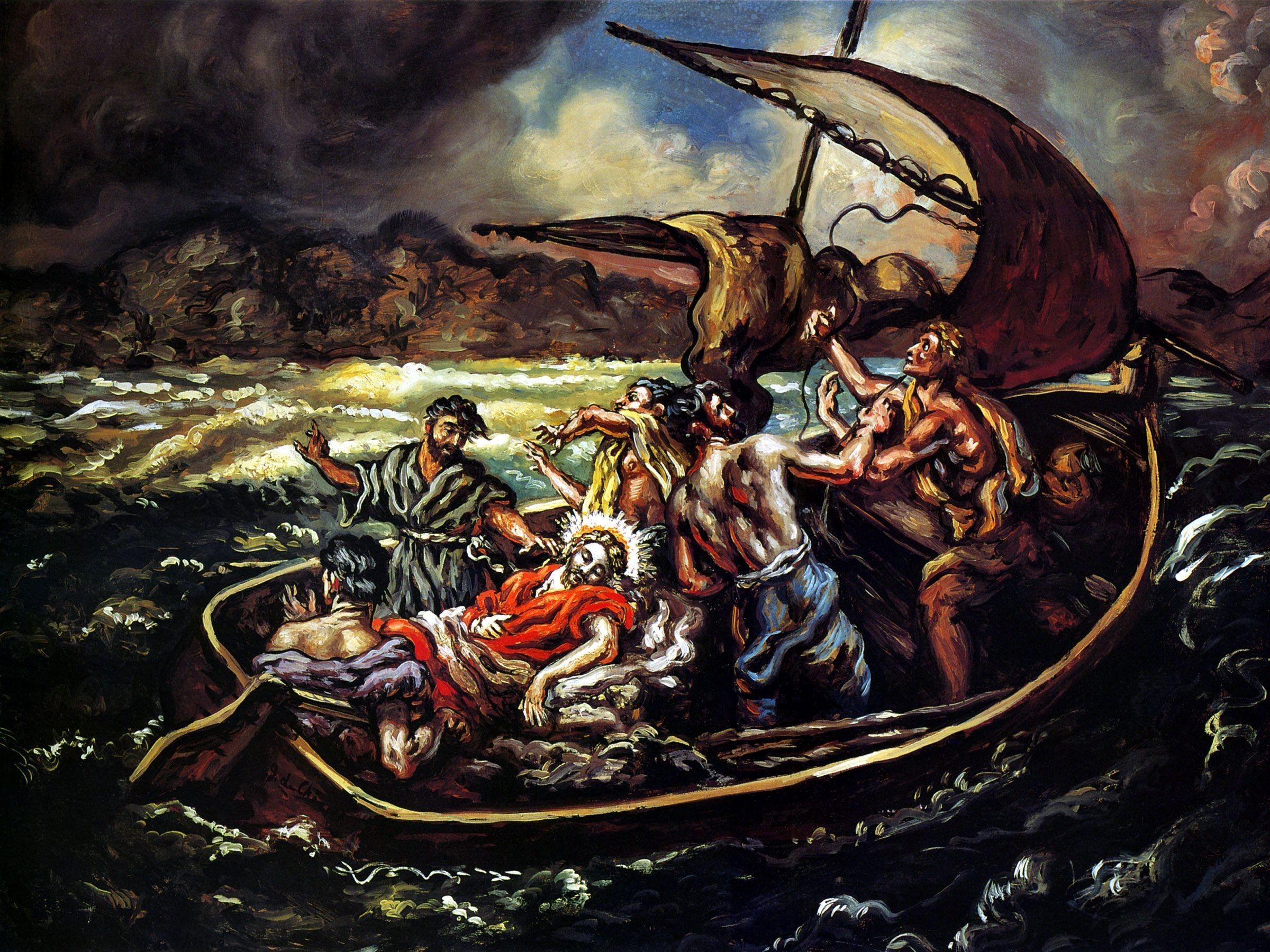
But Jesus was unconcerned, even unaware (or so it seemed) of their plight—He was asleep on a cushion in the boat. Asleep in the storm.

In such circumstances, the apostles do what seems sensible to them in the moment. They awaken Jesus, and in the face of His seeming lack of concern, ask, “Do you not care that we are perishing?”

In light of the life, teachings, service, and, ultimately, the sacrifice of Jesus, it seems like a ludicrous question, but imprisoned in the circumstances of the moment, it seemed like a fair question to the disciples. Jesus was asleep; He didn’t seem to care. He seemed absent from their suffering. Of course, we know the truth: He was there all along.

•  •  •

If I am honest, I can identify with the apostles here more than I might like to admit. As I have written recently, this has been a tough year for my daughter. She has experienced seizures for most of her life, but this year they have gotten worse, and we have struggled to control them. What’s worse, the frequency of the seizures and/or the many medications she is on to try to control them has led to a lessening of her energy, a muting of her (delightful) personality, and even some regressions in the abilities she has worked so hard to develop over the last few years.

Some days are better, with fewer seizures, more energy, and more personality, but other days are really hard. The emotional roller coaster is exhausting. This has been our situation for several months, despite the constant prayers of Caroline and myself and the faithful intercession on her behalf from countless friends and family (both physical and spiritual). You could say that we are experiencing our own “storm” right now, and have been for a while.

At times, it feels like we are drowning with grief, about to capsize, and the question the apostles asked Jesus seems like an appropriate one: “Lord, do you not care that we are perishing?” It can seem that God is absent.

The other day, I read through Luke’s version of the story recorded above, and it struck me in a way I had never thought of before (which, by the way, is one of the remarkable things about Scripture—as you read it and reread it, new insights constantly avail themselves to us; it is a transformative book!). So often in life, when we are living through a storm, we ask God to take it away from us, and when He doesn’t, we are left to wonder whether He cares about us at all.

But I think Luke 8 offers us a different perspective—in the midst of the storm, Jesus is neither distant, nor uncaring. He is right there with us, in the boat, riding out the storm. His seeming absence obscures His glorious presence. And while He certainly has the power to take the storm away (and we earnestly pray that He does so!), He asks us for faith, faith that His presence will protect us from being overwhelmed by the storms of life.

“Christ and the Storm,” by Giorgio de Chirico (1914)

Journey of Faith

You’ve likely heard the common saying, “Life is not about the destination; it’s about the journey,” or some variation thereof. It may be somewhat cliche, and to an extent, I think it sets up an unnecessary either/or situation. From a Christian perspective, I life is very much about a journey and a destination. Scripture speaks of life as a sojourn (see especially Hebrews 11, 13), but it’s a journey headed to a specific destination. As Christians, we yearn for an eternal home with our Creator, where crying, mourning, and pain are no longer a part of our existence. And yet, Scripture is very clear that whether or not we reach that destination is directly tied to the way in which we travel our earthly lives.

I appreciate the journey metaphor as I look back on my own life as a believer. I am still relatively young, but what a journey it has been! It has been characterized by exhilarating peaks and depressing valleys. Seemingly, there have been few straight stretches where I could confidently see what was coming next, and a lot of twists and turns where the future was impossible to predict.

Interestingly, I also can see how my faith itself has changed over the years. That shouldn’t be surprising—as a Christian I believe (and as a minister, I teach!) that God’s Spirit indwells His people and works to sanctify them, and, furthermore, that Scripture is something we study not just for information, but for transformation: God’s word is living and active, after all (Hebrews 4.12). That is not to say that I have reached a point of exceptional maturity in my faith, or that I have everything figured out. I certainly don’t, and remember, the point of this post is to emphasize the journey aspect of faith, so I in no way want to give the impression that I have somehow arrived. I haven’t.

And yet, in hindsight, I can see how far I have traveled. I can remember (with significant chagrin) the degree to which, as a college freshman, I felt that I had things pretty well figured out. I can remember having long discussions deep into the night with my roommate (who also happened to be my brother-cousin, a made-up category which best describes our relationship) where I would dogmatically assert all kinds of things. In one particularly cringeworthy conversation, I confidently declared that someone who committed suicided was automatically lost—an assertion I made with the vast knowledge and experience of an 18 year-old and with no biblical authority whatsoever! My roommate gently pushed back against my declaration, but at the time, I did not have “ears to hear.”

As I have aged and hopefully become wiser and grown deeper in my faith (see above), I have changed my mind  on some things and I have found that there are fewer religious doctrines that are deeply important to me, but that the ones that are have become more important than ever. Or, put in other words, not everything is worth fighting for, but some things are worth dying for.

In terms of my own faith journey, I do not know what the future holds. Based on the past, I bet there will be thrilling highs, crushing lows, and unexpected turns along the way. I expect that there will be changing perspectives, reconsidered positions, and core truths that do not change, but are gradually driven deeper and deeper. I pray that there will be increasing wisdom and spiritual maturity, and I hope—in the biblical sense of the word as confident expectation—that my journey of faith will lead to the destination which Christians have been seeking for thousands of years.

« Older posts Newer posts »

© 2026 The Doc File

Theme by Anders Noren — Up ↑