The online journal of Luke Dockery

Category: Christianity (Page 57 of 64)

God Is The One Upon Whom We Should Rely: Lipscomb On Human Government

David Lipscomb was a very influential leader within Churches of Christ in the late 19th and early 20th centuries. Lipscomb served as a minister, an educator (a co-founder of the Nashville Bible School, which exists today as Lipscomb University), and an editor of the very influential Gospel Advocate.

Lipscomb was also a pacifist, and in some sense, a Christian anarchist: he believed that Christians had no business interacting with government, including voting in elections or serving on juries. My own views on government are not as extreme as Lipscomb’s, but I do think his thoughts serve as a helpful corrective to what I see from a lot of people.

It has been distressing to me during this election cycle to see so many Christians who (based on their comments on Facebook or Twitter) seem to be placing so much of their hope for the betterment of our world in political candidates (regardless of which party they happen to support). To these folks, Lipscomb offers some helpful words:

“Everyone who honors and serves the human government and relies upon it, for good, more than he does upon the Divine government, worships and serves the creature more than he does the Creator.”

On Civil Government, 50

With all due respect to Lipscomb, I believe that it is appropriate for Christians to vote and that, ideally, Christians should use their vote to reinforce the values of the Kingdom. And sometimes it can be easy to get pretty wrapped up in the political process because those values can mean a lot to us.

But I think he is right on the money about this: let us never think that the president we elect or the government we put into place is the ultimate source to which we should look for guidance, protection, or good. Those things come from God, and He still sits firmly on His throne, in control of all the things we debate and worry about.

Stronger Brother, Weaker Brother: It’s Tough Either Way

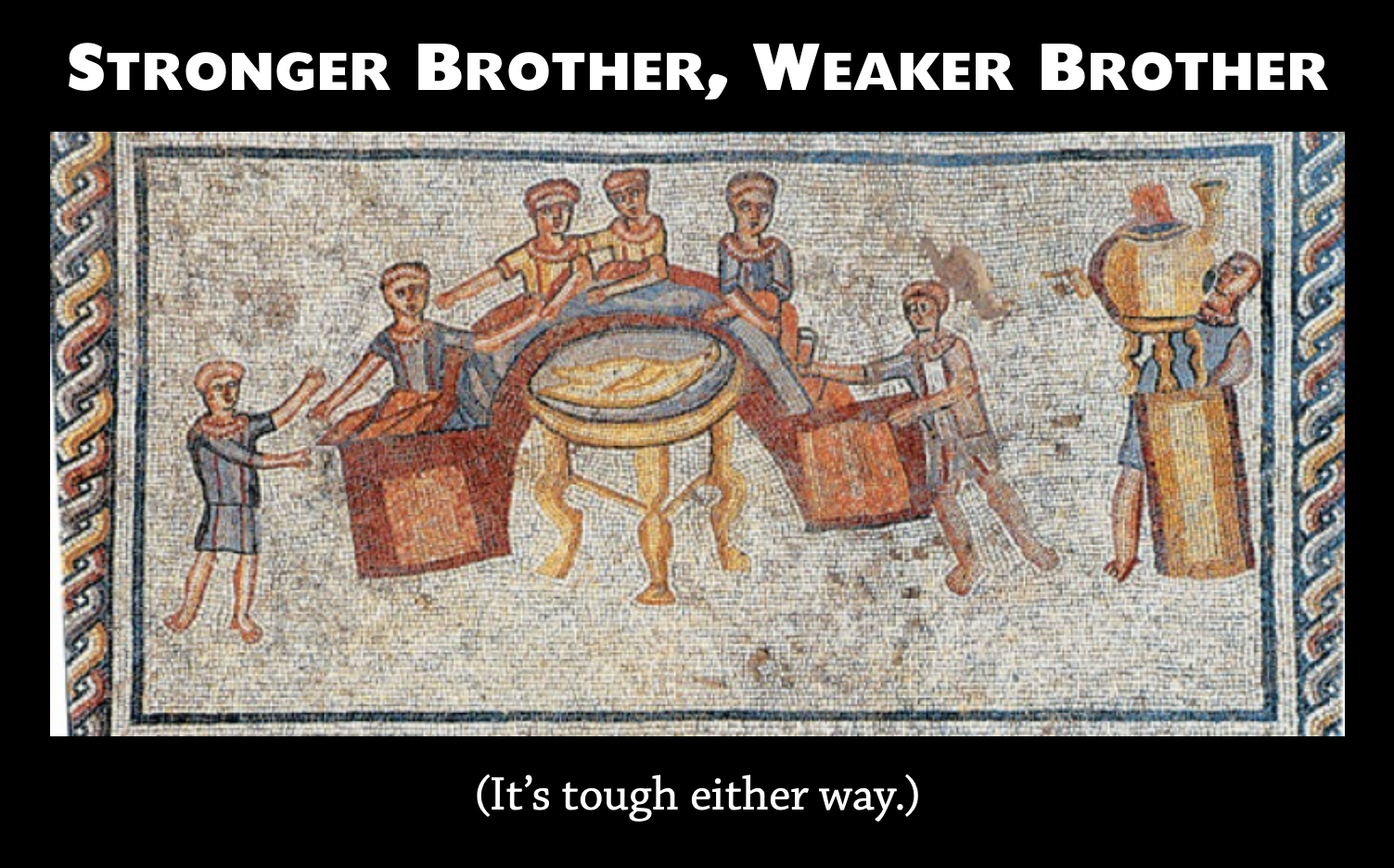
There are a few places in the New Testament where  Paul addresses the idea of the stronger brother and the weaker brother, usually in the context of the issue of eating meat that had formerly been sacrificed to idols (Romans 14; 1 Corinthians 8.4-13; 1 Corinthians 10.25-32).

It’s a fairly complex issue, but basically, Paul says that since idols are nothing (because they represent gods which don’t actually exist), eating food that had previously been offered to them is no big deal. Stronger, more mature Christians would be able to realize this, and would see that eating such meat would not be inherently wrong.

However, weaker, newer Christians, especially those who had been recently converted from a pagan background, could struggle with the idea of eating meat that had been sacrificed to an idol, and could feel like they were compromising their faith by doing so. For these Christians, it would be wrong for them to eat because doing so would violate their conscience.

Paul’s real focus in these passages is less on giving specific instructions on which activities should be partaken in and which should be abstained from, and more about teaching the stronger and weaker brothers how to interact with one another. Basically, they should treat one another with love: the stronger brother should be willing to give up meat forever in order to avoid leading his weaker brother to sin against his conscience, and the weaker brother shouldn’t try to bind his stronger brother’s actions by his own conscience.

In many ways, Paul’s thoughts are summed up in Romans 14.3:

“Let not the one who eats despise the one who abstains, and let not the one who abstains pass judgment on the one who eats, for God has welcomed him.”

Depending on the issue, I think I have been both the weaker and stronger brother at different times, and what Paul commands in Romans 14.3 is challenging to both groups.

The stronger brother is not to despise the weaker. I’ve seen this happen a lot, and it can be tempting to do. We grow frustrated at the qualms of our weaker brethren and so it gets easy to ridicule them as hopelessly backward and just write them off completely. Maybe make jokes about their limited understanding and speak with condescension to and about them.

The weaker brother is not to pass judgment on the stronger. This is tempting as well. Since our brothers are doing something that our own consciences won’t permit us to do, we are tempted to view them as less holy or less devoted to their faith than we are. Perhaps we even cease to think of them as faithful Christians.

As Paul points out in the verse above, both of these attitudes are wrong. Regardless of which side we find ourselves on, we have to be careful about how we treat each other: love and respect for our brethren should always be our primary response.

Legacy, Cap Anson, and Enoch

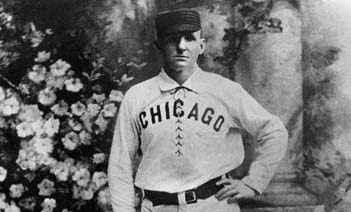
Cap Anson was Major League Baseball’s first superstar. Anson spent the majority of his career as a player/coach for the Chicago White Stockings, and was the first professional player to amass 3,000 hits.  Some of the many records he set during his career lasted for decades.

Anson was a fierce competitor, and his accomplishments in baseball were so important to him that he left instructions that his tombstone read, “Here lies a man who batted .300.”

I’m a huge baseball fan and I think it would be neat to play it at the same level as someone like Cap Anson, but to choose to sum up your entire life with a baseball statistic? Even I think that’s a little sad, and it reveals a perspective on life that is more than a little skewed.

If you could write your own epitaph, or choose just a few words to sum up your life, what words would you use? Perhaps a better question would be, if others were to sum up your life based on what they saw—how you spent your time and money, the things that seemed important to you—what words would they use?

  • Always looking for a promotion…
  • Had the largest house on the block…
  • Biggest gossip in town…
  • Obsessed with cars…
  • Lived vicariously through his children…

Closely related to all of this is the idea of legacy. In legal terms, a legacy is a gift of property or money, usually by means of a will. In a more general sense, your legacy is whatever you leave behind for those who come after you—in some ways it is a token or a synopsis of your life.

If we had the benefit of hearing the epitaphs that others would write for us, it might reveal how skewed our perspectives can be at times (not unlike Cap Anson’s), and let us see that the legacies we leave are often shallow and insignificant.

In Genesis 5, in the midst of a list of Adam’s descendants, we are introduced to a man named Enoch. Enoch lived for 365 years, but his life was summed up in just a few brief words:

“Enoch walked with God, and he was not, for God took him.”

“Walked with God.” That’s an epitaph that I could be happy with, and a legacy that I would be proud to have. But legacies like that don’t come about by accident; rather, they come from a stubborn, persistent lifestyle of discipleship. So all that leads to this question: What will your legacy be? Put in another way, if you were to pass from this life today, what would your tombstone say?

If you would like it to read differently, then it’s up to you to live differently.

“Liberal” and “Conservative” as Religious Labels

Liberal.

Conservative.

They are terms that you tend to hear frequently if you are in ministry, or studying theology, or spend much time at church.* Since all three of those descriptions fit me, I have definitely heard the terms a lot. I have also used them both, and I have even seen or heard myself described with both of them before. Despite their widespread use, I dislike them, and have come to believe that, without significant contextualization, they are basically meaningless. Let me explain.

What makes someone liberal? Well, there is a wide degree of difference between people who claim to be Christian, so it really depends which type of “Christian” you ask:

  • If you ask a Catholic, a liberal might be someone who advocates the use of birth control or believes that priests should have the right to marry.
  • If you ask an Amish person, a liberal might be someone who drives a car or fastens their clothes with zippers.
  • If you ask an evangelical Christian, a liberal might be someone who denies the divinity of Jesus Christ, or advocates that practicing homosexuals should be able to serve as priests or pastors.
  • If you ask a member of the mainline Churches of Christ, a liberal might be someone who believes that baptism is not a part of the process of salvation, or that instrumental music is acceptable in the worship of the church.
  • If you ask a member of the Non-Institutional Churches of Christ, a liberal might be someone who thinks it is permissible to eat in the church building, or that churches should provide assistance to the local poor.
  • In other sub-groups of the Churches of Christ, a liberal might be someone who advocates having a Bible class for children, or believes that the Holy Spirit personally indwells Christians, or thinks that it is okay to use more than one cup for the juice in the Lord’s Supper.

We could repeat the exercise with the term conservative, but hopefully, my point has become clear: if Person A, who denies the divinity of Christ, and Person B, who zips up his pants, and Person C, who thinks that a Bible class for children is a good idea, can all be described by the term “liberal,” then it’s not a particularly useful term.

How these terms are used depends almost entirely on our own perspective—where we are located on the conservative/liberal spectrum. In my own case, I am definitely conservative in the wide spectrum of Christianity, but would consider myself to be pretty middle-of-the-road within the context of Churches of Christ. Others (on both sides) would dispute where I placed myself though. In fact, based solely on the fact that I am a graduate of Harding University, some would label me as a “crazy liberal” while others would write me off as a “backward conservative.”

All that brings me to this—the labels only have meaning if you’re talking to someone who is in the exact same location on the conservative/liberal spectrum as you are.

Of course, there’s a reason why we like to have labels like this. They enable us to put people into categories and treat them accordingly. If we think of someone as a “crazy liberal” it is much easier to just write them off as unfaithful and never address any of the issues they bring up. And if we think of someone as a “backward conservative” we can condescendingly poke fun of their close-mindedness and never study any of their viewpoints or any of the cautions they raise.

What’s the alternative? Well, I guess we could look at people as individuals and get to know what their specific views are. We could try to learn why they think the way they do on a given issue, perhaps reexamine our own beliefs on that issue, and see to what extent both viewpoints are rooted in Scripture. And when we disagree with them, we could give the benefit of the doubt to people who claim to love God and want to do His will, rather than automatically question their motives or their intelligence.

But…that seems like a lot of work. Labels are definitely easier; maybe we should just stick with those.


*This blog post addresses the terms “conservative” and “liberal” in a religious sense, not a political one. The fact that the two terms are also used in the arena of politics and that they don’t always line up (people who are conservative religiously are not always conservative politically, and people who are liberal religiously are not always liberal politically) adds to my overall point.

Is God On Our Side?

“God is on our side.”

It’s a phrase you hear often (or something like it) in Christian books, music, and teaching. It’s a popular notion, and why wouldn’t it be? Of course we like the idea of having God on our side! But is it biblical?

The Book of Joshua recounts the efforts of the Israelites (God’s chosen, set-apart people) as they work to accomplish their (divinely-appointed) mission to conquer the land of Canaan (the land which God had promised to give to them). If there was ever a time of God being on “our” side, you’d expect to find it here.

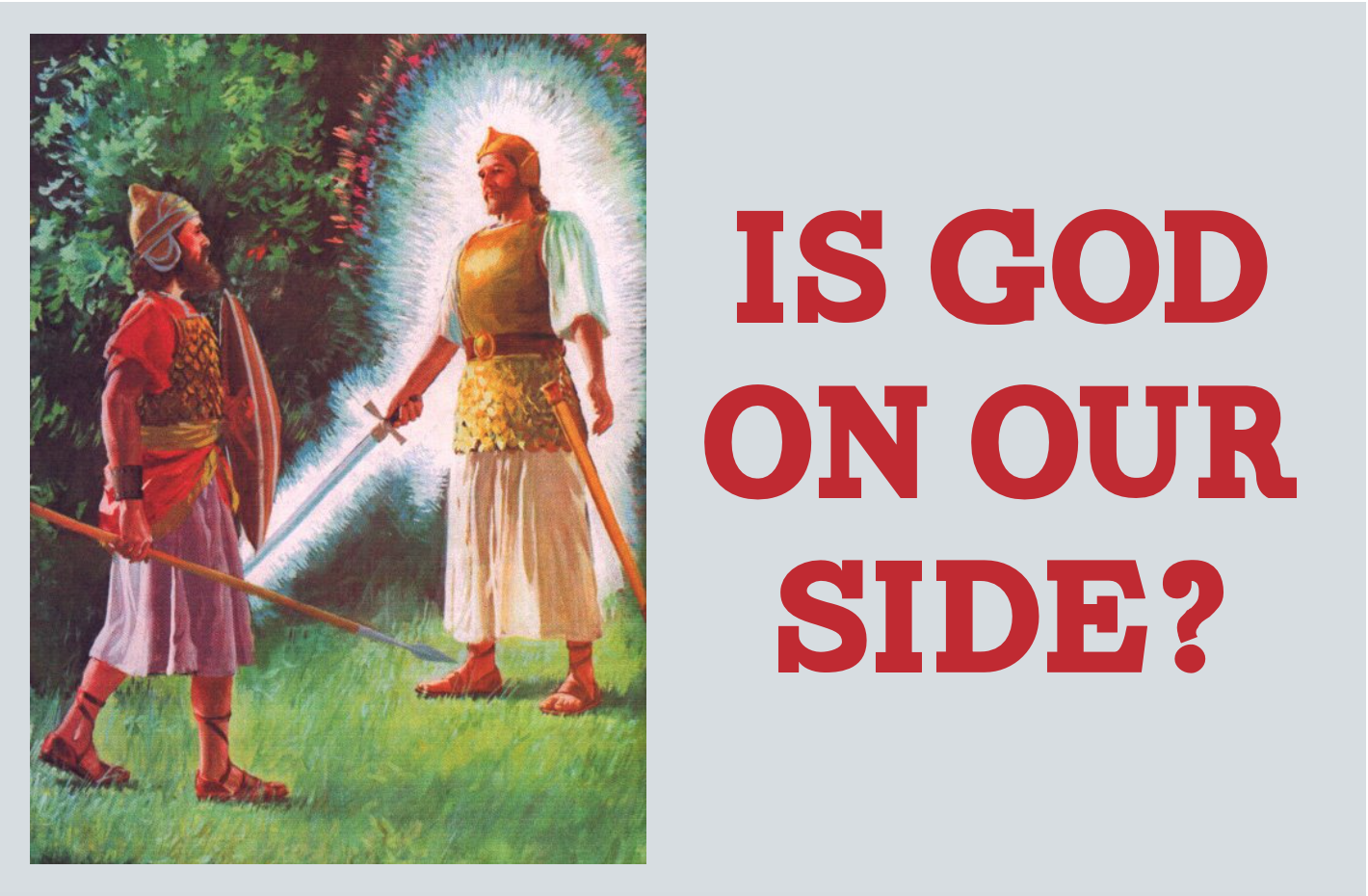
As Joshua is about to lead the people over the first big hurdle of the Conquest, the defeat of the city of Jericho, he has an interesting encounter (Joshua 5.13-15):

“When Joshua was by Jericho, he lifted up his eyes and looked, and behold, a man was standing before him with his drawn sword in his hand.
And Joshua went to him and said to him, ‘Are you for us, or for our adversaries?’ And he said, ‘No; but I am the commander of the army of the LORD. Now I have come.’
And Joshua fell on his face to the earth and worshiped and said to him, ‘What does my lord say to his servant?’ And the commander of the LORD’s army said to Joshua, ‘Take off your sandals from your feet, for the place where you are standing is holy.’ And Joshua did so.”

It’s interesting to me: Joshua asks the man if he is on the side of the Israelites, or on the side of Jericho, and in response, he says, “Neither; I’m on God’s side, not yours.”

Later on in Joshua 24, Joshua, advanced in age, addresses the people. He knows that he is near death, and is concerned about what the people will do after he is gone (Joshua 24.15-20):

“‘…Choose this day whom you will serve, whether the gods your fathers served in the region beyond the River, or the gods of the Amorites in whose land you dwell. But as for me and my house, we will serve the LORD.’
Then the people answered, ‘Far be it from us that we should forsake the LORD to serve other gods, for it is the LORD our God who brought us and our fathers up from the land of Egypt, out of the house of slavery, and who did those great signs in our sight and preserved us in all the way that we went, and among all the peoples through whom we passed. And the LORD drove out before us all the peoples, the Amorites who lived in the land. Therefore we also will served the LORD, for he is our God.’
But Joshua said to the people, ‘You are not able to serve the LORD, for he is a holy God. He is a jealous God; he will not forgive your transgressions or your sins. If you forsake the LORD and served foreign gods, then he will turn and do you harm and consume you, after having done you good.’”

In response to Joshua’s concern, the people basically say, “Don’t worry about it Joshua—we’ll serve the LORD. After all, He’s always been on our side.”

But Joshua isn’t convinced; he believes that the people won’t be faithful to God and that then they’ll find that He isn’t on their side at all—where He once provided for them and fought for them, He will now withhold blessings and actively fight against them.

And how well Joshua knows his people! Within a generation, they will fall away from following God and as a result, will experience a long period of turmoil and suffering as God allows their neighbors to conquer and oppress them (the Book of Judges, which recounts this time period, is one of the lowest points in all of Scripture!).

So, having said all that, back to the original question: is God on our side? I’d have to answer with a qualified “no.”

First, the qualifications:

I’m not doubting God’s love for us, His interest in our condition, or His saving work on our behalf. I’m not doubting that we can cast all our anxiety on Him, because He cares for us (1 Peter 5.7). I’m not doubting that God is “for us” in a Romans 8 sort of way, or that God doesn’t root for us to be successful (where success is defined in terms of faithfulness).

So what am I saying? Here’s my big point:

Jesus didn’t come to earth to live and die for us because God was on our side. He came so that we could be on God’s side. 

Maybe it sounds like I’m just arguing semantics, but really, I think there’s more to it than that. One perspective is centered on mankind, while the other is centered on God: if God is on our side, then all the focus is on us, instead of on God. But the focus should be on God, not us.

This helps to explain the Israelites in the Old Testament. When they were on God’s side and followed Him faithfully, He blessed them with prosperity and victory over their enemies. When they ceased to be on His side, the blessings ceased as well.

This also helps to put the Incarnation into proper perspective. The Incarnation wasn’t about Jesus becoming a man because humanity is the focus of everything; the Incarnation was about God becoming a man in order that men could become more like God, because God is the focus of everything!

So, with this God-centered perspective in mind, let’s ask the question one last time: is God on our side? According to Scripture, we don’t even have a side; we have to choose a side! The real question is, are we going to choose to be on God’s side, or will we side with the world?

« Older posts Newer posts »

© 2026 The Doc File

Theme by Anders Noren — Up ↑