The online journal of Luke Dockery

Category: Christianity (Page 63 of 64)

“An Eternal Oxymoron”

Here is a very good article on the ever-growing intersection between Christianity and pop culture.

I really liked the following excerpts:

“At this point in history, American evangelicals resemble the Israelites at various dangerous moments in the Old Testament: They are blending into the surrounding heathen culture, and having ever more trouble figuring out where it ends and they begin.

It’s always been a stretch to defend Christian pop culture as the path to eternal salvation. Now, they may have to face up to the fact that it’s more like an eternal oxymoron.”

The article is only a couple of pages long, and is well worth the time it takes to read. You’ll still have plenty of time to catch Dancing With The Stars.

True Peace

Wars with no end in sight are unpopular, and currently, the United States finds itself embroiled in such a war.

Because of this, it has become increasingly popular to trumpet the cause of peace, and among Christians (especially those of the blogging variety), I have observed the growing belief that all war is wrong and that it is, inherently and fundamentally, un-Christian.

I disagree with this viewpoint. Don’t get me wrong. I hate war. I think it is a terrible thing which should be avoided whenever possible, and should only be considered as a last resort, but I do believe that sometimes, war is the only option (World War II would be the classic support of this viewpoint).

Christians are called to be peacemakers, and it should always be our goal, in whatever circumstance we find ourselves, to reconcile rather than to incite.

But sometimes, I think the peace that Christ came to bring about is misunderstood.

My friend Robb Hadley wrote a very good article on peace the other day that I really appreciated, and he put it better than I could:

When Jesus was born, “Peace on earth” was proclaimed by angels (Luke 2.14). If you define peace as all people on earth holding hands with flowers in their hair singing, “I’d like to buy the world a Coke,” Jesus failed completely. If you understand that Jesus came to make peace with God and with each other available, then real peace is possible (Ephesians 2.15–16).

How would things be different if people would strive after the eternal peace of Christ as eagerly as they seek the uncertainty provided by man-made treaties?

The Eight Questions Meme, Sort Of

Several days ago, Edward “Hollywood” Carson tagged me to do this on his blog, so I decided I would comply, but with a couple of changes. I’m supposed to make up and then answer eight questions. Well, eight questions is a lot, and since I have to come up with them on my own, I’m going to limit it to 5.

1. What is something about you that embarrasses you, or at least that you wouldn’t want everyone on the World Wide Web to see?

I can’t swim. Not a bit. I don’t really have an excuse, I just never learned how. When I was younger, I was greatly ashamed by this, but I’ve had enough people joke with me about it over the years that now it just annoys me. One of my college buddies actually gave me a couple of lessons over the course of a couple of years, and I learned how to float on my back, but if I were ever in a situation where I had to put that into practice, I’m almost certain that I would choke (both metaphorically and literally).

2. In the About The Author link on the side of the page, you describe yourself as an ultimate frisbee player, but it seems like every other post you write is about baseball, while you hardly ever talk about ultimate. What’s up with that?
It is a firmly-held conviction of mine that baseball is the best sport of all time. It is not the world’s oldest sport, but the meticulous documentation of its history is unmatched. It is not the most demanding sport physically, but hitting a major league fastball has been called the most difficult thing to do in sports, and when placed alongside the grind of a 162 game schedule, it makes baseball demanding in a unique way. The sound of football pads crashing against each other is impressive, and the swish of a basketball net is cool, but no sound in sports compares to the poetry of the crack of the bat. I could go on and on.

Baseball is fun to play too, and for a while, I was pretty good at it, but I was never going to make it to the big leagues. I wasn’t even good enough to really play in college.
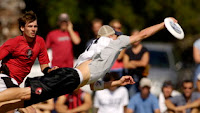
Ultimate doesn’t have nearly the history of baseball, but it has come a long way in the last 30 years. I made great friends in college through the frisbee team I played on, and when I’m healthy (which sadly is rarer and rarer these days), I can be competitive at the highest levels of ultimate, which is pretty neat.

Baseball is the better sport. Ultimate is the sport that I am better at.

3. What is your favorite animal?

Turtles, without a doubt. When I was little, I never really had much interest in pets, unless I found a turtle in the yard.

I’m not sure I can explain what the big deal about turtles is, but I’ll try: They’re easy to care for, generally very nice, occasionally friendly, and usually, not in too big of a hurry. People could learn a lot from turtles.

I’m not a big fan of snapping turtles though. They’re the jerks that give the rest of the turtles a bad name.

4. It’s pretty clear from reading your blog that you are a Christian. Why is that?

Honestly, the reason I became a Christian is because my parents are Christians—it’s just the way I was raised. As I got older though, especially when I went away to college, I examined my own beliefs and also learned about some other religions, and while some of my ideas have changed, my faith is probably stronger now than it has ever been.

When it comes down to it, the Person of Jesus is entirely unique, and, in my opinion, irresistibly appealing. There’s no one I would rather imitate.

5. If you were Barry Bonds, on the verge of making history by breaking Hank Aaron’s career home run record, what would you do?

I’d consult the nearest physician as soon as possible. With as many foreign substances as I’d have injected into my body, I’d be pretty sure that I had some major problems.

There you go. Since I only answered five questions, I’ll only tag five people: Angela, Clay Hendrix, David McMahon, Paul Murphy and Sam Travaglini. Technically, you’re supposed to answer eight questions, but I guess it would be pretty hypocritical of me to hold you to that. I’ll look forward to the responses.

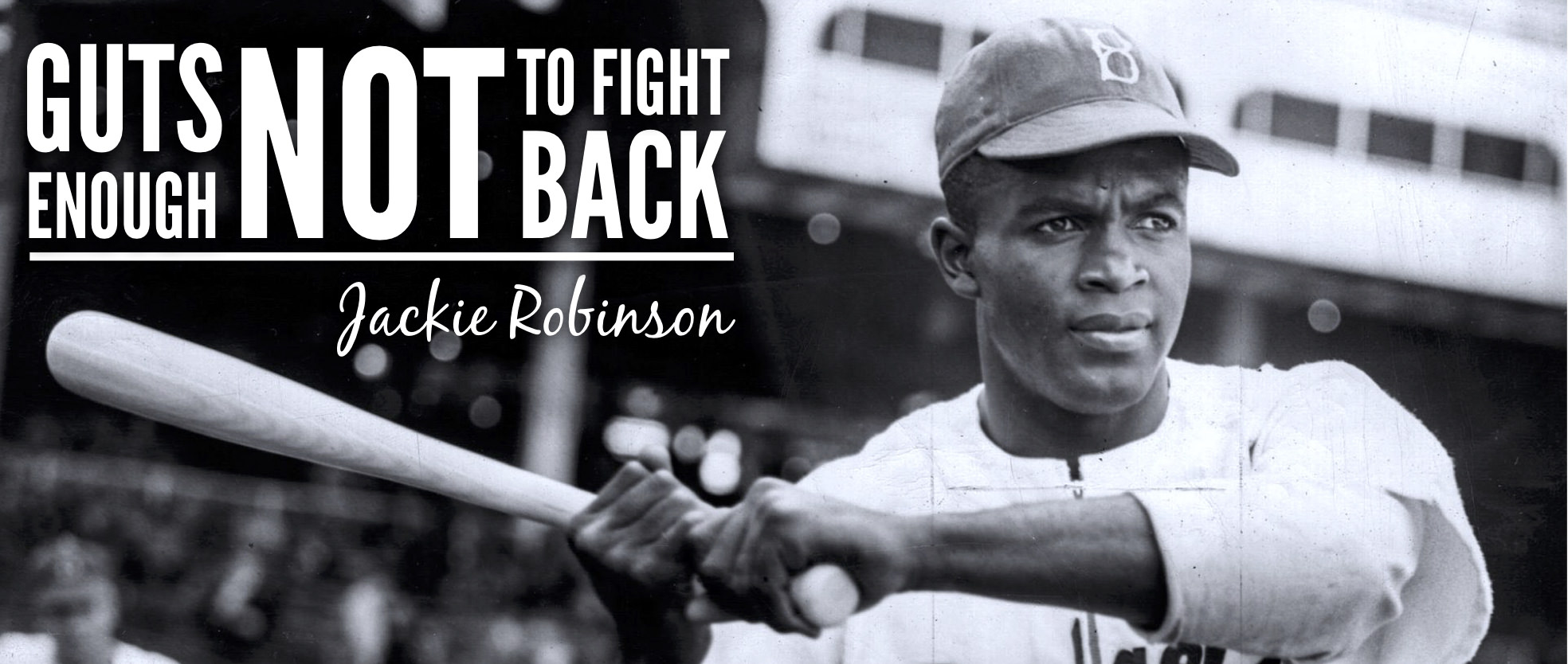
Guts Enough Not To Fight Back: Jackie Robinson

As a general rule in college and professional sports, teams retire the jersey numbers of the all-time greats who played for them. For example, no Chicago Bull can wear number 23, because that was Michael Jordan’s number and it has been retired. No New York Yankee can wear number 3, because that was Babe Ruth’s number and it has been retired. If you play Major League Baseball, regardless of what team you play for, you can’t wear the number 42, because that was Jackie Robinson’s number, and it is the only number to be retired by Major League Baseball.[1]

Sixty years ago yesterday, on April 15, 1947, Jackie Robinson donned that number 42 Brooklyn Dodgers jersey and appeared in his first regular-season Major League game, breaking baseball’s racial color barrier.[2]

Robinson’s Hall of Fame career and the way he handled himself on and off the field opened doors for other black athletes in professional sports (and ultimately many other fields as well), and it has been said that only Dr. Martin Luther King Jr. accomplished more for the American Civil Rights Movement than did Jackie Robinson.

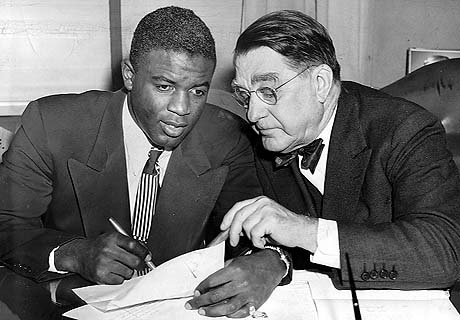
Jackie Robinson and Branch Rickey

Before he signed a contract to play for the Dodgers, Robinson was called into the office of Team President and General Manager Branch Rickey. To give him a taste of what it would be like to be the only black player in the Big Leagues, Rickey spent three hours taunting and insulting Robinson, calling him every racial slur he could think of. Rickey then told Robinson that this is what he would face every day on the field and that if he wanted it to work out, he would have to promise not to fight back or respond to insults of any kind for the first three years of his career.

Robinson, who possessed a fiery temperament and was very outspoken (he was actually court marshaled for refusing to sit at the back of a military bus), was put off by this and asked, incredulously, “Mr. Rickey, are you looking for a player who is afraid to fight back?”

Branch Rickey replied, “No, I want someone with guts enough not to fight back.”

After some deliberation, Robinson agreed to Rickey’s terms, and he lived up to them on the field. When opposing baserunners tried to spike him when sliding into second base, he didn’t fight back. When fans and players yelled and cursed at him and even questioned his very humanity, he showed them how wrong they were by taking the moral high ground.

He had the guts not to fight back.

What Branch Rickey told Jackie Robinson reminds me of Jesus’ words in The Sermon on the Mount in Matthew 5:

“But I tell you, do not resist an evil person. If someone strikes you on the right cheek, turn to him the other also. And if someone wants to sue you and take your tunic, let him have your cloak as well. If someone forces you to go one mile, go with him two miles.”

The world tells us to stand up for ourselves when we are treated unjustly. It tells us to have the courage to fight back and not let others push us around. On the other hand, Jesus tells us to have the courage to show that we are different from the world because we don’t fight back, and He tells us to forgive others when they mistreat us.

Jesus wants followers with guts enough not to fight back.


[1] Major League Baseball has established the practice of temporarily lifting this prohibition on April 15 to commemorate the anniversary of Robinson’s first game as a Dodger, as representatives from each Major League team wear number 42 in his honor.

[2] Contrary to popular belief, Robinson was not the first African-American to play in the Major Leagues. That honor goes to Moses Fleetwood Walker, who played for the Toledo Blue Stockings in 1884. Regardless of this, Robinson was the first African-American to play Major League Baseball in the 20th century, and it was his breaking of baseball’s color barrier that led to the permanent integration of the Major Leagues.

Remembered At Our Worst

What if the only thing you were remembered for was your worst moment?

Although Fred Merkle broke into the major leagues with the New York Giants in 1907, he was still practically (and technically) a rookie in the fall of 1908 when the Giants were locked in a tight pennant race with their arch-rivals, the Chicago Cubs.

On September 23, the Giants hosted the Cubs at the Polo Grounds in New York. The game was just like the whole season had been: a tense, hard-fought struggle between two teams of equal caliber.

With the score tied 1-1 with two outs in the 9th inning, Merkle singled, advancing Moose McCormick from first base to third. The next batter, Al Bridwell, also singled, which allowed McCormick to score and seemed to seal the crucial victory for the Giants. Jubilant New York fans stormed through the center field exit and onto the field in celebration.

Fred Merkle, seeing the rush of oncoming fans and convinced that the game was over, headed to the dugout without touching second base.

This was noticed by Johnny Evers, the Cubs’ crafty second baseman, who alerted umpire Hank O’Day and went after the ball. Evers fought through fans, claimed the ball, and relayed it to Chicago shortstop Joe Tinker at second base.

According to baseball rules, since Merkle had not touched second base and Tinker touched the base while holding the ball, Merkle was out on a force play, and Moose McCormick’s game-winning run was nullified. Merkle’s base-running error would cost the Giants the game, which was ruled a tie, to be replayed at the end of the season only if the two teams were tied in the standings.

Of course, they were, and when the game was replayed, Chicago won, and the 19 year-old Merkle was blamed for losing the pennant. The Cubs went on to win the World Series that year, although they haven’t managed to win another in the 98 seasons since.

Fred Merkle would go on to have a respectable year major league career that would span 18 seasons, one which produced 1,580 hits, 290 doubles and a .273 batting average (statistics more impressive when you consider that the majority of his career was played in the dead ball era), but he would never live down the “Merkle Boner,” as his 1908 mistake came to be known. In fact, it’s really the only thing he is remembered for today.

Sometimes, history can be pretty unforgiving like that—a lot of people are remembered only for their worst or most inept moments. That is one advantage of not being famous: we “normal” folk don’t have thousands or millions of people scrutinizing our every move and waiting to jump all over us when we mess up. Of course, even if we aren’t famous, we can still make some mistakes that have serious and far-reaching consequences.

But that is one of the most comforting aspects of Christianity; we may still make mistakes, but those are not what God remembers about us. In 2 Corinthians 5.17, the Apostle Paul says, “Therefore if anyone is in Christ, he is a new creature; the old things passed away; behold, new things have come.”

I’ve always felt sorry for Fred Merkle, and have thought that it isn’t fair that he is remembered only at his worst, for a mistake that he made as a 19 year-old kid. But his story reminds me of this: thanks to the blood of Christ, we don’t have to be remembered for our worst moments; they can be wiped away.

The picture above is a 1909-1911 T-206 Fred Merkle tobacco card, and was one of my favorite Christmas gifts this year. Thanks Jared!

Sources for the statistics and historical dates and names used in this article include Baseball Reference and Wikipedia.

« Older posts Newer posts »

© 2026 The Doc File

Theme by Anders Noren — Up ↑