The online journal of Luke Dockery

Category: Politics (Page 1 of 13)

Wise as Serpents, Gentle as Doves: Christian Engagement in the Public Square

In Matthew 10, Jesus sends his apostles out on what is often referred to as the “Limited Commission.” It is “limited” compared to the more famous Great Commission in Matthew 28, where Jesus sends His disciples into all the world. Here, He restricts the purview of their mission, telling them not to go to the Gentiles or Samaritans but rather to the “lost sheep of the house of Israel” (10.6). They are to proclaim the message of the kingdom of God, heal the sick, and cast out demons, and Jesus gives them other traveling instructions (10.7-14).

And, He makes it clear that He is sending them out into hostile territory, “as sheep in the midst of wolves,” so they need to be thoughtful and careful about how they act. He tells them to be wise as serpents (or “shrewd” depending on your translation) and as gentle (or “innocent” or “harmless”) as doves. Really, they need to act as Jesus Himself does, who was always full of discernment (John 2.25), but was also gentle and lowly in heart (Matthew 11.29).


It seems to me that these words, given by Jesus to His disciples long ago in a specific context, are important and instructive for disciples today as we enter into the public square, the marketplace of ideas, that is social media.

We live in troubled times. That should not be surprising, as disciples of Jesus have always lived in troubled times, but due in part to the constant connectivity of the digital age, our blunted attention spans, and our stunted spiritual formation, we are constantly flitting from one trouble to the next, outraged or despairing about one thing or another, and compelled to let everyone know how we feel.

And I don’t mean to give the impression that there is nothing going on worth feeling concern—or even outrage or despair—about. In any given week, our attention is pulled toward international conflicts, political scandals, inflammatory national rhetoric, and violent encounters tied to immigration and enforcement. The specific examples change almost daily, but the effect is the same: it is a lot.

In response to these stimuli, I have certainly seen a great amount of digital ink spilled by Christians on my social media feeds…but I haven’t observed much evidence of Christians being “wise as serpents, gentle as doves” in those spaces:

  • It is not wise for Christians to rush to judgment when a story breaks when there have been so many examples of the narratives around these sorts of stories significantly changing from what was originally reported.
  • It is not gentle for Christians to callously dismiss violent deaths of protesters with a quick reference to Romans 13.
  • It is not wise for Christians to blindly accept a photo, video, or source when we know that there is so much AI-generated content and misinformation sewering up the Internet.
  • It is not gentle for Christians to invite anyone who disagrees with them to unfriend or block them.
  • It is not wise for Christians to naively accept the claims of an agenda-driven administration that seems to think the truth is whatever they want it to be (a temptation that has proven to be both bipartisan and perennial).
  • It is not gentle for Christians to dehumanize illegal immigrants or the ICE agents seeking to apprehend them.
  • It is not wise for Christians to naively assume that those in opposition to the current administration are somehow virtuous and truthful when they have repeatedly given evidence to the contrary.

The world is a dark and troubled place, and the people of the world will rage and dispute. Following the directives of Jesus our King, Christians must strive to do better. Being wise as serpents and gentle as doves is one way that we can be salt and light in our world and distinguish ourselves from the prevailing cycle of verbal escalation.

The world is a dark and troubled place, and the people of the world will rage and dispute. Following the directives of Jesus our King, Christians must strive to do better. Share on X

That doesn’t mean it is wrong to share your thoughts. Indeed, I have read multiple posts, from different perspectives, that were measured in their tone and careful in their attempts to discern truth. But for all of us, there is a pressing need to examine whether our impulse to speak is being formed by the Spirit of Christ or manipulated by our social media algorithms.

Our world really doesn’t need more people with hot takes, lines drawn in the sand, and proclamations of outrage. It does need Christians who can demonstrate wisdom and gentleness—disciples who remember that we are still sheep among wolves, sent by Jesus to bear faithful witness to the world rather than to join sides in a war of outrage.

Our world really doesn’t need more people with hot takes, lines drawn in the sand, and proclamations of outrage. It does need Christians who can demonstrate wisdom and gentleness. Share on X

2025 Blog Review

I think reflection is a healthy practice, and I like to end each year by looking back and reviewing my year of blogging here at The Doc File (Here are some previous reviews from 2024, 2023, 2022, 2021, 2020, 2019, 2018, 2016, 2015, and 2012).

Overview

In 2024 I only wrote 19 times, and a goal for this past year was to write more frequently. I will end 2025 with 29 posts, which is hardly setting any sort of world records, but it does reflect an increase of over 50% from last year.

Top Posts

By traffic totals, here are my most-read posts during 2025 (posts in bold were actually written this year):

  1. So You Want to Hire a Youth Minister, August 18, 2025
  2. Where Do Churches of Christ Come From? Teaching Restoration Movement History…to Teenagers, February 11, 2025
  3. A New Heaven & A New Earth Series, April 29, 2020
  4. 2025 Harding University Lectureship Recap, December 1, 2025
  5. The Department of Government Efficiency…and The Parable of the Weeds, February 26, 2025
  6. Ecclesiastes on Independence Day, July 4, 2023
  7. A New Heaven & A New Earth: What the Bible Teaches about Eternity, April 9, 2020
  8. Reading in 2024, January 3, 2025
  9. The Mutual Admiration of Alexander Campbell and Barton W. Stone, February 14, 2017
  10. “He Loved Them to the End”, August 6, 2021

Five of the top posts from 2025 were actually written this year, and it is always good to see new content get some traction:

At the same time, part of the reason for preserving almost 20 years of posts on this site is for people to be able to go back and read things they missed, and I am always gratified when older posts are read by new people. The series I wrote in 2020 on renewed eschatology continues to get a lot of views (taking two of the top ten spots). I also shared a couple of old posts around Valentine’s Day (The Mutual Admiration of Alexander Campbell and Barton W. Stone) and the 4th of July (Ecclesiastes on Independence Day) that attracted a lot of readers.

Blog Series

In 2025, I contributed to one ongoing Blog Series, completed a new mini-series, and began a new ongoing project. I added four more posts to the Scripture Reflections series:

This brings the series to a total to 30 posts. I plan to continue adding to this indefinitely, and suspect that it will eventually turn into a book project.

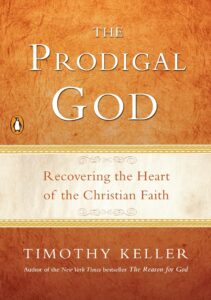
This past year I re-read Tim Keller’s modern classic, The Prodigal God. Though it wasn’t my intention to do so before reading the book, I was so struck by aspects of it that I ended up writing a brief, three-part series to emphasize some key ideas:

Finally, just this month I embarked on a new series that I anticipate continuing in future years. Christmas Carol Theology takes a closer look at some seasonal favorites and examines how they can help us to better understand the nature of God and/or what it means to follow Him. This year I wrote three posts for that series:


So, that was The Doc File in 2025! I always enjoy writing in this space, and it has become a formative spiritual discipline for me to process my thoughts here over the years. Lord willing, I hope to continue to do so for a long time. As always, I am thankful for your readership and support!

Christmas Carol Theology: “I Heard the Bells on Christmas Day”

As I mentioned in the first post of this series, I am a big fan of Christmas music, and Christmas carols (especially theologically thoughtful ones) are my favorite. Last time we examined “Good King Wenceslas” and saw how it tells the story of a good king that ultimately points us to the Good King, Jesus.

There are several more carols I’d like to look at and I’m sure I won’t get them finished before Christmas, which means that this will likely be a multi-year series. Having said that, one song I wanted to make sure to cover this year, “I Heard the Bells on Christmas Day”, was actually suggested by someone in response to the first post. This is a song I didn’t know well until recent years. I often have not had the patience to listen to more than the first verse or two, and some of the original seven verses are usually omitted, which is too bad because it strips the song of its historical context and some of its poignancy.

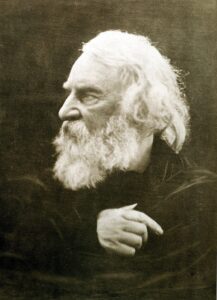
Henry Wadsworth Longfellow

The song is based on the poem, “Christmas Bells” by Henry Wadsworth Longfellow, who was the most popular poet of his day and is perhaps most famous for writing, “Paul Revere’s Ride.” “Christmas Bells” was written on Christmas day in 1863, and stemmed from Longfellow’s personal tragedy: his wife had died two years earlier (his second wife to have died), and his son had been severely wounded in combat in the Civil War earlier in the year. Indeed, it was not a Merry Christmas for Longfellow that year. The poem was later set to music (in various arrangements) and became popular in the 1950s when recorded by Bing Crosby, but by then it was common practice to abbreviate the number of verses. But originally, there were seven stanzas:

I heard the bells on Christmas Day
Their old, familiar carols play,
And wild and sweet
The words repeat
Of peace on earth, good-will to men!

And thought how, as the day had come,
The belfries of all Christendom
Had rolled along
The unbroken song
Of peace on earth, good-will to men!

Till ringing, singing on its way,
The world revolved from night to day,
A voice, a chime,
A chant sublime
Of peace on earth, good-will to men!

Then from each black, accursed mouth
The cannon thundered in the South,
And with the sound
The carols drowned
Of peace on earth, good-will to men!

It was as if an earthquake rent
The hearth-stones of a continent,
And made forlorn
The households born
Of peace on earth, good-will to men!

And in despair I bowed my head;
“There is no peace on earth,” I said;
“For hate is strong,
And mocks the song
Of peace on earth, good-will to men!”

Then pealed the bells more loud and deep:
“God is not dead, nor doth He sleep;
The Wrong shall fail,
The Right prevail,
With peace on earth, good-will to men.”


With the full complement of verses, the historical context becomes quite clear. The narrator hears the bells playing carols on Christmas day, proclaiming the message “Peace on earth, good-will to men!” (Luke 2.14, KJV). This is not an isolated incident, but something that has been repeated by church bells across Christendom. Indeed, this is a core Christian proclamation: that Christ, the Prince of Peace, has come into the world and has fundamentally altered reality.

The problem, though, is that a bloody Civil War is raging. Down South, the black cannons thunder, reminding the hearer of war and drowning out the Christmas bells. This war has divided the country in two: “it was as if an earthquake rent/The hearth-stones of a continent.” Even households have been divided, and the country has been deprived of peace and good will.

Verse six is poignant, and reveals this to be a song of lament, in keeping with the best tradition of the Psalms: looking around, the narrator’s experience doesn’t match the biblical proclamation: where is this supposed peace on earth? Nowhere that he can see! And this begins to dial up the tension and make us a bit uncomfortable. This is very different from the glitzy and glamorous notion that Christmas is the most wonderful time of the year. What if, in reality [in a halting, whispered voice], Christmas is actually all a sham? There is no peace on earth.

And honestly, don’t we also feel the tension between the biblical proclamation and our lived experience? I know that often, frequently, the words are true for me: “And in despair I bowed my head; ‘There is no peace on earth,’ I said.” Russia is still at war with Ukraine. The Israeli-Palestinian conflict remains a tinder box. There is a devastatingly steady stream of mass shootings. Our society is divided ideologically, and the most powerful people in our country seem to be actively opposed to promoting peace and good will. I want to lament as well.

But it is okay to lament—more than okay, it is righteous and faithful to do so. Lament itself is a language of faith. Roughly 40% of the Book of Psalms are lament psalms, and when we examine these psalms, we generally find four common characteristics:

  1. They are addressed to God recognizing that He is the One who is in control.
  2. They involve a complaint; something is wrong in the life of the one who is lamenting.
  3. They contain a request: the lamenter wants God to do something about the complaint.
  4. Usually, the laments close with confidence and praise: having turned their request over to God, the lamenter is confident that God is in control, and praises Him for His watchful care.

Seeing these elements shows that lament is different from just whining and complaining: lament is not about pouting because we don’t get our way. Instead, lament is what occurs when deep faith confronts deep suffering: we suffer, and in our faith, we turn to the Only One who can do anything about our suffering: the Father who sits on the throne and loves us deeply.

Lament is what occurs when deep faith confronts deep suffering: we suffer, and in our faith, we turn to the Only One who can do anything about our suffering: the Father who sits on the throne and loves us deeply. Share on X

“I Heard the Bells on Christmas Day” follows the pattern of a lament psalm pretty closely. God is not specifically addressed, but I think it is implied; the song certainly occurs against a backdrop of faith. Clearly there is a complaint: there is a violent war going on that is shaking the foundations of the entire nature, and the request, though implied, is clear enough: we want the peace that God has proclaimed!

And then, the closing words of confidence.

The bells peal louder and deeper, drowning out the noise of cannon fire, and reassuring that God is not absent, and is not oblivious to all the violence, evil, and injustice in the world. God hears it all, He knows what is occurring, and He will ultimately set the world to rights.[1]

This is a song of deep faith, and also of truth telling. It doesn’t seek to deaden the pain of the world with a hectic calendar of holiday parties, the obsessive giving and receiving of material gifts, or the gluttonous consumption of Reese’s Christmas trees.[2] Instead, it acknowledges the very real suffering that exists in our broken world, but trusts in God anyway; He is still in control, and He is working all things for good. Christmas is not a sham, after all. It’s our eyes that deceive us, and indeed, the Prince of Peace has come, has fundamentally altered reality by doing so, and will come again.


[1] Indeed, we already see elements of this now. For all the wickedness and suffering we see in our world today, it is a world that has been fundamentally changed by the coming of the Prince of Peace into the world. The ancient world took for granted the reality of constant warfare, infanticide, slavery, and general savagery. These things still exist today at certain times in certain places, but we assume that it is wrong that it does. The reality is that Jesus has fundamentally altered our sense of the way things are supposed to be. This is a central claim of Tom Holland’s excellent book, Dominion: How the Christian Revolution Remade the World.

[2] OK, that was a low blow.

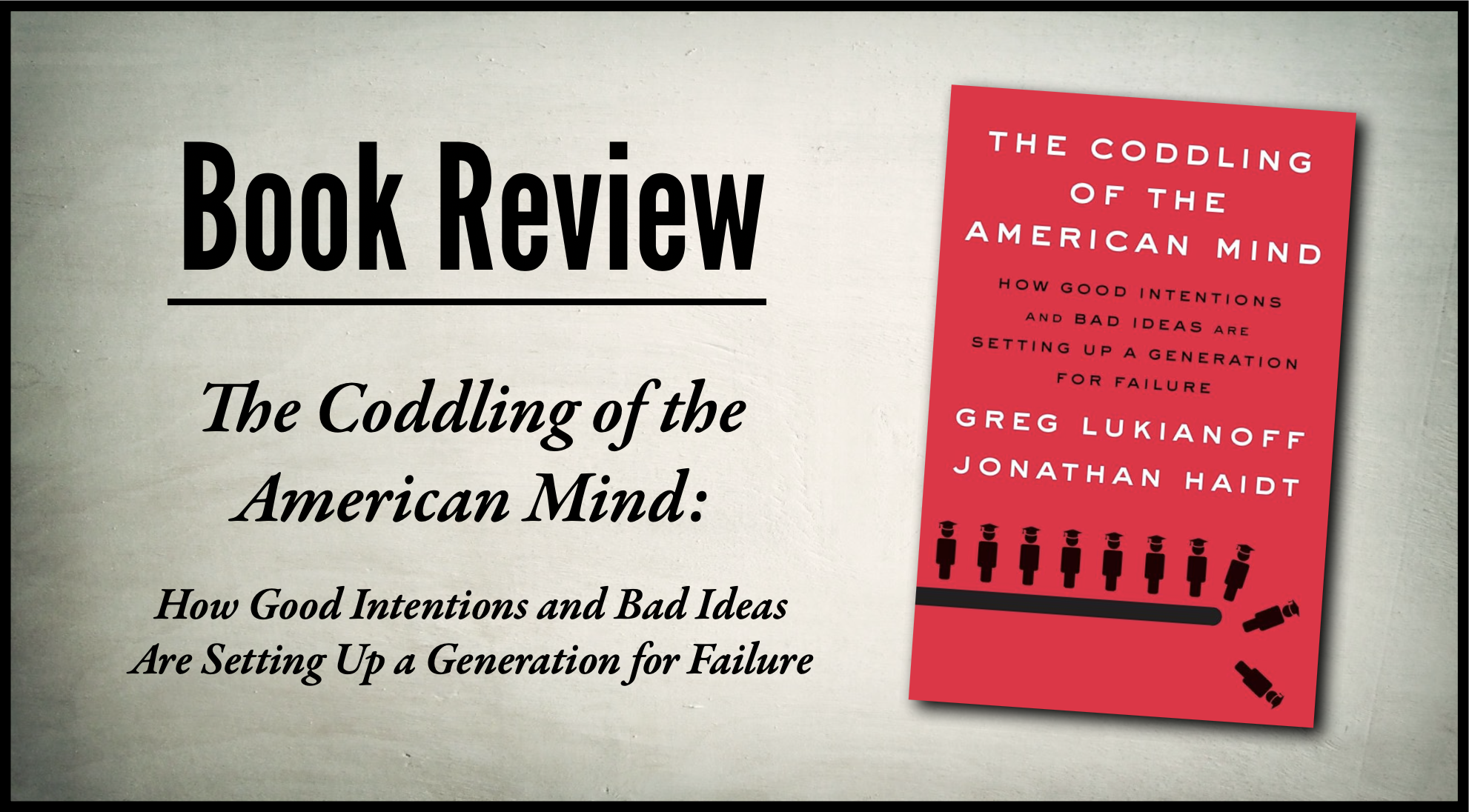
Book Review: The Coddling of the American Mind

Recently in my college youth ministry class, I was sharing research on current teenagers and college students, and while sharing some main ideas from The Coddling of the American Mind by Greg Lukianoff and Jonathan Haidt, I realized that I had never reviewed the book here on The Doc File. Earlier this year, I wrote a review of Haidt’s The Anxious Generation, and I shared how much I have benefitted from Haidt’s work, and how The Coddling of the American Mind was one of my top books in 2021.

But I want to share more about it, here. The Coddling of the American Mind is, I believe, a really helpful book. It is based on extensive research of the two authors, who come from different professional backgrounds (Lukianoff is an attorney and Haidt is a social psychologist). Politically, they would likely be described as moderate liberals, or centrists or something like that, and they do not write from a religious perspective (I am unsure about Lukianoff, but Haidt is an atheist). I mention that, because some of the central claims of their book resonate with conservative Christians like myself, but they are distinctly not writing from that perspective.

Their research is focused particularly on the culture of college campuses and the characteristics of Gen Z students. The basic premise of the book is that there are three widely-held false beliefs—Lukianoff and Haidt call them untruths—among this generation. To be clear, they are not blaming this generation for holding these beliefs; rather, they are “proposing that today’s college students were raised by parents and teachers who had children’s best interests at heart” but who ultimately raised them in some unhelpful ways.[1]

Part I, which I consider to be the best part of the book, examines these three untruths in great detail:

(1) The Untruth of Fragility: What Doesn’t Kill You Makes You Weaker

This is the basic idea that people are fragile and need to be protected from things that harm them. Not just actual, physical dangers, but also the perception of danger or ideas that they disagree with. Lukianoff and Haidt have major issues with this, however.[2]

First, children are antifragile. Their brains require a wide range of inputs from their environments in order to configure themselves for those environments. Similar to an immune system, children must be exposed to challenges and stressors (within limits, in age-appropriate ways), or they will fail to mature into strong and capable adults, able to productively engage with people and ideas that challenge their beliefs and moral convictions.

Second, concepts like “trauma” and “safety” have expanded so far since the 1980s that they are often employed in ways that are no longer grounded in legitimate psychological research. Grossly expanded conceptions of trauma and safety are now used to justify the overprotection of children of all ages—even college students, who are sometimes said to need safe spaces and trigger warnings lest words and ideas put them in danger. 

Finally, L&H discuss safetyism, or the cult of safety, an obsession with eliminating threats (both real and imagined) to the point where people become unwilling to make reasonable trade-offs demanded by other practical and moral concerns. Safetyism deprives young people of the experiences that their antifragile minds need, thereby making them more fragile, anxious and prone to seeing themselves as victims.[3]

To be clear, the three untruths discussed in Coddling of the American Mind are based on research from the social sciences rather than biblical teaching or some sort of Christian worldview. However, part of the reason this resonates with me so deeply and I teach this material in a college Bible class is because it coheres so well with biblical teaching:

[1] Therefore, since we have been justified by faith, we have peace with God through our Lord Jesus Christ. [2] Through him we have also obtained access by faith into this grace in which we stand, and we rejoice in hope of the glory of God. [3] Not only that, but we rejoice in our sufferings, knowing that suffering produces endurance, [4] and endurance produces character, and character produces hope, [5] and hope does not put us to shame, because God’s love has been poured into our hearts through the Holy Spirit who has been given to us.

(Romans 5.1-5)

Scripture doesn’t teach that hard times in life are tragedies to be avoided at all costs; on the contrary, God works through the suffering in our life to help us grow and mature.

(2) The Untruth of Emotional Reasoning: Always Trust Your Feelings

The basic idea here is that we that we often allow our emotions to be the ultimate interpreter of reality for us. This is problematic for several reasons, though:[4]

One of the most universal insights in the world’s wisdom traditions across time and culture is that what really frightens and dismays us is not external events themselves as much as the way in which we think about them. Put in other words, the things that we worry about tend to be less damaging than the fact that we worry about them!

L&H discuss Cognitive Behavior Therapy at some length, which is a very effective form of therapy that basically involves identifying common cognitive distortions (inaccurate, unhealthy thoughts) and then changing patterns of thinking. I am not a psychologist and this is not a book primarily about psychology, but the point here is that there is an entire branch of psychotherapy based on the understand that our thoughts and emotions can mislead us.

Finally, they discuss the practice of disinviting speakers from giving talks on college campuses due to the claim that these speakers will cause harm to students with their words. The Coddling of the American Mind was written back in 2018 when this practice was increasingly spreading to ridiculous proportions. In some of the fallout and cultural reaction to overreach from the left in the last few years, this practice of disinviting speakers is probably less than it was, but it is still a reality. Here’s the problem, though: feeling a negative emotional response because you disagree with someone is not the same as being harmed by them, and it actually diminishes and disregards real, actual harm when we pretend like it does (this also goes back to fragility).

Of course, none of this means that our emotions are bad or that we should ignore them. Indeed, our emotions are a gift from God. At the same time, our own emotional perceptions of things should not be final judge of reality. Again, this is a very biblical idea:

[12] There is a way that seems right to a man, but its end is the way to death.

(Proverbs 14.12)

[26] Whoever trusts in his own mind is a fool, but he who walks in wisdom will be delivered.

(Proverbs 28.26)

We should be skeptical of our emotions, and it is foolish to base our understanding of the world solely on our own thoughts and feelings.

(3) The Untruth of Us Versus Them: Life Is a Battle Between Good People and Evil People

The basic idea here is that our current cultural context emphasizes Common-Enemy Identity Politics: we identify a person or group that we classify as “evil” and then unite with others in opposition to that “evil” person or group. This should be readily apparent to anyone who pays any attention to public discourse—just think of the labels we use to vilify groups of people with whom we disagree: Trump-supporters, Marxists, Racists, Leftists, Anti-Vaxxers, etc. Again, this is problematic.[5]

It does seem to be true that the human mind functions in such a way that it readily divides the world into us/them categories. Haidt’s earlier work, The Righteous Mind, delves into this more, but if you spend much time with kids, you know how easily and naturally they divide into groups and teams to compete with each other (boys vs. girls, cops and robbers, etc.). L&H are not championing this reality and are not saying it’s something we should seek to amplify, but are simply acknowledging that it is a reality.

It becomes concerning, though, when it naturally leads to Common-Enemy Identity Politics (used both by those on the far right and the far left), which tries to unite a coalition against the “other” group. We determine our identity by what distinguishes us from those other people, who are, of course, inferior to us and quite likely evil to the core. This idea is quite different from Common-Humanity Identity Politics, which was used by people like Dr. Martin Luther King, Jr. MLK humanized his opponents and appealed to their common humanity, rather than demonizing them and emphasizing their differences as enemies.

Common-Enemy Identity Politics produces a call-out culture where almost anything can result in public shaming, which causes people to engage in self-censorship because they are afraid of what will happen if they say what they think (think: cancel culture). In a college context, call-out cultures are detrimental to students’ education and bad for their mental health. Additionally, call-out cultures and us-versus-them thinking are incompatible with the educational and research missions of universities, which require free inquiry, dissent, evidence-based argument, and intellectual honesty. 

And, again, this notion that life is a battle between good people and evil people is not a biblical idea, either. The Bible teaches that all humans are created good, in God’s image, but that all of us are tainted by sin and susceptible to its influence:

[10] Finally, be strong in the Lord and in the strength of his might. [11] Put on the whole armor of God, that you may be able to stand against the schemes of the devil. [12] For we do not wrestle against flesh and blood, but against the rulers, against the authorities, against the cosmic powers over this present darkness, against the spiritual forces of evil in the heavenly places.

(Ephesians 6.10-12)

It’s not that I am good and you are evil, or vice versa—it’s that the battle between good and evil is being waged within our own hearts, as we seek to resist evil spiritual influences

To be clear, what I have shared so far is not the entire book—it’s just Part I! This is the part that I found most helpful in terms of its cultural analysis and bringing clarity to some of what seems to have gone so wrong in our current context, but there are three other sections:

  • Part II looks at what these bad ideas actually look like in action, detailing various recent examples and case studies of events that show the negative effects of living out these ideas in the real world. This is very helpful in establishing that the untruths from Part I truly are widespread and damaging.
  • Part III provides an historical overview of how we go to this point, touching on topics of polarization, anxiety and depression, paranoid parenting, decline of free play, the problems of safetyism, and the quest for justice. Readers of Haidt’s The Anxious Generation and The Righteous Mind will find a lot of familiar territory here. This section is really helpful from an orientation perspective, especially for those who look at the untruths and how they are impacting our society and are scratching their heads: “How did we get here?”
  • Part IV seeks to offer some suggestions for a better way forward, and focuses those suggestions in three areas, helping to form Wiser Kids, Wiser Universities, and Wiser Societies. This section is practical, and provides some ideas for improvement for pretty much anyone, regardless of your context or influence.

I think this is a really helpful book, and I strongly recommend it. It has been overshadowed by the overwhelming popularity of The Anxious Generation (which is great and a must-read), but if you enjoyed that book, there’s likely a lot here for you as well.


[1] Greg Lukianoff and Jonathan Haidt, The Coddling of the American Mind: How Good Intentions and Bad Ideas Are Setting Up a Generation for Failure (New York: Penguin Press, 2018), 31.

[2] Lukianoff and Haidt, 19-32.

[3] Haidt further develops this idea significantly in The Anxious Generation.

[4] Lukianoff and Haidt, 33-51.

[5] Ibid., 53-77.
The Department of Government Efficiency…and The Parable of the Weeds

I am generally hesitant to comment on political matters, partially because politics can be so divisive, and partially because I am generally not informed enough to do so with any credibility. On the other hand, I am all about discussing Scripture, and also discerning how the wisdom of Scripture can be brought to bear on the challenging issues of life. Thus, this post.

Over the last few weeks, the new Department of Government Efficiency (DOGE) has been rifling through the drawers of the federal government, seeking to identify and eliminate waste, significantly by cutting funding or eliminating jobs. We live in a wildly polarized society, so I shouldn’t be surprised by the wide gulf between the different responses I have observed to DOGE’s activities so far. And yet, I am: on social media, some of my friends are hailing all of this as a much-needed and valuable work, while others identify it as the onset of fascism and the harbinger of the downfall of our nation.

And all I can think about is Jesus’s Parable of the Weeds.


Found in Matthew 13, the Parable of the Weeds is one of Jesus’s many parables that focuses on the nature of God’s kingdom:

24 He put another parable before them, saying, “The kingdom of heaven may be compared to a man who sowed good seed in his field, 25 but while his men were sleeping, his enemy came and sowed weeds among the wheat and went away. 26 So when the plants came up and bore grain, then the weeds appeared also. 27 And the servants of the master of the house came and said to him, ‘Master, did you not sow good seed in your field? How then does it have weeds?’ 28 He said to them, ‘An enemy has done this.’ So the servants said to him, ‘Then do you want us to go and gather them?’ 29 But he said, ‘No, lest in gathering the weeds you root up the wheat along with them. 30 Let both grow together until the harvest, and at harvest time I will tell the reapers, “Gather the weeds first and bind them in bundles to be burned, but gather the wheat into my barn.”’”

36 Then he left the crowds and went into the house. And his disciples came to him, saying, “Explain to us the parable of the weeds of the field.” 37 He answered, “The one who sows the good seed is the Son of Man. 38 The field is the world, and the good seed is the sons of the kingdom. The weeds are the sons of the evil one, 39 and the enemy who sowed them is the devil. The harvest is the end of the age, and the reapers are angels. 40 Just as the weeds are gathered and burned with fire, so will it be at the end of the age. 41 The Son of Man will send his angels, and they will gather out of his kingdom all causes of sin and all law-breakers, 42 and throw them into the fiery furnace. In that place there will be weeping and gnashing of teeth. 43 Then the righteous will shine like the sun in the kingdom of their Father. He who has ears, let him hear.”

(Matthew 13.24-30; 36-43)

This is a parable about the kingdom of God growing in a hostile environment and some of the realities that come with that. A man sows seed in a field, but then an enemy comes and secretly sows weeds among the good seed. When the plants start to grow, it becomes apparent what has happened, and the servants, wanting to be helpful, ask their master if they should pull the weeds. The master, though acknowledging the existence of the weeds and the problem they represent, tells his servants not to pull up the weeds because they might cause damage to the wheat when they do so. In other words, the effort to root out the bad can actively harm the good. 

Sometimes the effort to root out the bad can actively harm the good. Share on X

Jesus goes on to explain the spiritual significance of this parable and there are some really important lessons there that I have discussed elsewhere.[1] I don’t want to pretend or suggest that this parable is somehow about what we see going on in our current political landscape, but I do think there is a principle here that applies.

I don’t think any fair-minded person would deny that the U.S. federal government operates on a massive scale, and that in such a vast and complicated structure, there is bound to be a significant amount of inefficiency and even incompetence. Put differently, there really are weeds in the field. But that doesn’t mean that the wise course of action is to rush in and start indiscriminately yanking up the weeds, because you likely are going to pull out a lot of good plants as well.

From my perspective, this is what DOGE has done. I know an increasing number of good, faithful civil servants who are losing employment because of sweeping cuts, as well as good, worthwhile programs that are being defunded. None of this is to suggest that the federal government is efficient, or that no cuts should be made—there really are weeds in the field! But it does suggest that when you have such a vast and complicated network of employees and programs with problems that have accumulated over decades, you’re probably not going to be able to wisely solve the problem within a few weeks.


[1] Jeremy Myers & Luke Dockery, Kingdom Parables: A Study of the Stories of Jesus (Springdale, AR, Deeper Youth Ministry, 2024), 29-31.

« Older posts

© 2026 The Doc File

Theme by Anders Noren — Up ↑