The online journal of Luke Dockery

Category: Politics (Page 7 of 13)

Christians and the Sanctity of Marriage

A Chick-fil-A in Huntsville, Alabama on August 1. Photo by Glenn Baeske/AP Photo

So a couple of weeks ago there was a pretty big political/cultural/religious firestorm concerning gay marriage and Chick-fil-A. Perhaps you heard something about it.

I didn’t write anything about it at the time because (a) I was traveling, (b) Everybody in the world seemed to be writing something about it, and (c) When it comes to emotionally-charged issues, I think it is sometimes less helpful to talk about them when we are so fired up. So I have waited until now to post a brief thought for reflection.

I have no problem with a company executive expressing his views on marriage. I happened to agree with his views, but even if I didn’t, I support his freedom to express what he believes—that’s one of the neat things about our country. And speaking of freedom, I also support the freedom of those who disagree with him to boycott his company, and the freedom of those who agree with him to Eat (even) Mor Chikin than usual to show their support.

But here is what I wonder: in a society plagued by divorce, where Christians don’t do that much better than non-Christians at staying married,[1] what is the most effective way for Christians to protect the sanctity of marriage? Is it by eating at Chick-fil-A (or getting in debates on the internet, or holding up picket signs), or by actively cultivating healthy, God-glorifying marriages with our spouses?

Of course, it doesn’t have to be an either/or decision—you can affirm the value of biblical marriage by working hard to make yours conform to those standards, and at the same time, you can also use your political and economic voice to support it as well. Unfortunately, I think that the tendency is for a lot of people to follow the latter options (which, admittedly require less effort and less sacrifice) instead of the former rather than in addition to it.

By all means, let’s protect the sanctity of marriage—but let’s also admit that gay people aren’t the only ones who are bringing damage to it.


[1]This article talks about how the oft-quoted fact of Christians divorcing at the same rate as non-Christians is a myth. However, even this article puts the divorce rate among American Christians at about 42%, while that of non-religious Americans is about 50%. As Christians, are we really going to pat ourselves on the back about that level of difference?

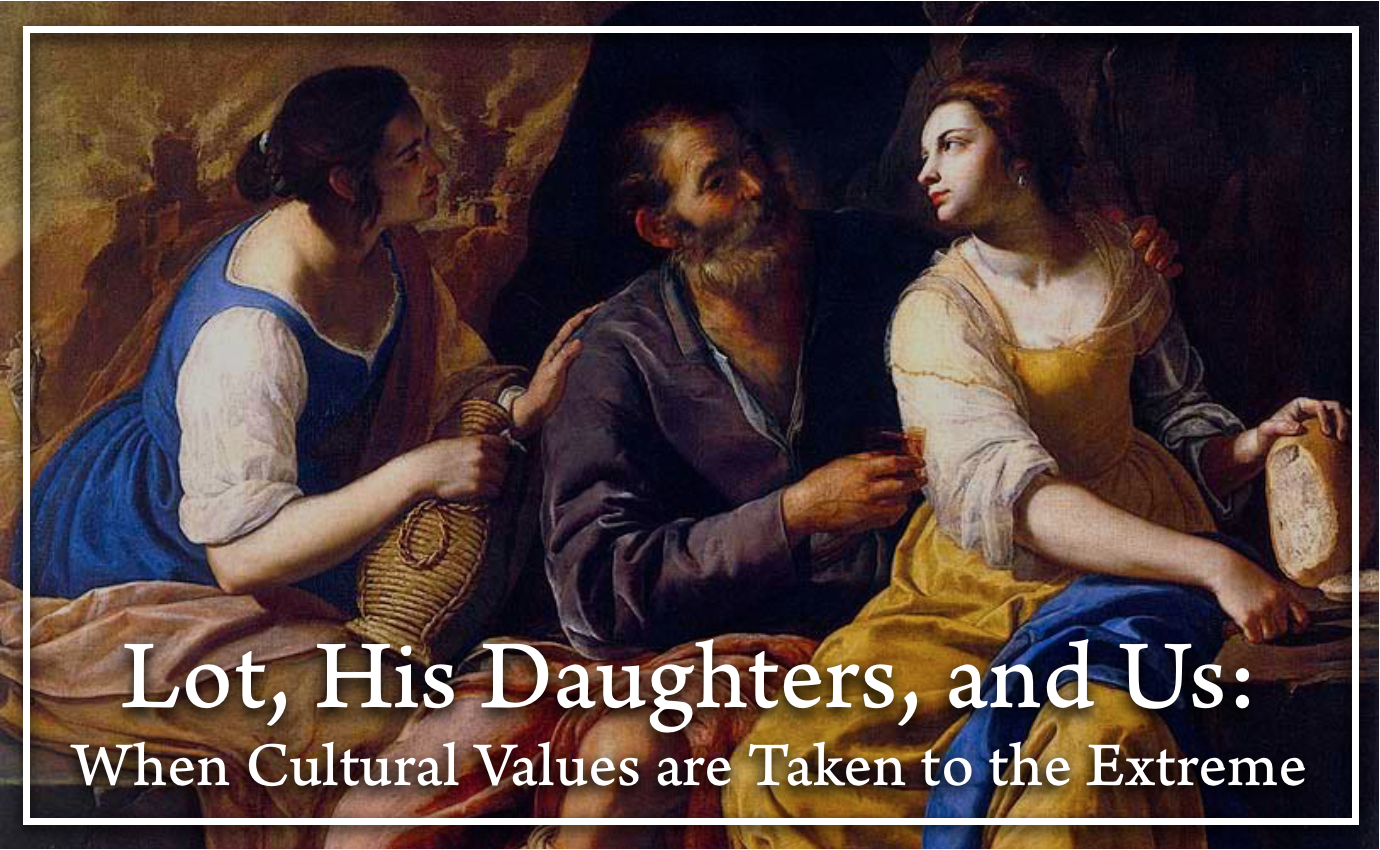
Lot, His Daughters, And Us: When Cultural Values are Taken to the Extreme

I’ve been encouraging my High School Bible Class to read through the narrative portions of Scripture this year and have been giving them a daily schedule to help. I think this is a good thing to do for many reasons, but one reason is that there are certain parts of the Bible which are often passed over in Bible classes and sermons, but it’s still important for people to know they are there (especially teens, who should be in the process of developing their own faith rather than relying on the faith of their parents).

When they made it to Genesis 19, I got a lot of questions, and as I discussed their questions with them, it struck me how often certain values that a culture emphasizes (which may be good in and of themselves) can be taken to dangerous and often sinful extremes.

The Importance of Hospitality

Genesis 19 covers the destruction of Sodom, which was something they were vaguely familiar with, but there were a couple of details that they had missed out on. Two angels, appearing as men, come to Sodom and stay with Lot, and the wicked men of the city bang on Lot’s doors and demand that Lot hand over the two men to them so they can engage in sexual relations with them. Lot’s response is shocking to our modern ears:

“Lot went out to the men at the entrance, shut the door after him, and said, ‘I beg you, my brothers, do not act so wickedly. Behold, I have to daughters who have not known any man. Let me bring them out to you, and do to them as you please. Only do nothing to these men, for they have come under the shelter of my roof.’”

Lot doesn’t seem to be in the running for any Father of the Year awards here, as he offers his daughters to the would-be rapists rather than his guests. That’s hard to understand unless you realize that the idea of hospitality and taking good care of one’s guests was of paramount importance in many ancient cultures (and some modern ones). It’s not that Lot was eager to give up his daughters—I’m sure he wasn’t—it’s just that hospitality was such an important cultural value that it led him to an extreme (and I would suggest, sinful) action. Fortunately for Lot’s daughters, the two angels intervene and strike the wicked men with blindness.

A Woman’s Value Through Child-Bearing

Another example of this phenomenon actually comes from the same chapter of Genesis. Ultimately, only Lot and his two daughters escape the destruction of Sodom, as his sons-in-law remained in the city and his wife was turned into a pillar of salt when she looked back on the destruction of the city.

Lot and his daughters flee to the hills and live in a cave, and here, another shocking development is recorded:

“And the firstborn said to the younger, ‘Our father is old, and there is not a man on earth to come in to us after the manner of all the earth. Come, let us make our father drink wine, and we will lie with him, that we may preserve offspring from our father.’ So they made their father drink wine that night. And the firstborn went in and lay with her father. He did not know when she lay down or when she arose.

The next day, the firstborn said to the younger, ‘Behold, I lay last night with my father. Let us make him drink wine tonight also. Then you go in and lie with him, that we may preserve offspring from our father.’ So they made their father drink wine that night also. And the younger arose and lay with him, and he did not know when she lay down or when she arose. Thus both the daughters of Lot became pregnant by their father.”

So a few days after Lot offers his daughters to rapists, they now get him drunk in order to sleep with him—Lot’s family seems to be the picture of dysfunction, right? Once again though, I think what we have here is a cultural value taken to an unhealthy extreme. In this case it seems that (as was often the case in many ancient cultures, and even some cultures today) for Lot’s daughters, their entire value as humans was derived from their ability to carry on the family line of their father through the bearing of children. With their husbands-to-be destroyed in the obliteration of Sodom and thus their means of child-bearing suddenly removed from them, Lot’s daughters turn to a sinful and (I imagine) undesirable last resort.

What About Us?

With a little careful reflection on the cultural forces that pulled on Lot and his daughters, I think their actions are a little more understandable. That being said, I don’t think these stories show us that the influences of culture validates sinful behavior—not at all. On the contrary, I believe one thing these stories do show us is how, if we’re not careful, the ideals we value as a culture can push us to do unthinkable things.

For example, in American society, one of our most sacred values is individual freedom. Many of the people who colonized the United States came here out of the desire to find freedom of one type or another. The American Revolution was fought because the descendants of those colonists felt that they should be free to govern themselves. The importance of liberty was hammered first into the Declaration of Independence and later into the U.S. Constitution, primarily through the Bill of Rights. As Americans, we pride ourselves on being free people.

But how could freedom be a bad thing? Well, it is the cultural value of freedom that, when taken to an extreme, is used to justify the yearly destruction of hundreds of thousands of unborn infants in the U.S. As a society, we are engaged in an ongoing genocide against our own unborn, but we pretend it is okay because supposedly, the mother should be free to do whatever she wants with her own body. It is cast as an issue of freedom and personal rights.

Clearly, our cultural values can cause moral blind spots for us today just as they did for Lot and his daughters some 4,000 years ago. Perhaps in the distant future, people will look back on our society and shake their heads in shame at the plague of abortion that we have embraced. And perhaps they will be able to somewhat understand our sin because of the cultural values that influence us and that we use to justify it.

But it will still be sin.

The Old Testament and Immigration

It’s always potentially controversial to mix the Bible and politics, but as Christians, shouldn’t our political views be informed by Scripture? If they are not, isn’t that a problem?

I have written some brief thoughts on the issue of immigration before, but in general, it is surprising and disappointing to me how frequently Christians endorse anti-immigrant political views considering the repeated and consistent witness of the Old Testament.

Consider the following scriptures:

“You shall not wrong a sojourner or oppress him, for you were sojourners in the land of Egypt.” (Exodus 22.21) 

“When a stranger sojourns with you in your land, you shall not do him wrong. You shall treat the stranger who sojourns with you as the native among you, and you shall love him as yourself, for you were strangers in the land of Egypt: I am the Lord your God.” (Leviticus 19.33-34) 

“He executes justice for the fatherless and the widow, and loves the sojourner, giving him food and clothing.” (Deuteronomy 10.18) 

“‘Cursed be anyone who perverts the justice due to the sojourner, the fatherless, and the widow.’ And all the people shall say, ‘Amen.’” (Deuteronomy 27.19) 

“For if you truly amend your ways and your deeds, if you truly execute justice one with another, if you do not oppress the sojourner, the fatherless, or the widow, or shed innocent blood in this place, and if you do not go after other gods to your own harm, then I will let you dwell in this place, in the land that I gave of old to your fathers…” (Jeremiah 7.5-7) 

“You shall allot it as an inheritance for yourselves and for the sojourners who reside among you and have had children among you. They shall be to you as native-born children of Israel. With you they shall be allotted an inheritance among the tribes of Israel.” (Ezekiel 47.22) 

“Thus says the Lord of hosts, Render true judgments, show kindness and mercy to one another, do not oppress the widow, the fatherless, the sojourner, or the poor, and let none of you devise evil against another in your heart.” (Zechariah 7.9-10) 

“Then I will draw near to you for judgment. I will be a swift witness against the sorcerers, against the adulterers, against those who swear falsely, against those who oppress the hired worker in his wages, the widow and the fatherless, against those who thrust aside the sojourner, and do not fear me, says the Lord of hosts.” (Malachi 3.5)

A few brief observations based on those verses:
First, someone will probably be quick to say something like, “All of those scriptures are from the Old Testament; Christians live under the New Testament” (because someone is always quick to say something like that). Of course, in a sense, they would be correct—as a Christian, I am not bound by all of the rules and regulations of the Law of Moses. At the same time, that doesn’t mean that consistent ethical principles from the Old Testament aren’t also meant to apply to Christians today (cf. Micah 6.8; Matthew 5.17).
Secondly, someone might point out that, while we are supposed to be kind and welcoming to immigrants (based on the verses above), according to Romans 13.1-7, we are to be subject to the laws of our land which means that we shouldn’t be supportive of illegal immigrants. And that might be true—I’m not really suggesting that Christians should develop an Underground Railroad to smuggle immigrants into the country illegally. However, if the consistent witness of Scripture is to suggest an “Open Arms” policy toward immigrants, then Christians probably do need to use their political influence to make immigration laws more immigrant-friendly (and thereby enable Christians to be subject to the laws of the land and also loving to immigrants).
Third, it should be remembered that these Old Testament directives were given to the Israelites, a people who were, as a general rule, supposed to remain ethnically pure as a means of ensuring faithfulness to Jehovah (when the people would intermarry with the surrounding peoples, it invariably led to the adoption of idolatry). Despite this, the Israelites were still supposed to be welcoming to foreigners. This is important to keep in mind, as a common objection to immigration has been a fear of the mixing of races or the influence of different religious beliefs.
Finally, a practical argument in favor of immigration has been that the United States is, fundamentally, a country of immigrants—how can we (American citizens) reject immigrants when the vast majority of us are here only because of the immigration of our ancestors? Interestingly, this is a repeated rationale of Scripture as well—how can the Israelites mistreat sojourners, when they themselves were sojourners in Egypt?
I have a hard time identifying closely with either major political party because, I believe, they both fail to consistently embrace biblical principles. When it comes to immigration, I think the rhetoric from the Right (and therefore, from a lot of Christians) often fails to live up to the biblical standard.

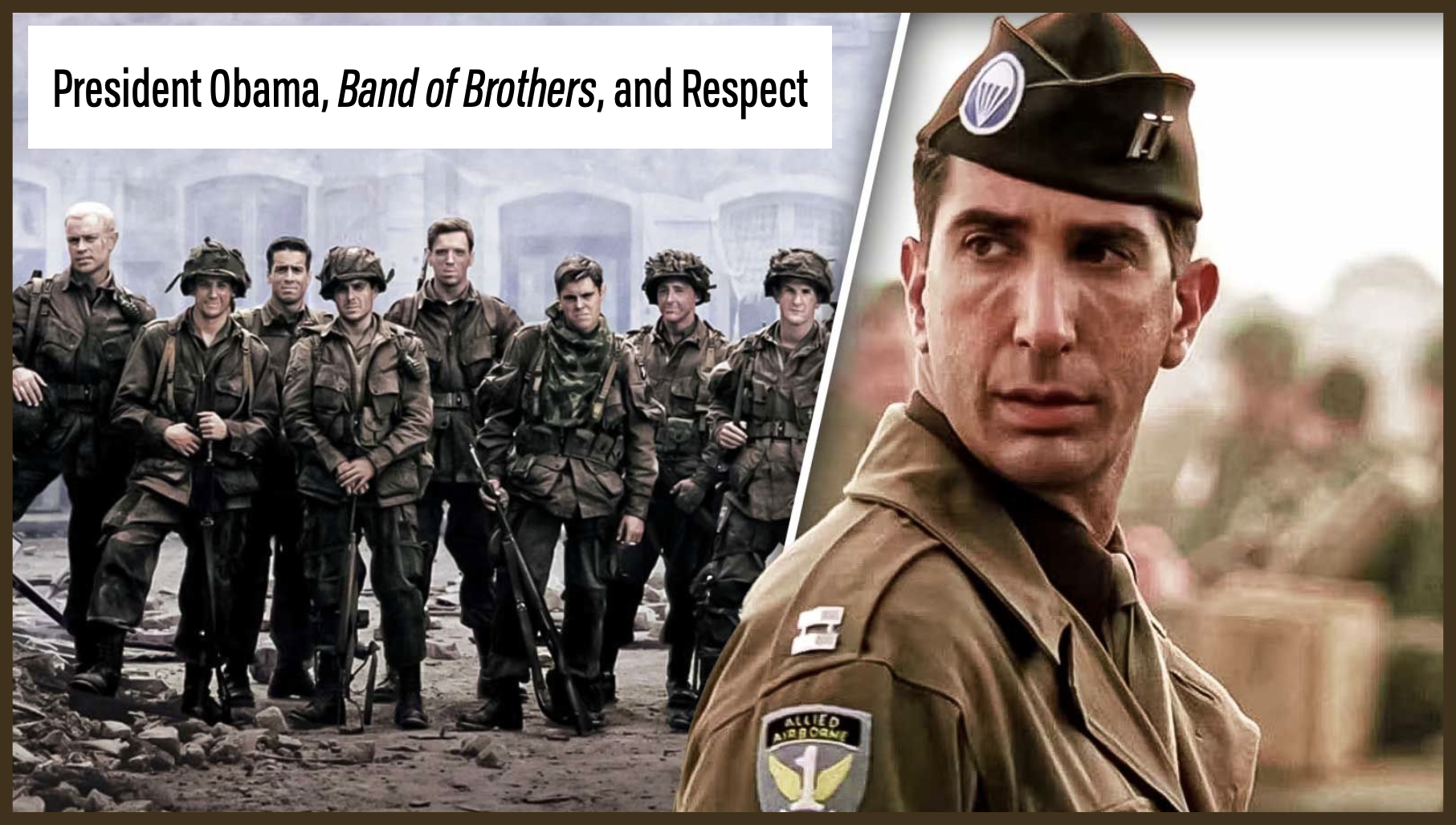
President Obama, Band of Brothers, and Respect

It used to frustrate me a lot to hear people constantly running down George W. Bush when he was in office. It wasn’t the people who had differences of opinion with him on policy that bothered me—it was those who felt it was appropriate for them to launch ceaseless personal attacks against the President of the United States.

Fast forward a few years, Barack Obama is in office, and the personal attacks continue (albeit, from a different portion of the population). Instead of calling him stupid (which they did with Bush), people call Obama a Muslim or a Communist, or accuse him of hating America. As with Bush, a basic lack of respect is shown for the President on a daily basis. I think that is unfortunate, but maybe not particularly surprising when you consider that people treating one another with respect isn’t really a defining characteristic of our culture these days.

One of my favorite scenes in Band of Brothers (which, by the way, I highly recommend) revolves around an interaction between Major Richard Winters and Captain Herbert Sobel.

At the beginning of the series, Sobel had been Winters’ commanding officer during training camp, and he was a difficult officer to work with—cruel, vindictive, and incapable of reading a field map. There was no love lost between Sobel and Winters, his executive officer. As time progressed, Sobel proved himself to be an inept officer and was transferred out of the unit, while Winters received one promotion after another, eventually becoming a major and a battalion commander.

Later on, Winters and Sobel cross paths again, but now, Winters, and not Sobel, is the senior officer. Sobel tries to walk past Winters without really acknowledging him or saluting, but then Winters forces him to do so and says something I absolutely love: “We salute the rank, not the man.”

Winters’ point is well taken, and ultimately, it’s one that I believe applies to Presidents as it does to superior officers—we owe them respect, not because of what we think about them personally, but because of the office they occupy (of course, it’s easier to respect admirable people, which is one reason why I think personal character is an important issue when it comes to choosing leaders).

Interestingly enough, this is a biblical idea as well. In Romans 13, in the context of talking about the Christian’s relationship with the government, the Apostle Paul says in verse 7:

“Pay to all what is owed to them: taxes to whom taxes are owed, revenue to whom revenue is owed, respect to whom respect is owed, honor to whom honor is owed.”

Later, in a similar context, the Apostle Peter conveys a similar message in 1 Peter 2.17:

“Honor everyone. Love the brotherhood. Fear God. Honor the emperor.”

I point out these scriptures because, unfortunately, Christians—from both sides of the political aisle— are often just as guilty of treating the President with disrespect as anyone else. I have some profound idealogical differences with our current President, and occasionally I’ll speak about those differences, but if I ever do so in a way that is disrespectful, I need to hear about it. Because it’s not right.

Honor the emperor, whether you like him or not.

Creation and Stewardship

Genesis 1.27-28 says,

“So God created man in His own image, in the image of God He created him; male and female He created them. And God blessed them, and God said to them, ‘Be fruitful and multiply and fill the earth and subdue it; and have dominion over the fish of the sea and over the birds of the air and over every living thing that moves upon the earth.’”

Referring to that passage of Scripture, I came upon a wonderful quotation from Father Robert A. Sirico in Environmental Stewardship in the Judeo-Christian Tradition regarding the way we should treat the environment from a biblical perspective:

“In our modern times, however, this biblical vision of the relationship between God, man, and nature is muddled by two false views. The one sees the natural world as the source of all value, man as an intruder, and God, if he exists at all, as so immanent in the natural order that he ceases to be distinguishable from it. The other places man as the source of all values, the natural order as merely instrumental to his aims, and God as often irrelevant. Genesis presents a radically different picture of how the world is put together.”

Discussions on the environment become highly charged and highly politicized in today’s climate (think global warming), and often the issue is painted as if there are only two options: either the protection of the environment is most important issue, or it isn’t important at all. The biblical perspective of stewardship falls between those two extremes, and is the position that Christians should seek to embrace.
« Older posts Newer posts »

© 2026 The Doc File

Theme by Anders Noren — Up ↑