The online journal of Luke Dockery

Category: Quotations (Page 6 of 17)

Book Review: Seven Congregations in a Roman Crucible

While on vacation, I was glad to be able to read Seven Congregations in a Roman Crucible: A Commentary on Revelation 1-3 by Richard Oster.

Dr. Oster is one of the professors at Harding School of Theology, and is known for his extensive knowledge of New Testament backgrounds, particularly through the study of ancient inscriptions, artwork, and numismatics (coins). In Seven Congregations, Oster does a masterful job of using that knowledge to help better explain John’s letters to the seven churches of Asia in the early chapters of the Book of Revelation.

Oster’s commentary focuses on the Asian congregations, and the challenges they faced as they were forced to choose between faithfulness to Christ and assimilation to the surrounding Roman culture. Interpretatively, Seven Congregations emphasizes the relevance of Revelation to the churches to whom it was written, rather than being a series of predictions of what would happen some 2,000 years in the future (which is exactly how far too many people read it). In addition to this emphasis and the fascinating background information, one of my favorite things about the book is the way in which Oster does not shy away from presenting ideas that are a part of Revelation but are not popular in today’s culture (you’ll see some of this reflected in the excerpts below).

I’ve selected some quotations which I enjoyed and which I think provide a good feel for the book (I have bolded certain parts for emphasis):

“As surprising as it might seem in light of centuries of mistaken emphasis, a careful examination of these six specific verses reveals that there is in fact no explicit reference to a temporary millennial enthronement of Christ in Revelation (20:4, 6). Furthermore, if this traditional view were true, then this millennial interregnum of Christ would stand in clear contradiction to the teachings of the rest of the New Testament regarding Christ’s cosmic enthronement.” (p.11)

“…The prophetic message of John is not designed only to comfort the afflicted. John’s words were also clearly written to afflict those Christians who were guilty of assimilation to idolatry, immorality, and emperor worship, either in the present or future. Without doubt the letters destined for the seven churches of Asia contain the promise of blessings to the faithful, the overcomes, but with equal clarity they contain the assurance of divine punishment and retribution for those believers who surrendered themselves to the pressures of the surrounding culture and its mores.” (21)

“The christophany of Rev 1:12-16…contains powerful and horrific imagery and does not portray a Jesus into whose lap one can sit and be cuddled.” (21)

“Indeed, the relevance of prophetic books lies in their specific connection with their own historical setting and not in their predictions about remote history and the end of humankind.” (24)

“Although it might initially sound strange to some futurists, this mention of Jesus’s “coming with the clouds” is one of the few references to Christ’s Second Coming in the entire book of Revelation. Most of the references to impending punishment in Revelation are either against the seven churches or are plagues, bowls of wrath, and the like, against the Roman Empire. Rarely in Revelation is the wrath of God and the Lamb directed against the entire planet with all its inhabitants.” (64)

“Specifically, John’s sectarian outlook considers all synagogue attending Jews who did not accept the messiahship of Jesus as no longer the true Jews…Thus Revelation agrees with other New Testament writings in its support of a modified replacement understanding of Israel and the Christ based congregation (cf. 1 Cor 3:11) of God…According to John, identification as a real Jew is determined on the basis of devotion to the Lamb rather than upon traditional Jewish criteria, e.g., birth and upbringing, adherence to Jewish statues and ceremony.” (124)

“Even though spiritual intolerance is currently the “unforgivable sin” in most areas of contemporary culture, both sacred and secular, this prevailing Western perspective does not represent the outlook revealed to John by Christ.” (148)

“…Christ’s kingdom is always subversive and has appeared explicitly to destroy alternative nations, empires, and their values, until “the kingdom of the world has become the kingdom of our Lord and of his Messiah, and he will reign forever and ever” (11:15).” (158)

“…This scene presented to the Laodicean congregation is patently not a prototype of the evangelical “sinner’s prayer” where Jesus is invited into the heart of the unregenerate sinner.” (191)

“…The meaning of repentance in Scripture is to change the direction of one’s life, not merely changing elements of intellectual assent.” (192)

“Unless intercession is only artificial role playing, then God’s future actions may be altered by the intercession of his people.” (207)

The commentary is 276 pages including notes and appendices, and though very scholarly, is still written in an engaging way (I was able to read it in a few days). I think the background information Seven Congregations provides is invaluable, and I look forward to reading the next volume.
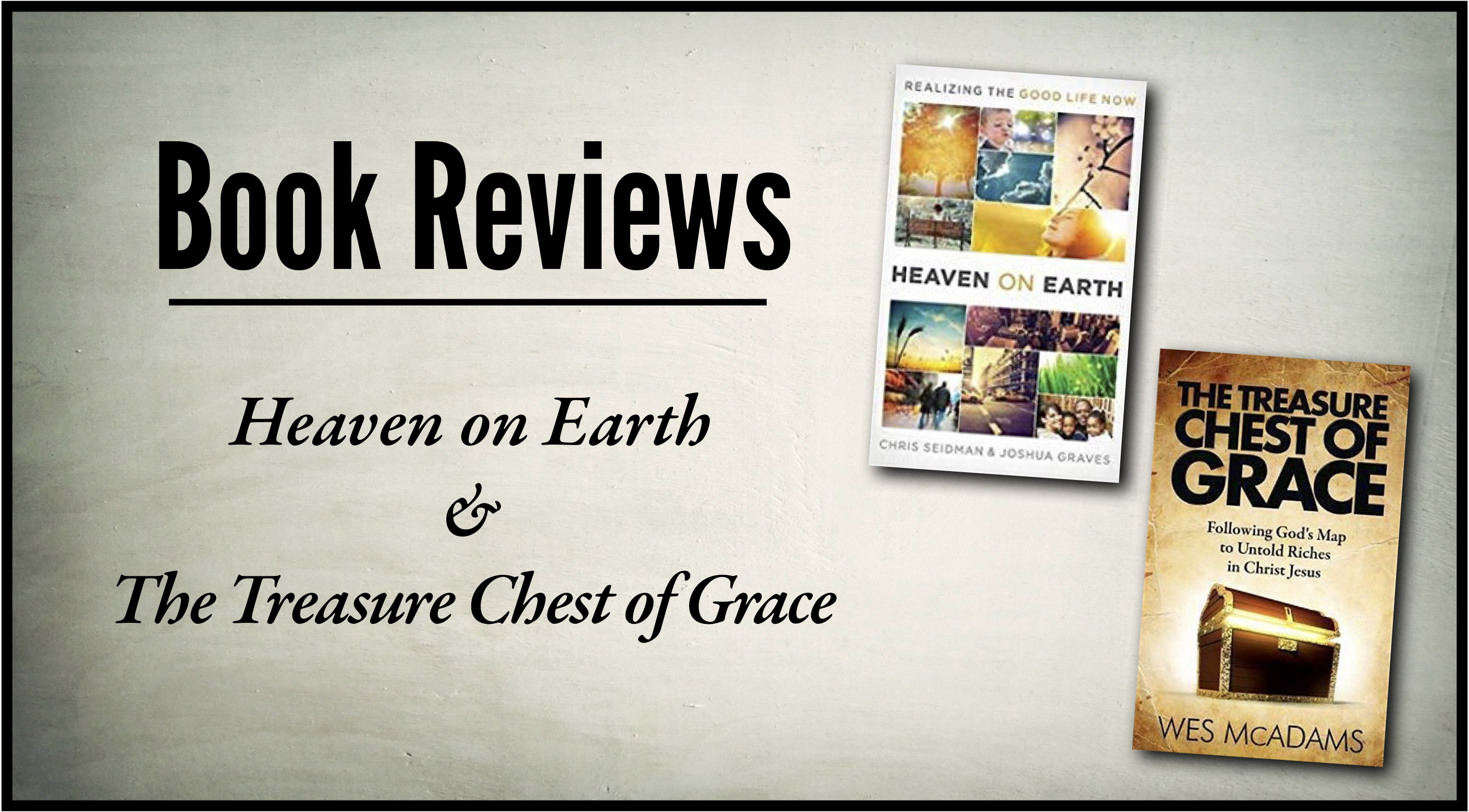
Two for One Book Reviews: Heaven on Earth and The Treasure Chest of Grace

I enjoy reading and sharing helpful things that I read with others. I like to read lots of different kinds of books, but as a minister and a theology students, a lot of what I read tends to focus on those areas.

As a part of my schooling, I read widely across the spectrum of Christianity. This invariably means that I read a lot of things I disagree with, but also that I am challenged to think about what the Bible teaches and what I believe frequently. That’s a good thing, I think.

Over the last several years, I have noticed a marked increase in the number of books being put out by ministers and thinkers within Churches of Christ. This is also a good thing, I think, and I have made an effort to read some of those books when I get the chance (and in the process, have come across some very good material). Having said all that, I wanted to offer some quick reviews of a couple of those books: Heaven on Earth: Realizing the Good Life Now, by Chris Seidman and Joshua Graves, and The Treasure Chest of Grace: Following God’s Map to Untold Riches in Christ Jesus, by Wes McAdams.

Heaven on Earth

Heaven on Earth was good, although it was not what I expected. The book is actually a careful examination of Jesus’ Beatitudes at the beginning of the Sermon on the Mount, and how living those out makes a difference in the here and now (while also identifying us as the kind of people who will be with Jesus eternally).

The subtitle, “Realizing the Good Life Now”, could potentially mean a lot of things, but basically, the authors assert that living this way (according to the Beatitudes) constitutes living the “good life”, and helps us to establish the ideals of God’s Kingdom on earth (to be clear, there are no hints of prosperity gospel nonsense in this book about how God wants us to be happy and therefore will shower us with material blessings if we are faithful to Him).

Each chapter covers a Beatitude, and discusses what it means as well as illustrating it with an abundance of real-life examples, mostly from modern day. The two authors do not write together, and instead, take turns writing different chapters. This is probably my main criticism of the book, as I think it gives it a choppiness in thought and style that wouldn’t be present if either writer was working entirely on his own.

Here are some good quotes:

“The good life is only possible in so far as God is involved. Experiencing the good life is more about what God has done and is doing that what we have done or are doing.” (xi)

“For Jesus, the kingdom of heaven had everything to do with life on this side of the grave while many of us are inclined to think it mostly has something to do with life on the other side. Consequently , we think of Jesus’ proclamation of the kingdom of heaven coming near as meaning through Jesus we now have access to the pace of heaven after we die. Even though this is one aspect of the context, it is not the entire context.” (3)

“The longer Paul dwelled in the kingdom of light the more aware he became of the darkness in his own life.” (16)

“Mourning is a pure vision of the large gulf between how things could be versus how things actually are.” (28)

“How do we respond to the pain and suffering that haunts us? Something’s amiss. Is life beautiful? Yes. But just on the horizon of its inherent beauty is a wild storm, waiting to tear everything to pieces, total destruction. Life is beautiful. But life is also deadly, depressing, and full of pain.” (33)

“Doing the right thing—whether individually (righteousness) or collectively (justice)—is always a primary interest of God in the prophets, because a life is the totality of choices made for the individual and the community.” (57)

“The person you are setting free when you reconcile is yourself.” (99)

“The most dangerous believers in the world to the kingdom of darkness are the ones who live as though they have nothing to lose.” (109)

“Faith is about seeing the world as God sees it. Not simply seeing the world for what it is—in all its paradox of beauty and death—but also seeing the world for what it will one day become.” (131)

The Treasure Chest of Grace

The Treasure Chest of Grace focuses on the fact that we have been saved by grace—nothing we have done or can do on our own has any bearing on salvation apart of the gracious acts of God on our behalf—and then sets about determining what conditions we must meet in order to become recipients of that grace. This is where the “map” of the subtitle comes in: the pages of Scripture reveal to us what we must do in order to come into contact with God’s grace.

This book differs significantly from Heaven on Earth in that McAdams uses no stories or modern-day examples to prove his points; he only uses Scripture. This is by design: “I have made every effort in this book to prove every point with Scripture, and only Scripture. No quotations of man are used to prove any point, only words inspired by God” (8). I understand his reasoning and certainly agree with him at the core (we should base our religious beliefs on Scripture, not something else), but I think the writing suffered somewhat as a result: a short book peppered with hundreds of Scripture references and no other illustrations or examples is harder to read. My other gentle critique is a subjective one: I don’t like really short chapters. The main body of the book is 144 pages long, and those pages are divided into 25 chapters, rendering the average chapter as a little less than six pages long. Constantly shifting from chapter to chapter gives the reader the impression that some thoughts haven’t been well developed (which I don’t think is true, I just think that many of the “chapters” would function better as sections within longer chapters).

Anyway, on to the quotes:

“Man is utterly incapable of earning the things we receive from God. This does not mean, of course, that we are incapable of obeying Him, pleasing Him, honoring Him, glorifying Him; but we must remember that by doing so, we have earned nothing.” (16)

“When people try to save themselves, they are communicating to God that they have no need for His grace.” (25)

“If there were nothing man had to do to receive salvation, there would be none who were lost.” (46)

“Too often people have assumed that because God freely gives grace, He gives it without conditions.” (78)

“Unfortunately many in the religious world have tried to sever the biblical ties between salvation and baptism” (97)

“Man is not saved because he obeys the gospel; he is saved when he obeys the gospel. The gospel itself, not the obedience of man, is the reason man is saved.” (106)

“Your salvation lies at the lace where His “amazing grace” meets your “trust and obey”.” (152)

“Do not mistake the emphasis on baptism to mean that it is more significant than it really is. Nor should you make the mistake of assuming baptism is meaningless or insignificant. Because it is a part of God’s plan to redeem man, it has great importance. But without the blood of Christ, baptism is nothing more than a glorified bath.” (155)

I thought both of these books were short, easy-to-read, helpful treatments of two very biblical ideas: what living the Beatitudes means for us as citizens of God’s Kingdom, and how God’s grace and our obedient faith work together in the act of salvation. I was thankful to have read both.

Dynamic Deacons

I haven’t been blogging much lately, which is usually an indication that I have been especially busy with other things. That is certainly the case right now—I am trying to finish up a challenging research paper, I have begun my fall class, and some ministry projects are requiring a good deal of time as well.

Briefly though, I wanted to offer a report on a seminar we had at our church over the weekend called Dynamic Deacons. Facilitated by Dr. Aubrey Johnson, the minister of the Peachtree City Church of Christ near Atlanta, this Friday-Saturday seminar was made up of five sessions which focused on the role, requirements, responsibilities, relationships, and rewards of serving as a deacon in the Body of Christ. The sessions were a combination of lecture and group discussion and were very practical.

Aubrey was a kind and engaging facilitator, and his love for the local church and his commitment to the importance and value of deacons was clear. I took notes throughout the weekend, and he also said a lot of wise things which I thought I would share:

Dynamic deacons always find a way forward.

Great churches are a consequence of great deacons.

When we do selfless acts that no one sees, God smiles.

God is not indifferent about indifference.

The most important thing you can do for God is to be the man your family needs.

Problems are often providence in disguise.

There are not enough jobs for everyone in the congregation, but there are enough teams for everyone to get on a team.

If you don’t have a real conversation, I don’t think you’re going to get a real commitment.

People do about as well as they’re led.

The congregation can’t be more united than its elders and deacons are.

To multiply your value to the church, build an incredible marriage.

I know that our deacons finished the weekend feeling encouraged and energized, and I am hopeful that some of the things that were discussed will lead to some positive, lasting changes. You can read more about Aubrey’s work, and schedule for him to come to your church, by going to his website; I certainly recommend his Dynamic Deacons seminar.

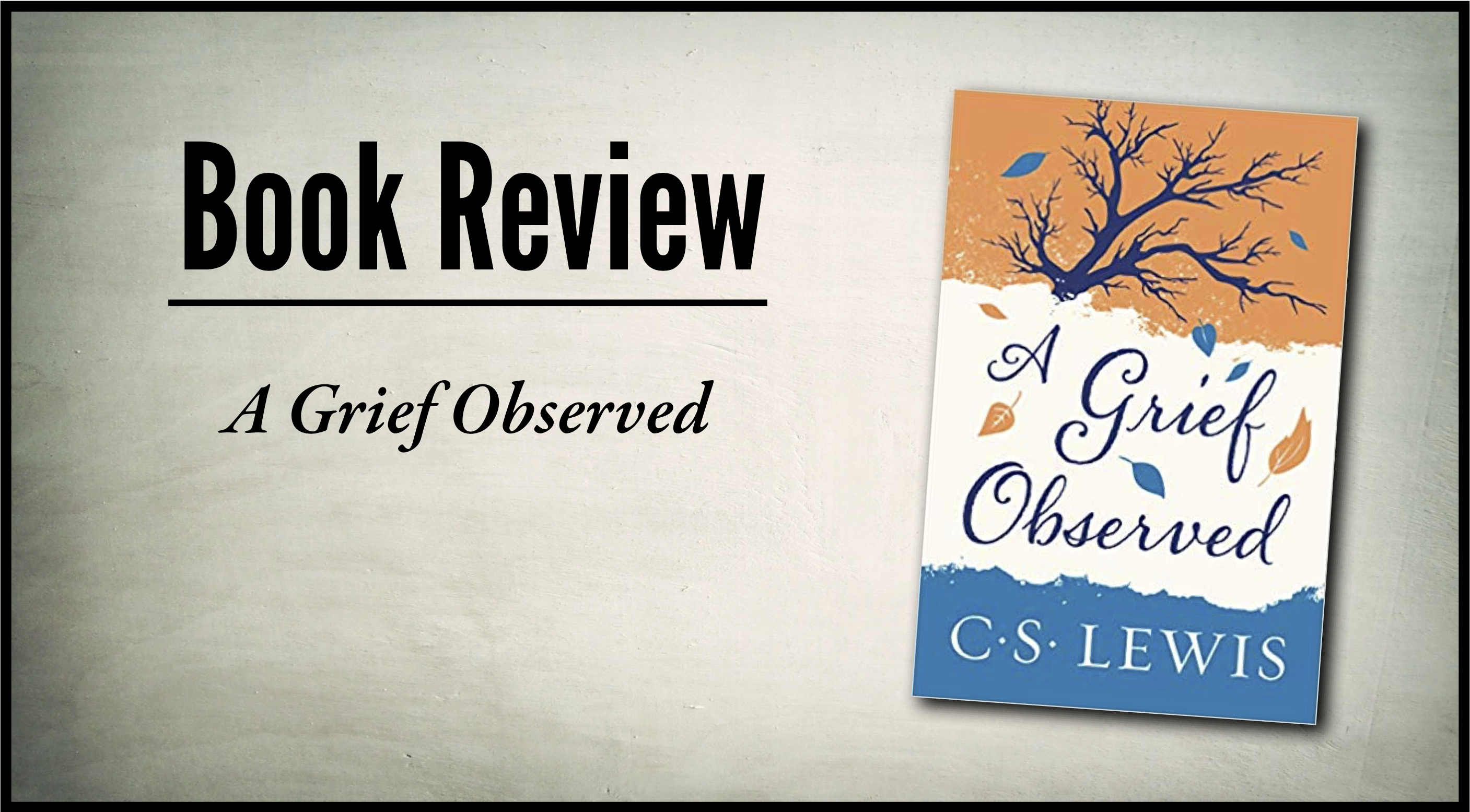
Book Review: A Grief Observed

I recently finished reading A Grief Observed by C.S. Lewis. Basically the book comes from journaling done by Lewis following the death of his wife and the grief he experienced following that event.

One thing that is interesting about the book is that it was written late in Lewis’s own life. To me, that makes his questions and frustrations that much more real, because this is after Lewis was already well-known as a Christian apologist and theologian (i.e. even C.S. Lewis struggled with grief).

I enjoyed this little book because I found it to be very personal and honest in the way it dealt with grief. Lewis didn’t try to explain his grief away or wrap it up in a neat package. This isn’t Lewis’s only book on this topic: The Problem of Pain addresses the issue of suffering in a more general, scholarly, and intellectual way; A Grief Observed is a more specific, personal, and raw treatment of the issue.

Here are some quotations I found to be helpful or insightful:

I not only live each endless day in grief, but live each day thinking about living each day in grief. (10)

Aren’t all these notes the senseless writings of a man who won’t accept the fact that there is nothing we can do with suffering except to suffer it? (33)

What’s wrong with the world to make it so flat, shabby, worn-out looking? Then I remember. (36)

What do people mean when they say, ‘I am not afraid of God because I know He is good’? Have they never even been to a dentist? (43)

You can’t see anything properly while your eyes are blurred with tears. (45)

We want to prove to ourselves that we are lovers on the grand scale, tragic heroes; not just ordinary privates in the huge army of the bereaved, slogging along and making the best of a bad job. (53)

Sorrow, however, turns out to be not a state but a process. (59)

My idea of God is not a divine idea. It has to be shattered time after time. He shatters it Himself. He is the great iconoclast. Could we not almost say that this shattering is one of the marks of His presence? The Incarnation is the supreme example; it leaves all previous ideas of the Messiah in ruins. (66)

I know the two great commandments, and I’d better get on with them. (69-70)

When it comes to grief and grieving, I find that people are very different, and thus, some books “work” better for some people than others. On the whole, I’m not sure if A Grief Observed was a powerful book for me, but I think it would certainly be very beneficial for some who were coping with grief.

Wealth, Discipleship, and American Christians

I continue to read David deSilva’s An Introduction to the New Testament, and to be really impressed by some of the things he has to say. In a discussion of Paul’s letters to Timothy and Titus, he says,

“The pursuit of wealth is a driving force of Western society, the key to what many people regard as the path to “life,” to the fullness of what life as to offer. The author warns us that, in the end, it does not deliver what it promises.

“Those who want to be rich fall into temptation and are trapped by many senseless and harmful desires that plunge people into ruin and destruction.…[I]n their eagerness to be rich some have wandered away from the faith and pierced themselves with many pains.” (1 Tim 6:9-10 NRSV)

To attain financial goals, as they are often called, both husband and wife often work, or one of them must work obscenely long hours. Those who are now young children suffer more and more from a lack of parenting. Is amassing wealth worth such piercing of hearts? The amount of time and energy invested in attaining our financial objectives, if these are set on wealth, often leaves very little time for discovery and exercise of those gifts that God has given each one of us for the nurture of the church and the care of others. The drive for acquiring more money means that seeking God and putting ourself at God’s service recedes. We serve a new master. That lifestyle is a path of pain—the pain of never acquiring enough to fill the void inside (because only God and meaningful investment in other people can do that), the pain of throwing away our lives for things that cannot give life, the pain of regret at the end of life, when our 20/20 hindsight will be our friend or our accuser.”

(p.773)

I think deSilva hits the nail on the head here. As a youth minister, I have watched parents who focus so much energy on their jobs in an effort to provide for their families (financial goals) that they end up actually neglecting their families because they deprive them of their time and influence (lack of parenting). As a minister in general, I have seen very talented people who are of almost no benefit to the church because they are so busy from working extra hours or extra jobs that they have little time for the Lord.

And, for what it’s worth, ministers are not immune to these problems. We are paid to be involved in the work of the church, so that part isn’t too difficult, but it is easy to be so involved in our work that our families are neglected. Furthermore, just because professional ministry isn’t a high-paying field doesn’t mean that ministers can’t also be too focused on money. Sometimes promising ministries are left and churches and families are damaged because a minister is looking for a higher salary. Sometimes a minister stays in a low-paying job, but as a result of that spends considerable worry and energy thinking about how little he has and how he can get more.

Whatever your situation is, money is a terrible master, and it can tear our loyalty away from God. That is a fact, regardless of whether we call our master “greed”, “financial goals”, or “providing for our families”. Serve God and use your money to glorify Him. Don’t serve money and be used by it.

« Older posts Newer posts »

© 2026 The Doc File

Theme by Anders Noren — Up ↑