The online journal of Luke Dockery

Category: Quotations (Page 7 of 17)

Watching Out for our Brothers and Sisters

More good stuff from David deSilva’s An Introduction to the New Testament: Contexts, Methods & Ministry Formation. In his discussion of the Book of Matthew, deSilva points out that Matthew locates the parable of the lost sheep (Matthew 18.10-14) within the context of several teachings about how believers are supposed to interact with one another:

“Matthew’s particular application of the parable of the “lost sheep” reminds the congregation that it is to be a community of people watching out for the sister or brother, a community in which members help one another to stay on track, to continue to “walk in line with the truth of the Gospel,” to borrow a phrase from Paul. Other New Testament voices also have much to say regarding our responsibility toward one another (Gal 6:1-2; Jas 5:19-20). Out of respect for another’s “privacy” or “rights,” or out of a philosophy of “minding one’s own business,” or out of a postmodern sense of “toleration” and “diversity,” many believers are reluctant to take up Matthew’s challenge to identify the ring, go after the wanderers, and bring them back to the right way. That hesitancy has facilitated many affairs, divorces, acts of dishonesty, and acts of abuse. Individuals facing powerful temptations or deep-rooted tendencies need the support, encouragement and commitment of their sisters and brothers if they are to rise victorious over the powers that seek to make shipwreck of their faith.”

(p.296)

How true this is! In our individualistic society, one of the worst things you can do is to stick your nose into someone else’s business. And yet, this is a fundamental part of what we are supposed to do as members of the family of God! If we ever find ourselves afraid of gently inserting ourselves into the lives of our brothers and sisters to help steer them on the right path, then we are listening more to the values of our culture than the values of Christ.

The Gospel as a Dissenting Voice

I am currently reading David deSilva’s An Introduction to the New Testament: Contexts, Methods & Ministry Formation for a grad school class. So far, I am really enjoying it, and since it is an incredibly long (900+ pages) book, I thought I would post some good quotations as I go, rather than write a really long review of such a massive book when I am done.

Discussing the environment of early Christianity in general and Christianity as related to Greco-Roman religion, deSilva says this:

“The Christian gospel, therefore, was also very much a political proclamation, an aberration, a dissenting voice. Even though it generally called for obedience to political authorities, it nevertheless threatened the socio-political order by calling its religious foundations into question as well as by calling it a temporary arrangement awaiting replacement by the order (kingdom) of the one God. The Christian gospel thus presented a grave affront to [Rome] and to all who found security and peace under her wings.”

(p.96)

In my thinking, Christianity should still come across as a dissenting voice. Christ’s kingdom is not of this world, which fundamentally means that we can’t truly be at home here.

Book Review: George MacDonald

George MacDonald was a Scottish author, poet, and Christian minister. I was aware of him primarily because he had a major influence on C.S. Lewis, and in fact, Lewis has said that MacDonald’s writings were instrumental in his acceptance of the Christian faith.

At one point, Lewis compiled an anthology of his favorite excerpts from MacDonald’s works, and that is what this volume is: 365 short readings taken from various books, sermons, and plays, and arranged and edited by Lewis himself.

Below are some of my favorite quotations [with my comments inserted in brackets]. I have included a lot of them because most are very short (and yes, I do realize that some irony is involved in me sharing my favorite quotations from a book which is essentially C.S. Lewis’s favorite quotations):

“For He regards men not as they are merely, but as they shall be; not as they shall be merely, but as they are now growing, or capable of growing, toward that image after which He made them that they might grow to it.” (p.3)

“It may be an infinitely less evil to murder a man than to refuse to forgive him. The former may be the act of a moment of passion: the latter is the heart’s choice. It is spiritual murder, the worst, to hate, to brood over the feeling that excludes, that, in our microcosm, kills the image, the idea of the hated.” (p.7) [This is a helpful perspective: refusing to forgive is truly a premeditated, cold-blooded act. It is soul-destroying.]

“Truth is truth, whether from the lips of Jesus or Balaam.” (p.8) [I think this speaks strongly against the idea that, if we disagree with someone about something, we can’t cooperate with them in any sense, affirm anything they say, or applaud anything they do. I think truth belongs to God, and should be affirmed whenever we hear it, regardless of the source.]

“But it is not the rich man only who is under the dominion of things; they too are slaves who, having no money, are unhappy from the lack of it.” (p.38) [Materialism can crush the rich and poor alike.]

“However bad I may be, I am the child of God, and therein lies my blame. Ah, I would not lose my blame! In my blame lies my hope.” (p.64)

“Of all things let us avoid the false refuge of a weary collapse, a hopeless yielding to things as they are. It is the life in us that is discontented: we need more of what is discontented, not more of the cause of its discontent.” (p.70) [I think N.T. Wright would be in full agreement with this!]

“If the Lord were to appear this day in England as once in Palestine, He would not come in the halo of the painters of with that wintry shine of effeminate beauty, of sweet weakness, in which it is their helpless custom to represent Him.” (p.91)

“…Dare I give quarter to what I see to be a lie because my brother believes it?” (p.105)

“While a satisfied justice is an unavoidable eternal event, a satisfied revenge is an eternal impossibility.” (p.121)

“It is not by driving away our brother that we can be alone with God.” (p.127)

“Our human life is often, at best, but an oscillation between the extremes which together make the truth.” (p.134) [So many problems and so many false teachings come about as a form of extremism. Balance is important.]

“Dissociate immortality from the living Immortality, and it is not a thing to be desired.” (p.141) [I think too many people see the primary benefit of eternal salvation as getting to live forever. But I think the Bible is clear that the primary benefit is getting to be with God forever. Without the latter, the former would be a punishment, not a reward.]

“There are those who in their very first seeking of it are nearer to the Kingdom of Heaven than many who have for years believed themselves of it. In the former there is more of the mind of Jesus, and when He calls them they recognize Him at once and go after Him; while the others examine Him from head to foot, and finding Him not sufficiently like the Jesus of their conception, turn their backs and go to church or chapel or chamber to kneel before a vague form mingled of tradition and fancy.” (p.144-45) [Ouch.]

“By obeying one learns how to obey.” (p.154)

“With every morn my life afresh must break the crust of self, gathered about me fresh.” (p.158) [Christianity is about dying to self. Every. Single. Day.]

“A beast does not know that he is a beast, an the nearer a man gets to being a beast the less he knows it.” (p.160)

“We are often unable to tell people what they need to know, because they want to know something else.” (p.168)

On the whole, I enjoyed reading George MacDonald, though the nature of the book meant that the quotations were, necessarily, removed from their fuller context and made for choppy reading if you read it as a regular book (which I did) rather than reading one excerpt per day. I do think it would be a helpful devotional book to read on a daily basis. The readings are short (5-6 words to a page) but powerful, and could do much to properly orient your perspective before you plunge into the world (say, right before you get out of the car when you are at work).

N.T. Wright on What the Bible Is (and Is Not)

I recently finished reading N.T. Wright’s Surprised By Hope: Rethinking Heaven, the Resurrection, and the Mission of the Church. For a variety of reasons, it has taken me far too long to read, but it has challenged me and I have enjoyed it. I haven’t decided yet whether or not I’m going to do an actual review of it, but I wanted to share the following quotation about what the Bible is and is not:

“The Bible is not, in other words, simply a list of true doctrines or a collection of proper moral commands—though it includes plenty of both. The Bible is not simply the record of what various people thought as they struggled to know God and follow him, though it is that as well. It is not simply the record of past revelations, as though what mattered were to study such things in the hopes that one might have one for oneself. It is the book whose whole narrative is about new creation, that is, about resurrection, so that when each of the gospels ends with the raising of Jesus from the dead, and when Revelation ends with new heavens and new earth populated by God’s people risen from the dead, this should come not as a surprise but as the ultimate fulfillment of what the story had been about all along.”

(pp. 282-83)

There is a balance to that perspective that I really like. There are many things which the Bible does or contains that do not comprise its primary focus. That doesn’t make them unimportant, but we should try to keep things in their proper place. For example, it makes me very uncomfortable when I hear the Bible described as “God’s rule book for how to live.” Certainly the Bible contains rules and it does tell us how to live, but isn’t it more that that?

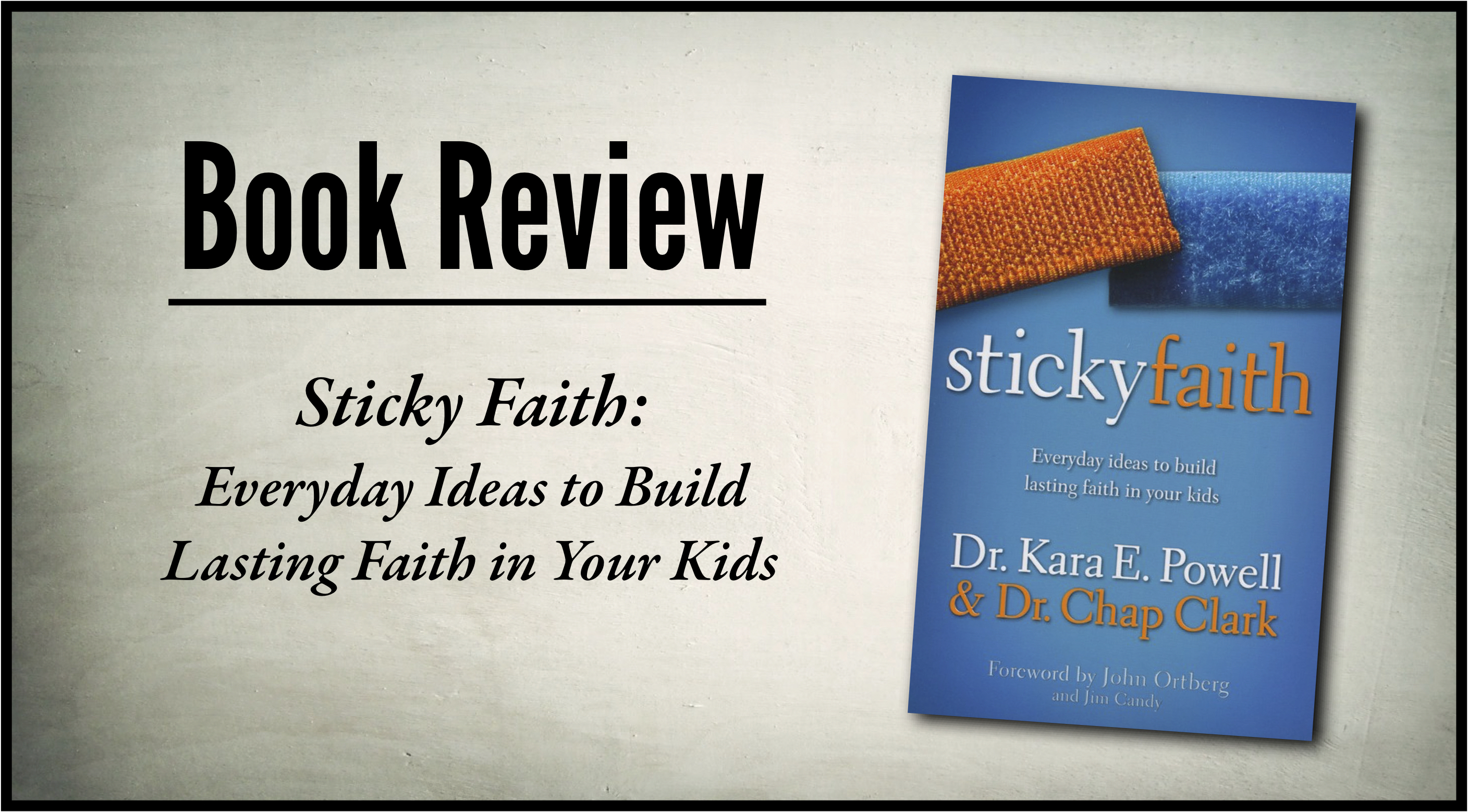
Book Review: Sticky Faith

I have just finished reading Sticky Faith: Everyday Ideas to Build Lasting Faith in Your Kids for the second time. Looking back, I was surprised that I hadn’t reviewed it here on my blog previously (though I have referenced it several times), so I thought I would quickly do so today. Quite simply, Sticky Faith is an outstanding book, and it’s one that I think all parents should read. I’m actually co-teaching a class on it right now at church, and along with 2-3 other sources, it forms the core of my youth ministry library.

Sticky Faith is written for parents (though there are other versions for youth workers and students), and is all about helping you to instill a lasting faith (or a faith that “sticks”, hence the title) in your children. And I’m sure there are a lot of books like that, but what I really like about Sticky Faith is that (1) it is based on extensive research, and (2) it offers incredibly practical suggestions of tangible things you can do to help faith development in your kids.

Like any book, there are some ideas and suggestions in Sticky Faith that I disagree with, and I’m sure it will be that way for you too. But that doesn’t change the fact that, overall, it is an incredibly helpful resource for Christian parents.

Here are some of my favorite quotations from the book [my comments are added in brackets]:

“…Our conclusion is that 40 to 50 percent of kids who graduate from a church of youth group will fail to stick with their faith in college…only 20 percent of college students who leave the faith planned to do so during high school. The remaining 80 percent intended to stick with their faith but didn’t.” (pp. 15-16) [There are a lot of other alarming statistics which they gather from their research. These helpful numbers describe a big problem, which the rest of the book then sets about trying to address.]

“How you express and live out your faith may have a greater impact on your son or daughter than anything else.” (p. 25)

“…A performance-based Christianity can last only so long.” (p. 36)

“The greatest gift you can give your children is to let them see you struggle and wrestle with how to live a lifetime of trust in God.” (p. 46)

“If I had to choose between living out my faith or talking about my faith in front of my kids, I’d choose the former every time. But I don’t have to choose. And neither do you. We can do both.” (p.70)

“The closest our research has come to that definitive silver bullet is this sticky finding: for high school and college students, there is a relationship between attendance at church-wide worship services and Sticky Faith.” (p. 97) [Parents, this should make you think twice before missing church for a hunting trip, or a baseball tournament, or some other family outing. It matters. Youth ministers, this should make us think twice before frequently removing our youth groups from our congregational worship gatherings. A big part of being the Body of Christ is being present with the Body of Christ.]

“Over and over, students have told us that the first two weeks at college are when they make key decisions about drinking and other high-risk behaviors, right along with choosing whether to go to church or to a campus ministry.” (p. 151)

“It’s okay to go through periods of doubt and distrust and disillusionment. It’s okay to go through periods of questioning and confusion. Don’t run away from them. At the same time, don’t go off the deep end. Do the intellectual and spiritual soul searching within the context of a secure community of people who truly love you.” (p. 172) [This quote actually came from a student who was part of the research study—a lot of wisdom here!]

“But [kids] soon come to know that faith is ultimately meaningless unless they choose it for themselves.” (p. 179) [Yes. We must own our faith, rather than simply inherit the faith of our parents.]

“Especially during their lowest times, your kids need to know that, above all else, you are there for them, regardless of what they are going through.” (p. 180)

“If your family has served Christ through much of your child’s life, the seeds you have planted are potent and real.” (p. 187)

I could go on and on—large sections of my copy of Sticky Faith are highlighted or underlined—but these quotations should give you an idea of what the book is like. In short, I would recommend it to any Christian parent, or anyone who works closely with teens.

« Older posts Newer posts »

© 2026 The Doc File

Theme by Anders Noren — Up ↑