The online journal of Luke Dockery

Category: Books (Page 20 of 27)

How Do You Read?

I enjoy reading and write about books quite a bit. Growing up I read a lot, but that slowed when I went to college and got busy with a lot of other things. After college I settled into adult life, and picked up the habit again.

When I started graduate school in 2010, I knew I would have a ton of school-related reading to do and I was afraid that this would cause me to dislike reading, but instead, the opposite happened: I now want to read all the time, and I have a long list of books to read in addition to my required reading for school.

For most of my life, I have been a guy who read one book at a time. This trend changed in grad school where time constraints required me to overlap the books I was reading, and gradually I have come to enjoy reading multiple books at once. That being said, I realized last week that this Reading Multiple Books At Once thing has really gotten out of hand.

Concurrently, I was reading:

  • Two books on ministry in small churches
  • Two books on youth ministry (actually I finished one and then immediately started and quickly finished another)
  • One book on the history of Churches of Christ in the 20th century
  • One book on biblical exegesis
  • One book on Genesis
  • One book of daily devotionals
  • One book based on the sermons and writings of Archbishop Oscar Romero
  • A lesson book on Ephesians for my Sunday morning Bible class
  • The Bible (specifically, I am in Psalms right now)

Let me just say: this is a terrible way to read. My attention is so split that it is particularly difficult to remember exactly where I read something. I am also completely out of bookmarks (which are very necessary, since I have no way of remembering my place in 11 different books).

Furthermore, reading this many books simultaneously is not a sign that I am smart for being able to balance them; it is a sign that I am dumb for trying to do so in the first place!

By nature, a few of these books are part of my daily or weekly routine (Bible, devotionals, Bible class), but other than these, I’d like to get back to just reading 1-3 other books at a time.

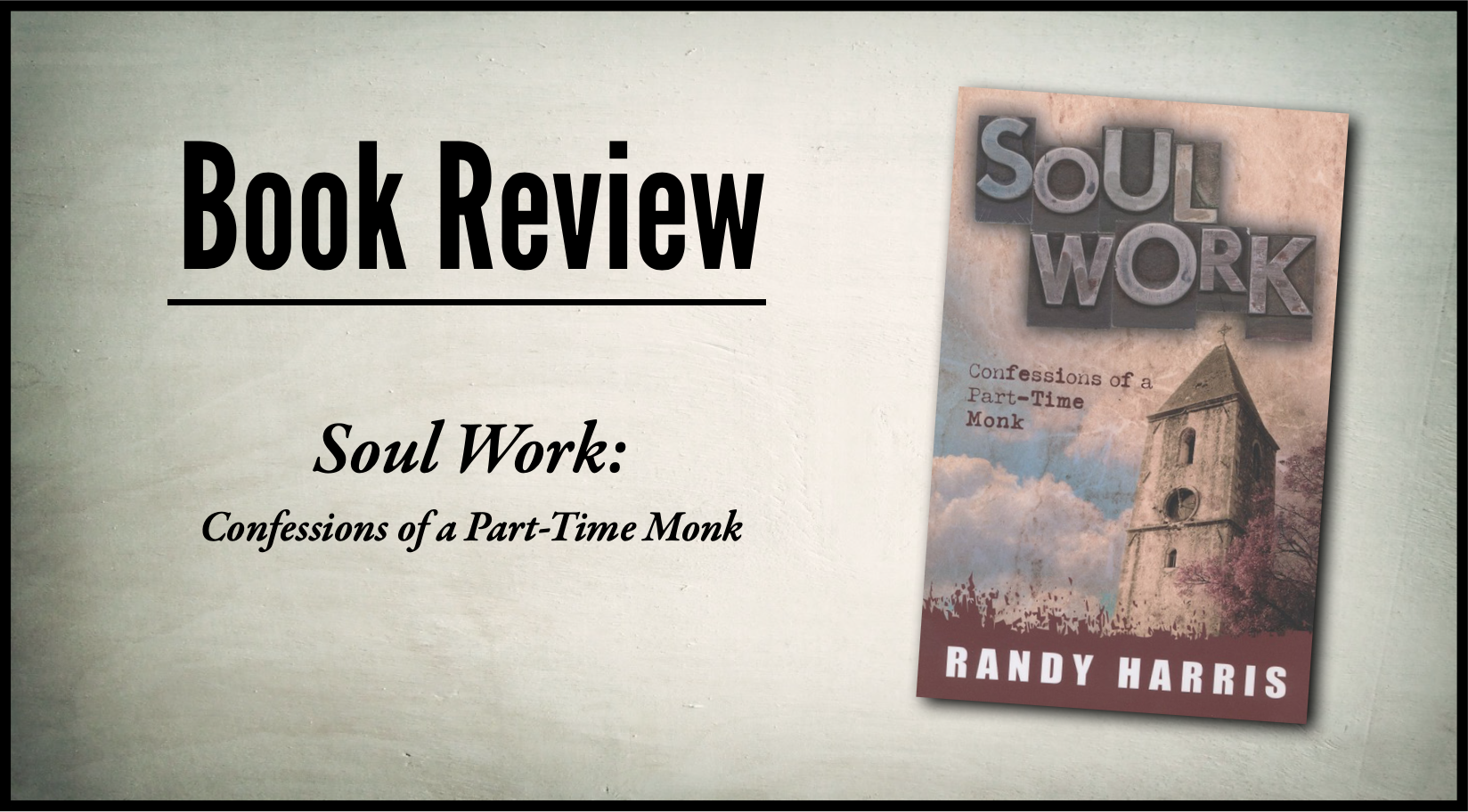
Book Review: Soul Work

As I mentioned in this post, I intend to do somewhat better in 2013 in regards to writing about books which I read. I really don’t enjoy writing book reviews (probably because it reminds me too much of school), but from time to time I will try to write very informal reviews and share some quotations which I found to be helpful or insightful.

I recently finished reading Soul Work: Confessions of a Part-Time Monk, by Randy Harris, which focuses on prayer and spiritual living. Harris has spent considerable time among monks and religious hermits (making him somewhat of an oddity for a Church of Christ minister and professor) to gain insight on the disciples of prayer, silence, and solitude, and in Soul Work, he shares some of the lessons he has learned.

Harris has an easy-to-read style, is full of humor, and doesn’t take himself too seriously at all. Parts of the book were a little mystical for me, but he had a lot of good things to say. Here are some of my favorite quotations (with random thoughts by me in brackets):

“One of the reasons that I think we struggle with prayer so much is that we think we need it so little.” (p. 13) [Ouch.]

“If you’re willing to walk and talk and spend time with God, he’ll start to remake your life even when you don’t know what’s going on.” (17)

“Obedience and submission aren’t really tested until you have to submit or obey in situations where you’re pretty sure you know a better way.” (56)

“We often give ourselves credit for obedience when we do what we’ve already wanted to do anyway—when the real test of obedience is doing what we don’t want to do.” (57) [Ouch, again.]

“Optimism depends on human beings and hope depends on God. And while I don’t see any reason to be optimistic, I see every reason to be hopeful.” (66)

“We would get healthier if we committed to fewer things over longer periods of time.” (72)  [Our obsessed-with-activity culture would benefit greatly from this wisdom.]

“Things are learned in suffering that can be learned in no other way.” (99)

“What would we lose if we lost all suffering in the world? There’s no longer any courage. There’s no longer any compassion. There’s no one to be compassionate towards. There’s no longer any patience. There’s no longer any endurance. There’s no longer the love that doesn’t give up when life goes badly. I don’t know about you, but it sounds like you give up an awful lot.” (100) [Great perspective on suffering.]

“Many of the most important events in your life are going to be ones over which not only do you have no control but which you’re not even going to see coming. And there is nothing like one of those events to burst your illusion about being one of those people who’ve got things under control. Nobody expects that their children will die before them. No one looks for that debilitating disease.” (102-103) [Wow, this really rang true to me.]

“Often the greatest ministry you do is while you’re on the way to do what you think is the important ministry.” (147) [I have found this to be true in my ministry as well.]

“The goal is not to have us praying more. The goal is to have us aware of and practicing God’s presence every moment of every day.” (154)

If you are interested in examining your prayer life and looking at prayer from several perspectives that you likely haven’t before, I recommend this book.

Reading in 2012

I like statistics, I like making lists, and I like competing with myself, so a few years ago I started keeping track of the books I read each year.
Here is my reading list for 2012:
  1. Garden of Beasts, by Jeffery Deaver
  2. In His Steps, by Charles Sheldon
  3. Jesus and Jonah, by J. W. McGarvey
  4. How we Got the Bible, by Neil R. Lightfoot
  5. Mystic River, by Dennis Lehane
  6. Killer Angels, by Michael Shaara
  7. Watchmen, by Alan Moore
  8. Biggest Brother: The Life of Major Dick Winters, the Man who Led the Band of Brothers, by Larry Alexander
  9. The Devil in the White City, by Erik Larson
  10. Batman: The Dark Knight Returns, by Frank Miller
  11. The Days of My Life, by George L. Dockery
  12. Sticky Faith: Everyday Ideas to Build Lasting Faith in your Kids, by Kara E. Powell and Chap Clark
  13. V for Vendetta, by Alan Moore and David Lloyd
  14. Will God Run?, by Charles Hodge
  15. For Freedom: The Biography of John Nelson Armstrong, by L.C. Sears
  16. Determining the Form: Structures for Preaching, by O. Wesley Allen Jr.
  17. Greek To Me: Learning New Testament Greek Through Memory Visualization, by J. Lyle Story and Cullen I.K. Story
  18. Steeped in the Holy: Preaching as Spiritual Practice, by Raewynne J. Whiteley
  19. The Practice of Preaching, by Paul Scott Wilson
  20. The Witness of Preaching, by Thomas G. Long
  21. Emergence of the “Church of Christ” Denomination, by David Edwin Harrell
  22. The Mystery of Cabin Island, by Franklin W. Dixon
  23. The Sinister Signpost, by Franklin W. Dixon
  24. A Study in Scarlet, by Sir Arthur Conan Doyle
  25. In the Garden of Beasts, by Erik Larson
  26. Southern Horrors: Lynch Law in all its Phases, by Ida B. Wells
  27. Hub Fans Bid Kid Adieu, by John Updike
  28. Fielder from Nowhere, by Jackson Scholz
  29. The Status of Missions in Churches of Christ: A Nationwide Survey of Churches of Christ, by Gailyn Van Rheenen and Bob Waldron
  30. The Fall of the House of Usher, by Edgar Allan Poe
  31. The Darth Side: Memoirs of a Monster, by Cheeseburger Brown
  32. Encountering Missionary Life and Work: Preparing for Intercultural Ministry, by Tom Steffen and Lois McKinney Douglas
  33. Christianity in Culture: A Study in Biblical Theologizing in Cross-Cultural Perspective, by Charles H. Kraft*
  34. The Church of Christ in the 21st Century, by Mark Adams
  35. Reading New Testament Greek: Complete Word Lists and Reader’s Guide, by Bernard Brandon Scott, Margaret Dean, Kristen Sparks, and Frances LaZar
  36. The Mark on the Door, by Franklin W. Dixon
  37. It’s Still Greek to Me: An Easy-to-Understand Guide to Intermediate Greek, by David Alan Black
  38. Set Free? Stay Free! The Fallacy and Failure of Legalism, by Larry Deason
  39. Using Twitter Effectively as a Congregation, by Adam Faughn
  40. Is The Bible Really Completely True? A Deeper Understanding of Biblical Inerrancy, by Matt Robertson
  41. Friend-O-Nomics: How Friendliness Can Make Your Youth Ministry Grow, by Rick Lawrence
  42. A Church That Flies: A New Call to Restoration in the Churches of Christ, by Tim Woodroof
  43. My Friend Dahmer, by Derf Backderf
  44. Stars in the Shadows: The Negro League All-Star Game of 1934, by Charles R. Smith Jr.
  45. The Story, by Biblica**

I stated at the beginning of last year that I intended to write more book reviews in 2012, but I didn’t do very well in that regard. I would like to do better in 2013, but I also realize that for whatever reason, I hate writing book reviews so I’m not sure that I will. Still, even if I don’t write formal reviews, I will try to share helpful quotations and ideas from books that I enjoy.

I read some really good books in 2012. The Devil in the White City and Mystic River were both great (though disturbing), and I also enjoyed Biggest Brother and Killer Angels. Moving over to biblical and theological books, For Freedom was an excellent biography on J.N. Armstrong, the first president of Harding University, and a helpful window into Restoration Movement studies as well. How We Got The Bible was a useful primer on the history of the Bible, The Church of Christ in the 21st Century is an excellent book for Bible class study, and The Status of Missions in Churches of Christ was a very helpful survey book which every Church of Christ elder and minister should read. Undoubtedly though, the gem of the year was Sticky Faith: Everyday Ideas to Build Lasting Faith in your Kids. This is a wonderful book which I believe should be read by every minister and Christian parent in the world. Seriously (it’s so good I just linked to it!).

Disappointing books that I read in 2012 include In His Steps (why is this book famous?), Is The Bible Really Completely True? (a very poor and barely coherent defense of inerrancy), In The Garden of Beasts (which was pretty good, but just disappointing after reading The Devil in the White City), and Christianity in Culture (which was truly unreadable). I also forayed into the graphic novel medium in 2012, but was rather disappointed by some of its highly-rated volumes: Watchmen, V for Vendetta, and Batman: The Dark Knight Returns (none of them were awful; neither were they very good).

My overall book total increased from 39 in 2011 to 45 in 2012. Realistically, I think this is about my limit. Maybe I could push it to 50, but with the delicate time balance that I currently maintain, I’m fairly pleased with this amount.

I’ve already started reading in 2013 and have a long list of books to read (I got 15-20 books for Christmas!), but I’m also interested in the recommendations of others. What were your favorite books from 2012?

(For comparison’s sake, you can see the books I read in 2011, 2010, 2009, and 2008).

*Full disclosure: I didn’t read this entire book. I read the first 1/3-1/2, and then skimmed the rest because of time constraints (it was an assignment for a class). As I mentioned above, I thought it was almost unreadable—some good ideas, but in need of significant editing.

**This was part of Biblica’s new Bible translation which puts the NIV in chronological order and removes chapter and verse numbers to make the text more readable. “The Story” was a compilation of Luke and Acts which we used for our youth group Bible class this past quarter. Since it was self-contained and over 100 pages on its own, I listed it on my reading list separate from my regular Bible reading for the year.
Dealing With Interruptions

This post has nothing to do with ESPN’s Pardon the Interruption. It’s a good show though.
In response to a post I wrote about time management where I mentioned having interruptions at work, one reader pointed me to a great quotation from Spiritual Leadership: Principles of Excellence for Every Believer by J. Oswald Sanders (thanks Karen!):
“One busy man told me how he mastered the problem of interruptions. ‘Up to some years ago,’ he testified, ‘I was always annoyed by them, which was really a form of selfishness on my part. People used to walk in and say, ‘Well, I just had two hours to kill here between trains, and I thought I would come and see you.’

That used to bother me. Then the Lord convinced me that He sends people our way. He sent Philip to the Ethiopian eunuch. He sent Barnabas to see Saul. The same applies today. God sends people our way.

So when someone comes in, I say, ‘The Lord must have brought you here. Let us find out why He sent you. Let us have prayer.’ Well this does two things. the interview takes on new importance because God is in it. And it generally shortens the interview. If a visitor knows you are looking for reasons why God should have brought him, and there are none apparent, the visit becomes pleasant but brief.

So now I take interruptions as from the Lord. They belong in my schedule, because the schedule is God’s to arrange at His pleasure.’”

I think it’s a great quotation, and it underscores the fact that sometimes, interruptions happen for a real reason. I say sometimes and not always because I don’t believe the popular mantra that “Everything happens for a reason.” But a lot of things do happen for a reason, and a little bit of probing and discernment can usually help you to see that.
It also underscores the fact that, if someone has interrupted by schedule with a real need, their need is more important than my schedule. If we claim to be servants of God, then we need to serve Him in all areas of life, and that means to serve Him with my schedule as well.
One last note on “ministry interruptions”: a wise and experienced minister once told me that when church members come by randomly just to shoot the breeze (and thus, interrupting his study time), he will enlist their aid in some ministry responsibility (making a visit, working on some project, etc.). In his experience, this has either led to productive visits where work is completed, or a reduction in those kinds of visits!

“The Myth of our Cultural Superiority”

In Christianity in Culture: A Study in Biblical Theologizing in Cross-Cultural Perspective, author Charles Kraft offer a stinging critique of western society:

“When one turns to the weaknesses of our culture, the myth of our cultural superiority falls to pieces. For example, we have poured so much of our resources into technological development that we have created social disorientation and disruption at every level of our society. Many families fall apart because they are unable to compete with our so-called educational system. The latter, for the sake of some imaginary ‘better’ future (defined in technological and materialistic terms) indoctrinates our youth against the past in general and their parents in particular (including any religious commitment they may have). Our quest for freedom and individualism, not to mention our mobility, mitigates against the development of close friendships, strong family ties, neighborliness, and stable marriages. Our extreme competitiveness, expressed interpersonally, intergenerationally, economically, vocationally, politically, and even between churches, is ripping our society apart. The naturalistic worldview at the center of our culture, the depersonalization of our people, the uncontrolled competitiveness between the various segments of our society, the choice usually to value the unknown and untried above the known but imperfect—these and so many other features to our society point not to its superiority but to its sickness.”

I am not one who holds that all creatures are inherently equal, and there are many things about western society that I greatly appreciate, but I think Kraft blows to pieces the perspective of those who hold that it is the pinnacle of everything.
« Older posts Newer posts »

© 2026 The Doc File

Theme by Anders Noren — Up ↑







