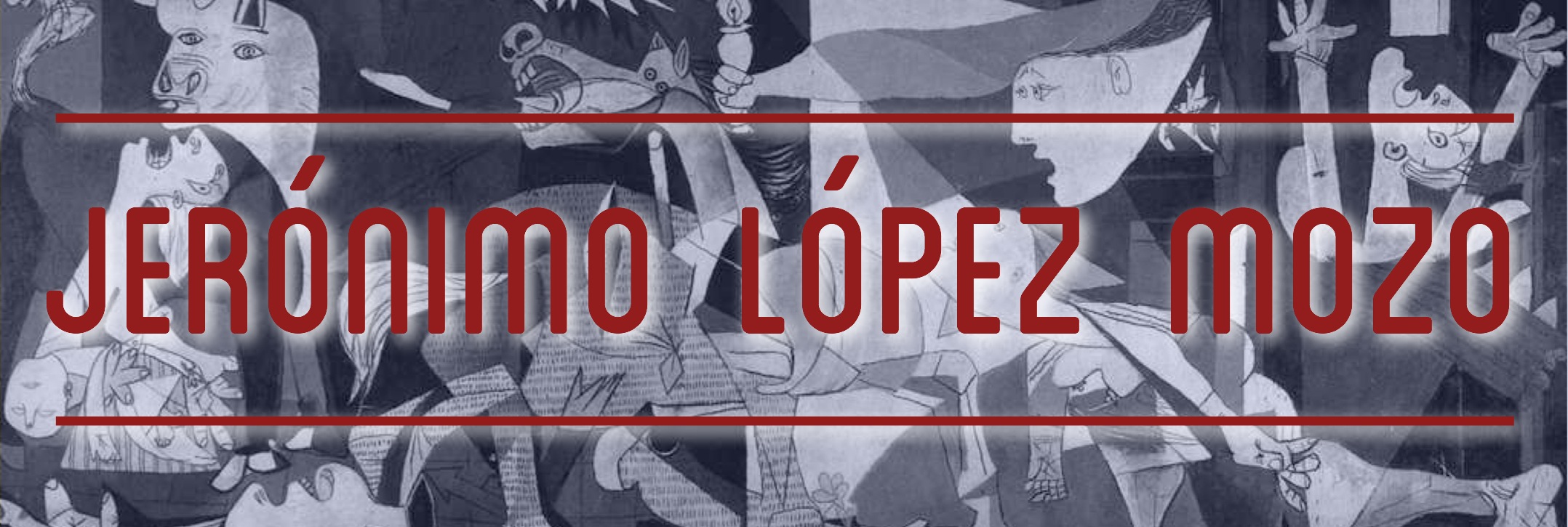
Jerónimo López Mozo es un dramaturgo muy prolífico quien es conocido por sus técnicas innovativas y también por sus relaciones antagonísticas con el gobierno de Generalísimo Franco en los años sesenta y setenta. Durante su vida, López Mozo ha escrito más que sesenta obras, incluyendo Guernica, un drama anti-guerra que fue inspirado por el cuadro famoso de Picasso, y que muestra ambos de sus características principales.
Jerónimo López Mozo nació en Gerona, Cataluña el 15 de mayo de 1942. Cuando López Mozo tenía cuatro años, su familia se trasladó a Toledo, y cuando tenía ocho años, su familia se trasladó otra vez a Madrid. López Mozo vivió en Madrid durante los años cincuenta y cursaba estudios en la Escuela Superior de Ingenieros Agrónomos de Madrid y recibió su título como Ingeniero Agrícola en 1964.[1] También en 1964, López Mozo escribió su primera obra de teatro, Los novios o la teoría de los números combinatorios. En 1966, fue instrumental en la fundación de la Federación Nacional de Teatro Universitario.[2]
Está considerado como parte de la generación llamada el “Nuevo Teatro Español”, un grupo de escritores de los años sesenta y setenta que trabajaban con grupos universitarios e independientes y participaban en numerosas creaciones colectivas.[3] Según a López Mozo, el Nuevo Teatro Español era unido por su odio al régimen de Franco, y no por sus estilos similares.[4] También, George Wellwarth, un profesor estadounidense se refiere a la obra de López Mozo como “underground drama” o “teatro censurado”.[5]
En facto, López Mozo tenía muchas problemas con el gobierno franquista, y la Junta de Censura no se permitieron casi 75 por ciento de sus obras, generalmente a causa del contenido crítico, aunque usualmente simbólico, de sus obras y sus creyencias ideológicas contra al régimen de Franco.[6] A pesar de sus problemas causado por la Junta de Censura, López Mozo dice que “escribí como si no existiera la Junta de Censura…supuso que buena parte de mis obras fueran prohibidas…[pero] no impidió…su publicación… en locales que escapaban a su control.”[7]
Desde la muerte de Franco en 1975 y el término de su gobierno fascista, la obra de López Mozo ha recibido más atención favorable crítica y popular también.[8] Pero, es todavía difícil encontrar sus obras en librerías y tiendas. López Mozo dice que es difícil encontrar obras de teatro en general porque “los textos dramáticos apenas interesan ni a los editores, ni a los distribuidores, ni a los libreros. Se venden poco y el precio no puede ser elevado.”[9]
Aparte de sus obras dramáticas, López Mozo ha sido muy activo en el mundo literario durante los años noventa. Desde 1995 a 1998, ocupó la Secretaría General de la Asociación de Autores de Teatro (AAT), desde 1998 ha pertenecido a la Asociación de Escritores de Teatro Infantil y Juvenil (AETIJ), y hasta 2004, formó parte del Consejo de Lectura del Centro Dramático Nacional.[10]
Desde López Mozo escribió su primera obra en 1964, ha escrito más que sesenta obras en solitario o en colaboración con otros autores. La mayoridad de las escrituras de López Mozo son creaciones teatrales, pero ha escrito cuentos, novelas, y ensayos también.[11] Sus dramas teatrales fueron influidos por el teatro del absurdo de la segunda mitad del siglo veinte, pero “a partir de 1990 ha incorporado a su obra elementos propios del teatro realista, que, hasta entonces, había rechazado.”[12] Sobre todo, los dramas de López Mozo son caracterizados por la búsqueda constante de nuevas formas de expresión teatral (por ejemplo, el uso de la proyección de película y el fragmentación estructural), y como resultado, sus dramas tienen “algunas de las técnicas más avanzadas, pero también más sólidas del teatro occidental contemporáneo.”[13]
Durante su carrera como dramaturgo, López Mozo ha recibido más que veinte premios y reconocimientos notables por su obra, empezando en 1968 cuando ganó el Premio Sitges de Teatro por Moncho y Mimí. Otros dramas y premios importantes incluyen el Buho de Bronce de la Institución Cultural Vox por Guernica en 1976, el Premio Tirso de Molina en 1996 y el Premio Nacional de Literatura Dramática en 1998, ambos por Ahlán, y el Premio Serantes de Teatro por La Infanta de Velázquez en 2000.[14]
Guernica, un drama anti-guerra que fue escrito por López Mozo en 1969, es una de sus obras mejor sabido. Esta drama fue inspirado por el cuadro famoso de Pablo Picasso del mismo título que cuenta la historia de un pueblo vasco que fue bombado por los Nazis de Alemania el 26 de Abril, 1937, durante la Guerra Civil Española. Durante la guerra, el gobierno fascista de Franco estaba aliado con los Nazis de Adolf Hitler, y Guernica fue atacado para desmoralizar las esfuerzas republicanas. Fue el primer ataque masivo aéreo contra una población civil en historia. En el cuadro y en el drama también, Picasso y López Mozo tratan de representar la vivacidad del pueblo y el horror que experimentó.[15]
El drama Guernica de López Mozo empiece con una sinopsis breve de que ocurrió—que 1.754 personas estaban matado y 889 estaban herido durante el ataque sorprendente. Entonces, los actores entran en la escena con piezas de un rompecabezas grande y se disponen a colocar las piezas como mural grande y reconstruyen el cuadro Guernica de Picasso.
Entonces, la voz de un narrador empiece a leer poemas anti-guerras del escritores tal como Pablo Neruda y Alberti. Al mismo tiempo, hay un ruido inmenso. Al primero, es el sonido de altavoces y el doblar de campanas, y entonces, se oye los motores de aviones en la lejanía. Se acercan hasta su rugido domina el sonido de las altavoces y campanas. Entonces, hay el sonido de bombardeo, los silbidos de bombas y proyectiles, explosiones, y gritos de miedo y dolor.
Después de eso, se proyectan fotografías y filmas en pantallas del bombardeo: un grupo de bombaderos en el aire, una bomba en vuelo, las calles del pueblo, le gente en refugio, una Guernica destruida, y unas cadáveres a los lados de un camino.
Finalmente, después de todo eso, los personajes comienzan a aparecer. En la Guernica de López Mozo, todos los personajes del drama son los mismos personajes del cuadro de Picasso: la mujer del incendio, la madre con su hijo muerto, la mujer que mira la luz, el toro, el caballo, el guerrero, el pájaro, la flor, y la portadora de la lámpara. Entonces, cada personaje dice su parte del cuento del bombardeo. Por ejemplo, la mujer del incendio está en la cocina recogiendo la mesa cuando oye el sonido de las campanas, y el ruido de aviones y explosiones. Ella va a la ventana, y ve que hay gente corriendo en las calles. De repente, una bomba estalla en su casa, y hay cascotes por todas partes. Las sabanas, los manteles, y las cortinas de la ventana se queman, y ella no puede respirar a causa del humo. Quiere salir de la casa, pero ve que muchas otras casas están incendiando también, que el pueblo entero es un fuego grande, y que es inútil salir. El fuego arde la ropa y la carne de la mujer. Ella grita desesperadamente, y se muere.
Los otros personajes dicen un cuento similar, y al fin, todos han muerto excepto la portadora de la lámpara, quien ha llegado tarde, después del bombardeo. Con la luz de su lámpara, ella ve las cadáveres y la destrucción del bombardeo, y con indignación y enojo, dice que “mi lámpara seguirá encendida señalando al mundo el lugar en que se ha consumado el crimen.”
Ella se sitúa ante el mural grande de la pintura Guernica, y el ruido y las proyecciones del bombardeo cesan. Los otros actores aparecen, y cada uno toma un cirio y lo encienda en el fuego de la lámpara de la portadora. Entonces, se dirigen al público y el fuego se multiplica de unos cirios a otros, y el drama termina.
Puesto que Guernica es un obra de teatro, es difícil a encontrar crítica acerca de la escritura de López Mozo en lugar de crítica de la música o los actores. Pero, hay alguna crítica de la organización del drama. Según a Tom Hawkinson, el drama es un poco tedioso a causa de los personajes del cuadro de Picasso están aislados y enfatizados tantas veces.[16]
Pero, Hawkinson tiene cosas buenas decir de Guernica también. Dice que el drama es muy bueno para transmitir el dolor de los personajes mientras recordando un importante incidente internacional de que la mayoridad de personas no han oido o han olvidado. También, piensa que el diseño del escenario, especialmente con el mural de la Guernica de Picasso es bello.[17]
A causa de no yo podía verlo el drama Guernica, tenía que usar mi imaginación cuando lo leía, pero todavía me gustaba mucho. Me gustaba el uso de los personajes del cuadro como los personajes del drama y sus historias individuales, y también me gustaba los efectos sonidos del bombardeo que continuaban por todo el drama. Pero mi cosa favorita del drama fue como la portadora de la lámpara daba la luz a la audencia que era simbólico de dar el conocimiento de la tragedia al mundo. Estoy seguro que, en un teatro, con los monólogos de los personajes, los efectos sonidos, y el uso simbólico de la luz, sería un drama muy conmovedor y poderoso.
Aunque López Mozo no es todavía bien conocido en los Estados Unidos, es un dramaturgo importante y influencia en España. Sus obras, como Guernica, no son solamente dramas innovativos y populares, pero también funcionan como acusaciones de la régimen turbulenta de Franco.
[1]“Jerónimo López Mozo.” Caos Editorial: http://www.caoseditorial.com/autores/ficha.asp?lg=es%id=29. March 26, 2005.
[2]Campal, José Luis. “Introducción a una bibliografía de la obra dramática de Jerónimo López Mozo.” La Ratonera: http://www.la-ratonera.net/numero4/n4_mozo.html. March 26, 2005.
[3]“Jerónimo López Mozo.” Cátedra Miguel Delibes: http://www.catedramdelibes.com/archivos/000103.html. March 26, 2005.
[4]Ferrer, Carlos. “Entrevista a Jerónimo López Mozo.” Anika Entre Libros: http://www.libros.ciberanika.com/entre51.htm. March 29, 2005.
[5]“El teatro español a partir de 1940.” http://free.hostdepartment.com//d/deflor/70.htm. March 26, 2005.
[6]Campal.
[7]Ferrer.
[8]“Cultural Night from Spain: Music and Theatre.” Loyola University: http://www.loyno.edu/newsandcalendars/release.php?id=707. March 26, 2005.
[9]Ferrer.
[10]Campal; Cátedra Miguel Delibes.
[11]Campal.
[12]Caos Editorial.
[13]“El teatro español a partir de 1940.”
[14]Cátedra Miguel Delibes.
[15]Hawkinson, Tom. “Picasso’s Guernica.” TheaterMania.com: http://1067litefm.theatermania.com/content/news.cfm/story/521. March 26, 2005. “Bombing of Guernica.” Wikipedia: http://en.wikipedia.org/wiki/Bombing_of_Guernica. March 27, 2005.
[16]Hawkinson.
[17]Ibid.

 As a theology grad student, I read a ton of stuff about religion, theology, and doctrine from a wide variety of sources. I also hear a lot of podcasts, sermons and devotionals. And some of the stuff I read and hear is really, really good, but some of it I’m not too sure about and some stuff I think is absolutely wrong.








