The online journal of Luke Dockery

Category: Sports (Page 10 of 16)

Determined To Be The Best

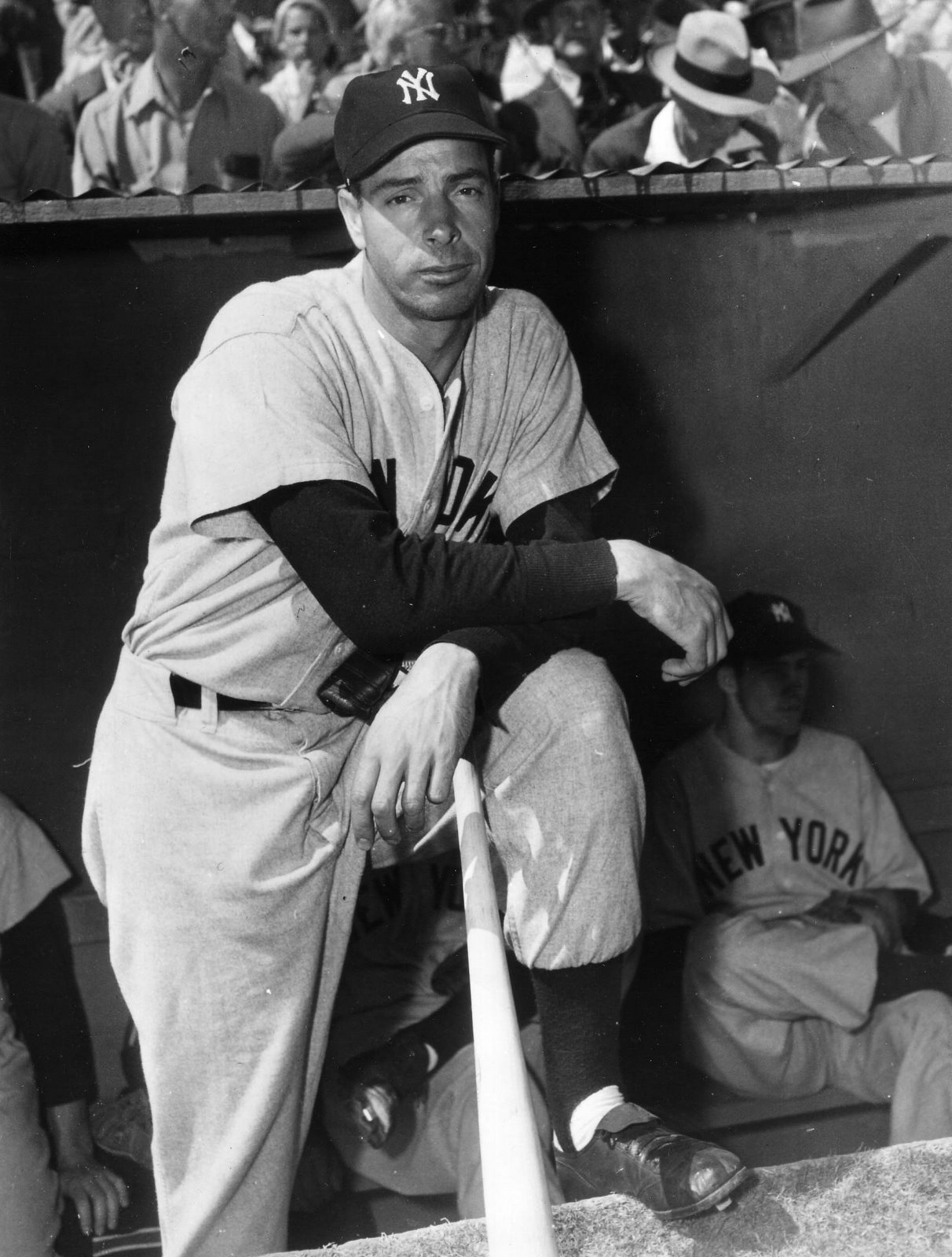
One of my favorite all-time baseball players is Joe DiMaggio. In the history of baseball, there have been other players who were better, but there have been few, if any, who so excelled in every facet of the game.

DiMaggio put up impressive numbers. He was a three-time MVP. He led the league in home runs and batting average twice. In 1941, he got a hit in 56 consecutive games—widely considered the most unbreakable record in professional sports. And he was a winner. In his 13 seasons with the Yankees, they won 10 Pennants and 9 World Series.

When it came to baseball, Joe DiMaggio was it. He was the peak; the pinnacle; as good as it got. And he knew it.

Pride and vanity can certainly be negative traits, and they were traits that DiMaggio possessed in abundance, but in his case, they spurred him to greatness. He liked the legend he had created for himself, and he was absolutely determined to live up to it. He did so by playing incredibly hard, while still making it look like everything he did on the field was effortless. The graceful way he played earned him the nickname, “The Yankee Clipper.”

DiMaggio always battled injuries, and late in his career, it got harder and harder for him to stay in the lineup and put up the impressive numbers that everyone was used to. Finally, in 1951 at a relatively young 36 years of age, DiMaggio walked away from the game, not content to just be an average player. As teammate Lefty Gomez put it, he retired because “he couldn’t be Joe DiMaggio anymore.”

There’s a lot to be said for setting high expectations for yourself and not settling for anything less, and in a time when our heroes seem to let us down all too often, it’s comforting to think about a guy like Joltin’ Joe, the hero who never did.

Once, late in a season when the Yankees had already clinched the American League Pennant and were just finishing out the rest of the season, one of Joe’s teammates asked him, “Why do you play so hard in a game that means nothing for your team?”

He replied, “Because there’s at least one person in the stands that has never seen Joe DiMaggio play before.”

I love that quote, and the idea it represents.

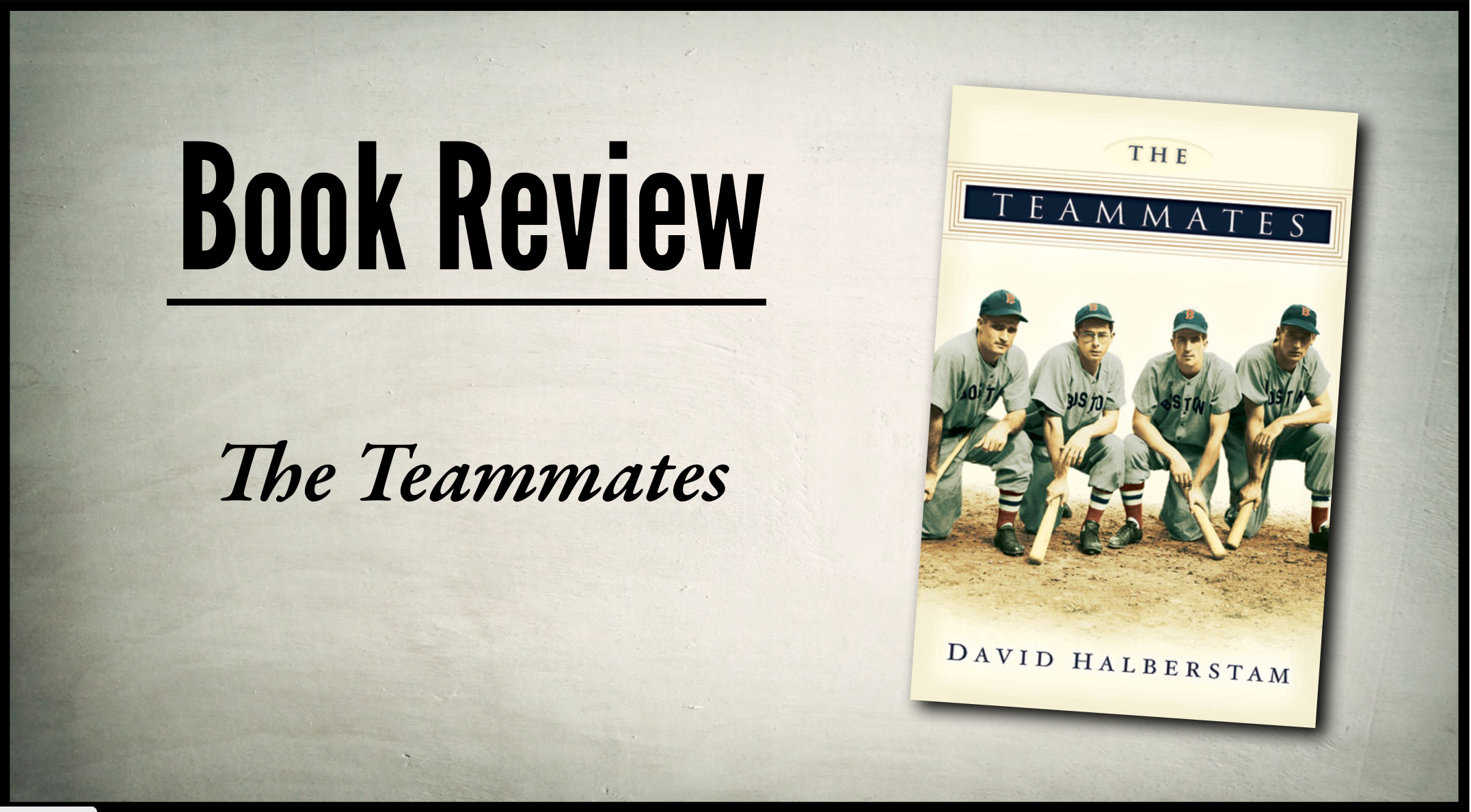
Book Review: The Teammates

Baseball has not been quite as appealing to me this year.

The steroid sagas of Clemens and Bonds have left me a bit cynical, the season-ending injury to John Smoltz and Atlanta’s inability to win one-run games has left me depressed, and TBS’s decision to no longer broadcast Braves games has left me out of touch.

But two things have kept me interested: Chipper Jones’ impressive run at .400 (maybe I’ll write about that later), and one of the best baseball books I have ever read, The Teammates, by David Halberstam.

The Teammates tells the story of four Boston Red Sox icons—Ted Williams, Dominic DiMaggio, Bobby Doerr and Johnny Pesky—the years they played together and the friendship they shared, which spanned 50 years.

In October of 2001, when Williams fell ill and his friends knew it was near the end, they traveled 1,300 miles by car to see him one more time.

Much of the book focuses on Ted Williams, the leader of the group, and possibly the greatest hitter in baseball history. On the relationship between Williams and Joe DiMaggio, Ted’s rival as the other dominant player of the 30s and 40s, Halberstam writes:

“The two had not been close when they played. Joe DiMaggio was the most aloof of men; he held out genuine warmth of friendship not even to his younger brother or his long-time teammates, let alone to Ted Williams, the one baseball player against whom he was constantly measured. Ted, by contrast, was far more open, far more generous, and far more volatile. After they quit playing his only real connection to Joe, other than through his admiration for him and his love of Joe’s younger brother, was the fact that for some 50 years they stood together atop the same pedestal of excellence, honored and celebrated at countless baseball dinners, posing for a seemingly endless number of photographs reflecting baseball’s royalty from an earlier age.

Because they had shared so much of an era, even if they had shared nothing else, their mortality was in some curious way a shared one; if they were linked in life by greatness then they would surely be linked in their obituaries. If Joe, who was nearly four years older than Ted, was dying, then Ted’s mortality was at stake as well. The imminent death of Joe DiMaggio meant that an era that belonged to Ted, as much as it did to Joe, was coming to an end. Thus when Joe’s health began to fail badly in the fall of 1998, and when it became clear that he was dying, Ted was deeply moved and his regular phone calls to Dominic started, always at the same time of day. As soon as the phone rang, Dominic knew it was Ted calling about Joe, wanting to know how he was, whether he was doing any better, asking what the doctors were saying. When Joe died, Ted took it, his friends realized with surprise, like a death in his extended family.”

Halberstam had interviewed Williams before for another book, and had come to know him pretty well:

“I have this view of him now, and it was beginning to form back then, that…he was not a modern man, had always gone his own way, always outside the bounds of contemporary society, and had been so absolutely true to himself. He did not wear ties to tie-certified events. He had crash-landed his plane in Korea once because he thought that there was a better chance to preserve his body that way than if he parachuted out, which might have been harder on his legs. It was a bet, and he had won. He always, if you think about it, bet on himself. He did not go around doing things that would make him popular; instead, even when there were things about him that were appealing, he tended to keep them to himself. He was always his own man.

I think in that sense the .406 is special and defining, not that he was the last man to accomplish it, but much more important was the way he did it. On the last day of the season, Boston faced the Philadelphia Athletics in a doubleheader and Ted’s averaged rounded out to .400 and Joe Cronin offered him the day off. But Ted Williams did not round things out, and he had played, gotten six hits, and taken the average up to .406.”

On the journey of three men who are desperate to see Williams one last time:

“The voyage of Dominic, John, and Dick Flavin from Marion to Hernando took three full days. All three men in the car were proud that they never turned the radio on, not once. Dominic loved the opera and had brought along a few tapes, and on occasion they played one, mostly Pavarotti and Domingo. But never the radio. There was just too much to say, too much to reminisce about, and they knew they would never be together again like this. This was the last time.”

Ted was in awful shape by the time his friends arrived, but just being with them again brought about a change in him, and for a while, again made everything as it should have been:

“Now, in his wheelchair, Ted was suddenly in charge again. It was fascinating to watch him become stronger by the minute with the arrival of his friends. He had to take charge, of course, because that was the natural order of things and that was what his friends wanted.”

I thought The Teammates was an amazing book, sometimes humorous, often poignant, and always interesting. Halberstam truly is a poet, and uses the story of four old-time ballplayers to talk about the things that are really important in life.

“The Kid” at 600

Ken Griffey Jr. made history Monday night by becoming just the sixth player in Major League History to hit 600 home runs.

If you watch a lot of ESPN, you knew that he was approaching the milestone, but otherwise, you might have been unaware, because it hasn’t really been talked about too much. The way Griffey hit the home run was somewhat fitting: on the road, at a largely empty Dolphin Stadium in front of just 16,000 fans.

Why does no one seem to care about such an achievement from Griffey, once the most popular baseball player on the planet?

This article offers some ideas. First, the fact that Griffey plays in small-market Cincinnati certainly doesn’t help. When Alex Rodriguez approaches 600 home runs in New York, he’ll certainly get more coverage.

It’s also true that Junior has battled one injury after another ever since he started playing for the Reds, and that has whittled away at the enormous fanfare that he once enjoyed. Just ask Grant Hill or Nomar Garciaparra—as an athlete, it’s hard to stay popular when you never get to play.

But likely the biggest reason is the fact that a home run just ain’t worth what it used to be. Ever since 1998, when McGwire, Sosa, and their enormous bodies started the assault on all of the home run records, each successive milestone has seemed less and less impressive.

Hitting 500 home runs used to be a special thing, but nowadays, it’s almost commonplace, and 600 doesn’t seem that much more exciting.

But in Griffey’s case, we should be excited.

Not only a great player on the field, he’s also been a great ambassador for the game. He’s not surly with reporters, he’s been a positive role model, and in this era, maybe most importantly of all, there’s never been any hint of steroid use.

He’s not perfect. People have called him greedy, and they’ve questioned whether or not he’s a winner, but at the end of the day, Griffey is one of the greatest players of all time, and he did it the right way.

As he got older, his body began to break down. He couldn’t make the spectacular plays in the outfield, didn’t have the speed on the basepath, and much of the time couldn’t seem to stay in the lineup.

But when you think about it, that’s the way it’s supposed to happen. It may have happened a little bit too soon for Griffey, but still it was right—as we get older, our bodies break down. They can’t do the same things they used to. And “The Natural,” who early in his career lived up to his nickname with his seemingly unending talent, lived up to it later in his career by making the most out of what his body could give him without enhancing it with drugs.

In an era where the alternative has become all too common, and we’ve seen the artificially inflated bodies and numbers of player after player, Junior should be applauded for doing the right thing.

But there’s an important lesson there too, I guess. Sometimes when you do the right thing, you don’t get recognized for it. You don’t get the credit or the acclaim you deserve. But the acclaim isn’t what’s important.

Doing the right thing is.

A Formidable Final Four

With Kansas squeaking by Davidson 59-57 Sunday afternoon, all four top seeds are in the Final Four for the first time in NCAA history.

It’s a fitting year for this historic development though, because these four teams—Kansas, Memphis, North Carolina and UCLA—have dominated college basketball all season long.

So far, they have combined for a record of 143-9, and have owned the polls as much as they have owned their opponents.

In my admittedly woeful bracket, I have Kansas and UCLA meeting in the National Championship game with the Jayhawks coming out on top, but right now, that doesn’t look too promising.

As good as Kansas and UCLA are, neither seem to be playing their best right now, with Kansas struggling against a 10-seed and UCLA having several close calls dating back to the close of the regular season. On the other hand, North Carolina and Memphis have been demolishing good teams.

I still think Kansas has the best starting five in the country, and that if they can pull it together they can beat UNC or anyone else, but one thing’s for sure: it should be a fun Final Four.

Saying So Long To Six Seniors

Due to some technical problems with my blog and a general level of busy-ness on my part, it has been a while since I’ve posted anything. I will try to make up for that this week.

On Sunday, while I was riding a bus on the way home from Nashville, the North Carolina Tar Heels were mercilessly ending the season of my beloved Arkansas Razorbacks.

It didn’t really come as a surprise that Arkansas lost to the overall number one seed of the NCAA Tournament, but at the same time, I wasn’t expecting a 31-point blowout either.

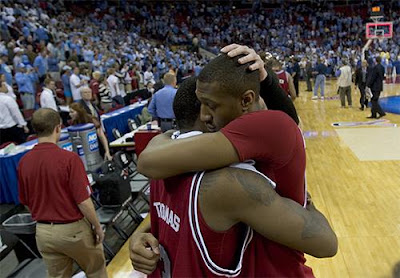
In addition to ending the Hogs’ season, the second-round loss also signified the end of the collegiate careers for six Arkansas players—Gary Ervin, Steven Hill, Vincent Hunter, Charles Thomas, Darian Townes and Sonny Weems.

On the whole, this group of seniors was rarely embraced by the Razorback faithful and were more often written off as overrated, inconsistent and soft. In reality, the 2008 Senior Class was a group of individually talented but flawed players who from time to time combined to create a formidable whole.

Vincent Hunter, a fifth-year senior, arrived on campus in 2003 built like a toothpick. His physique never changed, which likely contributed to his injury-plagued career, and as he found himself surrounded by more talented big men, his minutes declined each year. Nevertheless, the elder statesman of the 2008 senior class did come in to spell the other big men this season, and could occasionally be counted on the block a shot, hit a three, or knock down a couple of free throws (which is saying a lot when your team is ranked 200 and something nationally in free throw percentage).

Hill, Thomas and Townes all came in together as freshmen in the 2004-2005 season, and if you could combine them into one player, you’d probably wind up with the best center in the country.

Darian Townes was, at times, an offensive machine inside. He only possessed about two offensive moves, but on a good day, that was enough to make him unstoppable from about six feet in and put constant pressure on the other team’s interior defense. Unfortunately, Townes was generally a defensive liability and sometimes seemed to play without effort. After a promising freshman season, Townes spent his sophomore and junior seasons losing playing time and gradually turning the Arkansas fans against him before he turned things around his senior season and possibly played his way into an NBA career.

On the other side of the coin from Townes was Steven Hill. At 7’1”, Hill was one of the best shot blockers in SEC history, and the only Arkansas player I can ever remember who could single-handedly change the entire complexion of a game with his defense. On offense, Hill would occasionally find himself on the receiving end of a spectacular alley-oop and usually shot the ball with nice touch, but for the most part, was pretty clueless and helpless. In his senior season, Hill was frequently substituted for Townes on an Offense-for-Defense basis, to great effect.

Charles Thomas was the aggressive, rebounding, charge-taking player of the three. Thomas seemed to possess no consistent offensive moves, but managed to get a lot of garbage baskets through his hustle and also converted at a high percentage from the line. After a very solid junior season, Thomas seemed poised for an All-SEC type senior campaign, but he came out of the gates slowly in 2007 and following a one-game suspension for violating team rules at the end of January, was basically a no-show for the next nine games, a stretch in which the Hogs went 4-5. Fortunately, Thomas pulled it together when it counted, and had the best game of his career, a 24-point, 10-rebound double-double, in Arkansas’ SEC Tournament upset of fourth-ranked Tennessee.

Gary Ervin and Sonny Weems started their Razorback careers late. Ervin played two seasons at Mississippi State before transferring to Arkansas after the 2004-2005 season, and Weems joined the team the same year as a JUCO transfer.

Ervin was one of the most maligned players in Arkansas history. As an overall slightly above average player, Ervin was vilified for his limitations rather than being praised for being an overall upgrade from Arkansas’ last point guard, Eric Ferguson. Ervin dribbled too high, over-penetrated, and from time to time made incredibly careless mistakes, but he also threw amazing alley-oop passes, tore apart lackadaisical transition defense, and knocked down big shots. If the Hogs found themselves still in the game with the clock winding down, they always had a chance to win with the ball in Ervin’s hands.

Sonny Weems always had the skills—a smooth jumper with an unusually high release, long arms which disrupted passing lanes and led to steals, and the athleticism to jump out of the gym, but in his first season in the SEC, had trouble putting it all together. He would have big games and then disappear for long stretches. He would knock down big shots, and then make careless turnovers in crucial moments. But then, about eight games into his senior season, something clicked. Weems scored in double figures in the next 19 games, vaulting himself to the All-SEC First Team and helping the Razorbacks into a solid position at the end of the regular season. After struggling through the SEC Tournament, Weems showed up big in the NCAA Tournament, scoring a career high 31 against Indiana to help Arkansas secure its first tournament victory since 1999.

A lot was expected of these players, and maybe that was reasonable. Three of the six—Hill, Townes and Weems—will likely have a shot at the NBA, and Weems has the skill set to be a legitimate NBA player.

Judging by the Arkansas Razorback standards of the early to mid 1990s, when they advanced to three Final Fours and six Sweet Sixteens in seven years, the three consecutive NCAA Tournament appearances and one total NCAA Tournament win of the 2008 class hardly seems noteworthy, but the truth is that the Razorback Basketball program hasn’t lived up to those standards for a long time.

If success is determined by leaving a program better than you found it, then these six seniors found it during their years in Fayetteville.

I’ll miss not seeing them suit up next season.
« Older posts Newer posts »

© 2026 The Doc File

Theme by Anders Noren — Up ↑