The online journal of Luke Dockery

Category: Theology (Page 17 of 58)

A New Heaven & A New Earth Part 9: Bodily Resurrection

This post is part of an ongoing series. You can find links to all the posts here.

Several weeks ago, I discussed how the Christian hope as revealed in Scripture is not “going to heaven when we die” (and then talked about it more in the last post). In fact, that language is never used in the Bible. Really, the Christian hope is not based on what happens when we die, but what happens when Jesus returns, and that is what we have been talking about in this series.

Generally, though, people do talk about “going to heaven when we die” as being the source of Christian hope, and when they do that, very frequently, they have in mind some sort of “spiritual” existence, where “spiritual” means something other than existing in bodily form. In this post, I want to emphasize that the Bible clearly teaches that the Christian hope is not about living eternally as some sort of disembodied spirit; rather, the Christian hope is the resurrection from the dead, and the idea that we will live eternally as embodied people.

As we examine the idea of resurrection, I am going to emphasize two major ideas:

  1. Jesus is the firstfruits of our own resurrection, so we can learn about our own resurrection by looking at Jesus.
  2. Our resurrection bodies will be both similar to and dissimilar from our current bodies. There will be continuity and discontinuity.

To support and flesh out these two ideas, we will be looking at three New Testament passages: two narratives involving the resurrection of Jesus, and some detailed teaching by Paul on the nature of our own resurrection.

Luke 24.13-49

This passage recounts Jesus walking with the two disciples on the road to Emmaus following His resurrection, and then His appearance to the disciples as a group. From this passage, we get multiple indications that Jesus’ resurrection body seems to have both continuity and discontinuity with His earthly body.

Continuity: Though unable to do so initially, the disciples do eventually recognize Jesus (24.31). He also describes Himself as “flesh and bones” in contrast to a spirit (24.39), and eats with them (24.43). Summing up this element from the Lukan passage, Hicks, Valentine, and Wilson state:

“Luke describes the resurrected Jesus so there is no misunderstanding what resurrection means. The skepticism of the disciples provides the opportunity to dismiss any thought of resurrection as the continued life of a disembodied soul. The resurrect Lord commanded the disciples to “Look at my hands and my feet; see that it is I myself. Touch me and see; for a ghost does not have flesh and bones as you see that I have.”[1]

Discontinuity: But, there are other ways in which Jesus seems different from the way He was prior to resurrection. At first, His disciples fail to recognize him (24.16), and He also seems able to suddenly vanish (24.31) and appear (24.36)

John 20.11-21.14

This section of John’s Gospel provides several different post-resurrection appearances by Jesus: to Mary Magdalene, to the apostles without Thomas, to the apostles with Thomas, and to a group of disciples by the Sea of Tiberias. Again, we get multiple indications that Jesus’ post-resurrection body is both similar to and different from His earthly body.

Continuity: Jesus’ wounds from His crucifixion are still visible (20.27). In fact, this is a key point of His interaction with Thomas, and helps to answer his doubts: this Jesus was, in fact, one and the same as the man who had been crucified a few days before.[2] Also, as in the passage in Luke, here Jesus eats with His disciples, sharing a breakfast of fish over a charcoal fire (21.10-13).

Discontinuity: As in the account in Luke, Jesus is not immediately recognizable (20.14; 21.4), and He suddenly appears in their presence, despite the doors being locked (20.19).

Looking at these accounts from Luke and John, we can see that after the resurrection, Jesus’ body was similar to what it was like before…but also different. He had a tangible, touchable, visible, material body, but it was different from what it was like before.[3]

1 Corinthians 15.35-58

The Christians at Corinth were mixed up on a variety of issues related to doctrine and morality, and one of their points of doctrinal confusion was related to the idea of resurrection. In the Greco-Roman world, people were not like modern secular humanists; they believed in life after death, but for them, it was the soul that was immortal.[4] Resurrection, on the other hand, was a scandal to the Greek mind, worthy of mockery and derision (Acts 17.32), because it referred to what would happen to the body—physical bodies that are buried in the earth (or cremated, or whatever) are, in some way, reanimated or reconstituted. As N.T. Wright explains:

“In content, resurrection referred specifically to something that happened to the body; hence the later debates about how God would do this—whether he would start with the existing bones or make new ones or whatever. One would have debates like that only if it was quite clear that what you ended up with was something tangible and physical. Everybody knew about ghosts, spirits, visions, hallucinations and so on. Most people in the ancient world believed in some such things. They were quite clear that that wasn’t what they mean by resurrection. While Herod reportedly thought Jesus might be John the Baptist raised from the dead, he didn’t think he was a ghost. Resurrection meant bodies.”[5]

In Corinth, the believers didn’t seem to deny the reality of Jesus’ resurrection; they just didn’t see how it mattered for them. Paul insists, though, that resurrection is a two-stage event: Jesus’ resurrection is the firstfruits of our own (15.20, 23), so what happened to Him will also happen to believers (see also Philippians 3.21).[6]

After establishing the connection, Paul goes on to offer direct teaching[7] on the nature of our resurrection (so I will include the whole passage):

35 But someone will ask, “How are the dead raised? With what kind of body do they come?” 36 You foolish person! What you sow does not come to life unless it dies. 37 And what you sow is not the body that is to be, but a bare kernel, perhaps of wheat or of some other grain. 38 But God gives it a body as he has chosen, and to each kind of seed its own body. 39 For not all flesh is the same, but there is one kind for humans, another for animals, another for birds, and another for fish. 40 There are heavenly bodies and earthly bodies, but the glory of the heavenly is of one kind, and the glory of the earthly is of another. 41 There is one glory of the sun, and another glory of the moon, and another glory of the stars; for star differs from star in glory.

42 So is it with the resurrection of the dead. What is sown is perishable; what is raised is imperishable. 43 It is sown in dishonor; it is raised in glory. It is sown in weakness; it is raised in power. 44 It is sown a natural body; it is raised a spiritual body. If there is a natural body, there is also a spiritual body. 45 Thus it is written, “The first man Adam became a living being”; the last Adam became a life-giving spirit. 46 But it is not the spiritual that is first but the natural, and then the spiritual. 47 The first man was from the earth, a man of dust; the second man is from heaven. 48 As was the man of dust, so also are those who are of the dust, and as is the man of heaven, so also are those who are of heaven. 49 Just as we have borne the image of the man of dust, we shall also bear the image of the man of heaven.

50 I tell you this, brothers: flesh and blood cannot inherit the kingdom of God, nor does the perishable inherit the imperishable. 51 Behold! I tell you a mystery. We shall not all sleep, but we shall all be changed, 52 in a moment, in the twinkling of an eye, at the last trumpet. For the trumpet will sound, and the dead will be raised imperishable, and we shall be changed. 53 For this perishable body must put on the imperishable, and this mortal body must put on immortality. 54 When the perishable puts on the imperishable, and the mortal puts on immortality, then shall come to pass the saying that is written:

“Death is swallowed up in victory.” 55 “O death, where is your victory? O death, where is your sting?”

56 The sting of death is sin, and the power of sin is the law. 57 But thanks be to God, who gives us the victory through our Lord Jesus Christ. 58 Therefore, my beloved brothers, be steadfast, immovable, always abounding in the work of the Lord, knowing that in the Lord your labor is not in vain.

(1 Corinthians 15.35–58)

In this passage, Paul compares our physical bodies to a seed that is sown perishable and raised imperishable. This highlights a continuity between our current bodies and our resurrection bodies, but also a change. Seeds are not the same as the wheat they produce, but they are closely related: they are made of the same “stuff”, and one has the necessary DNA for the production of the other. So again, like with the accounts of the post-resurrection Jesus, we have the idea of similarity and dissimilarity; continuity and discontinuity.

Paul says that those who are in Christ will be raised with “spiritual bodies.”[8] We need to think about both of these words. The Christian hope is not to be disembodied spirits floating around in a non-material existence. But neither is the Christian hope to have the same old bodies that we have right now, which are “natural” or “fleshly”. We must keep both of these ideas in mind.

The idea of dissimilarity, or discontinuity, that we have already seen in the stories about Jesus’ resurrection body is repeated here. Paul is clear in these verses that there are some major differences between our current bodies, and our future, resurrection bodies (15.42-44):

  • Our current bodies are perishable, while our future bodies will be imperishable
  • Our current bodies are dishonorable, while our future bodies will be glorious
  • Our current bodies are weak, while our future bodies will be powerful
  • Our current bodies are natural, while our future bodies will be spiritual

As significant as these differences are, in other ways, our bodies will be the “same” as our current ones (which shouldn’t surprise us, considering the texts we read about Jesus after the resurrection). Like the resurrection body of Jesus, they will retain points of continuity with our previous bodies.

When talking about “spiritual bodies”, we need to spend some time defining what “spiritual” means here. Because for many people, when we read about a “spiritual” body, we assume that Paul is referring to a resurrection body that is “spiritual” in the sense that it is “non-material”; something that can’t be touched. When “spiritual” body is contrasted with “natural” body, many people assume that Paul is drawing a distinction between our current “material” bodies and a future “non-material” existence.[9]

It is important, though, that we not insert our own understanding of the word “spiritual” into the text and, instead, allow Paul to define his own terms. Earlier in 1 Corinthians, Paul has already told his readers what he means when he uses the words “natural” and “spiritual”:

14 The natural person does not accept the things of the Spirit of God, for they are folly to him, and he is not able to understand them because they are spiritually discerned. 15 The spiritual person judges all things, but is himself judged by no one. 16 For who has understood the mind of the Lord so as to instruct him? But we have the mind of Christ.

(1 Corinthians 2.14-16)

In this passage Paul speaks of tangible, material, physical-bodied Christians as being “spiritual” because they were living in harmony with the Holy Spirit. This is repeatedly what the word “spiritual” means in 1 Corinthians (3.1; 6.19; 14.37). He does not use the word “spiritual” to mean “non-material”; rather, it refers to men and women whose character and lifestyle is consistent with the Holy Spirit. So for Paul, the words “natural” and “spiritual” are not talking about a contrast between the material and the non-material; they describe a contrast between ordinary human life and life given by the Spirit.[10]

When Paul says “spiritual body,” the emphasis is on what provides the driving force for the body—it is animated by God’s Spirit.[11] Just as the Holy Spirit raised Jesus from the dead, it will be God’s Spirit (elsewhere described as a down payment on our salvation) that raises us up from the dead and gives power and life to our resurrection bodies. Paul says this elsewhere, in Romans 8:

9 You, however, are not in the flesh but in the Spirit, if in fact the Spirit of God dwells in you. Anyone who does not have the Spirit of Christ does not belong to him. 10 But if Christ is in you, although the body is dead because of sin, the Spirit is life because of righteousness. 11 If the Spirit of him who raised Jesus from the dead dwells in you, he who raised Christ Jesus from the dead will also give life to your mortal bodies through his Spirit who dwells in you.

(Romans 8.9-11)

But what about 1 Corinthians 15.50? There Paul says, “Flesh and blood cannot inherit the kingdom of God.” Doesn’t this mean that we won’t have bodies in the resurrection?

Well, no. It cannot mean that. After all, this whole section is answering the question of “what kind of bodies” we will have (1 Corinthians 15.35). Again, we need to let Paul define his own terms. Earlier, Paul has already described what he means by “fleshly” people:

1 But I, brothers, could not address you as spiritual people, but as people of the flesh, as infants in Christ. 2 I fed you with milk, not solid food, for you were not ready for it. And even now you re not yet ready, 3 for you are still of the flesh. For while there is jealousy and strife among you, are you not of the flesh and having only in a human way?

(1 Corinthians 3.1-3)

Here, Paul uses the term “of the flesh” to describe the same people that he earlier described as “natural” in 2.14-16. The “natural” people who are “of the flesh” are those who walk “only in a human way”, as opposed to the “spiritual” people who live in harmony with the Spirit. For Paul, “flesh” does not mean “made out of matter” or “material” or “tangible” but refers to people who live in sinful rebellion, and for our current bodies that are destined for decay and death.[12]

So, when Paul says that “flesh and blood cannot inherit the kingdom of God,” he is not claiming that material “bodies” cannot inherit the kingdom of God. Rather, he is saying that the perishable cannot inherit the imperishable—unless the nature of our bodies is changed from “corruptible” to “incorruptible” and “merely human” to “spiritual”, we cannot inherit the kingdom of God.[13]

But this is exactly what this passage is talking about: our bodies will be changed. They will be sown perishable, but raised imperishable; sown dishonorable, but raised glorious; sown in weakness, but raised in power; sown natural, but raised spiritual. Our resurrection bodies will be suited for an eternal existence with God.

Conclusion

The resurrection is not about us being freed from our bodies to live as spirits; it is about our bodies being transformed into something glorious that is both similar to and different from our current bodies.

Will we be raised with physical bodies? If by “physical,” we simply mean “bodily”, then yes, we will be raised with material, “physical” bodies. If by “physical” we mean “corruptible” or “mortal”, no our bodies will not be physical.

Again, we will close with how we began: continuity and discontinuity. In some sense, our bodies will be the same, but they will also be transformed into something new and different. Our bodies will be spiritual, incorruptible bodies, but we will not be bodiless spirits. We will have a tangible, material existence. Our dead bodies will actually be raised and will be made new.

And all of this fits quite seamlessly with the larger picture of cosmic redemption that we have been discussing in this series. Just as creation itself will be transformed and changed into something new, so, too, our bodies (as part of creation) will also be transformed and changed into something new. Creation isn’t thrown away; it is redeemed by God.

“Behold, I am making all things new.”

Just as creation itself will be transformed and changed into something new, so, too, our bodies will also be transformed and changed into something new. Creation isn’t thrown away; it is redeemed by God. Share on X

Excursus: Did Jesus’ Resurrection Body Change After His Ascension?

Sometimes, when discussing resurrection, people will basically acknowledge what I have said above about the nature of Jesus’ resurrection body and its tangible nature, but will then make the argument that this radically changed after His ascension, and that He now lives a “spiritual” existence.

The first and most important response to this notion: Scripture never actually teaches this anywhere. It is an assumption we make based on the assumption that you can’t have a “tangible” body in heaven. It seems to be an effort to reconcile what appears to be a contradiction between 1 Corinthians 15.50 and what we know about Jesus’ resurrection body. But if we accept Paul’s definition of “flesh and blood” as described above, there is no contradiction.

Furthermore, other places in Scripture continue to assert the continuity between Jesus’ post-ascension existence, and his human, bodily existence:

  • Acts 1.9 teaches that Jesus will return in the same form as He was in when He ascended (His resurrection body)
  • In Acts 7, Stephen saw the “Son of Man” standing at the right hand of God. “Son of Man” means “Human One”; it has messianic connotations that make it mean more than a simple reference to humanity, but it doesn’t mean less than that. Jesus is still an embodied human (though, with a glorified, imperishable, resurrection body).[14]
  • 1 Timothy 2.5 refers to “the man Jesus” in the present tense—Jesus didn’t lose his embodied humanity after the ascension.

[1]John Mark Hicks, Bobby Valentine, and Mark Wilson, Embracing Creation: God’s Forgotten Mission, (Abilene, TX: Leafwood: 2016): 112.

[2]That is clear enough, but for awhile, this passage troubled me: if Jesus’ resurrection body possessed scars, will I have scars in my resurrection body? Will one of my thumbs still be weaker than the other, atrophied by a long-ago injury? Will those who suffered paralysis in this life still be paralyzed? Will my own daughter still possess her significant disabilities? Some of these maladies seem to contradict an eternity where there will be no crying, mourning, or pain.

The answer, I believe, can be found In Thomas Aquinas, Summa Theologiae III, Q.54, Art. 4: “It was fitting for Christ’s soul at His Resurrection to resume the body with its scars. In the first place, for Christ’s own glory. For Bede says on Luke 24:40 that He kept His scars not from inability to heal them, “but to wear them as an everlasting trophy of His victory.” Hence Augustine says (De Civ. Dei xxii): “Perhaps in that kingdom we shall see on the bodies of the Martyrs the traces of the wounds which they bore for Christ’s name: because it will not be a deformity, but a dignity in them; and a certain kind of beauty will shine in them, in the body, though not of the body.” (emphasis mine)

As one commentator states: “These wounds are a dignity not a deformity, a sign of love not of loss, an indication of obedience not of onerousness.”

[3]Sometimes people will try to take Jesus’ words to Mary Magdalene in John 20.17—“Do not cling to me, for I have not yet ascended to the Father…”—to indicate that Jesus was immaterial and Mary was not able to grab or touch Him. This doesn’t seem to be the case, however. Jesus’ point seems to be, “It’s okay, Mary, you can let go. I’m not going anywhere yet; I’m not immediately ascending to the Father.”

[4]Embracing Creation, 112.

[5]N.T. Wright, Surprised By Hope: Rethinking Heaven, the Resurrection, and the Mission of the Church, (New York: HarperOne, 2008): 36.

[6]Embracing Creation, 113.

[7]I initially said “clear teaching,” but based on how often this passage is misconstrued to mean something other than what Paul means, it is clearly not “clear.” Our distance from Paul’s time (and our significant influence by neoplatonic thought) does make this a challenging passage, but I think it is understandable.

[8]The following section is greatly influenced by a series of excellent articles by Tyler Boyd. For more, see “Resurrection: The Redemption of Our Bodies”, “We Will Have ‘Spiritual Bodies’”, “Will We Have ‘Physical’ Bodies?”.

[9]Much of this next section relies specifically on Boyd, “Spiritual Bodies.”

[10]Ibid.

[11]Embracing Creation, 114, “The adjective spiritual does not refer to the composition of the body, but what makes it “tick.” While sin and death are like leaven bring corruption and decay, the Spirit of God animates resurrected bodies.”

Wright, Surprised By Hope, 155, echoes the same idea. Discussing the Greek words for physical and spiritual says that adjectives of this type “describe not the material out of which things are made but the power or energy that animates them. It is the difference between asking, on the one hand, “Is this a wooden ship or an iron ship?” (the material from which it is made) and asking, on the other, “Is this a steamship or a sailing ship?” (the energy that powers it).

[12]Boyd, “Will We Have “Physical” Bodies?”

Wright, 156, speaking of the “flesh and blood” reference: “he doesn’t mean that physicality will be abolished. “Flesh and blood” is a technical term for that which is corruptible, transient, heading for death. The contrast, again, is not between what we call physical and what we call nonphysical, but between corruptible physicality, on the one hand, and incorruptible physicality, on the other.” (Emphasis in the original)

[13]Boyd, “Will We Have “Physical” Bodies?”

[14]I am indebted to Ethan Longhenry, evangelist at the Venice church of Christ, for this insight.

A New Heaven & A New Earth Part 8: The Unified Story of Scripture

This post is part of an ongoing series. You can find links to all the posts here.

Some of the content of this post was anticipated in the previous one, when we looked at the consequences of sin as described in Genesis 3 and then saw how Revelation 21-22 show that, when Jesus returns, all of these consequences will be dealt with (including the curse that is placed on creation). Today, we are going to continue to spend time in these same areas of Scripture.

Before we do that, though, I want to reflect on the nature of Scripture itself: what is this book we have that we call “the Bible”? 

Well, first, we should probably point out that the Bible is not a book so much as it is a library of books. As we have it, it is a library of 66 books written over hundreds and hundreds of years by dozens of people.[1] Nevertheless, in the background, behind all of these human authors is the reality that Scripture is God-breathed:  in a way that we will never fully understand, the Holy Spirit worked in conjunction with humans to produce the Bible.


So, when I say that the Bible is a library of books, I don’t mean to say that because of that, it is hopelessly disjointed or contradictory; no: the Bible is a library of books all telling the same grand Story. 

And we need to come to that Story on its own terms.[2]

When asked what the Bible is, many Christians would say something about it being an instruction manual for how to go to heaven when we die (ever heard the B.I.B.L.E. = “Basic Instructions Before Leaving Earth mnemonic device?). As we discussed in an earlier post, not only does the phrase “go to heaven” not appear anywhere in the Bible in relation to death, this also just doesn’t seem to be the grand Story that Genesis is introducing. Genesis doesn’t talk about going to heaven when we die, and there are only minimal instructions. Instead, it introduces a story about a good God who lovingly created a good world. He created humanity in His image and tasked them with overseeing and stewarding His creation. When humans disobeyed God and betrayed His trust, they were sent into exile, sin reigned in the world, and creation was tainted, but God did not give up on His people or His creation. Instead, God set a plan in place to redeem and restore humanity, and, indeed, all of creation.[3]

This is what you would expect from reading the first book of the Bible, and it’s what you get when you read the last book of the Bible. Even though Genesis and Revelation were written hundreds of years apart by different authors in different languages, when compared to one another they provide fitting bookends to the Scripture library.

(It would be of great benefit to read Genesis 1-3 and Revelation 21-22 back-to-back before proceeding. Go ahead…I’ll wait.)

Creation and New Creation

Simply put, Genesis 1-3 describes the creation of the heavens and the earth, and Revelation 21-22 talks about the new creation of the new heavens and new earth.[4] In the description of the new heavens and new earth in Revelation 21-22, over and over again you have echoes of what occurred in the creation of the heavens and earth in Genesis 1-3:

  • In Genesis 1.4, there is a division of light and darkness; in Revelation 21.25, there is no night.
  • In Genesis 1.10, there is a division of land and sea; in Revelation 21.1, there is no more sea.
  • In Genesis 1.16, the rule of the sun and moon is described; in Revelation 21.23, we learn that there is no need for the sun or moon.
  • In Genesis 2.10, we are told about a river flowing out of the Garden of Eden; in Revelation 22.1, we are told about a river flowing from God’s throne.
  • Genesis 2.9 describes the Tree of Life in the midst of the garden; Revelation 22.2 describes the Tree of Life throughout the city.
  • Genesis 2.12 tells us that gold and precious stones are in the land; Revelation 21.19 tells us that gold and precious stones are throughout.
  • God walks in the garden, among His creation as described in Genesis 3.8; Revelation 21.3 states that God’s dwelling will be with His people.
  • Following Adam and Eve’s sin, Genesis 3.17 states that the ground itself will be cursed; in the New Creation, there will be no more curse (Revelation 22.3).
  • As a result of sin and the curse, life in creation is characterized by pain and sorrow (Genesis 3.17-19); in the new creation, there will be no more sorrow, pain, or tears (Revelation 21.1-4).
  • Additionally, the sin results in death, described as a returning to the dust (Genesis 3.19); in the New Heavens and New Earth, there is no more death (Revelation 21.4).
  • Adam and Eve are banished from the garden, and cherubim guard the entrance to it (Genesis 3.24); angels actively invite into the city in Revelation 21.9.

There are actually many more points of comparison that could be made, but I think these are sufficient to prove the point: in Revelation, John is clearly describing the eternity that God’s people will spend with Him in the New Heavens and New Earth in language that echoes back to the story of creation and fall in Genesis 1-3.

In making these connections between Revelation and Genesis, John is making a significant and profound theological point, and it is, in fact, the point of the Story of Scripture. God is going to redeem, recreate, and perfect the creation that was tainted by our sin. And when He does so, He will dwell with His people forever.

God is going to redeem, recreate, and perfect the creation that was tainted by our sin. And when He does so, He will dwell with His people forever. Share on X

[1]When I say “as we have it,” I am not implying that there are missing books of the Bible or anything like that. Rather, this is a reflection of the fact the number 66 is a product of combining the New Testament to the Hebrew Bible, and counting the books of the Hebrew Bible differently (for example, originally, Ezra and Nehemiah were combined in one book, 1-2 Kings were one book, etc.).

[2]Beginning to read Scripture in this way, as a grand, overarching, and interconnected Story, was a game-changer for me. Rather than pulling verses (or even entire books!) out of context, they must be read in light of the Story that Scripture is telling. 

[3]See Wes McAdams, “7 Things I Noticed When I Read Genesis Today,” and “A Quick Summary of the Old Testament.” These posts come from a series in which Wes read entire books of the Bible in one sitting to better glean the broad themes and discern the Story that Scripture tells. I highly recommend the series and the book that came from it.

[4]Or, we could say, the “recreation of the renewed heavens and renewed earth.” This is not a theological point that I am simply asserting here; the whole series has pointed in this direction. And we see it here, in Revelation 21.5: Jesus does not say, “I am making all new things”; He says, “I am making all things new.” This is renewal language: the point of Revelation 21-22 is that God is performing an epic makeover. Certainly, absolutely, things are different, but there are clear and repeated points of continuity to what was before.

Ranking The Chronicles of Narnia, Part 2: The Lion, the Witch and the Wardrobe

Last week, I began the process of scoring and ranking C.S. Lewis’s masterpiece, The Chronicles of Narnia.

I am scoring each book using a rubric with four different categories: story, characters, worldcraft, and theology. For each category, I will provide a subscore of 1-10, yielding a cumulative maximum score of 40 points.

In the first post, I ranked The Magician’s Nephew, and explained that I would be following the chronological order of the books (even though I don’t consider that to be the best order in which to read the books), which means that this week, I will be ranking The Lion, the Witch and the Wardrobe (or LWW).

The Lion, the Witch, and the Wardrobe

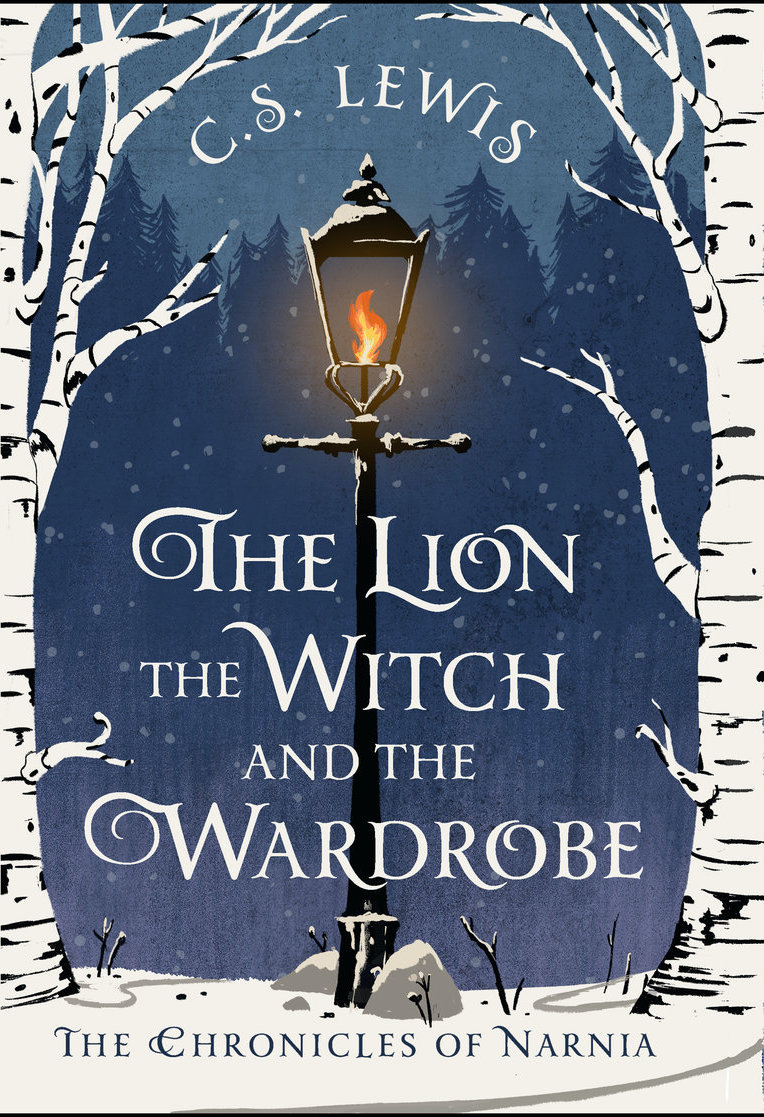
This is from a series of brilliant Narnia cover designs by Jeffrey Nguyen

Story

This is the book that started it all, introducing us to the world of Narnia and the Pevensie children. Despite this, the book doesn’t get bogged down in introductory material—Lucy is already in Narnia before the end of the first chapter, and the character of the White Witch and the menace she represents has already been revealed in chapter two.

It then takes a few chapters to get the rest of the Pevensie children into Narnia (including Edmund’s misadventure where he meets the Witch and becomes her ally), where they soon meet Mr. Beaver, who tells them:

They say Aslan is on the move—perhaps has already landed. (74)

This simple statement represents a key plot device in LWW: the building anticipation of the arrival of Aslan, who will not actually appear for several more chapters.[1] In the meantime, several signs begin to indicate that the Witch’s icy hold on Narnia is weakening.

Once Aslan does arrive, things move quickly: in a retelling of the biblical story, Aslan willingly gives himself to the Witch in order to redeem the treacherous Edmund. His mane is cut off in shameful fashion, and then he is killed by the Witch, who assumes that she has been victorious. But…Aslan returns to life. I will reflect on this further in the theology section below, but for me, this is a phenomenal retelling of the gospel story. I didn’t read the Narnia books as a child, so I am not sure what my reaction would have been there, but as a college student, this series of events brought me to tears and, then, to praise.

Following his resurrection, Aslan the Pevensie children, and the Narnians loyal to him quickly overwhelm the Witch and her forces. Peter, Susan, Edmund, and Lucy are enthroned as kings and queens of Narnia, and “live happily ever after” for many years before returning home to England.

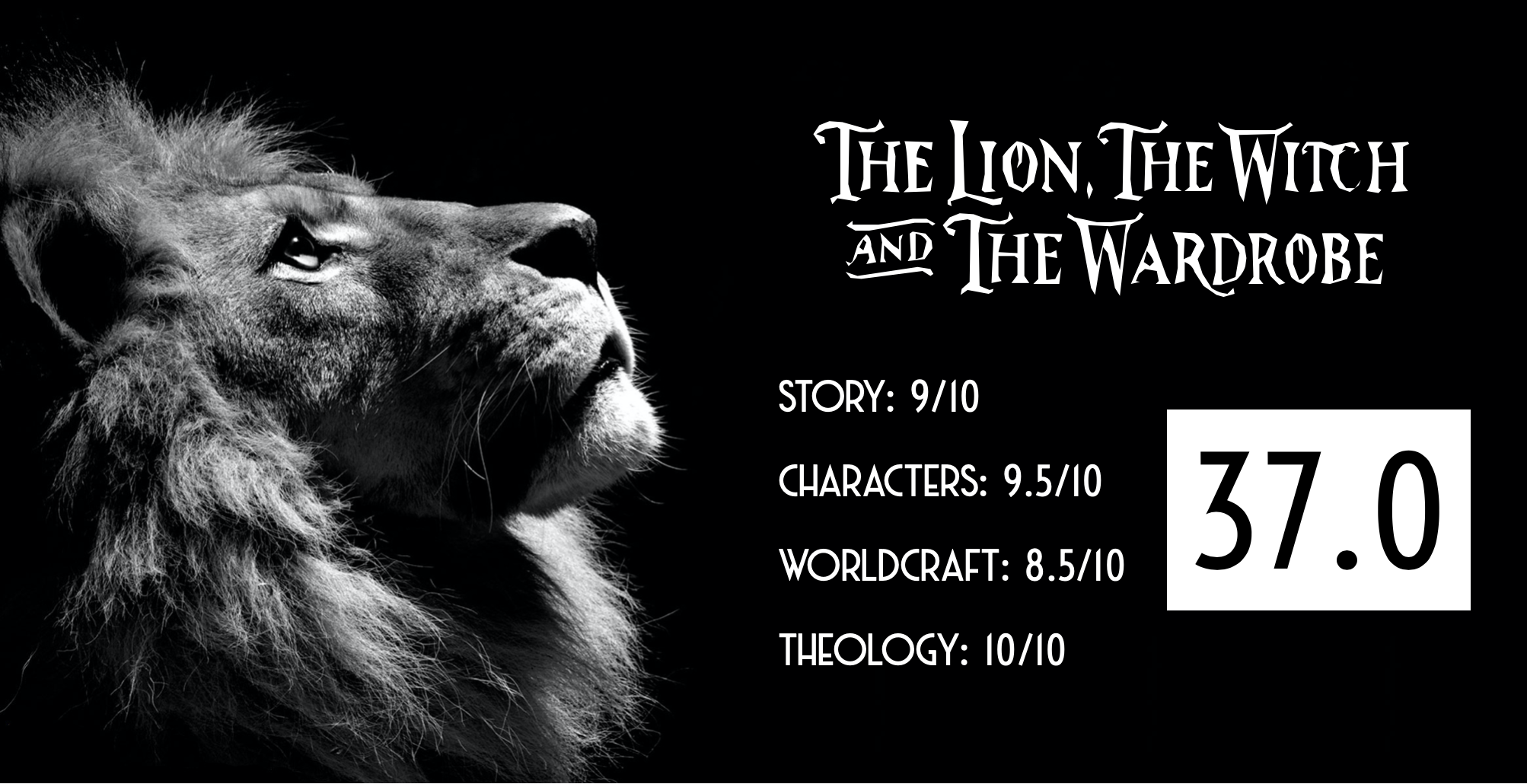
Story: 9/10

Characters

The main characters of LWW are the four Pevensie children, Peter, Susan, Edmund, and Lucy, and despite the fact that they frequently have to share the stage with one another, each is well developed. Peter is the big brother, a natural leader who is courageous and looks out for his siblings, but can be stubborn at times. Susan is practical, motherly, and gentle, but tends to boss around her siblings. Edmund comes across as churlish and selfish, while ultimately manifesting great potential for growth and change. Lucy, the youngest of all, is most faithful in her devotion to Aslan and possesses great bravery herself, but is also somewhat naive.

The Professor (Digory Kirke from The Magician’s Nephew) plays a minor but important role in LWW, as it is his house where the Pevensies are staying when they encounter the wardrobe that serves as a portal to Narnia, and his encouragement that opens the older Pevensie children to the possibility of other worlds.

Upon entering Narnia, Lucy encounters Mr. Tumnus the Faun, with whom she establishes a quick and deep bond. Tumnus features in the story mainly to introduce us to the White Witch and the power she has exerted over Narnia. The fear and sense of dread that this produces increases when the children return and find Mr. Tumnus missing and his home destroyed.

Mr. and Mrs. Beaver serve to guide the four children in Narnia, to keep them safe from the White Witch, and, ultimately, lead them to Aslan. It is they who provide some of the most famous dialogue about Aslan:

“Don’t you know who is the King of Beasts? Aslan is a lion—the Lion, the great Lion.”

“Ooh!” said Susan, “I’d thought he was a man. Is he—quite safe? I shall feel rather nervous about meeting a lion.”

“That you will, dearie, and no mistake,” said Mrs. Beaver; “if there’s anyone who can appear before Aslan without their knees knocking, they’re either braver than most or else just silly.”

“Then he isn’t safe?” said Lucy.

“Safe?” said Mr. Beaver; “don’t you hear what Mrs. Beaver tells you? Who said anything about safe? ’Course he isn’t safe. But he’s good. He’s the King, I tell you.” (86)

The White Witch, Jadis, Queen of Charn in The Magician’s Nephew, is the villainess of Narnia. When we meet her in LWW, she has held Narnia in a 100-year reign of terror, characterized by a never-ending winter. Compared to her appearance in MN, the White Witch is significantly more frightening in LWW: she is cruel, manipulative, and powerful, and no longer is she on her own—now in control of Narnia, she has amassed her own wicked army to support her. When, in exchange for Edmund’s freedom, she captures and kills Aslan, it seems that all hope is lost.

As mentioned previously, much of the plot of LWW revolves around the anticipation of the appearance of Aslan, which is forecasted fairly early on by Mr. Beaver, but does not come to fruition until many chapters later. His portrayal here is even better than in MN. He is mysterious, powerful, forgiving, severe, and wise. He is not safe, but he is good. Lewis repeatedly insisted that LWW was not an allegory, but Aslan is clearly a Christ-figure,[2] and, from my perspective, the Aslanic depiction of Jesus in LWW is as good as any interpretation I have seen outside of the gospels themselves.

Characters: 9.5/10

Worldcraft

In MN, we are given a picture of Narnia at its inception, but that picture is fleshed out more fully in LWW. When Lucy first enters Narnia, it is covered in snow, frozen in the curse of the Witch’s 100-year winter. This unending winter is the dominant feature of Narnia in LWW, and is a powerful metaphor for the Witch herself: while Aslan, full of creative vitality, sings worlds into existence and causes the onset of spring with His presence, the Witch is capable of none of this creative potential. All she can do is spread a cold lifelessness: we see this in the world of Charn in MN, the never-ending winter in LWW, and her preferred punishment of turning her enemies into frozen, lifeless statues. Her castle is cold, austere, and lifeless, and is a reflection of herself.

Edmund, the traitor who falls under the Witch’s influence, feels the cold keenly. He freezes while riding around with the Witch, and when he slinks away from the Beavers’ residence to report to her, it is an interminable, freezing journey.

For the other children, the cold is less of an ordeal. They seek refuge in the warm company of friends: Lucy with Mr. Tumnus, and then all the children (other than Edmund) enjoy their time in the Beavers’ home atop the dam. When they realize that Edmund has betrayed them, they begin their journey to meet Aslan at the Stone Table, but their journey is more pleasant than Edmund’s, as winter thaws all around them and spring emerges.

We are briefly introduced to the castle at Cair Pairavel and other aspects of the Narnian realm in the “happily ever after” portion of the narrative, but this is more of a footnote to the Narnia that comprises the majority of the tale.

Worldcraft: 8.5/10

Theology

LWW is an enjoyable book, but it is in this category that it truly shines. Of course, it is set up to do so, since its theological focus is on the crucifixion and resurrection,[3] but there are so many good theological elements throughout.

I already mentioned above the famous quotation about Aslan being good but not safe, which is a powerful reminder to Christians about the God that we serve. We live in a moment in history where safety and protection are valued so highly that I think it is important to remember that Scripture consistently reflects a God who is not “safe” and who calls us to follow Him regardless of what risks may come. This is part of the cost of discipleship.

A related idea occurs near the end of the book, and is also stated by Mr. Beaver (Mr. Beaver proves to be an excellent theologian):

But amid all these rejoicings Aslan himself quietly slipped away. And when the Kings and Queens noticed that he wasn’t there they said nothing about it. For Mr. Beaver had warned them, “He’ll be coming and going,” he had said. “One day you’ll see him and another you won’t. He doesn’t like being tied down—and of course he has other countries to attend to. It’s quite all right. He’ll often drop in. Only you mustn’t press him. He’s wild, you know. Not like a tame lion.” (200)

God often shows up in unexpected and unpredictable ways. At times we seek to domesticate Him and clearly delineate what He will and will not do, and the ways He will and will not act, but His ways are higher than our ways. And that is a very good thing: a domesticated God would not be worth serving.

The character of Edmund and his interaction with the Witch and with Aslan offers profound theological insight. Initially, Edmund sides with the evil Witch and disaster is the result. He craves the Witch’s Turkish Delight and enjoys eating it while he has it, but as soon as it is gone, he is unsatisfied. He is left feeling sticky and sick, but still wanting more. What a true picture of sin! Ultimately, Edmund is enslaved to the Witch, which is another very real picture of what sin does to us: it enslaves.

When Edmund comes to know Aslan for himself, it changes everything (including the way he views himself), and we have a powerful picture of God’s grace:

As soon as they had breakfasted they all went out, and there they saw Aslan and Edmund walking together in the dewy grass, apart from the rest of the court. There is no need to tell you (and no one ever heard) what Aslan was saying, but it was a conversation which Edmund never forgot. As the others drew nearer Aslan turned to meet them, bringing Edmund with him.

“Here is your brother,” he said, “and—there is no need to talk to him about what is past.” (152-153)

“You have a traitor there, Aslan” said the Witch. Of course everyone present knew that she meant Edmund. But Edmund had got past thinking about himself after all he’d been through and after the talk he’d had that morning. He just went on looking at Aslan. It didn’t seem to matter what the Witch said. (p. 155)

Once we are in Christ, it no longer matters what accusations the Evil One hurls against us.

In his depiction of Aslan’s “crucifixion,” Lewis employs a Christus Victor[4] understanding of the atonement, where Jesus brings about God’s victory of Satan and the forces of evil. The cross is, in a sense, a sort of trap, where it appears that Jesus has been defeated, only to reveal His ultimate victory when He is raised from the dead. Aslan explains it like this:

“…though the Witch knew the Deep Magic, there is a magic deeper still which she did not know. Her knowledge goes back only to the dawn of Time. But if she could have looked a little further back, into the stillness and the darkness before Time dawned, she would have read a different incantation. She would have known that when a willing victim who had committed no treachery was killed in a traitor’s stead, the Table would crack and Death itself would start working backwards.” (178-79)

Other echoes of the gospel story are powerfully re-cast, from Susan and Lucy staying near to Aslan in a Gethsemane-like scene, to the shame Aslan endures as his mane is shaved, or the Stone Table being split open.

After Aslan’s resurrection, he reanimates a host of Narnians who had been turned to stone by the Witch, and then they join in the battle between the Witch’s army and the forces led by Peter. When Aslan enters the fray and confronts the Witch, he immediately overwhelms her. It’s not even close. This gives us another powerful reminder of a core belief of Christianity. God, through Jesus, overwhelmingly conquers Satan, sin, and death. Christianity is not a dualistic religion, where equally-weighted forces of good and evil are locked in a never-ending struggle. Satan is powerful, but God is all-powerful. It is not a close thing. This reality is foreshadowed earlier by a conversation between the Pevensie children and Mr. Beaver:

“Who is Aslan?” asked Susan.

“Aslan?” said Mr. Beaver. “Why, don’t you know? He’s the king. He’s the Lord of the whole wood, but not often here you understand. Never in my time or my father’s time. But the word has reached us that he has come back. He is in Narnia at this moment. He’ll settle the White Queen all right. It is he, not you, that will save Mr. Tumnus.”

“She won’t turn him into stone too?” said Edmund.

“What a simple thing to say!” answered Mr. Beaver with a great laugh. “Turn him to stone? If she can stand on her two feet and look him in the face it’ll be the most she had do and more than I expect of her.” (85)

Theology: 10/10

A 37/40 is really high praise from me; if I were rating this book on somewhere like Amazon where I had to give 1 to 5 stars and could only choose whole numbers, it would unquestionably merit a 5-star rating. And, with a 10/10 in the Theology category, LWW earned one of only two Perfect 10’s that I awarded to any of the books.


Check out the full series of posts:


[1]The way that Aslan is introduced and then anticipated in LWW is one of several reasons why it should be read first, rather than The Magician’s Nephew (MN). It makes no sense to introduce Aslan to readers in this way if they have already read MN, and the introduction he receives in MN is inadequate if you don’t already know who he is.

[2]In Lewis’s own words: “If Aslan represented the immaterial Deity, he would be an allegorical figure. In reality however he is an invention giving an imaginary answer to the question, ‘What might Christ become like if there really were a world like Narnia and He chose to be incarnate and die and rise again in that world as He actually has done in ours?’”

[3]Paul Ford, Companion to Narnia: Revised Edition (San Franciso: HarperCollins, 2005): 6.

[4]For an excellent read on atonement theories (including Christus Victor) in LWW, see Matt Mikalotos, “Why Did Aslan Have to Die? Theories of Atonement in Narnia.”

A New Heaven & A New Earth Part 7: Sin’s Consequences and Remedy

This post is part of an ongoing series. You can find links to all the posts here.

Last week, we looked at some New Testament texts that point to the idea of cosmic redemption—when Jesus returns, it’s not just faithful men and women who are going to be “saved”; in some sense, the redemptive work of Jesus reaches beyond humanity to the rest of creation as well. We looked at several passages that are frequently overlooked, but together, they present a fairly consistent message: God’s salvation is restorative and holistic. It is restorative in that it fixes what went wrong with creation, and it is holistic in that God intends to restore “all things” in heaven and on earth, including our bodies and creation itself.[1]

In this post, we are going to look at a similar idea, but we’re going to go about it in a different way: we’re going to examine how Genesis 3 describes the far-reaching consequences of Adam and Eve’s sin, and then look at what God is going to do to address those consequences. 

Here is the basic premise, the underlying questions that we want to consider:

  • Do we believe that God, through Jesus, is going to overcome and defeat sin?
  • If so, shouldn’t that mean that whatever God does to overcome and defeat sin should address all of the different types of consequences that sin produces?


Sin’s Far-Reaching Consequences

Genesis 3 is going to be central for our thinking in this post, but really, we shouldn’t just drop down into Genesis 3, because the story actually begins in Genesis 1. In the beginning, God created the heavens and the earth, and we have an account of what was created on each day. On the sixth day, God creates humanity. And everything God creates He calls good.

Humanity is special: God creates humans, male and female, in His own image, and gives them a task. Humans are supposed to rule over and take care of creation. This was the plan: God has created this wonderful place where humans can live, and where God can also dwell in relationship with them.

But things go badly very quickly.

Adam and Eve are placed in a garden paradise to live with only one prohibition: they are not to eat from the tree of knowledge of good and evil (Genesis 2.16-17). But then, the crafty serpent (elsewhere in the Bible identified as Satan[2]) comes along and entices Eve to disobey God and eat the forbidden fruit. Eve shares the fruit with her husband and Adam violates the command of God as well.

Usually, when we talk about this event, we focus on it in a couple of predictable ways: the disobedient act of eating the fruit represents the first human sin, and as a result, the spiritual relationship between humanity and God is ruptured, and physical death comes to mankind as a result.

Both of those things—the disruption of our relationship with God and our mortality—are important, and are certainly presented as results of Adam and Eve’s sin in Genesis 3. But the consequences of sin don’t stop there; they are widespread, and affect all areas of life. To put it in other words, sin breaks everything, and as a result, we live in a broken world.

Genesis 3 indicates that sin has theological, personal, sociological, ecological, and physical consequences:[3]

  • Genesis 3.8-10: Adam and Eve hide from God because they are afraid (theological effects).
  • Genesis 3.10-11: Adam and Eve realize they are naked and are ashamed (personal effects).
  • Genesis 3.12-13, 16: Adam and Eve refuse to take responsibility and their relationship is changed (sociological effects).
  • Genesis 3.17-19: Creation itself becomes cursed (ecological effects).
  • Genesis 3.22-24: Adam and Eve are kicked out of the garden and separated from the tree of life (physical effects).

We will look at each of these categories individually in order to see how the Bible portrays sin as an incredibly serious problem. Sin is all-destroying.

The Theological Consequences of Sin

This category probably won’t require as much commentary as some of the others, since this (along with physical effects) tends to be the area we hone in on.

Simply put, what I mean by “theological consequences” is that sin affects our relationship with God. Just as Adam and Eve hide from the presence of God when they hear Him walking in the garden after they have eaten the forbidden fruit, so we too are unfit to stand in the presence of a holy God. Scripture repeatedly affirms that our sin separates us from God (Isaiah 59.2; Romans 3.23), and this is a big deal, because we were specifically created to live in relationship with God. With that intended relationship destroyed, people desperately seek out all sorts of ways of living out their desires in order to find meaning and fulfillment in life.

In the process, we become enslaved to sin (John 8.34; Romans 6), which is a powerful and disturbing image—the very desires that we chase after in hopes of finding fulfillment become our masters, and on our own, we are powerless to escape their bondage! It’s a desperate situation to be in, and in large part accounts for a society where there are so many people who are completely lost without any hope or direction in life.

Sin destroys our relationship with God.

The Personal Consequences of Sin

Genesis 3 also describes personal consequences of sin (which, as we shall see, are closely related to the theological consequences). This aspect of sin’s destructiveness is hinted at in Genesis 3.7, 10-11 where Adam and Eve realize they are naked, sew together fig leaves to make loincloths and then, because of their nakedness, hide from God when He enters the garden.

What was so bad about Adam and Eve being naked? After all, it was the way God had created them, so clearly He had no problem with it! The problem came from Adam and Eve themselves: after they sin by eating the forbidden fruit, they become self-conscious and immediately feel that there is something wrong with them, and they are ashamed.[4] Ever since then, men and women have felt the same way: we exist in a state of inner conflict, lacking the self-confidence and self-acceptance that we should have as God’s image-bearers.

Basically, the process looks something like this:

  1. Humans were created for the purpose of living in relationship with God.
  2. Sin distorts and destroys that relationship.
  3. Without a relationship with God, we are inherently unfulfilled, because we are not living out the purpose for which we were created.
  4. We feel bad about ourselves and follow all sorts of false avenues looking for fulfillment.

Just consider our world today. People desperately want to feel happy or significant or fulfilled, so they are willing to try anything: fame, fortune, career accomplishment, relationships, children, sex, drugs, sports, etc. Why do you think the self-help industry generates billions of dollars each year? It is because deep down, we all feel like there is something wrong with us. We struggle with self-confidence and self-image, and we are convinced that we are deeply flawed.

And, biblically speaking, people are messed up; we are deeply flawed. But flatter abs, a more secure retirement, or a better relationship with your boyfriend won’t provide the answer. Oh sure, these things might make you feel a little better about yourself for a while, but it won’t last. We were created to live in relationship with God, and only in the context of that relationship can we find the solution to our deep flaws.

Sin destroys the way we look at ourselves.

The Sociological Consequences of Sin

Returning to our text in Genesis 3, we can see the sociological dimension of sin clearly played out in verses 11-13:

11 “[God] said, “Who told you that you were naked? Have you eaten of the tree of which I commanded you not to eat?” 12 The man said, “The woman whom you gave to be with me, she gave me fruit of the tree, and I ate.” 13 Then the LORD God said to the woman, “What is this that you have done?” The woman said, “The serpent deceived me, and I ate.””

People were created to live in community with one another. Specifically, Eve was created to be the perfect counterpart for Adam (Genesis 2.18-25). But when God confronts Adam and Eve with their sin, something very significant (and unfortunate) happens: the unity that had previously existed between Adam and Eve is disrupted as Adam immediately blames his wife for the sin that they had committed together.

This brings a conflict and disharmony between them that would be passed down and magnified over time (v.16), and we can see it unfold in the pages of Genesis—Cain’s murder of his brother Abel, the continually evil humanity of Genesis 6, the depraved society of Sodom and Gomorrah, the broken relationships between Sarah and Hagar, Jacob and Esau, Joseph and his brothers, and more. But the problems don’t stop there—this same conflict and disharmony continues to darken and distort our world today.

Our world is deeply flawed by sin, and this manifests itself everyday sociologically, as we treat one another in a wide array of horrible, messed up ways:

  • On an international level, nations wage war and kill because of conflict over ideology or resources.
  • Systemic evils such as poverty, abortion, racism, sex trafficking, government corruption, lotteries, and more stem from our exploitation of our neighbors in order that we might obtain our own selfish desires.
  • Horrific acts of incomprehensible violence fill our news cycles. Mass shootings at elementary schools, the use of passenger airliners as terrorist missiles, and bombings at marathon finish lines shock and dismay us and cause us to weep.
  • Our interpersonal relationships are a mess. Dishonesty, reckless ambition, and violence abound. The (supposedly) lifelong bonds of marriage are broken on a whim.

And the sum result: our society as a whole stagnates and decays, as people live lives marked by self-interest and fear of one another. The community for which we were created is broken.

Sin destroys our relationships with one another.

The Ecological Consequences of Sin

As mentioned above, we tend to focus on the theological and personal consequences of Adam and Eve’s sin while ignoring some of the other areas. I think the most ignored of those other areas is the ecological consequences associated with the sin in the Garden of Eden (at least, in the Christian circles in which I reside).[5]

Men and women were created to live in relationship with God and with one another, and, in a sense, with creation as well. This is clear in the early chapters of Genesis. Genesis 1.26-30 recounts how Adam and Eve were to have dominion over creation, and Genesis 2.15 mentions that they were to work it and keep it. So in effect, Adam and Eve were to rule over creation, but to do so as stewards who would take care of what God had made.

But, following their disobedience to God’s command to not eat of the forbidden fruit in Genesis 3, the ecological consequence is evident, as a curse is placed on creation in Genesis 3.17-19:

17 “And to Adam he said, ‘Because you have listened to the voice of your wife and have eaten of the tree of which I commanded you, ‘You shall not eat of it,’ cursed is the ground because of you; in pain you shall eat of it all the days of your life; 18 thorns and thistles it shall bring forth for you; and you shall eat the plants of the field. 19 By the sweat of your face you shall eat bread, till you return to the ground, for out of it you were taken; for you are dust, and to dust you shall return.’”

This curse makes it clear that the relationship between man and creation has been damaged as well. And that’s pretty easy to see, right? Rather than embrace our role as stewards of God’s earth, we tend to exploit creation to satisfy our own selfish desires. There are countless examples of companies that have carelessly polluted in order to cut corners and maximize profits, carelessness and consumptive greed leads to the extinction of plant and animal species, and even “little” problems like widespread littering show a basic lack of respect for the home God has created for us.

Furthermore, there is significant indication in Scripture that the problem isn’t all one-sided: creation itself doesn’t operate the way it was intended to. In Romans 8.20-22 (a text that we considered last week), Paul makes this point, speaking of creation in personified terms:

20 “For the creation was subjected to futility, not willingly, but because of him who subjected it, in hope 21 that the creation itself will be set free from its bondage to corruption and obtain the freedom of the glory of the children of God. 22 For we know that the whole creation has been groaning together in the pains of childbirth until now.”

A creation that is subjected to futility, bound to corruption and groans in the pains of childbirth seems distinctly different from the creation that God made and called “good.” I suppose this is ultimately unprovable, but my personal opinion is that the natural disasters that plague our lives—tornadoes, hurricanes, earthquakes, and, yes, global pandemics—are symptomatic of the problems Paul refers to, as creation lives out a cursed existence different from the one for which it was intended.[6]

It’s worth pointing out that there was a degree of chaos in creation from the beginning (creation was “good,” not “perfect,” the serpent was present along with his temptation toward evil, and the Garden of Eden needed to be tended and kept), but it does seem clear that that chaos was intensified following Adam and Eve’s sin by the curse that was placed on creation.[7] Adam and Eve are ultimately expelled from Eden, and outside of the Garden, creation is less than the good and hospitable home for humanity which it was created to be, and we fail to care for it as we should.

Sin destroys our relationship with creation.

The Physical Consequences of Sin

As I mentioned earlier, when we talk about sin in the Garden and the Fall of Man, we tend to focus on the theological and physical consequences. We began by examining the theological fallout from Adam and Eve’s fateful actions, and we will conclude by looking at the physical ramifications.

God had told Adam and Eve that if they ate from the Tree of Knowledge of Good and Evil, they “would surely die” (Genesis 2.16-17; 3.3), and although they didn’t drop dead as soon as the fruit passed their lips, physical death did ultimately result as they were expelled from the Garden of Eden and deprived of access to the Tree of Life (Genesis 3.22-23).

This development should provide some clarity to our thinking on death. Often, we talk about death being a “natural part of life,” but although death is a universal experience to humans, theologically, it is not “natural.” God created us as mortals with access to immortality in the Garden. Because of sin, that access was taken away and the reality of death came to be fundamental to human existence. No wonder that Paul can talk of death as an “enemy” in 1 Corinthians 15.26: death is not a part of the existence that God desired for us! It is a result of sin and it belongs to the realm of Satan.

Outside of the Garden of Eden, Adam and Eve (and all of their descendants) are subjected to the futility of mortality. We have mutations in our DNA that lead to horrible diseases, we get sick because our immune systems don’t perfectly protect us, we grow old and weak, and ultimately, we die.

Sin leads to physical death.

The Remedy to Sin’s Consequences

As you can see, sin is like a pervasive cancer, a sickness spreading throughout the world that causes damage and devastation in all sorts of ways. The consequences of sin certainly include separation from God and physical death, but they are much more widespread and far-reaching than just that.

Going back to something I said at the beginning:

  • Do we believe that God, through Jesus, is going to overcome and defeat sin?
  • If so, shouldn’t that mean that whatever God does to overcome and defeat sin should address all of the different types of consequences that sin produces?

And thus, the main point of this post: if sin is this widespread, then the remedy for sin must also be this widespread.

Otherwise, sin is not overcome. God does not defeat it. God does not win.

Now, I don’t think we always do a good job talking about all these different consequences of sin, and we  also struggle to talk about how God, through Christ, fully and systematically defeats sin. But the Bible actually gives us a picture of how, in the end, all of these consequences of sin are undone:

1 Then I saw a new heaven and a new earth, for the first heaven and the first earth had passed away, and the sea was no more. 2 And I saw the holy city, new Jerusalem, coming down out of heaven from God, prepared as a bride adorned for her husband. 3 And I heard a loud voice from the throne saying, “Behold, the dwelling place of God is with man. He will dwell with them, and they will be his people, and God himself will be with them as their God. 4 He will wipe away every tear from their eyes, and death shall be no more, neither shall there be mourning, nor crying, nor pain anymore, for the former things have passed away.”

5 And he who was seated on the throne said, “Behold, I am making all things new.” Also he said, “Write this down, for these words are trustworthy and true.”

(Revelation 21.1-5)

Revelation 21.1-5 (and really, all of Revelation 21-22) is a major passage that reinforces the NHNE perspective that we have been examining in this series. We are not going to examine it in detail in the post, and we will continue to touch on it in coming weeks, but you will notice in the few verses above that there are several ideas present that we have discussed previously:

  • The language of “a new heaven and a new earth”; our eternal location is not described as “heaven”
  • The holy city, new Jerusalem comes down out of heaven
  • It is described as “prepared as a bride adorned for her husband” (remember, “I go to prepare a place for you”)
  • God will dwell/tabernacle with His people, as He has done throughout the biblical story
  • The One on the throne says, “Behold, I am making all things new.” He doesn’t say, “Behold, I am making all new things.” See the difference?

But what does this passage and the wider context of Revelation 21-22 have to say about the defeat of sin? If we look closely, we can see that this portrayal of the New Heaven and New Earth clearly announces a solution to the widespread effects of sin.

The Remedy to the Theological Consequences

3 And I heard a loud voice from the throne saying, “Behold, the dwelling place of God is with man. He will dwell with them, and they will be his people, and God himself will be with them as their God.

(Revelation 21.3)

22 And I saw no temple in the city, for its temple is the Lord God the Almighty and the Lamb. 23 And the city has no need of sun or moon to shine on it, for the glory of God gives it light, and its lamp is the Lamb. 24 By its light will the nations walk, and the kings of the earth will bring their glory into it, 25 and its gates will never be shut by day—and there will be no night there. 26 They will bring into it the glory and the honor of the nations. 27 But nothing unclean will ever enter it, nor anyone who does what is detestable or false, but only those who are written in the Lamb’s book of life.

(Revelation 21. 22-27)

The relationship between God and humanity has been restored. God dwells eternally with His people.

The Remedy to the Personal Consequences

4 He will wipe away every tear from their eyes, and death shall be no more, neither shall there be mourning, nor crying, nor pain anymore, for the former things have passed away.”

(Revelation 21.4)

No longer will we feel shame and revulsion about ourselves. The crying and the pain will have passed away.

The Remedy to the Sociological Consequences

1 Then the angel showed me the river of the water of life, bright as crystal, flowing from the throne of God and of the Lamb 2 through the middle of the street of the city; also, on either side of the river, the tree of life with its twelve kinds of fruit, yielding its fruit each month. The leaves of the tree were for the healing of the nations.

(Revelation 22.1-2)

The removal of our crying and pain (21.4) obviously has implications for our sociological strife as well, but 22.1-2 goes even further: the leaves of the Tree of Life are for the healing of the nations. No longer will nation war against nation, or brother against brother.

The Remedy to the Ecological Consequences

3 No longer will there be anything accursed, but the throne of God and of the Lamb will be in it, and his servants will worship him.

(Revelation 22.3)

After a discussion of the new creation, with the river of the water of life and the tree of life with its fruit and healing leaves (22.1-2), we are told that there will no longer be anything accursed. The curse that set creation in bondage is no more. Creation has been redeemed, and has obtained “the freedom of the glory of the children of God (Romans 8).

The Remedy to the Physical Consequences

5 And night will be no more. They will need no light of lamp or sun, for the Lord God will be their light, and they will reign forever and ever.

(Revelation 22.5)

Death has been removed from existence. God’s people will live and reign with Him eternally.

Conclusion: Does God Defeat Sin…Or Not?

The biblical narrative describes a pervasive sin problem that affects every aspect of existence, but it also provides a conclusion to the story where every consequence of sin has been overcome, including the curse placed upon creation.

Renewed eschatology adequately addresses all of the different consequences of sin that Scripture describes, but on the other hand, I simply do not see how the traditional understanding, where God’s good creation is destroyed and thrown away, does. If sin damages creation itself, then the remedy for sin must fix creation; it cannot simply destroy it.

A creation that is destroyed is simply not what the biblical story anticipates. It is a result that allows the power of sin to remain unvanquished.

A creation that is destroyed is simply not what the biblical story anticipates. It is a result that allows the power of sin to remain unvanquished. Share on X

But, thankfully, Scripture assures us of a different outcome: God does win, sin is defeated, and all of its consequences are put to rights. Our relationship with God is restored, our shame is taken away, we are enabled to live in harmony with one another, creation is renewed, and we dwell with our Creator for eternity.

Come, Lord Jesus! Amen.


[1] Or, to put it in terms we hear frequently, salvation is not just about saving human “souls.”

[2] See Revelation 12.9. Some argue that when Satan is identified as the “ancient serpent” in Revelation 12.9, this is a reference to Leviathan, the chaos monster of various Ancient Near Eastern texts (including the Book of Job), rather than the serpent of Genesis 3, who (according to this view) is just another of God’s animal creations.

I struggle with this argument. While not denying the importance of the chaos monster in ANE thought, I am not convinced that this archetype would be more prevalent in the minds of John’s first-century audience than the serpent of Genesis 3. Furthermore, the serpent of Genesis 3 is clearly an element of chaos! He brings disruption and distortion into God’s good creation. With that in mind, it seems possible to me that this is a case of both/and rather than either/or: Satan is a chaotic, malevolent force that seeks to disrupt the order that God built into His creation. We see this in Genesis 3.

[3] These thoughts on the widespread devastation of sin are based in considerable part on the lectures of Dr. Mark Powell in his Systematic Theology class which I took at Harding School of Theology.

[4] It is important to note that, according to the biblical account, Adam and Eve are ashamed of their nakedness, not of their sin (it should have been the other way around). Sin had fundamentally changed the way they viewed themselves.

[5] It is probably more accurate to say that different segments of Christianity emphasize these various types of consequences to different degrees. For example, more progressive Christians spend a great deal of energy addressing issues like racism and the environment (sociological and ecological consequences), while more conservative Christians tend to focus less on such issues. On the other hand, conservative Christians are more likely to focus on sinful behaviors (theological consequences) than their progressive counterparts.

From where I sit, we would all do well to acknowledge the widespread devastation of sin, and seek to address it in all of its forms. 

Speaking as a theologically conservative Christian, I think the general neglect of the ecological consequences of sin is itself evidence of the distorted relationship we have with creation. The sad reality is that, all too often, discussion of creation care is dismissed as a political idea (specifically a politically liberal idea), despite the fact that environmental stewardship is a clear biblical principle! We must do better.

[6] If my thinking on this is correct, then it also stands in judgment against the hurtful things that some religious people say in very public ways following a natural disaster such as “Hurricane Katrina was God’s judgment against the wickedness of New Orleans”.

God is sovereign and can bring judgment in any way He chooses, but it is incredibly presumptuous for humans to proclaim what God is doing when such has not been revealed. Natural disasters are a condition of our broken world, and while God can use these events to accomplish His purposes, it is theological malpractice to rush in when such an event occurs to declare why God supposedly brought it about.

[7] For more on this, see “Creation, Chaos, and Suffering”, in which I interact with the views of Terence E. Fretheim in Creation Untamed: The Bible, God, and Natural Disasters.

Ranking The Chronicles of Narnia, Part 1: The Magician’s Nephew

COVID-19 has brought all sorts of challenges, but one benefit that it has brought to me is that I have gotten a lot of reading done during my time of sheltering-in-place (I believe I have completed 18 books in the 60+ days that we have been isolated at home). One particular highlight is that I have been able to re-read the seven volumes of C.S. Lewis’s classic series, The Chronicles of Narnia.

I did not grow up reading Narnia, and it wasn’t until the influence of some friends in college that I read it for the first time. I really liked the series, but it had been over a decade since I had read it and I decided it was time to do so again. Not only has it been an enjoyable experience, but it also has struck me as very appropriate reading for the anxiety-filled time of global pandemic: not only does the fantastic world of Narnia offer some imaginative escape at a time when actual travel is not possible, but the centrality of the character of Aslan serves as a theological reminder that Jesus Christ is the focus of my life and the source of my hope at a time when it is easy to be distracted and dispirited.

As I re-read the series I also started debating with myself (and with friends) which of the Narnia books was best. It has always been a characteristic of my personality that I enjoy keeping records, rating, and ranking things, and so I decided it would be a fun exercise to do so with Narnia. Ranking books is an inherently subjective task, but to make my ranking a little bit less haphazard and arbitrary, I decided to develop a rubric in order to give my rankings some level of consistency.

Using this rubric, in this series, I will provide the definitive ranking of the Narnia books.[1]

The Rubric

After some reflection (and discussion with the aforementioned friends), I settled on four different categories in which I would grade each book: story, characters, worldcraft, and theology. For each category, I will provide a subscore of 1-10, yielding a cumulative maximum score of 40 points.

I do not claim that my rubric is perfect by any means, and it is not one that I would apply to just any book or set of books, but I think it works well for The Chronicles of Narnia:

  • Story: Simply put, how good is the story? Does the pacing of the plot make me want to keep reading, or do I have to plow through tedious pages? Is there a good mix of humor and heaviness, entertainment and poignancy?
  • Characters: Are the characters compelling, or are they shallow and lacking in depth? Do they grow and change throughout the narratives, or do they remain fixed and simplistic?
  • Worldcraft: Inherently, this is a series about another world, so how is the world of Narnia and its surrounding lands portrayed and developed? Are new locations described with passion and interest, or are they just treated as obstacles to plot development?
  • Theology: Building upon the last point, this is a series about another world that teaches us lessons about living in this one. It is a children’s series written by a brilliant theologian: what lessons does Lewis teach us about God, or about the life of following Jesus?

The Magician’s Nephew

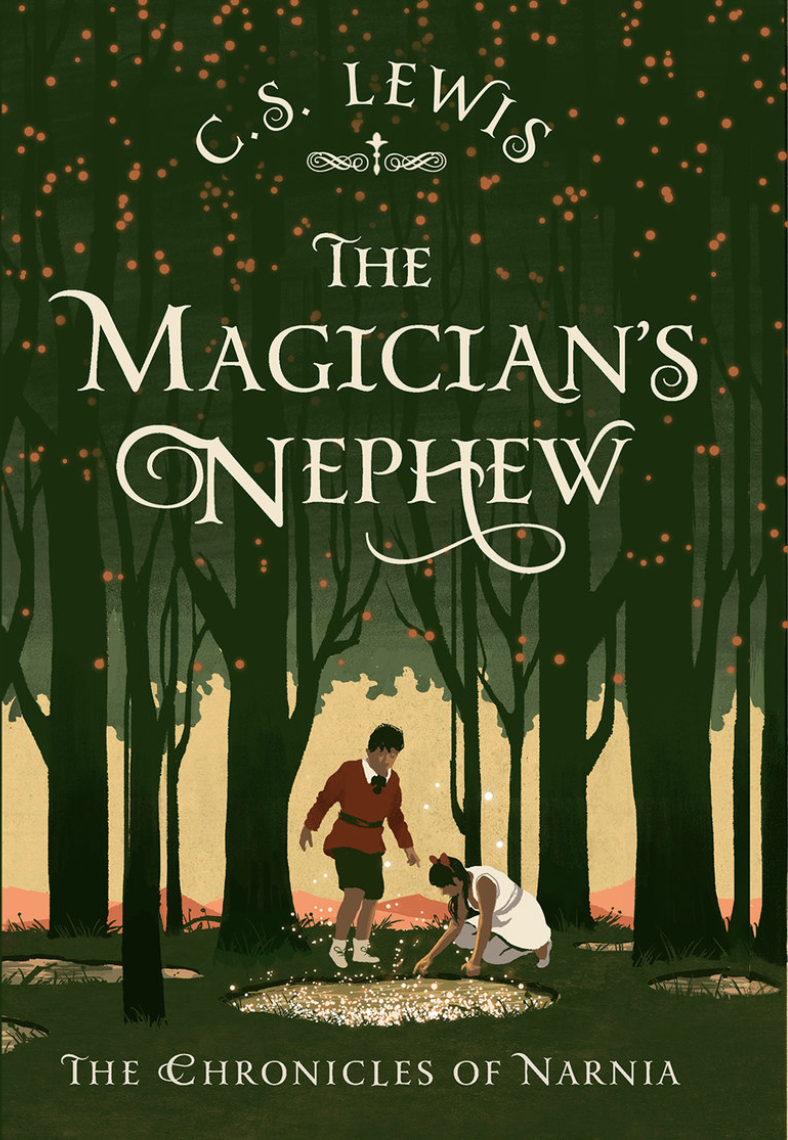
This is from a series of brilliant Narnia cover designs by Jeffrey Nguyen

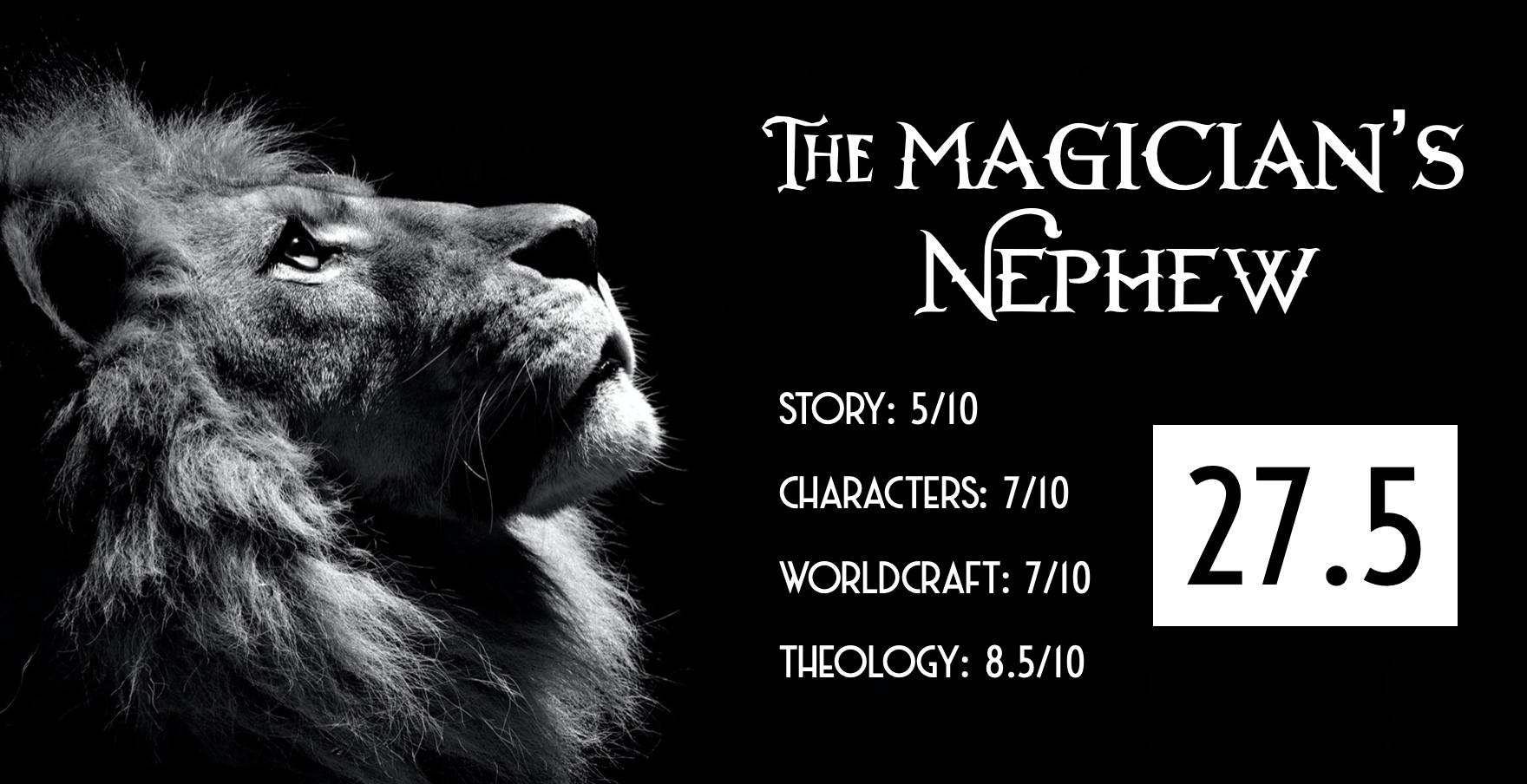
Having introduced the rubric, I’ll conclude this post by applying it to the first book in the series, The Magician’s Nephew:[2]

Story

Honestly, the story of The Magician’s Nephew is kind of rough. It is a classic prequel in the negative sense: you care about the story because you are already invested in the world in which it exists; if you actually read the prequel first, you wouldn’t understand what was so great about the series and may not even be inclined to continue.[3]

It seems like great pains are taken to explain things that really don’t need to be explained (like how a lamppost ended up in Narnia, or why the wardrobe is a doorway to it), while other unexplained items more central to the plot are introduced (like the origin of Uncle Andrew’s rings).

The plot is not particularly interesting or compelling. The pacing is slow, it feels like it takes forever for Digory and Polly to get to the other worlds, and once they do, what they find is not particularly exciting. The appearance of Jadis in England leads to a battle that is anticlimactic. Really, nothing very exciting happens until the founding of Narnia.

Story: 5/10

Characters

The main characters of The Magician’s Nephew are Digory Kirke (the old professor in The Lion, the Witch and the Wardrobe; hereafter referred to as LWW) and Polly Plummer. Digory is a fairly-well developed character: he is concerned about his sick mother and despises his wicked uncle. He craves adventure, and does not think highly of Polly when she doesn’t:

“It’s because you’re a girl. Girls never want to know anything but gossip and rot about people getting engaged.” (57)

Ultimately, that desire for adventure gets him in trouble, as he foolishly unleashes Jadis upon England and, ultimately, Narnia. But he owns up to his mistake and shows courage as he seeks to make amends.

Polly is less developed, and serves largely as a sidekick and somewhat of a foil to Digory. She shows prudence and also loyalty, sticking with Digory throughout his misadventures.

Though less of a focus, Uncle Andrew is a well-written character in his own right: at first, he appears impressive in his magical knowledge and frightening in his villainy, but as the book unfolds, we see that he is more of a selfish and doddering old man who dabbles in magic without understanding it, and less of a villain than he is a cowardly jerk. He is placed in sharp contrast to Jadis, Queen of Charn and the White Witch of LWW. She is the true villainess of The Magician’s Nephew, but honestly, she is less impressive and less developed here than in LWW.

Aslan, the Great Lion, is mysterious and exciting, and the most impressive actions and best lines of the book are largely reserved for him: we are struck by his power, wisdom, severity, and forgiveness.

Characters: 7/10

Worldcraft

The Magician’s Nephew transports us to two different worlds. Charn is the ancient and crumbling world of Queen Jadis, which she herself has destroyed. The description of the dying world prepares us for the twilight of Narnia in The Last Battle, and also, I think, the sort of cold, lifeless reality that Jadis will unleash upon Narnia in LWW.

We also are taken to Narnia at its creation and founding. Since the world is brand new, there is not much to explore in some ways, but the creation account, along with the origin of the talking animals and the life-infused ground that grows trees from anything dropped upon it (like lamppost bars or gold coins), is compelling.

Worldcraft: 7/10

Theology

I enjoy reading the Narnia books, but in many ways, I am here for the theology, and The Magician’s Nephew does not disappoint on this score. I thought the most significant instance of this was the creation account, where Aslan sings the world into existence. John 1 and Colossians 1 teach that Jesus is the agent of creation, and Aslan’s singing reminds us of Yahweh speaking everything into existence (Genesis 1), and the Word who was with God in the beginning (John 1).[4]

But there were other profound tidbits that Lewis sprinkled throughout the book. On God’s response to our suffering:

“They were such big, bright tears compared with Digory’s own that for a moment he felt as if the Lion must really be sorrier about his Mother than he was himself.” (168)

On the importance of asking God for things:

“‘Wouldn’t [Aslan] know without being asked?’ said Polly.

‘I’ve no doubt he would,’ said the horse. ‘But I’ve a sort of idea that he likes to be asked.’” (178)

On the contentment that comes when we truly see Jesus:

“But he was in no danger of feeling conceited for he didn’t think about it at all now that he was face to face with Aslan. This time he found he could look straight into the Lion’s eyes. He had forgotten his troubles and felt absolutely content.” (197)

And Lewis also hints at his vision of hell and eternal punishment, which he develops further in The Last Battle and, especially, The Great Divorce:

“I cannot tell that to this old sinner, and I cannot comfort him either; he has made himself unable to hear my voice. If I spoke to him, he would hear only growlings and roarings. Oh Adam’s sons, how cleverly you defend yourselves against all that might do you good!” (Aslan, 202-203)

“All get what they want. They do not always like it.” (Aslan, 208)

Theology: 8.5/10

A score of 27.5/40 basically comes out to 3.5 stars on a 5-star scale, which is not bad. That probably says something about The Chronicles of Narnia (or, at least, my opinion of them): to me, this is easily the worst of the seven books. I have not yet applied my rubric to the other six, but I expect those scores to be higher.


Check out the full series of posts:


[1] Definitive, according to me.

[2] Some of you are probably screaming, “The Magician’s Nephew is not the first book in the series!” And I would totally agree with you. The first Narnia book Lewis wrote and published was The Lion, the Witch and the Wardrobe, while The Magician’s Nephew was actually sixth. But The Magician’s Nephew is a prequel, and chronologically occurs first in the series.

I prefer reading The Chronicles of Narnia in the order in which they were published, but I am following the chronological order in this series because (1) this is, sadly, almost universally the way the books are published now, and (2) I think The Magician’s Nephew is the weakest book in the series, and this enables me to get it out of the way.

[3] This is very similar to The Phantom Menace in the Star Wars series. There are a lot of people out there who put up with The Phantom Menance because they were already Star Wars fans, but I cannot imagine that there are too many people out there who became Star Wars fans because of The Phantom Menace (in fact, most Star Wars fans I know try to forget that The Phantom Menace exists).

By the way, this is a really strong reason in my opinion why you shouldn’t read The Chronicles of Narnia in chronological order (at least, the first time you read them): because you might dislike The Magician’s Nephew and become discouraged from reading the other, superior books.

[4] I know there are debates about whether the Narnia books in general and LWW, in particular, should be read as allegories of the Christian story. I am not really interested in engaging those discussions, beyond saying this: it is clear that Aslan is a Christ-figure, and, thus, my comments in this series on the theology of The Chronicles of Narnia will look at what Aslan teaches us about Jesus.

« Older posts Newer posts »

© 2026 The Doc File

Theme by Anders Noren — Up ↑