The online journal of Luke Dockery

Category: Theology (Page 18 of 58)

A New Heaven & A New Earth Part 6: The Redemption of All Things

This post is part of an ongoing series. You can find links to all the posts here.

We have spent the last few posts examining passages that supposedly contradict the renewed earth perspective, and have seen that these texts don’t actually oppose that perspective. Indeed, they fit better with the NHNE view than with the traditional idea that this earth will be destroyed and that when Jesus comes, we will leave this earth and return to heaven with Him.

Today marks a shift in this series, as we begin to make positive arguments for the renewed earth perspective. In this post, in particular, we are going to be looking at several texts that teach cosmic redemption: God intends to redeem and restore all of creation, not just humans. 

The content and line of argumentation employed in this post rely significantly on J. Richard Middleton’s A New Heaven and a New Earth: Reclaiming Biblical Eschatology.[1] We are going to look at several New Testament passages[2] that all describe God’s salvation in some sense, and with each passage, we are going to ask two questions:

  • How is salvation described in this passage?
  • What is the object or recipient of God’s salvation in this passage? Who or what gets saved?


Acts 3.19-21

Here, in context, Peter is preaching the Gospel outside the temple. He has told his audience (“Men of Israel”) that the God of their fathers has raised Jesus from the dead following HIs crucifixion, and that this was foretold by the mouths of the prophets.

19 Repent therefore, and turn back, that your sins may be blotted out, 20 that times of refreshing may come from the presence of the Lord, and that he may send the Christ appointed for you, Jesus, 21 whom heaven must receive until the time for restoring all the things about which God spoke by the mouth of his holy prophets long ago.

There is not a lot of detail in this passage and it is somewhat cryptic, but looking at our two questions, we can see the answers.

How is salvation described in this passage? Who or what gets saved?

Depending on your translation, Acts 3.21 says something like “universal restoration” or “restoring all the things.”[3] According to Peter, salvation is restorative in that it fixes what sin has broken, and it is also holistic in that it affects everything.[4]

Peter also says that God has talked about this through the mouth of the prophets. Later in this series, we will track the notion of cosmic redemption throughout Scripture, but it is worth keeping in mind that Peter says universal restoration is something that has been prophesied.

This is a brief text and perhaps a murky one, but I think it becomes clearer when it is placed beside some other statements in the New Testament.

Ephesians 1.3-10

Here, Paul discusses God’s plan of salvation and the spiritual blessings we have in Christ:

3 Blessed be the God and Father of our Lord Jesus Christ, who has blessed us in Christ with every spiritual blessing in the heavenly places, 4 even as he chose us in him before the foundation of the world, that we should be holy and blameless before him. In love 5 he predestined us for adoption to himself as sons through Jesus Christ, according to the purpose of his will, 6 to the praise of his glorious grace, with which he has blessed us in the Beloved. 7 In him we have redemption through his blood, the forgiveness of our trespasses, according to the riches of his grace, 8 which he lavished upon us, in all wisdom and insight 9 making known to us the mystery of his will, according to his purpose, which he set forth in Christ 10 as a plan for the fullness of time, to unite all things in him, things in heaven and things on earth.

This passage talks about our adoption into God’s family and the redemption and forgiveness we have made possible through Jesus Christ. And then, look specifically at verses 9-10: how is salvation described in this passage? Who or what gets saved?

“Here salvation (God’s plan for the fullness of time) is understood as gathering up or unifying in Christ that which has been fragmented (or perhaps alienated) through sin.”[5]

So again, we see salvation described in restorative terms, and it is also holistic, because what will be saved? Paul is as explicit as he can be: “all things…things in heaven and on earth.” If you think back to the first post in this series, we talked about heaven and earth as the biblical pairing that we see over and over again in Scripture (cf. Genesis 1.1).

Salvation will be as widespread as creation.

Colossians 1.15-20

This has been one of my favorite texts in the New Testament for several years. It is a magisterial text that elevates Jesus Christ as the Creator, Sustainer, and Redeemer. But it wasn’t until I considered it more closely that I saw how it also teaches cosmic redemption.

15 He is the image of the invisible God, the firstborn of all creation. 16 For by him all things were created, in heaven and on earth, visible and invisible, whether thrones or dominions or rulers or authorities—all things were created through him and for him. 17 And he is before all things, and in him all things hold together. 18 And he is the head of the body, the church. He is the beginning, the firstborn from the dead, that in everything he might be preeminent. 19 For in him all the fullness of God was pleased to dwell, 20 and through him to reconcile to himself all things, whether on earth or in heaven, making peace by the blood of his cross.

Look at verse 19-20 specifically: how is salvation described in this passage? Who or what gets saved?

Salvation is described in terms of reconciliation, making peace between those who are at enmity with one another by removing the cause of the enmity between them: sin. So, again, we see salvation as restorative. 

As Christians, we tend to think of this in very individualistic terms: Jesus died for me. While that is certainly true, it’s not what this text emphasizes: the reconciliation made possible by Jesus is applied to “all things, whether on earth or in heaven.”

This clearly refers to more than just humans:

  • Colossians 1.16: “all things…in heaven and on earth” were created through Jesus. 
  • Colossians 1.17: “all things” hold together in Him. 
  • Colossians 1.20: “All things, whether on earth or in heaven” will be reconciled in Him.

The same language is used in all three instances: what Jesus created, He also sustains and will redeem. Salvation is holistic. It is as wide as creation; it is cosmic in scope.

Romans 8.18-23

I like this passage a lot; I think it is really neat, and also weird. After talking about how those who are led by the Spirit are sons of God and fellow heirs with Christ, Paul launches into a series of thoughts about future glory:

18 For I consider that the sufferings of this present time are not worth comparing with the glory that is to be revealed to us. 19 For the creation waits with eager longing for the revealing of the sons of God. 20 For the creation was subjected to futility, not willingly, but because of him who subjected it, in hope 21 that the creation itself will be set free from its bondage to corruption and obtain the freedom of the glory of the children of God. 22 For we know that the whole creation has been groaning together in the pains of childbirth until now. 23 And not only the creation, but we ourselves, who have the firstfruits of the Spirit, groan inwardly as we wait eagerly for adoption as sons, the redemption of our bodies.

The background of this passage lies in the Fall of Man in Genesis 3 and the fact that a curse is placed on Creation itself because of human sin (v. 20; cf. Genesis 3.17-19). Because of human sin, creation has been “subjected to futility” and is under “bondage to decay”. Both the “whole creation” and “we ourselves” long for redemption.

How is salvation described in this passage? Who or what gets saved?

Salvation is described here as liberation—being set free from bondage—and also as redemption.  Again, this is restorative language. Furthermore, creation itself[6] is longing to be liberated, and we ourselves long for the redemption of our own bodies.[7] Salvation is about more than just us; it is holistic.

2 Peter 3.10-13

We will not spend much time on this passage because we covered it at length in a previous post. In context, Peter is giving a warning to those who scoff and think that judgment won’t come, and he tells them that indeed it will. Here, near the end of 2 Peter 3, he talks about how we should live lives of holiness and godliness, waiting for the coming day of God (and of course, this is when “salvation” comes):

10 But the day of the Lord will come like a thief, and then the heavens will pass away with a roar, and the heavenly bodies will be burned up and dissolved, and the earth and the works that are done on it will be exposed. 11 Since all these things are thus to be dissolved, what sort of people ought you to be in lives of holiness and godliness, 12 waiting for and hastening the coming of the day of God, because of which the heavens will be set on fire and dissolved, and the heavenly bodies will melt as they burn! 13 But according to his promise we are waiting for new heavens and a new earth in which righteousness dwells.

How is salvation described in this passage? Who or what gets saved?

We have studied this already: there is a process where “the earth and the works in it” will be disclosed or laid bare, and we talked about the idea of refining or purification by fire. Again, salvation is restorative.

Then, Peter says, a new heavens and a new earth will come about—not brand new, but a new version of what was before—salvation is holistic.

Putting It All Together

Here is a summary of what we have seen in the passages we have discussed:[8]
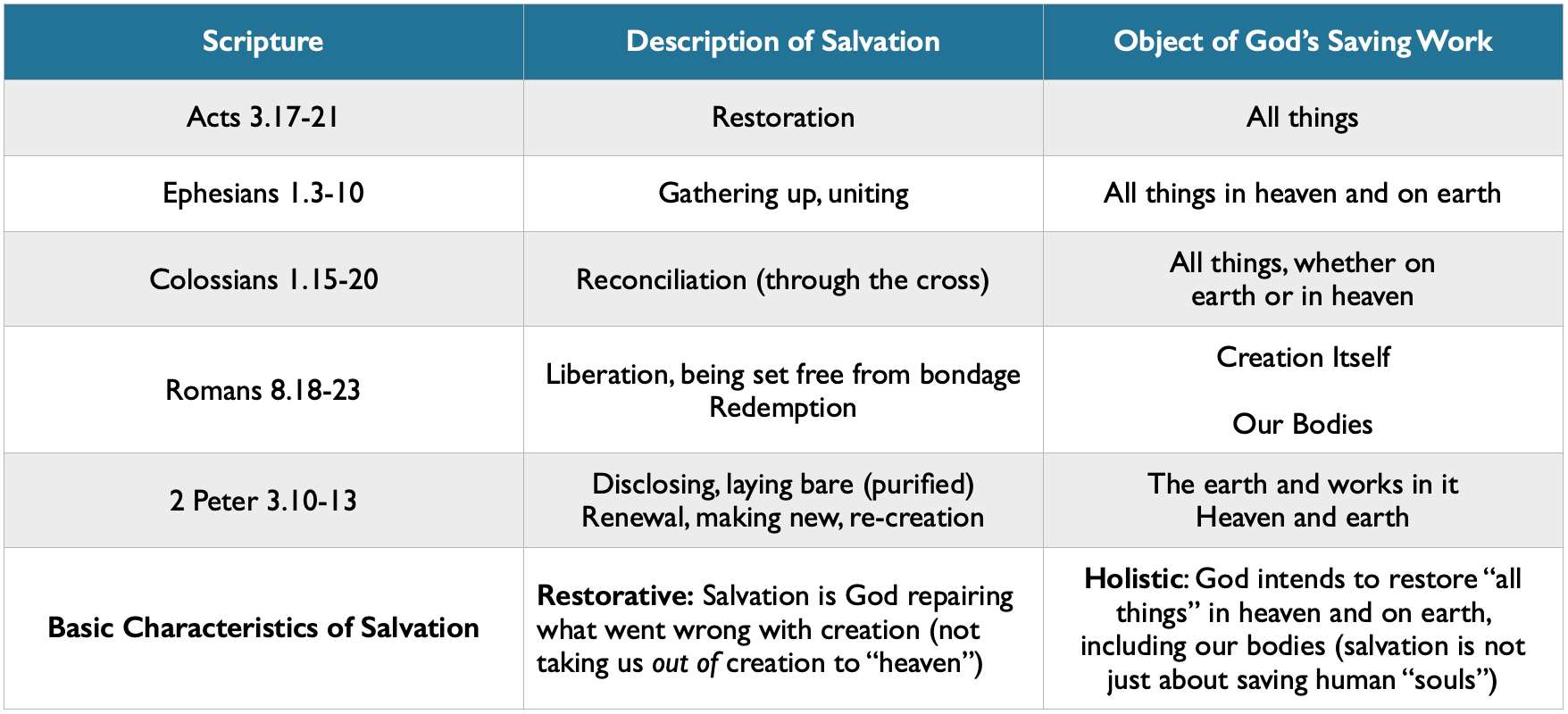
So, tying all this together, what can we conclude? In the words of Middleton:

“First, salvation is conceived not as God doing something completely new, but rather as redoing something, fixing or repairing what went wrong; this point is expressed in the language of restoration, reconciliation, renewal, and redemption found in these tests. Second, this restorative work is applied as holistically and comprehensively as possible, to all things in heaven and on earth, where the phrase “heaven and earth” is how Scripture typically designates the entire created order (with the earth understood as the distinctively human realm [Ps. 115:16]). The point is that the final salvific state envisioned in these five texts clearly contradicts an understanding of an immaterial, supramundane “heaven” as the ultimate dwelling place of the redeemed.”[9]

Scripture describes redemption in cosmic terms. It is restorative and holistic.


[1]J. Richard Middleton, A New Heaven and a New Earth: Reclaiming Biblical Eschatology, (Grand Rapids: Baker Academic, 2014): 155-63.

[2]I am not attempting in this post (or even in this entire series) to examine every passage in Scripture that supports the notion of a renewed creation. In this post, we are looking at a certain kind of text that supports this idea of cosmic redemption. In future posts, we will trace this theme through Scripture in different ways, but there are some passages that we will not get to.

For example, in Matthew 5.5 Jesus says, “Blessed are the meek, for they shall inherit the earth.” Although this passage was not central to my own development on this topic, it is a verse that is frequently referenced in support of NHNE. For an excellent discussion of this passage, see Jacob Rutledge, “The Christian and Creation, Chapter 4: Jesus and the Restoration of All Things.”

[3]BDAG, 112, glosses this word, apokatastasis/αποκαταστασις as “restoration”, and suggests a meaning of “restoring everything to perfection or, as of stars in their orbits, to their starting points.”

As Middleton, 157 n.5, points out, this term does not refer to the ultimate salvation of all people. Cosmic redemption is not universalism. While Scripture teaches that God loves and will ultimately redeem His creation, it also teaches that God honors the choices of humans who reject His love and offer of redemption. Middleton, 207-09, covers this in more detail.

[4]The word here is the common Greek word, panta/παντα, which means “all”. Here, it appears in the neuter gender, which is what provides the translation “things.” So, “all things” is the more literal translation; “universal” is more interpretive, but seems sound.

[5]Middleton, 158.

[6]The Greek word for “creation” in this passage is ktisis/κτισις and refers simply to something that is created. Those seeking a different interpretation than what I offer above will occasionally try to argue that in this text, ktisis is referring to humans rather than other forms of creation (animals, plants, rocks, etc.). This interpretation cannot be correct.

BDAG, 573, acknowledges the dispute over the meaning of the word in this passage, but does state that it is usually “taken to mean the waiting of the whole creation below the human level (animate and inanimate).”

Jimmy Allen, Survey of Romans (Searcy, AR: 1973): 79, presses further, helpfully laying out why ktisis cannot refer to humans in this passage. First, it cannot refer to those who are in Christ, because a clear distinction is made between believers and ktisis in Romans 8.23 (“not only the creation, but we ourselves…”). Second, it cannot refer to those who are outside of Christ, because “unbelievers do not look forward to the revealing of God’s sons in glory nor will they obtain the glorious liberty of God’s children.”

[7]This is a reference to the resurrection and the glorious transformation of our bodies, which we will discuss at length in a later post.

[8] This chart is adapted from Middleton, 163.

[9] Ibid.
A New Heaven & A New Earth Part 5: “Problem” Texts–John 14.1-3

This post is part of an ongoing series. You can find links to all the posts here.

Today’s post is the third focused specifically on dealing with “problem” passages that are frequently brought up as evidence that the Bible does not teach that creation will be renewed when Jesus returns. My contention is that these texts are really not “problems” after all—when properly understood, they either argue for the NHNE perspective, or at least, do not argue against it.

Previously, we have discussed 1 Thessalonians 4.13-18 and 2 Peter 3.1-13, and today, we will look at John 14.1-3. There are, certainly, other texts that people use to argue against the NHNE perspective, but these are the “Big 3” in my experience, and next week, we will move on and begin looking at various arguments for the renewed creation perspective.[1]

I will be clear up front: I do not believe that John 14.1-3 clearly teaches the NHNE position, but neither do I believe that it is a problem for that position.

Here is the passage in question:

1 Let not your hearts be troubled. Believe in God; believe also in me. 2 In my Father’s house are many rooms. If it were not so, would I have told you that I go to prepare a place for you? 3 And if I go and prepare a place for you, I will come again and will take you to myself, that where I am you may be also.

Why is this text considered to be a “problem”? Frequently, this passage is read to mean that Jesus is preparing a place for us in heaven and so when He returns, He will take us back with Him to heaven. 

Is this the only way to read it? Well, certainly not. Let’s take a closer look.


The Harmony of Scripture

First off, at this point, it is helpful for us to remember some of what we have studied in previous posts, because it is important for us to consider these passages in relation to one another.

I do not believe that the New Testament presents a bunch of contradictory ideas about what happens when Jesus returns (or anything else, for that matter), where one text presents a certain idea and another text says something completely different. Instead, I believe the teaching of Scripture is consistent and unified and that various passages harmonize with one another to provide a fuller picture on a given subject.

So, if we have 1 Thessalonians 4 in mind, we know from the historical background and use of imperial language in that passage that we are going to meet Jesus and then return here (whatever “here” is like at that point). Thus, we should already be skeptical about any interpretation of John 14 that indicates that when Jesus returns we will leave here to go somewhere else with Him.

Looking at the Passage in Context

In context, what is Jesus trying to do in this passage? John 14.1 gives us the answer as Jesus tells His disciples, “Let not your hearts be troubled.” Jesus is providing comfort to His disciples.

If we go up a few verses (remember, chapter additions were added much later; this is all part of Jesus’ “Farewell Discourse”), we see that there is plenty that Jesus has told them that would have been distressing to them: one of the disciples will betray Him, Jesus will not be with them much longer, and Peter will deny Jesus repeatedly. With all of this in their minds, it makes sense that the disciples would be troubled!

But Jesus tells them not to be troubled, but to trust in God and in Himself. We then have the famous verse, “In my Father’s house are many rooms” (v.2).

Rooms

I want to look at the two crucial words/phrases in this verse—“Father’s house” and “rooms”—in reverse order.

The word translated as “rooms” or “dwelling places” is the Greek word μοναι/monai, which can mean something like “temporary lodging place”.[2] Because of this, it has been argued that this is a reference to the intermediate state and that Jesus is preparing an interim resting place for His disciples when they die,  prior to the return of Jesus and the resurrection of the dead.

This seems unlikely, though, because John 14.3 focuses on when Jesus comes again and not on when the disciples will die.[3]

Father’s House

Generally speaking, “Father’s house” is temple language. Think of the story of Jesus as a boy when His parents find Him in the temple and He says, “Did you not now that I must be in My Father’s house?” (Luke 2.49), or Jesus cleansing the temple in John 2.16 and saying, “Do not make my Father’s house a den of trade.”[4]

When Jesus talks about His Father’s house in John 14.2, He isn’t referring to the literal temple, but rather, is using this language as a shorthand for “where God is”—in ancient understanding, temples were places where God dwells, and we see this throughout the story of Scripture. 

We referenced this idea when we discussed the relationship between Heaven and Earth in the first post of this series. Heaven is God’s domain, the earth is humanity’s domain, and we see throughout the biblical story that there are times and places where heaven and earth overlap[5]—where God dwells with humanity in a special way:

  • At creation, God constructed a cosmic temple[6] where God was able to dwell with humans and walked with them in the garden.
  • With the tabernacle (and later, its more permanent counterpart, the temple), God created a means to dwell within the midst of the nation of Israel.
  • In the incarnation, the Word became flesh and “tabernacled” among us. Jesus Himself was a walking temple, as God dwelt among us in an unprecedented way. 
  • Through the giving of the Spirit, God’s presence was multiplied exponentially. God’s Spirit lives within believers, and Paul says that we are temples of God’s Spirit, individually (1 Corinthians 3.16) and collectively (1 Corinthians 6.19-20).
  • In eternity, God will make His dwelling (tabernacle) with humanity in the new heaven and new earth (Revelation 21.1-5).

Throughout Scripture, we can see how temple language is used to indicate spaces where God’s presence can dwell with humanity. Here, in John 14, when Jesus talks about His “Father’s house”, this is the background against which we need to hear His statement. And the emphasis of what Jesus says here is not the where of His Father’s house, but its expansiveness: there is plenty of room for everyone: many dwelling places. Remember, this is a passage of comfort.

Jesus will go and prepare a place for His disciples in His Father’s house, and will come again so they can dwell together.

But When Will This Happen?

In my discussion of the Greek word μοναι/monai above, I argued that this passage can’t really be a reference to the intermediate state, because the emphasis is on when Jesus comes again, not on when the disciples themselves die. So, what does Jesus mean when He says, “I will come again”? When will this happen?

It is easy for us to read these words and immediately think of the Second Coming, but I am not sure that does justice to the context of this passage. This is the night that Jesus is betrayed. In a matter of hours, Jesus will “go away”. He will be forcibly removed from their presence, tried, scourged, and crucified, ultimately leaving them at His death. He would then “come again” to be with them following His resurrection. 

Thus, in one sense, I think we can say that the most straightforward way of reading this passage is in light of what was about to happen to Jesus and the disciples. This reading makes sense from a theological perspective as well: when Jesus “goes away” to be crucified, He absorbs the sins of the world upon Himself and makes it possible for all people to have a relationship with the Father. 

A little later in John 14.23, Jesus says, “If anyone loves me, he will keep my word, and my Father will love him, and we will come to him and make our home with him.” The word “home” in this passage is μονὴν/monen, the same word Jesus used in 14.2, and I think we see this happening in a powerful way at Pentecost, with the sending of God’s Spirit to live among God’s people and make his home among us.[7]

However, once we have acknowledged the immediate context of Jesus’ words in John 14.1-3, I think there is also a fuller meaning to which this passage points, just as the current indwelling of the Spirit is a guarantee or down payment that points to our future inheritance (2 Corinthians 1.22, 5.5; Ephesians 1.13-14).[8] As Jesus’ work on the cross and His defeat of sin and death make it possible for the Spirit to come and dwell among us, so also it makes possible God’s ultimate dwelling with His people in the new creation—He prepares this for us.

When Jesus returns, we will go to be with Him (1 Thessalonians 4.17; John 14.3).[9] Revelation 21.2 describes that time of God’s ultimate dwelling with His people by saying that “the holy city, new Jerusalem” will come “down out of heaven from God, prepared as a bride adorned for her husband”, and the word “prepared” is the same word that Jesus uses in John 14.3.

Or, as Hicks, Valentine, and Wilson describe it in Embracing Creation:

“Jesus goes away to complete the construction (preparation) of God’s new house, the new creation. When Jesus returns, the heavenly Jerusalem will descend—with Jesus—to the new earth under the new heavens. Jesus will receive us, and we will dwell with Jesus within the Father’s house forever.”[10]

With all of that in mind, I think there is a two-fold answer to the question of when the things that Jesus describes in John 14.1-3 will happen. First, Jesus is going away to be crucified, but He will return to His disciples after the resurrection, and what He accomplishes in the meantime will change everything and will make it possible for God to dwell with His people in an unprecedented way. But beyond that, this points ahead to eternity, where Jesus will return again take us to Himself, and the Father will fully and eternally dwell with us in His house—a new heaven and a new earth.

Conclusion

It is important to remember that the focus of John 14.1-3 is really not on what happens when Jesus returns; it is that Jesus’ disciples can be comforted in the knowledge that when He returns, they can be with Him forever (wherever that may be). 

Thus, this passage doesn’t really come down on the NHNE issue one way or the other. It does, however, fit nicely with other texts such as 1 Thessalonians 4 and Revelation 21 in a way that the traditional view does not.


[1]J. Richard Middleton, A New Heaven and a New Earth: Reclaiming Biblical Eschatology, (Grand Rapids: Baker Academic, 2014): 179-237, has an excellent, lengthy discussion of various texts that could be construed as presenting a perspective contrary to renewed eschatology.

[2]The King James Version erroneously translates this word as “mansions,” which is the source of old songs like “Mansion Over the Hilltop” and “An Empty Mansion.” The theological point of this verse is the comfort of dwelling with God, not on the magnificent opulence of that dwelling.

[3]Middleton, 228-29; Ian Paul, “Jesus’ farewell discourse in John 14”, https://www.psephizo.com/biblical-studies/jesus-farewell-discourse-in-john-14/

[4]Technically, the word for “house” does not occur in the Greek of the Luke 2 passage, but the fact that Jesus is in the temple and that it is widely translated this way illustrates the point I am making: “Father’s house” is temple language.

[5]See Timothy Mackie and Jonathan Collins, When Heaven Meets Earth: A 12-Part Biblical Study on Heaven (Portland: The Bible Project, 2017). This resource is available for download on The Bible Project website here.

[6]The notion that God is depicted as creating a cosmic temple and setting it in order in Genesis 1-2 and setting it in order is a widespread understanding in biblical studies. For helpful summaries of this, see John Mark Hicks, Bobby Valentine, and Mark Wilson, Embracing Creation: God’s Forgotten Mission, (Abilene, TX: Leafwood: 2016): 33-45; Middleton, 46-49, 163-65, 168-72.

[7] I am indebted to Stephen Scaggs for his thoughts in helping me to understand this reading of the text. 

Embracing Creation, 195: “In one sense, Jesus comes even now in the presence of the Spirit to live within us and make his home among us. This is his promise in John 14:23, the only place where Jesus uses this word other than John 14:2. In the coming of the Spirit, the Father and Son, Jesus said, will “make our home [dwelling place] with them.”

See also Middleton, 229.

[8]Embracing Creation, 196, discusses the “fuller experience” to which this passage refers beyond the immediate context. 

[9]To me, the language of 1 Thessalonians 4.17 and John 14.3 are strikingly similar. In 1 Thessalonians 4.17, we will be “caught up” to meet the Lord in the air; in John 14.3, Jesus says, “I will take you to myself.” These are forceful actions, initiated by Jesus, that result in our dwelling with Him.

[10]Embracing Creation, 196.

The Christian Response to a Broken World

Over the weekend, my family and I passed the 50-day milestone of our COVID-19-inspired home isolation. I have tried to view this as an opportunity for growth, and there have certainly been some benefits to this season, but like the vast majority of folks, I acknowledge its challenges and am ready to move on to something else.

There is no denying that this is a rough time all around the world. Hundreds of thousands of people have died, and millions have contracted COVID-19. Financial uncertainty is widespread, as millions have lost their jobs.  The quarantine directives have been particularly devastating in parts of the world with food insecurities where starvation is a legitimate threat. Closer to home, financial stress and sheltering-in-place have created a volatile mix that, according to some reports, has led to a spike in abuse, mental health issues, and suicide.


In light of what is literally a worldwide crisis, you would like to think that perhaps this shared experience could bring us together somewhat—unify us in a time of need as we all pull together to jointly overcome. To be sure, that has happened to a degree, but louder, shriller voices continue to sow discord and division, placing blame along party lines and even promoting wild conspiracy theories.

From my perspective, the response to these events from a lot of Christians has been pretty disappointing as well. Too often, we are quick to speak and slow to listen instead of the other way around (see James 1.19), and when we react in that way, we can often add fuel to the fires of heartache, division, and confusion that are already waging.

The reality is that we live in a broken world marred by lots of problems. As Christians living in this context, how should we respond when tragedy occurs? I don’t claim to have all the answers, but here are three responses that I believe are helpful in the face of tragedy:

(1) In response to a broken world, Christians should lament. Perhaps our most basic response to suffering is that we should weep with those who weep (Romans 12.15). That seems like the most obvious thing in the world, but recently, instead of this, I have seen Christians telling those who weep that what they weep about isn’t really a big deal or worth weeping about at all! When the world gives us evidence of its brokenness, we should acknowledge that brokenness, allow ourselves feel distress, and bring that distress before God. It has become popular, in some circles, to criticize prayer as a response to horrible tragedy, but as Christians, we should take no note of such dismissals. Christians believe that God is ultimately sovereign over the universe, and thus, He is the one who can do something about the brokenness in our world. It is absolutely appropriate that we bring out laments before our Father, as we yearn for a day when He will wipe every tear from our eyes (Revelation 21.4).

(2) In response to a broken world, Christians should aid the suffering. I think part of the reason that a lot of people are critical of prayer is that they feel that this is all that Christians do. And perhaps that can be a fair criticism at times, because God certainly expects us to accompany our prayers with righteous actions. Philip Yancey says that the church forms the front line of God’s response to the suffering world, and I think he is right: Christians have a responsibility to get into the mess of the world and try to do something to clean it up. That is probably accomplished less by questioning the statistics that are released, distrusting the media, or berating government officials, and more by being present with those who suffer, and looking for ways to aid those who are in need: offering a shoulder to cry on (even a socially-distant one!) for the grieving, a card or phone call for the lonely, a bag of groceries or a check in the mail for those with financial needs.[1]

(3) In response to a broken world, Christians should proclaim Jesus. Too often, this part is neglected. In John 16.33, Jesus was speaking to His disciples on the night of His arrest and He said simply, “In this world you will have tribulation.” Though not spoken directly to us, those words certainly apply to us as well; as recent and ongoing events remind us, we live in the same world, a world which was created good but has been tainted by sin and is now characterized by heartache. As Christians, we weep with those who weep, we do what we can to help those who are suffering, but we also remember the second half of John 16.33: “In this world you will have tribulation…but take courage, I have overcome the world!” As Christians, we also proclaim that the death and resurrection of Jesus Christ mean that sin, illness, suffering, strife, injustice, and death do not get the last word. As Christians, we long for the day when Jesus returns, when death dies, and when every tear is wiped away from our eyes.

This is not an exhaustive list, and I am certain that more could be said. At the same time, I am equally certain that if Christians everywhere would respond to suffering and tragedy in our world in these ways, the Christian witness would be strengthened, the suffering of people would be limited, and the borders of God’s Kingdom would be expanded.

This is an updated version of an older post. 


[1]If you have been blessed with financial means and would like to share with those who are in need, please contact me. I am working to help some ministers in impoverished areas who are providing food for vulnerable populations who are at risk of literally starving, and I would be happy to help your gift get to a place where it could accomplish much good.

A New Heaven & A New Earth Part 4: “Problem” Texts–2 Peter 3.1-13

This post is part of an ongoing series. You can find links to all the posts here.

Last week’s post was about our first “problem” text, 1 Thessalonians 4.13-17. In that post, I argued that, when properly understood in its historical context, paying close attention to the specific Greek words that Paul uses, this passage isn’t actually a “problem” for the NHNE perspective at all; it actually supports renewed eschatology.

For me, the “problem” passage we are going to look at today was even more important in my own journey, because this was the passage that to me most seemed to refute the notion that God would renew and redeem creation when Jesus returned. I am talking about 2 Peter 3.1-13, which is another “problem” in the sense that it supposedly opposes renewed eschatology. When properly understood, I don’t think it does, and I think it actually fits quite well with the NHNE perspective.

There is a lot going on in this passage that we will need to consider, and even in what I am sure will be a very long post, we won’t be able to fully do it justice.

Let’s start by taking a look at the passage itself (I have the verse that people tend to focus on in bold):

1 This is now the second letter that I am writing to you, beloved. In both of them I am stirring up your sincere mind by way of reminder, 2 that you should remember the predictions of the holy prophets and the commandment of the Lord and Savior through your apostles, 3 knowing this first of all, that scoffers will come in the last days with scoffing, following their own sinful desires. 4 They will say, “Where is the promise of his coming? For ever since the fathers fell asleep, all things are continuing as they were from the beginning of creation.” 5 For they deliberately overlook this fact, that the heavens existed long ago, and the earth was formed out of water and through water by the word of God, 6 and that by means of these the world that then existed was deluged with water and perished. 7 But by the same word the heavens and earth that now exist are stored up for fire, being kept until the day of judgment and destruction of the ungodly.

8 But do not overlook this one fact, beloved, that with the Lord one day is as a thousand years, and a thousand years as one day. 9 The Lord is not slow to fulfill his promise as some count slowness, but is patient toward you, not wishing that any should perish, but that all should reach repentance. 10 But the day of the Lord will come like a thief, and then the heavens will pass away with a roar, and the heavenly bodies will be burned up and dissolved, and the earth and the works that are done on it will be exposed.

11 Since all these things are thus to be dissolved, what sort of people ought you to be in lives of holiness and godliness, 12 waiting for and hastening the coming of the day of God, because of which the heavens will be set on fire and dissolved, and the heavenly bodies will melt as they burn! 13 But according to his promise we are waiting for new heavens and a new earth in which righteousness dwells.


Different Translations

When I taught through this passage in Bible class, I made sure that we read from several different Bible translations, paying close attention to the different ways that 2 Peter 3.10 is translated. Above, I quoted from the ESV. Here is verse 10 again:

10 But the day of the Lord will come like a thief, and then the heavens will pass away with a roar, and the heavenly bodies will be burned up and dissolved, and the earth and the works that are done on it will be exposed.

Here is the same verse in the KJV: 

10 But the day of the Lord will come as a thief in the night; in the which the heavens shall pass away with a great noise, and the elements shall melt with fervent heat, the earth also and the works that are therein shall be burned up.

The NKJV:

10 But the day of the Lord will come as a thief in the night, in which the heavens will pass away with a great noise, and the elements will melt with fervent heat; both the earth and the works that are in it will be burned up.

And also, the NASB:

10 But the day of the Lord will come like a thief, in which the heavens will pass away with a roar and the elements will be destroyed with intense heat, and the earth and its works will be burned up.

Lest you think that the ESV is the oddball and that all other translations say that the earth will be “burned up” in v. 10, here is the NIV:

10 But the day of the Lord will come like a thief. The heavens will disappear with a roar; the elements will be destroyed by fire, and the earth and everything done in it will be laid bare.

And, finally, the NRSV:

10 But the day of the Lord will come like a thief, and then the heavens will pass away with a loud noise, and the elements will be dissolved with fire, and the earth and everything that is done on it will be disclosed.

Obviously, we have a translation issue here: one group of translations says that, in this context, the earth and its works will be “burned up”, while the other translations say the earth and its works will be “exposed”, “laid bare”, or “disclosed”. We will get into the details of this textual problem later, but for the moment, we will just acknowledge why this appears to be problematic for the idea of a renewed cosmos when Jesus comes: if you are reading from the NJKV or a similar translation, this verse makes it seem like the earth is going to be destroyed or annihilated by fire. Thus, we will either (1) go off to heaven with Jesus (which works well if paired with a faulty interpretation of 1 Thessalonians 4), or (2) live in a “new heavens and a new earth” (v.13) that is completely distinct from our current system.[1]

In other words, the idea that our current earth will in some way be renewed, redeemed, transformed—the perspective I am presenting in this series—is dismissed, because it sounds like it’s going to be burned up.

Is this the best way to read this passage? In this post, we’re going to take a closer look. I will confess that this is a challenging passage, but I think we can bring some clarity to it.

Context

First, let’s look at the point of what Peter is trying to say in context. In this section, Peter is talking about sinful people who scoff at the notion of judgment. They say things like, “You say judgment is going to happen, but everything just continues as it always has!” (v.4), but Peter points out that judgment came upon the earth before when God judged the world by a flood (v.5-6). In the same way, “the heavens and earth that now exist are stored up for fire, being kept until the day of judgment and the destruction of the ungodly” (v.7).

This knowledge—God’s impending judgment upon evil—should encourage the wicked to repent.

When the day of the Lord comes, the heavenly bodies[2] will be burned up and dissolved, and the earth and the works that are done on it will be…burned up? exposed? (This is the verse that we looked at in multiple translations; we’ll get to it in a few minutes.)

Because of all this, Peter says that we should be motivated to live lives of holiness and godliness, waiting for the coming day of God, and anticipating “new heavens and a new earth in which righteousness dwells” (v.13).

So, to keep things in perspective, whatever v.10 is talking about, what is the main point of this passage? Judgment upon evil has happened before (flood), judgment upon evil is going to happen again (fire), and the knowledge of this should motivate us to live holy lives.

Interpreting the Passage: Important Ideas to Consider

Three Worlds, and the Comparison to Noah: 

In 2 Peter 3.1-13, Peter refers to three different habitable worlds:[3]

  • Past: The original “heavens” and “earth” that emerged from and through water by the command of God. This world “perished” in the flood of Noah (2 Peter 3.5-6)
  • Present: The “heavens and earth that now exist” that are “stored up for fire” at the command of God (2 Peter 3.7,10,12)
  • Future: The future “new heavens and a new earth in which righteousness dwells” according to the promise of God (2 Peter 3.13)

Keeping these three worlds in mind is helpful as we consider the comparison that is made to the days of Noah: whatever is going to happen with fire in this present world, Peter compares to the judgment that God brought on the world through the flood.

Did the flood of Noah destroy the world? Well, yes…and no.

Certainly, the world as it had previously been was no more, but it’s not like the earth ceased to exist. The flood brought judgment upon the sins of the world and it certainly changed things. In some ways, it reset the system and perhaps even instituted a new system of existence (kind of like reformatting the hard drive of a computer after it crashes).

The flood of Noah washed the earth clean, preparing it to be a new sort of world (the “Present” world, as described above). But the earth was not annihilated.

Biblical Use of Fiery Judgment

The notion of fiery judgment upon the earth that Peter uses in this passage has a background in the Hebrew prophets, where it is a repeated motif.

One example of this is Malachi 4.1 (though, see also Malachi 3.1-4, Isaiah 34.4, Isaiah 64.1, and Zephaniah 3.8, among others):

1 “For behold, the day is coming, burning like an oven, when all the arrogant and all evildoers will be stubble. The day that is coming shall set them ablaze, says the LORD of hosts, so that it will leave them neither root nor branch.”

This is common judgment language, but in Malachi 4, who is the focus of it? Who will actually be burned up? The arrogant and all evildoers. Compare that to 2 Peter 3.7, which says that this fire is being stored up to bring destruction on the ungodly. The emphasis here, and in the entire passage, is not on destroying all that has been created, but a judgment of destruction upon the wicked.[4]

“The earth and the works that are done on it will be __________.”

We noted this problem at the beginning of the post, that different translations render 2 Peter 3.10 in very different ways, and one of those ways indicates that the earth will be “burned up.”

This is not a translation problem, but a textual one. As you probably know, we have thousands and thousands of hand-copied New Testament manuscripts, and, as you can imagine if you were responsible for copying the entire New Testament by hand, no matter how hard you tried, you would make some mistakes. Textual criticism is the academic study of comparing manuscripts with one another to determine which is more accurate and reflects the original reading.

Textual criticism is a complex field, and I do not pretend to be an expert, but here are two major rules of textual criticism:

  • Older manuscripts are considered to be more reliable than recent ones. This makes a lot of sense if you think about it: since you are trying to figure out what the original copy said, it would be more likely that manuscripts that are closer chronologically to the original would be closer in content as well, because there would be less time and fewer iterations for mistakes to accumulate.
  • When you have two textual variants (a disagreement between two manuscripts), the more difficult reading is considered more likely to be authentic. This one might seem counterintuitive, but also makes sense when you think about it. A scribe copying a manuscript is unlikely to change a word or passage that reads satisfactorily into something that is less clear; he is much more likely to smooth out passages that seem difficult to make them understandable.

In 2 Peter 3.10, different manuscript traditions have different words. Some have the Greek word heurethesetai/εύρεθησεται (will be found, will be exposed, will be laid bare), while others have the word katakaesetai/κατακαησεται (will be burned up, will be consumed).

  • The older, more reliable manuscripts (Vaticanus, Sinaiticus) have heurethesetai (will be found, will be exposed, will be laid bare) in v. 10.[5]
  • This is also the more difficult reading and thus, preferred. If you are a scribe copying this text, based on the language earlier in this passage (that talks about fire and destruction), it would be easy to lose your place or make an assumption and think that katakaesetai fits here. It is much more difficult to explain why a scribe would insert the word heurethesetai in this context. 

To sum up, going back to our rules for textual criticism: “exposed/laid bare” is the older reading, and it is the more difficult reading as well. So even though we have different translations of the Bible that have different readings here, our best guess is that the Greek text originally said heurethesetai. This is what my Greek New Testament has as well.[6]

So, the idea here is that when this fiery judgment comes, it will work in such a way as to expose the things that have been done on earth, not destroy the earth. It is like a refining or purifying fire—God’s judgment determines what is pure and what is not.[7]

What Are the “Elements” or “Heavenly Bodies” of v.10,12?

Unlike the textual issue we have been discussing, this is a translation issue. The Greek word stoicheia/στοιχεια can be translated in different ways in English, and each of those English renderings has multiple possible meanings:[8]

  • Stoicheia could refer to Elements, like the basic building blocks of the physical universe. As modern readers, we hear this word and probably think of things like carbon, hydrogen, etc. that we would find on the Periodic Table of Elements. Obviously, this would have been unknown to Peter’s audience, and cannot be what he was referring to. There is evidence in the ancient world that stoicheia was used to refer to the “elements” of earth, air, fire, and water, but interpreting the word in this way would mean that the earth is included in the meltdown, whereas 2 Peter 3 doesn’t say that the earth will be destroyed or burned up, as already explained above. Thus, this meaning seems untenable.
  • Stoicheia could refer to Elements, in the sense of “elementary teachings” or false teaching. It is used in that way elsewhere in the New Testament (Colossians 2.8,20), so the idea could be that these false teachings will be destroyed, and the false teachers themselves will be exposed and subject to judgment.
  • Stoicheia could refer to Heavenly Bodies, like the sun, moon, and stars. If this is correct, perhaps what this passage is referring to is that the “top layer” of the world will be removed (see Isaiah 34.4), so that what lies beneath on the world can be exposed and judged.
  • Stoicheia could refer to Heavenly Bodies, as a reference to angelic powers, beings that Paul describes as powers, principalities, etc. This would make sense in that it could be talking about God bringing judgment upon spiritual forces that are in rebellion to God, paralleling the humans who are in rebellion to God and are going to be judged as well. So, first, the heavenly bodies are judged and destroyed, then the earth is laid bare/exposed, and finally the ungodly are next in line for God’s judgment.

Ultimately, I am not sure which of these understandings is correct, but I lean toward “heavenly bodies” being the better translation.

“New heavens and a new earth in which righteousness dwells”

When all of this happens, when the present world is judged, when evil is exposed and destroyed and the world is changed (“destroyed” through a refining process), 2 Peter 3.13 describes the future world as a “new heavens and a new earth in which righteousness dwells.”[9]

There are multiple Greek words for “new”, which have overlapping but somewhat distinct meanings:

  • Neos/νεος: the primary usage of this word in the New Testament refers to something that has been in existence for a relatively short time. Something that is “fresh” or “brand new.”[10]
  • Kainos/καινος: this word can be used similarly to neos, but also can refer to that which is recent in contrast to something old in the sense that what is old has become obsolete. It is a newer and better version of what has been.[11]

It is interesting to note that kainos is the word used here. On its own, this doesn’t prove anything, but it does give additional evidence to the idea that the new heavens and new earth is a refined, purified, restored, recreated heavens and earth rather than a brand new replacement for something that has been destroyed. It is a newer and better version of what has been.

Conclusion

Putting all of this together, 2 Peter 3 is not about the annihilation of the earth; it is about a fiery judgment upon sin, analogous to the watery judgment on sin through the flood. This judgment will expose all that has been done, and wickedness will be judged and destroyed in some sense. 

The fallout from all of this is that everything will be changed. Just as things were dramatically different after the flood of Noah brought about a new world, this instance of fiery judgment will purify and refine God’s creation and will bring about a new heavens and a new earth in which righteousness dwells. As Christians, this is what we look forward to, and our hope, as well as our sober acknowledgment of the certainty of judgment, motivates us to live in a certain way.[12]

Far from refuting the notion of a renewed earth, 2 Peter 3 actually teaches it.


[1]Most people who hold to (1) would probably acknowledge the existence of “new heavens and a new earth” because 2 Peter 3.13 mentions it, but would just equate that with heaven. This interpretation is perplexing to me (talking about “new heavens and a new earth” seems like a really confusing way of talking about “heaven as it already is”), but I wanted to acknowledge that these people, though mistaken in my view, are not ignoring 2 Peter 3.13.

[2]Depending on your translation, “heavenly bodies” is instead rendered as “elements.” We will discuss this later.

[3]This listing is based significantly on John Mark Hicks, Bobby Valentine, and Mark Wilson, Embracing Creation: God’s Forgotten Mission, (Abilene, TX: Leafwood: 2016): 197, but altered to fit a different translation.

[4]This is just one example to show the common biblical practice of using language fiery destruction to talk about God’s judgment upon sin. J. Richard Middleton, A New Heaven and a New Earth: Reclaiming Biblical Eschatology, (Grand Rapids: Baker Academic, 2014): 109-28, discusses at length the ways in which biblical authors depict God coming in judgment upon the world, how storms, earthquakes, and fire are a part of this imagery, and how the effects of God’s judgment are cosmic in scope.

It is also worth pointing out that this is apocalyptic language, commonly used in biblical prophecy, and not always intended to be pressed literally. For example, in Acts 2, Peter describes the events of the Day of Pentecost as fulfilling the prophecy of Joel: “And I will show wonders in the heavens above and signs on the earth below, blood, and fire, and vapor of smoke; the sun shall be turned to darkness and the moon to blood…” (Acts 2.19-20, quoting from Joel 2.30-31). Obviously, these things did not literally happen on that Day of Pentecost. I am indebted to Mark Wilson for pointing this out.

[5]Middleton, 160-62, overviews the text-critical issue and explains in greater detail why heurethesetai/εύρεθησεται is the preferred reading.

[6]The UBS Greek New Testament: Reader’s Edition with Textual Notes (Stuttgart, Germany: Deutsche Bibelgesellschaft, 2010). 

I have heard that more recent versions of the Greek New Testament have a negative rendering of heurethesetai/εύρεθησεται (“not found”), but have not confirmed this. Regardless, Hicks, Valentine, and Wilson, Embracing Creation, 198, address this: “The addition of the negative (“not found”), favored by some textual critics, lacks support from any Greek manuscripts, and it cannot explain the origin of the more difficult reading (“found” rather than “not found”).

[7]I am indebted to Andrew Gass, preacher at the West Oaks church of Christ in Columbus, Texas, for pointing out that Peter himself uses the imagery of fire as a refining and purifying force in 1 Peter 1.7.

Middleton, 194, “…the image of judgment by fire in 2 Peter 3 is not purely destructive, but instead may be understood as a smelting process by which the dross of human sinfulness is burned off, so that “found means something like “standing the test” or “showing one’s mettle.” John C. Nugent, Endangered Gospel: How Fixing the World is Killing the Church (Eugene, OR: Cascade Books, 2016), 38n1, “In [2 Peter 3:10] the earth is disclosed or revealed, whereas only heavenly elements are burned. Together they convey a refining of God’s good creation. The impurities are burned off so the true essence will shine forth all the more brilliantly.”

[8]Middleton, 190-93; 198-200.

[9]In this discussion, it is easy to focus on the language of “new heavens and a new earth” in 2 Peter 3.13 and overlook the second part, “in which righteousness dwells,” but the second part is essential: the context of this passage is directly about the judgment on and destruction of evil; once evil is dealt with, the future world that is brought about is a place characterized by righteousness.

[10]Walter Bauer,  A Greek-English Lexicon of the New Testament and Other Early Christian Literature, 3rd rev. ed., ed. Frederick W. Danker (Chicago: University of Chicago Press, 2000), 669.

[11]BDAG, 496-97.

[12]How does this fit with the 1 Thessalonians 4 passage that we discussed last week? Because I am hesitant to speculate, I have relegated this to a footnote, but let me offer a hypothetical reconstruction of how these may fit together: Jesus returns with the sound of a trumpet as the heavenly bodies are destroyed, we meet Him in the air as this earth is laid bare, the evil works are exposed and destroyed, our world is refined/renewed/recreated, and then we escort him back here, to live with God eternally in a New Heaven and New Earth.

A New Heaven & A New Earth Series

Below, you can find links to each of the posts in the A New Heaven & A New Earth series:

« Older posts Newer posts »

© 2026 The Doc File

Theme by Anders Noren — Up ↑