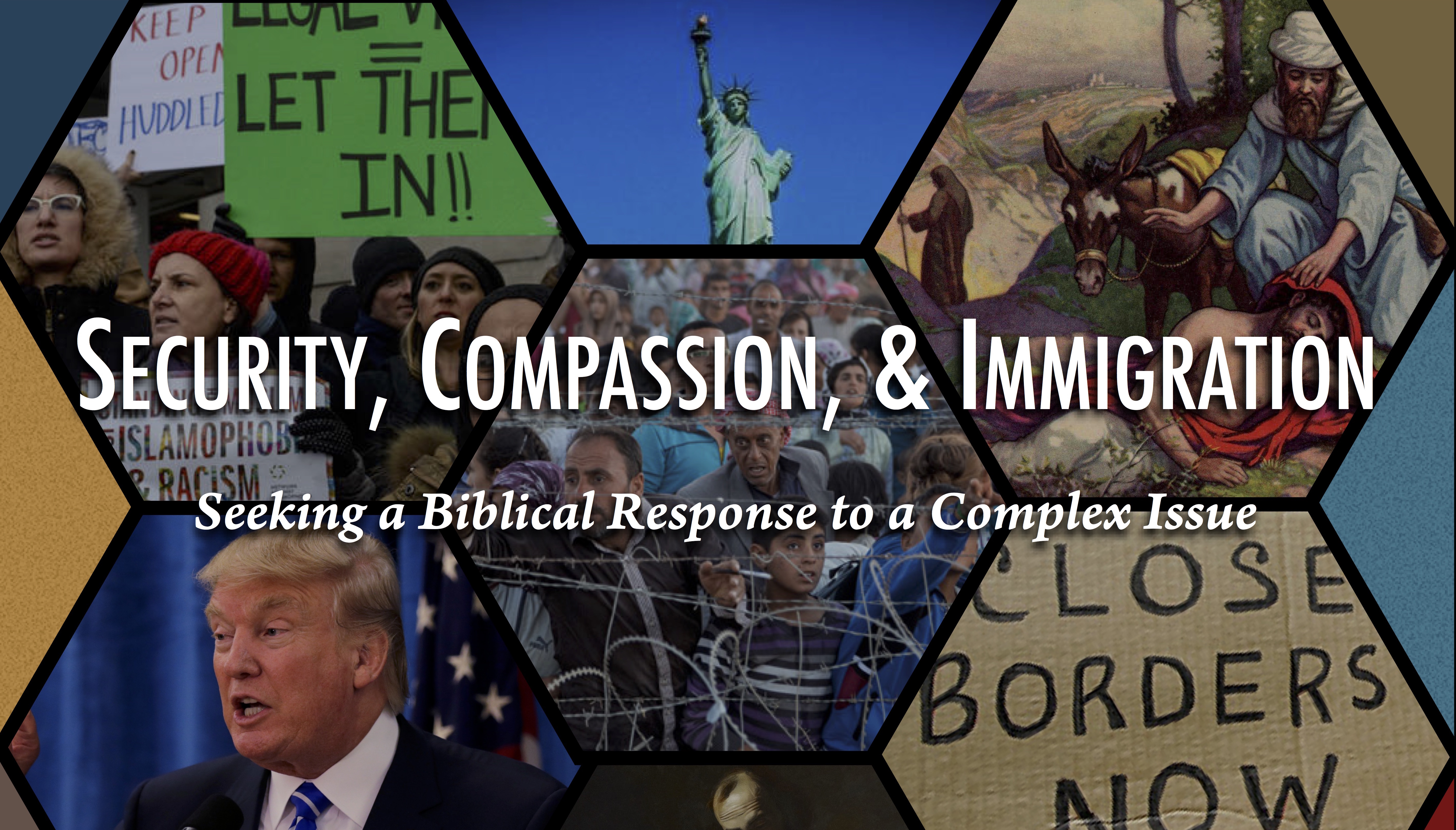
I have read a lot the past few days regarding the recent executive order limiting immigration from certain locations, and the response and fallout following that order. Some of what I have read has been thoughtful and helpful, some has been hysterical and, in my view, has added little of value to the conversation, and some has been decidedly un-Christian.
What I have not seen is an attempt to look at what the Bible teaches on this issue in a way that seeks to be faithful to the context(s) of Scripture and also acknowledges the complexities and nuances of the situation. That task is a tall order, but is what I will seek to do in this space. By nature of the limitations of a blog post, I will not be able to address every relevant Scripture; by the nature of my limitations as a thinker and biblical scholar, I will not be able to perfectly make my case. Regardless, I hope you will give me a fair hearing.
Preliminary Considerations
There are multiple factors which make it difficult to directly apply biblical passages to today’s situation, and before looking at specific verses, I think we should begin by addressing some of those issues.
(1) Biblical Israel is not the equivalent of the United States of America. We will look at some passages that tell Israel how to treat immigrants—sojourners, foreigners—in their midst, but before applying those passages wholesale to our current context, we would do well to remember that the nation of Israel was God’s chosen people, a theocracy established by Him to be His representatives on the earth. Contrary to this, the US is not a theocracy, and it is not God’s chosen nation. That distinction lies with the Renewed Israel, the Church.
This doesn’t mean that we can learn nothing from these scriptures—on the contrary, they show God’s heart for sojourners and immigrants—but we would do well to recognize and honor the differences in our contexts.
(2) Governments are not individual Christians. This point is related to the previous one, but basically, once we realize that “God’s people” today are represented by the church, we also do well to acknowledge that there is a difference between how disciples of Christ are instructed to live individually in their interactions with others and the duties and responsibilities that governments have to protect their citizens. To put it in other terms, the Sermon on the Mount is addressed to disciples, not to governments.
This doesn’t mean it is inappropriate for Kingdom principles to influence government policy, or that it is inappropriate for Christians to wish that the correlation between the two was higher; it does mean that we should recognize that, biblically, governments have God-given assignments of what they are to accomplish, and sometimes those assignments are in tension with behaviors that individual Christians are encouraged to do or forbidden from doing.*
 Tweet This
(3) Biblical texts are written in specific contexts…and contexts change. All that I mean by this is that we need to exercise care and caution when we directly apply biblical texts to our lives. Later, I will discuss Romans 13, which is an incredibly important text for this discussion. However, it is interesting to note that Paul portrays government very positively in Romans 13, which makes sense because he is writing in a time of relative peace when Christians are not being oppressed. One gets a very different (biblical) perspective on government in the Book of Revelation, where John clearly portrays the Roman Empire as being in league with Satan. In addition to the fact that Paul and John are writing with different purposes, in John’s time, the government is much more hostile to believers than it was when Paul wrote Romans. The context has changed.
This doesn’t mean that Romans 13 does not apply or has no implication on our lives today; it does mean that we should realize that Scripture speaks differently about government depending on the context, and we shouldn’t take Romans 13 to apply to every single instance of governmental authority for all time.
Relevant Biblical Texts
With all of the above considerations in mind, there are a variety of biblical texts that I believe have some bearing on this entire discussion. As mentioned above, this is not an exhaustive list, but is hopefully enough to provide a representative sampling.
Governmental Authority–There are multiple texts which represent the government’s job to protect its citizens and establish order.
Let every person be subject to the governing authorities. For there is no authority except from God, and those that exist have been instituted by God. Therefore whoever resists the authorities resists what God has appointed, and those who resist will incur judgment. For rulers are not a terror to good conduct, but to bad. Would you have no fear of the one who is in authority? Then do what is good, and you will receive his approval, for he is God’s servant for your good. But if you do wrong, be afraid, for he does not bear the sword in vain. For he is the servant of God, an avenger who carries out God’s wrath on the wrongdoer. Therefore one must be in subjection, not only to avoid God’s wrath but also for the sake of conscience. For because of this you also pay taxes, for the authorities are ministers of God, attending to this very thing. Pay to all what is owed to them: taxes to whom taxes are owed, revenue to whom revenue is owed, respect to whom respect is owed, honor to whom honor is owed.
(Romans 13.1-7)
Be subject for the Lord’s sake to every human institution, whether it be to the emperor as supreme, or to governors as sent by him to punish those who do evil and to praise those who do good. For this is the will of God, that by doing good you should put to silence the ignorance of foolish people. Live as people who are free, not using your freedom as a cover-up for evil, but living as servants of God. Honor everyone. Love the brotherhood. Fear God. Honor the emperor.
(1 Peter 2.13-17)
There are several general principles that we can glean from these texts: God delegates authority to human governments, He expects governments to protect their citizens and punish wrongdoers, and He expects Christians to submit to their governments and honor their leaders.
Relevant to the issue at hand, it does seem that, biblically, it is appropriate for governments to protect their citizens from harm, and to have concern for their own citizens first, before extending concern for others (and if that seems harsh, recall that governments are not Christians, and are not called to live as individual Christians are).
Compassion—There are a multitude of texts which encourage people of faith to be compassionate to others; I will use two famous passages to be representative of this idea.
“When the Son of Man comes in his glory, and all the angels with him, then he will sit on his glorious throne. Before him will be gathered all the nations, and he will separate people one from another as a shepherd separates the sheep from the goats. And he will place the sheep on his right, but the goats on the left. Then the King will say to those on his right, ‘Come, you who are blessed by my Father, inherit the kingdom prepared for you from the foundation of the world. For I was hungry and you gave me food, I was thirsty and you gave me drink, I was a stranger and you welcomed me, I was naked and you clothed me, I was sick and you visited me, I was in prison and you came to me.’ Then the righteous will answer him, saying, ‘Lord, when did we see you hungry and feed you, or thirsty and give you drink? And when did we see you a stranger and welcome you, or naked and clothe you? And when did we see you sick or in prison and visit you?’And the King will answer them, ‘Truly, I say to you, as you did it to one of the least of these my brothers, you did it to me.’
“Then he will say to those on his left, ‘Depart from me, you cursed, into the eternal fire prepared for the devil and his angels. For I was hungry and you gave me no food, I was thirsty and you gave me no drink, I was a stranger and you did not welcome me, naked and you did not clothe me, sick and in prison and you did not visit me.’ Then they also will answer, saying, ‘Lord, when did we see you hungry or thirsty or a stranger or naked or sick or in prison, and did not minister to you?’Then he will answer them, saying, ‘Truly, I say to you, as you did not do it to one of the least of these, you did not do it to me.’ And these will go away into eternal punishment, but the righteous into eternal life.”
(Matthew 25.31-46)
And behold, a lawyer stood up to put him to the test, saying, “Teacher, what shall I do to inherit eternal life?” He said to him, “What is written in the Law? How do you read it?” And he answered, “You shall love the Lord your God with all your heart and with all your soul and with all your strength and with all your mind, and your neighbor as yourself.” And he said to him, “You have answered correctly; do this, and you will live.”
But he, desiring to justify himself, said to Jesus, “And who is my neighbor?” Jesus replied, “A man was going down from Jerusalem to Jericho, and he fell among robbers, who stripped him and beat him and departed, leaving him half dead. Now by chance a priest was going down that road, and when he saw him he passed by on the other side. So likewise a Levite, when he came to the place and saw him, passed by on the other side. But a Samaritan, as he journeyed, came to where he was, and when he saw him, he had compassion. He went to him and bound up his wounds, pouring on oil and wine. Then he set him on his own animal and brought him to an inn and took care of him. And the next day he took out two denarii and gave them to the innkeeper, saying, ‘Take care of him, and whatever more you spend, I will repay you when I come back.’ Which of these three, do you think, proved to be a neighbor to the man who fell among the robbers?” He said, “The one who showed him mercy.” And Jesus said to him, “You go, and do likewise.”
(Luke 10.25-37)
The first of these selections is the famous “Least of These” text, where Jesus indicates that the way in which we treat those who are downtrodden corresponds to the way we treat Him: If we show mercy and compassion to the least of these, we show mercy and compassion to Jesus. If we neglect the least of these, we neglect Jesus. In context, it seems that the least of these refers specifically to other believers, but based on other sections of Scripture, I see no problem with generally applying these verses to the least of these in our world.
These verses are addressed to individual believers, not governments, and have far-ranging implications: Christians should be people who care about those who are downtrodden or oppressed in some way: those who are poor, hungry, sick, imprisoned, persecuted for their faith, disabled, the unborn, and yes, immigrants too. We should be concerned about all of these people, because the way we act toward them directly correlates to our relationship with Christ, and the way He will act toward us in the Day of Judgment.
Similarly, in the Parable of the Good Samaritan, we have an example of radical mercy and compassion, with the clear implication that everyone qualifies as our “neighbor” and thus, deserves our assistance.
So, regardless of government policy one way or the other, I do believe there are certain attitudes that Christians should convey toward the least of these (including immigrants), people whom Jesus clearly considers to be our neighbors. And once people like this are in our midst, there is a clear mandate for the way in which we should treat them.
Also, it is worth mentioning that there is some risk involved in showing compassion as Jesus calls us to: we may be inconvenienced, or get taken advantaged of, or even find ourselves in dangerous situations. But none of this seems to alter the command that Jesus gives us.
Sojourners–This is perhaps a subset of the last section, but there are many biblical texts which implore God’s people to take care of the foreigners or sojourners in their midst. I will share several of these because they are short, and also because I think they are often overlooked or unknown by believers.
“You shall not wrong a sojourner or oppress him, for you were sojourners in the land of Egypt.”
(Exodus 22.21)
“When a stranger sojourns with you in your land, you shall not do him wrong. You shall treat the stranger who sojourns with you as the native among you, and you shall love him as yourself, for you were strangers in the land of Egypt: I am the Lord your God.”
(Leviticus 19.33-34)
“He executes justice for the fatherless and the widow, and loves the sojourner, giving him food and clothing.”
(Deuteronomy 10.18)
“‘Cursed be anyone who perverts the justice due to the sojourner, the fatherless, and the widow.’ And all the people shall say, ‘Amen.’”
(Deuteronomy 27.19)
“For if you truly amend your ways and your deeds, if you truly execute justice one with another, if you do not oppress the sojourner, the fatherless, or the widow, or shed innocent blood in this place, and if you do not go after other gods to your own harm, then I will let you dwell in this place, in the land that I gave of old to your fathers…”
(Jeremiah 7.5-7)
“You shall allot it as an inheritance for yourselves and for the sojourners who reside among you and have had children among you. They shall be to you as native-born children of Israel. With you they shall be allotted an inheritance among the tribes of Israel.”
(Ezekiel 47.22)
“Thus says the Lord of hosts, Render true judgments, show kindness and mercy to one another, do not oppress the widow, the fatherless, the sojourner, or the poor, and let none of you devise evil against another in your heart.”
(Zechariah 7.9-10)
“Then I will draw near to you for judgment. I will be a swift witness against the sorcerers, against the adulterers, against those who swear falsely, against those who oppress the hired worker in his wages, the widow and the fatherless, against those who thrust aside the sojourner, and do not fear me, says the Lord of hosts.”
(Malachi 3.5)
Keeping in mind all that we have already said about honoring biblical context and not equating the nation of Israel with the United States, isn’t it interesting how much emphasis is placed upon caring for sojourners in the Old Testament? They are frequently grouped along with the poor, widows, and orphans—basically a repeat of the “least of these” idea.
This special concern for sojourners/immigrants/foreigners occurs despite the fact that God is concerned about His people remaining their ethnic and religious identity: even in a society where God limited things like racial intermarriage, He still goes out of His way to mandate concern for foreigners.
And He provides a rationale for this as well: the people of Israel themselves had been sojourners in the Land of Egypt (where they were not well-treated); how dare they mistreat foreigners within their own midst? As Americans, most of us have ancestors who came to this country from other places, so this is reasoning that we should easily be able to follow. And as Christians, we are sojourners and exiles in this present world (1 Peter 2.11), which should provide us with an extra level of understanding for others with similar status.
First of all, then, I urge that supplications, prayers, intercessions, and thanksgivings be made for all people, for kings and all who are in high positions, that we may lead a peaceful and quiet life, godly and dignified in every way.
(1 Timothy 2.1-2)
I don’t think that praying for leaders precludes Christian citizens from also engaging in courses of action like contacting representatives and protesting and using their political voice through voting. Furthermore, I don’t want to assume that the people who are protesting the loudest are not also praying, but I just want to offer this reminder: praying for our leaders is a biblical command, and it should be our first (and most frequent) response in difficult times.
I believe this is the most powerful “weapon” at our disposal when it comes to influencing policy for good, and yet, how often is it neglected or even openly disregarded and mocked (and sometimes by believers!)? I confess that just this morning, as I contemplated writing this post, it struck me at how little I had prayed for our nation’s leaders and the entire situation, and I stopped right then to do just that.
Gracious Interaction–As this variety of texts has illustrated, I do think this is an issue with some complexities and nuances, and sometimes, loving Christians who genuinely care for other people and want to do what’s best might come to different conclusions. When that happens, the way we interact with one another is very important.
Rather, speaking the truth in love, we are to grow up in every way into him who is the head, into Christ, from whom the whole body, joined and held together by every joint with which it is equipped, when each part is working properly, makes the body grow so that it builds itself up in love.
(Ephesians 4.15-16)
Walk in wisdom toward outsiders, making the best use of the time. Let your speech always be gracious, seasoned with salt, so that you may know how you ought to answer each person.
(Colossians 4.5-6)
The first of these texts occurs in the context of a discussion on unity in the Body of Christ, while the second refers to the way in which believers are to speak with “outsiders.” The key idea here is that we are to be extremely careful of the way we speak to and interact with others. We “should speak the truth in love”, and our speech should be “gracious, seasoned with salt.”
I think these two different sayings represent the same idea: it is possible to feel passionate about something, and even be right, but to present that idea in such a way that you become wrong. When we engage in discussion over this (or any) topic, it is paramount that we treat one another with grace, and that we present our own views with love and respect.
So, for example, it is neither helpful, nor Christian, to assume that if someone disagrees with me by supporting the Executive Order, he/she must not care about refugees. Similarly, it is neither helpful, nor Christian, to assume that if someone disagrees with me by opposing the Executive Order, he/she must not care about protecting their own family.
Dangerous Attitudes
With all of the discussion and biblical passages in mind, there are some attitudes which I have witnessed (from Christians) that I believe are spiritually dangerous, and must be opposed:
- Attitudes that are driven by fear are inherently un-Christian. We are not called to be people of fear, but people of boldness who absolutely rely on our Heavenly Father to protect us. The argument, “If we let these immigrants enter into our country there may be terrorists in their midst who want to harm us” is a worldly argument. It is not a Christian one. It is an argument that I understand, and honestly, sympathize with, but the part of me that wants to make that argument is the worldly part of me, not the part of me that seeks to be a disciple of Jesus and live according to the principles He has established.
- Attitudes with an “America first” mentality may be good (even necessary) national policy, but they are not Christian attitudes. Biblical teaching on the Body of Christ and the household of faith make it clear that, as a Christian, I have more in common with a Syrian Christian who speaks a different language than I do and whom I have never met than with my secular neighbor who lives just down the street. The Kingdom of God is universal, and it is to this Kingdom that I owe my primary allegiance.
- Attitudes that display a lack of concern to those who are oppressed and suffering in foreign countries are un-Christian. To be clear, you can support President Trump’s policy and still be concerned for those affected by it, but I have also witnessed people say things such as, “We have too many of our own people and problems to worry about before we focus on others.” This is not a Christian attitude. All people matter to God, and thus, all people deserve our concern.
- Attitudes that judge the motives of others are not Christian. It is beyond our ability to know the motives of others, and certainly beyond our job description to judge those motives. We should be charitable towards people with whom we disagree, and not assume that they are evil for disagreeing with us.
- Attitudes that conflate the nation of Israel and/or the church with the United States of America are biblically uninformed and also do not reflect a Christian perspective. The US is not the Kingdom of God, and should not be expected to behave as if it is. There is nothing wrong (in my opinion) with seeking to influence American policy with Kingdom values, but expecting the US to reflect the policies of Ancient Israel or the behavioral requirements of individual Christians reflects confused and possibly disingenuous thinking.
- Attitudes that perpetuate untruth are not Christian. Sometimes people repeat falsehood out of ignorance rather than malevolence, but still, truth is hindered when this happens. It seems to me that both sides are guilty of this: calling the Executive Order a “Muslim ban” does not seem fully honest, when it actually restricts people of multiple religious backgrounds from only a select number of (predominately Muslim) countries. There are non-Muslims who have been affected, and there are Muslim countries that have not been affected. On the other hand, claims that President Trump’s Executive Order mirror earlier policy made by President Obama also seem to be untrue, as there are significant differences between the two.
Concluding Thoughts
At this point, I have spilt a lot of digital ink discussing this issue without telling you what to think, or even telling you what I think, but neither of those things has really been my purpose. Instead, I have been trying to address Christians, and get them to reflect on a variety of things:
- This is a complex issue, made so by some preliminary considerations related to applying biblical texts to our own situation, and also by what the Bible teaches concerning the role of governments, and the role we play as individual believers (and the tension that may exist between those two things).
- We must be careful in the way we discuss these sorts of topics, and make sure to speak the truth in love and season our speech with grace.
- There are a variety of dangerous spiritual attitudes that Christians can be guilty of. When we recognize them in our own thinking, we should seek to eliminate them, and when we see them portrayed by Christian brothers and sisters, we should (lovingly) seek to correct them.
As for my own thoughts, I appreciate the desire of President Trump to keep American citizens safe, but considering that we already have an extensive vetting process in place for refugees which has seemingly worked well to prevent terror attacks, I feel the Executive Order was unnecessary. Besides, in my own life, I feel that I would rather err on the side of compassion, and that is a Kingdom value that I would be happy to see influence American policy.
*To use an example of this principle that I think all people will agree with and understand: if a drunk driver severely injures or kills someone I care about, it is appropriate and necessary for governments to execute justice and punish criminals. It is inappropriate for me, as an individual Christian, to take justice into my own hands and retaliate for the criminal act.
 A quirk of my personality is that I like to keep track of certain things in my life, and for several years, one of those things is the list of books that I read each year. Somewhat surprising to me, people actually seem to enjoy reading the list of what I read, so I have been sharing that for several years.