The online journal of Luke Dockery

Category: Theology (Page 36 of 58)

A Difficult Birth, Part 1: The Scandal of Christmas

For some people, Christmas is all about spending time with family, and the giving and receiving of gifts, but for others, Christmas is also a celebration and remembrance of the birth of Christ.

When thinking about the birth of Jesus, I think it’s important to remember that it isn’t a fairy tale in a story book. The birth of Jesus was a real historical event with real historical people, and it’s an event with a lot of rough edges to it. A lot of times in our minds I think we like to smooth out those rough edges and turn the story of Christ’s birth into something from a Hallmark greeting card, but it really wasn’t like that.

It was a difficult birth, but I think it’s a good thing for us that it was a difficult birth, because it helps us to see how to better live our difficult lives.

The Scandal of Christmas

The birth of Jesus—the Incarnation, God becoming flesh—was amazing. It was miraculous, and it was unthinkable until it happened. It was the first step in Jesus becoming our High Priest, Someone who knew what it was like to live as a human, but to do so perfectly, without sin.

And a big part of this miraculous event was the fact that Mary the mother of Jesus was a virgin when she became pregnant.

Now for us, this is history. We believe that it happened, we accept it as fact, and we commonly hear her referred to as the Virgin Mary (growing up I knew that Mary was a virgin loooong before I knew what that word actually meant). What I’m trying to say is that we are so familiar with the idea of Mary being an unwed virgin that I think we tend to overlook how big of a scandal this would have been for her.

The angel Gabriel appears to Mary in Luke 1.26-38 and tells her that she is going to give birth to Jesus. The Bible says that Mary is troubled, and she’s also confused as to how she’s going to give birth while she is still a virgin, so Gabriel tells her that it will happen by the power of the Holy Spirit.

I think we get the first hint of scandal in Luke 1.39, where it says that Mary “went with haste” to visit her relative Elizabeth, who is six months pregnant with John the Baptist. It’s almost like Mary is trying to get out of town to hide her pregnancy. She spends three months with Elizabeth, presumably until the time that John is born, and I get the impression that while there, Mary is encouraged by Elizabeth and comes to terms with what it going on and begins to glorify God for it.

Then she returns home. And if going out of town to visit Elizabeth had successfully hidden her pregnancy to this point, it’s probably not hidden any longer. At this point, people can likely see that Mary is pregnant.

And we’re not really sure of the timeline, but maybe it’s at this point that we have Matthew 1.18-19:

“Now the birth of Jesus Christ took place in this way. When his mother Mary had been betrothed to Joseph, before they came together she was found to be with child from the Holy Spirit. And her husband Joseph, being a just man and unwilling to put her to shame, resolved to divorce her quietly.”

Now, there is some background information here that we need to know. In Jewish culture at that time, a man and a woman would be engaged to one another, and this would be considered to be a binding engagement. They would be referred to as husband and wife, even though they weren’t technically married yet, and even though it would have been considered immoral for them to have sexual relations.

If a woman like Mary was discovered to have had sexual relations during this time of engagement, it would have been considered adultery, and under the Law of Moses, she could have been stoned to death.

That’s the gravity of the situation that Mary would have been in when she was “found to be with child.” And just stop for a moment and imagine the conversation that must have happened between Joseph and Mary when he found out. Remember, these were real people, in many ways not so very different from you and me. They were likely both fairly young (some estimate that Mary would have been between 14-16):

Joseph…I’m pregnant.

What?!? Mary, I can’t believe this! How could you? Who, who is the father?

Well, the Holy Spirit. I’m still a virgin, Joseph! I haven’t been unfaithful to you!

(And I can just picture the look on Joseph’s face)

The Holy Spirit?! Yeah, right.

And then, we get to see the character of Joseph. You know, I think God chose the earthly parents of Jesus carefully. He didn’t pick rich parents or powerful parents, or members of the social elite, but he chose carefully. He selected quality people to raise His Son. Joseph, despite all the disappointment and heartbreak he must have been feeling, decides to show Mary compassion and divorce her quietly so she won’t be put to shame and face the punishment for adultery.

And then an angel appears to him in a dream and says, “No really, this is a special birth, a special child who has been conceived by the Holy Spirit.” And from that point on, Joseph’s on board.

But even then, in a small town like Nazareth, I’m sure that the gossip and the rumors of scandal would have persisted.

Scandal in our Lives

Well, just like we try to smooth over the scandal in the birth of Jesus, a lot of times we try to do that in our lives as well.

Sometimes we do this by putting on a brave face and trying to pretend like we have it all together, like we don’t have any sin or problems in our lives that we need help with. But really, all of us are a mess. We all have issues and problems in our lives. The key to dealing with the scandal, with the mess in our lives, is not to smooth it over and pretend it’s not there, but rather to address it, repent of it, and leave it behind.

But sometimes we also try to remove scandal from our lives by having nothing to do with people we consider to be sinful or scandalous. And let’s be clear, it’s true that bad company corrupts good moral and that we shouldn’t tolerate sin in the church, but Paul is clear in 1 Corinthians 5.9-10 that in order to be out in the world and point people to Christ, we’re going to come in contact with some scandalous things (because that’s how the world is).

Don’t misunderstand me—none of what I am saying here is meant to downplay the importance of holiness in our lives, or to downplay the seriousness of sin. But our world is a sin-ridden, scandalous place, and sometimes that sin and scandal can even creep into the church.

And if we’re going to mature as Christians, if we’re going to help our world, if we’re going to save souls, we can’t be afraid of the scandal.

Syria, Obadiah, and Us

If you have paid any attention to the news over the last several days, you are aware that there is a country in the Middle East plagued by civil unrest and violent atrocities, and the United States finds itself in the position of determining if and how to intervene. Sounds like a story that we’ve heard several times before, doesn’t it?

Knowing the proper response to the messy situation in Syria is difficult. I am not a foreign policy expert, and I don’t pretend to have all the answers. This helpful article has made the rounds on the internet, and basically suggests that although there is no good solution and military action is likely to be unhelpful in the long term, it is unacceptable for a brutal regime to attack its own citizen population with chemical weapons and not be punished for it (I recommend that you read the article linked to above if you haven’t already).

As I think about the situation in Syria (and similar conflicts in other parts of the world in which the U.S. has sometimes intervened in and sometimes not), I can’t help but think about the little Old Testament Book of Obadiah.

We don’t talk about Obadiah all that often. It is short—only one chapter long—and is hard to find tucked away in the minor prophets. Basically, the Book of Obadiah is a judgment against the people of Edom which proclaims their coming downfall. The Edomites were the descendants of Esau, and thus cousins of the Israelites. Obadiah’s suggestion is that, as close relatives of the Israelites, the Edomites should have come to the aid of Judah during its conflict with Babylon, but they didn’t, and will be punished as a result (Obadiah 1.10-14). I find verse 11 to be particularly haunting (emphasis mine):

“On the day that you stood aloof,
on the day that strangers carried off his wealth
and foreigners entered his gates
and cast lots for Jerusalem,
you were like one of them.”

Now, I am aware that the situation of Edom and Judah (and Babylon) in Obadiah’s time and the situation today in Syria and the U.S. response to it are not direct parallels. I am further aware of the need for caution when it comes to seemingly removing a passage of Scripture from its context and applying it elsewhere.

But at the same time, I’m also aware that Scripture teaches certain principles that seem to apply regardless of context, and I think this is one of them. The Bible teaches repeatedly that God blesses people not so they can hoard those blessings, but so that they can be a blessing to others. The Bible teaches that we are supposed to consider others to be our neighbors, and rather than ignoring their plight, to step in and help them as we can. The Bible teaches that when we come to the aid of the “least of these,” we are coming to the aid of Jesus Himself.

So, that brings us back to Syria. What are we to do? Again, I am not a foreign policy expert, and in a real sense, I’m not qualified to give an answer. But at the least, it seems that we should consider tactical missile strikes against chemical weapons stockpiles (as the article above suggests).

But maybe a different question that I am (somewhat) more suited to answer: what would the Bible suggest that we do? Biblically, I think we have to do something. At least try to help. Something more than standing aloof and being like one of them, which is the response I have unfortunately heard from several Christians. They give excuses like:

  • We shouldn’t get involved because it will be expensive.
  • We shouldn’t get involved because it’s none of our business.
  • We shouldn’t get involved because we have problems of our own to deal with.
  • We shouldn’t get involved because it will make other countries more annoyed with us than they already are.

Are those good enough reasons to justify standing aloof on the sidelines? I really don’t think so. In fact, I think the Edomites could have used some of those same excuses, and God wasn’t too pleased with them.

God and Government

I go back and forth quite a bit in my thoughts on the relationship between God, government, Christians, politics, etc. I read this yesterday in a journal article and found it helpful:

“Jesus lived in a conquered province in an empire whose imperialistic ruler stood for everything that was antagonistic to the revealed faith of the Jews. Jesus was not a revolutionary but instead conformed to the laws of civil government. Nowhere did he denounce the legitimate power of the state. Jesus paid his taxes (Matthew 17.24-27). He recognized the authority of Pontius Pilate, even when Pilate unjustly delivered him over to his enemies (John 19.11). Jesus reminded him, however, that his authority was not autonomous (John 19.10-11) but that it was delegated from the One who was above. Thus, in practice and precept Jesus recognized that the government under which he lived was ordained of God.”

–David Plaster

Grace Theological Journal 6 (Fall 1985), p. 437.

The Fall of Man and the Ecological Consequences of Sin

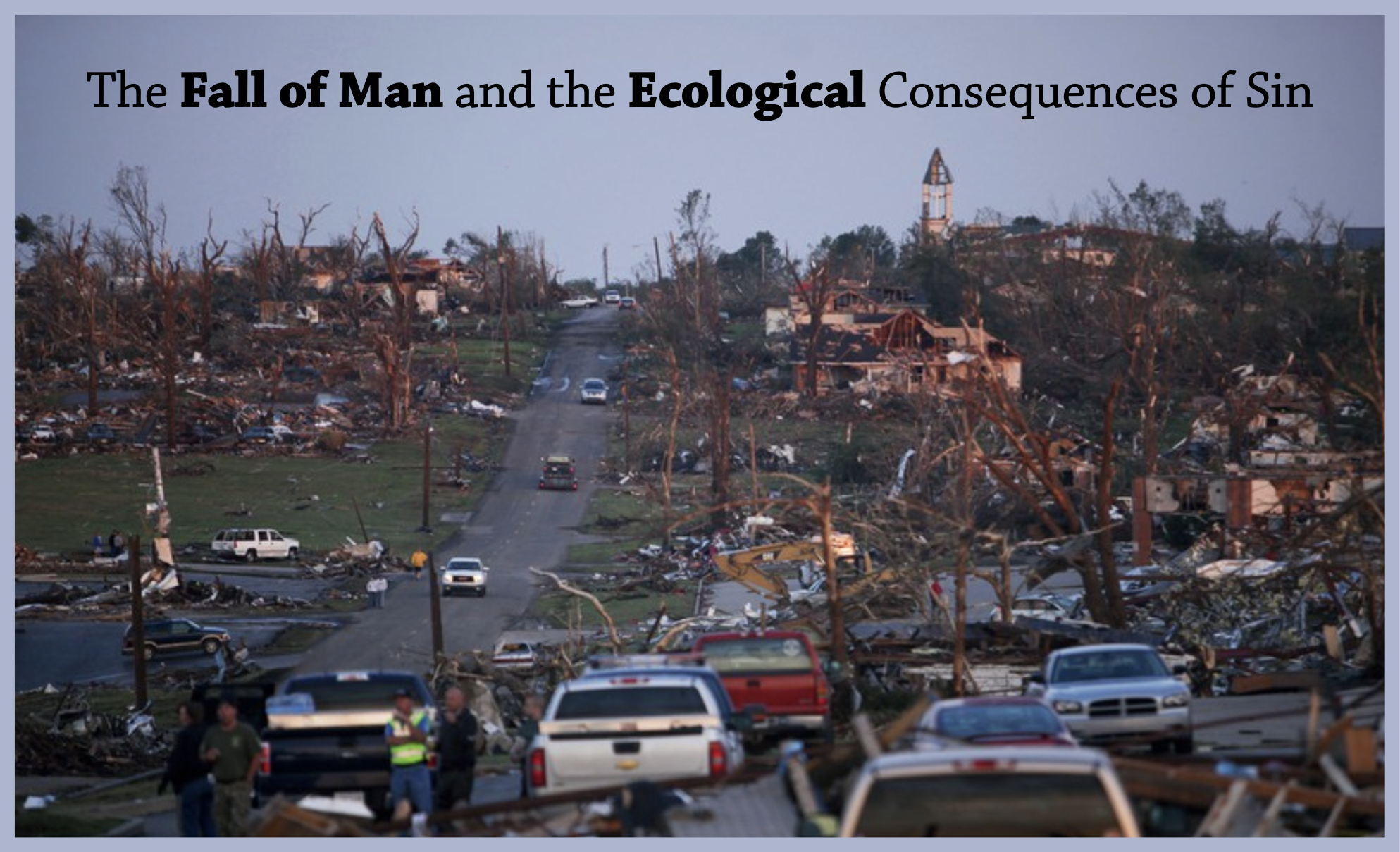
In the first post of this series on the Fall of Man in Genesis 3 and the widespread devastation of sin, I mentioned that we tend to focus on the theological and personal consequences of Adam and Eve’s sin while ignoring some of the other areas. I think the most ignored of those other areas is the ecological consequences associated with the sin in the Garden of Eden.

Men and women were created to live in relationship with God and with one another, and, in a sense, with creation as well. This is clear in the early chapters of Genesis. Genesis 1.26-30 recounts how Adam and Eve were to have dominion over creation, and Genesis 2.15 mentions that they were to work it and keep it. So in effect, Adam and Eve were to rule over creation, but to do so as stewards who would take care of what God had made.

But following their disobedience to God’s command to not eat of the forbidden fruit in Genesis 3, the ecological consequence is evident, as a curse is placed on creation in Genesis 3.17-19:

“And to Adam he said, ‘Because you have listened to the voice of your wife and have eaten of the tree of which I commanded you, ‘You shall not eat of it,’ cursed is the ground because of you; 

in pain you shall eat of it all the days of your life; thorns and thistles it shall bring forth for you; and you shall eat the plants of the field. 

By the sweat of your face you shall eat bread, till you return to the ground, for out of it you were taken; for you are dust, and to dust you shall return.’” 

This curse makes it clear that the relationship between man and creation has been destroyed as well. And that’s pretty easy to see, right? Rather than embrace our role as stewards of God’s earth, we tend to exploit creation to satisfy our own selfish desires. There are countless examples of companies that have carelessly polluted in order to cut corners and maximize profits, and even “little” problems like widespread littering show a basic lack of respect for the home God has created for us.

And I think there is significant indication in Scripture that the problem isn’t all one-sided: creation itself doesn’t operate the way it was intended to. In Romans 8.20-22, Paul makes this point, speaking of creation in personified terms:

“For the creation was subjected to futility, not willingly, but because of him who subjected it, in hope that the creation itself will be set free from its bondage to corruption and obtain the freedom of the glory of the children of God. For we know that the whole creation has been groaning together in the pains of childbirth until now.”

A creation that is subjected to futility, bound to corruption and groaning in the pains of childbirth seems distinctly different from the creation that God made and called “good.” I suppose this is ultimately unprovable, but my personal opinion is that the natural disasters that plague our lives—tornadoes, hurricanes, earthquakes, tsunamis, etc.—are symptomatic of the problems Paul refers to, as creation lives out a cursed existence different from the one for which it was intended.[1]

In sum, sin has devastated this aspect of our existence as well. Creation is less than the good and hospitable home for humanity for which it was created to be, and we fail to care for it as we should.[2]


[1] If my thinking on this is correct, then it stands in judgment against the hurtful things that some religious people say in very public ways following a natural disaster such as “Hurricane Katrina was God’s judgment against the wickedness of New Orleans”. Natural disasters are a condition of our broken world, rather than God’s wrath against a specific people/place. Incidentally, I think the promise made to Noah following the flood (Genesis 9.8-17) that man and creation would not again be judged by a massive flood (and perhaps, by extension, other natural disasters) supports this idea.

[2] I mentioned the general neglect of this topic, and I think that neglect is itself evidence of the distorted relationship we have with creation. In a significant portion of Christendom, discussion of the creation care is considered to be a “political” or “liberal” idea, despite the fact that environmental stewardship is clearly a biblical principle!

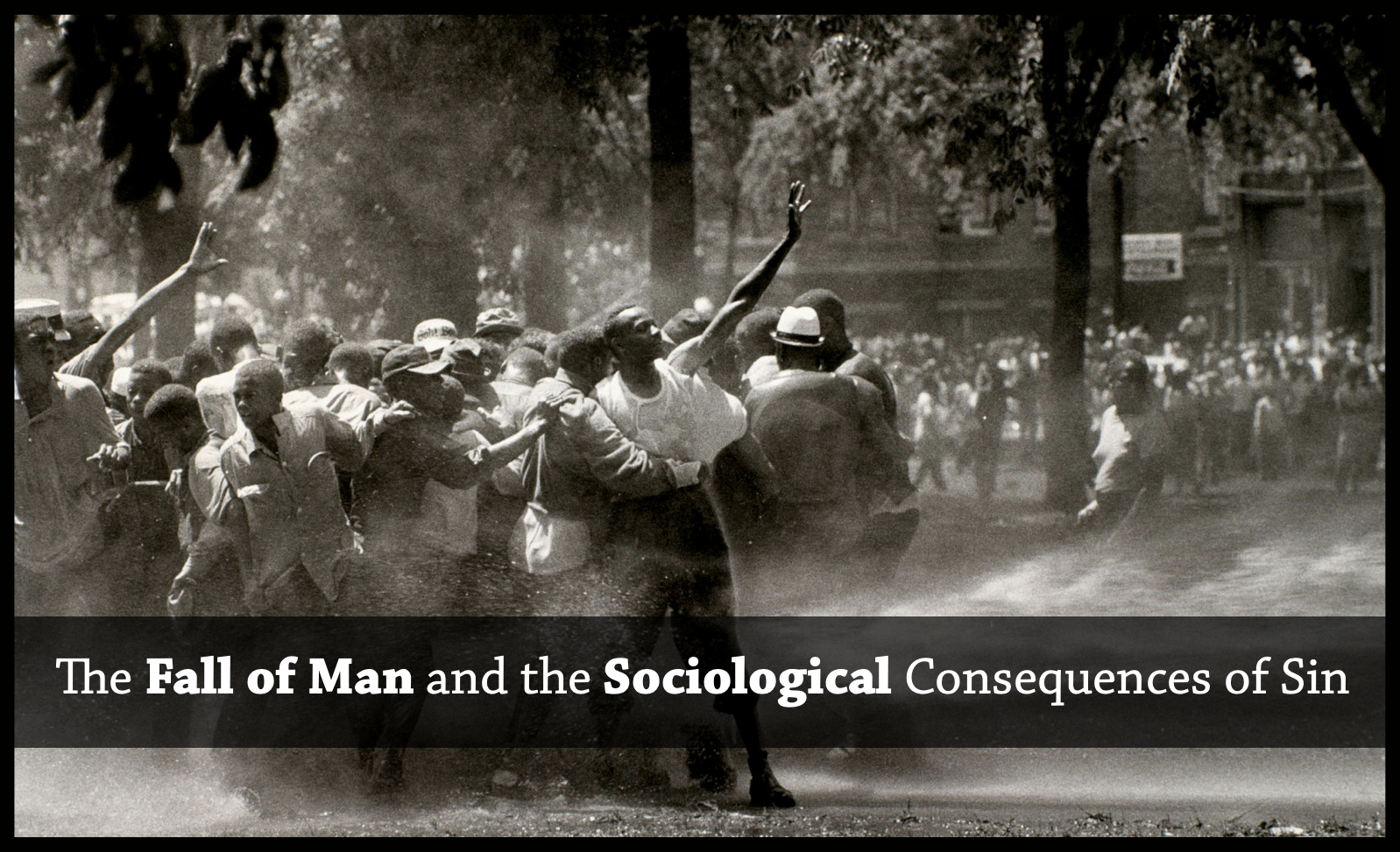
The Fall of Man and the Sociological Consequences of Sin

In our continuing discussion of the Fall of Man in Genesis 3 and the widespread devastation of sin, we have already covered the theological and personal consequences of Adam and Eve’s misdeed; in this post we turn to the sociological fallout of that sin, or the way that sin affects our relationships with one another.

Returning to our text, we can see this dimension clearly played out in verses 11-13:

“[God] said, ‘Who told you that you were naked? Have you eaten of the tree of which I commanded you not to eat?’ The man said, ‘The woman whom you gave to be with me, she gave me fruit of the tree, and I ate.’ Then the Lord God said to the woman, ‘What is this that you have done?’ The woman said, ‘The serpent deceived me, and I ate.’”

People were created to live in community with one another. Specifically, Eve was created to be the perfect partner for Adam (Genesis 2.18-25). But when God confronts Adam and Eve with their sin, something very significant (and unfortunate) happens: the unity that had previously existed between Adam and Eve is shattered as Adam immediately blames his wife for the sin which they had committed together.

This brings a conflict and disharmony between them that would be passed down over time (Genesis 3.16), and we can see it unfold in the pages of Genesis in the accounts of numerous broken relationships—Cain’s murder of his brother, the depraved society of Sodom and Gomorrah, the distorted relationships between Sarah and Hagar, Jacob and Esau, Jacob and Laban, Joseph and his brothers, and more. But the problems certainly don’t stop there—this same conflict and disharmony continue to darken and distort our world today.

Our world is deeply flawed by sin, and this manifests itself everyday sociologically, as we treat one another in a wide array of horrible, messed up ways:

  • On an international level, countries wage war and kill because of conflict over ideology or resources.
  • Systemic evils such as poverty, abortion, racism, sex trafficking, government corruption, lotteries, and more stem from our exploitation of our neighbors in order that we might obtain our own selfish desires.
  • Horrific acts of incomprehensible violence fill our news cycles. Mass shootings at elementary schools, the use of passenger airliners as terrorist missiles, bombings at marathon finish lines and incomprehensible barbarity at soccer matches shock and dismay us and cause us to weep.
  • Our interpersonal relationships are also a mess. Dishonesty, reckless ambition, and violence abound. The (supposedly) lifelong bonds of marriage are broken on a whim.

And the sum result: our society as a whole stagnates and decays, as people live lives marked by self-interest and fear of one another. The community for which we were created is broken.

Sin destroys our relationships with one another.

« Older posts Newer posts »

© 2026 The Doc File

Theme by Anders Noren — Up ↑