“It is time for those whose faith and practice rest on Scripture to get on with Kingdom business with or without the help of legal maneuvers and political and ecclesiastical machinations.”
Category: Theology (Page 37 of 58)

After the death of King Saul, there is a struggle between David and Saul’s son, Ish-bosheth, for the throne of Israel. With God’s support, David eventually wins out, things settle down, and everything seems to be okay.
But David isn’t happy. He isn’t happy because he realizes that while he lives in a nice, comfortable house made of cedar, the Ark of God is kept in a tent!
This doesn’t seem right to David, so he determines that he wants to build a temple for the Ark to be housed in. That sounds like a good idea, but God rejects his offer in 1 Chronicles 22.8-10:
“But the word of the Lord came to me, saying, ‘You have shed much blood and have waged great wars; you shall not build a house to My name, because you have shed so much blood on the earth before Me. Behold a son will be born to you, who shall be a man of rest; and I will give him rest from all his enemies on every side; for his name shall be Solomon, and I will give peace and quiet to Israel in his days. He shall build a house for My name, and he shall be My son and I will be his father; and I will establish the throne of his kingdom over Israel forever.’”
Later, Solomon talks about his father’s desire to build a temple for God in 1 Kings 8.17-19:
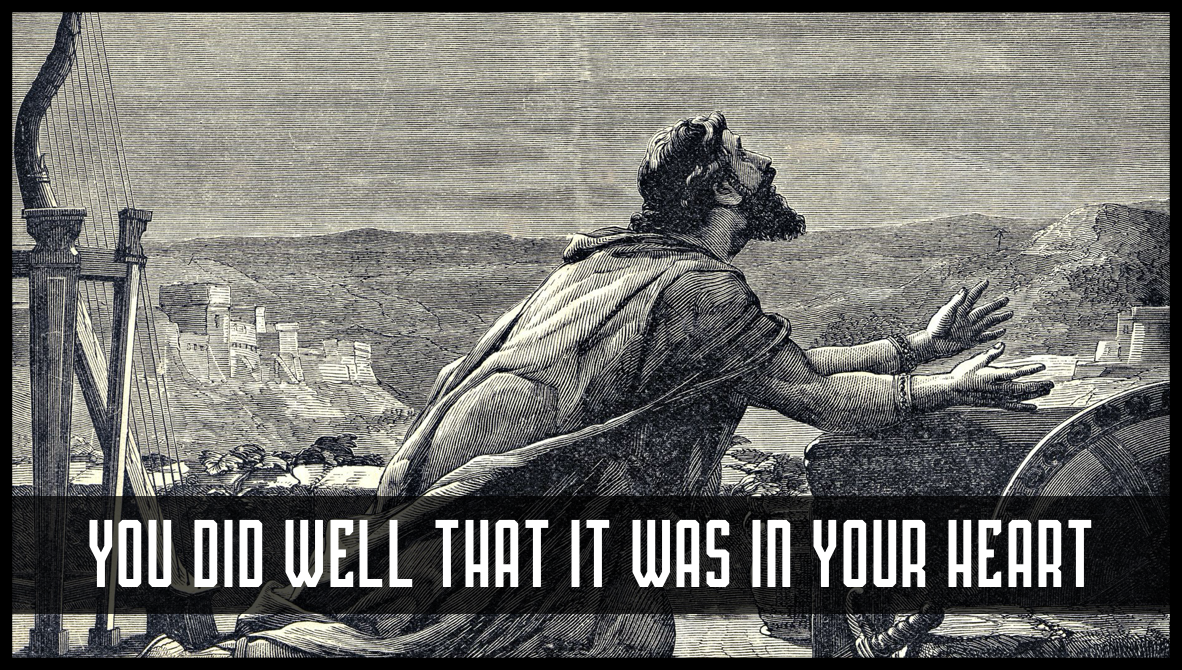
“Now it was in the heart of my father David to build a house for the name of the Lord, the God of Israel. But the Lord said to my father David, ‘Because it was in your heart to build a house for My name, you did well that it was in your heart. Nevertheless you shall not build the house, but your son who will be born to you, he will build the house for My name.’”
Did you catch that? God tells David, “You did well that it was in your heart.”
Even though David wasn’t going to be able to accomplish his goal of building the temple, God still appreciated and honored David’s intentions. Because he had been a man of war, David was told that he would not be the one to build a temple for the Lord—but God still appreciated that David had the desire to do so.
“It’s the thought that counts” is a common saying that we tend to throw around when we receive a gift we don’t like. It’s somewhat of an ironic saying since often the reason we receive bad gifts is specifically because very little thought was put into it, but I think it’s still a true statement, and it’s basically what God tells David in this story: “It’s the thought that counts.”
By extension, this passage means that God cares about our intentions as well. And to me, as a Christian and as a minister, that is incredibly encouraging—while our actions certainly matter, the thoughts behind our actions matter as well. We can’t always control how things turn out, but we can control our intentions.
When we try to do something big for God, as David did, and we fail and our plans don’t pan out, I’m thankful to know that we have a God who says, “You did well that it was in your heart!”
I don’t know what your exact situation is…
- Maybe you try to help a friend with a problem like substance abuse or financial or marital difficulties, but your assistance is refused…God looks at your “failure” and says, “You did well that it was in your heart!”
- Maybe you try to influence others for good and try to be salt and light in the world, but your influence is ignored and they continue to embrace darkness…You did well that it was in your heart!
- Maybe you’re a youth minister and you’ve got that teen who you’ve poured yourself into— teaching, going to athletic events, modeling the Christian life, praying for them and lying awake at night worrying about them—but they choose to follow the world…You did well that it was in your heart!
- Maybe you try to share your faith with someone, perhaps a family member or close friend, but it simply falls on deaf ears…You did well that it was in your heart!
Realize that you are going to fail in life. Your results won’t always match up with your intentions and your plans. But our God is someone who sees our hearts and appreciates our best efforts. With that in mind, let us attempt great things for Him!
In 2 Timothy 3.16-17, Paul writes:
“All Scripture is breathed out by God and profitable for teaching, for reproof, for correction, and for training in righteousness, that the man of God may be complete, equipped for every good work.”
Based on Paul’s words here, I think it should be obvious that we should give attention to all of Scripture, rather than just study the parts that we like over and over again. Some people focus on Paul’s writings; others spend a lot of time in the Gospels. Some folks obsess over the accounts of the early church in Acts, while others never stray far from the wisdom literature or the historical books of the Old Testament.
And it’s okay to have favorites, but if we emphasize our favorites to the point that we neglect the other portions of Scripture, then we aren’t taking Paul’s words from 2 Timothy 3.16-17 very seriously.
In Reading the Gospels Wisely: A Narrative and Theological Introduction, Jonathan T. Pennington puts it very well:
“…For Jefferson County, Kentucky, where I live, we could look at a topographical map that shows terrain and elevations or a road map; at a map that records annual rainfall or one that indicates historical landmarks and points of scenic interest; or we could consult a survey that shows where property lines begin and end. These are all different maps, and they would look very different if set beside one another. But of course they don’t contradict one another. They are complementary and beneficial. They are different discourses of truth—or different ways of approaching and presenting knowledge.
If this is true for maps of Jefferson County, Kentucky, how much more for theology and Holy Scripture. We need to think of the Bible not as a single map that just gives us doctrinal statements or moral commands, but we must realize that the Bible is like an atlas—a collection of maps/books that shows us the way, the truth, and the life but in a variety of languages or discourses or ways of communicating. To privilege—or worse, to rely exclusively on—only one form is detrimental to apprehending truth; a topographical map helps little when we’re seeking the best restaurants.”
What a great analogy this is! The Bible is true, but it presents truth in a variety of ways. In Matthew, truth might be presented through a parable. In 1 Kings or Acts, it might be presented in historical narrative. In Psalms, truth is presented through poetry, and in Proverbs through pithy sayings. In books like Romans, Paul often presents truth in direct theological or doctrinal statements, and in Revelation, John presents truth through bizarre and sometimes frightening visions.
All of these different “maps” are a vital part of the entire “atlas” of the Bible. Some are more useful for certain purposes than others, but all contain truth and none should be neglected.
I think all people of faith would do well to be more well-rounded in our Bible study.
As a theology grad student, I read a ton of stuff about religion, theology, and doctrine from a wide variety of sources. I also hear a lot of podcasts, sermons and devotionals. And some of the stuff I read and hear is really, really good, but some of it I’m not too sure about and some stuff I think is absolutely wrong.
There was a time in my life when I was greatly disturbed anytime someone disagreed with me about theology, and felt a compulsion to try to convince them that I was right. I still feel this way at times especially if the issue at hand is one that I think is of essential importance.
That being said, I have come to understand something which I think is very important: I can still respect someone’s opinion even if I disagree with it.
Sounds pretty simple right? And it is simple, but it’s not all that easy—just look at all the religious, political, and cultural debates that surround us and see how often respect is completely left out of them.
When it comes to matters of theology, even if I disagree with you, I can respect your opinion if the following two characteristics are true:
(1) You are a person of integrity. Maybe this is obvious, but I’m going to tend to be skeptical about what you’re telling me if you’re not a very good person. If I don’t see the Fruit of Spirit in your life, why would I think that you have an exemplary understanding of the character and nature of God?
(2) Your viewpoint is not shallow. I am not going to be impressed with your argument if it is based on some hunch or feeling or tradition or something your pastor told you that you cannot support with Scripture. If we have a difference of opinion about how a particular biblical passage should be interpreted, that’s a different issue, but if you’re making no attempt to be anchored to the Word in the first place, we’re going to have a problem.
If you meet these two qualifications, we might disagree on some things (and we almost certainly will), but I can still respect you despite those disagreements.

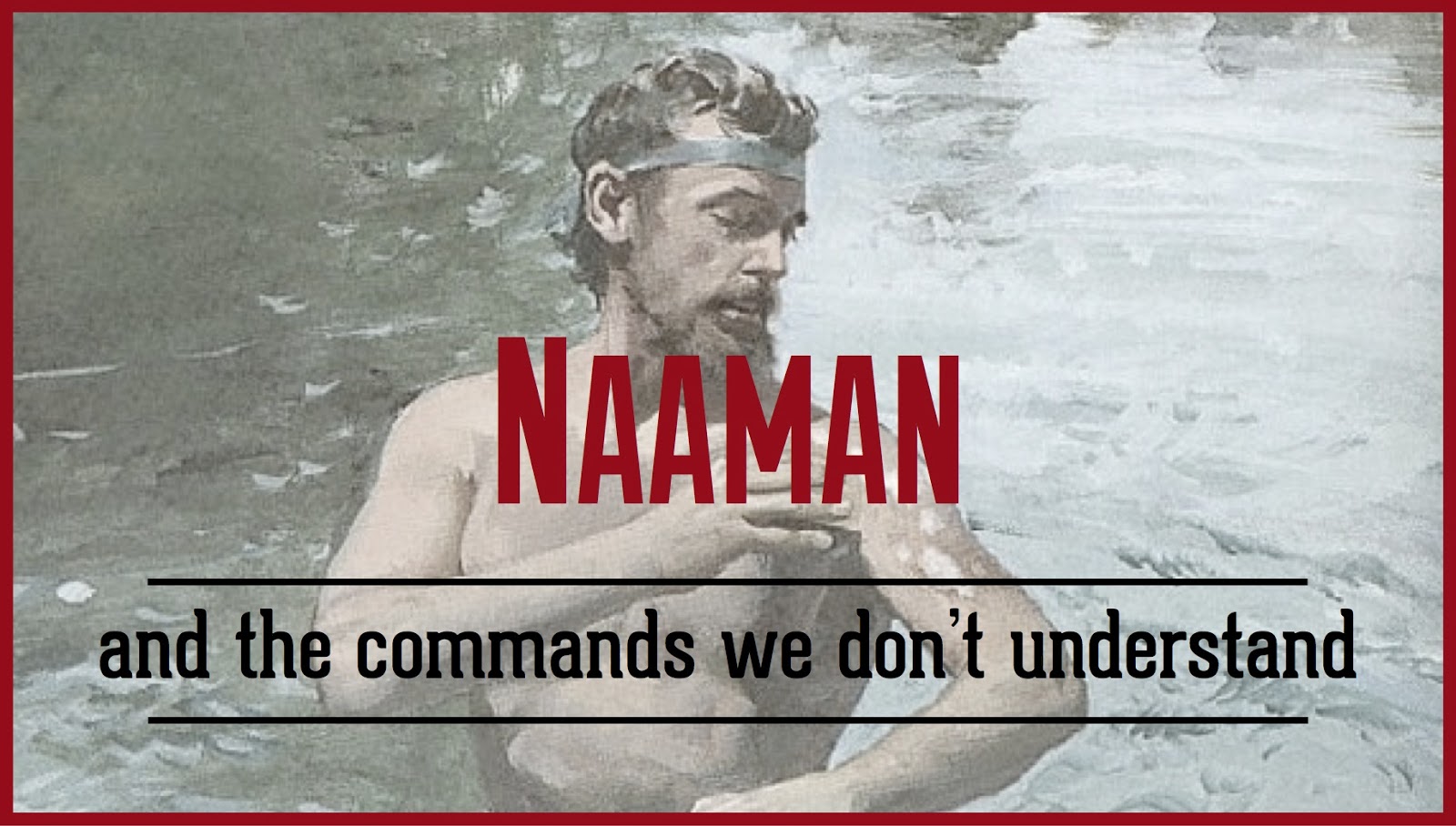
As a kid, one of my favorite Bible stories was the story of Naaman in 2 Kings 5. I think I had some sort of children’s storybook version which probably influenced my preference, but it has remained a story that I enjoy as I’ve gotten older.
Do you remember the story? Naaman is an important man, the commander of the army of Syria, but he has leprosy. An Israelite slave girl who works in the service of Naaman’s wife suggests that Elisha, a prophet from Israel, could heal him. Naaman relates this to Ben-Hadad, king of Syria, and then the king sends him to Israel, laden with gifts, to seek a cure. Eventually, Elisha gets word of what is happening and sends for Naaman, who arrives at Elisha’s house with his horses and chariots.
But Elisha doesn’t even come out to see Naaman; instead he just sends a messenger to tell him that his health will be restored if he goes and washes in the Jordan River seven times. Naaman is enraged by this response. He had expected Elisha to come out and do something dramatic, and he doesn’t even begin to understand how washing in a dirty little river could cleanse his leprosy. Furious, Naaman prepares to depart for home, but his servants basically point out that he has nothing to lose by obeying Elisha’s commandment, and so Naaman goes to wash and sure enough, his leprosy is cured.
Grateful for his healing, Naaman renounces Rimmon, his former god, and accepts the God of Israel, pledging to worship no other god in the future.
By personality, and by heritage as well, I like to understand things. If someone makes a decision that affects me, I want to understand why the decision was made. If I am told or required to do something, I want to understand why it is a good thing to do. The same thing is true in my approach to Scripture as well. I come to Scripture wanting to understand it, wanting to figure out what it means, and wanting to discern the correct interpretation of a certain passage.
And there’s nothing necessarily wrong with that, except this: even when I don’t understand Scripture, I still have to obey it.
And honestly, there are a lot of things in the Bible that I don’t really understand. Why does God choose to save people the way He does? Why is He so particular about some things and not about others? Why are some practices so abhorrent to Him? How exactly does the Trinity work? I have some ideas, but ultimately, I don’t know.
But I don’t have to understand everything, I just have to obey. Just like Naaman.
God is more interested in my trust than my knowledge.
He is more interested in my obedience than my understanding.









