The online journal of Luke Dockery

Category: Theology (Page 38 of 58)

Destroying the Works of Satan

A couple of weeks ago I had the opportunity to speak at a youth rally and my topic was the purpose of the church. I talked about how the church is God’s vehicle for saving the world today (through the preaching of the gospel), for influencing the world and trying to make it a better place (through service), and equipping Christians for those first two tasks (through education and discipleship).

And those are all pretty standard ideas—we hear about those things a lot when we talk about what the church should do. But the church has another important purpose that is often neglected in such discussions: the mission of the church is to oppose and destroy the works of Satan.

In 1 John 3.8, John said that Jesus came to earth so that “He might destroy the works of the devil.” In Ephesians 6.12, Paul says that our struggle as Christians is not against flesh and blood, but against the forces of darkness.

These verses make it clear that as the church, we are a part of a spiritual battle against Satan and his influence. Moral corruption and sin are the works of the Devil (and we focus on things like that a lot),  but so are things like disease, starvation, poverty, terrorism, and racism.

When you look at all the sad and messed up stuff that happens in our world—do you think God likes that stuff? Of course not! Children starving to death in the developing world, or innocent people being killed because of racial wars, or bombs going off at marathon finish lines—those are works of Satan, and when we take part in efforts to fight against those things, we are fulfilling the purpose of the church in opposing and destroying the works of the Devil.

To me, realizing that when we fight against evil, we’re part of a cosmic struggle and are fighting against Satan himself gives us a whole new level of motivation for doing it. The decisions we make each and every day are important because we have the opportunity to stand up against evil.

A cosmic struggle against evil: think about that the next time one of your friends tells a racist joke—are you going to sit there and laugh at the works of Satan, or realizing that God loves all people regardless of race and that racism comes from Satan, are you going to speak up and put a stop to it?

Or the next time you have an opportunity to give to people, maybe people living on the other side of the world who have less than you do—are you going to be willing to use what you have to fight against the works of Satan like poverty and starvation, or are you going to hold onto those things so you can continue to pursue the idolatry of the “American dream”?

Studies show that a whole bunch of teens leave the church after high school, and I think a big reason for that is because it just doesn’t seem like the work of the church is all that important. After all, if we narrow down what church is to only a couple hours of activity a week, of course its importance is going to be diminished. But when we realize the cosmic nature of the struggle we are involved in—saving the world, serving the world, training Christians to do those things, and opposing the works of Satan—we see that the church is absolutely a cause worth giving our lives to.


Jesus: God In Our Neighborhood

Who is God? What is He like? What does He want from me? What does He expect of me?

These are ancient questions, asked by countless people over thousands of years, but they are also modern questions that people still wrestle with today. We can get answers to those questions and can learn things about God by looking at nature, and by reading about Him in Scripture, but the fullest and clearest expression of what God is like was made available to us through the Incarnation of Jesus.

The word “incarnation” comes from Latin and literally means “to make into flesh” or “to be made flesh”. The Incarnation is one of the central teachings regarding Jesus, and says that Jesus was the Son of God, but that he “became flesh” and lived life as a man. Jesus was both God and human.

For many of us, that idea is pretty straightforward because it’s what we’ve been taught for a long time, but it’s an idea that was debated and argued about for a long time in the early church, and a lot of false teachings came up to try and explain who Jesus really was:

  • Adoptionism said that Jesus was an ordinary man who followed and obeyed the Law so carefully that he became the Messiah and that God “adopted” Jesus as His Son at baptism. So basically this view says that Jesus was a man, but was not really God—it stressed His humanity, but not His divinity.
  • Docetism said that Jesus was a divine being that took on human appearance but not flesh. It comes from a Greek word which means “to seem”, so basically this view says that Jesus seemed like a man but really wasn’t one. Docetism stresses the divinity of Jesus, but not His humanity.
  • Arianism said that Jesus was divine in some sense, but that He was created by the Father, so that He wasn’t an eternal being—He wasn’t God in the same sense that the Father was.
  • Nestorianism said that the Son of God and the man Jesus shared the same body, but were two separate beings within that body with different natures. Almost like Jesus had a split personality.

That all might start to sound somewhat confusing, and that’s okay, because it is confusing, and I think it illustrates an important point—sometimes we get ourselves into trouble by trying to explain things that we really can’t explain. The Bible really doesn’t try to explain in detail how the Incarnation “worked”—how it was that Jesus was both God and human at the same time—it just affirms that that’s who He was. He wasn’t part human and part God, he was completely human and completely God at the same time. So while I can’t fully explain how the Incarnation worked, I can say that the “isms” that we mentioned before are not true, because they deny that Jesus was both fully human and fully God.

What I think is more important than completely understanding how the Incarnation worked is understanding what the Incarnation means to us as Christians—how Jesus living as a human shows us what God is like and what He expects from us.

The classic passage on the Incarnation is in John 1. There in v. 14 it says, “The Word became flesh and made his dwelling among us.”

A lot of times when speaking about the Incarnation, we talk about that first part, “The Word becoming flesh” and that’s an important concept (all of arguments and debates and “isms” mentioned above are based on the first part of the verse), but I want to focus on the second clause, “The Word made his dwelling among us”.

Here John is using Old Testament language from the time when the Israelites wandered in the wilderness and God dwelt in the tabernacle to explain how God, through Jesus, came down to be among His people in a new way. A more literal translation of the end of John 1.14 would be something like, “he put up his tent among us.”

The Message, which is a paraphrase translation of Scripture in modern language, says in John 1.14 that the Word became flesh and moved into our neighborhood, and I love that idea—through Jesus, God is no longer Someone who is unknowable or impossible to figure out, because He lives right down the street from us—we can see what God is like for ourselves!

Shah Abbas the Great

There’s an old story about Shah Abbas, the great king of Persia who came to the throne in the late 1500s. Shah Abbas was beloved by his people, and he loved them in return, and in order to understand them better, historically we know that he would often disguise himself as a common man and mingle among them.

The story goes that one day, while visiting a bathhouse, Shah Abbas went down into the cellar and sat down next to the poor man whose job was to keep the furnaces burning to heat the baths. The king quickly struck up a friendship with this lowly laborer, who welcomed his company without having any idea who he was. They became friends and the king returned often to visit the furnace keeper. When mealtime came, the peasant would share his meager food with the king, and the two came to be close.

At last, one day the king revealed his true identity to the man. Shah Abbas expected the keeper of the fire to ask him for a special gift or some favor. Instead, when the man recovered from his shock, his request of the king was for neither wealth nor favors. He simply said:

“You left your palace and your glory to sit with me in this dark place, to eat of my coarse food, to care whether my heart is glad or sorry. To others you may give rich presents, but to me you have given yourself, and all I can ask is that you never withdraw the gift of your friendship.”

Like the Shah of the story, God put on a lowly disguise and through Jesus, moved into our neighborhood. From there, right down the street, He offers the gift of friendship and as our friend, we are never left to wonder what He is like, or what He wants from us.

Through Jesus, we can know what God is like, and how He wants us to live.

Planning Ahead Is A Good Thing, Except When It Isn’t


Last week, in what was an entirely unplanned and spectacular display of clumsiness, I managed to spill a cup of water on my MacBook.

Most likely, this will result either in the death of said MacBook or a significant “doctor’s” bill to replace  the water-logged and destroyed components (the MacBook is currently drying out in a bag of kitty litter. It’s theoretically possible that it will turn back on when I try it in a few days…that would be nice).

I was frustrated when this happened, but ultimately, it was more of a major annoyance than a tragedy because I had planned ahead. It was an annoyance because it disrupted my week and forced me to devote a lot of time I didn’t really have to retrieving files and ordering and setting up a new laptop. It was not a tragedy because I had been faithfully saving up money for over a year to get a new MacBook anyway (and let’s be real: it’s a computer, a thing. Losing it wouldn’t actually be a tragedy, but it would be tough considering how integral a computer is to my life in 2013).

Some people are better planners than others, but in general, planning ahead is a good thing. It is a form of good stewardship of our resources to plan for the future, and planning ahead was what downgraded my water-spilling escapades from a tragedy to an annoyance.

But a word of caution: planning can be a dangerous thing as well, because it can give us the illusion that we are in control when we really aren’t. Consider James 4.13-16:

“Come now, you who say, “Today or tomorrow we will go into such and such a town and spend a year there and trade and make a profit”—yet you do not know what tomorrow will bring. What is your life? For you are a mist that appears for a little time and then vanishes. Instead you ought to say, “If the Lord wills, we will live and do this or that.” As it is, you boast in your arrogance. All such boasting is evil.”

So while planning is a good thing, it is essential that we recognize its limitations: it can help us better respond to situations that arise, but it doesn’t give us control over those situations.

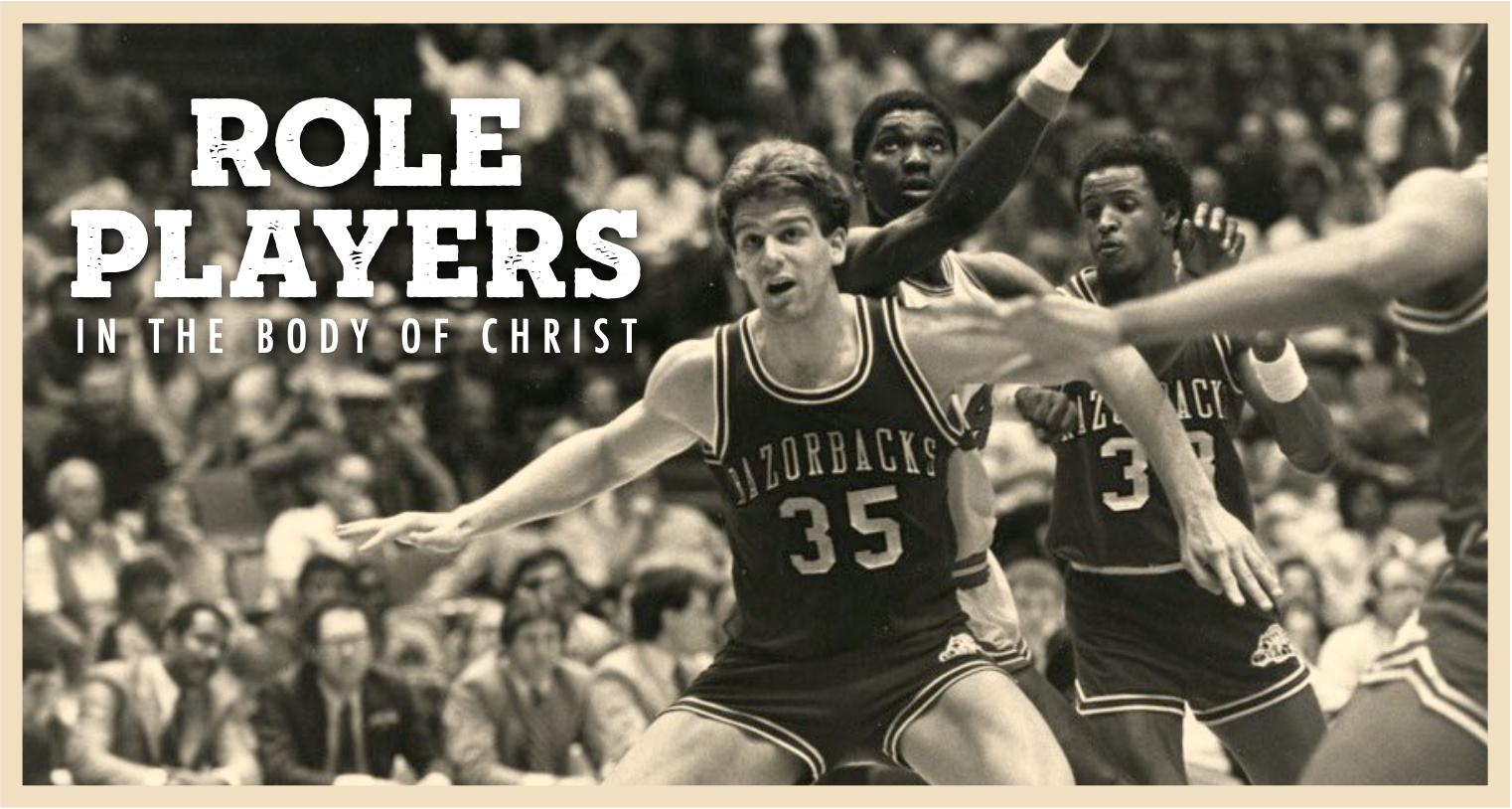
Role Players in the Body of Christ

Joe Kleine was one of the best basketball players in Arkansas Razorback history. An All-Conference Selection in 1984 and 1985, and Kleine also played on the 1984 Gold Medal U.S. Olympic team. In a game against the 2nd-ranked Houston Cougars in 1984, Kleine led the Razorbacks to victory, snapping Houston’s 31-game conference winning streak and outscoring future Hall of Famer Hakeem Olajuwon 22-10. During his career at Arkansas, Kleine averaged 18 points per game—more than Michael Jordan averaged during his career at the University of North Carolina.

But, after completing his collegiate career and joining the NBA in 1985, Kleine went from being a stand-out all-star to an average, backup, role player. In the late 80s and early 90s, Kleine played for the Boston Celtics. While he was there, he was overshadowed by a number of very famous and very good players—Larry Bird, Kevin McHale, Reggie Lewis, and Robert Parrish. Parrish in particular overshadowed Kleine, because Parrish played the exact position that Kleine did—center. Robert Parrish is considered by basketball experts to be one of the greatest centers who has ever played the game, so Joe Kleine got to be Parrish’s backup.

It’s not easy being a backup, a second-teamer. Backups are called things like “substitutes” and “bench-warmers” and “role players”. Backups don’t get to play on the Dream Team; they don’t get to play in All-Star games. Their basketball cards aren’t worth very much, and they don’t get to make many commercials. It would seem that being a backup isn’t a very important job.

Nothing could be further from the truth, however. Consider the following description of Joe Kleine from an article by a Celtic sportswriter a few years back:

“He is what he is. And he knows exactly what that is—the backup center on an NBA team. Every NBA team would love to have Kleine be what he is, which, in addition to being a competent NBA center, includes being a first-rate person.”

The article goes on to quote one of Kleine’s former coaches:

“When we had him here, Joe was our lug. Now, he’s your lug. But you know what? He’s a good lug, I wish we still had him.”

Why is Joe Kleine, a second-string backup center, the kind of player that every coach wants on his team? Why is he the kind of player that coaches don’t want to give up? Because he is willing to accept the role he is given, and do his best performing in that role, even if it is not exciting or glamorous. 

Paul talked about role players in 1 Corinthians 12.14-18:

“Now the body is not made up of one part but of many. If the foot should say, ‘Because I am not a hand, I do not belong to the body,’ it would not for that reason cease to be a part of the body. And if the ear should say, ‘Because I am not an eye, I do not belong to the body,’ it would not for that reason cease to be a part of the body. If the whole body were an eye, where would the sense of hearing be? If the whole body were an ear, where would the sense of smell be? But in fact, God has arranged the parts in the body, every one of them, just as He wanted them to be.”

We don’t each fill the same role, but Paul goes on to tell us that we each have a role to fill. Moreover, he tells us that God bestows an extra measure of honor upon those who fill roles that seem unglamorous:

“The eye cannot say to the hand, ‘I don’t need you!’ And the head cannot say to the feet, ‘I don’t need you!’ On the contrary, those parts of the body that seem to be weaker are indispensable, and the parts that we think of as less honorable we treat with special honor. And the parts that are unpresentable are treated with special modesty, while our presentable parts need no special treatment. But God has combined the members of the body and has given greater honor to the parts that lacked it, so that there should be no division in the body, but that its parts should have equal concern for each other.”

Just as role players are an integral part of any NBA team, they are also indispensable within the church. Unfortunately, this is often a difficult lesson for Christians to learn. Even some of Jesus’ apostles struggled with this concept—in Mark 10, James and John asked to sit at the right and left hand of Jesus so that they could receive special recognition. This request was made because they did not understand the role that God had given them. In Mark 10.43-45, Jesus explained to them that “whoever wishes to become great among you shall be your servant, and whoever wishes to be first among you shall be slave of all. For even the Son of Man did not come to be served, but to serve, and to give His life as a ransom for many.”

Are you willing to be a role player in the Body of Christ? Because that’s the kind of player that God is looking for on His team.

Pity for Those Who Do Not Know: The Story of Jonah, Part 3

If you’re coming late to the party, be sure to check out Part 1 and Part 2.

So far, we’ve seen that Jonah was pretty mixed up about what was important—he valued a plant which provided him with shade more than he valued the lives of the people of the great city of Nineveh. We’ve also seen that as the people of God, we can get similarly mixed up.

God’s response to Jonah at the end of chapter 4 is an attempt to correct Jonah’s perspective on things. He says,

“You pity the plant, for which you did not labor, nor did you make it grow, which came into being in a night and perished in a night. And should not I pity Nineveh, that great city, in which there are more than 120,000 persons who do not know their right hand from the left, and also much cattle?”

God tries to get Jonah to see how He pities the people of Nineveh. A lot of time we have a negative connotation with the word “pity”, but it really just means to feel sorrow over someone else’s condition (The New American Standard Bible says “compassion”; The NIV uses “concern”). God points out how ridiculous it is that Jonah felt sorrow over the death of the plant, but feels no concern at all over the 120,000 people of Nineveh “who do not know their right hand from their left”—basically, people who don’t even realize how bad of a spiritual condition they are in.

It’s interesting—the Book of Jonah ends with God’s question. We don’t get to hear how Jonah responded; we don’t get to see if he corrected his attitude. But really, that makes sense, because the Book of Jonah isn’t really about Jonah—it’s about God…and God’s concern for all people…and God letting His people know about how much He is concerned for all people! So it makes sense that the book ends with God sharing that concern with Jonah.

It is our understanding of God’s pity for the lost—His feeling of sorrow for their condition—that can provoke a similar sense of concern in us. You know, a large part of Jonah’s problem was that he didn’t understand the value of the Ninevites. To him, they were worthless, less deserving of his concern than a plant which sprung up overnight.

What about us? Do we understand the value of those who are lost?

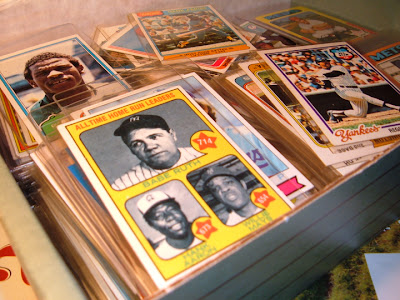
Most of my readers know that I am a huge baseball fan, and when I was younger, one of my favorite hobbies was collecting baseball cards. I would spend most of my allowance buying packs of cards, I would collect and trade for my favorite players, and I would spend a lot of time looking at and organizing my cards.

Another thing I would do with my baseball cards was try to figure out how much they were worth. They would put out price guides every month that would supposedly tell you the value of each card. I remember I would look up my cards and I would take them and brag about it to my dad: “Look Dad, this card is worth $2; this one is worth $5; this one is really rare—it’s worth $30!”

My dad was never impressed with my claims though, and I remember that he would always look at me and say:

“Son, that card is only worth what someone will pay for it.”

You know, that definition of value makes a lot of sense to me. And if the value of something is determined by what someone will pay for it, God made it abundantly clear for once and for all that the lost are worth more to Him than anything—because He paid for them with the death of Jesus on the cross.

That price was paid even for folks whom we don’t like very much, people who make us uncomfortable, or people who have hurt us in some way.

That price puts all of the distractions in our lives—the other things that seem so important to us—into perspective.

As I said at the beginning of this series, I’m really not a big fan of Jonah, because he reminds me too much of myself:

  • I’m not always eager to do what God wants me to do…
  • I make the mistake of thinking that I am somehow more worthy of God’s grace than someone else…
  • I get distracted by unimportant things and forgetting the value of the souls around me…

Maybe some of you can understand where I’m coming from.

Fortunately, the God who is gracious and merciful, slow to anger and abounding in love with the Ninevites is also that same way with me. Fortunately, that same God decided that my soul was worth enough for Jesus to come and die for it.

« Older posts Newer posts »

© 2026 The Doc File

Theme by Anders Noren — Up ↑