The online journal of Luke Dockery

Category: Theology (Page 54 of 58)

The Jungle on Jesus

Towards the end of Upton Sinclair’s The Jungle, a Socialist ex-preacher rails on the way a capitalist society has twisted the character of Jesus:

“And why should Jesus have nothing to do with his church—why should his words and his life be of no authority among those who profess to adore him? Here is a man who was the world’s first revolutionist, the true founder of the Socialist movement; a man whose whole being was one flame of hatred for wealth, and all that wealth stands for—for the pride of wealth, and the luxury of wealth, and the tyranny of wealth; who was himself a beggar and a tramp, a man of the people, an associate of saloon-keepers and women of the town; who again and again, in the most explicit language, denounced wealth and the holding of wealth: ‘Lay not up for yourselves treasures on earth!’—‘Sell that ye have and give alms!’—‘Blessed are ye poor, for yours is the kingdom of Heaven!’—‘Woe unto you that are rich, for ye have received your consolation!’—‘Verily, I say unto you, that a rich man shall hardly enter into the kingdom of Heaven!’ Who denounced in unmeasured terms the exploiters of his own time: ‘Woe unto you, scribes and Pharisees, hypocrites!’—‘Woe unto you also, you lawyers!’—‘Ye serpents, ye generation of vipers, how can ye escape the damnation of hell?’ Who drove out the business men and brokers from the temple with a whip! Who was crucified—think of it—for an incendiary and a disturber of the social order! And this man they have made into the high-priest of property and smug respectability, a divine sanction of all the horrors and abominations of modern commercial civilization! Jewelled images are made of him, sensual priests burn incense to him, and modern pirates of industry bring their dollars, wrung from the toil of helpless women and children, and build temples to him, and sit in cushioned seats and listed to his teachings expounded by doctors of dusty divinity…” (emphasis mine)

Capitalism isn’t the great problem of the world as Sinclair might suggest, and socialism isn’t the great solution, but I think he’s hit upon a lot of truth here.

How Christians (myself included) get so mixed up about wealth is beyond me.
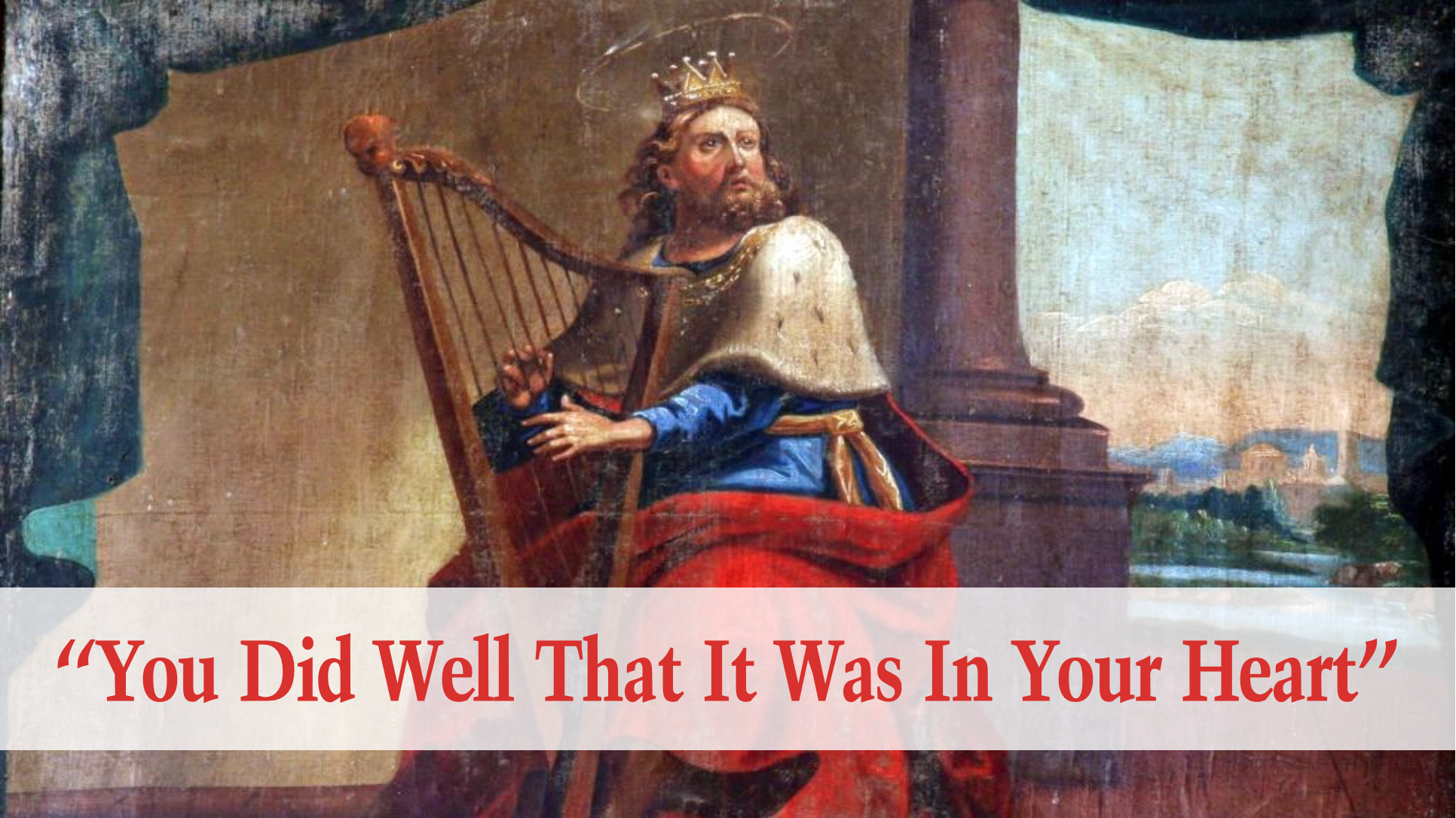
“You Did Well That It Was In Your Heart”

After the death of King Saul, there is a struggle between David and Saul’s son, Ish-bosheth, for the throne of Israel. With God’s support, David eventually wins out, things settle down, and everything seems to be okay.

But David isn’t happy. He isn’t happy because he realizes that while he lives in a nice, comfortable house made of cedar, the Ark of God is kept in a tent!

This doesn’t seem right to David, so he determines that he wants to build a temple for the Ark to be housed in. That sounds like a good idea, but God rejects his offer in 1 Chronicles 22.8-10:

“But the word of the Lord came to me, saying, ‘You have shed much blood and have waged great wars; you shall not build a house to My name, because you have shed so much blood on the earth before Me. Behold a son will be born to you, who shall be a man of rest; and I will give him rest from all his enemies on every side; for his name shall be Solomon, and I will give peace and quiet to Israel in his days. He shall build a house for My name, and he shall be My son and I will be his father; and I will establish the throne of his kingdom over Israel forever.’”

Later, Solomon talks about his father’s desire to build a temple for God in 1 Kings 8.17-19:

“Now it was in the heart of my father David to build a house for the name of the Lord, the God of Israel. But the Lord said to my father David, ‘Because it was in your heart to build a house for My name, you did well that it was in your heart. Nevertheless you shall not build the house, but your son who will be born to you, he will build the house for My name.’”

Because he had been a man of war, David was told that he would not be the one to build a temple for the Lord—but God still appreciated that David had the desire to do so.

“It’s the thought that counts” is a common saying that we tend to throw around when we receive a gift we don’t like. It’s somewhat of an ironic saying, since often the reason we receive bad gifts is specifically because very little thought was put into it, but I think it’s still a true statement, and it’s basically what God tells David in this story.

While our actions certainly matter, the thoughts behind our actions matter as well. We can’t always control how things turn out, but we can control our intentions.

When we decide to try to do something good, even if it doesn’t work out the way we plan, it’s still important that we try.

If you try to help a friend with a problem, but your assistance is refused…

If you try to influence others for good, but your example is ignored…

If you share your faith with someone, but it falls on deaf ears…

Whatever the circumstance, it’s still important that you try.

“You did well that it was in your heart…”

Life of Pi

I’ve been reading quite a bit lately, and I’m getting behind in reporting on the stuff I’ve enjoyed.

After The Ministry of Fear, I read Yann Martel’s Life of Pi. I had heard some good things about it, and knew that it had won some award, so I decided to give it a try.

Life of Pi is not a Christian book, but it is religious—the main character, Pi Patel, actually considers himself to be Hindu, Christian and Muslim at the same time. Martel doesn’t really explain how that is possible, and actually, doesn’t explain much of anything in the book, but he does offer some stellar insights on religion, philosophy, and the story of life through the tale of a boy fighting for his survival while stuck on a lifeboat with a Bengal tiger in the middle of the Pacific Ocean.

Some of my favorite quotes from the book:
On the relationship between zoos and religion:

“I know zoos are no longer in people’s good graces. Religion faces the same problem. Certain illusions about freedom plague them both.”

As I mentioned before, Pi is deeply religious. His thoughts on agnosticism:

“I’ll be honest about it. It is not atheists who get stuck in my craw, but agnostics. Doubt is useful for a while. We must all pass through the garden of Gethsemane. If Christ played with doubt, so must we. If Christ spent an anguished night in prayer, if He burst out from the Cross, “My God, my God, why have you forsaken me?” then surely we are also permitted to doubt. But we must move on. To choose doubt as a philosophy of life is akin to choosing immobility as a means of transportation.”

On the importance of ending things well:

“What a terrible thing it is to botch a farewell…It’s important in life to conclude things properly. Only then can you let go. Otherwise you are left with words you should have said but never did, and your heart is heavy with remorse.”

Life of Pi concludes with a couple of sharp plot twists that leave the reader wondering what has really happened, but even more importantly, questioning whether knowing what really happened is even all that important:

“The world isn’t just the way it is. It’s also how we understand it, no? And in understanding something, we bring something to it, no? Doesn’t that make life a story? I know what you want. You want a story that won’t surprise you. That will confirm what you already know. That won’t make you see higher or further or differently. You want a flat story. An immobile story. A dry, yeastless factuality.”

If you’re interested in survival stories, animals, Indian culture, religion or philosophy, I recommend Life of Pi. It provides a healthy dose of each.

“An Eternal Oxymoron”

Here is a very good article on the ever-growing intersection between Christianity and pop culture.

I really liked the following excerpts:

“At this point in history, American evangelicals resemble the Israelites at various dangerous moments in the Old Testament: They are blending into the surrounding heathen culture, and having ever more trouble figuring out where it ends and they begin.

It’s always been a stretch to defend Christian pop culture as the path to eternal salvation. Now, they may have to face up to the fact that it’s more like an eternal oxymoron.”

The article is only a couple of pages long, and is well worth the time it takes to read. You’ll still have plenty of time to catch Dancing With The Stars.

Resigning Our Commission

General George Washington Resigning His Commission (1824), by John Trumbull

Two TV shows I always enjoyed watching were Horatio Hornblower on A&E and Star Trek: The Next Generation.

These two shows didn’t exactly have a whole lot in common since one was set in 1790s Europe, while the other was set in 24th century outer space, but there was one similarity in that the main characters of both shows were basically naval officers who served on ships—a similar occupation, just separated by 600 years or so.

In the course of both shows, events occasionally transpired which led to certain characters, in dramatic fashion, offering to resign their commissions. Usually this occurred if the character felt he had performed in an unacceptable manner, or if some action had taken place or was about to take place which he didn’t approve of and wanted nothing to do with.

In the TV shows, the characters rarely went through with their resignations, but if they did, they were no longer a part of the group which had issued them the commission in the first place (whether it was the Royal Navy or Star Fleet).

Christians talk quite a bit about a commission which Jesus issued to His disciples in Matthew 28.18-20. We actually refer to it as “The Great Commission.”

“All authority has been given to Me in heaven and on earth. Go therefore and make disciples of all the nations, baptizing them in the name of the Father and the Son and the Holy Spirit, teaching them to observe all that I commanded you…”

Although we may never consciously resign the commission which Jesus bestowed upon us, all too often, we do so by our actions.

When George Washington (pictured above) resigned his commission as the Commander-in-Chief of the Continental Army, he was no longer a member of it.

If we resign our commission, where does that leave us?

« Older posts Newer posts »

© 2026 The Doc File

Theme by Anders Noren — Up ↑







