The online journal of Luke Dockery

Category: Theology (Page 56 of 58)

Bad Decisions

I’m around teenagers a lot. I’ve spent the last several summers working with youth groups and at summer camps, and now I am a youth minister year-round.

Working with young people definitely has its upsides. Teenagers have a different perspective on things than do adults, and being around young people with so much energy can make you feel young yourself. Also, the teenage years are a time of drastic change, and it’s fun (and rewarding) to watch young people grow physically, emotionally and spiritually.

But there’s one thing about working with and being around young people that I can’t stand, and that is having to sit back and watch as they make terrible decisions.

Of course, making poor, ignorant decisions and then learning lessons from their consequences is a part of growing up, but that’s not really what I’m talking about here. I’m referring to those terrible, life-altering decisions (or maybe more often, a series of poor decisions) that put you on the wrong path in life.

I’m thinking about someone in particular as I write this, but really, I’ve known way too many people who fit this description—they start off on the right path but then, sometimes suddenly and sometimes slowly, begin to make a series of bad decisions which cause their lives to spiral out of control.

It upsets me. It baffles me. It keeps me up at night.

Sometimes I feel that if only I could make these decisions for them, then they would turn out alright.

One day when I was thinking this, I suddenly wondered how God feels when I make bad decisions. God, who could have created us however He wanted to, but decided to give us the gift of free will, a gift which people often use to make terrible decisions, sometimes devastating ones that destroy the lives of others.

If the poor decisions of someone else can upset me, as self-centered and unloving as I can sometimes be, so much, how much more must they grieve a God who defines selflessness and love?

Conflicting Natures

I read a children’s version of The Strange Case of Dr. Jekyll and Mr. Hyde when I was about 10 years old, and it is a story that has fascinated me ever since.

Robert Louis Stevenson, of Treasure Island fame, penned the novella in 1885. Stevenson’s body of work was criticized and largely dismissed by modern writers because it was so popular (and therefore perceived to be too commonplace), but in recent years, critics have begun to appreciate him as a man of prodigious artistic talent.

That talent is never more evident than in Dr. Jekyll and Mr. Hyde, which features impressive character development despite being a novella, clever framing, and most importantly, an insightful investigation of the dualistic nature of man.

In the story, Dr. Jekyll is a respected and talented medical doctor who wants to live a good and pure life but is plagued by his own evil desires.

Jekyll’s problem is experienced by all of us to some degree, and is one which the Apostle Paul describes in Romans 7.18-21:

“For I know that nothing good dwells in me, that is, in my flesh; for the willing is present in me, but the doing of the good is not.

For the good that I want, I do not do, but I practice the very evil that I do not want. But if I am doing the very thing I do not want, I am no longer the one doing it, but sin which dwells in me.

I find then the principle that evil is present in me, the one who wants to do good.”

In Stevenson’s story, Jekyll recognizes the good and evil natures warring within himself, and, by means of a chemical potion, decides to separate those natures with the hope of purging himself of his evil desires and the guilt that accompanies them.

Jekyll’s potion leads to the creation of Hyde, his despicable and wholly evil alter ego, who ultimately brings about his downfall.

Continuing in Romans 7.24-25 and 8.1-2, Paul points out a different solution to the problem of sin:

“Wretched man that I am! Who will set me free from the body of this death?

Thanks be to God through Jesus Christ our Lord!

Therefore there is now no condemnation for those who are in Christ Jesus. For the law of the Spirit of life in Christ Jesus has set you free from the law of sin and of death.”

Sin is dangerous and seductive, and has the power to enslave us. No chemical potion or medical doctor can loosen the bonds of that slavery; only The Great Physician can set us free.

The 1895 photograph above pictures Richard Mansfield, an American actor who was best known for playing the dual roles of Dr. Jekyll and Mr. Hyde.

My Skin is Yellow

During my last year at Harding, while I was taking graduate classes, playing ultimate and waiting for my wife-to-be to graduate, I also worked at Sidney Deener Elementary as an ESL Teacher.

With ESL (English as a Second Language), the emphasis is on getting non-native speakers to learn English, so technically, you don’t really need to be able to speak the native language of the students you work with. But it does help to be able to understand their language, and since most of the ESL students were from Spanish backgrounds and I was a former Spanish major, they offered me the job.

I did have one student who did not speak Spanish. His name was Phong, and he was a second grader from Vietnam. Phong was very smart—he was a math whiz and excelled at all kinds of logic puzzles, but when I met him, he had an English vocabulary of about 20 words. Needless to say, he was my most challenging student.

I worked with Phong every day for the next six months or so, and although I enjoyed all of my students (with Searcy not exactly being a multi-cultural mecca, I only had seven students in all), he quickly became my favorite. Getting to know him better and witnessing how much progress he made in learning English was easily one of the more rewarding experiences of my life, and it gave me some insight as to why teachers like to teach.

But Phong gave me some insight into other things too.

Like any other elementary student, Phong had a spelling list each week, and every week we would do various activities to help him understand the meanings of the words he was learning to spell and incorporate them into his working vocabulary. Towards the end of my time with him, he was capable enough with English that I would have him demonstrate his understanding of the meaning of each spelling word by using it in a sentence.

That’s what we were doing one morning when Phong came to the word “yellow.” He paused and looked around for a minute, and then smiled and exclaimed:

“Yellow. My arm is yellow.”

I remember being a little taken aback. After all, we’re not supposed to refer to people in colors, right? Describing someone as “black” inconsistently draws disapproving looks, glorifying someone for being “red” generally leads to a school having to change the name of a mascot, and everyone knows that referring to an Asian as “yellow” is offensive.

In this culturally-sensitive frame of mind, I was on the verge of correcting Phong when I realized: if he said his arm was yellow, who was I to tell him it wasn’t? I mean, it was his arm, and his skin was yellowish in a way, just as mine was whitish.

It didn’t bother him in the least to say that his skin was yellow or to realize that mine was white; he knew that we were different, but he also knew that the difference didn’t matter.

It seems to me that over the years, people generally have one of two reactions to the issue of race: either that racial differences are supremely important and even insurmountable, or that there are no differences at all.

I think Phong’s approach is more correct than either of these: we are different, but those differences don’t matter with respect to our value or worth as human beings.

This is also in line with the view that the Apostle Paul put forth Galatians 3.26-29:

“For you are all sons of God through faith in Christ Jesus. For all of you who were baptized into Christ have clothed yourselves with Christ.

There is neither Jew nor Greek, their is neither slave nor free man, there is neither male nor female; for you are all one in Christ Jesus.”

Paul wasn’t saying that there were no differences between Jews and Gentiles; he was saying that those differences are nothing when compared to the unity we share in Christ.

If we could come to the understanding of Phong, and of Paul, I think the world would be much better off.

Twilight


For the second time in just five years, the St. Louis Cardinals find themselves mourning the loss of one of their own.

Josh Hancock, a 29 year-old right-handed reliever who was in his second year with the Cardinals, was killed instantly early Sunday morning when his SUV struck a stationary tow truck on Interstate 64. All of the details surrounding the wreck have yet to be sorted out, but Hancock’s untimely passing brings back memories of another Cardinals’ hurler who died too young.

Darryl Kile died unexpectedly during the night of June 21, 2002 due to a coronary disease. The death came as a shock to the baseball community because Kile was just 33 years old, and seemingly in the prime of life. He was married with three kids, a three-time All-Star, two years removed from a 20-win season, and making millions of dollars a year.

The idea that death is the great equalizer is not a new one; from Ecclesiastes to Shakespeare, it is a point that has been well-made many times over.

But maybe the point is never driven home quite as hard as it is when someone like Josh Hancock or Darryl Kile dies unexpectedly. It’s at these times that we are reminded that death comes for each of us, whether in the form of a car accident, or heart attack, or old age, and that neither wealth, nor fame, nor physical ability can save us from it.

During times like these I’m also reminded of the words of Jesus in John 9.4:

“We must work the works of Him who sent Me as long as it is day; night is coming when no one can work.”

Daylight is fading for each of us, and none of us knows for sure when night will fall on our lives. Make the most of the daylight.

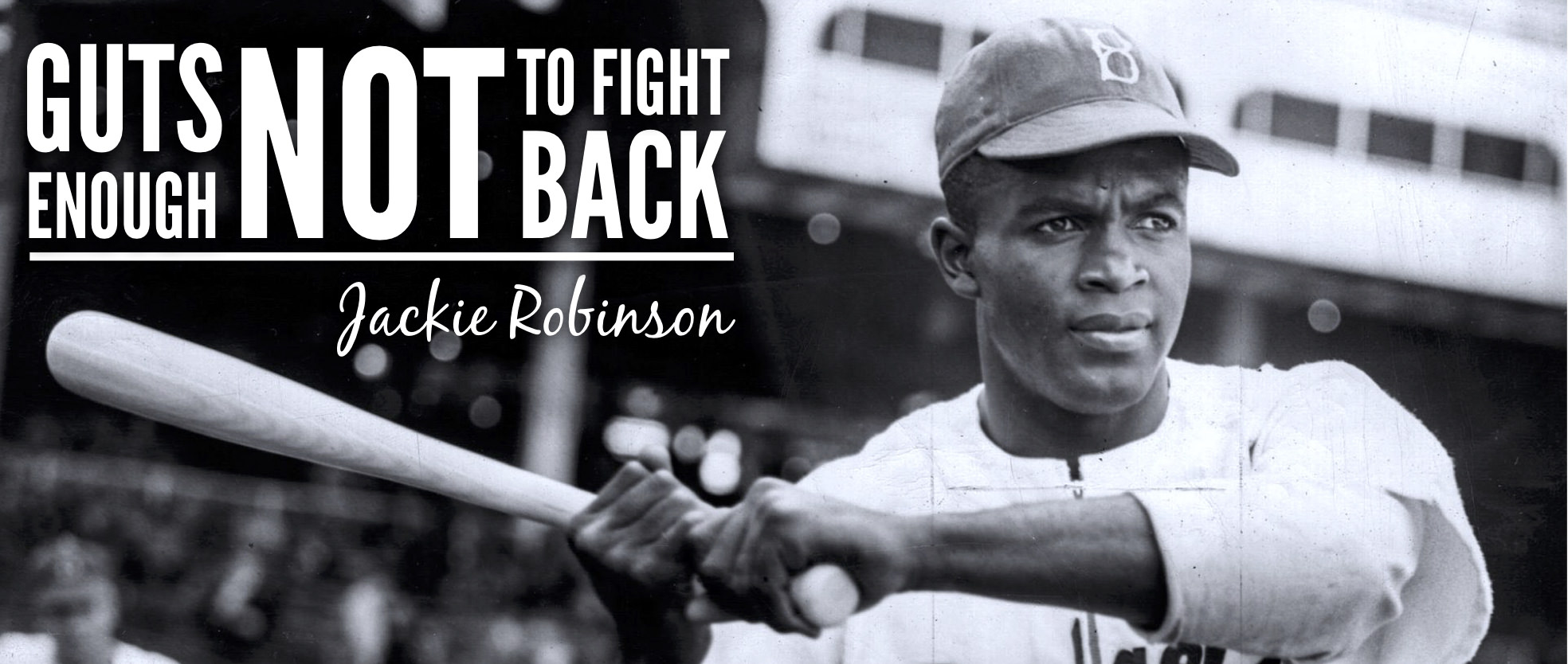
Guts Enough Not To Fight Back: Jackie Robinson

As a general rule in college and professional sports, teams retire the jersey numbers of the all-time greats who played for them. For example, no Chicago Bull can wear number 23, because that was Michael Jordan’s number and it has been retired. No New York Yankee can wear number 3, because that was Babe Ruth’s number and it has been retired. If you play Major League Baseball, regardless of what team you play for, you can’t wear the number 42, because that was Jackie Robinson’s number, and it is the only number to be retired by Major League Baseball.[1]

Sixty years ago yesterday, on April 15, 1947, Jackie Robinson donned that number 42 Brooklyn Dodgers jersey and appeared in his first regular-season Major League game, breaking baseball’s racial color barrier.[2]

Robinson’s Hall of Fame career and the way he handled himself on and off the field opened doors for other black athletes in professional sports (and ultimately many other fields as well), and it has been said that only Dr. Martin Luther King Jr. accomplished more for the American Civil Rights Movement than did Jackie Robinson.

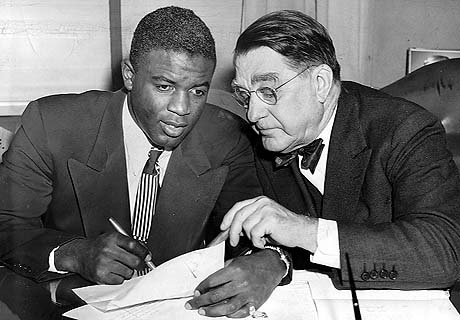
Jackie Robinson and Branch Rickey

Before he signed a contract to play for the Dodgers, Robinson was called into the office of Team President and General Manager Branch Rickey. To give him a taste of what it would be like to be the only black player in the Big Leagues, Rickey spent three hours taunting and insulting Robinson, calling him every racial slur he could think of. Rickey then told Robinson that this is what he would face every day on the field and that if he wanted it to work out, he would have to promise not to fight back or respond to insults of any kind for the first three years of his career.

Robinson, who possessed a fiery temperament and was very outspoken (he was actually court marshaled for refusing to sit at the back of a military bus), was put off by this and asked, incredulously, “Mr. Rickey, are you looking for a player who is afraid to fight back?”

Branch Rickey replied, “No, I want someone with guts enough not to fight back.”

After some deliberation, Robinson agreed to Rickey’s terms, and he lived up to them on the field. When opposing baserunners tried to spike him when sliding into second base, he didn’t fight back. When fans and players yelled and cursed at him and even questioned his very humanity, he showed them how wrong they were by taking the moral high ground.

He had the guts not to fight back.

What Branch Rickey told Jackie Robinson reminds me of Jesus’ words in The Sermon on the Mount in Matthew 5:

“But I tell you, do not resist an evil person. If someone strikes you on the right cheek, turn to him the other also. And if someone wants to sue you and take your tunic, let him have your cloak as well. If someone forces you to go one mile, go with him two miles.”

The world tells us to stand up for ourselves when we are treated unjustly. It tells us to have the courage to fight back and not let others push us around. On the other hand, Jesus tells us to have the courage to show that we are different from the world because we don’t fight back, and He tells us to forgive others when they mistreat us.

Jesus wants followers with guts enough not to fight back.


[1] Major League Baseball has established the practice of temporarily lifting this prohibition on April 15 to commemorate the anniversary of Robinson’s first game as a Dodger, as representatives from each Major League team wear number 42 in his honor.

[2] Contrary to popular belief, Robinson was not the first African-American to play in the Major Leagues. That honor goes to Moses Fleetwood Walker, who played for the Toledo Blue Stockings in 1884. Regardless of this, Robinson was the first African-American to play Major League Baseball in the 20th century, and it was his breaking of baseball’s color barrier that led to the permanent integration of the Major Leagues.

« Older posts Newer posts »

© 2026 The Doc File

Theme by Anders Noren — Up ↑