
The online journal of Luke Dockery

Category: Youth Ministry (Page 18 of 24)

Selling God Short

Being A Pessimist Realist

My wife likes to say that I am a pessimist; I argue that I am a realist. For example, when I’m watching an Arkansas Razorback football game, it doesn’t take me long to decide that we aren’t likely to win. To me, that’s not pessimism, it’s realism, based on the reality that the Razorbacks have only won 7 games over the past two combined seasons.

And I’m that way about other things too. As a minister, I’ve had ample opportunity to become very familiar with a lot of really good people, and in the process see how flawed they are. So when it comes to most people, I really don’t have very high expectations. Again, Caroline would call me a pessimist; I would argue that I’m a realist. Either way though, it’s really just an issue of semantics.

My realism/pessimism is useful in a lot of situations because it keeps me from getting my hopes up only to be disappointed by the end result. However, it’s neither helpful nor particularly faithful when it comes to my expectations of what God can do.

Which brings me to the Elf Party.

The Elf Party

A few years ago, a sweet lady at church came up with the idea of an “Elf Party” for our youth group, where our teens would play the role Santa’s elves by purchasing and wrapping gifts for the kids of a needy family. Generally, we would “adopt” a family from one of the local schools (anonymously), and our 10-15 teens would get a bunch of gifts for 3-4 kids who otherwise wouldn’t get much of a Christmas. It was great.

In addition to this, several adult members from our church would also “adopt” a child from one of the local schools on their own, and purchase gifts for them.

Well, during my study and practice of youth ministry, I have become increasingly convicted that young people need to spend a lot of time with older Christians. Developing relationships with older Christians is key ingredient to building a faith that lasts, and furthermore, serving alongside older Christians helps younger Christians to learn that service is an inherent part of the Christian life rather than an isolated youth group project.

With all that in mind, we decided that this past Christmas, we would expand the Elf Party to a church-wide event, and invite those adults who had participated on their own in the past to join in. We would all meet together, split up in groups to shop, and then come back and wrap the gifts together. Teens (and kids) working alongside adults all along the way. Also, since we were expanding our numbers, we decided to expand the number of kids we would adopt, so instead of the usual one family (of 3-4 kids) that I was used to, we adopted 26 kids (a large increase, I know).

And so we were all set. We picked a date on a Monday night, made a series of announcements about it at church, and got ready. For my part, I started worrying. Had we taken on too many kids? What would we do if we didn’t have enough people show up and volunteer to spend their money buying presents for others?

Then a winter storm came, a good bit of ice with six plus inches of snow on top (which is significant for here). Schools were closed on the Thursday and Friday before the Elf Party. Church services were cancelled on Sunday. It stayed so cold that the roads didn’t improve much—they would melt a little during the day and then refreeze at night and become hazardous again. School was cancelled again on Monday, and we decided to push the party back one day, to Tuesday night.

As Tuesday came around (and school was cancelled once again), I began to get really nervous. I received calls and texts from people who I had expected to be there who weren’t going to be able to make it because of the weather. The roads were still really bad in some places. By not having worship services on Sunday, we had missed our opportunity to push the event one last time to the whole congregation. Donations I had expected to receive in advance were minimal.

I really wasn’t sure what we were going to do when we had a dozen or so kids not get presents. I figured I would just go and pay for a bunch of stuff personally, which would have been a real concern—now that Caroline doesn’t teach and we are basically living on one salary (she has a small part-time job), there’s not a lot of extra money to go around.

And in the process of all of my worrying, I basically sold God short. I should’ve known better than to think that He would let us fail in an effort to show our love for our neighbors.

Because then Tuesday night came, and it was awesome. We filled up our 21-seat bus with people who had braved the roads to come help, and had to take several other vehicles besides. We all headed to Wal-Mart, and what a fun experience it was to bump into shopping groups from our church around every corner! We returned to the church building, and our fellowship hall was overflowing with happy, cabin fever-crazed people (this was the first time some of them had been out of their houses in days because of the storm). We spent the next hour or so in fellowship, sharing a quick meal together and then wrapping the gifts we had purchased.

And, as it turned out, we had just enough volunteers and funds to cover all of the needs. Our church family came together on an icy night and provided a Christmas for 26 kids who might not have had one otherwise.

Our Elf Party gifts filled the stage in the auditorium.

An Important Lesson for a New Year

The point of this post is not to highlight what we did, or to emphasize how amazing we are. I was proud of and thankful for my brothers and sisters who came out to help, but that’s not my focus here. My focus is on how faithful God was at a time when my faith proved to be pretty weak. When I was full of worry and doubt and could see no way that we would be able to live up to the commitment that we made, God was faithful, providing all that we needed and teaching me a helpful lesson that I will remember.

Although our Elf Party was almost a month ago, it’s fitting that I share this story with you at the beginning of a new year. Because in 2014, I am determining (or resolving, if you will) that I am not going to sell God short. I am going to make big plans, and attempt big things (doing my best, of course, to make sure that those plans and things are in accordance with His will), and let God provide results that glorify Him.


Friday Summary Report, October 4

Next week I am on fall break from school, which is awesome. The combination of the Hebrew and Greek classes that I am taking this semester is a heavy load (and has led to particularly infrequent posting here). It will be nice to have a week off from intensive study and to “just” focus on full-time ministry.

Here are a few links for your Friday reading:

  • This is an outstanding article from a youth minister friend of mine. Faith is more than just following a list of rules, it is placing ourselves within God’s story. And thus, teaching and training others in the faith is more about sharing that story than simply providing a list of Do’s and Don’ts.
  • Here is another great blog post that focuses on living in such a way that our future is better than our past. Here’s one brief excerpt: “We must see today as a starting point—a time to make good choices instead of bad ones (that’s part of what repentance is). Once we make the right decisions instead of ones we know to be wrong, we can finish without regret, without nostalgia, and without a desire to go back to now.”
  • Earlier in the week, I shared my review of a really good book. You can check that post for some good quotes, or better yet, get the book yourself!

I hope you have a blessed and relaxing weekend. On my end, I will be holding out hope that the Braves and Razorbacks are able to pull off some upsets!

Big Lessons from the First Day of School

Today is the first day of school for a lot of people. As a youth minister, I’m very aware of this because my students were (generally) bummed about it yesterday at church. As a grad student, I’m also very aware of it because today I have taken the plunge and started the process of learning Hebrew. And if I wasn’t already aware that today was Back to School Day, I would’ve figured it out quickly once I checked Facebook this morning, as my newsfeed was blowing up with everyone’s pictures of their kids dressed up and ready for the First Day of School.

So for a lot of folks, today is a big day, and it got me thinking about some important lessons that the First Day of School reminds us of:

(1) We need to be prayerful on behalf of our students. As a youth minister, this is something that I’m very aware of, but it is hard to overemphasize how difficult it is to be a young person today and to cling to Christian values, and how much our young people need our prayers and support.

I am not trying to make a political statement or start a debate on the issue of prayer in schools or anything like that; I am simply making the observation that our society is an increasingly dark place, and this darkness is absolutely manifested in our schools. Teens (and even those who aren’t yet teens) are exposed to all sorts of things that are contrary to a Christian worldview, and resisting those things can be difficult.

But there’s good news as well: a shining light makes the biggest difference in a dark place! Pray not only that our students resist the darkness, but that they shine their lights and point others to Jesus Christ.

(2) We should be thankful for educators. On the whole, I think teachers tend to get a bad rap. Certainly, some teachers are not as good, or as caring, or as dedicated as they could be, but on the whole, teachers are people who care about young people and want to do what they can to help them (come to think of it, that entire last sentence could probably be applied to youth ministers as well!).

And really, they have pretty tough jobs: they have to do a lot of work to stay current in their field, they have to deal with children with significant behavior problems (and the parents who produced them!), they get to work long hours before and after school grading papers, working on lesson plans, and going to school activities, and often they spend significant portions of their (not always great) salaries to buy additional resources for their classrooms and students.

Be thankful for educators! Encourage them, tell them you appreciate their efforts, and try to be cooperative when they need something from you (helping your child with homework, getting a paper signed, coming to a parent/teacher conference, etc.).

(3) We should realize how quickly our lives pass by. My first day of Kindergarten was 25 years ago, a quarter of a century. But seriously, I can remember it like it was just yesterday! A repeated theme I saw on Facebook today was parents who couldn’t quite believe that their kids had gotten so old so fast!

I mentioned this a couple of weeks ago, but it really is amazing how quickly time flies. The Bible says that our life is like a mist, something that is here for a short time and then vanishes. And as I see pictures on my news feed of college students who I think should still be in high school, high school students who should still be in grade school, and kindergarteners who should still be in diapers, it really hits home.

Our lives will be gone before we know it; we must make the most of the time we have!

(4) We need to never stop being students. I’m not talking about formal education here, but rather that we need to always have the attitude of being learners—we should never think of ourselves as knowing all there is to know on a given subject and always be willing to learn more.

This is one of my favorite things about the preaching minister that I work with. He is in his 50s and has decades of experience in ministry, but he is always looking to learn new things so he can stay current. He reads constantly and is always interested in examining things that I come across in my studies. What a great example that is!

I know so much more about life, ministry, and theology than I did two, five, and ten years ago. But I am by no means I finished product, and I hope and expect to know a lot more in two, five, and ten years down the road than I do now.

One of these days, if the Lord wills, I will finish my grad school education. But that won’t mark the end of my learning, as I plan to continue doing that until the end of my life.

What do you think? Agree or disagree? Did you think of an important Back to School Lesson that I left out?

2013 Summer Trip Recap

Every year, one of the high points for our youth group is a summer trip. Generally, we combine some type of service project with some fun activities. This year, we went to Morrilton, Arkansas, and Memphis, Tennessee.

In Morrilton, we stayed at Southern Christian Home, where we helped to move a ton of furniture, get things organized for a huge yard sale they were having, and also did some painting. It was good to meet the people there and see the campus and the work they were doing, and to help out a little.

For me, one of the highlights of that part of the trip was getting to work in the main building on the campus, which back in the 1920s served as the campus of my alma mater, Harding University. Specifically, I was working down in the basement, which had originally been a basketball gymnasium. Though in need of a lot of work, it is an incredible building, and still has the original hardwood flooring from 1919!

Old Gym from the 1920s.

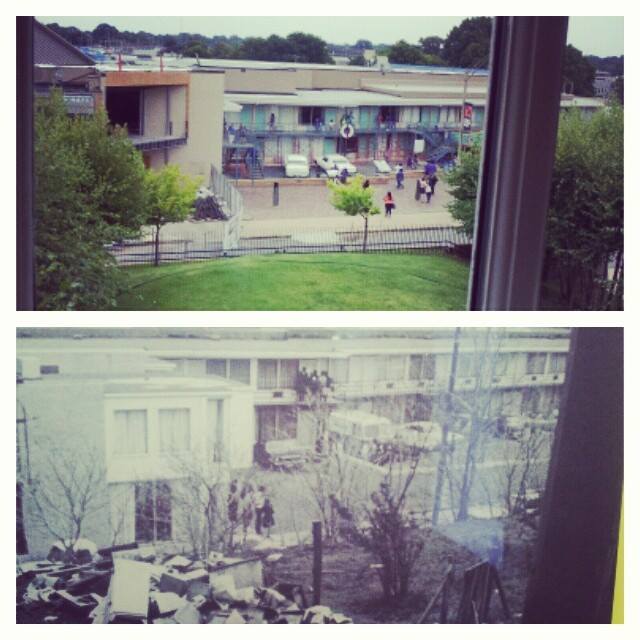
After a couple of nights in Morrilton, we headed to Memphis. While there, we visited the National Civil Rights Museum. I wasn’t sure how this part of the trip would go over, because teens don’t always appreciate educational experiences during their summer vacations, but several of them mentioned how cool it was and how much they enjoyed it. The museum itself is across the street from the Lorraine Motel where Martin Luther King Jr. was shot, and everything has been carefully preserved. The museum itself is actually the converted boarding house from which the shot was fired.

View from assassin‘s window today (top) and in 1968

I like museums and enjoyed the National Civil Rights Museum a lot (even though some of the exhibits were closed because of construction). I learned a lot of details about the assassination that I didn’t know before, and it was pretty neat to watch my teens grasp the significance (or at least some part of it) of what they were experiencing.

From there, we spent some time at a mall and then went back to our hotel to swim and hang out. The next morning, we went to Sky Zone Indoor Trampoline Park in Memphis. There we spent a couple of hours jumping, flipping, and playing dodgeball. It was a lot of fun, though exhausting as well (I am still sore a couple of days later).

Part of our group at Sky Zone Memphis.

After that, we loaded up and began the process of heading home. All in all, we had a great trip: we were able to accomplish some work at the Children’s Home, the teens had a great time and were well-behaved, and I had some really good chaperones who helped a ton. I think it was the most stress-free trip I’ve ever had, which was awesome.

How to Have a Great VBS

This past Wednesday, we wrapped up our 2013 Vacation Bible School at Farmington. If I have done my math correctly, this was my ninth consecutive year to help direct VBS, and although it is a lot of work, it is a lot of fun as well.

I think some people have the idea that VBS is a hopelessly outdated program from a bygone era. I do think that some congregations have a VBS like this, but I don’t think it has to be this way. VBS is one of the highlights of the year for our congregation, and while what we do is by no means perfect, I thought I would share some of the things that have made it successful.

What Does “Successful” Mean?

Before you have a VBS (or any program really), it’s important that you have specific goals, or at the very least, a general idea of what it is that you are shooting for. If you don’t have any idea of what a successful VBS will look like for your congregation, then it’s impossible to know if you’ve had one or not when you are finished.

For us, Vacation Bible School provides a lot of benefits, and I generally consider our VBS to be a success if these things happen:

(1) Kids have fun. Vacation Bible School is supposed to be fun. If kids from the community come and are then bored out of their minds, then all your hard work has been for naught (at least with that particular child).

(2) The church gets excited. The summer months can be somewhat of an energy drain on a congregation. A lot of people travel, so attendance and giving sags. Sometimes it seems that you go for weeks and weeks without seeing people that you care about and are used to seeing on a weekly basis. For us, VBS is an antidote to the summer slump, as every year it provides an energy boost to our congregation. A lot of people pool their talents and abilities for a common purpose, and then get to experience the satisfaction of watching their plans and efforts come to fruition. This is an important thing.

(3) Our reputation in the community is enhanced. Vacation Bible School provides a great opportunity for your congregation to increase its visibility and reputation in the community. If you get visitors from the community to come and then put on a quality Bible school, children and their parents will leave with a good impression of your church.

(4) A lot of people come. Numbers aren’t the most important thing (which is why I listed this one last), but they are important. After all, what does it matter if you have the most amazing VBS in the world if no one is there to see it? Attendance of visitors is especially important, as the church should always be trying to reach out to bring more people in. This year we were blessed with the largest attendance we have had in my time year (Also, related to the second point, if a lot of people come it definitely adds to the excitement factor of your congregation).

Tips for a Successful VBS

Now that you know how I define a successful VBS, here are some tips for bringing it about:

(1) Recruit a lot of talented helpers to do what they are good at. If you do it right, VBS takes a lot of work. So, you can either have a few people try to do everything, or you can recruit a lot of people who can focus on specific tasks. I have tried it both ways, and believe me, the second way is preferable. When you do it the second way, you end up having a better product, fewer burned-out people, and more church involvement. For example, this year we had:

  • A coach in charge of our outdoor games and activities
  • Someone who had studied theater in college working with our skits
  • Teens with years of experience doing Puppet Theater at Lads to Leaders doing the puppet shows
  • A talented song-leader directing our time in the auditorium
  • People with strong organizational skills doing registration and refreshments
  • Some very talented ladies doing decorations and crafts

All of these people used specific skills they possessed to enhance our VBS. And as a result, I got to do less work!

(2) Provide something for the adults to do. Kids may be the primary focus of VBS, but that doesn’t mean you should ignore your adults. Some parents will drop off their kids and leave, but others live far enough away that they would rather stay if there was a reason for them to. And what about adult members of the congregation who aren’t helping to run things? Shouldn’t they get to be around the fun as well? We have had good classes for adults in the past, but this year we focused on it more, bringing in one speaker for all four nights to present a topic that was different from what people generally get to hear (biblical archaeology). The class was excellent, our adult numbers swelled, and I heard from members and guests alike how much they enjoyed the class and how it strengthened their faith.

(3) Get teens involved on the service side. Several years ago we made the decision that, rather than having the teens come and sit through a Bible class, we would get them involved in serving during VBS, and I think it was one of the best decisions we could have made. Our teens spend hours at the building the week before VBS moving furniture, decorating, and cleaning. During VBS itself, they are the primary characters and teachers in the story rooms, they do puppets, they help lead the kids around from place to place, and they help run games outside. Not only do our teens really enjoy these roles, it also provides opportunities for them to interact with all generations of the congregation: they get to work alongside those who are older than they are, and teach and lead those who are younger (this is hugely important!).

(4) Provide a variety of activities for the kids. Our hi-tech digital society does not cultivate long attention spans in children. Just the opposite. So if your VBS schedule calls for children to sit in class for 90 minutes listening to a teacher, then it will probably be hard for the teachers and rough on the kids. I absolutely believe that biblical instruction is important, and that is at the center of what we do. But the lessons are taught through skits in decorated rooms and then reinforced in craft time and puppet skits. Kids also get to play games outside, sing, have refreshments, and buy trinkets in the VBS store with coins they have earned by bringing guests and answering questions in class.

(5) Choose good material. Not all VBS material is created equally. Some of it looks really nice; some of it looks as if it was made in 1975. Some of it looks like it was made for children; some of it seems like it was made by someone who had never even seen children before. We have found some VBS curriculum that we like, but even it isn’t good every year. This year we actually re-used (good) curriculum from 2009 rather than use the new (not-as-good) stuff. Personally, I am a fan of VBS themes that try to transport the kids to Bible time and places (this year our theme was “Rome: Paul and the Underground Church”) rather than those odd topical themes that don’t make sense and seem incredibly lame to me (things like “VBS Pirates: Searching for Buried Treasure in God’s Word” or “Tropical VBS: Learning Lessons from God’s Word in an Island Paradise”).


(6) Advertise. Honestly, I didn’t do a great job advertising this year; if I had, we might’ve had even more people. There are a lot of ways to advertise. You can send out flyers to area congregations. If your VBS is early in the summer, you can see about sending home flyers at local elementary schools. You can hang attractive banners outside of your church building for those who drive by. For us, the best method of advertising is contacting those parents from our community whom we already know through Thursday Bible School. If you have a similar program at your congregation, these are exactly the sort of people who would be interested in participating in your VBS.

(7) Follow up with the guests who come. We have, admittedly, been weak on this in the past, but are trying to do better this year. If you have registration information on all of the children who came, then you should have contact information for those whose parents are not members. Send a card thanking them for their attendance. Send a letter or brochure telling them more about your church family and the programs you have available.

(8) Plan for next year. Soon, we will have a follow-up meeting to reflect on things that worked well, and things that we could improve for next year. It’s important that we do this now, while this year’s VBS is still fresh on our minds. No matter how successful things were this year, there’s always something that could be done better or more people who could be involved.

Vacation Bible School can be a powerful ministry for your congregation if only you put the necessary time, planning, and effort into it. The ideas I have suggested above might not be the only “right” way to do VBS, but it certainly works for us!

« Older posts Newer posts »

© 2026 The Doc File

Theme by Anders Noren — Up ↑